Olivier Corneille
Olivier Corneille
@ocorneille.bsky.social

Prof at UCLouvain

Evaluative learning | Demand artifacts | Methods

Psychology 44%
Neuroscience 22%
Pinned
This recent blog post provides a very accurate and useful summary of Bertram and I's recent Nature Reviews Psychology article on the value of self-reports relative to "implicit measures" (as we defined them in the original article):

www.psypost.org/self-report-...
Self-report measures outperform implicit tools in assessing thoughts and feelings, new psychology paper argues
Self-reports outperform implicit measures, according to a new review, offering greater reliability, predictive validity, and flexibility. The paper challenges beliefs about implicit tools’ robustness,...
www.psypost.org

Reposted by Olivier Corneille

Why single-item measures of wellbeing are best
Nature Human Behaviour, Published online: 02 February 2026; doi:10.1038/s41562-026-02401-yWhy single-item measures of wellbeing are best
dlvr.it
Read my latest post for reflections on reproducibility, research quality and a summary of a great new study which shows how NOT to do it

https://open.substack.com/pub/tomstafford/p/gambling-with-research-quality
Gambling with research quality
How you get 244 different ways to measure performance on the same test of decision making. And what it means for the reliability of behavioural science
tomstafford.substack.com
Danish Parliament Deputy Speaker Lars-Christian Brask:

"If I could come with some advice, it would be for the Senate & House to start to take control of political power in America because with this erratic & mad behaviour, you have to ask the question, is the President capable of running the US?"

Amazing picture !
THREAD: I'll fact-check all the viral misinformation about the US military operation in Venezuela in this thread

This image, purporting to show the US military arresting Venezuelan President Nicolas Maduro, is AI-generated.

According to Google's SynthID detector, it was created using Google AI.

"40 percent of MRI signals do not correspond to actual brain activity"; "Since tens of thousands of fMRI studies worldwide are based on this assumption, our results could lead to opposite interpretations in many of them.”
www.tum.de/en/news-and-...
40 percent of MRI signals misinterpreted
Interpretation of numerous MRI data may be incorrect: blood flow is not a reliable indicator of brain activity.
www.tum.de
Closing out my year with a journal editor shocker 🧵

Checking new manuscripts today I reviewed a paper attributing 2 papers to me I did not write. A daft thing for an author to do of course. But intrigued I web searched up one of the titles and that's when it got real weird...

WHY ARE YOU ANNOYED THIS IS WHAT YOU WANTED TO HAPPEN
Early Christmas present! For the last couple of years, I have been helping to update this textbook for a new edition. I joined a great team that had written the original book, and together we thoroughly revised it and updated it with new research and examples. My copies arrived just the other day!

We hope this work sparks discussion and inspires new approaches in psychological research and beyond it !

Demand artifacts threaten both the internal and external validity of research. Often viewed as a "scarecrow" or a "vexing problem," they can discourage researchers from examining them too closely. Yet, our conclusion offers a more optimistic and actionable perspective on these artifacts:

Our review is organized around a recent framework of demand effects proposed by P. Lush and I, which identifies three stages in the production of demand artifacts: hypothesis formation, motivation, and control strategy.

doi.org/10.1177/1088...
Sixty Years After Orne’s American Psychologist Article: A Conceptual Framework for Subjective Experiences Elicited by Demand Characteristics - Olivier Corneille, Peter Lush, 2023
Study participants form beliefs based on cues present in a testing situation (demand characteristics). These beliefs can alter study outcomes (demand effects). ...
doi.org
Thrilled to share this new preprint, co-authored with @peterlush.bsky.social and Chloé Fournier Bernard!

We offer a broad and structured discussion of leading methods developed in the past >60 years to tackle demand artifacts in psychological research and beyond.

doi.org/10.31234/osf...
OSF
doi.org

Reposted by Olivier Corneille

In a large, preregistered study (see preprint), we compared InteroMap to emBODY. Overall, InteroMap demonstrated superior construct validity and usability
www.researchgate.net/publication/...
(PDF) InteroMap: A Novel Tool to Map the Phenomenology of Bodily Sensations
PDF | Interoception, the processing of internal bodily states, contributes to human behaviour through multiple cognitive and affective processes,... | Find, read and cite all the research you need on ...
www.researchgate.net
Very excited to introduce InteroMap, a new bodily mapping tool designed to measure how we subjectively experience our bodily sensations, what we call interoceptive phenomenology 🧵👇

Reposted by Olivier Corneille

New publication. Congrats to the whole team, and especially @paulbertin.bsky.social who led this effort. Thanks also to the editor (Nicolas Sommet) and reviewers, who desserve credit for improving our paper.

Thanks to Chloé Fournier Bernard, @mayanna.bsky.social and @jeremybena.bsky.social for the inspiring collaboration !

We discuss whether this Truth Beliefs Conditioning effect should be considered an experimental demand artifact, and whether it matters.

This research follows-up on a recent article that examined three outstanding questions raised by instruction-based procedures:

doi.org/10.1525/coll...
Instruction-based Replication Studies Raise Challenging Questions for Psychological Science
A variety of psychological effects have been recently replicated in studies where participants merely received information describing experimental tasks, while participants experienced these tasks in ...
doi.org

In this new research, we found that truth beliefs can be successfully conditioned:

Statements - true and false - are rated as more true after their pairing with positive than negative pictures.

This effect bridges research on evaluative conditioning and misinformation.

osf.io/preprints/ps...

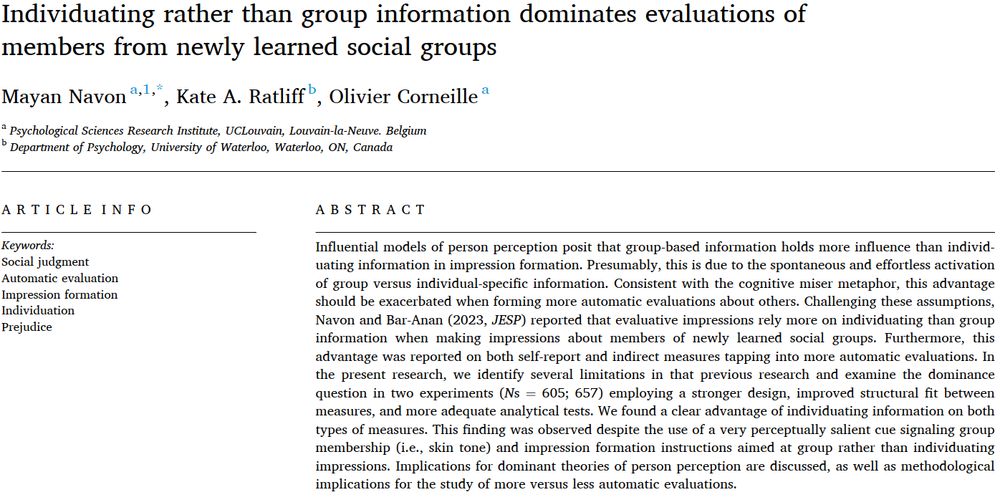
In this research, we found that individuating information dominates social group information when forming impressions about members of newly learned social groups. This dominance was observed both on self-reports *and* more automatic measures *despite* conditions favoring group-level impressions.
🚨 New paper alert, at @jexpsocpsych.bsky.social:

Classic person perception models argue that group information (e.g., group valence) dominates impression formation, especially in less-than-optimal conditions. But is this really the case?

👉 Read the full paper
authors.elsevier.com/a/1m66p51f8w...

Reposted by Olivier Corneille

This overturns familiar assumptions of perceivers as “cognitive misers” and calls for rethinking how we conceptualize automatic evaluations.

Reposted by Olivier Corneille

Even with skin tone as a group marker and explicit instructions to form group-based impressions, people relied more on the actual characteristics of the individual they encountered.
🚨 New paper alert, at @jexpsocpsych.bsky.social:

Classic person perception models argue that group information (e.g., group valence) dominates impression formation, especially in less-than-optimal conditions. But is this really the case?

👉 Read the full paper
authors.elsevier.com/a/1m66p51f8w...

In case you find it useful, we have recently elaborated on this issue here (see section 5.1): doi.org/10.1111/spc3...
Evaluative Conditioning has a Vexing Demand Problem
Attitude research has long been concerned with the potential influence of demand characteristics in evaluative conditioning effects. Here, we argue that this concern remains justified and cannot be r....
doi.org

I found the general discussion rather cautious, but this point might be further elaborated on. Another issue is that these manipulations are sometimes totally ineffective (Ps simply don't trust a hypothesis that runs against commonsense) but this does not seem to apply in this case 3/

As a result, demand effects may operate differently in these studies vs. in original procedures where the experimental hypothesis is not directly communicated. The same issue applies when probing demand effects based on instruction-based replication procedures 2/

If I may add a few thoughts, a major issue with this widespread approach to demand effects is that experimenters usually do not tell their Ps about their hypothesis. This communication creates unique demand characteristics that may consequentially depart from the original procedure 1/

Congratulations, Ian !
Shout-out to the best possible team of co-authors: Elisa Tognon, @kenzonera.bsky.social, @rritabajraktari.bsky.social, Vincent Yzerbyt, @olivierklein.bsky.social, and Klein Pit (who originally started this project).

OA here: onlinelibrary.wiley.com/doi/10.1002/...
The Impact of Freedom of Speech on Conspiracy Beliefs
Conspiracy beliefs are often portrayed as a threat to democracies. However, less is known about the extent to which the state of democracy may affect conspiracy beliefs. Hence, we investigated the im...
onlinelibrary.wiley.com

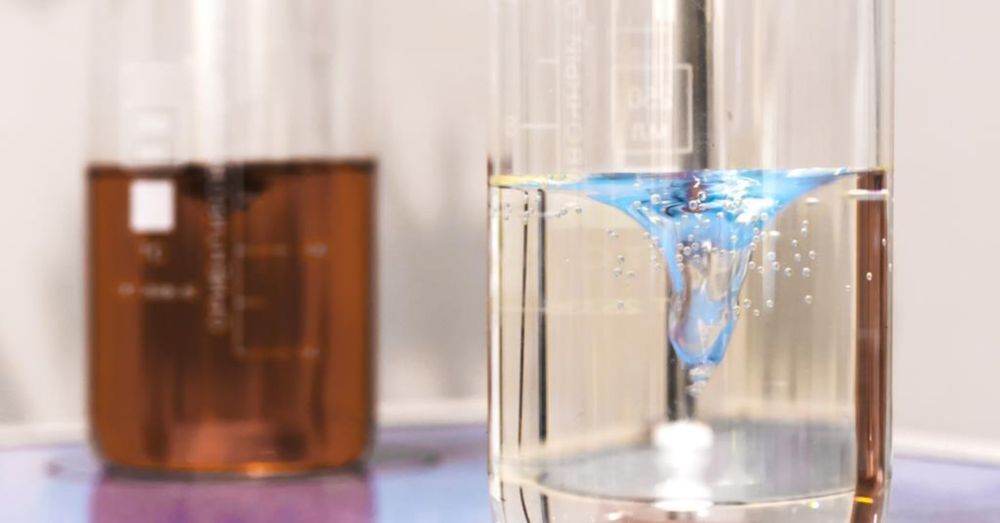
New research shows that simply changing how a reaction vessel is positioned on a magnetic stirrer can significantly change a reaction's speed and product quality, influencing the reproducibility of results. #ChemSky #ScienceSky #EduSky
Position of flask on magnetic stirrers can drastically affect reproducibility of experiments
Comprehensive examination reveals improper siting of reaction vessels can affect catalyst formation, alter nanoparticle formation and change yields
www.chemistryworld.com