




Maxence Lejars
@mlejars.bsky.social
Assistant Professor in Aix Marseille Université / Laboratoire de Chimie Bactérienne (LCB) working on bacterial gene regulation
Pinned
Maxence Lejars
@mlejars.bsky.social
· Sep 10

EASY-edit: a toolbox for high-throughput single-step custom genetic editing in bacteria
Abstract. Targeted gene editing can be achieved using CRISPR–Cas9-assisted recombineering. However, high-efficiency editing requires careful optimization f
academic.oup.com
Happy to share the published version of our genetic toolbox, EASY-edit, for simple, flexible and efficient targeted editing in E. coli!
Feel free to to try it, we can send strains and plasmids!
academic.oup.com/nar/article/...
Feel free to to try it, we can send strains and plasmids!
academic.oup.com/nar/article/...
Reposted by Maxence Lejars

beautiful work by Gaurav Dugar, who taught me my first RNA stuff and even a bit of Campylobacter :)
September 12, 2025 at 12:33 PM
beautiful work by Gaurav Dugar, who taught me my first RNA stuff and even a bit of Campylobacter :)
Reposted by Maxence Lejars

Starvation-independent alarmone production inhibits translation through GTP depletion in Bacillus
#MicroSky
#MicroSky

Starvation-independent alarmone production inhibits translation through GTP depletion https://www.biorxiv.org/content/10.64898/2026.01.12.699007v1
February 7, 2026 at 4:06 PM
Starvation-independent alarmone production inhibits translation through GTP depletion in Bacillus
#MicroSky
#MicroSky
Reposted by Maxence Lejars

@ewarman.bsky.social has followed up on her discovery of bidirectional promoters in bacteria by defining their basic rules for regulation and links to gene expression noise...
academic.oup.com/nar/article/...
academic.oup.com/nar/article/...

Bidirectional promoters in Escherichia coli: regulatory rules and implications for gene expression noise
Abstract. In prokaryotes, bidirectional promoters are pseudo-symmetrical DNA sequences that stimulate divergent transcription. Ubiquitous, and far more lik
academic.oup.com
February 6, 2026 at 3:35 PM
@ewarman.bsky.social has followed up on her discovery of bidirectional promoters in bacteria by defining their basic rules for regulation and links to gene expression noise...
academic.oup.com/nar/article/...
academic.oup.com/nar/article/...
RNase Y mutations and RNA turnover optimization as a possible pathway for ATB tolerance
RNA Quality Control Enables Antibiotic Tolerance https://www.biorxiv.org/content/10.64898/2026.02.02.703294v1
February 4, 2026 at 6:54 AM
RNase Y mutations and RNA turnover optimization as a possible pathway for ATB tolerance
Reposted by Maxence Lejars

Passioned by #bioenergetics? Do not miss our new article on the evolutionary history of oxidoreductases with G. Borrel and @sgribaldo.bsky.social @archaeal.bsky.social @valdeanda.bsky.social @pasteur.fr @cnrs.fr @cnrsbiologie.bsky.social @natecoevo.nature.com (www.nature.com/articles/s41...).

Evolution and diversity of oxidoreductases involved in redox balance and energy conservation - Nature Ecology & Evolution
HORBEC are protein complexes involved in the regulation of redox balance and energy conservation. The authors develop a bioinformatic tool for HORBEC annotation in bacterial and archaeal genomes and r...
www.nature.com
February 3, 2026 at 10:52 AM
Passioned by #bioenergetics? Do not miss our new article on the evolutionary history of oxidoreductases with G. Borrel and @sgribaldo.bsky.social @archaeal.bsky.social @valdeanda.bsky.social @pasteur.fr @cnrs.fr @cnrsbiologie.bsky.social @natecoevo.nature.com (www.nature.com/articles/s41...).
Reposted by Maxence Lejars

Online Now: Why m⁶A? An RNA surveillance model Online now:

Why m⁶A? An RNA surveillance model
Dierks and Schwartz discuss the m6A surveillance model, proposing that m6A flags “undesirable” intron-less RNAs (e.g., transposons) for decay. This provides a mechanism to distinguish “legitimate” spliced mRNAs and potentially suppress harmful RNA.
dlvr.it
January 28, 2026 at 12:32 PM
Online Now: Why m⁶A? An RNA surveillance model Online now:
Reposted by Maxence Lejars

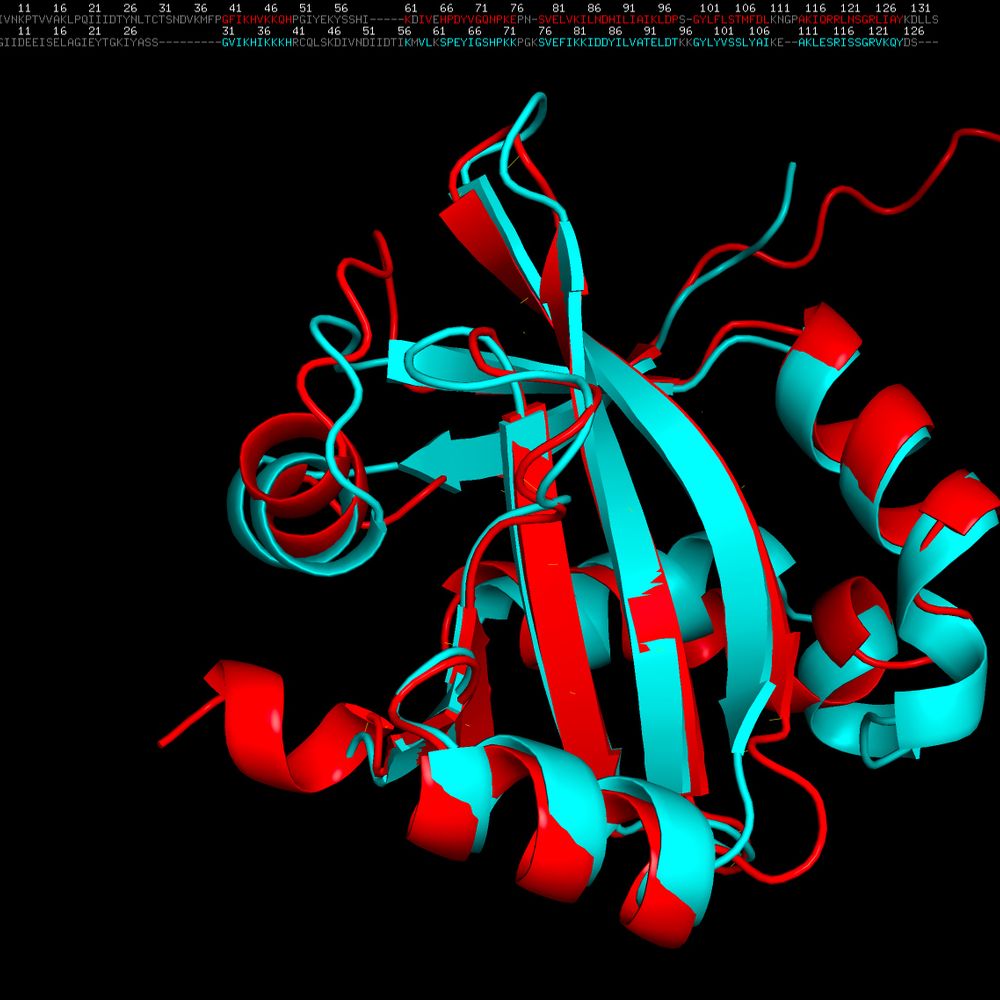
🫴 Fantastic work: DNA recognition-mimicry switch governs induction in arbitrium phages:
www.sciencedirect.com/science/arti...
@spp2330.bsky.social #subtiwiki @cp-cellhostmicrobe.bsky.social
www.sciencedirect.com/science/arti...
@spp2330.bsky.social #subtiwiki @cp-cellhostmicrobe.bsky.social

A DNA recognition-mimicry switch governs induction in arbitrium phages
Temperate phages integrate multiple information sources to regulate lysis-lysogeny transitions. SPbeta-like phages use arbitrium signaling and DNA dam…
www.sciencedirect.com
February 1, 2026 at 8:32 AM
Reposting just for the title!
New Article! Integrated fluorescence light microscopy-guided cryo-focused ion beam-milling for in situ montage cryo-ET

Integrated fluorescence light microscopy-guided cryo-focused ion beam-milling for in situ montage cryo-ET
Nature Protocols, Published online: 30 January 2026; doi:10.1038/s41596-025-01284-zA protocol for cryogenic 3D correlative focused ion beam milling using an integrated fluorescence light microscope and montage cryo-ET for nonadherent and adherent mammalian cells, as well as primary Drosophila melanogaster neurons.
dlvr.it
January 31, 2026 at 12:11 PM
Reposting just for the title!
Reposted by Maxence Lejars

New Article! Integrated fluorescence light microscopy-guided cryo-focused ion beam-milling for in situ montage cryo-ET
Integrated fluorescence light microscopy-guided cryo-focused ion beam-milling for in situ montage cryo-ET
Nature Protocols, Published online: 30 January 2026; doi:10.1038/s41596-025-01284-zA protocol for cryogenic 3D correlative focused ion beam milling using an integrated fluorescence light microscope and montage cryo-ET for nonadherent and adherent mammalian cells, as well as primary Drosophila melanogaster neurons.
dlvr.it
January 30, 2026 at 11:25 AM
New Article! Integrated fluorescence light microscopy-guided cryo-focused ion beam-milling for in situ montage cryo-ET
Reposted by Maxence Lejars

Combining super-resolution imaging and machine learning, we reveal that C. thermocellum shifts from a microbe-mediated strategy to dynamic cellulosome redistribution during growth on insoluble substrates.
www.life-science-alliance.org/content/9/3/...
www.life-science-alliance.org/content/9/3/...

January 26, 2026 at 4:04 PM
Combining super-resolution imaging and machine learning, we reveal that C. thermocellum shifts from a microbe-mediated strategy to dynamic cellulosome redistribution during growth on insoluble substrates.
www.life-science-alliance.org/content/9/3/...
www.life-science-alliance.org/content/9/3/...
Reposted by Maxence Lejars

Many many moons ago I fell in love with science while working on how Polyamines regulate programmed ribosomal frame shifting
www.nature.com/articles/nat...
Time to get back to these fascinating and complex field
www.nature.com/articles/nat...
Time to get back to these fascinating and complex field

Polyamine sensing by nascent ornithine decarboxylase antizyme stimulates decoding of its mRNA - Nature
Ornithine decarboxylase (ODC), the rate-limiting enzyme in the biosynthesis of polyamines, is regulated by an antizyme (OAZ). Polyamines induce antizyme expression by promoting ribosomal frame-shiftin...
www.nature.com
January 24, 2026 at 7:08 AM
Many many moons ago I fell in love with science while working on how Polyamines regulate programmed ribosomal frame shifting
www.nature.com/articles/nat...
Time to get back to these fascinating and complex field
www.nature.com/articles/nat...
Time to get back to these fascinating and complex field
Reposted by Maxence Lejars

Raman spectroscopy can be used to predict cellular physiology and proteome composition in E. coli.
🔗 buff.ly/bcALp6R
🔗 buff.ly/bcALp6R

January 24, 2026 at 11:01 AM
Raman spectroscopy can be used to predict cellular physiology and proteome composition in E. coli.
🔗 buff.ly/bcALp6R
🔗 buff.ly/bcALp6R
Reposted by Maxence Lejars

“A student joining a lab is often presented with a hypothesis to work on and may see science as a hypothesis-testing endeavor. Many young postdocs have been told that as a PhD student their job was to answer questions—now they have to discover their own unknown unknowns.”


January 24, 2026 at 9:58 AM
“A student joining a lab is often presented with a hypothesis to work on and may see science as a hypothesis-testing endeavor. Many young postdocs have been told that as a PhD student their job was to answer questions—now they have to discover their own unknown unknowns.”
Reposted by Maxence Lejars

🧫🧪

We’ve discovered how the superbug E. faecalis prevents chronic wounds from healing.
It’s not a toxin. It’s metabolism.
The bacteria use extracellular electron transport (EET) to electrochemically generate ROS, effectively "freezing" skin cells in place.
doi.org/10.1126/sciadv.aeb5297
It’s not a toxin. It’s metabolism.
The bacteria use extracellular electron transport (EET) to electrochemically generate ROS, effectively "freezing" skin cells in place.
doi.org/10.1126/sciadv.aeb5297

Enterococcus faecalis redox metabolism activates the unfolded protein response to impair wound healing
E. faecalis EET generates ROS, which induces the UPR in keratinocytes, inhibiting in vitro migration.
doi.org
January 17, 2026 at 3:57 AM
🧫🧪
Reposted by Maxence Lejars


Reposted by Maxence Lejars

Its been a pleasure to be a part of this work.
Our group, and in particular Junwoo Park, describes a powerful tool to study single-molecule tracking. FreeTrace reconstruct trajectories under fractional Brownian motion, which enabled us to study anomalous diffusion 🔬
www.biorxiv.org/content/10.6...
Our group, and in particular Junwoo Park, describes a powerful tool to study single-molecule tracking. FreeTrace reconstruct trajectories under fractional Brownian motion, which enabled us to study anomalous diffusion 🔬
www.biorxiv.org/content/10.6...

Novel estimation of memory in molecular dynamics with extended and comprehensive single-molecule tracking software: FreeTrace
Single-molecule tracking (SMT) in live cells reveals how biomolecules explore crowded intracellular environments, yet most tracking software assumes Brownian motion, an approximation that fails when a...
www.biorxiv.org
January 10, 2026 at 7:31 PM
Its been a pleasure to be a part of this work.
Our group, and in particular Junwoo Park, describes a powerful tool to study single-molecule tracking. FreeTrace reconstruct trajectories under fractional Brownian motion, which enabled us to study anomalous diffusion 🔬
www.biorxiv.org/content/10.6...
Our group, and in particular Junwoo Park, describes a powerful tool to study single-molecule tracking. FreeTrace reconstruct trajectories under fractional Brownian motion, which enabled us to study anomalous diffusion 🔬
www.biorxiv.org/content/10.6...
Reposted by Maxence Lejars

New Microbe Matters!
@relenski.bsky.social traces the legacy of Escherichia coli and how science is evolving to use this model organism in new ways
#microsky
www.nature.com/articles/s41...
@relenski.bsky.social traces the legacy of Escherichia coli and how science is evolving to use this model organism in new ways
#microsky
www.nature.com/articles/s41...

January 9, 2026 at 11:09 AM
New Microbe Matters!
@relenski.bsky.social traces the legacy of Escherichia coli and how science is evolving to use this model organism in new ways
#microsky
www.nature.com/articles/s41...
@relenski.bsky.social traces the legacy of Escherichia coli and how science is evolving to use this model organism in new ways
#microsky
www.nature.com/articles/s41...
Reposted by Maxence Lejars


A 5′-UTR cis-acting RNA element targeted by RNase III is essential for DNA simple sequence repeat-dependent phase variation in Haemophilus influenzae
academic.oup.com/nar/article/...
academic.oup.com/nar/article/...

A 5′-UTR cis-acting RNA element targeted by RNase III is essential for DNA simple sequence repeat-dependent phase variation in Haemophilus influenzae
Abstract. Simple sequence repeats (SSRs) are insertion-deletion mutational hotspots causing phase variation in bacterial genomes. When located in intergeni
academic.oup.com
January 8, 2026 at 2:57 PM
A 5′-UTR cis-acting RNA element targeted by RNase III is essential for DNA simple sequence repeat-dependent phase variation in Haemophilus influenzae
academic.oup.com/nar/article/...
academic.oup.com/nar/article/...
Reposted by Maxence Lejars
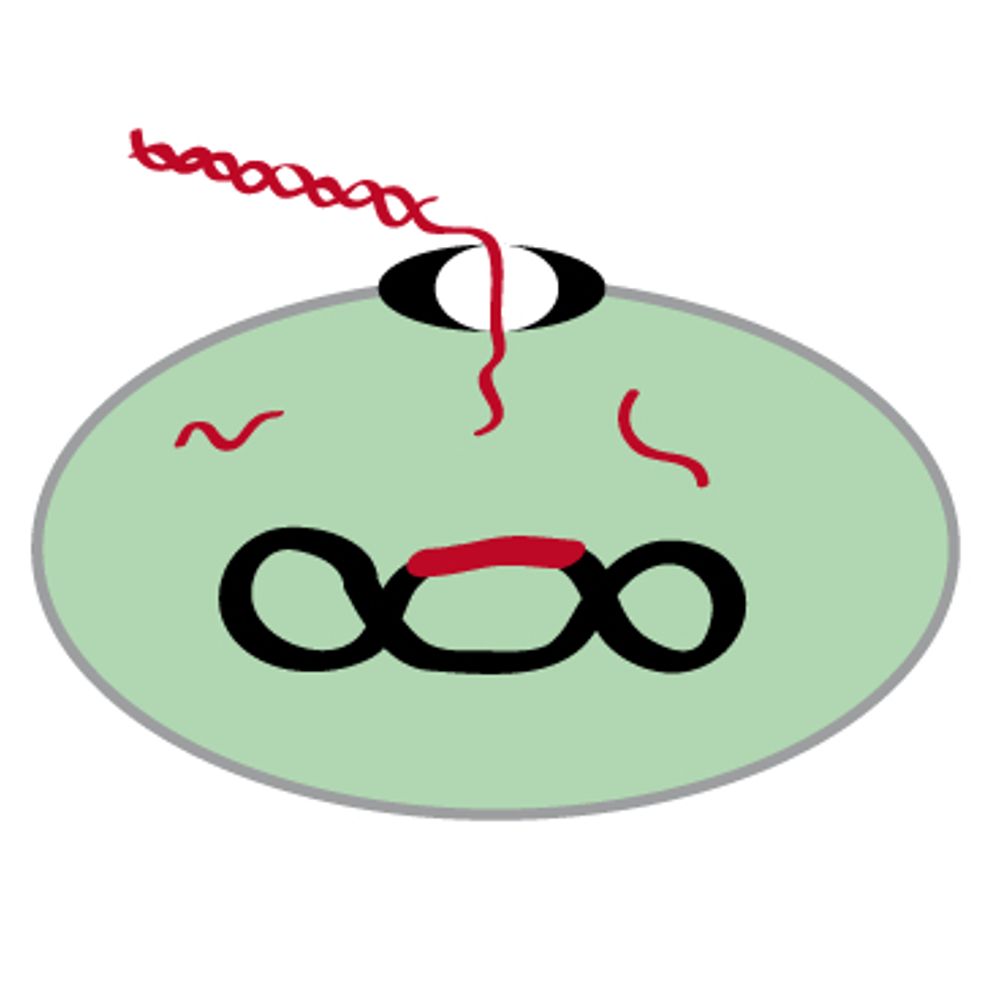
Delighted to share a new paper from our lab, a study led by Mathieu Bergé looking at how an endogenous toxin targets replication to induce competence in the pneumococcus. dx.plos.org/10.1371/jour...

A toxin/antitoxin system targeting the replication sliding-clamp induces competence in Streptococcus pneumoniae
Author summary The environment in which bacteria live puts them under a great deal of stress, forcing them to adapt constantly, either temporarily or permanently. Streptococcus pneumoniae, a pathogeni...
dx.plos.org
January 8, 2026 at 9:03 AM
Delighted to share a new paper from our lab, a study led by Mathieu Bergé looking at how an endogenous toxin targets replication to induce competence in the pneumococcus. dx.plos.org/10.1371/jour...
+ a large dataset to explore!

Pooled single-cell CRISPRa/i screens for functional genomics in bacteria at scale https://www.biorxiv.org/content/10.64898/2025.12.20.695731v1
December 23, 2025 at 7:56 PM
+ a large dataset to explore!
Beautiful story!
Host infection selects for sRNA variants that drive bacterial social cheating https://www.biorxiv.org/content/10.64898/2025.12.19.695336v1
December 23, 2025 at 2:19 PM
Beautiful story!
Reposted by Maxence Lejars

fans of two component systems (TCS) take note 👇
#MicroSky
#MicroSky

Thrilled to share that my first-author paper is now published in Nature Communications! 🎉 Huge thanks to my PI, Dr. Drew Bridges (@bridgesbio.bsky.social), my collaborators, and all the incredible lab members for their support throughout this project
www.nature.com/articles/s41...
www.nature.com/articles/s41...

A small periplasmic protein governs broad physiological adaptations in Vibrio cholerae via regulation of the DbfRS two-component system - Nature Communications
A two-component system, DbfRS, regulates biofilm formation in Vibrio cholerae. Here, Nguyen et al. identify a small periplasmic protein that controls the activity of the system’s receptor, and show th...
www.nature.com
December 19, 2025 at 8:06 PM
fans of two component systems (TCS) take note 👇
#MicroSky
#MicroSky
Reposted by Maxence Lejars

Final version is out! Our large-scale cryo-ET dataset 🔬 of Chlamydomonas reinhardtii 🦠 is now published in @cp-molcell.bsky.social
Huge collaborative effort! So glad to see the community already using it to develop new resources & tools.
Check it out here: shorturl.at/z4i4c
#CryoEM #CryoET
Huge collaborative effort! So glad to see the community already using it to develop new resources & tools.
Check it out here: shorturl.at/z4i4c
#CryoEM #CryoET

December 19, 2025 at 4:45 PM
Final version is out! Our large-scale cryo-ET dataset 🔬 of Chlamydomonas reinhardtii 🦠 is now published in @cp-molcell.bsky.social
Huge collaborative effort! So glad to see the community already using it to develop new resources & tools.
Check it out here: shorturl.at/z4i4c
#CryoEM #CryoET
Huge collaborative effort! So glad to see the community already using it to develop new resources & tools.
Check it out here: shorturl.at/z4i4c
#CryoEM #CryoET
Reposted by Maxence Lejars

Do viruses use RNA to rewire bacteria?
Yes!
In our paper in @cp-molcell.bsky.social RIL-seq reveals interkingdom RNA interactions during λ infection. Phages don’t just encode proteins, they use small RNAs to hijack bacterial replication and fine-tune infection.
#RNA #Phage
doi.org/10.1016/j.mo...
Yes!
In our paper in @cp-molcell.bsky.social RIL-seq reveals interkingdom RNA interactions during λ infection. Phages don’t just encode proteins, they use small RNAs to hijack bacterial replication and fine-tune infection.
#RNA #Phage
doi.org/10.1016/j.mo...

Phage-encoded small RNA hijacks host replication machinery to support the phage lytic cycle
Using RIL-seq, Silverman et al. map the RNA interactome of E. coli during phage lambda
infection and uncover a conserved phage-encoded sRNA that activates host replication
machinery. Their findings re...
www.cell.com
December 19, 2025 at 6:43 AM
Do viruses use RNA to rewire bacteria?
Yes!
In our paper in @cp-molcell.bsky.social RIL-seq reveals interkingdom RNA interactions during λ infection. Phages don’t just encode proteins, they use small RNAs to hijack bacterial replication and fine-tune infection.
#RNA #Phage
doi.org/10.1016/j.mo...
Yes!
In our paper in @cp-molcell.bsky.social RIL-seq reveals interkingdom RNA interactions during λ infection. Phages don’t just encode proteins, they use small RNAs to hijack bacterial replication and fine-tune infection.
#RNA #Phage
doi.org/10.1016/j.mo...