Rita Hamad
ritahamad.bsky.social
Rita Hamad
@ritahamad.bsky.social

Professor, social epidemiologist @hsph.harvard.edu • Social policy + health equity • Director https://hsph.me/sphere • Mama, immigrant • Opinions mine

Public Health 41%
Medicine 22%
Pinned
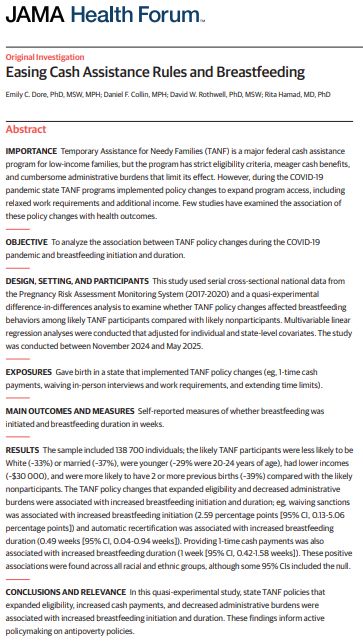
Our latest study @jamahealthforum.com shows the harms of work requirements for safety net programs. Women who were subject to harsher requirements and who received less cash assistance from TANF were less likely to breastfeed. jamanetwork.com/journals/jam... @donmoyn.bsky.social @hsph.harvard.edu 1/

Reposted by Rita Hamad

Thank you to everyone who joined us for our webinar, The Day Federal Data Went Dark: A Year of Monitoring and Action. We are grateful to be in a community with so many amazing organizations.

You can watch the recording to learn about more than a dozen efforts to monitor and safeguard federal data.
The Day Federal Data Went Dark: A Year of Monitoring and Action
January 31, 2025, is infamous as the day thousands of federal datasets and webpages went dark. While many of these resources have since been restored–often after being scrubbed of references to gender, DEI, and climate–they continue to face significant risks. In the webinar, we mark the one-year anniversary of this takedown to discuss the current state of federal data and recognize the immense amount of work that has been done to defend these public resources. Leaders from the data community will share insights on monitoring tools they have developed and the actions being taken to safeguard essential federal data. This webinar is cohosted by dataindex.us and the Association of Public Data Users. 0:00 Introduction 2:53 EssentialData.US x Federation of American Scientists 6:51 American Statistical Association 10:31 CDC Data Project 14:17 Friends of BLS 17:50 Public Environmental Data Partners 21:24 The Leadership Conference Education Fund 26:26 Movement Advancement Project 30:37 Population Association of America 35:05 Democracy 2025 40:42 Data Rescue Project 44:16 Population Reference Bureau 47:14 Association of Public Data Users 50:10 dataindex.us 55:19 Conclusion
tinyurl.com

Honored to be new director @harvardpopcenter.bsky.social, following in Lisa Berkman's footsteps. I'm excited to inherit a brilliant & dedicated staff + network of research & community affiliates. Looking forward to advancing our mission of improving wellbeing of global populations! @hsph.harvard.edu
Rita Hamad, MD, PhD, a leading social epidemiologist, has been appointed the next director of the Harvard Pop Center. Read about this leadership transition in today’s Harvard Gazette. @ritahamad.bsky.social @apc.org @hsph.harvard.edu @harvard.edu hsph.me/hcpds_new_di...

Reposted by Rita Hamad

Rita Hamad, MD, PhD, a leading social epidemiologist, has been appointed the next director of the Harvard Pop Center. Read about this leadership transition in today’s Harvard Gazette. @ritahamad.bsky.social @apc.org @hsph.harvard.edu @harvard.edu hsph.me/hcpds_new_di...
How many STEM Ph.D.s were lost from the U.S. federal government last year?

My colleagues @mghersher.bsky.social and @policyhound.bsky.social dug into a recent data release to find the answer. A @science.org exclusive.

www.science.org/content/arti...

Reposted by Evan Roberts

Reposted by Ben Barr, Rita Hamad

Paid family leave improves the health of US families. Read our new research brief on #PaidLeave: hsph.harvard.edu/wp-content/u...
@ritahamad.bsky.social
The US remains one of only six countries in the world without national PFL - we can do better. @paidleaveforall.bsky.social

Some important points from new study: if you describe specific safety net programs (eg SNAP, unemployment insurance) instead of generic "welfare programs," people are more likely to tolerate slightly higher fraud to ensure access. There is always this trade-off; framing matters. @donmoyn.bsky.social
People are willing to accept a fraud access tradeoff. More specifically, the accepted allowing about 1 case of fraud to ensure access for 5 eligible claimants. For every ineligible person who might wrongly receive benefits, Americans are willing to ensure five eligible people get help.

Reposted by Rita Hamad

People are willing to accept a fraud access tradeoff. More specifically, the accepted allowing about 1 case of fraud to ensure access for 5 eligible claimants. For every ineligible person who might wrongly receive benefits, Americans are willing to ensure five eligible people get help.

The authors describe a crosswalk framework to estimate life expectancies at school district level. Hopefully others will find this resource helpful in their own work. doi.org/10.1016/j.ss... @popassocamerica.bsky.social @harvardpopcenter.bsky.social 2/2
Redirecting
doi.org

Reposted by Ben Barr

Cool new paper by colleagues @hsph.harvard.edu on school districts as proxies for neighborhood. District boundaries are underutilized in #pophealth research, limiting our ability to understand health impacts of school exposures. doi.org/10.1016/j.ss... @iaphs.bsky.social @capolicylab.bsky.social 1/

Reposted by Rita Hamad

@christinajcross.bsky.social's fabulous book painstakingly details how family structure is - and isn't - related to children's academic achievements, including insights into why pushing marriage won't alleviate race and ethnic differences in achievement.

Thanks @dataindex.us for hosting webinar on Trump administration's cancellation of PRAMS, the only national long-term survey data on perinatal & infant health. Register to learn more, including action steps: us06web.zoom.us/webinar/regi... @popassocamerica.bsky.social @societyforepi.bsky.social

Reposted by Rita Hamad

I was interviewed for @theguardian.com by the wonderful @melodyschreiber.com, one of the finest health reporters in the world, about what I called a “neocolonialist” study planned by Danish researchers in Guinea-Bissau, funded by RFK Jr. So many red flags 🚩🚩🚩🚩🚩🚩🚩

www.theguardian.com/society/2025...
US plan for $1.6m hepatitis B vaccine study in Africa called ‘highly unethical’
Experts decry ‘neocolonialist’ Guinea-Bissau study after Trump administration changed advice for US babies
www.theguardian.com

Here's the link to leave an actual comment: www.regulations.gov/document/CDC...
See this screenshot (and it's alt-text) for sample language.

Hoping that key professional organizations will spread the word! We need to tell the feds that these data are critical. @popassocamerica.bsky.social @apha.org @societyforepi.bsky.social @ameracadpeds.bsky.social @defendpublichealth.bsky.social @ashecon.bsky.social @iaphs.bsky.social @acog.org 2/2

Reposted by Sarah Burgard

CDC PRAMS office is still non-operational, but there's an opportunity for public comment on proposal to support continued collection of state PRAMS data. Please leave even a few sentences, stating support for this critical maternal & child health resource: www.federalregister.gov/documents/20... 1/

🚨Job alert! We're hiring experienced programmer to analyze national Medicaid claims data, along w/ colleague Ari Ne'eman @hsph.harvard.edu. Details & application instructions: careers.harvard.edu/job/statisti...

@societyforepi.bsky.social @popassocamerica.bsky.social @ashecon.bsky.social @apha.org
Statistical Analyst/Programmer
careers.harvard.edu

Reposted by Rita Hamad

Study by faculty affiliate @ritahamad.bsky.social & colleagues finds an association between the expanded child tax credit, temporarily distributed monthly during the pandemic, and a reduction in child behavioral problems...
hsph.harvard.edu/news/child-b...
Child behavioral health improved with expanded Child Tax Credit | Harvard T.H. Chan School of Public Health
Pandemic-era expansions to the Child Tax Credit—one of the largest income transfer programs in the U.S.—was associated with improved child behavioral health, according to a new Harvard Chan School stu...
hsph.harvard.edu

@whitneywells.bsky.social has also authored an op-ed with support of @scholars.org describing the importance of #paidleave for young families: scholars.org/contribution...

She was inspired by her own personal experiences & her research @amjepi.bsky.social on this topic: doi.org/10.1093/aje/... 2/2
Paid Family Leave Can Be a Lifeline
A week before I gave birth last February, the research team I work with published a study in a prominent scientific journal on how paid family leave affects maternal and child health. The study found ...
scholars.org

New research brief by UCSF PhD student and SPHERE affiliate @whitneywells.bsky.social on #paidleave. The US is the only high-income country without such a policy, despite clear health benefits, summarize here: hsph.harvard.edu/wp-content/u... @paidleaveforall.bsky.social @hsph.harvard.edu 1/

Reposted by Florencia Torche

Important new paper on policy implementation and how to reduce stigma and boost participation in safety net policies.
New article out in print with @donmoyn.bsky.social

How Framing of Income Eligibility Guidelines Affect Attitudes Towards Program Access and Burdens in Health and Health-Protective Programs

doi.org/10.1002/wmh3...

Study has implications for design of tax policies, esp reviving CTC & making payments monthly. Conducted using valuable @umpsid.bsky.social data and rigorous quasi-experimental methods. @itep.org @mdrc-news.bsky.social @centeronbudget.bsky.social @epi.org onlinelibrary.wiley.com/doi/10.1111/... 2/2
The 2021 Child Tax Credit and Children's Health and Well‐Being: Evidence From a National Longitudinal Study
Policy Points Evidence suggests the 2021 temporary Child Tax Credit expansion reduced material hardship and improved parental mental health, but less is known about its effects on child well-bein...
onlinelibrary.wiley.com

New paper led by G Wang @ucsf-ihps.bsky.social is among first to examine #childhealth impacts of 2021 #ctc, finding improved behavioral health. After policy expired, #childhealth worsened. This suggests policymakers should focus on more frequent payments. onlinelibrary.wiley.com/doi/10.1111/... 1/

Reposted by Rita Hamad

New article out in print with @donmoyn.bsky.social

How Framing of Income Eligibility Guidelines Affect Attitudes Towards Program Access and Burdens in Health and Health-Protective Programs

doi.org/10.1002/wmh3...
What happens to self-reported race/ethnicity when you change the way you ask it?

There is some discordance.

And it is consequential for estimating quantities of interest, like disease risks by population group.

See our ppr: arxiv.org/pdf/2501.023...

#econsky #medsky

@johnmullahy.bsky.social

Thanks to @sabrinamalhi.bsky.social @washingtonpost.com for covering this study, including the fact that recent cuts in spending for youth #mentalhealth are likely going to prevent us from addressing the long-term consequences of school closures: www.washingtonpost.com/health/2025/...
Going back to school during the pandemic linked to improved child mental health
A new study finds that school reopenings during the pandemic were associated with declines in diagnoses of anxiety, depression and other mental health conditions in children.
www.washingtonpost.com

Thanks to @ellenbarry.bsky.social @nytimes.com for covering this story with some thoughtful insights into the broader school and pandemic context! www.nytimes.com/2025/12/08/h...
Youth Mental Health Improved When Schools Reopened, Study Finds
www.nytimes.com

We used quasi-experimental diff-in-diff analysis & commercial claims data on 180,000 kids. Of course, usual limitations apply in terms of possible time-varying confounding, like other COVID policies. Also, healthcare *utilization* does not necessarily = health. journals.lww.com/epidem/abstr... 5/5
journals.lww.com

Our study findings resonate with another recent study @stanfordeducation.bsky.social finding that kids' test scores dropped during the pandemic, especially math scores for girls. Gendered patterns in social interactions may help explain this. apnews.com/article/math... 4/
The gender gap in math widened in the pandemic. Schools are trying to make up lost ground
Efforts to close the gender gap in STEM education are gaining momentum after setbacks during the COVID-19 pandemic.
apnews.com

Does this mean schools shouldn't have closed during pandemic? No, #publichealth folks were making decisions based on available evidence under uncertainty. It does mean policymakers should balance physical well-being (infections) & mental well-being in the future. journals.lww.com/epidem/abstr... 3/
journals.lww.com