



Virus Addict
@virusaddict.bsky.social
PhD Candidate in Structural Virology 🇪🇸
Reposted by Virus Addict

Happy to share our lab's recent #cryoEM studies that show how a SPIN90 dimer activates Arp2/3 complex to form either uni or bidirectional actin filaments. Congrats🎉👏 @justusfrancis.bsky.social @achyutha-kp.bsky.social @tejashyamk.bsky.social @sridharskulkarni.bsky.social @kiranvyshnav.bsky.social

New online: Activation of Arp2/3 complex by a SPIN90 dimer in linear actin-filament nucleation

Activation of Arp2/3 complex by a SPIN90 dimer in linear actin-filament nucleation
Nature Structural & Molecular Biology, Published online: 15 September 2025; doi:10.1038/s41594-025-01673-8Francis et al. used cryo-electron microscopy to show how a SPIN90 dimer activates the metazoan Arp2/3 complex to nucleate linear actin filaments for unidirectional and bidirectional growth, forming potential scaffolds for rapid assembly of dynamic actin networks.
go.nature.com
September 15, 2025 at 12:06 PM
Happy to share our lab's recent #cryoEM studies that show how a SPIN90 dimer activates Arp2/3 complex to form either uni or bidirectional actin filaments. Congrats🎉👏 @justusfrancis.bsky.social @achyutha-kp.bsky.social @tejashyamk.bsky.social @sridharskulkarni.bsky.social @kiranvyshnav.bsky.social
Reposted by Virus Addict
In situ cryo-ET redefines HPV disassembly and transport paradigms pubmed.ncbi.nlm.nih.gov/40949969/ #cryoem
September 17, 2025 at 3:18 AM
In situ cryo-ET redefines HPV disassembly and transport paradigms pubmed.ncbi.nlm.nih.gov/40949969/ #cryoem
Reposted by Virus Addict
Improved cryo-EM reconstruction of sub-50 kDa complexes using 2D template matching www.biorxiv.org/content/10.1101/2025.09.11.675606v1 #cryoem
September 17, 2025 at 8:49 AM
Improved cryo-EM reconstruction of sub-50 kDa complexes using 2D template matching www.biorxiv.org/content/10.1101/2025.09.11.675606v1 #cryoem
Reposted by Virus Addict

Epstein–Barr virus exploits desmocollin 2 as the principal epithelial cell entry receptor | @natmicrobiol.nature.com
sco.lt/6i4kd6
sco.lt/6i4kd6
Epstein–Barr Virus Uses Desmocollin 2 to Infect Cells | Virus World
In a groundbreaking advancement in virology, scientists have unveiled the elusive mechanism by which Epstein–Barr virus (EBV), a pervasive human herpesvirus, infects epithelial cells. This discovery c...
sco.lt
September 27, 2025 at 10:56 AM
Epstein–Barr virus exploits desmocollin 2 as the principal epithelial cell entry receptor | @natmicrobiol.nature.com
sco.lt/6i4kd6
sco.lt/6i4kd6
Reposted by Virus Addict

Our paper is out today! In @tiffmschmidt.bsky.social lab, we identified a single transcription factor, BRN3B, that shapes multiple, key features that define diverse ipRGC subtypes🧬👁️🐭

Genetic tuning of retinal ganglion cell subtype identity to drive visual behavior
Nature Communications - This study reveals that graded expression of the transcription factor BRN3B fine-tunes the identity and function of melanopsin-expressing ipRGC subtypes in the retina....
urldefense.com
September 30, 2025 at 9:52 PM
Our paper is out today! In @tiffmschmidt.bsky.social lab, we identified a single transcription factor, BRN3B, that shapes multiple, key features that define diverse ipRGC subtypes🧬👁️🐭
Reposted by Virus Addict

Novel insights into the molecular underpinnings of islet cell dysfunction in #T1D highlighting pathways that may be leveraged to preserve residual β-cell function and modulate α-cell activity @bcellorg.bsky.social www.jci.org/articles/vie...

September 30, 2025 at 4:45 PM
Novel insights into the molecular underpinnings of islet cell dysfunction in #T1D highlighting pathways that may be leveraged to preserve residual β-cell function and modulate α-cell activity @bcellorg.bsky.social www.jci.org/articles/vie...
Reposted by Virus Addict

Great talk by Jenn Prescher at the Virtual @chembiotalks.bsky.social. She talked about her group's many contributions to expanding the toolbox of bioluminescent tools. Cool insights into tracking RNA. www.nature.com/articles/s41...
#ChemBio #ChemSky
#ChemBio #ChemSky
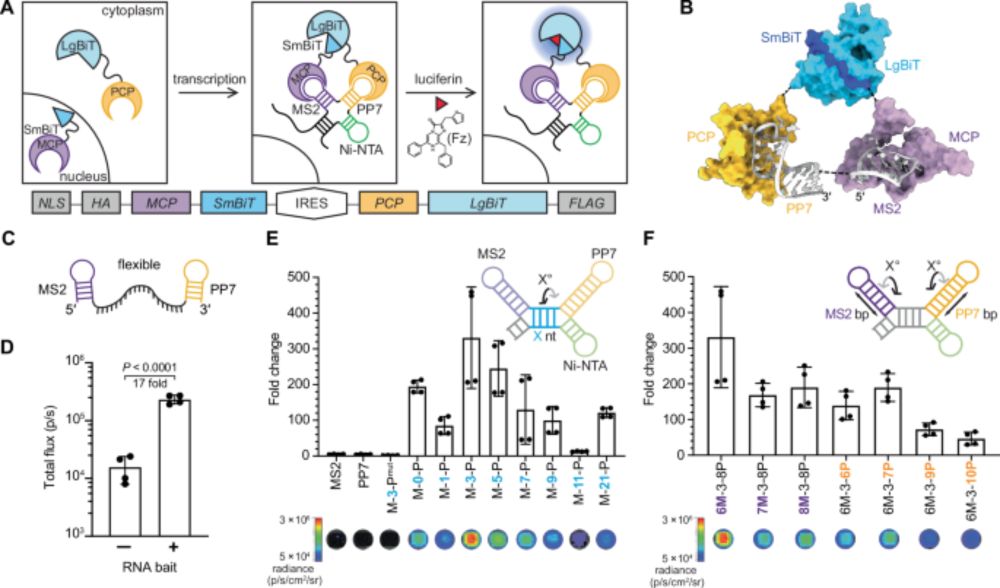
A modular platform for bioluminescent RNA tracking - Nature Communications
Studying RNA dynamics in vivo often relies on fluorogenic approaches, but these can be hampered by factors such as limited sensitivity and sample autofluorescence. Here, the authors describe an ultrasensitive platform for RNA imaging, which features RNA tags that recruit light-emitting luciferase fragments.
www.nature.com
September 30, 2025 at 2:52 PM
Great talk by Jenn Prescher at the Virtual @chembiotalks.bsky.social. She talked about her group's many contributions to expanding the toolbox of bioluminescent tools. Cool insights into tracking RNA. www.nature.com/articles/s41...
#ChemBio #ChemSky
#ChemBio #ChemSky
Reposted by Virus Addict

SRBD1, a highly conserved gene required for chromosome individualization

SRBD1, a highly conserved gene required for chromosome individualization
Raaijmakers et al. study S1 domain containing protein 1 (SRBD1), a previously uncharacterized essential protein. The loss of SRBD1 results in a complete failure in anaphase chromosome segregation due to defects established in prophase. The phenotype…
dlvr.it
March 19, 2025 at 11:23 PM
SRBD1, a highly conserved gene required for chromosome individualization
Reposted by Virus Addict
Experimental verification is increasingly the bottleneck in protein design projects.
In this paper, we develop a new mini-binder screening pipeline based on the microfluidic sizing technique called flow-induced dispersion analysis (FIDA).
doi.org/10.1002/pro....
In this paper, we develop a new mini-binder screening pipeline based on the microfluidic sizing technique called flow-induced dispersion analysis (FIDA).
doi.org/10.1002/pro....

Screening de novo designed protein binders in unpurified lysate using flow induced dispersion analysis
Computational protein design can create binders against targets of interest, but identifying binders with sufficient affinity still requires biochemical screening of many designs. In this work, we te....
doi.org
September 15, 2025 at 7:51 PM
Experimental verification is increasingly the bottleneck in protein design projects.
In this paper, we develop a new mini-binder screening pipeline based on the microfluidic sizing technique called flow-induced dispersion analysis (FIDA).
doi.org/10.1002/pro....
In this paper, we develop a new mini-binder screening pipeline based on the microfluidic sizing technique called flow-induced dispersion analysis (FIDA).
doi.org/10.1002/pro....
Reposted by Virus Addict
New review on computational design of intrinsically disordered proteins 🖥️🍝 by @giuliotesei.bsky.social @fpesce.bsky.social & 👴
doi.org/10.48550/arX...
doi.org/10.48550/arX...

September 17, 2025 at 4:17 PM
New review on computational design of intrinsically disordered proteins 🖥️🍝 by @giuliotesei.bsky.social @fpesce.bsky.social & 👴
doi.org/10.48550/arX...
doi.org/10.48550/arX...
Reposted by Virus Addict

🚨New Article Out!!
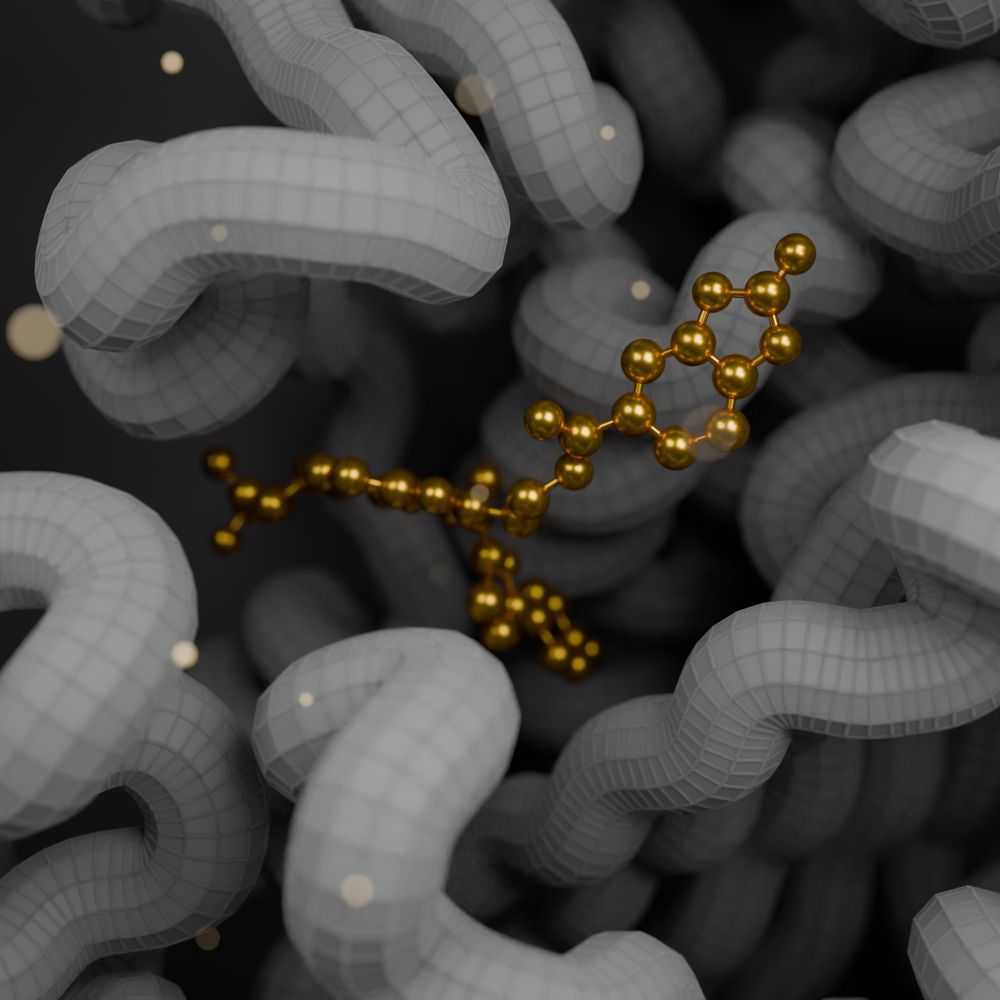
📢 In our latest work, we propose a Three-Point Lock binding mode for ATX inhibitors 🔒
🚀 This approach may represent the final piece in the puzzle of known binding mode types — and could have therapeutic relevance
♥️ Thanks for your support
Read more here: doi.org/10.1016/j.bm...
📢 In our latest work, we propose a Three-Point Lock binding mode for ATX inhibitors 🔒
🚀 This approach may represent the final piece in the puzzle of known binding mode types — and could have therapeutic relevance
♥️ Thanks for your support
Read more here: doi.org/10.1016/j.bm...
April 15, 2025 at 11:24 PM
🚨New Article Out!!
📢 In our latest work, we propose a Three-Point Lock binding mode for ATX inhibitors 🔒
🚀 This approach may represent the final piece in the puzzle of known binding mode types — and could have therapeutic relevance
♥️ Thanks for your support
Read more here: doi.org/10.1016/j.bm...
📢 In our latest work, we propose a Three-Point Lock binding mode for ATX inhibitors 🔒
🚀 This approach may represent the final piece in the puzzle of known binding mode types — and could have therapeutic relevance
♥️ Thanks for your support
Read more here: doi.org/10.1016/j.bm...
Reposted by Virus Addict
Excited to share our latest work in expanding AI-based protein design into targeting PTMs! I’m particularly excited in this work as there is so much we don’t know about PTMs despite their central role in signaling and hopefully we can start to decode their rules and functions.

Phosphorylation on tyrosines control key pathways in immunity, cancer, and metabolism. For the first time, we can now design proteins that specifically recognize individual phosphotyrosines, even in disordered regions. (1/8)
Preprint: www.biorxiv.org/content/10.1...
Preprint: www.biorxiv.org/content/10.1...
September 30, 2025 at 11:42 PM
Excited to share our latest work in expanding AI-based protein design into targeting PTMs! I’m particularly excited in this work as there is so much we don’t know about PTMs despite their central role in signaling and hopefully we can start to decode their rules and functions.
Reposted by Virus Addict

I am thrilled to release ProteinDJ: a high-performance and modular protein design pipeline. Our open-source workflow incorporates #RFdiffusion, #ProteinMPNN, #FAMPNN, #AlphaFold2 and #Boltz-2. It is a fast, free, and fun way to design proteins (1/5)
doi.org/10.1101/2025.09.24.678028 #proteindesign
doi.org/10.1101/2025.09.24.678028 #proteindesign

September 28, 2025 at 9:16 PM
I am thrilled to release ProteinDJ: a high-performance and modular protein design pipeline. Our open-source workflow incorporates #RFdiffusion, #ProteinMPNN, #FAMPNN, #AlphaFold2 and #Boltz-2. It is a fast, free, and fun way to design proteins (1/5)
doi.org/10.1101/2025.09.24.678028 #proteindesign
doi.org/10.1101/2025.09.24.678028 #proteindesign
Reposted by Virus Addict

David Baker & colleagues develop an #IL21 mimic (21h10) that is more stable & shows x-reactivity against both human & murine #IL21R. 21h10 promotes potent antitumor responses in mice and in human #melanoma tumor explants, expanding low-affinity CD8 #TCells & #TH1 cells & reducing #Tregs in #tumors!

Design of a potent interleukin-21 mimic for cancer immunotherapy
A de novo IL-21 mimic, 21h10, exhibits improved stability and potent antitumor activity in vivo compared with native IL-21.
www.science.org
September 29, 2025 at 9:13 PM
Reposted by Virus Addict

🚨 New strategy against colorectal cancer!
Dual GSK-3 & BCL-XL inhibition kills APC-mutant cells in organoid models, tipping the balance towards healthy cells—a promising way to halt early tumor growth 💪🧪
➡️Read more: www.nature.com/articles/s41...
Dual GSK-3 & BCL-XL inhibition kills APC-mutant cells in organoid models, tipping the balance towards healthy cells—a promising way to halt early tumor growth 💪🧪
➡️Read more: www.nature.com/articles/s41...

GSK-3 and BCL-XL inhibition mitigates the competitive advantage of APC-mutant colorectal cancer cells - Oncogenesis
Oncogenesis - GSK-3 and BCL-XL inhibition mitigates the competitive advantage of APC-mutant colorectal cancer cells
www.nature.com
July 15, 2025 at 9:39 AM
🚨 New strategy against colorectal cancer!
Dual GSK-3 & BCL-XL inhibition kills APC-mutant cells in organoid models, tipping the balance towards healthy cells—a promising way to halt early tumor growth 💪🧪
➡️Read more: www.nature.com/articles/s41...
Dual GSK-3 & BCL-XL inhibition kills APC-mutant cells in organoid models, tipping the balance towards healthy cells—a promising way to halt early tumor growth 💪🧪
➡️Read more: www.nature.com/articles/s41...
Reposted by Virus Addict
📢 Excited to announce that our Opinion paper on GPI-anchored proteins is now Published! 🎉
👀 If you're working in this field, be sure to check out our paper — we've highlighted some truly outstanding questions on the topic! ⚠️
www.cell.com/trends/cell-...
👀 If you're working in this field, be sure to check out our paper — we've highlighted some truly outstanding questions on the topic! ⚠️
www.cell.com/trends/cell-...

January 23, 2025 at 10:09 PM
📢 Excited to announce that our Opinion paper on GPI-anchored proteins is now Published! 🎉
👀 If you're working in this field, be sure to check out our paper — we've highlighted some truly outstanding questions on the topic! ⚠️
www.cell.com/trends/cell-...
👀 If you're working in this field, be sure to check out our paper — we've highlighted some truly outstanding questions on the topic! ⚠️
www.cell.com/trends/cell-...
Reposted by Virus Addict

Part of something that we have been working on for a while-A 3.1 Å map of a flexibly tethered 38 kDa domain. Hopefully preprinted soon along with a few other structures. #CryoEM
September 21, 2025 at 3:02 PM
Part of something that we have been working on for a while-A 3.1 Å map of a flexibly tethered 38 kDa domain. Hopefully preprinted soon along with a few other structures. #CryoEM
Reposted by Virus Addict

I am excited to share our new preprint on the CAGE complex, a mysterious hollow protein complex that I first saw years ago while surveying Tetrahymena ciliary lysate www.biorxiv.org/content/10.1... #cilia #protistsonsky 🧬🧪
September 23, 2025 at 5:08 PM
I am excited to share our new preprint on the CAGE complex, a mysterious hollow protein complex that I first saw years ago while surveying Tetrahymena ciliary lysate www.biorxiv.org/content/10.1... #cilia #protistsonsky 🧬🧪
Reposted by Virus Addict

September Map of the Month: Small Data, Big Insights ⚡️
From just 233 movies, CryoCloud delivered a 3.2 Å SARS-CoV-2 spike map in 3.5 h.
Fast and efficient #cryoEM, exactly what vaccine design teams need when screening dozens of antigen variants per day.
📬 DM or hi@cryocloud.io for more info!
From just 233 movies, CryoCloud delivered a 3.2 Å SARS-CoV-2 spike map in 3.5 h.
Fast and efficient #cryoEM, exactly what vaccine design teams need when screening dozens of antigen variants per day.
📬 DM or hi@cryocloud.io for more info!
September 24, 2025 at 12:23 PM
September Map of the Month: Small Data, Big Insights ⚡️
From just 233 movies, CryoCloud delivered a 3.2 Å SARS-CoV-2 spike map in 3.5 h.
Fast and efficient #cryoEM, exactly what vaccine design teams need when screening dozens of antigen variants per day.
📬 DM or hi@cryocloud.io for more info!
From just 233 movies, CryoCloud delivered a 3.2 Å SARS-CoV-2 spike map in 3.5 h.
Fast and efficient #cryoEM, exactly what vaccine design teams need when screening dozens of antigen variants per day.
📬 DM or hi@cryocloud.io for more info!
Reposted by Virus Addict
gapTrick - Structural characterisation of protein-protein interactions using AlphaFold pubmed.ncbi.nlm.nih.gov/40985612/ #cryoem
September 24, 2025 at 10:31 PM
gapTrick - Structural characterisation of protein-protein interactions using AlphaFold pubmed.ncbi.nlm.nih.gov/40985612/ #cryoem
Reposted by Virus Addict
Initial attempt at replicating in relion (parameters in next post). This is for Aca2-RNA, using a 100k subset of the 2D-classified particles (no prior 3D cleanup).
A 1-class ab initio in relion, then local refinement in relion (1.8deg searches+blush) gives a nominally 3.3Å map; 3.5 Å w/out blush.
A 1-class ab initio in relion, then local refinement in relion (1.8deg searches+blush) gives a nominally 3.3Å map; 3.5 Å w/out blush.
September 26, 2025 at 2:28 AM
Initial attempt at replicating in relion (parameters in next post). This is for Aca2-RNA, using a 100k subset of the 2D-classified particles (no prior 3D cleanup).
A 1-class ab initio in relion, then local refinement in relion (1.8deg searches+blush) gives a nominally 3.3Å map; 3.5 Å w/out blush.
A 1-class ab initio in relion, then local refinement in relion (1.8deg searches+blush) gives a nominally 3.3Å map; 3.5 Å w/out blush.
Reposted by Virus Addict
Rounding off an incredibly busy week with the excellent third installment of the Dutch Structural Biology Meeting! Many thanks to Arjen for the kind invitation to present our lab’s work.

September 26, 2025 at 6:37 PM
Rounding off an incredibly busy week with the excellent third installment of the Dutch Structural Biology Meeting! Many thanks to Arjen for the kind invitation to present our lab’s work.
Reposted by Virus Addict
Latest preprint from the lab, many years in the making!
By combining #cryoEM with #AlphaFold3 modelling, we propose that norovirus NS3 forms a transmembrane RNA translocase.
This could have big implications for our understanding of viral replication & assembly (🧵)
www.biorxiv.org/content/10.1...
By combining #cryoEM with #AlphaFold3 modelling, we propose that norovirus NS3 forms a transmembrane RNA translocase.
This could have big implications for our understanding of viral replication & assembly (🧵)
www.biorxiv.org/content/10.1...
June 18, 2025 at 6:32 AM
Latest preprint from the lab, many years in the making!
By combining #cryoEM with #AlphaFold3 modelling, we propose that norovirus NS3 forms a transmembrane RNA translocase.
This could have big implications for our understanding of viral replication & assembly (🧵)
www.biorxiv.org/content/10.1...
By combining #cryoEM with #AlphaFold3 modelling, we propose that norovirus NS3 forms a transmembrane RNA translocase.
This could have big implications for our understanding of viral replication & assembly (🧵)
www.biorxiv.org/content/10.1...
Reposted by Virus Addict
In today’s publication in Science we introduce Zincore: a novel protein of QRICH1 and SEPHS1 and functions as a transcriptional coregulator dedicated to zinc finger transcription factors. Here’s how we found it: 🧵 www.science.org/doi/10.1126/... 1/11
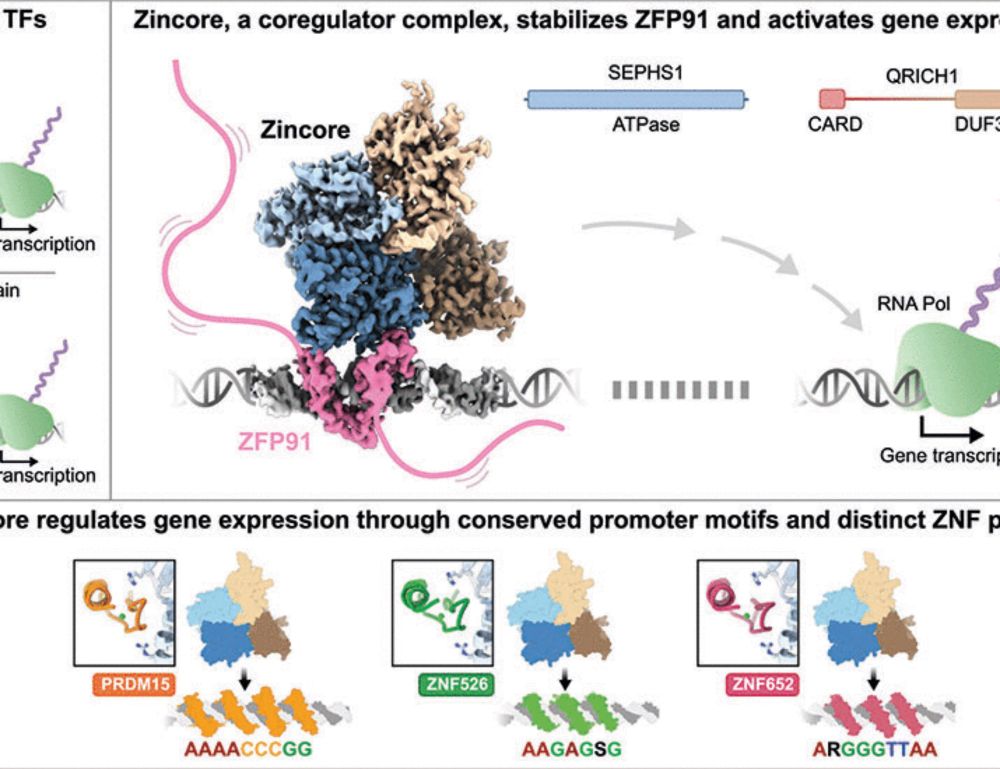
Zincore, an atypical coregulator, binds zinc finger transcription factors to control gene expression
Zinc finger proteins (ZNFs) are the largest family of transcription factors, yet how they activate gene expression remains unclear. In this study, we identified Zincore, a protein complex consisting o...
www.science.org
July 4, 2025 at 11:00 AM
In today’s publication in Science we introduce Zincore: a novel protein of QRICH1 and SEPHS1 and functions as a transcriptional coregulator dedicated to zinc finger transcription factors. Here’s how we found it: 🧵 www.science.org/doi/10.1126/... 1/11
Reposted by Virus Addict
👀 Just updated my Google Scholar and... can’t believe one of my papers reached 100 citations! 🚀
💪🏼 It might not seem like much, but as a PhD student, it feels like a big achievement.
❤️ To all fellow PhDs, keep going, stay strong, and celebrate every milestone!🔁
Read it: www.jbc.org/article/S002...
💪🏼 It might not seem like much, but as a PhD student, it feels like a big achievement.
❤️ To all fellow PhDs, keep going, stay strong, and celebrate every milestone!🔁
Read it: www.jbc.org/article/S002...

July 15, 2025 at 10:50 PM
👀 Just updated my Google Scholar and... can’t believe one of my papers reached 100 citations! 🚀
💪🏼 It might not seem like much, but as a PhD student, it feels like a big achievement.
❤️ To all fellow PhDs, keep going, stay strong, and celebrate every milestone!🔁
Read it: www.jbc.org/article/S002...
💪🏼 It might not seem like much, but as a PhD student, it feels like a big achievement.
❤️ To all fellow PhDs, keep going, stay strong, and celebrate every milestone!🔁
Read it: www.jbc.org/article/S002...