




Magnus Bauer
@kinasekid.bsky.social
Enjoying life one molecule at a time! / Postdoc @UWproteindesign / ex @Stanford / PhD @LMU_Muenchen / tweeting in English, thinking in Bavarian, coding in Python
Pinned
Magnus Bauer
@kinasekid.bsky.social
· Sep 30
Phosphorylation on tyrosines control key pathways in immunity, cancer, and metabolism. For the first time, we can now design proteins that specifically recognize individual phosphotyrosines, even in disordered regions. (1/8)
Preprint: www.biorxiv.org/content/10.1...
Preprint: www.biorxiv.org/content/10.1...
Reposted by Magnus Bauer

Not new, but a new to us update:
The first preprint out of my lab! We joined forces with @kinasekid.bsky.social @jasonzxzhang.bsky.social and David Baker to study protein phosphorylation! Congrats to Isabella from my lab on her first first author paper! tinyurl.com/43jwwfua
The first preprint out of my lab! We joined forces with @kinasekid.bsky.social @jasonzxzhang.bsky.social and David Baker to study protein phosphorylation! Congrats to Isabella from my lab on her first first author paper! tinyurl.com/43jwwfua
De novo design of phosphotyrosine peptide binders
Phosphorylation on tyrosine is a key step in many signaling pathways. Despite recent progress in de novo design of protein binders, there are no current methods for designing binders that recognize phosphorylated proteins and peptides; this is a challenging problem as phosphate groups are highly charged, and phosphorylation often occurs within unstructured regions. Here we introduce RoseTTAFold Diffusion 2 for Molecular Interfaces (RFD2-MI), a deep generative framework for the design of binders for protein, ligand, and covalently modified protein targets. We demonstrate the power and versatility of this method by designing binders for four critical phosphotyrosine sites on three clinically relevant targets: Cluster of Differentiation 3 (CD3ε), Epidermal Growth Factor Receptor (EGFR), Insulin Receptor (INSR) and Signal Transducer and Activator of Transcription 5 (STAT5). Experimental characterization shows that the designs bind their phosphotyrosine containing targets with affinities comparable to native binding sites and have negligible binding to non-phosphorylated targets or phosphopeptides with different sequences. X-ray crystal structures of generated binders to CD3ε and EGFR are very close to the design models, demonstrating the accuracy of the design approach. A designed binder to an EGFR intracellular region phosphorylated upon EGF activation co-localizes with the receptor following EGF stimulation in single-particle tracking (SPT) experiments, demonstrating pY specific recognition in living cells. RFD2-MI provides a generalizable all-atom diffusion framework for probing and modulating phosphorylation-dependent signaling, and more generally, for developing research tools and targeted therapeutics against post-translationally modified proteins. ### Competing Interest Statement The authors have declared no competing interest. NIH NCI, 1K99CA293001
www.biorxiv.org
January 29, 2026 at 12:57 PM
Not new, but a new to us update:
The first preprint out of my lab! We joined forces with @kinasekid.bsky.social @jasonzxzhang.bsky.social and David Baker to study protein phosphorylation! Congrats to Isabella from my lab on her first first author paper! tinyurl.com/43jwwfua
The first preprint out of my lab! We joined forces with @kinasekid.bsky.social @jasonzxzhang.bsky.social and David Baker to study protein phosphorylation! Congrats to Isabella from my lab on her first first author paper! tinyurl.com/43jwwfua
Reposted by Magnus Bauer
It was such a fun journey working with Krishna’s lab and @kinasekid.bsky.social! Really excited to see where this phospho-binder technology goes!
Not new, but a new to us update:
The first preprint out of my lab! We joined forces with @kinasekid.bsky.social @jasonzxzhang.bsky.social and David Baker to study protein phosphorylation! Congrats to Isabella from my lab on her first first author paper! tinyurl.com/43jwwfua
The first preprint out of my lab! We joined forces with @kinasekid.bsky.social @jasonzxzhang.bsky.social and David Baker to study protein phosphorylation! Congrats to Isabella from my lab on her first first author paper! tinyurl.com/43jwwfua
De novo design of phosphotyrosine peptide binders
Phosphorylation on tyrosine is a key step in many signaling pathways. Despite recent progress in de novo design of protein binders, there are no current methods for designing binders that recognize phosphorylated proteins and peptides; this is a challenging problem as phosphate groups are highly charged, and phosphorylation often occurs within unstructured regions. Here we introduce RoseTTAFold Diffusion 2 for Molecular Interfaces (RFD2-MI), a deep generative framework for the design of binders for protein, ligand, and covalently modified protein targets. We demonstrate the power and versatility of this method by designing binders for four critical phosphotyrosine sites on three clinically relevant targets: Cluster of Differentiation 3 (CD3ε), Epidermal Growth Factor Receptor (EGFR), Insulin Receptor (INSR) and Signal Transducer and Activator of Transcription 5 (STAT5). Experimental characterization shows that the designs bind their phosphotyrosine containing targets with affinities comparable to native binding sites and have negligible binding to non-phosphorylated targets or phosphopeptides with different sequences. X-ray crystal structures of generated binders to CD3ε and EGFR are very close to the design models, demonstrating the accuracy of the design approach. A designed binder to an EGFR intracellular region phosphorylated upon EGF activation co-localizes with the receptor following EGF stimulation in single-particle tracking (SPT) experiments, demonstrating pY specific recognition in living cells. RFD2-MI provides a generalizable all-atom diffusion framework for probing and modulating phosphorylation-dependent signaling, and more generally, for developing research tools and targeted therapeutics against post-translationally modified proteins. ### Competing Interest Statement The authors have declared no competing interest. NIH NCI, 1K99CA293001
www.biorxiv.org
January 29, 2026 at 1:40 PM
It was such a fun journey working with Krishna’s lab and @kinasekid.bsky.social! Really excited to see where this phospho-binder technology goes!
Reposted by Magnus Bauer
Thrilled to announce our new preprint, “Protein Hunter: Exploiting Structure Hallucination within Diffusion for Protein Design,” in collaboration with @Griffin, @GBhardwaj8 and @sokrypton.org
🧬Code and notebooks will be released by the end of this week.
🎧Golden- Kpop Demon Hunters
🧬Code and notebooks will be released by the end of this week.
🎧Golden- Kpop Demon Hunters
October 13, 2025 at 3:45 PM
Thrilled to announce our new preprint, “Protein Hunter: Exploiting Structure Hallucination within Diffusion for Protein Design,” in collaboration with @Griffin, @GBhardwaj8 and @sokrypton.org
🧬Code and notebooks will be released by the end of this week.
🎧Golden- Kpop Demon Hunters
🧬Code and notebooks will be released by the end of this week.
🎧Golden- Kpop Demon Hunters
Phosphorylation on tyrosines control key pathways in immunity, cancer, and metabolism. For the first time, we can now design proteins that specifically recognize individual phosphotyrosines, even in disordered regions. (1/8)
Preprint: www.biorxiv.org/content/10.1...
Preprint: www.biorxiv.org/content/10.1...
September 30, 2025 at 9:55 PM
Phosphorylation on tyrosines control key pathways in immunity, cancer, and metabolism. For the first time, we can now design proteins that specifically recognize individual phosphotyrosines, even in disordered regions. (1/8)
Preprint: www.biorxiv.org/content/10.1...
Preprint: www.biorxiv.org/content/10.1...
Reposted by Magnus Bauer

(1/7)
Training biomolecular foundation models shouldn't be so hard. And open-source structure prediction is important. So today we're releasing two software packages: AtomWorks and RosettaFold3 (RF3)
[https://www.biorxiv.org/content/10.1101/2025.08.14.670328v2](www.biorxiv.org/content/10.1...)
Training biomolecular foundation models shouldn't be so hard. And open-source structure prediction is important. So today we're releasing two software packages: AtomWorks and RosettaFold3 (RF3)
[https://www.biorxiv.org/content/10.1101/2025.08.14.670328v2](www.biorxiv.org/content/10.1...)

Accelerating Biomolecular Modeling with AtomWorks and RF3
Deep learning methods trained on protein structure databases have revolutionized biomolecular structure prediction, but developing and training new models remains a considerable challenge. To facilita...
www.biorxiv.org
August 15, 2025 at 5:17 PM
(1/7)
Training biomolecular foundation models shouldn't be so hard. And open-source structure prediction is important. So today we're releasing two software packages: AtomWorks and RosettaFold3 (RF3)
[https://www.biorxiv.org/content/10.1101/2025.08.14.670328v2](www.biorxiv.org/content/10.1...)
Training biomolecular foundation models shouldn't be so hard. And open-source structure prediction is important. So today we're releasing two software packages: AtomWorks and RosettaFold3 (RF3)
[https://www.biorxiv.org/content/10.1101/2025.08.14.670328v2](www.biorxiv.org/content/10.1...)
Who knew a Nobel Prize win could unlock an entire city? Join us live on YouTube as we celebrate 2024 Nobel Laureate David Baker together with the Mayor of Seattle and many others on March 10th starting at 5 pm (PT)! 🥇🔑🌇
www.youtube.com/live/z8NO4Bg...
www.youtube.com/live/z8NO4Bg...

Celebrating Seattle's 2024 Nobel Prize with Professor David Baker
YouTube video by UW Medicine
www.youtube.com
March 7, 2025 at 4:55 AM
Who knew a Nobel Prize win could unlock an entire city? Join us live on YouTube as we celebrate 2024 Nobel Laureate David Baker together with the Mayor of Seattle and many others on March 10th starting at 5 pm (PT)! 🥇🔑🌇
www.youtube.com/live/z8NO4Bg...
www.youtube.com/live/z8NO4Bg...
Reposted by Magnus Bauer
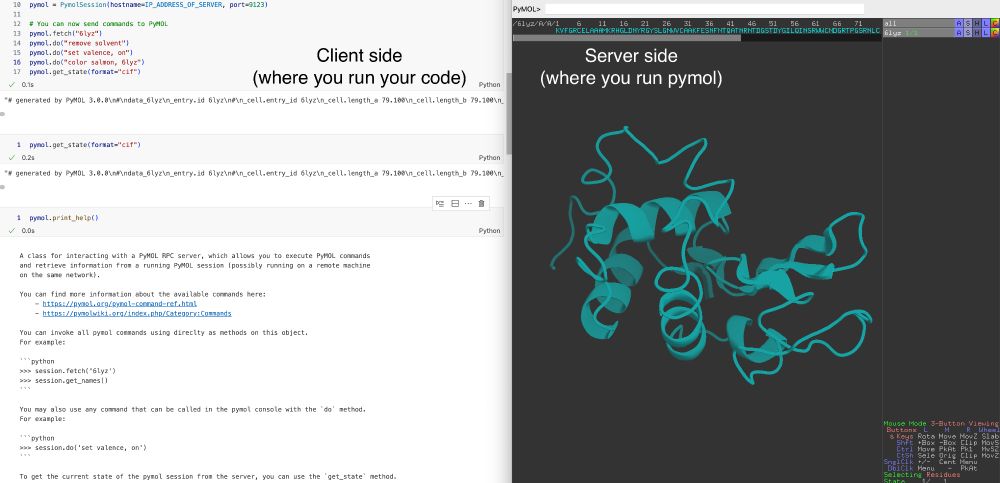
A weekend project from a while back -- this little package (with no dependencies) allows you to interact with pymol remotely.
I use it a lot for my protein design workflows together with @biotite.bsky.social.
Just `pip install pymol-remote`
I use it a lot for my protein design workflows together with @biotite.bsky.social.
Just `pip install pymol-remote`
November 25, 2024 at 2:50 PM
A weekend project from a while back -- this little package (with no dependencies) allows you to interact with pymol remotely.
I use it a lot for my protein design workflows together with @biotite.bsky.social.
Just `pip install pymol-remote`
I use it a lot for my protein design workflows together with @biotite.bsky.social.
Just `pip install pymol-remote`
Reposted by Magnus Bauer
#CompChemSky 🧶🖥️🧬🧪
I wonder, is there any computational approach, that would find protein in PDB according to any arbitrary shape?
I wonder, is there any computational approach, that would find protein in PDB according to any arbitrary shape?
December 6, 2023 at 7:23 PM
#CompChemSky 🧶🖥️🧬🧪
I wonder, is there any computational approach, that would find protein in PDB according to any arbitrary shape?
I wonder, is there any computational approach, that would find protein in PDB according to any arbitrary shape?
Reposted by Magnus Bauer
The Praetorius lab for Biomolecular Design at the Institute of Science and Technology Austria (ISTA) is looking for grad students in 2024. If you are interested in protein design at a great institute near Vienna reach out to me!
www.dropbox.com/scl/fi/6iny2...
www.dropbox.com/scl/fi/6iny2...
www.dropbox.com
November 28, 2023 at 1:08 AM
The Praetorius lab for Biomolecular Design at the Institute of Science and Technology Austria (ISTA) is looking for grad students in 2024. If you are interested in protein design at a great institute near Vienna reach out to me!
www.dropbox.com/scl/fi/6iny2...
www.dropbox.com/scl/fi/6iny2...
Reposted by Magnus Bauer

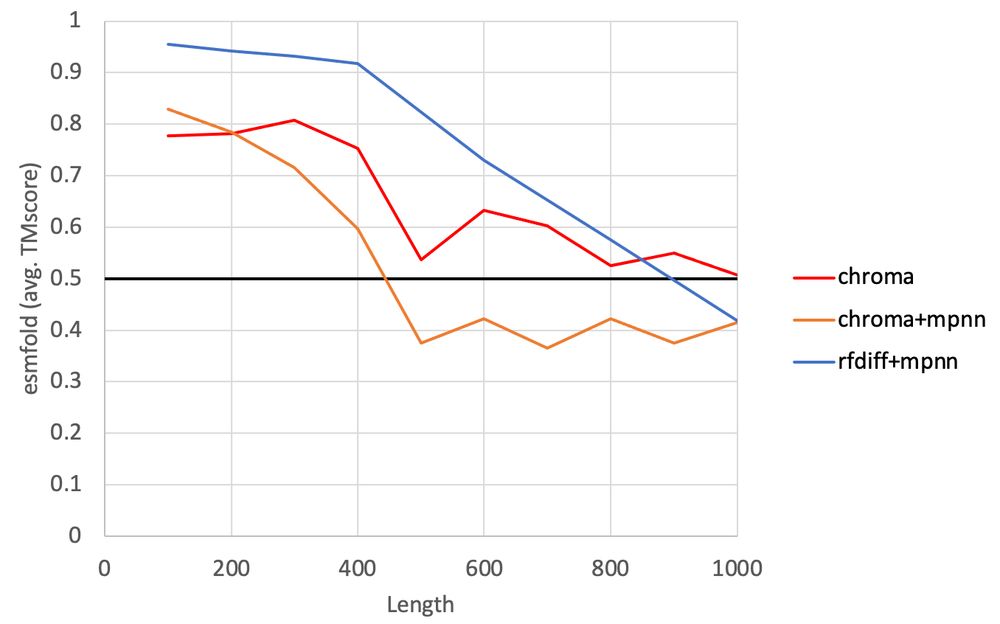
Update on the Chroma vs RfDiffusion analysis.
ProteinMPNN just doesn't like Chroma's backbones (poor prediction of proteinMPNN generated sequences by ESMFold). Interestingly, Chroma's own sequence design method (which was trained in the context of partially noise backbones) loves it! (1/3)
ProteinMPNN just doesn't like Chroma's backbones (poor prediction of proteinMPNN generated sequences by ESMFold). Interestingly, Chroma's own sequence design method (which was trained in the context of partially noise backbones) loves it! (1/3)
November 18, 2023 at 7:04 PM
Update on the Chroma vs RfDiffusion analysis.
ProteinMPNN just doesn't like Chroma's backbones (poor prediction of proteinMPNN generated sequences by ESMFold). Interestingly, Chroma's own sequence design method (which was trained in the context of partially noise backbones) loves it! (1/3)
ProteinMPNN just doesn't like Chroma's backbones (poor prediction of proteinMPNN generated sequences by ESMFold). Interestingly, Chroma's own sequence design method (which was trained in the context of partially noise backbones) loves it! (1/3)
Reposted by Magnus Bauer
"Performance and structural coverage of the
latest, in-development AlphaFold model" 🧪🧶🧬
DeepMind & Isomorphic Labs sharing some updates (but no code) on what is presumably alphafold 3, capable of modeling ligands, nucleic acids, antibody-antigen complexes etc
storage.googleapis.com/deepmind-med...
latest, in-development AlphaFold model" 🧪🧶🧬
DeepMind & Isomorphic Labs sharing some updates (but no code) on what is presumably alphafold 3, capable of modeling ligands, nucleic acids, antibody-antigen complexes etc
storage.googleapis.com/deepmind-med...

October 31, 2023 at 1:48 PM
"Performance and structural coverage of the
latest, in-development AlphaFold model" 🧪🧶🧬
DeepMind & Isomorphic Labs sharing some updates (but no code) on what is presumably alphafold 3, capable of modeling ligands, nucleic acids, antibody-antigen complexes etc
storage.googleapis.com/deepmind-med...
latest, in-development AlphaFold model" 🧪🧶🧬
DeepMind & Isomorphic Labs sharing some updates (but no code) on what is presumably alphafold 3, capable of modeling ligands, nucleic acids, antibody-antigen complexes etc
storage.googleapis.com/deepmind-med...