




Yutong Zhang
@zyt0329.bsky.social
PhD from Weihong Tan lab and Haoxing Xu lab.
Chemistry student trying to understand Biology
Google scholar: https://scholar.google.com/citations?user=67Y2GokAAAAJ&hl=en&oi=ao
Chemistry student trying to understand Biology
Google scholar: https://scholar.google.com/citations?user=67Y2GokAAAAJ&hl=en&oi=ao
Pinned

DNA nanodevices detect an acidic nanolayer on the lysosomal surface - Nature Cell Biology
Tan and colleagues develop DNA nanodevices to detect the pH of the lysosomal outer surface, observing an acidic layer generated by TMEM175 that regulates lysosome positioning in response to changes in...
www.nature.com
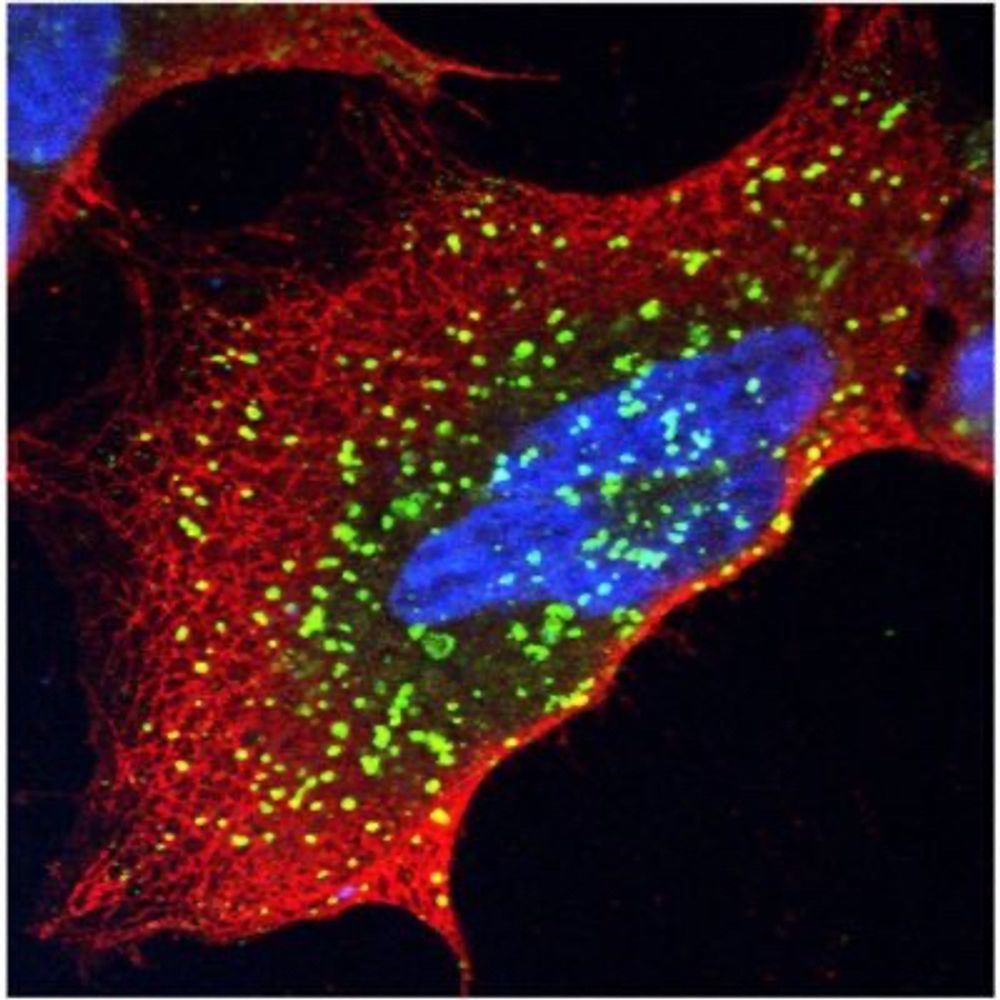
Beyond thrilled to share my PhD work out today in @natcellbio.nature.com , uncovering a nanoscale acidic environment around lysosomes that controls their mobility through proton signaling.🥳🥳🥳
Great thanks to my advisors and excellent peers for helping me!
www.nature.com/articles/s41...
Great thanks to my advisors and excellent peers for helping me!
www.nature.com/articles/s41...
Happy Chinese New Year!🐴
A horse year 2026!
A horse year 2026!

February 17, 2026 at 2:07 AM
Happy Chinese New Year!🐴
A horse year 2026!
A horse year 2026!

☕ @zyt0329.bsky.social et al develop DNA nanodevices to detect the pH of the lysosomal outer surface, observing an acidic layer generated by TMEM175 that regulates lysosome positioning in response to changes in juxta-lysosomal pH.
👉https://rdcu.be/e3TPL
bit.ly/4auh4aD
👉https://rdcu.be/e3TPL
bit.ly/4auh4aD

DNA nanodevices detect an acidic nanolayer on the lysosomal surface - Nature Cell Biology
Tan and colleagues develop DNA nanodevices to detect the pH of the lysosomal outer surface, observing an acidic layer generated by TMEM175 that regulates lysosome positioning in response to changes in...
bit.ly
February 13, 2026 at 7:48 PM
Excellent work!
How could a simple self-replicating system emerge at the origins of life? RNA polymerase ribozymes can replicate RNA, but existing ones are so large that their self-replication seems impossible. Could they be smaller?
Excited to share our latest work in @science.org on a new small polymerase.
1/n
Excited to share our latest work in @science.org on a new small polymerase.
1/n

A small polymerase ribozyme that can synthesize itself and its complementary strand
The emergence of a chemical system capable of self-replication and evolution is a critical event in the origin of life. RNA polymerase ribozymes can replicate RNA, but their large size and structural ...
www.science.org
February 13, 2026 at 2:52 PM
Excellent work!
Reposted by Yutong Zhang

How did life arise from simple chemical building blocks?
New #LMBResearch led by @edogia.bsky.social in @philholliger.bsky.social group has identified a small self-replicating ribozyme that could be the answer.
Read more: mrclmb.ac.uk/news-events/...
New #LMBResearch led by @edogia.bsky.social in @philholliger.bsky.social group has identified a small self-replicating ribozyme that could be the answer.
Read more: mrclmb.ac.uk/news-events/...
February 13, 2026 at 10:20 AM
How did life arise from simple chemical building blocks?
New #LMBResearch led by @edogia.bsky.social in @philholliger.bsky.social group has identified a small self-replicating ribozyme that could be the answer.
Read more: mrclmb.ac.uk/news-events/...
New #LMBResearch led by @edogia.bsky.social in @philholliger.bsky.social group has identified a small self-replicating ribozyme that could be the answer.
Read more: mrclmb.ac.uk/news-events/...
Thank you for highlighting our work with very visionary perspectives! @mstagi.bsky.social @natcellbio.nature.com
Decoding the proton veil around lysosomes
www.nature.com/articles/s41...
Decoding the proton veil around lysosomes
www.nature.com/articles/s41...

Decoding the proton veil around lysosomes - Nature Cell Biology
A newly discovered acidic nanolayer that envelopes lysosomes reveals that proton gradients extend beyond the organelle lumen, identifying a nanoscale regulatory interface that links luminal pH, TMEM17...
www.nature.com
January 26, 2026 at 2:04 PM
Thank you for highlighting our work with very visionary perspectives! @mstagi.bsky.social @natcellbio.nature.com
Decoding the proton veil around lysosomes
www.nature.com/articles/s41...
Decoding the proton veil around lysosomes
www.nature.com/articles/s41...
Reposted by Yutong Zhang

Reposted by Yutong Zhang

📢 #RSCChemBio is sponsoring two poster prizes at the EMBO-EMBL Chemical Biology Workshop 2026!
📅 8 - 11th September 2026
📍 EMBL Heidelberg, Germany
🔗 www.embl.org/about/i...
Submit your abstract by 2nd June 2026 to a part of the event!
EMBO #ChemicalBiology
📅 8 - 11th September 2026
📍 EMBL Heidelberg, Germany
🔗 www.embl.org/about/i...
Submit your abstract by 2nd June 2026 to a part of the event!
EMBO #ChemicalBiology

January 9, 2026 at 6:03 PM
📢 #RSCChemBio is sponsoring two poster prizes at the EMBO-EMBL Chemical Biology Workshop 2026!
📅 8 - 11th September 2026
📍 EMBL Heidelberg, Germany
🔗 www.embl.org/about/i...
Submit your abstract by 2nd June 2026 to a part of the event!
EMBO #ChemicalBiology
📅 8 - 11th September 2026
📍 EMBL Heidelberg, Germany
🔗 www.embl.org/about/i...
Submit your abstract by 2nd June 2026 to a part of the event!
EMBO #ChemicalBiology
Beyond thrilled to share my PhD work out today in @natcellbio.nature.com , uncovering a nanoscale acidic environment around lysosomes that controls their mobility through proton signaling.🥳🥳🥳
Great thanks to my advisors and excellent peers for helping me!
www.nature.com/articles/s41...
Great thanks to my advisors and excellent peers for helping me!
www.nature.com/articles/s41...
DNA nanodevices detect an acidic nanolayer on the lysosomal surface - Nature Cell Biology
Tan and colleagues develop DNA nanodevices to detect the pH of the lysosomal outer surface, observing an acidic layer generated by TMEM175 that regulates lysosome positioning in response to changes in...
www.nature.com
January 21, 2026 at 11:27 AM
Beyond thrilled to share my PhD work out today in @natcellbio.nature.com , uncovering a nanoscale acidic environment around lysosomes that controls their mobility through proton signaling.🥳🥳🥳
Great thanks to my advisors and excellent peers for helping me!
www.nature.com/articles/s41...
Great thanks to my advisors and excellent peers for helping me!
www.nature.com/articles/s41...
Congrats to my advisor Weihong and team!
doi.org/10.1126/scie...
doi.org/10.1126/scie...

SPARK-seq: A high-throughput platform for aptamer discovery and kinetic profiling
Cell surface proteins are key disease biomarkers and therapeutic targets, yet high-throughput methods for aptamer discovery targeting these proteins in situ remain limited. We introduce single-cell pe...
doi.org
January 2, 2026 at 2:05 AM
Congrats to my advisor Weihong and team!
doi.org/10.1126/scie...
doi.org/10.1126/scie...
Cheers!Finally get my doctoral diploma and become Dr.Zhang🥳🥳 Look forward!


December 30, 2025 at 4:55 AM
Cheers!Finally get my doctoral diploma and become Dr.Zhang🥳🥳 Look forward!
Reposted by Yutong Zhang

ICYMI: Molecular bioengineering of functional nucleic acids

Molecular bioengineering of functional nucleic acids
Nature Reviews Bioengineering, Published online: 17 October 2025; doi:10.1038/s44222-025-00361-yFunctional nucleic acids (FNAs) achieve specific target recognition, molecular binding and catalytic activity by folding into defined secondary and tertiary structures. This Review focuses on two major classes of FNAs — aptamers and DNAzymes — and discusses their structural features, production strategies and engineering approaches as well as their clinical applications in diagnostics, targeted therapy and precision medicine.
www.nature.com
October 19, 2025 at 8:38 AM
ICYMI: Molecular bioengineering of functional nucleic acids
First time to make an offline flash talk to present my PhD work🤩🤓 Really good opportunity😍

October 15, 2025 at 5:23 PM
First time to make an offline flash talk to present my PhD work🤩🤓 Really good opportunity😍
Glad to share my work and to receive first prize award of poster
!🤩🤩🤩
!🤩🤩🤩


October 12, 2025 at 2:06 PM
Glad to share my work and to receive first prize award of poster
!🤩🤩🤩
!🤩🤩🤩
Reposted by Yutong Zhang

These intriguing materials - the world's most porous sponges - won today's Nobel Prize in Chemistry
go.nature.com/3VVjXug
go.nature.com/3VVjXug

World’s most porous sponges: intricate carbon-trapping powders hit the market
Metal-organic frameworks were the next big thing in chemistry when they were invented more than three decades ago. Now, these intriguing materials are becoming commercial tools for capturing carbon dioxide and harvesting water from the air.
go.nature.com
October 8, 2025 at 10:20 AM
These intriguing materials - the world's most porous sponges - won today's Nobel Prize in Chemistry
go.nature.com/3VVjXug
go.nature.com/3VVjXug
Reposted by Yutong Zhang
Being named as a Nobel laureate is the ultimate prize for many scientists, but how do other science prizes compare?
go.nature.com/4nvVk3p
go.nature.com/4nvVk3p

These science prizes want to rival the Nobels: how do they compare?
Nature - Being named as a Nobel laureate is the ultimate prize for many scientists, but how do other science prizes compare?
go.nature.com
October 5, 2025 at 10:48 AM
Being named as a Nobel laureate is the ultimate prize for many scientists, but how do other science prizes compare?
go.nature.com/4nvVk3p
go.nature.com/4nvVk3p
Congrats to Yuting and Prof.Qiu! I'm glad to participate in this nice work as well🤩

A paper out today shows that monocytes derived from bone marrow leucocytes chemically conjugated with a Tau-specific aptamer enable systemic delivery across the blood–brain barrier and targeted clearance of extracellular Tau in Alzheimer’s disease mouse models. www.nature.com/articles/s41...

October 2, 2025 at 2:46 AM
Congrats to Yuting and Prof.Qiu! I'm glad to participate in this nice work as well🤩
Reposted by Yutong Zhang

2022 Nobel Prize winner in Chemistry, #Stanford Prof. Carolyn Bertozzi, delivered an inspiring lecture on #BioorthogonalChemistry at #PekingUniversity on Aug. 28.
@stanford.edu @carolynbertozzi.bskyverified.social
@stanford.edu @carolynbertozzi.bskyverified.social


August 30, 2025 at 11:22 AM
2022 Nobel Prize winner in Chemistry, #Stanford Prof. Carolyn Bertozzi, delivered an inspiring lecture on #BioorthogonalChemistry at #PekingUniversity on Aug. 28.
@stanford.edu @carolynbertozzi.bskyverified.social
@stanford.edu @carolynbertozzi.bskyverified.social
Have same lysosome slide with @carolynbertozzi.bskyverified.social happy to chat with you my work as a chemistry student doing cell biology🤩🤩🤩

August 26, 2025 at 2:50 AM
Have same lysosome slide with @carolynbertozzi.bskyverified.social happy to chat with you my work as a chemistry student doing cell biology🤩🤩🤩
Reposted by Yutong Zhang

Out today in @nature.com: Together with the Honigmann, Shevchenko, Drobot and Hof labs, we present a general workflow for imaging the localization and transport of individual lipids in cells and mapping their metabolism.
www.nature.com/articles/s41...
www.nature.com/articles/s41...

August 21, 2025 at 5:19 AM
Out today in @nature.com: Together with the Honigmann, Shevchenko, Drobot and Hof labs, we present a general workflow for imaging the localization and transport of individual lipids in cells and mapping their metabolism.
www.nature.com/articles/s41...
www.nature.com/articles/s41...
Reposted by Yutong Zhang
Another piece of the #glycoRNA puzzle revealed by @raflynn5.bsky.social and @vijayrathinam.bsky.social!! RNAs with modified base acp3U activate TLR3/7, but not when acp3U is N-glycosylated. This is how cell surface/secreted glycoRNAs avoid stimulating autoimmunity.
www.nature.com/articles/s41...
www.nature.com/articles/s41...

RNA N-glycosylation enables immune evasion and homeostatic efferocytosis - Nature
N-glycans on glycoRNAs prevent innate immune sensing of endogenous small RNAs, and the natural mechanism they use demonstrates how glycoRNAs exist on the cell surface and in the endosomal network with...
www.nature.com
August 19, 2025 at 7:43 PM
Another piece of the #glycoRNA puzzle revealed by @raflynn5.bsky.social and @vijayrathinam.bsky.social!! RNAs with modified base acp3U activate TLR3/7, but not when acp3U is N-glycosylated. This is how cell surface/secreted glycoRNAs avoid stimulating autoimmunity.
www.nature.com/articles/s41...
www.nature.com/articles/s41...
Reposted by Yutong Zhang

New Online! Lysosomal membrane homeostasis and its importance in physiology and disease
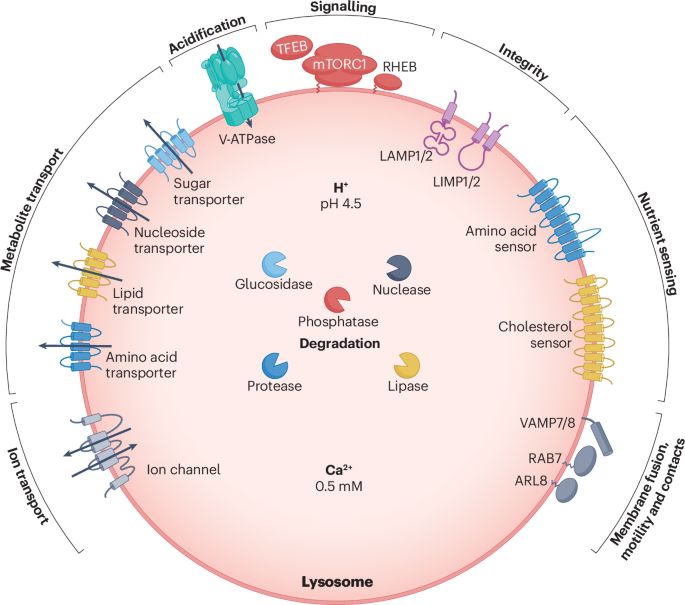
Lysosomal membrane homeostasis and its importance in physiology and disease
Nature Reviews Molecular Cell Biology, Published online: 04 August 2025; doi:10.1038/s41580-025-00873-wLysosomes degrade cellular components, and their membrane is an important signalling hub. Recent insights into the mechanisms that maintain lysosomal membrane homeostasis — including the interplay between membrane damage, repair, lysophagy and lysosome biogenesis — highlight their importance in physiology, in disease and during ageing.
bit.ly
August 4, 2025 at 6:47 PM
New Online! Lysosomal membrane homeostasis and its importance in physiology and disease
Reposted by Yutong Zhang
Scientists have mapped individual sugar molecules on the surface of cells at a resolution once thought to be impossible for light microscopes
go.nature.com/40I9Ewv
go.nature.com/40I9Ewv
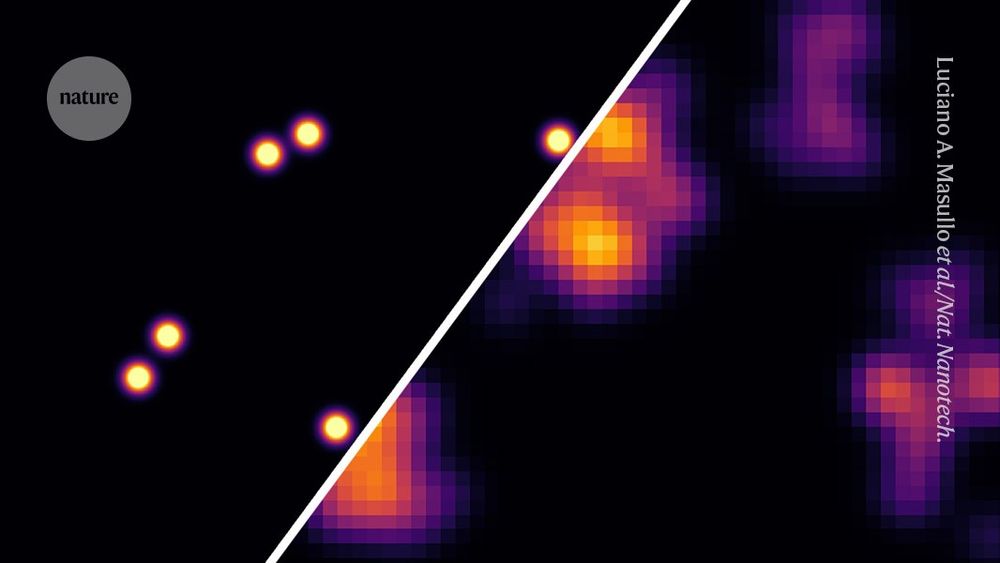
Cell's sugar coating mapped at below-nanometre resolution
Nature - Super-resolution technique works with off-the-shelf optical microscopes.
go.nature.com
August 3, 2025 at 8:59 AM
Scientists have mapped individual sugar molecules on the surface of cells at a resolution once thought to be impossible for light microscopes
go.nature.com/40I9Ewv
go.nature.com/40I9Ewv
Reposted by Yutong Zhang
Scientists have mapped individual sugar molecules on the surface of cells at a resolution once thought to be impossible for light microscopes
go.nature.com/4l2wVjS
go.nature.com/4l2wVjS
Cell's sugar coating mapped at below-nanometre resolution
Super-resolution technique works with off-the-shelf optical microscopes.
go.nature.com
July 30, 2025 at 7:57 AM
Scientists have mapped individual sugar molecules on the surface of cells at a resolution once thought to be impossible for light microscopes
go.nature.com/4l2wVjS
go.nature.com/4l2wVjS
Reposted by Yutong Zhang

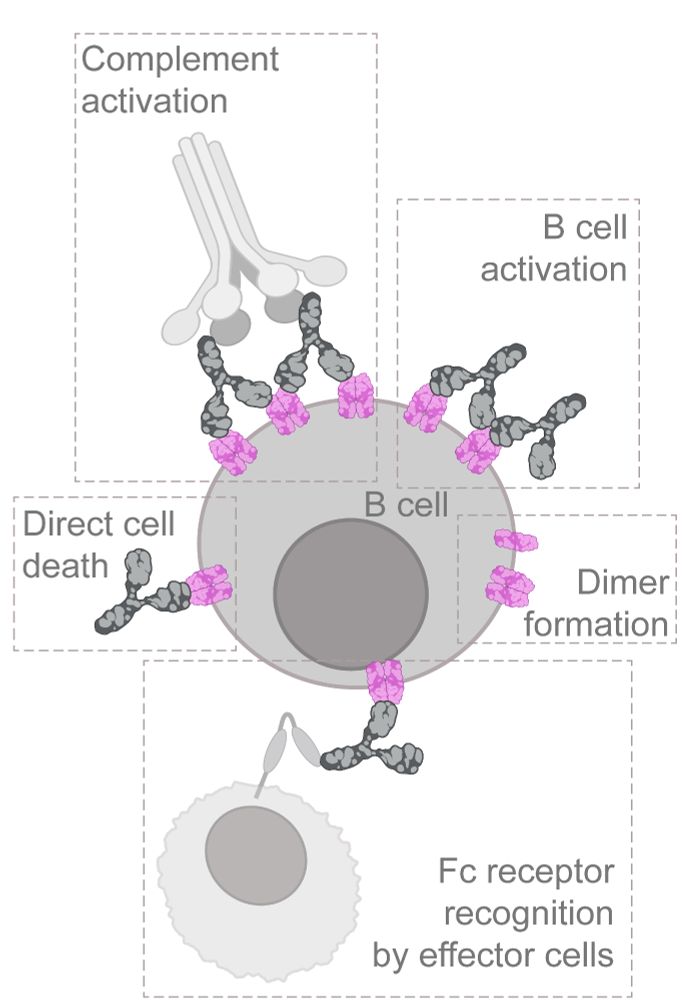
Ever wondered what happens when therapeutic antibodies bind to cancer cells? In our latest study, we used multiplexed 3D-RESI to directly visualize how anti-CD20 antibodies interact with their receptors, revealing their precise arrangement at single-protein resolution. (1/6)
July 28, 2025 at 8:36 AM
Ever wondered what happens when therapeutic antibodies bind to cancer cells? In our latest study, we used multiplexed 3D-RESI to directly visualize how anti-CD20 antibodies interact with their receptors, revealing their precise arrangement at single-protein resolution. (1/6)
Reposted by Yutong Zhang

New paper online:
Ångström-resolution imaging of cell-surface glycans.
The molecular organization of sugars in the native #glycocalyx has been resolved at 9 ångström using bioorthogonal metabolic labeling and #superresolution imaging of DNA barcodes.
#Glycotime
www.nature.com/articles/s41...
Ångström-resolution imaging of cell-surface glycans.
The molecular organization of sugars in the native #glycocalyx has been resolved at 9 ångström using bioorthogonal metabolic labeling and #superresolution imaging of DNA barcodes.
#Glycotime
www.nature.com/articles/s41...
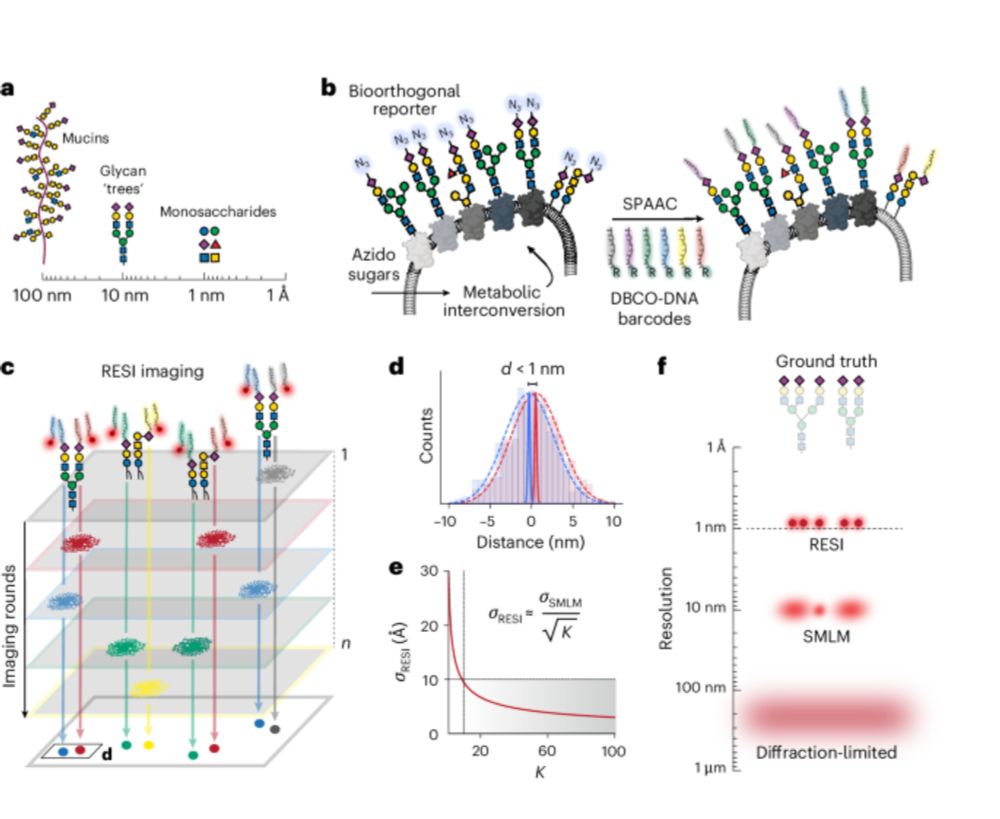
Ångström-resolution imaging of cell-surface glycans - Nature Nanotechnology
By combining bioorthogonal metabolic labelling and resolution enhancement through sequential imaging of DNA barcodes, the molecular organization of individual sugars in the native glycocalyx has been ...
www.nature.com
July 28, 2025 at 9:44 AM
New paper online:
Ångström-resolution imaging of cell-surface glycans.
The molecular organization of sugars in the native #glycocalyx has been resolved at 9 ångström using bioorthogonal metabolic labeling and #superresolution imaging of DNA barcodes.
#Glycotime
www.nature.com/articles/s41...
Ångström-resolution imaging of cell-surface glycans.
The molecular organization of sugars in the native #glycocalyx has been resolved at 9 ångström using bioorthogonal metabolic labeling and #superresolution imaging of DNA barcodes.
#Glycotime
www.nature.com/articles/s41...