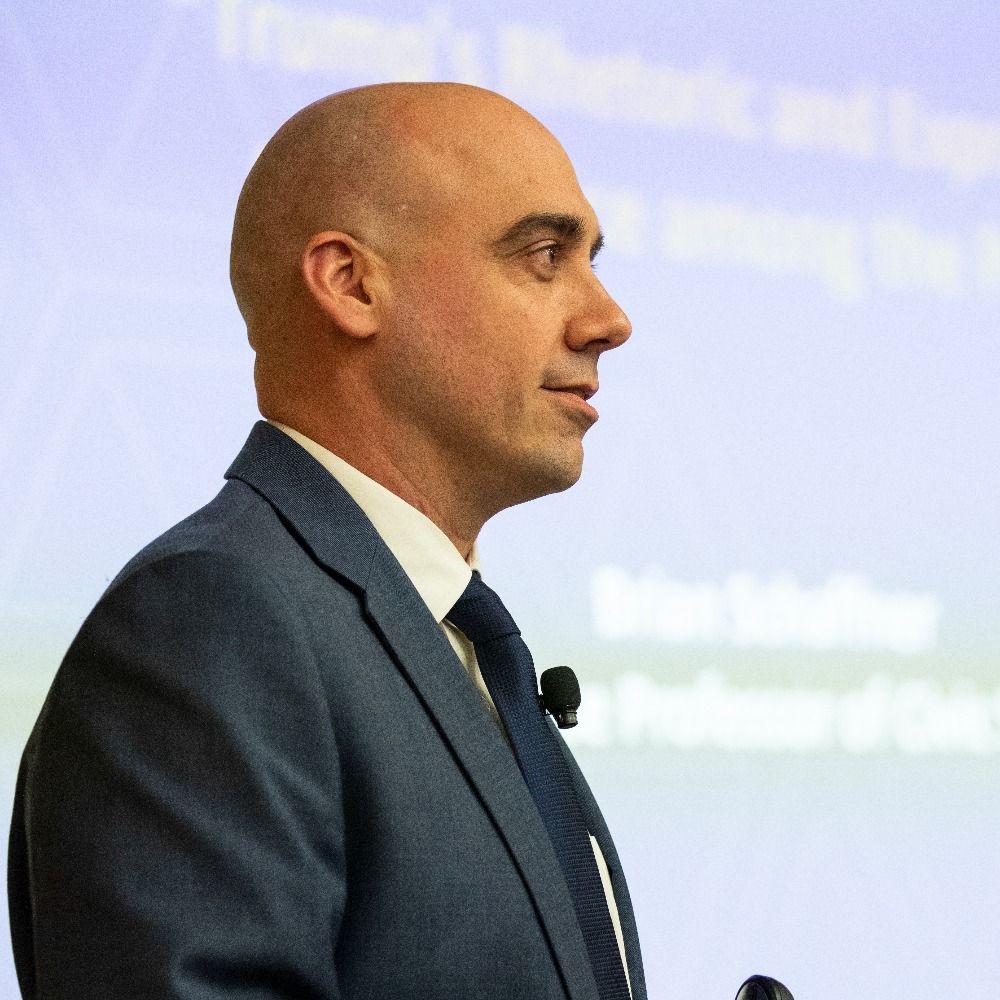
Brian Schaffner
bfschaffner.bsky.social
Brian Schaffner
@bfschaffner.bsky.social

Political scientist ~ Newhouse Professor of Civic Studies at Tufts ~ CES Whisperer ~ #COYS #GoDawgs

Brian Frederick Schaffner is an American political scientist. He is the Newhouse Professor of Civic studies at Tufts University and a faculty associate at Harvard University's Institute for Quantitative Social Science. He is also the founding director of the UMass Poll and a co-principal investigator for the Cooperative Congressional Election Study (CCES), a survey of about 50,000 U.S. voters. He has criticized President Donald Trump for citing a 2014 study based on data from the CCES as proof that voter fraud is widespread in the United States. Of this study, Schaffner told CNN that "Of the people who we were sure were non-citizens, we could not find any who actually cast a vote." He has also said that the authors of the study Trump cited, Jesse Richman and David Earnest, used inaccurate methodology to conclude that millions of non-citizens voted in U.S. elections. He told MassLive.com in January 2017 that "I have been very vocal in speaking out about the study, especially because I feel a sense of responsibility". .. more

Political science 61%
Sociology 13%
Pinned
🚨🚨🚨 The Cooperative Election Study's 2024 vote validation data is now available!
Microdata: doi.org/10.7910/DVN/...

Or easy interactive analysis of the data on...
vote choice: cooperativeelectionstudy.shinyapps.io/VoteTrends/
demographics of voters: cooperativeelectionstudy.shinyapps.io/votercomp/
doi.org

Reposted by Brian Schaffner

Reposted by Brian Schaffner

Most Americans don’t see compromise as central to good citizenship.

Our election survey data reveal some surprising findings.

The latest from @bfschaffner.bsky.social, see the data here: goodauthority.org/news/most-am...
Most Americans don’t see compromise as central to good citizenship
Most Americans don’t see compromise as central to good citizenship. Our election survey data reveal some surprising findings.
goodauthority.org

in 2024, Trump improved most on his vote share in counties that saw the smallest numbers of people moving there. the newest @TuftsUniversity Public Opinion Lab blog post from Toby Winick. tufts-pol.medium.com/trumps-suppo...
Trump’s support increased the most in counties with the fewest transplants
by Toby Winick (class of 2026)
tufts-pol.medium.com

Reposted by Samuel Workman

there are a lot of things that Americans think are important for being a good citizen, engaging in compromise is not one of them ... my latest post with @goodauth.bsky.social
goodauthority.org/news/most-am...

I have a new paper. We look at ~all stats articles in political science post-2010 & show that 94% have abstracts that claim to reject a null. Only 2% present only null results. This is hard to explain unless the research process has a filter that only lets rejections through.

it is actually a question to respondents, though I think YouGov grabs the meta data and it lines up closely with how people respond to this item. the question is available in public releases, variable name is comptype, I believe. curious to see what you find!

in a new Tufts Public Opinion Lab post, Seona Maskara (class of '26) shows that LGBTQ liberals are more supportive of Gaza than other liberals tufts-pol.medium.com/queers-for-p...
“Queers for Palestine”: Ironic, or a representation of Queer Theory in action?
by Seona Maskara (class of 2026)
tufts-pol.medium.com

Reposted by Brian Schaffner

Reposted by Brian Schaffner

Reposted by Brian Schaffner

📝Inattentive respondents are a growing concern in online surveys.

➡S Blatte & @bfschaffner.bsky.social that 4 to 6% of respondents pass attention checks yet remain inattentive, biasing public opinion estimates for small subgroups www.cambridge.org/core/journal... #FirstView

Reposted by Brian Schaffner

Very interesting new study using CES data from Scott Platte and @bfschaffner.bsky.social new in @psrm.bsky.social

www.cambridge.org/core/journal...

tldr: the fairly low rate of inattentiveness is unlikely to affect estimates with the full sample or large subgroups, but may bias estimates for smaller subgroups.

this was Scott's pet project & everyone on the CES team is grateful to him for helping us learn more about inattentiveness in the CES!

we also tested an experimental intervention where we flagged respondents' contradictory responses to one set of items, but that intervention did not produce more attentiveness on subsequent items in the survey compared to the control group

it is important to note that the inattentiveness we document occurs in the final sample provided by @today.yougov.com, after they have applied their own extensive quality control checks. these rates are much higher in raw samples obtained from lower quality vendors

while these low rates of inattentiveness are ignorable for analyses using the full sample, inattentive respondents tend to become a bigger share of small subgroups and can affect those subgroup estimates more.

respondents who were consistently inattentive moved through the survey much quicker, were more likely to straight-line and take the survey on a mobile device and less likely to answer the post-election wave and be validated voters

we utilize two pairs of items for which it would be logically inconsistent to indicate support for both items. about 5% of respondents gave logically inconsistent responses to these items and just 2% gave inconsistent responses on both sets of items

Reposted by Nazita Lajevardi

i have a new article out in @psrm.bsky.social with Scott Blatte exploring respondent attentiveness in the Cooperative Election Study. we find fairly low rates of inattentiveness but our intervention failed to nudge respondents to pay more attention (thread)
www.cambridge.org/core/journal...
Surviving the screens: the problem of hidden inattentive respondents in online surveys | Political Science Research and Methods | Cambridge Core
Surviving the screens: the problem of hidden inattentive respondents in online surveys
www.cambridge.org

Reposted by Brian Schaffner