



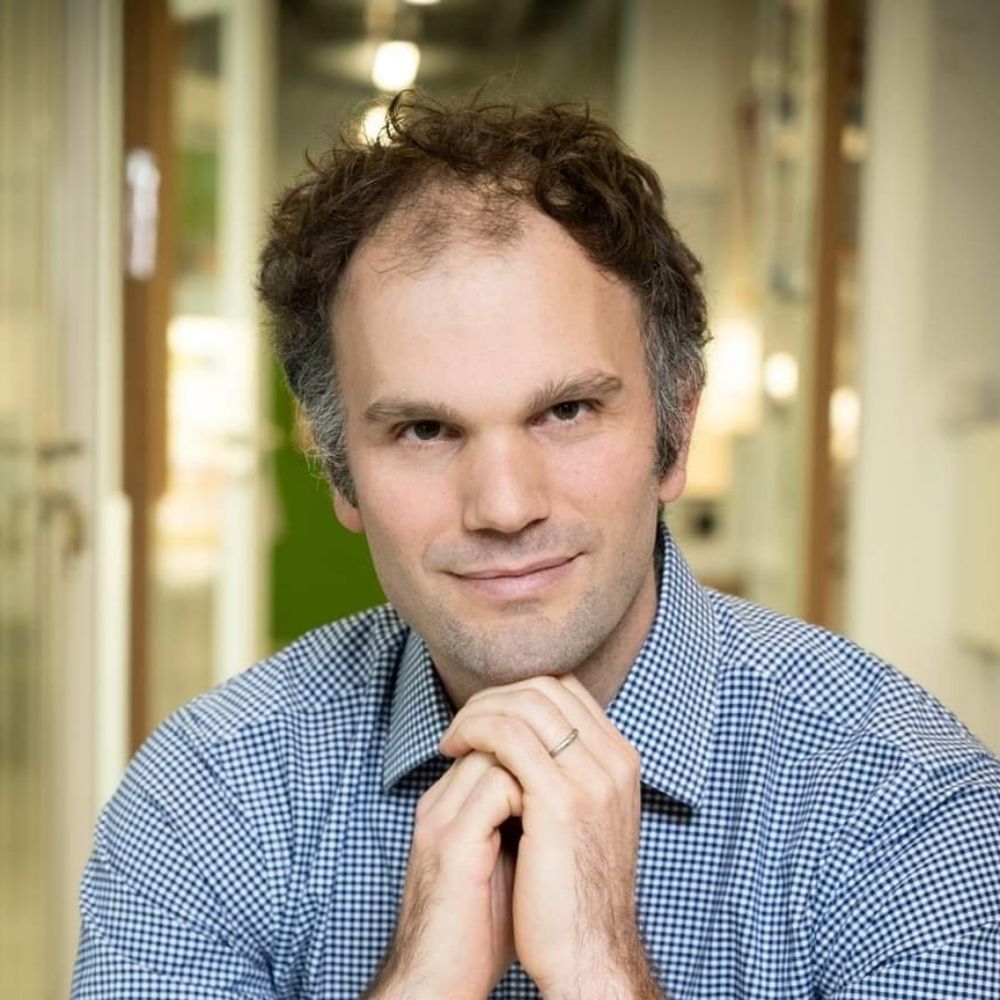
David Bikard
@dbikard.bsky.social
Bacterial Immunity and Synthetic Biology enthusiast. Head of Lab at Institut Pasteur. Co-Founder of Eligo Bioscience.
Join us at the 2026 GRC Microbial Stress Response to be held on July 19th-24th at Mount Holyoke College!! Here is the link for more information: www.grc.org/microbial-st...
2026 Microbial Stress Response Conference GRC
The 2026 Gordon Research Conference on Microbial Stress Response will be held in South Hadley, Massachusetts. Apply today to reserve your spot.
www.grc.org
February 3, 2026 at 11:20 AM
Join us at the 2026 GRC Microbial Stress Response to be held on July 19th-24th at Mount Holyoke College!! Here is the link for more information: www.grc.org/microbial-st...
🚨 Hiring Alert! 🚨My lab at Institut Pasteur is recruiting several Postdocs! We have exciting open projects in: 🦠 Synthetic Biology and🛡️ Bacterial Immunity. Come do great science with us in the middle of Paris! 🇫🇷🥐 research.pasteur.fr/en/job/postd...
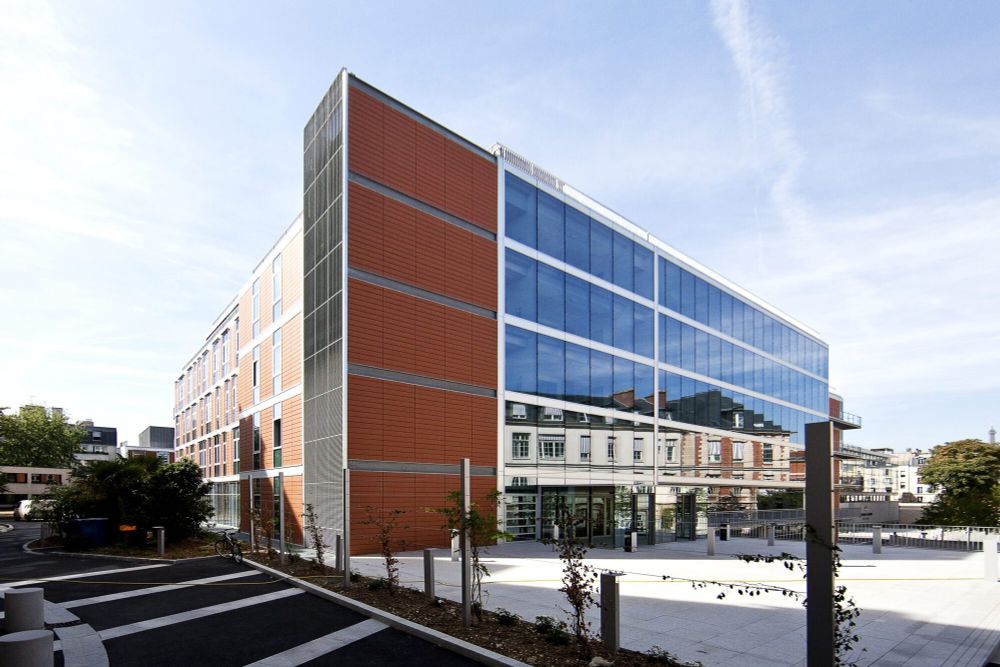
Postdoctoral position - Synthetic Biology / Bacterial Immunity - Research
The Bikard lab at Institut Pasteur in Paris is seeking to hire postdoctoral researchers. We are investigating bacteria / bacteriophages interactions, and the genetic innovation that happens at this in...
research.pasteur.fr
January 28, 2026 at 11:19 AM
🚨 Hiring Alert! 🚨My lab at Institut Pasteur is recruiting several Postdocs! We have exciting open projects in: 🦠 Synthetic Biology and🛡️ Bacterial Immunity. Come do great science with us in the middle of Paris! 🇫🇷🥐 research.pasteur.fr/en/job/postd...
Deadline is approaching (Feb 9) to apply for a PI position at Institut Pasteur. Come join us and contribute to an amazing scientific environment!!!

January 19, 2026 at 4:55 PM
Deadline is approaching (Feb 9) to apply for a PI position at Institut Pasteur. Come join us and contribute to an amazing scientific environment!!!
Reposted by David Bikard
I’m thrilled to share our work on phage triggers of the bacterial immune system in its final form @natmicrobiol.nature.com www.nature.com/articles/s41...

A phage protein screen identifies triggers of the bacterial innate immune system - Nature Microbiology
A library of 400 phage protein-coding genes is used to find a trove of antiphage systems, revealing systems that target tail fibre and major capsid proteins.
www.nature.com
January 18, 2026 at 10:45 PM
I’m thrilled to share our work on phage triggers of the bacterial immune system in its final form @natmicrobiol.nature.com www.nature.com/articles/s41...
It was a true privilege to co-chair the inaugural GRC meeting on Microbiome Editing together with @jenniferdoudna.bsky.social . The positive energy and quality of the Science presented were truly inspiring. I look forward to the next one chaired by KC Huang and @omalleylab.bsky.social !!!

January 19, 2026 at 1:53 PM
It was a true privilege to co-chair the inaugural GRC meeting on Microbiome Editing together with @jenniferdoudna.bsky.social . The positive energy and quality of the Science presented were truly inspiring. I look forward to the next one chaired by KC Huang and @omalleylab.bsky.social !!!
Reposted by David Bikard

🦠🧫 Envie d'en savoir plus sur la Microbiologie et de découvrir l'Institut Pasteur ?
Rejoignez nous pour conférence scientifique grand public, accompagnée d’une performance artistique le 27 janvier à 18h! Inscrivez-vous :)
research.pasteur.fr/fr/event/con...
Rejoignez nous pour conférence scientifique grand public, accompagnée d’une performance artistique le 27 janvier à 18h! Inscrivez-vous :)
research.pasteur.fr/fr/event/con...

Conférence Scientifique Grand Public & Performance Artistique - "Virus contre bactéries : Une solution pour vaincre la résistance aux antibiotiques ?" - Pascale Cossart & Fabrice Hyber - Research
L’Institut Pasteur vous ouvre ses portes et vous invite à une conférence scientifique pour le grand public, accompagnée d’une performance artistique ! Pascale Cossart parlera de virus et de bactéries,...
research.pasteur.fr
January 19, 2026 at 12:28 PM
🦠🧫 Envie d'en savoir plus sur la Microbiologie et de découvrir l'Institut Pasteur ?
Rejoignez nous pour conférence scientifique grand public, accompagnée d’une performance artistique le 27 janvier à 18h! Inscrivez-vous :)
research.pasteur.fr/fr/event/con...
Rejoignez nous pour conférence scientifique grand public, accompagnée d’une performance artistique le 27 janvier à 18h! Inscrivez-vous :)
research.pasteur.fr/fr/event/con...
Reposted by David Bikard
This is shaping up to be one of the top conferences on microbiome editing!!

We're excited to help launch the inaugural Gordon research conference on #microbiome editing, coming up in January in Pomona, CA! Learn more and register here: https://ow.ly/a6Am50X9XkE

January 13, 2026 at 11:45 PM
This is shaping up to be one of the top conferences on microbiome editing!!
Reposted by David Bikard
Such a privilege to share the Phage Foundry (phagefoundry.org) team’s work at the inaugural GRC meeting on Microbiome Editing 🎉🎊.

January 13, 2026 at 11:56 PM
Such a privilege to share the Phage Foundry (phagefoundry.org) team’s work at the inaugural GRC meeting on Microbiome Editing 🎉🎊.
Reposted by David Bikard

@francoisrousset.bsky.social, chercheur en microbiologie au @ciri-lyon.bsky.social est lauréat du Prix Paoletti 2025.
👋 @cnrs-rhoneauvergne.bsky.social
buff.ly/o9MCTni
👋 @cnrs-rhoneauvergne.bsky.social
buff.ly/o9MCTni

Francois Rousset, chercheur en microbiologie | Prix Paoletti 2025
Après une thèse en microbiologie à l’Institut Pasteur sous la direction de David Bikard (2017-2020), François Rousset rejoint en 2021 l’équipe de Rotem Sorek au Weizmann Institute of Science pour son…
www.youtube.com
January 8, 2026 at 2:46 PM
@francoisrousset.bsky.social, chercheur en microbiologie au @ciri-lyon.bsky.social est lauréat du Prix Paoletti 2025.
👋 @cnrs-rhoneauvergne.bsky.social
buff.ly/o9MCTni
👋 @cnrs-rhoneauvergne.bsky.social
buff.ly/o9MCTni
Reposted by David Bikard
Reposted by David Bikard

Microbes weaponizing secondary metabolites to make rivals vulnerable to phage attack 🧪🦠
www.nature.com/articles/s41...
www.nature.com/articles/s41...
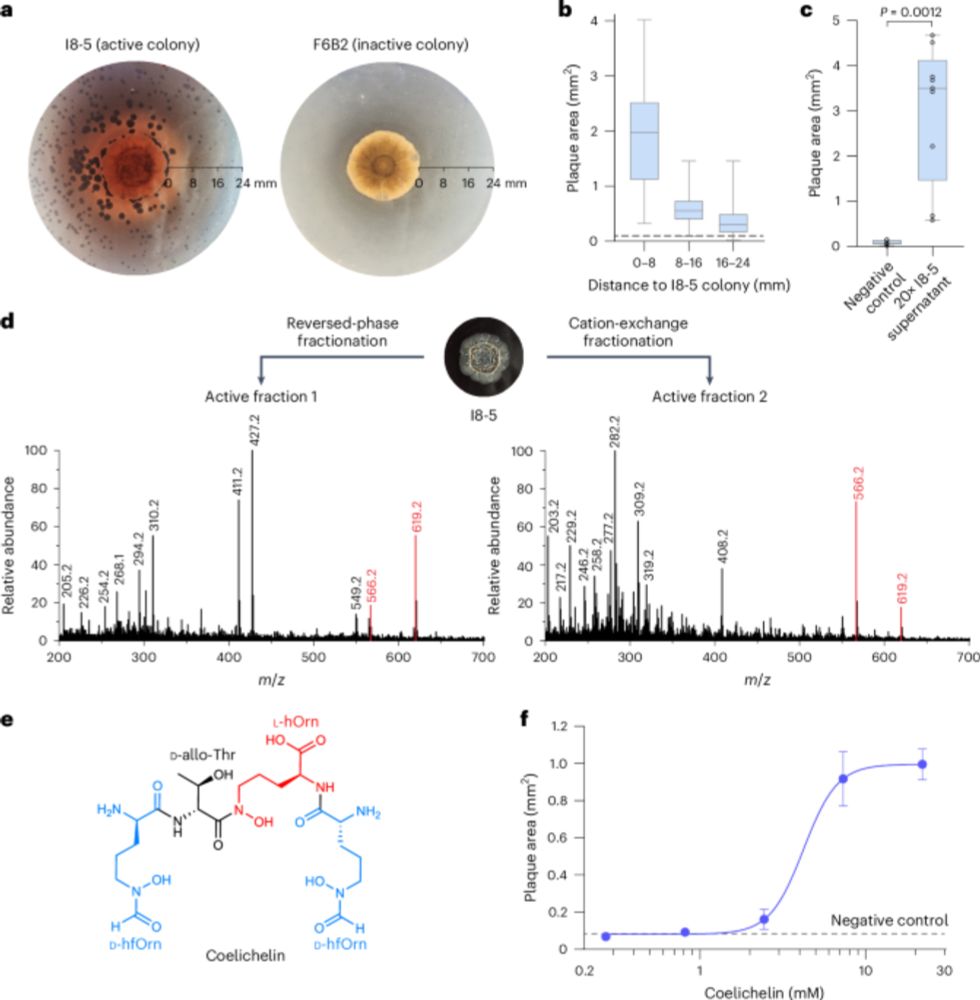
Streptomyces secretes a siderophore that sensitizes competitor bacteria to phage infection - Nature Microbiology
A secondary metabolite sensitizes competitor Bacillus subtilis to a wide panel of lytic phages by sequestering iron and preventing the activation of Spo0A.
www.nature.com
December 19, 2025 at 3:03 PM
Microbes weaponizing secondary metabolites to make rivals vulnerable to phage attack 🧪🦠
www.nature.com/articles/s41...
www.nature.com/articles/s41...
Reposted by David Bikard
Our new paper on DusB’s role in redox metabolism in V. cholerae is now out in @narjournal.bsky.social linking tRNAmodif enzymes and metabolic adaptation.
Beyond RNA modification: a tRNA-modifying enzyme shaping oxidative stress resilience and metabolism in V. cholerae #rnasky #rnabiology
😊🦠💫
Beyond RNA modification: a tRNA-modifying enzyme shaping oxidative stress resilience and metabolism in V. cholerae #rnasky #rnabiology
😊🦠💫

Beyond RNA modification: a novel role for tRNA modifying enzyme in oxidative stress response and metabolism
Abstract. RNA modifications play a fundamental role in regulating essential cellular processes, including translation fidelity and stress adaptation. While
academic.oup.com
December 13, 2025 at 8:57 PM
Our new paper on DusB’s role in redox metabolism in V. cholerae is now out in @narjournal.bsky.social linking tRNAmodif enzymes and metabolic adaptation.
Beyond RNA modification: a tRNA-modifying enzyme shaping oxidative stress resilience and metabolism in V. cholerae #rnasky #rnabiology
😊🦠💫
Beyond RNA modification: a tRNA-modifying enzyme shaping oxidative stress resilience and metabolism in V. cholerae #rnasky #rnabiology
😊🦠💫
Reposted by David Bikard

The EMBO Gold Medal 2025 was awarded to Tanmay Bharat and David Bikard: https://www.embo.org/press-releases/embo-gold-medal-2025-awarded-to-tanmay-bharat-and-david-bikard/ 🧪
At #CellBio2025, the EMBO Gold Medal was handed over to David Bikard in recognition of his pioneering work on #GeneEditing.
At #CellBio2025, the EMBO Gold Medal was handed over to David Bikard in recognition of his pioneering work on #GeneEditing.


December 10, 2025 at 1:40 PM
The EMBO Gold Medal 2025 was awarded to Tanmay Bharat and David Bikard: https://www.embo.org/press-releases/embo-gold-medal-2025-awarded-to-tanmay-bharat-and-david-bikard/ 🧪
At #CellBio2025, the EMBO Gold Medal was handed over to David Bikard in recognition of his pioneering work on #GeneEditing.
At #CellBio2025, the EMBO Gold Medal was handed over to David Bikard in recognition of his pioneering work on #GeneEditing.
Reposted by David Bikard

✨New preprint!
🧵1/4 Excited to share our work on AI-guided design of minimal RNA-guided nucleases. Amazing work by @petrskopintsev.bsky.social @isabelesain.bsky.social @evandeturk.bsky.social et al!
Multi-lab collaboration @banfieldlab.bsky.social @jhdcate.bsky.social @jacobsenucla.bsky.social🧬
🔗👇
🧵1/4 Excited to share our work on AI-guided design of minimal RNA-guided nucleases. Amazing work by @petrskopintsev.bsky.social @isabelesain.bsky.social @evandeturk.bsky.social et al!
Multi-lab collaboration @banfieldlab.bsky.social @jhdcate.bsky.social @jacobsenucla.bsky.social🧬
🔗👇
December 9, 2025 at 7:52 AM
✨New preprint!
🧵1/4 Excited to share our work on AI-guided design of minimal RNA-guided nucleases. Amazing work by @petrskopintsev.bsky.social @isabelesain.bsky.social @evandeturk.bsky.social et al!
Multi-lab collaboration @banfieldlab.bsky.social @jhdcate.bsky.social @jacobsenucla.bsky.social🧬
🔗👇
🧵1/4 Excited to share our work on AI-guided design of minimal RNA-guided nucleases. Amazing work by @petrskopintsev.bsky.social @isabelesain.bsky.social @evandeturk.bsky.social et al!
Multi-lab collaboration @banfieldlab.bsky.social @jhdcate.bsky.social @jacobsenucla.bsky.social🧬
🔗👇
Reposted by David Bikard
🧬🛡️How are new immune mechanisms created?
We show how Lamassu antiphage system, originated from a DNA-repair complex and evolved into a compact and modular immune machine, wt Dinshaw Patel lab in @pnas.org.
👏 @matthieu-haudiquet.bsky.social, Arpita Chakravarti & all authors!
doi.org/10.1073/pnas...
We show how Lamassu antiphage system, originated from a DNA-repair complex and evolved into a compact and modular immune machine, wt Dinshaw Patel lab in @pnas.org.
👏 @matthieu-haudiquet.bsky.social, Arpita Chakravarti & all authors!
doi.org/10.1073/pnas...


November 27, 2025 at 9:35 AM
🧬🛡️How are new immune mechanisms created?
We show how Lamassu antiphage system, originated from a DNA-repair complex and evolved into a compact and modular immune machine, wt Dinshaw Patel lab in @pnas.org.
👏 @matthieu-haudiquet.bsky.social, Arpita Chakravarti & all authors!
doi.org/10.1073/pnas...
We show how Lamassu antiphage system, originated from a DNA-repair complex and evolved into a compact and modular immune machine, wt Dinshaw Patel lab in @pnas.org.
👏 @matthieu-haudiquet.bsky.social, Arpita Chakravarti & all authors!
doi.org/10.1073/pnas...
Reposted by David Bikard

🚀New preprint from our lab!
I am very excited to finally share what has been the main focus of my PhD for the past almost 3 years! It is about viral dark matter and a powerful tool we built to shed light on it. 🧬💡
Continue reading (🧵)
I am very excited to finally share what has been the main focus of my PhD for the past almost 3 years! It is about viral dark matter and a powerful tool we built to shed light on it. 🧬💡
Continue reading (🧵)

November 20, 2025 at 6:52 PM
🚀New preprint from our lab!
I am very excited to finally share what has been the main focus of my PhD for the past almost 3 years! It is about viral dark matter and a powerful tool we built to shed light on it. 🧬💡
Continue reading (🧵)
I am very excited to finally share what has been the main focus of my PhD for the past almost 3 years! It is about viral dark matter and a powerful tool we built to shed light on it. 🧬💡
Continue reading (🧵)
Reposted by David Bikard

🚨Preprint alert - this is a big one! We transfer the revolutionary power of TnSeq to bacteriophages.
Our HIDEN-SEQ links the "dark matter" genes of your favorite phage to any selectable phenotype, guiding the path from fun observations to molecular mechanisms.
A thread 1/8
Our HIDEN-SEQ links the "dark matter" genes of your favorite phage to any selectable phenotype, guiding the path from fun observations to molecular mechanisms.
A thread 1/8

November 20, 2025 at 8:40 PM
🚨Preprint alert - this is a big one! We transfer the revolutionary power of TnSeq to bacteriophages.
Our HIDEN-SEQ links the "dark matter" genes of your favorite phage to any selectable phenotype, guiding the path from fun observations to molecular mechanisms.
A thread 1/8
Our HIDEN-SEQ links the "dark matter" genes of your favorite phage to any selectable phenotype, guiding the path from fun observations to molecular mechanisms.
A thread 1/8
Reposted by David Bikard
#NewResearch
A bile acid-bound structure of toxin TcdB revealed the mechanism of inhibition and guided the design of a synthetic bile acid that alleviated C. difficile infection in mice.
#MicroSky 🦠💊
www.nature.com/articles/s41...
A bile acid-bound structure of toxin TcdB revealed the mechanism of inhibition and guided the design of a synthetic bile acid that alleviated C. difficile infection in mice.
#MicroSky 🦠💊
www.nature.com/articles/s41...

Structure-guided design of a synthetic bile acid that inhibits Clostridioides difficile TcdB toxin - Nature Microbiology
A bile acid-bound structure of toxin TcdB revealed the mechanism of inhibition and guided the design of a synthetic bile acid that alleviated Clostridioides difficile infection in mice.
www.nature.com
November 18, 2025 at 2:07 PM
#NewResearch
A bile acid-bound structure of toxin TcdB revealed the mechanism of inhibition and guided the design of a synthetic bile acid that alleviated C. difficile infection in mice.
#MicroSky 🦠💊
www.nature.com/articles/s41...
A bile acid-bound structure of toxin TcdB revealed the mechanism of inhibition and guided the design of a synthetic bile acid that alleviated C. difficile infection in mice.
#MicroSky 🦠💊
www.nature.com/articles/s41...
Reposted by David Bikard
Our new paper is out in @narjournal.bsky.social We show that natural transformation enables bacteria to shuffle integron cassettes, boosting their phenotypic diversity.
academic.oup.com/nar/article/... 1/5
academic.oup.com/nar/article/... 1/5

Bacterial natural transformation drives cassette shuffling and simplifies recombination in chromosomal integrons
Abstract. Integrons act as biobanks of gene cassettes conferring functions crucial for bacterial defense, including protection against phages and antibioti
academic.oup.com
November 17, 2025 at 3:44 PM
Our new paper is out in @narjournal.bsky.social We show that natural transformation enables bacteria to shuffle integron cassettes, boosting their phenotypic diversity.
academic.oup.com/nar/article/... 1/5
academic.oup.com/nar/article/... 1/5
Reposted by David Bikard
#microsky #phagesky
Predicting host- #phage interactions from genomics.
www.biorxiv.org/content/10.1...
Predicting host- #phage interactions from genomics.
www.biorxiv.org/content/10.1...

Phylogeny-agnostic strain-level prediction of phage-host interactions from genomes
Bacteriophages offer promising alternatives to antibiotics for treating drug-resistant infections and engineering microbiomes, but applications are limited by inability to select phages infecting spec...
www.biorxiv.org
November 16, 2025 at 9:53 AM
#microsky #phagesky
Predicting host- #phage interactions from genomics.
www.biorxiv.org/content/10.1...
Predicting host- #phage interactions from genomics.
www.biorxiv.org/content/10.1...
Don't forget to register for the first Microbiome Editing GRC: www.grc.org/microbiome-e... We have an exciting lineup of speakers!
2026 Microbiome Editing Conference GRC
The 2026 Gordon Research Conference on Microbiome Editing will be held in Pomona, California. Apply today to reserve your spot.
www.grc.org
November 14, 2025 at 8:37 AM
Don't forget to register for the first Microbiome Editing GRC: www.grc.org/microbiome-e... We have an exciting lineup of speakers!
Reposted by David Bikard
We are hiring PhD & Postdocs in this space so please reach out if interested. Also check out the Gordon Research Conference on Microbiome Editing in Jan 11-16, 2026.
www.grc.org/microbiome-e...
www.grc.org/microbiome-e...
2026 Microbiome Editing Conference GRC
The 2026 Gordon Research Conference on Microbiome Editing will be held in Pomona, California. Apply today to reserve your spot.
www.grc.org
November 13, 2025 at 8:53 PM
We are hiring PhD & Postdocs in this space so please reach out if interested. Also check out the Gordon Research Conference on Microbiome Editing in Jan 11-16, 2026.
www.grc.org/microbiome-e...
www.grc.org/microbiome-e...
Reposted by David Bikard

Our nuclease-protease story is out! We explored a fascinating case of coevolution and modularity in prokaryotic immune systems: www.science.org/doi/10.1126/...
Thanks to wonderful coauthors/collaborators/friends, the whole @doudna-lab.bsky.social and everyone at @innovativegenomics.bsky.social
Thanks to wonderful coauthors/collaborators/friends, the whole @doudna-lab.bsky.social and everyone at @innovativegenomics.bsky.social

Recurrent acquisition of nuclease-protease pairs in antiviral immunity
Antiviral immune systems diversify by integrating new genes into existing pathways, creating new mechanisms of viral resistance. We identified genes encoding a predicted nuclease paired with a trypsin...
www.science.org
November 13, 2025 at 10:15 PM
Our nuclease-protease story is out! We explored a fascinating case of coevolution and modularity in prokaryotic immune systems: www.science.org/doi/10.1126/...
Thanks to wonderful coauthors/collaborators/friends, the whole @doudna-lab.bsky.social and everyone at @innovativegenomics.bsky.social
Thanks to wonderful coauthors/collaborators/friends, the whole @doudna-lab.bsky.social and everyone at @innovativegenomics.bsky.social
Reposted by David Bikard
Assembly, architecture and functional roles of microbial surface layers
Review article published in @natrevmicro.nature.com with @bupbuse.bsky.social, Andriko von Kügelgen and @vikramalva.bsky.social.
S-layers are everywhere!
www.nature.com/articles/s41...
Review article published in @natrevmicro.nature.com with @bupbuse.bsky.social, Andriko von Kügelgen and @vikramalva.bsky.social.
S-layers are everywhere!
www.nature.com/articles/s41...

Assembly, architecture and functional roles of microbial surface layers - Nature Reviews Microbiology
Surface layers (S-layers) are ubiquitous protein assemblies that coat prokaryotic cells, with their functional roles increasingly coming into focus. In this Review, Isbilir and colleagues discuss rece...
www.nature.com
November 13, 2025 at 8:14 PM
Assembly, architecture and functional roles of microbial surface layers
Review article published in @natrevmicro.nature.com with @bupbuse.bsky.social, Andriko von Kügelgen and @vikramalva.bsky.social.
S-layers are everywhere!
www.nature.com/articles/s41...
Review article published in @natrevmicro.nature.com with @bupbuse.bsky.social, Andriko von Kügelgen and @vikramalva.bsky.social.
S-layers are everywhere!
www.nature.com/articles/s41...
Reposted by David Bikard
also, an excellent perspective by @dbikard.bsky.social summarizing the work! 🙏
www.science.org/doi/10.1126/...
www.science.org/doi/10.1126/...

Programmable DNA insertion in native gut bacteria
A gene-editing approach enables modification of bacteria within the mouse gut
www.science.org
November 13, 2025 at 9:39 PM
also, an excellent perspective by @dbikard.bsky.social summarizing the work! 🙏
www.science.org/doi/10.1126/...
www.science.org/doi/10.1126/...