


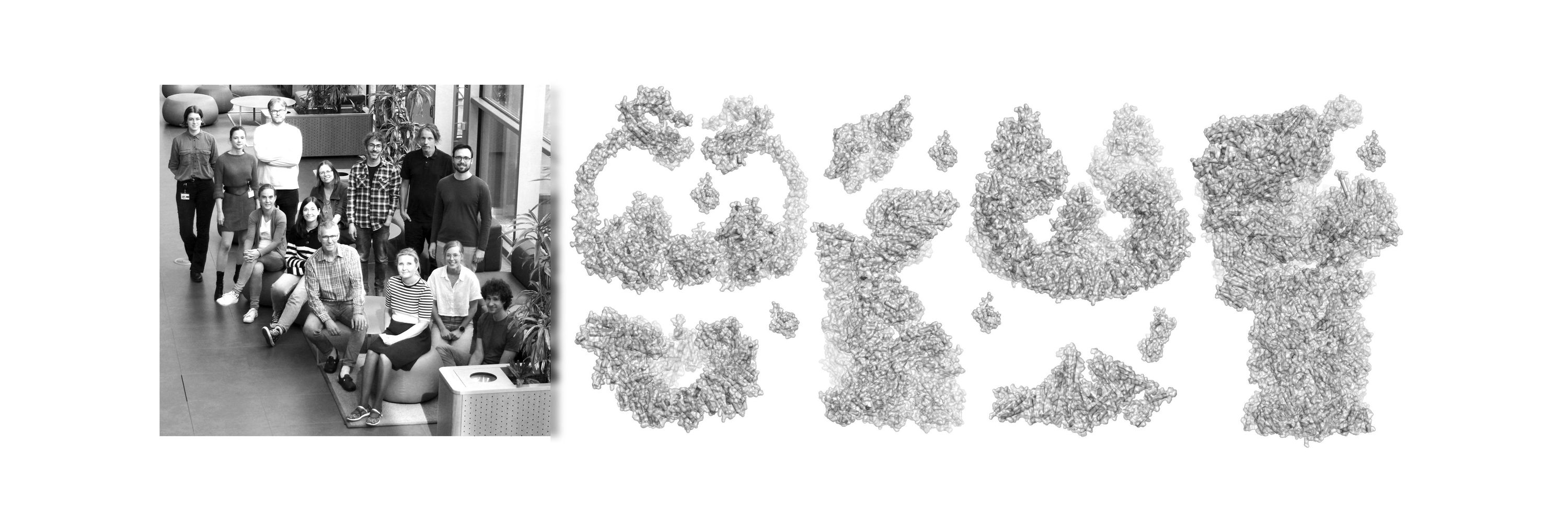
Clausen Lab
@clausenlab.bsky.social
Molecular machines, Proteostasis, Ubiquitin Signaling, Cell Autonomous Defense, Protein Disorders and Team Nematode
@IMP Vienna
www.imp.ac.at/groups/tim-clausen/
@IMP Vienna
www.imp.ac.at/groups/tim-clausen/
Reposted by Clausen Lab
Polymerization-inducing chimeras (PINCHs) are a novel bifunctional modality that sequesters target homodimers in a polymeric state, thereby inhibiting their function
www.nature.com/articles/s41...
www.nature.com/articles/s41...

A pharmacological modality to sequester homomeric proteins - Nature Chemical Biology
Polymerization-inducing chimeras are a novel bifunctional modality that uses protein symmetry to sequester targets by forming insoluble supramolecular assemblies. This approach overcomes reliance on a...
www.nature.com
February 17, 2026 at 7:59 PM
Polymerization-inducing chimeras (PINCHs) are a novel bifunctional modality that sequesters target homodimers in a polymeric state, thereby inhibiting their function
www.nature.com/articles/s41...
www.nature.com/articles/s41...
Reposted by Clausen Lab
Happy to share our newest preprint on Parkin missense variants in work led by Erna Sol &
@vvouts.bsky.social in @rhp-lab.bsky.social
Using a multiplexed assay we determined the effects of 9,212 out of 9,300 single amino acid substitutions and nonsense Parkin variants. 1/n
doi.org/10.64898/202...
@vvouts.bsky.social in @rhp-lab.bsky.social
Using a multiplexed assay we determined the effects of 9,212 out of 9,300 single amino acid substitutions and nonsense Parkin variants. 1/n
doi.org/10.64898/202...

February 16, 2026 at 4:53 PM
Happy to share our newest preprint on Parkin missense variants in work led by Erna Sol &
@vvouts.bsky.social in @rhp-lab.bsky.social
Using a multiplexed assay we determined the effects of 9,212 out of 9,300 single amino acid substitutions and nonsense Parkin variants. 1/n
doi.org/10.64898/202...
@vvouts.bsky.social in @rhp-lab.bsky.social
Using a multiplexed assay we determined the effects of 9,212 out of 9,300 single amino acid substitutions and nonsense Parkin variants. 1/n
doi.org/10.64898/202...
Reposted by Clausen Lab

And a new paper from the lab. A follow up to a previous study in which we elucidate the mechanism of the nuclear transport. Read the full story: www.nature.com/articles/s41...
February 11, 2026 at 5:12 PM
And a new paper from the lab. A follow up to a previous study in which we elucidate the mechanism of the nuclear transport. Read the full story: www.nature.com/articles/s41...
Reposted by Clausen Lab

Look at this 🙂 #CryoEM
Structural basis for CTCF-mediated chromatin organization by @lucas.farnunglab.com @voslab.org
www.biorxiv.org/content/10.6...
Structural basis for CTCF-mediated chromatin organization by @lucas.farnunglab.com @voslab.org
www.biorxiv.org/content/10.6...

February 9, 2026 at 8:32 AM
Look at this 🙂 #CryoEM
Structural basis for CTCF-mediated chromatin organization by @lucas.farnunglab.com @voslab.org
www.biorxiv.org/content/10.6...
Structural basis for CTCF-mediated chromatin organization by @lucas.farnunglab.com @voslab.org
www.biorxiv.org/content/10.6...
Reposted by Clausen Lab
Too much data, too little thinking.
A important essay from Ruslan Medzhitov on the importance of understanding data, not just generating it. A must read.
@Yale
www.nature.com/articles/s41...
A important essay from Ruslan Medzhitov on the importance of understanding data, not just generating it. A must read.
@Yale
www.nature.com/articles/s41...

On the balance of knowledge - Nature Reviews Immunology
Ruslan Medzhitov shares his thoughts on the balance between generating data and developing theories in immunology, with a focus on exploring the rules that govern complex systems.
www.nature.com
February 6, 2026 at 2:31 AM
Too much data, too little thinking.
A important essay from Ruslan Medzhitov on the importance of understanding data, not just generating it. A must read.
@Yale
www.nature.com/articles/s41...
A important essay from Ruslan Medzhitov on the importance of understanding data, not just generating it. A must read.
@Yale
www.nature.com/articles/s41...
Reposted by Clausen Lab
A new paper reports a “nucleotide code” that coordinates Lis1-dynein binding stoichiometry, which in turn governs Lis1’s ability to relieve dynein autoinhibition
www.nature.com/articles/s41...
www.nature.com/articles/s41...

A nucleotide code governs Lis1’s ability to relieve dynein autoinhibition - Nature Chemical Biology
A combination of biochemical, cell biological and electron microscopy analyses reveal a ‘nucleotide code’ that coordinates Lis1–dynein binding stoichiometry, which in turn governs Lis1’s ability to re...
www.nature.com
February 5, 2026 at 4:38 PM
A new paper reports a “nucleotide code” that coordinates Lis1-dynein binding stoichiometry, which in turn governs Lis1’s ability to relieve dynein autoinhibition
www.nature.com/articles/s41...
www.nature.com/articles/s41...
Reposted by Clausen Lab

I’m excited to share my first-author paper, with co-first author @rongqinxiaoxiao.bsky.social, now out in @nature.com. We developed a live-cell single-particle tracking platform to see how TRiC & prefoldin engage proteins during co- and post-translational folding. 1/9 www.nature.com/articles/s41...

Single-molecule dynamics of the TRiC chaperonin system in vivo - Nature
Single-particle tracking experiments in intact cells reveal dynamic co- and post-translational interactions of the TRiC–PFD chaperonin complex with client proteins during in vivo protein folding.
www.nature.com
February 5, 2026 at 5:17 PM
I’m excited to share my first-author paper, with co-first author @rongqinxiaoxiao.bsky.social, now out in @nature.com. We developed a live-cell single-particle tracking platform to see how TRiC & prefoldin engage proteins during co- and post-translational folding. 1/9 www.nature.com/articles/s41...
Reposted by Clausen Lab

Nature research paper: PtdIns(3,5)P2 is an endogenous ligand of STING in innate immune signalling
go.nature.com/4klvMp1
go.nature.com/4klvMp1

PtdIns(3,5)P2 is an endogenous ligand of STING in innate immune signalling - Nature
Phosphatidylinositol 3,5-bisphosphate is a ligand of STING and, together with cGAMP, induces STING activation and innate immune responses.
go.nature.com
February 5, 2026 at 8:57 AM
Nature research paper: PtdIns(3,5)P2 is an endogenous ligand of STING in innate immune signalling
go.nature.com/4klvMp1
go.nature.com/4klvMp1
Reposted by Clausen Lab

Our latest cotranslational folding story is now published @cp-molcell.bsky.social. Really cool (I think) new ideas about how exactly the ribosome directs folding and assembly to make sure complicated proteins mature efficiently in cells.
www.cell.com/molecular-ce...
www.cell.com/molecular-ce...

The ribosome synchronizes folding and assembly to promote oligomeric protein biogenesis
Large oligomeric proteins constitute a major fraction of proteomes, but are difficult
to refold in vitro, raising the question of how cells direct their biogenesis. Roeselová
and Shivakumaraswamy et a...
www.cell.com
January 19, 2026 at 5:14 PM
Our latest cotranslational folding story is now published @cp-molcell.bsky.social. Really cool (I think) new ideas about how exactly the ribosome directs folding and assembly to make sure complicated proteins mature efficiently in cells.
www.cell.com/molecular-ce...
www.cell.com/molecular-ce...
Reposted by Clausen Lab
Have a look at our new structure of co translational folding in yeast. This is collaborative work initialized by the Rospert lab from the @uni-freiburg.de. Structural work has been done by the amazing @lgrundmann.bsky.social Stay tuned for the next ribosome paper from him, following very soon.

🧪Scientists from our Haselbach lab captured how proteins begin to fold as they’re being made.
Using cryo-EM, they visualised chaperones guiding nascent proteins on the ribosome: https://www.nature.com/articles/s41467-025-67685-6
Using cryo-EM, they visualised chaperones guiding nascent proteins on the ribosome: https://www.nature.com/articles/s41467-025-67685-6

January 19, 2026 at 11:09 AM
Have a look at our new structure of co translational folding in yeast. This is collaborative work initialized by the Rospert lab from the @uni-freiburg.de. Structural work has been done by the amazing @lgrundmann.bsky.social Stay tuned for the next ribosome paper from him, following very soon.
Reposted by Clausen Lab

New preprint!
Led by @sarahgersing.bsky.social we map how 7,500+ variants in glucokinase (GCK) affect binding to GKRP and disentangle this from stability.
We now have activity, abundance, and interaction scores for 7,128 GCK variants - a resource for understanding phenotypes and glucose homeostasis.
Led by @sarahgersing.bsky.social we map how 7,500+ variants in glucokinase (GCK) affect binding to GKRP and disentangle this from stability.
We now have activity, abundance, and interaction scores for 7,128 GCK variants - a resource for understanding phenotypes and glucose homeostasis.

Mapping the GCK-GKRP interaction landscape using deep mutational scanning by reverse two-hybrid screening https://www.biorxiv.org/content/10.64898/2026.01.15.699699v1
January 16, 2026 at 7:57 AM
New preprint!
Led by @sarahgersing.bsky.social we map how 7,500+ variants in glucokinase (GCK) affect binding to GKRP and disentangle this from stability.
We now have activity, abundance, and interaction scores for 7,128 GCK variants - a resource for understanding phenotypes and glucose homeostasis.
Led by @sarahgersing.bsky.social we map how 7,500+ variants in glucokinase (GCK) affect binding to GKRP and disentangle this from stability.
We now have activity, abundance, and interaction scores for 7,128 GCK variants - a resource for understanding phenotypes and glucose homeostasis.
Reposted by Clausen Lab
With so many great reviews on LDs already out, do we need another?
Sarah @cohenlaboratory.bsky.social and I were approached by
@natrevmcb.nature.com to do a review on LD heterogeneity and inter-organelle contacts...topics in reviews, but not a focus. Fun project!
www.nature.com/articles/s41...
Sarah @cohenlaboratory.bsky.social and I were approached by
@natrevmcb.nature.com to do a review on LD heterogeneity and inter-organelle contacts...topics in reviews, but not a focus. Fun project!
www.nature.com/articles/s41...

Heterogeneity, dynamics and organelle interactions of lipid droplets - Nature Reviews Molecular Cell Biology
Lipid droplets have key roles in energy storage and lipid metabolism. This Review discusses tools used for assessing lipid droplet heterogeneity, and how their heterogeneous composition and interactio...
www.nature.com
January 16, 2026 at 2:18 PM
With so many great reviews on LDs already out, do we need another?
Sarah @cohenlaboratory.bsky.social and I were approached by
@natrevmcb.nature.com to do a review on LD heterogeneity and inter-organelle contacts...topics in reviews, but not a focus. Fun project!
www.nature.com/articles/s41...
Sarah @cohenlaboratory.bsky.social and I were approached by
@natrevmcb.nature.com to do a review on LD heterogeneity and inter-organelle contacts...topics in reviews, but not a focus. Fun project!
www.nature.com/articles/s41...
Reposted by Clausen Lab
"RNAPII clusters reflect local accumulations of transcriptionally engaged polymerases and do not form through higher-order mechanisms such as phase separation"
😬
www.biorxiv.org/content/10.1...
by the @mirlab.bsky.social
😬
www.biorxiv.org/content/10.1...
by the @mirlab.bsky.social

A single cluster of RNA Polymerase II molecules is stably associated with active genes
In eukaryotic nuclei, transcription is associated with the clustering of RNA Polymerase II (RNAPII) molecules. The mechanisms underlying cluster formation, their interactions with genes, and their imp...
www.biorxiv.org
January 15, 2026 at 9:50 AM
"RNAPII clusters reflect local accumulations of transcriptionally engaged polymerases and do not form through higher-order mechanisms such as phase separation"
😬
www.biorxiv.org/content/10.1...
by the @mirlab.bsky.social
😬
www.biorxiv.org/content/10.1...
by the @mirlab.bsky.social
Reposted by Clausen Lab

Hey #portfolioday!
I'm a bloke who used to investigate Genetics before turning into a full-time Artist.
Now I do handmade installations, molecular graffiti, and digital design to convey the beauty of Science.
I'm a bloke who used to investigate Genetics before turning into a full-time Artist.
Now I do handmade installations, molecular graffiti, and digital design to convey the beauty of Science.

January 15, 2026 at 6:34 AM
Hey #portfolioday!
I'm a bloke who used to investigate Genetics before turning into a full-time Artist.
Now I do handmade installations, molecular graffiti, and digital design to convey the beauty of Science.
I'm a bloke who used to investigate Genetics before turning into a full-time Artist.
Now I do handmade installations, molecular graffiti, and digital design to convey the beauty of Science.
a Trp/Phospho/Ub trifecta linking metabolism and degradation - wow 🤩 big congrats to the whole team for this amazing, almost historic study.
New year, new preprint! 🎊
We are excited to share our recent work on #E3 ligase regulation in #metabolism!
www.biorxiv.org/content/10.6...
#ubiquitin #targetedproteindegradation #chemicalbiology
1/6
We are excited to share our recent work on #E3 ligase regulation in #metabolism!
www.biorxiv.org/content/10.6...
#ubiquitin #targetedproteindegradation #chemicalbiology
1/6
A CK2-FBXW11 kinase-E3 ubiquitin ligase cascade is a metabolic sensor regulating Tryptophan 2,3-dioxygenase stability
Small molecules toggling the ubiquitin-proteasome system (UPS) are powerful regulators of protein degradation. Yet, mechanistic knowledge of how endogenous ligands gate UPS decisions remains rudimentary. Here, we define control of UPS access to Tryptophan-2,3-dioxygenase (TDO2), which converts the essential amino acid tryptophan (Trp) to N-formylkynurenine. When Trp concentrations are limiting, TDO2 is degraded to avert tryptophanemia. Using CRISPRi screening and biochemistry, we identify a CK2-FBXW11 kinase-E3 ligase cascade that generates and recognizes tandem TDO2 phosphodegrons when not protected by Trp. Trp binding to an exosite safeguards TDO2 from phosphorylation-dependent ubiquitylation. Effects of Trp analogs on CK2-FBXW11-dependent ubiquitylation indicated that the indole, amino, and carboxylate groups are necessary for substrate shielding. Cryo-EM reveals how these moieties order a region proximal to the phosphodegrons; without Trp, this segment is flexible, enabling phosphorylation-coupled ubiquitylation. Overall, our data uncovered an endogenous small molecule allosterically stabilizing its own metabolizing enzyme through protection from a phosphorylation-ubiquitylation cascade. ### Competing Interest Statement B.A.S. is a member of the scientific advisory boards of Proxygen and Lyterian. The other authors declare no competing interests. Max Planck Society, https://ror.org/01hhn8329 European Union, ERC AdvG, UPSmeetMet, 101098161 to BAS Boehringer Ingelheim Fonds, https://ror.org/00dkye506
www.biorxiv.org
January 13, 2026 at 9:24 PM
a Trp/Phospho/Ub trifecta linking metabolism and degradation - wow 🤩 big congrats to the whole team for this amazing, almost historic study.
Reposted by Clausen Lab
Join us for the #Ubiquitin & Friends Symposium 2026, April 29-30, in Vienna!
Fantastic guest speakers👇 & many slots for talks from abstracts, flash-talks & posters. Lots of opportunities to network. Register now to save your spot!
➡️ www.protein-degradation.org/symposium/
#ubfriends2026
Fantastic guest speakers👇 & many slots for talks from abstracts, flash-talks & posters. Lots of opportunities to network. Register now to save your spot!
➡️ www.protein-degradation.org/symposium/
#ubfriends2026

January 10, 2026 at 12:47 AM
Join us for the #Ubiquitin & Friends Symposium 2026, April 29-30, in Vienna!
Fantastic guest speakers👇 & many slots for talks from abstracts, flash-talks & posters. Lots of opportunities to network. Register now to save your spot!
➡️ www.protein-degradation.org/symposium/
#ubfriends2026
Fantastic guest speakers👇 & many slots for talks from abstracts, flash-talks & posters. Lots of opportunities to network. Register now to save your spot!
➡️ www.protein-degradation.org/symposium/
#ubfriends2026
Reposted by Clausen Lab
Can we design mutations that bias proteins towards desired conformational states?
Today in @science.org, we introduce Conformational Biasing (CB), a simple and scalable computational method that uses contrastive scoring by inverse folding models to identify conformation-biasing mutations.
Today in @science.org, we introduce Conformational Biasing (CB), a simple and scalable computational method that uses contrastive scoring by inverse folding models to identify conformation-biasing mutations.

Computational design of conformation-biasing mutations to alter protein functions
Conformational biasing (CB) is a rapid and streamlined computational method that uses contrastive scoring by inverse folding models to predict protein variants biased toward desired conformational sta...
www.science.org
January 8, 2026 at 7:08 PM
Can we design mutations that bias proteins towards desired conformational states?
Today in @science.org, we introduce Conformational Biasing (CB), a simple and scalable computational method that uses contrastive scoring by inverse folding models to identify conformation-biasing mutations.
Today in @science.org, we introduce Conformational Biasing (CB), a simple and scalable computational method that uses contrastive scoring by inverse folding models to identify conformation-biasing mutations.
Reposted by Clausen Lab

We are thrilled to share our latest work uncovering the mechanistic basis of target-directed microRNA degradation (TDMD). This work was driven by @jakobfarnung.bsky.social and @elenaslo.bsky.social in a fantastic collaboration with Brenda Schulman's lab. tinyurl.com/E3TDMD (1/5)
January 6, 2026 at 3:16 PM
We are thrilled to share our latest work uncovering the mechanistic basis of target-directed microRNA degradation (TDMD). This work was driven by @jakobfarnung.bsky.social and @elenaslo.bsky.social in a fantastic collaboration with Brenda Schulman's lab. tinyurl.com/E3TDMD (1/5)
Reposted by Clausen Lab

This is really cool and important.

Some of the longest-lived organisms on Earth aren’t whales, trees or corals, but microbes buried deep in the earth. This eye-opening essay examines the slowest lives on Earth, asking what such lives mean for how we define life itself @karenlloyd.bsky.social

The discovery of aeonophiles expands our definition of life | Aeon Essays
The discovery of organisms that have been alive for many thousands of years requires a revolution in how we understand life
buff.ly
December 18, 2025 at 4:56 PM
This is really cool and important.
Reposted by Clausen Lab

Writing is thinking - a short but memorable thread.
I've spent all day struggling to write a single page of a popular science article. I bang away at a word processor; give up; start diagramming on paper. Take some notes; draft a few sentences in pen; return to the computer...and very slowly I figure out what I was trying to say in the first place.
December 17, 2025 at 7:37 AM
Writing is thinking - a short but memorable thread.
Reposted by Clausen Lab

The Clavel Group is recruiting a new postdoc for two possible projects dealing with plant-virus interactions and selective autophagy! More (wordy) details below ⬇️🌱🦠

December 16, 2025 at 5:15 PM
The Clavel Group is recruiting a new postdoc for two possible projects dealing with plant-virus interactions and selective autophagy! More (wordy) details below ⬇️🌱🦠
Reposted by Clausen Lab

Vaults. They are cell biology's greatest puzzle! This preprint from Martin Beck's lab shows them docked on ER membranes with a ribosome inside. What on earth is going on there??
#CellBiology #WTFology
www.biorxiv.org/content/10.6...
#CellBiology #WTFology
www.biorxiv.org/content/10.6...

The vault associates with membranes in situ
The eukaryotic vault particle is a giant ribonucleoprotein complex that assembles into an iconic barrel-like cage. Its cellular function has remained elusive despite extensive characterization. Using ...
www.biorxiv.org
December 16, 2025 at 6:35 AM
Vaults. They are cell biology's greatest puzzle! This preprint from Martin Beck's lab shows them docked on ER membranes with a ribosome inside. What on earth is going on there??
#CellBiology #WTFology
www.biorxiv.org/content/10.6...
#CellBiology #WTFology
www.biorxiv.org/content/10.6...
Reposted by Clausen Lab
New work describes our efforts to achieve CRISPR editing of the mitochondrial genome.
www.biorxiv.org/lookup/conte...
www.biorxiv.org/lookup/conte...

Towards CRISPR-based editing of the mitochondrial genome in yeast
Mitochondria, which evolved from symbiotic bacteria, possess their own genomes (mtDNA) and support independent transcription and translation within the organelle. Given the essential role of mtDNA in ...
www.biorxiv.org
December 10, 2025 at 4:18 PM
New work describes our efforts to achieve CRISPR editing of the mitochondrial genome.
www.biorxiv.org/lookup/conte...
www.biorxiv.org/lookup/conte...
Reposted by Clausen Lab

Excited to share our work into ubiquitin E1-E2 specificity mechanisms. CryoEM visualising #ubiquitin transfer,biochemistry,evolution @labhofmann.bsky.social & tissue expression analyses @psarkies.bsky.social Big thanks to the team,reviewers & handling editor @dimitristypas.bsky.social rdcu.be/eTRdR

UBA6 specificity for ubiquitin E2 conjugating enzymes reveals a priority mechanism of BIRC6
Nature Structural & Molecular Biology - Riechmann et al. uncover structural features governing ubiquitin transfer from ubiquitin-activating E1 enzymes UBA1 and UBA6 to specific E2...
rdcu.be
December 9, 2025 at 1:21 PM
Excited to share our work into ubiquitin E1-E2 specificity mechanisms. CryoEM visualising #ubiquitin transfer,biochemistry,evolution @labhofmann.bsky.social & tissue expression analyses @psarkies.bsky.social Big thanks to the team,reviewers & handling editor @dimitristypas.bsky.social rdcu.be/eTRdR
Reposted by Clausen Lab
Für seinen Beitrag zum Verständnis der zellulären Kraftwerke (Mitochondrien) wurde Nikolaus Pfanner in die Accademia Nazionale dei Lincei, die nationale Akademie der Wissenschaften Italiens, aufgenommen. Zudem erhielt er die Walter Neupert-Medaille. ufr.link/auszeichnung-pfanner @cibss.bsky.social

December 2, 2025 at 12:24 PM
Für seinen Beitrag zum Verständnis der zellulären Kraftwerke (Mitochondrien) wurde Nikolaus Pfanner in die Accademia Nazionale dei Lincei, die nationale Akademie der Wissenschaften Italiens, aufgenommen. Zudem erhielt er die Walter Neupert-Medaille. ufr.link/auszeichnung-pfanner @cibss.bsky.social