



daniel campion
@travelhealthdoc.medsky.social
travel medicine│immunology│pasc│emerging infections ☣️│vaccines│mb mph dtm&h│🇮🇪🇪🇺🇩🇪
📷 flic.kr/p/49HUpn
⚕ posts ≠ medical advice
📷 flic.kr/p/49HUpn
⚕ posts ≠ medical advice
Reposted by daniel campion
Can’t decide who this is worse for, the EU or the UK. But the real looser, of course, is European defence. So all of us.
on.ft.com/4pb0xP6
UK talks to join EU defence fund break down
on.ft.com/4pb0xP6
UK talks to join EU defence fund break down

UK talks to join EU defence fund break down
Discussions fail after Britain refuses to pay billions of euros in fees
on.ft.com
November 30, 2025 at 7:03 AM
Can’t decide who this is worse for, the EU or the UK. But the real looser, of course, is European defence. So all of us.
on.ft.com/4pb0xP6
UK talks to join EU defence fund break down
on.ft.com/4pb0xP6
UK talks to join EU defence fund break down
Reposted by daniel campion

#IDTwitter had ~450K tweets & 1.8B impressions (2019-2023)📈. After Musk's takeover, many scientists exited due to toxicity & misinformation📉. Bluesky grows; 70% of surveyed scientists use it now🌤️.##idsky
Joining the X-odus: Contrasting perspectives on whether infection specialists should leave X (formerly Twitter)
Social media is a cultural and communications phenomenon that is an integral part of life in the 2020s. Twitter was founded in 2006 and became a leading social media platform with an active user base of approximately 500 million. The site uses the ‘microblogging’ format, which is a character-limited short form of content posted by users.The site became a popular medium with scientists and physicians to communicate, share ideas, and network [1]. The infectious disease community was strongly represented, with a peak of interest from the wider medical and scientific community, not to mention the public at large, arising from the COVID-19 pandemic. From June 2019 to March 2023, there were nearly 450 000 ‘tweets’ tagged with #IDTwitter (Infectious Diseases Twitter), resulting in an astonishing 1.8 billion impressions (the number of times a post appeared on users’ timelines) [2]. At its height, #IDTwitter included journal clubs [3], recruitment opportunities for jobs and fellowships, robust case discussions, thoughtful educational content, and live conference updates [4].However, in October 2022, Twitter was purchased by technology entrepreneur Elon Musk, who renamed it ‘X’ and implemented a series of changes that have significantly altered the functionality and culture of the platform. These changes, the owner’s erratic behaviour, and the platform’s role in advancing a polarized and partisan agenda have led to mass exit of scientists and clinicians, among others, a phenomenon sometimes dubbed the ‘X-odus’.Whether there is still value in having an active presence on Twitter/X is a topic of contention. Herein, we present opposing views from two infectious disease physicians who have been active on social media regarding the question of whether infection specialists should leave the platform known as ‘X’.No: the case for staying by Dr Neil R.H. StoneDespite these undeniable challenges posed by the changes that have been implemented on the site, I argue that it is incumbent upon scientists and experts to remain engaged with it.1.Conceding space to extremism: By leaving, this creates space for the most extreme voices to perpetuate disinformation and misinformation unchecked. Challenging these narratives is essential, and the very failure to do so has allowed falsehoods to perpetuate and take hold. We find ourselves in an atmosphere of antiscience and a contempt for expertise, in part, because as infection professionals ourselves, we have not done enough to counter it. The answer is to stand up for our perspective rather than to raise the white flag and retreat.2.Avoiding an echo chamber: While debating the most extreme viewpoints is often ineffective and a poor use of time, it can be healthy to understand and be aware of staunch proponents of views that are often diametrically opposed to your own. Retreating to friendly ‘echo chambers’ where everyone around you shares the same views as you can lead to insularity and blinkered thinking. Confirmation bias feels good, but it is not helpful in terms of scientific critique. It has been argued that alternative sites, such as BlueSky, have simply become a ‘left-wing’ mirror image of largely conservative/right-wing X, where views that do not conform to the supposedly left-wing/liberal/progressive orthodoxy dominant on that site are disdained and denigrated [5].3.Volatility of the social media space: Social media sites are relatively new to humanity and are rapidly evolving. They are unpredictable and can change quickly, as evidenced by the rapid transformation from Twitter to X. Given its huge user base and market dominance, X is likely to undergo further changes and perhaps a change in management. ‘Playing the long game’ and staying on the site for this eventuality could pay off.4.Communicating with the public: The majority of Americans now get their news from social media [6], with Twitter/X being one of the major sources. Clearly, social media reaches an audience far wider than the narrow confines of a medical or scientific community. Social media sites, such as Twitter/X, therefore allow for effective science communication with the public at large, who would otherwise receive messaging primarily from antivaccine voices and activists. No other site comes close in terms of size of public audience; newer sites, such as BlueSky, contribute to a tiny proportion of news consumption.5.Access to journalists: Twitter/X remains a prime source of information and networking for media professionals. This can lead to direct quotation or invitation to comment or interview in print or visual media, including the powerful medium of podcasts. Leaving the site risks losing these valuable opportunities for public science communications.6.Access to policymakers: Politicians and senior policymakers across many fields have a strong presence. All 100 U.S. Senators maintain a presence on Twitter/X, allowing for direct engagement with and access to those who can directly influence health and science policy.7.No viable alternatives: Like it or not, there is no alternative that offers anywhere near the engagement of Twitter/X. BlueSky, although receiving a surge of new users fleeing Twitter/X around the time of the 2024 U.S. Presidential election, has failed to capitalize on this, and engagement remains a tiny fraction of that of Twitter/X [5].Twitter/X is clearly imperfect, now more than ever. However, it remains the dominant social media platform and an essential part of the media landscape. Opinions are formed by its content, including those expressed in mass media and in key policy-making positions. Scientists and doctors leaving the site will be – and are being – replaced by pseudoscientists and charlatans with fringe, unproven views. Conceding the world’s largest microblogging site to these antiscientific voices will only lead to the further spread of disinformation, misinformation, and poorly informed damaging health policy.Staying the course needs a thick skin, but ultimately, science and reason can still shine, even in the most hostile environment.Yes: the case for leaving by Dr Ilan S. SchwartzThere is an understandable temptation to wistfully return to one’s former stomping grounds, where meaningful and productive conversations once took place and relationships flourished, even after new ownership has transformed the joint into something ugly, even unrecognizable. However, I argue that remaining on Twitter/X is counterproductive for the infectious diseases community, which wishes for a social media platform that allows them to cordially engage with one another outside audiences, share science, and increase their visibility within our profession.Since purchasing Twitter and rebranding it ‘X’, Elon Musk has repeatedly implemented changes that have made the platform a more toxic and intolerable place [7,8]. He doctored the algorithm to determine which posts are visible to whom, inundating users with content that is irrelevant or unwelcome, including misinformation, polarizing political content, and bigotry against minoritized groups. He disbanded the workforce responsible for content moderation and safety, while welcoming back accounts exiled for misinformation and hateful conduct [9]. He scrapped a system of authenticating notable accounts, replacing it with a scheme granting any paying user the blue check that previously denoted legitimacy, irrespective of whether they are bots (automated or semiautomated accounts that can be deployed en masse to sway public opinion) or trolls (rage-baiting online provocateurs), or actual people. He disabled a safety feature that allowed users to block harassers from viewing their posts [10]. By monetizing user engagement, he added direct financial incentivization for provoking outrage [11]. The net effects of these changes included the accelerated growth of antiscience misinformation and hostility towards infection professionals (among many others). He embedded into the site a large language model-powered chatbot called Grok to engage with users and train off their data, periodically tinkering with its settings to increase output of extremist propaganda (like answering unrelated queries with talking points about ‘White genocide’) and blatant fascism (like espousing Nazi ideology while dubbing itself ‘MechaHitler‘) [12].These and other changes to Twitter/X led many academics and clinicians to leave the platform in waves that began soon after the takeover. However, some optimistic holdouts, undeterred by Twitter/X’s worsening functionality and toxicity, finally abandoned the site following the cruel and consequential foray of its owner into U.S. and global politics. For many, Musk’s financing of Donald Trump’s Presidential campaign and his use of Twitter/X as a bullhorn, not just for Trump’s return to the White House but also for far-right parties around the world [13], hastened their exits. For others, the final straw was Musk’s cruel and gleeful destruction of the United States Agency for International Development, a government agency that oversaw foreign aid, including programmes to prevent and control infectious diseases in resource-poor settings [14].If all that were not enough, the fact is that science communication on Twitter/X is now ineffectual [15]. Posts with links outside the platform (e.g. to journals or public health websites) are suppressed in the algorithm. Posts from nonpaying users are deamplified and drowned out by boosted, paying accounts. Moreover, the algorithm is biased against apolitical posts, favouring partisan accounts, especially those aligned with the political stance of the site’s owner [16]. Some scientists report that the post-Musk era has been associated with levels of engagement with their posts, which have plummeted by 90% or more [17].Whereas Twitter/X once had a near monopoly as the preferred platform for academics and clinicians, this is no longer the case. Several viable alternatives now exist among social media sites, most notably Bluesky, a decentralized platform created by Twitter’s brain trust, which spun off independently when Musk acquired Twitter. The Bluesky timeline has a look and feel reminiscent of Twitter/X, but with several notable enhancements. First, user safety is prioritized, and abusive accounts can be easily blocked; in fact, users can subscribe to specific curated block lists, which block abusive or spam accounts en masse. Second, users can curate customized timelines, termed ‘feeds’, which can compartmentalize content according to one’s interests. For instance, one can follow an ‘IDSky’ (infectious diseases on Bluesky) feed that shows just posts that include this term, a feed comprised posts from followed accounts sharing academic articles, or – should the need arise – a feed comprised entirely of photos of corgis. Third, the ability to create account ‘starter packs’ of curated user lists can facilitate reconnection with one’s professional or social networks. More than a dozen IDSky starter packs exist [18], each with 150 accounts, to help rebuild connections lost during the mass migration.In addition to Bluesky, many former Twitter/X users have found functionality in LinkedIn, which has matured since its earlier days, where it was primarily the domain of job seekers and recruiters, or in Threads, a microblogging site from Meta (the corporation behind Facebook).The medical and scientific communities have already voted with their feet [19]. A Nature poll of nearly 6000 readers (85% of whom identified as working scientists) found that more than half of respondents were former users of Twitter/X who have abandoned the platform. Seventy percent of respondents reported current use of Bluesky [20].Although contemporaneous comparative analyses of platforms are limited due to shielding of Twitter/X user data since Musk’s takeover, there are reasons to think that Bluesky is significantly outperforming Twitter/X for academic engagement. Bluesky posts discussing research were found to be more original and spurred more robust engagement than had previously been reported for Twitter/X [21]. In fact, despite the relatively diminutive size of its user base (reportedly a tenth the size of Twitter/X), Bluesky already drives more web traffic for many journals [22], and Altmetric (which tracks online discussion of academic articles) reported that as of March 2025, on most days, journal articles were shared more on Bluesky than on Twitter/X [23].Finally, the argument that users should remain on Twitter/X to hold back the incessant tide of extremism and misinformation is naïve and misguided: it fundamentally misunderstands (or ignores) how algorithmic bias stacks the deck against such an approach. The algorithm prioritizes content that garners more engagement, irrespective of the sentiment elicited. By design, posts that are polarizing and inflammatory are boosted over those that are measured and reasoned. There is nothing valiant about remaining on a toxic platform to endure abuse and to shout into the void, all while bad faith actors spew misinformation and hatred with impunity.In summary, there is no longer either reason or justification for infectious disease professionals or organizations to remain on Twitter/X. Doing so is not just clinging to the nostalgia of what the site once was, but it also provides tacit approval for what it has become. While social media can still hold significant value for infection specialists, it is no longer to be found on Twitter/X.ConclusionSocial media is a fact of life in the modern world. The ‘information age’ has undoubtedly brought both benefits and challenges to humanity, and the field of infectious diseases is no different. Given the especially high public awareness of infectious diseases since the onset of the COVID-19 pandemic, and the fractious discourse around vaccine policy globally (but particularly in the United States), social media remains a powerful, yet controversial, and easily abused tool. Core principles of upholding science, evidence, and protecting patient confidentiality must always be upheld.Ultimately, it remains the decision of individuals whether to use social media and, if so, which platform. Despite constant attacks on our legitimacy and expertise, infection clinicians and scientists still have a crucial role in informing the public and stand to benefit professionally and socially from connecting in digital spaces with their peers. For some individuals, there may still be something worth staying for on Twitter/X, while for others, there are bluer skies ahead.Financial reportNo funding was received for the current manuscript.CRediT authorship contribution statementNeil R.H. Stone: Writing – original draft. Ilan S. Schwartz: Writing – original draft.Declaration of competing interestThe authors declare the following financial interests/personal relationships which may be considered as potential competing interests:Neil R.H. Stone reports a relationship with Gilead that includes: speaking and lecture fees and travel reimbursement. Neil R.H. Stone reports a relationship with Pfizer that includes: speaking and lecture fees. Neil R.H. Stone reports a relationship with Hikma Pharmaceuticals PLC Amman that includes: speaking and lecture fees and travel reimbursement. Neil R.H. Stone reports a relationship with Shionogi Inc that includes: speaking and lecture fees. Neil R.H. Stone reports a relationship with Napp Pharmaceuticals Ltd that includes: speaking and lecture fees. If there are other authors, they declare that they have no known competing financial interests or personal relationships that could have appeared to influence the work reported in this paper.AcknowledgementsThe views expressed by the authors are their own and do not necessarily reflect those of their institutions, the journal, the European Society for Clinical Microbiology and Infectious Diseases, or Elsevier.
www.sciencedirect.com
December 1, 2025 at 6:30 AM
#IDTwitter had ~450K tweets & 1.8B impressions (2019-2023)📈. After Musk's takeover, many scientists exited due to toxicity & misinformation📉. Bluesky grows; 70% of surveyed scientists use it now🌤️.##idsky
Reposted by daniel campion

After the Zika outbreak ended in Brazil, many families faced a new reality: a child whose life was irrevocably altered after the mother contracted the virus while pregnant. Here's what happened next. n.pr/48bOXNK

These Zika mothers went to battle — and their cry was heard
After the Zika outbreak ended in Brazil, many families faced a new reality: a child whose life was irrevocably altered after the mother contracted the virus while pregnant. Here's what happened next.
n.pr
November 30, 2025 at 1:25 AM
After the Zika outbreak ended in Brazil, many families faced a new reality: a child whose life was irrevocably altered after the mother contracted the virus while pregnant. Here's what happened next. n.pr/48bOXNK
Reposted by daniel campion

Police aggression in Germany is not even hidden

NEW: Over 50,000 people attempted to block the founding convention for the new youth org of the far-right AfD party on Nov. 29 in Gießen, Germany. Wide-ranging actions-including 19 blockades around the small city-prevented a majority of participants from attending. Police violently beat blockaders.
November 30, 2025 at 1:07 PM
Police aggression in Germany is not even hidden
Reposted by daniel campion

Shame is the underrated, old skool emotion of the 21st century. When we don't feel it anymore, social restraint and social order fall apart.


November 30, 2025 at 1:10 PM
Shame is the underrated, old skool emotion of the 21st century. When we don't feel it anymore, social restraint and social order fall apart.
Reposted by daniel campion


November 18, 2025 at 12:33 AM
Reposted by daniel campion
Finally got around to reading Prasad's actual memo about the purported deaths in children from COVID-19 vaccines, and it's kind of amazing in the worst ways possible.
At one point, he says (regarding rare adverse events):
"Causality is easy to assess in a randomized trial..."
At one point, he says (regarding rare adverse events):
"Causality is easy to assess in a randomized trial..."
November 30, 2025 at 1:14 AM
Finally got around to reading Prasad's actual memo about the purported deaths in children from COVID-19 vaccines, and it's kind of amazing in the worst ways possible.
At one point, he says (regarding rare adverse events):
"Causality is easy to assess in a randomized trial..."
At one point, he says (regarding rare adverse events):
"Causality is easy to assess in a randomized trial..."
Reposted by daniel campion
🔥 The mood in Brexit-world is changing...

November 29, 2025 at 10:19 PM
🔥 The mood in Brexit-world is changing...
Reposted by daniel campion

I can't read this as anything other than a direct assault on the vaccine industry. Full stop. They are laying the groundwork to prevent all vaccine R&D. Not directly, but by requiring study designs for approval that are scientifically unnecessary and financially inviable.

Here's Prasad's full email, if you'd like to read it for yourself: www.washingtonpost.com/documents/30...
And I jotted down a few thoughts on my substack, including how the strategy of "asking more evidence" — which on the surface, sure, everyone wants more data — can lead to red tape.
And I jotted down a few thoughts on my substack, including how the strategy of "asking more evidence" — which on the surface, sure, everyone wants more data — can lead to red tape.
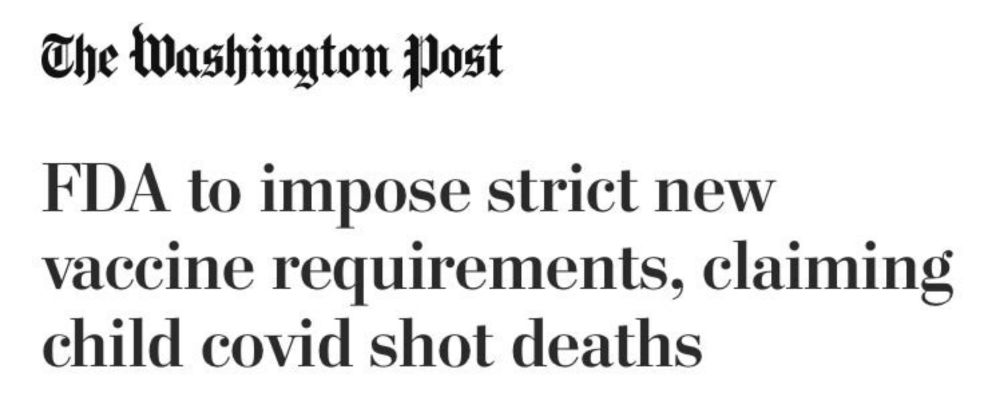
FDA's big change to how vaccines will get approved
We obtained an internal email laying out the planned shift in strategy.
dandiamond.substack.com
November 29, 2025 at 5:00 PM
I can't read this as anything other than a direct assault on the vaccine industry. Full stop. They are laying the groundwork to prevent all vaccine R&D. Not directly, but by requiring study designs for approval that are scientifically unnecessary and financially inviable.
Reposted by daniel campion
Remember, Prasad already announced that he starts with his conclusions and works backwards to produce the “evidence.”
sciencebasedmedicine.org/pbem/
sciencebasedmedicine.org/pbem/
November 29, 2025 at 6:53 AM
Remember, Prasad already announced that he starts with his conclusions and works backwards to produce the “evidence.”
sciencebasedmedicine.org/pbem/
sciencebasedmedicine.org/pbem/
Reposted by daniel campion

How does fever work?
Our new Science paper shows how elevated body temperature can protect against severe influenza and that avian-origin viruses escape this defence.
This is likely one reason why bird flus and some pandemic influenzas can be so severe.🧵
www.science.org/doi/10.1126/...
Our new Science paper shows how elevated body temperature can protect against severe influenza and that avian-origin viruses escape this defence.
This is likely one reason why bird flus and some pandemic influenzas can be so severe.🧵
www.science.org/doi/10.1126/...

Avian-origin influenza A viruses tolerate elevated pyrexic temperatures in mammals
Host body temperature can define a virus’s replicative profile—influenza A viruses (IAVs) adapted to 40° to 42°C in birds are less temperature sensitive in vitro compared with human isolates adapted t...
www.science.org
November 27, 2025 at 7:55 PM
How does fever work?
Our new Science paper shows how elevated body temperature can protect against severe influenza and that avian-origin viruses escape this defence.
This is likely one reason why bird flus and some pandemic influenzas can be so severe.🧵
www.science.org/doi/10.1126/...
Our new Science paper shows how elevated body temperature can protect against severe influenza and that avian-origin viruses escape this defence.
This is likely one reason why bird flus and some pandemic influenzas can be so severe.🧵
www.science.org/doi/10.1126/...
Reposted by daniel campion

Reposted by daniel campion

Keep out: what flags mean to community NHS workers
Frontline NHS staff are feeling an increasing sense of exclusion and intimidation from the surge of St George’s flags displayed on homes | Mark Cunliffe
@markcunliffe.bsky.social @centralbylines.co.uk
Frontline NHS staff are feeling an increasing sense of exclusion and intimidation from the surge of St George’s flags displayed on homes | Mark Cunliffe
@markcunliffe.bsky.social @centralbylines.co.uk

Keep out: what flags mean to community NHS workers
Frontline NHS staff are feeling an increasing sense of exclusion and intimidation from the surge of St George’s flags displayed on homes
centralbylines.co.uk
November 26, 2025 at 5:59 PM
Keep out: what flags mean to community NHS workers
Frontline NHS staff are feeling an increasing sense of exclusion and intimidation from the surge of St George’s flags displayed on homes | Mark Cunliffe
@markcunliffe.bsky.social @centralbylines.co.uk
Frontline NHS staff are feeling an increasing sense of exclusion and intimidation from the surge of St George’s flags displayed on homes | Mark Cunliffe
@markcunliffe.bsky.social @centralbylines.co.uk
Reposted by daniel campion

Still depressing that this isn’t THE story of his first year.
The numbers vary from study to study but hundreds of thousands of people have died because of Elon Musk and Marco Rubio illegally disbanding USAID — a body count on par with the first eight years of the Syrian civil war — In just seven months. It’s mass death that is simply unfathomable in scale.

USAID shutdown has led to hundreds of thousands of deaths | Harvard T.H. Chan School of Public Health
The Trump administration’s decision to shut down the U.S. Agency for International Development (USAID) has resulted in hundreds of thousands of deaths from infectious diseases and malnutrition, accord...
hsph.harvard.edu
November 25, 2025 at 5:48 PM
Still depressing that this isn’t THE story of his first year.
Reposted by daniel campion

Cycle journeys soar 43% in London since 2019, new Transport for London data reveals.
Read more: zagdaily.com/places/cycle...
Read more: zagdaily.com/places/cycle...

November 25, 2025 at 5:54 PM
Cycle journeys soar 43% in London since 2019, new Transport for London data reveals.
Read more: zagdaily.com/places/cycle...
Read more: zagdaily.com/places/cycle...
Reposted by daniel campion

Turns out interest in Metaverse had about a ~9 month half life.

November 23, 2025 at 8:51 PM
Turns out interest in Metaverse had about a ~9 month half life.
Reposted by daniel campion

Moscow's guilty men in the White House are trying to destroy Ukraine and weaken Europe.
open.substack.com/pub/arthursn...
open.substack.com/pub/arthursn...

Another Day, Another Russian-US Attempt to Betray Ukraine and Destroy Europe
The Putin-Trump surrender plan will lay the groundwork for Russia to expand its attacks on other parts of Europe
open.substack.com
November 23, 2025 at 10:50 AM
Moscow's guilty men in the White House are trying to destroy Ukraine and weaken Europe.
open.substack.com/pub/arthursn...
open.substack.com/pub/arthursn...
Reposted by daniel campion

A stunning night where the Northern Lights crown the silent winter peaks. 🌌💚

November 22, 2025 at 5:53 PM
A stunning night where the Northern Lights crown the silent winter peaks. 🌌💚
Reposted by daniel campion

Powerful piece by @drrachelclarke.com on the COVID inquiry. Those who say it’s easy to be wise in hindsight are being utterly disingenuous. Many of us spoke out at the time, and it’s in the public record.
@independentsage.bsky.social
observer.co.uk/news/nationa...
@independentsage.bsky.social
observer.co.uk/news/nationa...

I’ll never forget the horror of the Covid wards | The Observer
observer.co.uk
November 23, 2025 at 8:02 AM
Powerful piece by @drrachelclarke.com on the COVID inquiry. Those who say it’s easy to be wise in hindsight are being utterly disingenuous. Many of us spoke out at the time, and it’s in the public record.
@independentsage.bsky.social
observer.co.uk/news/nationa...
@independentsage.bsky.social
observer.co.uk/news/nationa...
Reposted by daniel campion

New from me: I talked to CDC staffers about the new vaccines and autism page. They said things like:
“The best way I can put it is it feels like we’re on a hijacked airplane.”
“I think people are starting to see that we can’t fulfill our mission here.”
“The best way I can put it is it feels like we’re on a hijacked airplane.”
“I think people are starting to see that we can’t fulfill our mission here.”

“Embarrassing” and “horrifying”: CDC workers describe the new vaccines and autism page
"The best way I can put it is it feels like we're on a hijacked airplane."
www.motherjones.com
November 21, 2025 at 5:41 PM
New from me: I talked to CDC staffers about the new vaccines and autism page. They said things like:
“The best way I can put it is it feels like we’re on a hijacked airplane.”
“I think people are starting to see that we can’t fulfill our mission here.”
“The best way I can put it is it feels like we’re on a hijacked airplane.”
“I think people are starting to see that we can’t fulfill our mission here.”
Reposted by daniel campion

The Covid Inquiry report doesn't offer any surprises. The huge mistakes made were knowable at the time and repeatedly warned against by many of us.
And in relation to preparing for the burden of post viral chronic disease, I don’t think we’re in any better position with a future pandemic.
And in relation to preparing for the burden of post viral chronic disease, I don’t think we’re in any better position with a future pandemic.
November 21, 2025 at 8:29 PM
The Covid Inquiry report doesn't offer any surprises. The huge mistakes made were knowable at the time and repeatedly warned against by many of us.
And in relation to preparing for the burden of post viral chronic disease, I don’t think we’re in any better position with a future pandemic.
And in relation to preparing for the burden of post viral chronic disease, I don’t think we’re in any better position with a future pandemic.

Reposted by daniel campion

Does he even own a suit?

November 19, 2025 at 12:03 AM
Does he even own a suit?
Reposted by daniel campion
The Putin-Trump surrender plan is the end if European security. If you decided you didn’t care about Ukraine (I do, but just if) you should oppose with every fibre if you don’t want further Russian attacks on Europe.
It really is that simple.
It really is that simple.

Completely agree.
The fates of Ukraine and Europe are linked.
European security system will be destroyed without Ukraine.
The fates of Ukraine and Europe are linked.
European security system will be destroyed without Ukraine.

November 21, 2025 at 5:39 PM
The Putin-Trump surrender plan is the end if European security. If you decided you didn’t care about Ukraine (I do, but just if) you should oppose with every fibre if you don’t want further Russian attacks on Europe.
It really is that simple.
It really is that simple.
'February 2020 was a lost month' — well, yeah. In Feb I attended a #COVID19 expert update at the Royal College of Physicians where we were told it was our "duty as a profession" to explain the DHSC's half-baked mitigation/herd immunity strategy to our patients
www.theguardian.com/uk-news/2025...
www.theguardian.com/uk-news/2025...

‘Too little, too late’: damning report condemns UK’s Covid response
Report on handling of pandemic contains stinging criticism of ‘toxic and chaotic’ culture inside Boris Johnson’s No 10
www.theguardian.com
November 21, 2025 at 8:30 AM
'February 2020 was a lost month' — well, yeah. In Feb I attended a #COVID19 expert update at the Royal College of Physicians where we were told it was our "duty as a profession" to explain the DHSC's half-baked mitigation/herd immunity strategy to our patients
www.theguardian.com/uk-news/2025...
www.theguardian.com/uk-news/2025...