Maria Paniw
banner
paniw.bsky.social
Maria Paniw
@paniw.bsky.social

RyC fellow at Spanish National Research Council (Doñana Biological Station). Global-change ecology| forecasting| multi-species demographic models. For more info: https://globalchangeeco.com/ and also https://euro-ecoforecast.wordpress.com/ .. more

Environmental science 53%
Agriculture 20%
Pinned
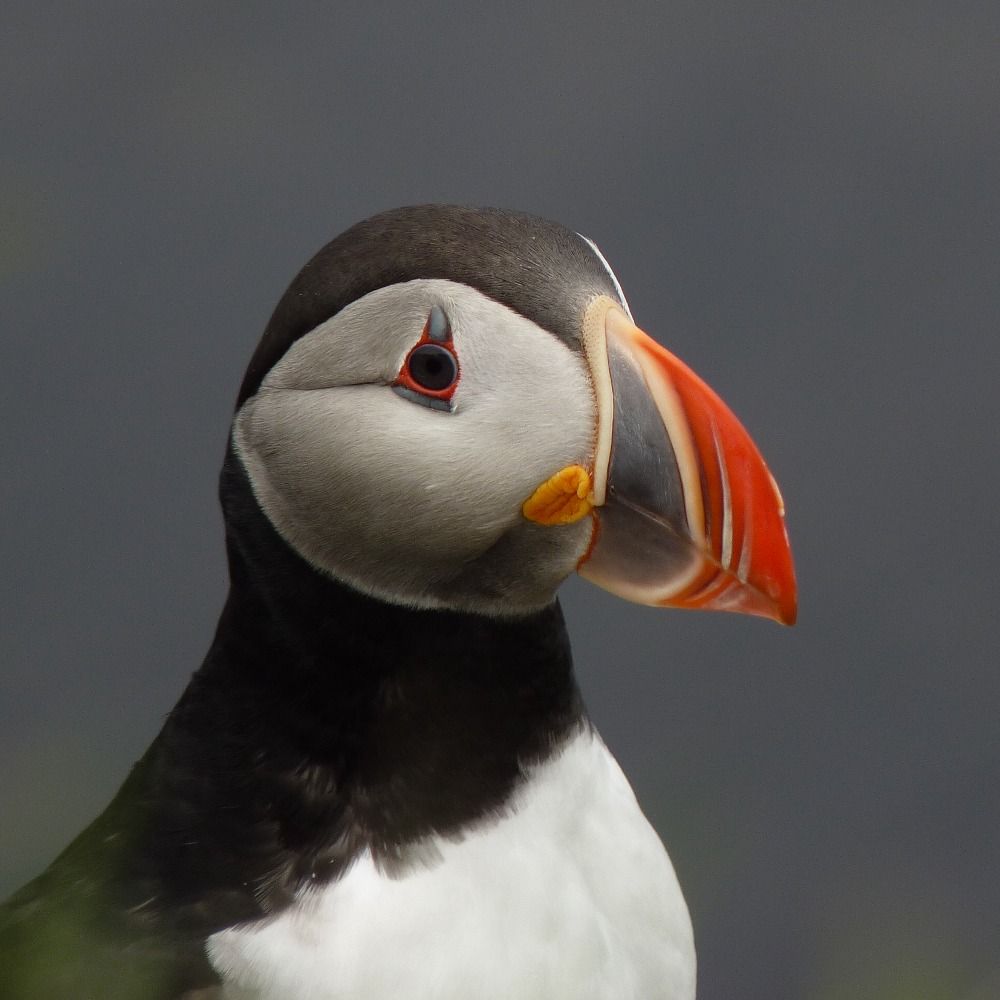
What do this👇 lovely plant, lemur, and petrel have in common? They have populations where individuals were monitored for decades - and now provide amazing resources to compare complex responses of populations to threats. So, go beyond “it’s context dependent” to find common patterns.
remember when the panama papers came out and we found out every rich person on earth was committing tax fraud and then nothing happened

Ah, pues no, pero ahora las pongo online y te paso el link

Fue un placer enorme participar en esta reunión ❤️ muchas gracias a los organizadores 😘
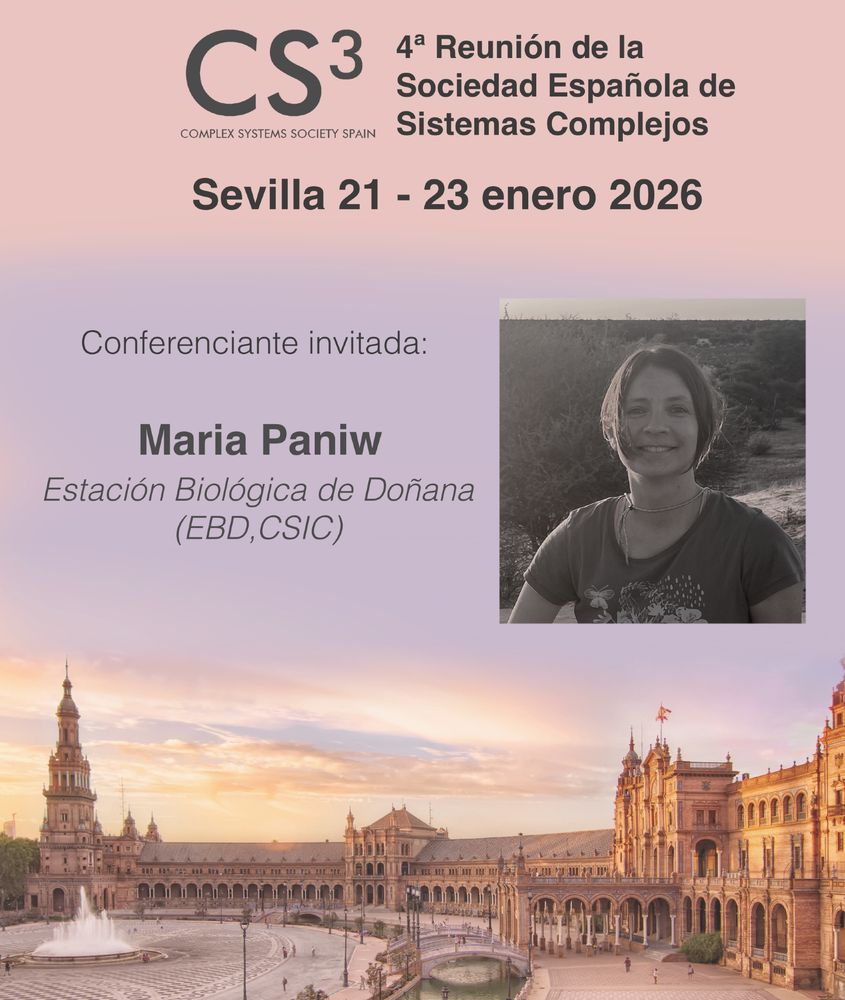
🌱🧩 La semana pasada tuvo lugar en Sevilla la 4ª Reunión de la Sociedad Española de Sistemas Complejos, organizado por nuestras investigadoras @violetacalleja.bsky.social y @domgarvir.bsky.social y la @unisevilla.us.es.

La investigadora @paniw.bsky.social fue una de las conferenciantes invitadas.

Reposted by Maria Paniw

🌱🧩 La semana pasada tuvo lugar en Sevilla la 4ª Reunión de la Sociedad Española de Sistemas Complejos, organizado por nuestras investigadoras @violetacalleja.bsky.social y @domgarvir.bsky.social y la @unisevilla.us.es.

La investigadora @paniw.bsky.social fue una de las conferenciantes invitadas.

join us now for an exciting seminar!
Did all of science peak in 2021 and is yet to recover from the pandemic? Jeremy Fox has a new post about this. I know my own productivity didn’t go up (altho citations did!) even in the 1st year of covid (existential fights for tenure can do that) & I’ve continued to struggle with motivation since.
Science (all of it) peaked in 2021
An ecologist friend* noticed that the annual number of times he’s been cited grew throughout his career up until 2021, when it peaked. It then declined for a couple of years straight. Then it…
dynamicecology.wordpress.com

Great study on temperature effects 🌡️ on #dwarfmongooses
Super interesting article by @chameauleon.bsky.social.

Meerkats' little cousins, #dwarfmongooses, also battle with hot temperatures. Work led by @laurenvane.bsky.social shows how they gain less body mass on particularly hot days due to limited behavioural plasticity: doi.org/10.1002/ece3...

Reposted by Maria Paniw

Super interesting article by @chameauleon.bsky.social.

Meerkats' little cousins, #dwarfmongooses, also battle with hot temperatures. Work led by @laurenvane.bsky.social shows how they gain less body mass on particularly hot days due to limited behavioural plasticity: doi.org/10.1002/ece3...

Lovely piece on how meerkats deal with climate change by @chameauleon.bsky.social in National Geographic: www.nationalgeographic.com/animals/arti... I had the pleasure to chat with Camille about the importance of understanding how extreme heat changes food availability 🐛 for meerkats
Why matriarchs reign supreme in the meerkat world
As a corner of Africa heats up, new research shows how the future of the species rests with powerful matriarchs making tough choices for survival.
www.nationalgeographic.com

Reposted by Tuomas Mattila

If you have a STEM background & would like to use it to develop predictions in complex systems, do reach out! We are a diverse, interdisciplinary team (globalchangeeco.com), and Sevilla is a fantastic place to live

Interested in doing a PhD in biodiversity predictions 📈🐦🌸🪲📈? The Ciaxa Foundation has launched a call for PhD fellowships in 🇪🇸 Excellence Research Centers. @ebdonana.bsky.social is one of them: lacaixafoundation.org/en/doctoral-... 🧪🌎

Reposted by Maria Paniw

Trump thinks immigrants will destroy Europe. The truth is the opposite.
This column is about the long arc of population change, the hybridity of European cultures, and the widely-misinterpreted results of demographic momentum.
Big issues we need to understand.
www.theguardian.com/commentisfre...
The facts are stark: Europe must open the door to migrants, or face its own extinction | George Monbiot
These are the facts: plummeting birth rates mean that without attracting immigration, many countries are sliding towards collapse, says Guardian columnist George Monbiot
www.theguardian.com

Reposted by Maria Paniw

...Orcas use dolphins to increase their chances of locating salmon; dolphins gain protection from predators and feast on bite-sized salmon scraps. Dolphins have even been seen tossing salmon to orcas to break it into more manageable pieces: wapo.st/4aJuZeE (gift). 🌎
Video shows orcas and dolphins teaming up to hunt more efficiently
Scientists say the aquatic allies were observed apparently relying on one another to find prized prey: large adult Chinook salmon.
wapo.st

Reposted by Maria Paniw

Issue #54 of the EFI Newsletter is now available at: conta.cc/3MpMWF0

Lots of info about

- conferences, including the new EFI2026 Conference website,
- a Social Science and Ecoforecasting Award RFP due Dec 15,
- upcoming virtual seminars,
- new community manuscript guidelines

and more!
Ecological Forecasting Initiative December 2025 Newsletter
Email from Ecological Forecasting Initiative EFI Newsletter Issue 54| December 9, 2025 Trouble viewing this email? View as Webpage As an annual tradition, this month's newsletter highlights the upcomi
conta.cc
🚨 Job alert 🚨 Postdoc position in ecological forecasting 📈 as part of the Horizon Europe OSCARS call. The postdoc will be based in lovely Sevilla (fantastic place to live) and will include working closely with several European forecasting projects. Apply by Dec 11! 🌎🧪 globalchangeeco.com/jobs
#biologging #research is booming - but do #loggers actually impact the birds? Yes, they do - depending on the mass and attachment location. If you work with biologging, you should read our latest publication seapop.no/en/2025/11/l...
@ninanatureresearch.bsky.social #seabirds
Loggers attached to birds can affect foraging behaviour
Loggers have become a central part of research on seabirds and other groups of animals over the past 20 years. In seabird research, loggers provide very useful documentation of diving behaviour…
seapop.no
Interesante artículo en @jappliedecology.bsky.social de expertos #incendios y eco. terrestres en el que se resalta papel plantaciones forestales pinos en: (1) exacerbación severidad incendios y mayor facilidad extensión a masas contiguas... (1/9) besjournals.onlinelibrary.wiley.com/doi/10.1111/...
The legacy of pine plantations on fire severity
Our findings provide quantitative evidence that pine plantations can exacerbate fire severity under contemporary climate conditions, and that, once burned, these areas seldom recover. Effective spati....
besjournals.onlinelibrary.wiley.com

Reposted by Billur Bektaş

It’s a great initiative! Submit your projects
Are you involved in ecological forecasting in Europe?
We’re mapping forecasting applications across the continent — from SDMs to observatories with predictive potential.
Our goal: make EU forecasting more connected and identify both immediate and long-term forecasting potential.

Reposted by Maria Paniw

Reposted by Maria Paniw
Are you involved in ecological forecasting in Europe?
We’re mapping forecasting applications across the continent — from SDMs to observatories with predictive potential.
Our goal: make EU forecasting more connected and identify both immediate and long-term forecasting potential.

Que revista es? Name and shame

Super hyped that our project *PREDICT – Platform for REsilient Data Integration and Coordinated Forecasting Tools* is among the selected ones - oscars-project.eu/news/2nd-osc... We will demystify complex ecological predictions to make them usable for decision makers. @ebdonana.bsky.social
2nd OSCARS Open Call concluded with 12 projects selected | OSCARS
The OSCARS consortium decided for a complementary second call with a residual budget of only 3 millions €.
oscars-project.eu

Un evento fantástico! Apuntaros!
¡Continuamos con nuestros conferenciantes invitados!
En la 4º reunión de la Sociedad Española de Sistemas Complejos tendremos el placer de contar con
Maria Paniw, EBD-CSIC
@paniw.bsky.social

🚨 ¡Envía tu abstract hasta el 1 de noviembre!
🌐 cs3.es/conference-2026
Reposted by Maria Paniw
¡Continuamos con nuestros conferenciantes invitados!
En la 4º reunión de la Sociedad Española de Sistemas Complejos tendremos el placer de contar con
Maria Paniw, EBD-CSIC
@paniw.bsky.social

🚨 ¡Envía tu abstract hasta el 1 de noviembre!
🌐 cs3.es/conference-2026

Join us!!!
🧊 Did your model freeze in time? Let’s bring it back to life!
Join our hands-on workshop “Building Near-Term Iterative Forecasting Workflows” at #TIBS2026 – Aarhus, 6 Jan 2026 🌍
We’ll explore how to turn static predictions into dynamic, self-updating forecasts. @paniw.bsky.social
🧊 Did your model freeze in time? Let’s bring it back to life!
Join our hands-on workshop “Building Near-Term Iterative Forecasting Workflows” at #TIBS2026 – Aarhus, 6 Jan 2026 🌍
We’ll explore how to turn static predictions into dynamic, self-updating forecasts. @paniw.bsky.social

Crazy!
Hot wings coming up! - i.e., brown rats hunt bats IN FLIGHT.
🐀🦇🍴

While this has serious conservation implications for urban bats, I can't help but be amazed by the rats' dexterity and adaptability.

Full paper by @berlinbatlab.bsky.social here:
www.sciencedirect.com/science/arti... 🧪🌍🦊

Reposted by Maria Paniw

Hot wings coming up! - i.e., brown rats hunt bats IN FLIGHT.
🐀🦇🍴

While this has serious conservation implications for urban bats, I can't help but be amazed by the rats' dexterity and adaptability.

Full paper by @berlinbatlab.bsky.social here:
www.sciencedirect.com/science/arti... 🧪🌍🦊

Reposted by Maria Paniw

A technology feature in Nature describes how ‘digital twins’ of real-world objects are moving from manufacturing to wildlife management and how it’s helping ecologists, including predicting migration patterns. 🧪
Digital flocks, predators allow ecologists to simulate real-world animal behaviour
‘Digital twins’ of real-world objects are moving from manufacturing to wildlife management.
go.nature.com

Plants may seem to do well under anthropogenic land use, but add climate change to the mix of stressors and it becomes clear that many species are hanging in by a thin thread
🔥 A new study shows a higher vulnerability of a fire-adapted subshrub to climate change in anthropogenic Mediterranean habitats, emphasising the need for more demographic studies in human-modified habitats🌊

@paniw.bsky.social @arpatoz.bsky.social @ebdonana.bsky.social

📖 :