



illep
@illep.bsky.social
MSc Paleoclimasomething | Scientific enviromentalist | Glaciovolcanism 🌋❄️ | Biosignatures & extreme environments |
Pinned
illep
@illep.bsky.social
· Nov 25

L'ultima volta avevamo parlato della reazione di Urey e di come questa sia intimamente connessa con il termostato geologico della Terra: il weathering dei silicati. In questo episodio parleremo invece di cosa succede quando il termostato si inceppa in modalità Ice Age.
Un lunghissimo thread
1/n
Un lunghissimo thread
1/n
Reposted by illep
Some good news at last! Sediments have been recovered by @swais2c.bsky.social team from UNDERNEATH the #Antarctic ice sheet. Fantastic achievement and more to come 👏❄️🇦🇶🧪
#geology #drilling
#geology #drilling

We’ve got our eyes on the prize 24/7, through blowing snow, lashing winds and sunshine. With more than 100 metres of sediment core retrieved, we’re more than halfway towards our target of 200 metres. Co-Chief Huw Horgan shares this expedition update from our deep-field camp at Crary Ice Rise.
January 6, 2026 at 9:44 PM
Some good news at last! Sediments have been recovered by @swais2c.bsky.social team from UNDERNEATH the #Antarctic ice sheet. Fantastic achievement and more to come 👏❄️🇦🇶🧪
#geology #drilling
#geology #drilling
Reposted by illep

You want to know about this site that lets you explore data collected by the HMS Challenger from 1872–1876, an expedition that laid the foundation of oceanography. 🌊
challenger-expedition.sams.ac.uk/explore
challenger-expedition.sams.ac.uk/explore

December 22, 2025 at 9:50 AM
You want to know about this site that lets you explore data collected by the HMS Challenger from 1872–1876, an expedition that laid the foundation of oceanography. 🌊
challenger-expedition.sams.ac.uk/explore
challenger-expedition.sams.ac.uk/explore
Reposted by illep

✨Year-end office clean-up and we found a hard copy of the IGBP Newsletter (1990) revealing the very beginnings of PAGES 🐣
💡Did you know PAGES was first proposed as an IGBP core-project called “PaGloCha”? More than 30 years later, PAGES is still going strong thanks to the #paleoscience community!
💡Did you know PAGES was first proposed as an IGBP core-project called “PaGloCha”? More than 30 years later, PAGES is still going strong thanks to the #paleoscience community!

December 16, 2025 at 12:46 PM
✨Year-end office clean-up and we found a hard copy of the IGBP Newsletter (1990) revealing the very beginnings of PAGES 🐣
💡Did you know PAGES was first proposed as an IGBP core-project called “PaGloCha”? More than 30 years later, PAGES is still going strong thanks to the #paleoscience community!
💡Did you know PAGES was first proposed as an IGBP core-project called “PaGloCha”? More than 30 years later, PAGES is still going strong thanks to the #paleoscience community!
Reposted by illep

Looking back over the last 12 months, all latitude bands observed above average temperatures. This was largest in the Arctic region.
Plot shows zonal-mean surface air temperature anomalies, where latitude = x-axis (not scaled by distance). Data from NASA GISTEMPv4 (1951-1980 baseline).
Plot shows zonal-mean surface air temperature anomalies, where latitude = x-axis (not scaled by distance). Data from NASA GISTEMPv4 (1951-1980 baseline).

December 15, 2025 at 1:03 PM
Looking back over the last 12 months, all latitude bands observed above average temperatures. This was largest in the Arctic region.
Plot shows zonal-mean surface air temperature anomalies, where latitude = x-axis (not scaled by distance). Data from NASA GISTEMPv4 (1951-1980 baseline).
Plot shows zonal-mean surface air temperature anomalies, where latitude = x-axis (not scaled by distance). Data from NASA GISTEMPv4 (1951-1980 baseline).
Reposted by illep

Titolo:
EPA e cambiamento climatico.
Sottotitolo:
Almeno sforzatevi
Dopo il penoso report del DOE sul ruolo della CO2, le modifiche apportate sulle pagine dell'EPA dedicate al cambiamento climatico sono a dir poco ridicole.
Così non c'è gusto fare debunking. 1/9
EPA e cambiamento climatico.
Sottotitolo:
Almeno sforzatevi
Dopo il penoso report del DOE sul ruolo della CO2, le modifiche apportate sulle pagine dell'EPA dedicate al cambiamento climatico sono a dir poco ridicole.
Così non c'è gusto fare debunking. 1/9

December 14, 2025 at 8:29 PM
Titolo:
EPA e cambiamento climatico.
Sottotitolo:
Almeno sforzatevi
Dopo il penoso report del DOE sul ruolo della CO2, le modifiche apportate sulle pagine dell'EPA dedicate al cambiamento climatico sono a dir poco ridicole.
Così non c'è gusto fare debunking. 1/9
EPA e cambiamento climatico.
Sottotitolo:
Almeno sforzatevi
Dopo il penoso report del DOE sul ruolo della CO2, le modifiche apportate sulle pagine dell'EPA dedicate al cambiamento climatico sono a dir poco ridicole.
Così non c'è gusto fare debunking. 1/9
Reposted by illep

Early instrumental climate reconstructions (pre-1850) struggle with sparse measurements and have large uncertainties.
But they do provide some insights into a particularly interesting period.
Four major volcanic eruptions occurred 1780-1840, each larger than anything since.
1/
But they do provide some insights into a particularly interesting period.
Four major volcanic eruptions occurred 1780-1840, each larger than anything since.
1/

December 2, 2025 at 12:03 PM
Early instrumental climate reconstructions (pre-1850) struggle with sparse measurements and have large uncertainties.
But they do provide some insights into a particularly interesting period.
Four major volcanic eruptions occurred 1780-1840, each larger than anything since.
1/
But they do provide some insights into a particularly interesting period.
Four major volcanic eruptions occurred 1780-1840, each larger than anything since.
1/
“This isn’t Hawking’s party!”


November 28, 2025 at 3:51 PM
“This isn’t Hawking’s party!”
Reposted by illep

⚒️ Article: Early Holocene retreat of an ice shelf in East Antarctica was linked to ocean-driven forcing enhanced by ice-sheet meltwater from adjoining regions
www.nature.com/articles/s41...
www.nature.com/articles/s41...

Antarctic ice-shelf collapse in Holocene driven by meltwater release feedbacks - Nature Geoscience
Early Holocene retreat of an ice shelf in East Antarctica was linked to ocean-driven forcing enhanced by ice-sheet meltwater from adjoining regions, as unveiled through the integration of proxy record...
www.nature.com
November 7, 2025 at 4:00 PM
⚒️ Article: Early Holocene retreat of an ice shelf in East Antarctica was linked to ocean-driven forcing enhanced by ice-sheet meltwater from adjoining regions
www.nature.com/articles/s41...
www.nature.com/articles/s41...
Reposted by illep
As the ice cap forms, it traps air bubbles, which then remain isolated. It has allowed us to reconstruct our past climate of 800,000 years ago. This was the date of the oldest Antarctic ice sampling thanks to a ice core drilled near the base of the Antarctic ice sheet.
www.pnas.org/doi/10.1073/...
www.pnas.org/doi/10.1073/...

Miocene and Pliocene ice and air from the Allan Hills blue ice area, East Antarctica | PNAS
Antarctic ice cores provide a unique archive of Earth’s atmosphere and its largest
extant ice sheet. The oldest continuous ice core extends back 80...
www.pnas.org
November 6, 2025 at 8:44 AM
As the ice cap forms, it traps air bubbles, which then remain isolated. It has allowed us to reconstruct our past climate of 800,000 years ago. This was the date of the oldest Antarctic ice sampling thanks to a ice core drilled near the base of the Antarctic ice sheet.
www.pnas.org/doi/10.1073/...
www.pnas.org/doi/10.1073/...
Reposted by illep
Could rising antimicrobial activity in warmer soils make microbes less efficient at using carbon & push more CO₂ into the atmosphere?
🦠📈💊
Our new work in @isme-microbes.bsky.social explores how the combined effects of warming & AMR may alter microbial C processing
🧵👇
academic.oup.com/ismej/articl...
🦠📈💊
Our new work in @isme-microbes.bsky.social explores how the combined effects of warming & AMR may alter microbial C processing
🧵👇
academic.oup.com/ismej/articl...

Microbial interactions between climate warming and antimicrobial resistance threaten soil carbon storage and global health
Abstract. Anthropogenic activities are impacting the environment in ways that may intersect and have compounding effects. In soil, the spread of antibiotic
academic.oup.com
November 6, 2025 at 2:39 PM
Could rising antimicrobial activity in warmer soils make microbes less efficient at using carbon & push more CO₂ into the atmosphere?
🦠📈💊
Our new work in @isme-microbes.bsky.social explores how the combined effects of warming & AMR may alter microbial C processing
🧵👇
academic.oup.com/ismej/articl...
🦠📈💊
Our new work in @isme-microbes.bsky.social explores how the combined effects of warming & AMR may alter microbial C processing
🧵👇
academic.oup.com/ismej/articl...
Reposted by illep

The #CopernicusEU Sentinel-1 mission welcomes a new member: Sentinel-1D, launched at 21:02 GMT/22:02 CET from Kourou on Ariane 6 #VA265.
www.esa.int/Applications...
@cnes.fr @euspa.bsky.social @ec.europa.eu @thalesaleniaspace.bsky.social @transport.esa.int
www.esa.int/Applications...
@cnes.fr @euspa.bsky.social @ec.europa.eu @thalesaleniaspace.bsky.social @transport.esa.int

November 4, 2025 at 10:54 PM
The #CopernicusEU Sentinel-1 mission welcomes a new member: Sentinel-1D, launched at 21:02 GMT/22:02 CET from Kourou on Ariane 6 #VA265.
www.esa.int/Applications...
@cnes.fr @euspa.bsky.social @ec.europa.eu @thalesaleniaspace.bsky.social @transport.esa.int
www.esa.int/Applications...
@cnes.fr @euspa.bsky.social @ec.europa.eu @thalesaleniaspace.bsky.social @transport.esa.int
Reposted by illep

New video: A glacier on Antarctica’s Eastern Peninsula experienced the fastest retreat recorded in modern history—in just two months, nearly 50 percent of the glacier disintegrated. Watch this video to understand what happened. Study by @ciresnews #Antarctica #glaciermelt
November 3, 2025 at 8:17 PM
New video: A glacier on Antarctica’s Eastern Peninsula experienced the fastest retreat recorded in modern history—in just two months, nearly 50 percent of the glacier disintegrated. Watch this video to understand what happened. Study by @ciresnews #Antarctica #glaciermelt
Reposted by illep

Notice the data source in the bottom right: NASA JPL. This is the type of space climate science Trump is illegally dismantling.
We built insanely complicated satellites, operated them for years, discovered in detail how the ice caps are melting, and our response as a country is "who cares."
We built insanely complicated satellites, operated them for years, discovered in detail how the ice caps are melting, and our response as a country is "who cares."
In summary, the outlook is grim. It is highly likely that Thwaites Glacier will eventually be lost, which will destabilise adjoining parts of the West Antarctic Ice Sheet, increasing the committed long-term rise in global mean sea level by more than 3 m.

October 26, 2025 at 10:04 PM
Notice the data source in the bottom right: NASA JPL. This is the type of space climate science Trump is illegally dismantling.
We built insanely complicated satellites, operated them for years, discovered in detail how the ice caps are melting, and our response as a country is "who cares."
We built insanely complicated satellites, operated them for years, discovered in detail how the ice caps are melting, and our response as a country is "who cares."
Reposted by illep

September 2025 was the third warmest on record in the Berkeley Earth dataset. But this downplays how anomalous it was; without 2023 and 2024 this year would have been well above any prior records and well above the long-term trend:

October 23, 2025 at 9:43 PM
September 2025 was the third warmest on record in the Berkeley Earth dataset. But this downplays how anomalous it was; without 2023 and 2024 this year would have been well above any prior records and well above the long-term trend:
Reposted by illep

Samples of hyaloclastite from Krafla in Iceland 🇮🇸 🌋 These samples are from different depths within the shallow reservoir, and they’re now ready for some physical and mechanical probing in the laboratory!

October 22, 2025 at 1:04 PM
Samples of hyaloclastite from Krafla in Iceland 🇮🇸 🌋 These samples are from different depths within the shallow reservoir, and they’re now ready for some physical and mechanical probing in the laboratory!
Reposted by illep
Postdoc vacancy: Microbial dormancy in the cryosphere
@erc.europa.eu #ERC_SIESTA
📢 PLEASE RT
🧬 Single cell microbial activity measurements, flow cytometry, cell sorting, omics, ecological interpretation
☀️ Marseille, France
‼️ Apply ASAP & before 7 Nov
Link: emploi.cnrs.fr/Offres/CDD/U...
@erc.europa.eu #ERC_SIESTA
📢 PLEASE RT
🧬 Single cell microbial activity measurements, flow cytometry, cell sorting, omics, ecological interpretation
☀️ Marseille, France
‼️ Apply ASAP & before 7 Nov
Link: emploi.cnrs.fr/Offres/CDD/U...

October 21, 2025 at 3:48 PM
Postdoc vacancy: Microbial dormancy in the cryosphere
@erc.europa.eu #ERC_SIESTA
📢 PLEASE RT
🧬 Single cell microbial activity measurements, flow cytometry, cell sorting, omics, ecological interpretation
☀️ Marseille, France
‼️ Apply ASAP & before 7 Nov
Link: emploi.cnrs.fr/Offres/CDD/U...
@erc.europa.eu #ERC_SIESTA
📢 PLEASE RT
🧬 Single cell microbial activity measurements, flow cytometry, cell sorting, omics, ecological interpretation
☀️ Marseille, France
‼️ Apply ASAP & before 7 Nov
Link: emploi.cnrs.fr/Offres/CDD/U...
Reposted by illep
Ever wondered what lies beneath the fastest melting glacier in #Antarctica? Read on….
🔥New paper just out🔥led by my brilliant @bas.ac.uk colleague Tom Jordan: www.nature.com/articles/s43...
Combining #geology & #geophysics, we discovered a huge granite beneath Pine Island Glacier! 🧵 below…. 1/n
🧪❄️🥼
🔥New paper just out🔥led by my brilliant @bas.ac.uk colleague Tom Jordan: www.nature.com/articles/s43...
Combining #geology & #geophysics, we discovered a huge granite beneath Pine Island Glacier! 🧵 below…. 1/n
🧪❄️🥼

Subglacial geology and palaeo flow of Pine Island Glacier from combining glacial erratics with geophysics - Communications Earth & Environment
A nearly 175 Ma granite body in West Antarctica reveals ice flowed across the southern Hudson Mountains at the Last Glacial Maximum, resulting in erratics derived from local subglacial bedrock, as rev...
www.nature.com
October 22, 2025 at 9:35 AM
Ever wondered what lies beneath the fastest melting glacier in #Antarctica? Read on….
🔥New paper just out🔥led by my brilliant @bas.ac.uk colleague Tom Jordan: www.nature.com/articles/s43...
Combining #geology & #geophysics, we discovered a huge granite beneath Pine Island Glacier! 🧵 below…. 1/n
🧪❄️🥼
🔥New paper just out🔥led by my brilliant @bas.ac.uk colleague Tom Jordan: www.nature.com/articles/s43...
Combining #geology & #geophysics, we discovered a huge granite beneath Pine Island Glacier! 🧵 below…. 1/n
🧪❄️🥼
Reposted by illep

Geologists Discover The First Evidence of 4.5-billion-year-old “proto-Earth”
astrobiology.com/2025/10/geol... #astrobiology #exoplanet #astrogeology
astrobiology.com/2025/10/geol... #astrobiology #exoplanet #astrogeology

Geologists Discover The First Evidence of 4.5-billion-year-old “proto-Earth” - Astrobiology
Scientists at MIT and elsewhere have discovered extremely rare remnants of “proto Earth,” which formed about 4.5 billion years ago
astrobiology.com
October 15, 2025 at 6:07 PM
Geologists Discover The First Evidence of 4.5-billion-year-old “proto-Earth”
astrobiology.com/2025/10/geol... #astrobiology #exoplanet #astrogeology
astrobiology.com/2025/10/geol... #astrobiology #exoplanet #astrogeology
Reposted by illep
In a time where it is hard to celebrate something, I just published my first news article in #TheMicrobiologist about how gases, made by microbes on Earth, help us detect alien life.
Thanks @amiposts.bsky.social !
#astrobiology#biosignarure#microbes
www.the-microbiologist.com/features/bre...
Thanks @amiposts.bsky.social !
#astrobiology#biosignarure#microbes
www.the-microbiologist.com/features/bre...

Breathing alien air: the search for biosignatures on exoplanets
Among the most promising indicators of biogenic elements are volatile organic compounds produced by life forms. The detection of specific metabolites such as dimethyl sulphide (DMS) and related compou...
www.the-microbiologist.com
October 2, 2025 at 12:16 PM
In a time where it is hard to celebrate something, I just published my first news article in #TheMicrobiologist about how gases, made by microbes on Earth, help us detect alien life.
Thanks @amiposts.bsky.social !
#astrobiology#biosignarure#microbes
www.the-microbiologist.com/features/bre...
Thanks @amiposts.bsky.social !
#astrobiology#biosignarure#microbes
www.the-microbiologist.com/features/bre...
Reposted by illep
I grafici che vedete dovrebbero:
far venire i brividi;
essere commentati sui giornali;
stimolare una forte e generalizzata consapevolezza.
Invece non fanno nulla, o quasi.
Se ne stanno lì, nel sito del SOCIB, in compagnia di tanti altri che descrivono lo stato di crisi del Mediterraneo. 1/5
far venire i brividi;
essere commentati sui giornali;
stimolare una forte e generalizzata consapevolezza.
Invece non fanno nulla, o quasi.
Se ne stanno lì, nel sito del SOCIB, in compagnia di tanti altri che descrivono lo stato di crisi del Mediterraneo. 1/5

October 14, 2025 at 2:54 PM
I grafici che vedete dovrebbero:
far venire i brividi;
essere commentati sui giornali;
stimolare una forte e generalizzata consapevolezza.
Invece non fanno nulla, o quasi.
Se ne stanno lì, nel sito del SOCIB, in compagnia di tanti altri che descrivono lo stato di crisi del Mediterraneo. 1/5
far venire i brividi;
essere commentati sui giornali;
stimolare una forte e generalizzata consapevolezza.
Invece non fanno nulla, o quasi.
Se ne stanno lì, nel sito del SOCIB, in compagnia di tanti altri che descrivono lo stato di crisi del Mediterraneo. 1/5
Reposted by illep
Dunque.
In 10 anni (dieci anni) le Alpi Svizzere hanno preso non 1/10, non 1/8, non 1/6, ma UN QUARTO del loro volume.
Nell'estate del 2022 il 6%, in quella del 2023 il 4%, nel 2024 il 2.5% e nel 2025 il 3%.
Forse non ci rendiamo conto di cosa accade...1/4
In 10 anni (dieci anni) le Alpi Svizzere hanno preso non 1/10, non 1/8, non 1/6, ma UN QUARTO del loro volume.
Nell'estate del 2022 il 6%, in quella del 2023 il 4%, nel 2024 il 2.5% e nel 2025 il 3%.
Forse non ci rendiamo conto di cosa accade...1/4

October 7, 2025 at 5:44 AM
Dunque.
In 10 anni (dieci anni) le Alpi Svizzere hanno preso non 1/10, non 1/8, non 1/6, ma UN QUARTO del loro volume.
Nell'estate del 2022 il 6%, in quella del 2023 il 4%, nel 2024 il 2.5% e nel 2025 il 3%.
Forse non ci rendiamo conto di cosa accade...1/4
In 10 anni (dieci anni) le Alpi Svizzere hanno preso non 1/10, non 1/8, non 1/6, ma UN QUARTO del loro volume.
Nell'estate del 2022 il 6%, in quella del 2023 il 4%, nel 2024 il 2.5% e nel 2025 il 3%.
Forse non ci rendiamo conto di cosa accade...1/4
Ottime notizie dal British Antartic Survey: con oggi dovrebbe essere terminata la fusione e le analisi iniziali degli ultimi 190m dell’ice-core estratto dal progetto Beyond EPICA. Se tutto va come deve dovremmo ottenere una serie continua di dati per oltre 1.2 milioni di anni! /

A historical moment: over 1.2 million years of Earth's climate history captured from an Antarctic ice core - British Antarctic Survey
Ancient ice from Antarctica, extracted as part of the Beyond EPICA – Oldest Ice project, captures a unique climate record spanning at least the past 1.2 million years.
www.bas.ac.uk
October 3, 2025 at 10:27 AM
Ottime notizie dal British Antartic Survey: con oggi dovrebbe essere terminata la fusione e le analisi iniziali degli ultimi 190m dell’ice-core estratto dal progetto Beyond EPICA. Se tutto va come deve dovremmo ottenere una serie continua di dati per oltre 1.2 milioni di anni! /
In Antartide è stato (probabilmente) raggiunto il picco annuale di estensione del ghiaccio marino. 3° valore più basso nei 47 anni di dati. A fare compagnia sul podio al 2025 ci sono, rullo di tamburi, 2024 e 2023.
nsidc.org/sea-ice-toda...
nsidc.org/sea-ice-toda...

October 2, 2025 at 1:23 PM
In Antartide è stato (probabilmente) raggiunto il picco annuale di estensione del ghiaccio marino. 3° valore più basso nei 47 anni di dati. A fare compagnia sul podio al 2025 ci sono, rullo di tamburi, 2024 e 2023.
nsidc.org/sea-ice-toda...
nsidc.org/sea-ice-toda...
Reposted by illep
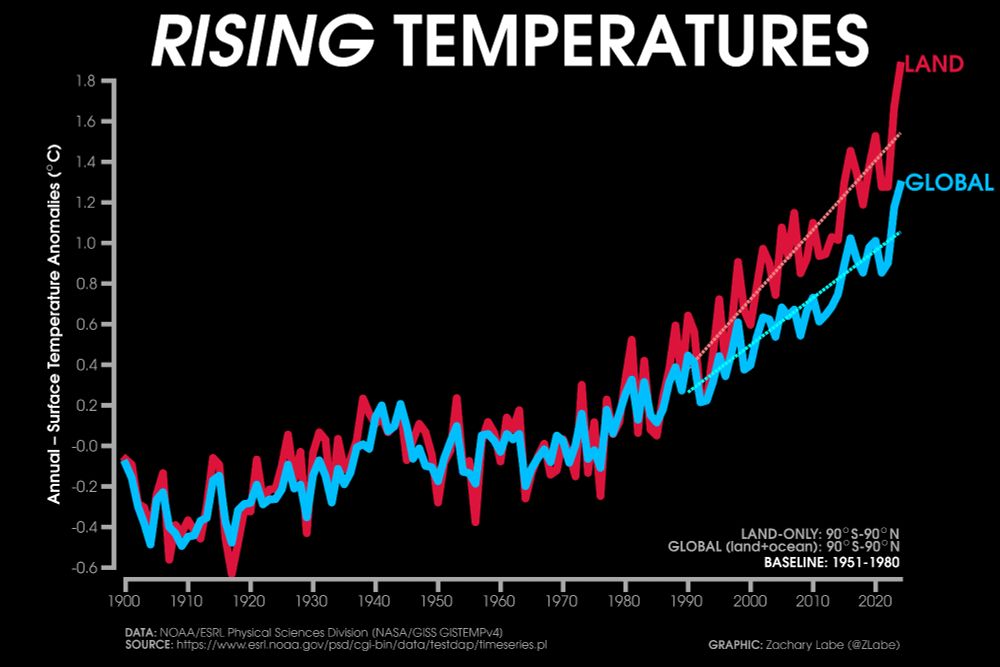
As a reminder, land areas (where we live) are warming around twice as fast as over the oceans. Subsequently, most of us are 'feeling' temperatures rising faster than the global mean record.
Graphic from zacklabe.com/climate-chan...
Graphic from zacklabe.com/climate-chan...
September 21, 2025 at 12:57 AM
As a reminder, land areas (where we live) are warming around twice as fast as over the oceans. Subsequently, most of us are 'feeling' temperatures rising faster than the global mean record.
Graphic from zacklabe.com/climate-chan...
Graphic from zacklabe.com/climate-chan...
Reposted by illep

New from me on The Climate Brink: The Cartoon Villain's Guide to Killing Climate Action
www.theclimatebrink....
www.theclimatebrink....

September 18, 2025 at 7:45 PM
New from me on The Climate Brink: The Cartoon Villain's Guide to Killing Climate Action
www.theclimatebrink....
www.theclimatebrink....