




Thibaud Boutin 🧬💻 🧀
@tsboutin.bsky.social
Statistical Geneticist
IGC - University of Edinburgh
Views are my own
IGC - University of Edinburgh
Views are my own
Reposted by Thibaud Boutin 🧬💻 🧀
Interested in pleiotropy dissection but not sure where to start, which methods are useful, which studies offer illustrative examples, or how to robustly validate your results? Look no further 👀 rdcu.be/eSfAZ

Dissecting pleiotropy to gain mechanistic insights into human disease
Nature Reviews Genetics - Genome-wide association studies of increasing scale have revealed the prevalence of pleiotropic genetic variants that affect multiple traits. In this Review, the authors...
rdcu.be
November 28, 2025 at 1:10 PM
Interested in pleiotropy dissection but not sure where to start, which methods are useful, which studies offer illustrative examples, or how to robustly validate your results? Look no further 👀 rdcu.be/eSfAZ
Reposted by Thibaud Boutin 🧬💻 🧀

A project many years in the process, we’re pleased to present our work on multi-ancestry meta-analysis across a boatload of traits in the UK Biobank: www.nature.com/articles/s41...

Pan-UK Biobank genome-wide association analyses enhance discovery and resolution of ancestry-enriched effects - Nature Genetics
Genome-wide analyses for 7,266 traits leveraging data from several genetic ancestry groups in UK Biobank identify new associations and enhance resources for interpreting risk variants across diverse p...
www.nature.com
September 18, 2025 at 5:25 PM
A project many years in the process, we’re pleased to present our work on multi-ancestry meta-analysis across a boatload of traits in the UK Biobank: www.nature.com/articles/s41...
Reposted by Thibaud Boutin 🧬💻 🧀

First time on Bsky and first big announcement!
I am excited to announce that our new study explaining the missing heritability of many phenotypes using WGS data from ~347,000 UK Biobank participants has just been published in @Nature.
Our manuscript is here: www.nature.com/articles/s41....
I am excited to announce that our new study explaining the missing heritability of many phenotypes using WGS data from ~347,000 UK Biobank participants has just been published in @Nature.
Our manuscript is here: www.nature.com/articles/s41....

Estimation and mapping of the missing heritability of human phenotypes - Nature
WGS data were used from 347,630 individuals with European ancestry in the UK Biobank to obtain high-precision estimates of coding and non-coding rare variant heritability for 34 co...
www.nature.com
November 12, 2025 at 5:57 PM
First time on Bsky and first big announcement!
I am excited to announce that our new study explaining the missing heritability of many phenotypes using WGS data from ~347,000 UK Biobank participants has just been published in @Nature.
Our manuscript is here: www.nature.com/articles/s41....
I am excited to announce that our new study explaining the missing heritability of many phenotypes using WGS data from ~347,000 UK Biobank participants has just been published in @Nature.
Our manuscript is here: www.nature.com/articles/s41....
Reposted by Thibaud Boutin 🧬💻 🧀

How do GWAS and rare variant burden tests rank gene signals?
In new work @nature.com with @hakha.bsky.social, @jkpritch.bsky.social, and our wonderful coauthors we find that the key factors are what we call Specificity, Length, and Luck!
🧬🧪🧵
www.nature.com/articles/s41...
In new work @nature.com with @hakha.bsky.social, @jkpritch.bsky.social, and our wonderful coauthors we find that the key factors are what we call Specificity, Length, and Luck!
🧬🧪🧵
www.nature.com/articles/s41...

Specificity, length and luck drive gene rankings in association studies - Nature
Genetic association tests prioritize candidate genes based on different criteria.
www.nature.com
November 7, 2025 at 12:05 AM
How do GWAS and rare variant burden tests rank gene signals?
In new work @nature.com with @hakha.bsky.social, @jkpritch.bsky.social, and our wonderful coauthors we find that the key factors are what we call Specificity, Length, and Luck!
🧬🧪🧵
www.nature.com/articles/s41...
In new work @nature.com with @hakha.bsky.social, @jkpritch.bsky.social, and our wonderful coauthors we find that the key factors are what we call Specificity, Length, and Luck!
🧬🧪🧵
www.nature.com/articles/s41...
Reposted by Thibaud Boutin 🧬💻 🧀
Excited to share our latest work on the factors that determine what genes we find (and don't find!) in GWAS and burden tests.
We describe a critical concept that we call *specificity*.
Led by Jeff Spence and Hakhamanesh Mostafavi:
We describe a critical concept that we call *specificity*.
Led by Jeff Spence and Hakhamanesh Mostafavi:
How do GWAS and rare variant burden tests rank gene signals?
In new work @nature.com with @hakha.bsky.social, @jkpritch.bsky.social, and our wonderful coauthors we find that the key factors are what we call Specificity, Length, and Luck!
🧬🧪🧵
www.nature.com/articles/s41...
In new work @nature.com with @hakha.bsky.social, @jkpritch.bsky.social, and our wonderful coauthors we find that the key factors are what we call Specificity, Length, and Luck!
🧬🧪🧵
www.nature.com/articles/s41...
Specificity, length and luck drive gene rankings in association studies - Nature
Genetic association tests prioritize candidate genes based on different criteria.
www.nature.com
November 7, 2025 at 4:08 AM
Excited to share our latest work on the factors that determine what genes we find (and don't find!) in GWAS and burden tests.
We describe a critical concept that we call *specificity*.
Led by Jeff Spence and Hakhamanesh Mostafavi:
We describe a critical concept that we call *specificity*.
Led by Jeff Spence and Hakhamanesh Mostafavi:
Reposted by Thibaud Boutin 🧬💻 🧀

Let’s talk about rare variant association tests - we have a new method that helps you discover more with the same data! It’s called *FlexRV* to signal our approach: “flexibly modeling rare variant pathogenicity improves gene discovery for complex traits”. www.biorxiv.org/content/10.1...

Flexibly Modeling Rare Variant Pathogenicity Improves Gene Discovery for Complex Traits
Rare variant burden tests can directly identify genes that influence complex traits, but their power is limited by our ability to separate functional from benign alleles. We introduce FlexRV, an appro...
www.biorxiv.org
November 5, 2025 at 10:29 PM
Let’s talk about rare variant association tests - we have a new method that helps you discover more with the same data! It’s called *FlexRV* to signal our approach: “flexibly modeling rare variant pathogenicity improves gene discovery for complex traits”. www.biorxiv.org/content/10.1...
Reposted by Thibaud Boutin 🧬💻 🧀

New: GWAS of serurm antibody levels. Interesting findings include genetically correlated traits with hard-to-find shared causal variants, and apparently genetically uncorrelated traits sharing causal variants that operate in inconsistent directions www.medrxiv.org/content/10.1...

Large-scale GWAS meta-analysis of serum antibody levels reveals distinct genetic architectures
Antibodies are the principal effector proteins of humoral immunity. Dysregulated antibody production is a feature of a number of heritable immune-mediated diseases, such as the antibody deficiencies a...
www.medrxiv.org
October 30, 2025 at 1:30 PM
New: GWAS of serurm antibody levels. Interesting findings include genetically correlated traits with hard-to-find shared causal variants, and apparently genetically uncorrelated traits sharing causal variants that operate in inconsistent directions www.medrxiv.org/content/10.1...
Reposted by Thibaud Boutin 🧬💻 🧀

I know that Galton called out for sharing data in 1901

October 24, 2025 at 11:21 AM
I know that Galton called out for sharing data in 1901
Reposted by Thibaud Boutin 🧬💻 🧀

🧬💥 Do the genetics that make you develop a disease also help you survive it? Not much.
Our new study in Nature Genetics including 9 disease and 7 biobanks shows:
• Susceptibility variants ≠ survival
• PRSs for onset weak at predicting progression
• Lifespan PRS predicts survival better
Our new study in Nature Genetics including 9 disease and 7 biobanks shows:
• Susceptibility variants ≠ survival
• PRSs for onset weak at predicting progression
• Lifespan PRS predicts survival better


September 30, 2025 at 12:50 PM
🧬💥 Do the genetics that make you develop a disease also help you survive it? Not much.
Our new study in Nature Genetics including 9 disease and 7 biobanks shows:
• Susceptibility variants ≠ survival
• PRSs for onset weak at predicting progression
• Lifespan PRS predicts survival better
Our new study in Nature Genetics including 9 disease and 7 biobanks shows:
• Susceptibility variants ≠ survival
• PRSs for onset weak at predicting progression
• Lifespan PRS predicts survival better
Reposted by Thibaud Boutin 🧬💻 🧀

Apply to do a PhD with me, Laura Corbin, Gareth Hawkes and George Davey Smith ( @mendelrandom.bsky.social) in Bristol on identifying rare effects on health using new and innovative methods. Amazing team, great educational environment, lovely city. Forward to your undergrads wrapping up!
Shining a light on the un-common to identify novel health risk-factors - GW4 BioMed MRC DTP
Project Code MRCPHS26Br Nivard Project Type Dry lab Research Theme Population Health Science Project Summary Download Summary Complex traits such as body mass index and height are influenced by a mixt...
gw4biomed.ac.uk
September 19, 2025 at 7:46 AM
Apply to do a PhD with me, Laura Corbin, Gareth Hawkes and George Davey Smith ( @mendelrandom.bsky.social) in Bristol on identifying rare effects on health using new and innovative methods. Amazing team, great educational environment, lovely city. Forward to your undergrads wrapping up!
Reposted by Thibaud Boutin 🧬💻 🧀

Some people call it a minefield. Others call it dangerous, even irresponsible. I call it the most promising field in life sciences.
My love letter to social science genetics: communities.springernature.com/posts/a-love...
My love letter to social science genetics: communities.springernature.com/posts/a-love...

A Love Letter to Social Science Genetics
Some people call social science genetics a minefield. Others call it dangerous, even irresponsible. I call it the most promising field in life sciences.
communities.springernature.com
September 8, 2025 at 5:55 AM
Some people call it a minefield. Others call it dangerous, even irresponsible. I call it the most promising field in life sciences.
My love letter to social science genetics: communities.springernature.com/posts/a-love...
My love letter to social science genetics: communities.springernature.com/posts/a-love...
Reposted by Thibaud Boutin 🧬💻 🧀

Brilliant paper by Visscher et al.
Populations differ in traits/disease burden. Are these differences due to genetics?
Comparing single variants or polygenic scores between populations is biased due to environmental confounders correlated with the variants.
1/3
www.medrxiv.org/content/10.1...
Populations differ in traits/disease burden. Are these differences due to genetics?
Comparing single variants or polygenic scores between populations is biased due to environmental confounders correlated with the variants.
1/3
www.medrxiv.org/content/10.1...

Direct effect of genetic ancestry on complex traits in a Mexican population
Human populations differ in disease prevalences and in average values of phenotypes, but the extent to which differences are caused by genetic or environmental factors is unknown for most complex trai...
www.medrxiv.org
September 11, 2025 at 5:57 AM
Brilliant paper by Visscher et al.
Populations differ in traits/disease burden. Are these differences due to genetics?
Comparing single variants or polygenic scores between populations is biased due to environmental confounders correlated with the variants.
1/3
www.medrxiv.org/content/10.1...
Populations differ in traits/disease burden. Are these differences due to genetics?
Comparing single variants or polygenic scores between populations is biased due to environmental confounders correlated with the variants.
1/3
www.medrxiv.org/content/10.1...
Reposted by Thibaud Boutin 🧬💻 🧀

Multi-ancestry GWAS can increase power and precision, but how should we analyze them? Pooled or stratified? We answer that question in a paper out today in AJHG, led by Julie Dias and Haoyu Zhang. 1/7 www.cell.com/ajhg/fulltex...

Evaluating multi-ancestry genome-wide association methods: Statistical power, population structure, and practical implications
Multi-ancestry GWASs enhance discovery in diverse populations, but optimal methods
remain debated. Using theory, simulations, and analyses from the UK Biobank and All
of Us, we show that pooled analys...
www.cell.com
September 2, 2025 at 3:26 PM
Multi-ancestry GWAS can increase power and precision, but how should we analyze them? Pooled or stratified? We answer that question in a paper out today in AJHG, led by Julie Dias and Haoyu Zhang. 1/7 www.cell.com/ajhg/fulltex...
Reposted by Thibaud Boutin 🧬💻 🧀

Incredibly proud to see our latest work out in Nature Genetics: www.nature.com/articles/s41...
Here we share our FLAMES framework, which predicts the effector genes in GWAS loci with state-of-the-art precision🔥
Special thanks to @daniposthu.bsky.social
A full thread describing findings below!
Here we share our FLAMES framework, which predicts the effector genes in GWAS loci with state-of-the-art precision🔥
Special thanks to @daniposthu.bsky.social
A full thread describing findings below!
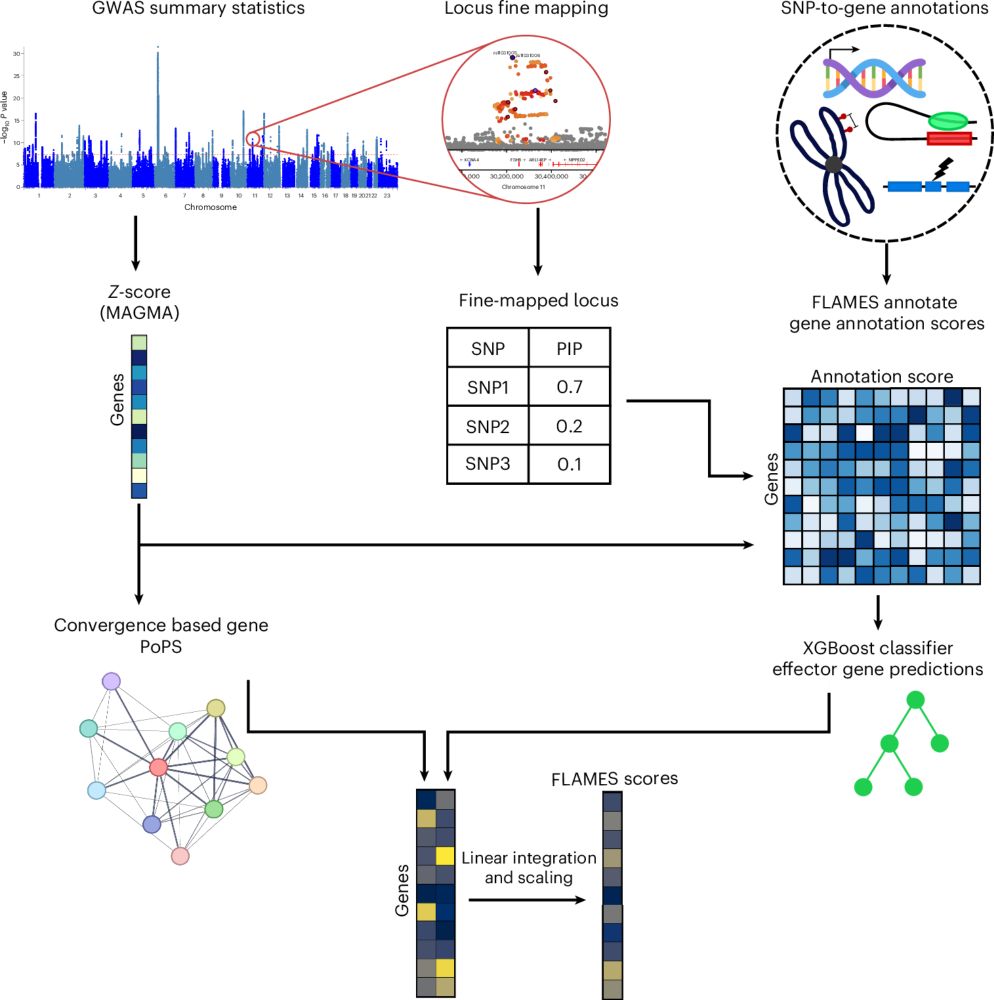
Prioritizing effector genes at trait-associated loci using multimodal evidence
Nature Genetics - FLAMES is a machine learning approach combining variant fine-mapping, SNP-to-gene annotations and convergence-based gene prioritization scores to identify candidate effector genes...
rdcu.be
February 11, 2025 at 9:58 AM
Incredibly proud to see our latest work out in Nature Genetics: www.nature.com/articles/s41...
Here we share our FLAMES framework, which predicts the effector genes in GWAS loci with state-of-the-art precision🔥
Special thanks to @daniposthu.bsky.social
A full thread describing findings below!
Here we share our FLAMES framework, which predicts the effector genes in GWAS loci with state-of-the-art precision🔥
Special thanks to @daniposthu.bsky.social
A full thread describing findings below!
Reposted by Thibaud Boutin 🧬💻 🧀
🚨 This will become a curated list of awesome tools for complex trait genetics, **add yours**! it may become a review in which case those who contribute are invited as co-authors.
GitHub - MichelNivard/awesome-complex-trait-genetics: A list of awesome tools for complex trait genetics.
A list of awesome tools for complex trait genetics. - MichelNivard/awesome-complex-trait-genetics
github.com
November 28, 2024 at 9:21 AM
🚨 This will become a curated list of awesome tools for complex trait genetics, **add yours**! it may become a review in which case those who contribute are invited as co-authors.
Reposted by Thibaud Boutin 🧬💻 🧀

Just out from #ctglab by @mjschipper.bsky.social
- our new tool FLAMES 🔥🔥, to identify the most likely causal genes in GWAS loci, using machine learning techniques, thoroughly benchmarked and freely available
Paper: rdcu.be/d9iQP
Code: github.com/Marijn-Schip...
- our new tool FLAMES 🔥🔥, to identify the most likely causal genes in GWAS loci, using machine learning techniques, thoroughly benchmarked and freely available
Paper: rdcu.be/d9iQP
Code: github.com/Marijn-Schip...

Prioritizing effector genes at trait-associated loci using multimodal evidence
Nature Genetics - FLAMES is a machine learning approach combining variant fine-mapping, SNP-to-gene annotations and convergence-based gene prioritization scores to identify candidate effector genes...
rdcu.be
February 11, 2025 at 8:42 AM
Just out from #ctglab by @mjschipper.bsky.social
- our new tool FLAMES 🔥🔥, to identify the most likely causal genes in GWAS loci, using machine learning techniques, thoroughly benchmarked and freely available
Paper: rdcu.be/d9iQP
Code: github.com/Marijn-Schip...
- our new tool FLAMES 🔥🔥, to identify the most likely causal genes in GWAS loci, using machine learning techniques, thoroughly benchmarked and freely available
Paper: rdcu.be/d9iQP
Code: github.com/Marijn-Schip...
Reposted by Thibaud Boutin 🧬💻 🧀

📣 New paper published in @natcomms.nature.com, where we explored sex differences in local genetic correlations, local heritabilities, and magnitude of effect sizes in quantitative traits.
link: rdcu.be/ezuZd
1/7
link: rdcu.be/ezuZd
1/7

Local genetic sex differences in quantitative traits
Nature Communications - Analysing 157 traits, this study finds widespread local genetic sex differences masked at the genome-wide level. Using LAVA, it tests for sex-specific heritability, genetic...
rdcu.be
August 6, 2025 at 12:51 PM
📣 New paper published in @natcomms.nature.com, where we explored sex differences in local genetic correlations, local heritabilities, and magnitude of effect sizes in quantitative traits.
link: rdcu.be/ezuZd
1/7
link: rdcu.be/ezuZd
1/7
Reposted by Thibaud Boutin 🧬💻 🧀

Good discussion & study-design recommendations in this new preprint by @mikelove.bsky.social @klmohlke.bsky.social & colleagues:
Higher eQTL power reveals signals that boost GWAS colocalization 🧪🧬
www.biorxiv.org/content/10.1...
Higher eQTL power reveals signals that boost GWAS colocalization 🧪🧬
www.biorxiv.org/content/10.1...

Higher eQTL power reveals signals that boost GWAS colocalization
Expression quantitative trait locus (eQTL) studies in human cohorts typically detect at least one regulatory signal per gene, and have been proposed as a way to explain mechanisms of genetic liability...
www.biorxiv.org
August 6, 2025 at 12:45 PM
Good discussion & study-design recommendations in this new preprint by @mikelove.bsky.social @klmohlke.bsky.social & colleagues:
Higher eQTL power reveals signals that boost GWAS colocalization 🧪🧬
www.biorxiv.org/content/10.1...
Higher eQTL power reveals signals that boost GWAS colocalization 🧪🧬
www.biorxiv.org/content/10.1...
Reposted by Thibaud Boutin 🧬💻 🧀

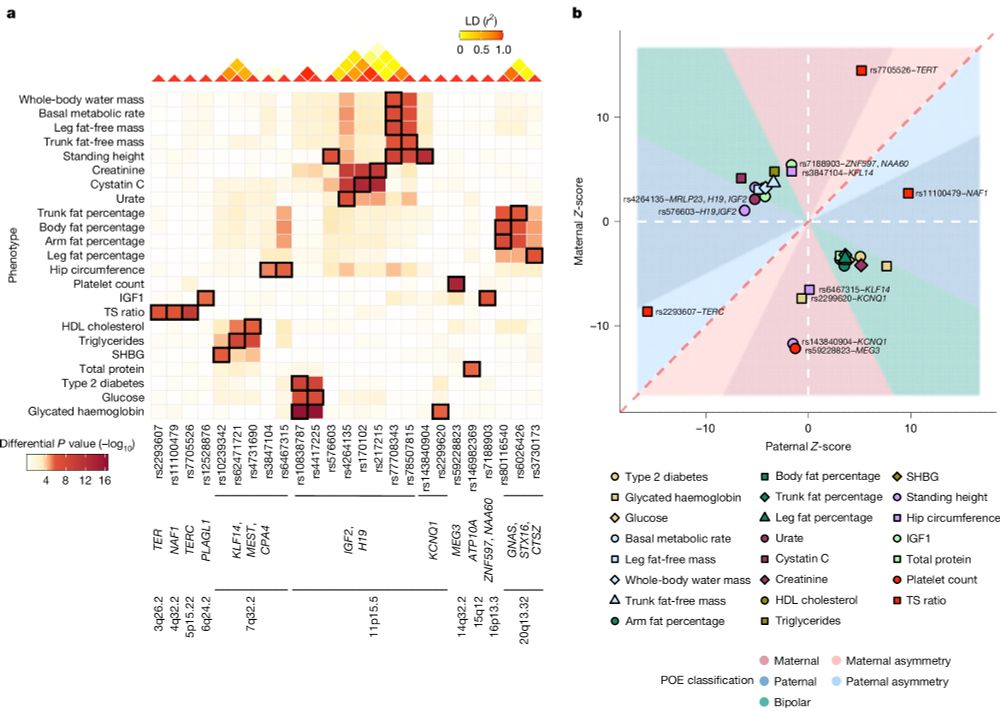
🚨 Our parent-of-origin study is out in Nature! 🧬
Maternal and paternal alleles can have distinct — even opposite — effects on human traits, revealing a hidden layer of genetic architecture that standard GWAS miss.
🔗 www.nature.com/articles/s41...
Highlights below!
Maternal and paternal alleles can have distinct — even opposite — effects on human traits, revealing a hidden layer of genetic architecture that standard GWAS miss.
🔗 www.nature.com/articles/s41...
Highlights below!
August 6, 2025 at 6:27 PM
🚨 Our parent-of-origin study is out in Nature! 🧬
Maternal and paternal alleles can have distinct — even opposite — effects on human traits, revealing a hidden layer of genetic architecture that standard GWAS miss.
🔗 www.nature.com/articles/s41...
Highlights below!
Maternal and paternal alleles can have distinct — even opposite — effects on human traits, revealing a hidden layer of genetic architecture that standard GWAS miss.
🔗 www.nature.com/articles/s41...
Highlights below!
Reposted by Thibaud Boutin 🧬💻 🧀

✅ Published in @natureportfolio.nature.com today, the paper describing the initial whole-genome sequencing analysis of 500,000 UK Biobank participants.
Read here: www.nature.com/articles/s41...
Read here: www.nature.com/articles/s41...
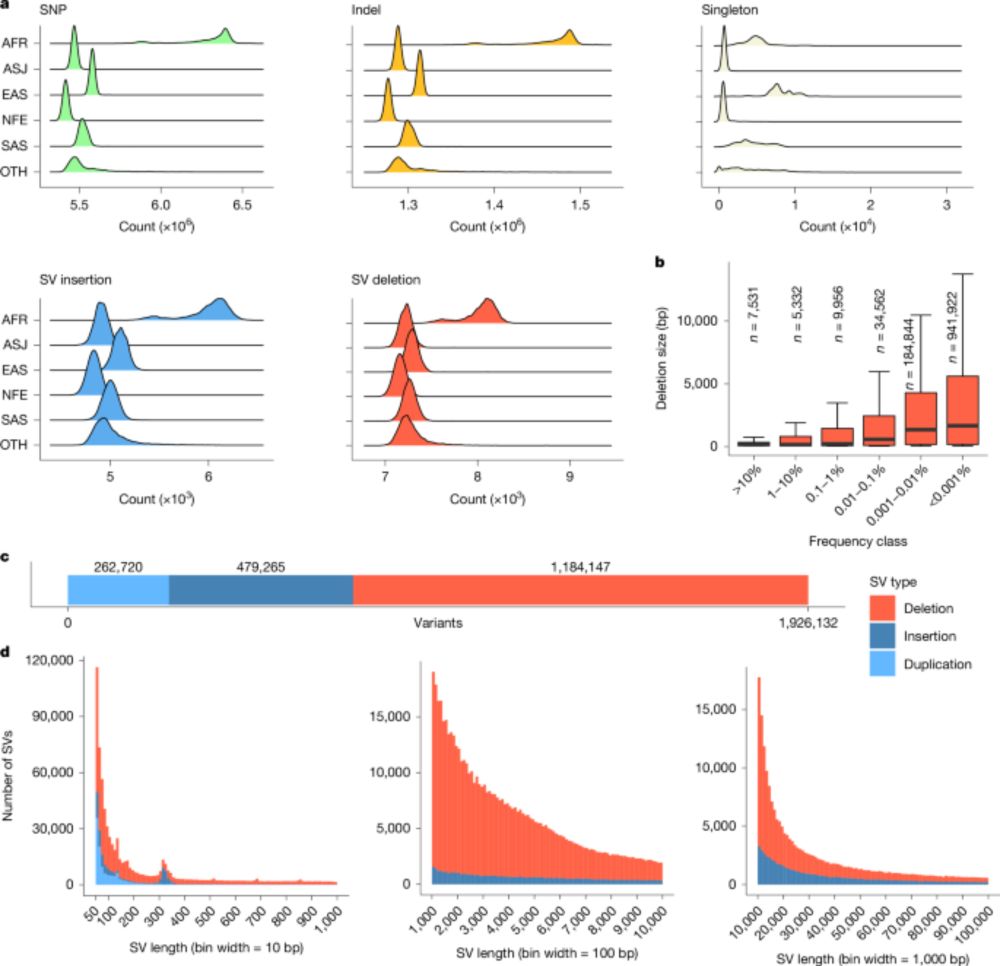
Whole-genome sequencing of 490,640 UK Biobank participants - Nature
A study reports whole-genome sequences for 490,640 participants from the UK Biobank and combines these data with phenotypic data to provide new insights into the relationship between human variation a...
www.nature.com
August 6, 2025 at 3:17 PM
✅ Published in @natureportfolio.nature.com today, the paper describing the initial whole-genome sequencing analysis of 500,000 UK Biobank participants.
Read here: www.nature.com/articles/s41...
Read here: www.nature.com/articles/s41...
Reposted by Thibaud Boutin 🧬💻 🧀

How much do people know and understand what their administrative and health data is used for?
Another story of consent for genetic data use this week.
Another story of consent for genetic data use this week.
The iPSYCH study represents a unique example to understand the ethical and legal challenges of using existing samples/data for health research. A thread 🧵
www.science.org/content/arti...
www.science.org/content/arti...

Blood taken from Danish babies ended up in huge genetic study—without consent
The iPsych project, which investigates the genetics of psychiatric disorders, has sent 140,000 opt-out notices amid backlash
www.science.org
August 6, 2025 at 10:21 AM
How much do people know and understand what their administrative and health data is used for?
Another story of consent for genetic data use this week.
Another story of consent for genetic data use this week.
Reposted by Thibaud Boutin 🧬💻 🧀

If you are new to GWAS, the lectures by Matti Pirinen are a good place to start. Conceptual foundations rather than how to use software.
www.mv.helsinki.fi/home/mjxpiri...
www.mv.helsinki.fi/home/mjxpiri...
July 25, 2025 at 8:08 AM
If you are new to GWAS, the lectures by Matti Pirinen are a good place to start. Conceptual foundations rather than how to use software.
www.mv.helsinki.fi/home/mjxpiri...
www.mv.helsinki.fi/home/mjxpiri...
Reposted by Thibaud Boutin 🧬💻 🧀
Very excited to see this out and delighted to have played a small part -- @courtsmithrun.bsky.social did a deep dive into the pleiotropy of the HLA locus and found tons of cool stuff, including lots of associations at the SNP, HLA allele, and haplotype levels.

📣New today!
📄Haplotype analysis reveals pleiotropic disease associations in the HLA region
🧑🤝🧑 @jkpritch.bsky.social @finngen.bsky.social & colleagues
📄Haplotype analysis reveals pleiotropic disease associations in the HLA region
🧑🤝🧑 @jkpritch.bsky.social @finngen.bsky.social & colleagues

Haplotype analysis reveals pleiotropic disease associations in the HLA region
The HLA region plays an important role in human health but is often excluded in large-scale
GWASs. We performed haplotype-based associations from genotype data to investigate
pleiotropy across thousan...
www.cell.com
July 10, 2025 at 11:15 PM
Very excited to see this out and delighted to have played a small part -- @courtsmithrun.bsky.social did a deep dive into the pleiotropy of the HLA locus and found tons of cool stuff, including lots of associations at the SNP, HLA allele, and haplotype levels.
Reposted by Thibaud Boutin 🧬💻 🧀


This long-shot paper aimed to assess whether common GWAS pipelines are reaching their limits for prediction purposes. The review process was lengthy and painful. We're curious to see how it will fly! All comments are welcome! www.cell.com/hgg-advances...
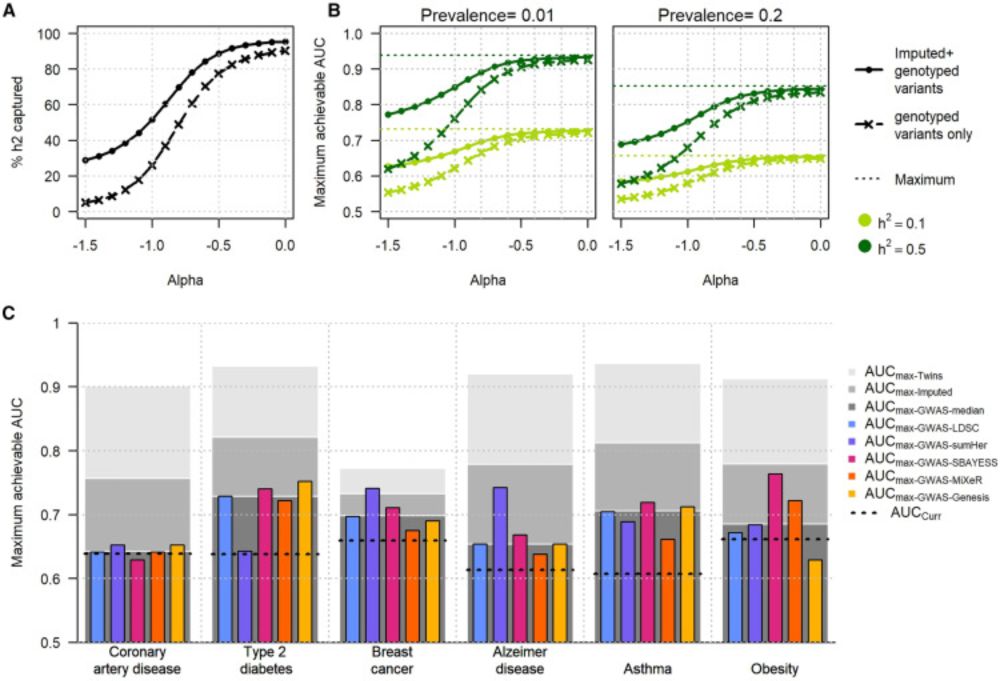
Polygenic risk score prediction accuracy convergence
Polygenic risk prediction has the potential to transform the diagnosis, treatment,
and prevention of many common human diseases. However, the timescale and breadth of
this transformation is partly unk...
www.cell.com
July 1, 2025 at 11:31 AM
Reposted by Thibaud Boutin 🧬💻 🧀

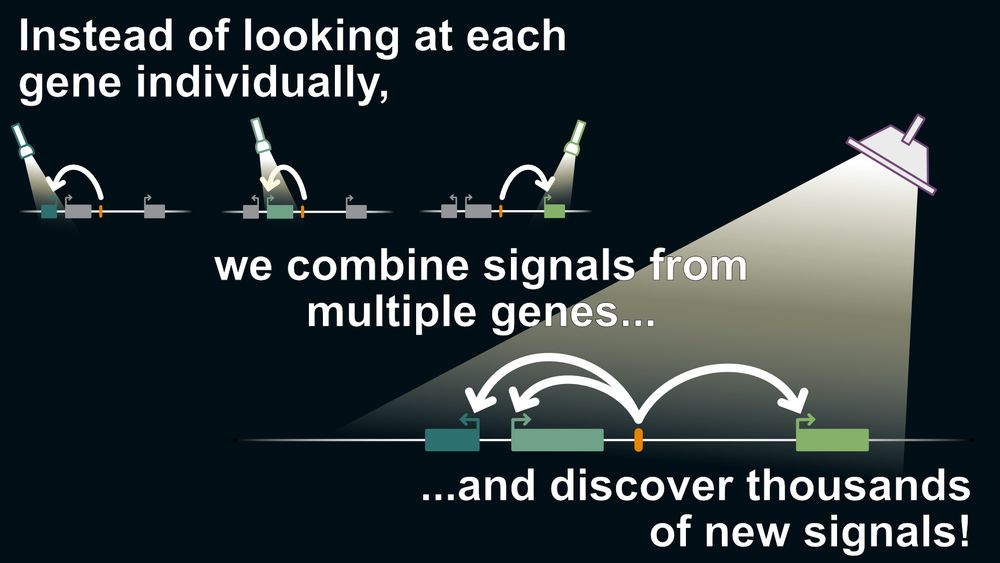
Excited to share my first PhD paper in the @sbmontgom.bsky.social lab with @tamigj.bsky.social (www.biorxiv.org/content/10.1...)! Standard QTL methods treat each gene independently. But what if a single variant regulates multiple nearby genes at once - what we call “allelic proxitropy”? 🧵 ⬇️
June 8, 2025 at 5:39 PM
Excited to share my first PhD paper in the @sbmontgom.bsky.social lab with @tamigj.bsky.social (www.biorxiv.org/content/10.1...)! Standard QTL methods treat each gene independently. But what if a single variant regulates multiple nearby genes at once - what we call “allelic proxitropy”? 🧵 ⬇️