



María Angélica Bravo Núñez
@mariangebravo.bsky.social
HHMI Hanna Gray Fellow and Assistant Professor at @CornellMBG studying the evolution and molecular mechanisms of chromosome segregation in fungi 🍄| PhD @ScienceStowers | she/her | 🇲🇽
Reposted by María Angélica Bravo Núñez

@pravrutharaman.bsky.social got super intrigued about EZHIP/CATACOMB, previously identified as a histone H3K27M mimic of PRC2. You can read about her efforts here: www.biorxiv.org/content/10.6... We hope these analyses will help spur more analyses in this very cool gene! 1/

Dynamic evolution of EZHIP, an inhibitor of the Polycomb Repressive Complex 2 in mammals
The Polycomb Repressive Complex 2 (PRC2) is an ancient, conserved chromatin-interacting complex that controls gene expression, facilitating differentiation and cellular identity during development. It...
www.biorxiv.org
December 13, 2025 at 10:08 PM
@pravrutharaman.bsky.social got super intrigued about EZHIP/CATACOMB, previously identified as a histone H3K27M mimic of PRC2. You can read about her efforts here: www.biorxiv.org/content/10.6... We hope these analyses will help spur more analyses in this very cool gene! 1/
Reposted by María Angélica Bravo Núñez

To all current/future planarian enthusiasts:
The next installment of the North American Planarian Meeting will occur in June 2026 in Ithaca, New York. We welcome anyone who wants to participate, organized by me and Chris Petersen (Northwestern). Please share far and wide. napm2026.weebly.com
The next installment of the North American Planarian Meeting will occur in June 2026 in Ithaca, New York. We welcome anyone who wants to participate, organized by me and Chris Petersen (Northwestern). Please share far and wide. napm2026.weebly.com

December 12, 2025 at 9:24 PM
To all current/future planarian enthusiasts:
The next installment of the North American Planarian Meeting will occur in June 2026 in Ithaca, New York. We welcome anyone who wants to participate, organized by me and Chris Petersen (Northwestern). Please share far and wide. napm2026.weebly.com
The next installment of the North American Planarian Meeting will occur in June 2026 in Ithaca, New York. We welcome anyone who wants to participate, organized by me and Chris Petersen (Northwestern). Please share far and wide. napm2026.weebly.com
Reposted by María Angélica Bravo Núñez

🗞️ New preprint from the lab, led by our postdoc Ana Garoña (not on here) in collab with @andreagiometto.bsky.social: “Experimental evolution of cellular miniaturization reveals a mechanism for cell size evolution”, aka: “honey, we shrank the yeasts!” 🎥
www.biorxiv.org/content/10.6...
www.biorxiv.org/content/10.6...

December 9, 2025 at 5:08 PM
🗞️ New preprint from the lab, led by our postdoc Ana Garoña (not on here) in collab with @andreagiometto.bsky.social: “Experimental evolution of cellular miniaturization reveals a mechanism for cell size evolution”, aka: “honey, we shrank the yeasts!” 🎥
www.biorxiv.org/content/10.6...
www.biorxiv.org/content/10.6...
Reposted by María Angélica Bravo Núñez
So excited to see my PhD work finally being published!!!
It was such a pleasure working with a great team!!!
It was such a pleasure working with a great team!!!
How to keep in step when your (protein) partner speeds up…
Here we investigated the adaptive remodeling of a protein-protein interaction surface essential for telomere protection.
Congrats to whole team!
www.science.org/doi/10.1126/...
Here we investigated the adaptive remodeling of a protein-protein interaction surface essential for telomere protection.
Congrats to whole team!
www.science.org/doi/10.1126/...

Rapid compensatory evolution within a multiprotein complex preserves telomere integrity
Intragenomic conflict with selfish genetic elements spurs adaptive changes in subunits of essential multiprotein complexes. Whether and how these adaptive changes disrupt interactions within such comp...
www.science.org
November 29, 2025 at 5:45 AM
So excited to see my PhD work finally being published!!!
It was such a pleasure working with a great team!!!
It was such a pleasure working with a great team!!!
Reposted by María Angélica Bravo Núñez

Rapid compensatory evolution within a multiprotein complex preserves telomere integrity www.science.org/doi/10.1126/... @levine-lab.bsky.social very cool work

Rapid compensatory evolution within a multiprotein complex preserves telomere integrity
Intragenomic conflict with selfish genetic elements spurs adaptive changes in subunits of essential multiprotein complexes. Whether and how these adaptive changes disrupt interactions within such comp...
www.science.org
November 27, 2025 at 8:43 PM
Rapid compensatory evolution within a multiprotein complex preserves telomere integrity www.science.org/doi/10.1126/... @levine-lab.bsky.social very cool work
Reposted by María Angélica Bravo Núñez
How do new centromeres evolve while staying compatible with the division machinery?
Discover it in our new Nature paper! We show centromeres transition gradually via a mix of drift, selection, and sex, reaching new states that still work with the kinetochore.
👉 doi.org/10.1038/s41586-025-09779-1
Discover it in our new Nature paper! We show centromeres transition gradually via a mix of drift, selection, and sex, reaching new states that still work with the kinetochore.
👉 doi.org/10.1038/s41586-025-09779-1

November 26, 2025 at 4:21 PM
How do new centromeres evolve while staying compatible with the division machinery?
Discover it in our new Nature paper! We show centromeres transition gradually via a mix of drift, selection, and sex, reaching new states that still work with the kinetochore.
👉 doi.org/10.1038/s41586-025-09779-1
Discover it in our new Nature paper! We show centromeres transition gradually via a mix of drift, selection, and sex, reaching new states that still work with the kinetochore.
👉 doi.org/10.1038/s41586-025-09779-1
Reposted by María Angélica Bravo Núñez
Happy to share that my PhD project is finally published!🪱✨
Selfish genes are found across the tree of life. They can disrupt inheritance patterns and at the same time act as units for molecular innovation. Here we tried to answer one big question: how do selfish genes emerge in the first place?
Selfish genes are found across the tree of life. They can disrupt inheritance patterns and at the same time act as units for molecular innovation. Here we tried to answer one big question: how do selfish genes emerge in the first place?

Recurrent evolution of selfishness from an essential tRNA synthetase in Caenorhabditis tropicalis 🧪
www.nature.com/articles/s41...
www.nature.com/articles/s41...

Recurrent evolution of selfishness from an essential tRNA synthetase in Caenorhabditis tropicalis - Nature Ecology & Evolution
In Caenorhabditis tropicalis, three toxin–antidote elements arose via gene duplication from the essential tRNA-synthetase subunit FARS-3. The ancestral antidote probably acquired affinity for FARS-3, ...
www.nature.com
November 24, 2025 at 9:10 PM
Happy to share that my PhD project is finally published!🪱✨
Selfish genes are found across the tree of life. They can disrupt inheritance patterns and at the same time act as units for molecular innovation. Here we tried to answer one big question: how do selfish genes emerge in the first place?
Selfish genes are found across the tree of life. They can disrupt inheritance patterns and at the same time act as units for molecular innovation. Here we tried to answer one big question: how do selfish genes emerge in the first place?
Reposted by María Angélica Bravo Núñez
We're looking for a PhD student! If you're interested in #fungal #genomics & #TEs, meiotic drive, or pathogens, please consider applying. The project is about toxin/antidote genes in the human fungal pathogen A. fumigatus. uu.varbi.com/en/what:job/...

November 19, 2025 at 9:20 AM
We're looking for a PhD student! If you're interested in #fungal #genomics & #TEs, meiotic drive, or pathogens, please consider applying. The project is about toxin/antidote genes in the human fungal pathogen A. fumigatus. uu.varbi.com/en/what:job/...
Reposted by María Angélica Bravo Núñez

Calling all rising juniors & seniors: Interested in biological or biomedical research? Applications for our ’26 Summer Undergraduate Research Experience Program are now open! Nine weeks, hands-on research, & mentorship from some of the nation’s top scientists — learn more: bit.ly/CechFellows

Summer Undergraduate Research Experience | HHMI
The Cech Fellows Program is a paid, nine-week summer research experience empowering the next generation of scientific leaders.
bit.ly
November 18, 2025 at 2:44 PM
Calling all rising juniors & seniors: Interested in biological or biomedical research? Applications for our ’26 Summer Undergraduate Research Experience Program are now open! Nine weeks, hands-on research, & mentorship from some of the nation’s top scientists — learn more: bit.ly/CechFellows
Reposted by María Angélica Bravo Núñez
A bittersweet acceptance: Between a manuscript and grief
Stefanie Williams @sillysciencelady.bsky.social shares the story behind her paper on the synaptonemal complex, including a tribute to her supervisor Scott Hawley, who passed away while Stefanie was completing the research.
Stefanie Williams @sillysciencelady.bsky.social shares the story behind her paper on the synaptonemal complex, including a tribute to her supervisor Scott Hawley, who passed away while Stefanie was completing the research.

A bittersweet acceptance: Between a manuscript and grief - the Node
I was so excited when I received notification that my first first-author research paper was accepted. My excitement quickly turned into sadness with the realization that my co-PI was not seeing our vi...
thenode.biologists.com
November 17, 2025 at 9:58 AM
A bittersweet acceptance: Between a manuscript and grief
Stefanie Williams @sillysciencelady.bsky.social shares the story behind her paper on the synaptonemal complex, including a tribute to her supervisor Scott Hawley, who passed away while Stefanie was completing the research.
Stefanie Williams @sillysciencelady.bsky.social shares the story behind her paper on the synaptonemal complex, including a tribute to her supervisor Scott Hawley, who passed away while Stefanie was completing the research.
Reposted by María Angélica Bravo Núñez
Our NY area population genetics meeting is back and "upgraded", as Simons Foundation @simonsfoundation.org generously agreed to host. Please save the date: March 9, 2026. Look forward to seeing many of you from NY and beyond.
SAVE THE DATE: the yearly NY Population Genetics meeting will be back on March 9 2026, generously hosted by the
@simonsfoundation.org. Details to follow. Please RT.
@simonsfoundation.org. Details to follow. Please RT.
November 14, 2025 at 5:58 PM
Our NY area population genetics meeting is back and "upgraded", as Simons Foundation @simonsfoundation.org generously agreed to host. Please save the date: March 9, 2026. Look forward to seeing many of you from NY and beyond.
Reposted by María Angélica Bravo Núñez

I launched my lab at UMass Amherst this fall. We study the mechanisms of meiotic homolog pairing using advanced live‑cell and super‑resolution imaging. Currently in budding yeast, with plans to expand to other eukaryotes. #Chromosome #Meiosis #Mitosis
www.umass.edu/biology/abou...
www.umass.edu/biology/abou...
November 13, 2025 at 12:13 PM
I launched my lab at UMass Amherst this fall. We study the mechanisms of meiotic homolog pairing using advanced live‑cell and super‑resolution imaging. Currently in budding yeast, with plans to expand to other eukaryotes. #Chromosome #Meiosis #Mitosis
www.umass.edu/biology/abou...
www.umass.edu/biology/abou...
Reposted by María Angélica Bravo Núñez

¿Hiciste tu doctorado en México? ¿Quieres hacer un postdoc en California? ¿Te interesa la genética evolutiva? ¡Checa esta beca y mándame un mensaje! alianzamx.universityofcalifornia.edu/research-and...
Postdoctoral Research Fellowships - University of California Alianza MX
Submitting an Application Current Fellows 2025 Cohort Additional Information Humberger Toggle Menu Interested in applying for a Postdoctoral Research Fellowship? Eligibility The program seeks applican...
alianzamx.universityofcalifornia.edu
November 7, 2025 at 10:47 PM
¿Hiciste tu doctorado en México? ¿Quieres hacer un postdoc en California? ¿Te interesa la genética evolutiva? ¡Checa esta beca y mándame un mensaje! alianzamx.universityofcalifornia.edu/research-and...
Reposted by María Angélica Bravo Núñez

Come be our colleague! The University of Rochester is hiring a TT Assistant Professor in evolutionary genetics and genomics: apply.interfolio.com/173431.
Apply - Interfolio
{{$ctrl.$state.data.pageTitle}} - Apply - Interfolio
apply.interfolio.com
October 29, 2025 at 2:12 PM
Come be our colleague! The University of Rochester is hiring a TT Assistant Professor in evolutionary genetics and genomics: apply.interfolio.com/173431.
Reposted by María Angélica Bravo Núñez
Interesting to see new papers connecting Pol II stalling to heterochromatin formation.
www.cell.com/molecular-ce...
Reminiscent of our work in S. pombe:
pmc.ncbi.nlm.nih.gov/articles/PMC...
www.cell.com/molecular-ce...
Reminiscent of our work in S. pombe:
pmc.ncbi.nlm.nih.gov/articles/PMC...
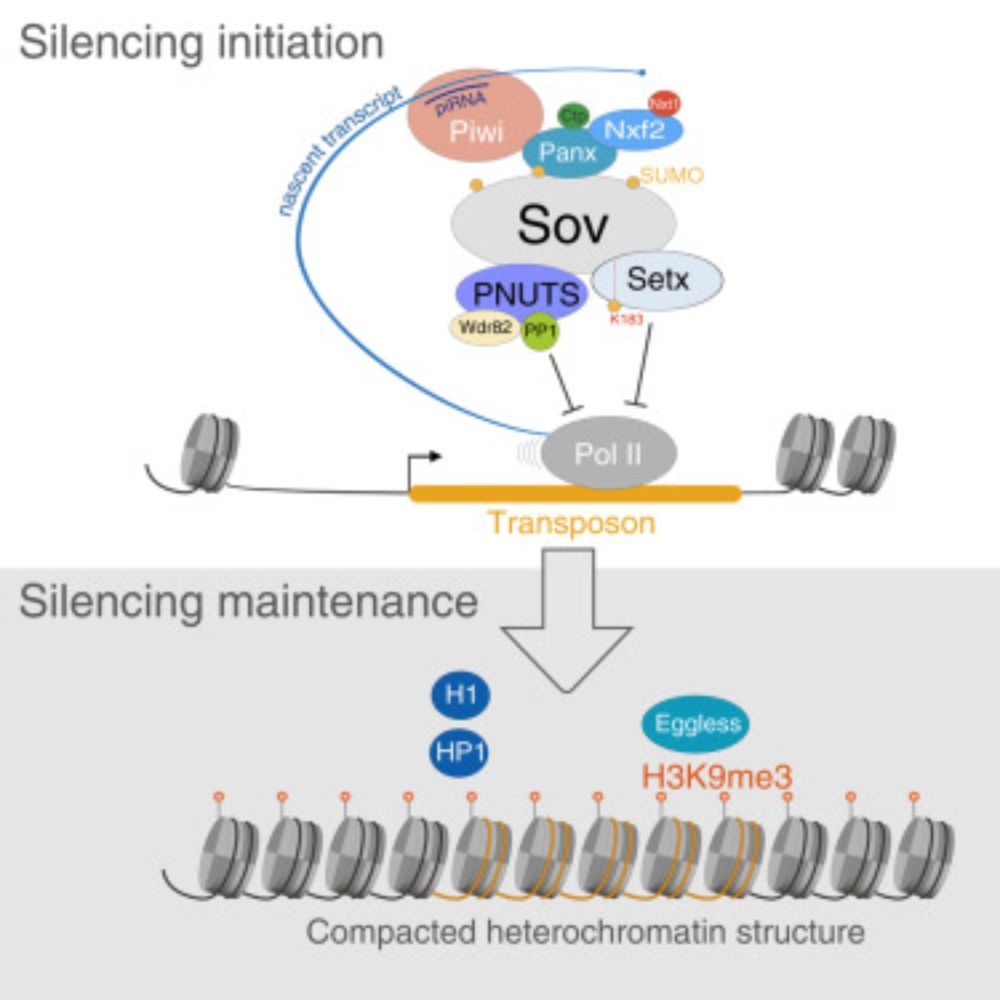
The Piwi-piRNA complex initiates transposon silencing via transcription termination factors PNUTS and Senataxin
Wu et al. reveal that the SFiNX complex triggers transposon silencing through the
association of Sov with two transcription termination factors, PNUTS and Senataxin,
leading to RNA Pol II stalling. Th...
www.cell.com
October 29, 2025 at 3:47 PM
Interesting to see new papers connecting Pol II stalling to heterochromatin formation.
www.cell.com/molecular-ce...
Reminiscent of our work in S. pombe:
pmc.ncbi.nlm.nih.gov/articles/PMC...
www.cell.com/molecular-ce...
Reminiscent of our work in S. pombe:
pmc.ncbi.nlm.nih.gov/articles/PMC...
Reposted by María Angélica Bravo Núñez
Please help distribute this announcement for the Ph.D. in Biology Program @stowersinstitute.bsky.social

October 29, 2025 at 6:15 PM
Please help distribute this announcement for the Ph.D. in Biology Program @stowersinstitute.bsky.social
Reposted by María Angélica Bravo Núñez

Please help distribute this announcement for the Ph.D. in Biology Program @stowersinstitute.bsky.social
October 29, 2025 at 6:17 PM
Reposted by María Angélica Bravo Núñez

Reposted by María Angélica Bravo Núñez

Fungal #GenomeSize variation is largely driven by TEs & lineage-specific genome defenses. @tbadet.bsky.social & @danielcroll.bsky.social show that presence/absence of RIP mutation systems influences #genome architecture, identifying a likely novel defense mechanism @plosbiology.org 🧪 plos.io/4hcC5tx

October 16, 2025 at 12:55 PM
Fungal #GenomeSize variation is largely driven by TEs & lineage-specific genome defenses. @tbadet.bsky.social & @danielcroll.bsky.social show that presence/absence of RIP mutation systems influences #genome architecture, identifying a likely novel defense mechanism @plosbiology.org 🧪 plos.io/4hcC5tx
Reposted by María Angélica Bravo Núñez
Looking for science and fun by the ocean next June?🧬🌊
Join at the GSA Yeast 2026 meeting in beautiful Asilomar, Pacific Grove, CA!
📅 Save the date: June 14–18, 2026
➡️ genetics-gsa.org/yeast-2026/
Join at the GSA Yeast 2026 meeting in beautiful Asilomar, Pacific Grove, CA!
📅 Save the date: June 14–18, 2026
➡️ genetics-gsa.org/yeast-2026/

Homepage - Yeast Genetics Meeting 2026
Visit our website to learn more.
genetics-gsa.org
October 10, 2025 at 5:57 AM
Looking for science and fun by the ocean next June?🧬🌊
Join at the GSA Yeast 2026 meeting in beautiful Asilomar, Pacific Grove, CA!
📅 Save the date: June 14–18, 2026
➡️ genetics-gsa.org/yeast-2026/
Join at the GSA Yeast 2026 meeting in beautiful Asilomar, Pacific Grove, CA!
📅 Save the date: June 14–18, 2026
➡️ genetics-gsa.org/yeast-2026/
Reposted by María Angélica Bravo Núñez
The Peters lab is looking for a new team member! The role transposons play in evolution, basic mechanisms regulating transposition, and applying transposons as tools for genome modification with a special focus on guide RNA-directed transposition. cornell.wd1.myworkdayjobs.com/CornellCaree...

Technician III - Department of Microbiology
Position Summary This position will be in the lab of Dr. Joseph E. Peters in the Department of Microbiology. Research in the Peters’ lab broadly involves deciphering mechanisms in genome stability and...
cornell.wd1.myworkdayjobs.com
October 3, 2025 at 1:01 PM
The Peters lab is looking for a new team member! The role transposons play in evolution, basic mechanisms regulating transposition, and applying transposons as tools for genome modification with a special focus on guide RNA-directed transposition. cornell.wd1.myworkdayjobs.com/CornellCaree...
Reposted by María Angélica Bravo Núñez
#Wolbachia has puzzled scientists with its power to rewire insect reproduction. What if I tell you that we found one of the keys Wolbachia use to rewire its host AND a small molecule inhibitor uses this key to mimic what this microbe has mastered for millions of years.
www.cell.com/cell-reports...
www.cell.com/cell-reports...

Beyond Wolbachia—Can a small molecule control insect reproduction?
Kaur et al. demonstrate reduced histone acetylation as a key mechanism underpinning
Wolbachia’s paternal-effect embryonic lethality trait in Drosophila melanogaster.
Recapitulation of this trait by in...
www.cell.com
October 3, 2025 at 12:58 PM
#Wolbachia has puzzled scientists with its power to rewire insect reproduction. What if I tell you that we found one of the keys Wolbachia use to rewire its host AND a small molecule inhibitor uses this key to mimic what this microbe has mastered for millions of years.
www.cell.com/cell-reports...
www.cell.com/cell-reports...
Reposted by María Angélica Bravo Núñez

Just throwing this out there as a significant conceptual advance in the field
www.biorxiv.org/content/10.1...
www.biorxiv.org/content/10.1...

The Eukaryotic homology search complex distorts donor DNA structure to probe for homology
Homologous recombination (HR) is a DNA double-strand break repair pathway that facilitates genetic exchange and protects damaged replication forks during DNA synthesis. As a template-based repair proc...
www.biorxiv.org
September 17, 2025 at 6:23 PM
Just throwing this out there as a significant conceptual advance in the field
www.biorxiv.org/content/10.1...
www.biorxiv.org/content/10.1...
Reposted by María Angélica Bravo Núñez
This week we said farewell to the amazing @caitlinkowa.bsky.social as she moves to start her new lab at Dartmouth. So grateful for all her leadership and mentoring the last few years.
If you’re interested in all things skin microbes (especially fungi) check out her lab! I can’t recommend enough.
If you’re interested in all things skin microbes (especially fungi) check out her lab! I can’t recommend enough.
HOME
Visit the post for more.
caitlinkowalski.com
August 1, 2025 at 12:05 AM
This week we said farewell to the amazing @caitlinkowa.bsky.social as she moves to start her new lab at Dartmouth. So grateful for all her leadership and mentoring the last few years.
If you’re interested in all things skin microbes (especially fungi) check out her lab! I can’t recommend enough.
If you’re interested in all things skin microbes (especially fungi) check out her lab! I can’t recommend enough.
Reposted by María Angélica Bravo Núñez
I finally decided to be more active here after missing the science side of twitter. Please check out my paper, "IRE1α promotes phagosomal calcium flux to enhance macrophage fungicidal activity" with @drbadbug.bsky.social and @teresaomeara.bsky.social!
www.cell.com/cell-reports...
www.cell.com/cell-reports...
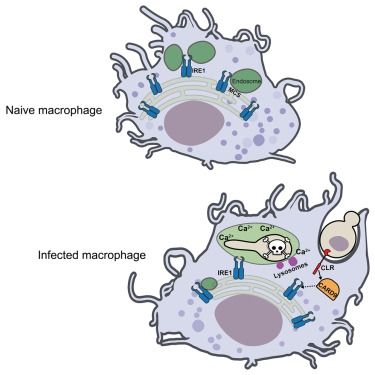
IRE1α promotes phagosomal calcium flux to enhance macrophage fungicidal activity
McFadden et al. find the endoplasmic reticulum (ER) stress sensor inositol-requiring
enzyme 1α (IRE1α) is activated by C-type lectin receptor signaling during Candida
albicans infection without protei...
www.cell.com
June 17, 2025 at 10:02 PM
I finally decided to be more active here after missing the science side of twitter. Please check out my paper, "IRE1α promotes phagosomal calcium flux to enhance macrophage fungicidal activity" with @drbadbug.bsky.social and @teresaomeara.bsky.social!
www.cell.com/cell-reports...
www.cell.com/cell-reports...