



Westermann Lab
@westermannlab.bsky.social
Microbiota RNA Lab at the University of Würzburg and the Helmholtz Institute for RNA-based Infection Research.
https://www.helmholtz-hiri.de/en/research/associated-scientists-alumni/teams/team/host-pathogen-microbiota-interactions/
https://www.helmholtz-hiri.de/en/research/associated-scientists-alumni/teams/team/host-pathogen-microbiota-interactions/
3′UTR-derived small RNA couples acid resistance to metabolic reprogramming of Salmonella within macrophages url: academic.oup.com/nar/article/...

3′UTR-derived small RNA couples acid resistance to metabolic reprogramming of Salmonella within macrophages
Abstract. Acid resistance is crucial for enterobacteria to withstand host acidic environments during infection, including the gastrointestinal tract and ma
academic.oup.com
January 7, 2026 at 8:19 AM
3′UTR-derived small RNA couples acid resistance to metabolic reprogramming of Salmonella within macrophages url: academic.oup.com/nar/article/...
RIL-seq boosts the study of sRNAs. Here comes its first application to intracellular bacteria. Plus, 10 years after its characterization, we now present an RNA sponge of Salmonella PinT.
Congrats to @kooshapour.bsky.social & great collaboration w/ @jorg-vogel-lab.bsky.social!
doi.org/10.1093/nar/...
Congrats to @kooshapour.bsky.social & great collaboration w/ @jorg-vogel-lab.bsky.social!
doi.org/10.1093/nar/...

Intramacrophage RIL-seq uncovers an RNA antagonist of the Salmonella virulence-associated small RNA PinT
Abstract. Salmonella virulence chiefly relies upon two major pathogenicity islands, SPI-1 and SPI-2, which enable host cell invasion and intracellular surv
doi.org
December 27, 2025 at 2:06 PM
RIL-seq boosts the study of sRNAs. Here comes its first application to intracellular bacteria. Plus, 10 years after its characterization, we now present an RNA sponge of Salmonella PinT.
Congrats to @kooshapour.bsky.social & great collaboration w/ @jorg-vogel-lab.bsky.social!
doi.org/10.1093/nar/...
Congrats to @kooshapour.bsky.social & great collaboration w/ @jorg-vogel-lab.bsky.social!
doi.org/10.1093/nar/...
🎓 Congrats to Elise Bornet, who completed her PhD this week! Her courageous work dissected morphological heterogeneity in predominant human gut commensals, and yielded an ultra-sensitive transcriptomics pipeline to sequence the RNA content of single Bacteroides cells. doi.org/10.1016/j.ce...

December 20, 2025 at 10:06 AM
🎓 Congrats to Elise Bornet, who completed her PhD this week! Her courageous work dissected morphological heterogeneity in predominant human gut commensals, and yielded an ultra-sensitive transcriptomics pipeline to sequence the RNA content of single Bacteroides cells. doi.org/10.1016/j.ce...
Reposted by Westermann Lab

Grateful to be among the 25 inspiring women featured in @zeit.de as part of the #Zia fellowship for Visible Women in Science. Thanks to @uni-wuerzburg.de for their support and to everyone involved for making scientific work by women more visible. Honored and proud to be part of this initiative ☺️.

December 19, 2025 at 3:24 PM
Grateful to be among the 25 inspiring women featured in @zeit.de as part of the #Zia fellowship for Visible Women in Science. Thanks to @uni-wuerzburg.de for their support and to everyone involved for making scientific work by women more visible. Honored and proud to be part of this initiative ☺️.
Reposted by Westermann Lab

Our new paper from my PhD work is online. It shows how bacterial population structure can trick machine learning—sampling matters! Many thanks to @lbarquist.bsky.social for the support and guidance! dx.plos.org/10.1371/jour...

Biased sampling driven by bacterial population structure confounds machine learning prediction of antimicrobial resistance
Machine learning methods have emerged as promising tools to predict antimicrobial resistance (AMR) and uncover resistance determinants from genomic data. This study shows that sampling biases driven b...
dx.plos.org
December 16, 2025 at 8:49 PM
Our new paper from my PhD work is online. It shows how bacterial population structure can trick machine learning—sampling matters! Many thanks to @lbarquist.bsky.social for the support and guidance! dx.plos.org/10.1371/jour...
Reposted by Westermann Lab

How does a bacterial small RNA evolve new functions?
Our new study reveals the stepwise evolutionary journey of UhpU, a 3′UTR-derived sRNA in E. coli and relatives. It evolved from a metabolically-focused regulator to one with expanded targets and biogenesis manner.
www.pnas.org/doi/10.1073/...
Our new study reveals the stepwise evolutionary journey of UhpU, a 3′UTR-derived sRNA in E. coli and relatives. It evolved from a metabolically-focused regulator to one with expanded targets and biogenesis manner.
www.pnas.org/doi/10.1073/...

December 4, 2025 at 7:50 PM
How does a bacterial small RNA evolve new functions?
Our new study reveals the stepwise evolutionary journey of UhpU, a 3′UTR-derived sRNA in E. coli and relatives. It evolved from a metabolically-focused regulator to one with expanded targets and biogenesis manner.
www.pnas.org/doi/10.1073/...
Our new study reveals the stepwise evolutionary journey of UhpU, a 3′UTR-derived sRNA in E. coli and relatives. It evolved from a metabolically-focused regulator to one with expanded targets and biogenesis manner.
www.pnas.org/doi/10.1073/...
🔊 Interested in doing a PhD on RNA-binding proteins in an abundant microbiota species and becoming a member of the German Priority Programme “Illuminating Gene Functions in the Human Gut Microbiome”? Apply here: www.uni-wuerzburg.de/karriere/sin...
Job offer for a PhD student position at the Chair of Microbiology
www.uni-wuerzburg.de
December 1, 2025 at 9:20 AM
🔊 Interested in doing a PhD on RNA-binding proteins in an abundant microbiota species and becoming a member of the German Priority Programme “Illuminating Gene Functions in the Human Gut Microbiome”? Apply here: www.uni-wuerzburg.de/karriere/sin...
Reposted by Westermann Lab

De-DUFing the DUFs 🧩 @franznarberhaus.bsky.social lab uncovers how small DUF1127 proteins regulate #phosphate uptake by binding the sensor kinase PhoR. Their conserved role from Agrobacterium to E. coli highlights how even small DUFs can shape bacterial physiology 🦠
buff.ly/jJd9Eho
buff.ly/jJd9Eho

October 21, 2025 at 7:02 AM
De-DUFing the DUFs 🧩 @franznarberhaus.bsky.social lab uncovers how small DUF1127 proteins regulate #phosphate uptake by binding the sensor kinase PhoR. Their conserved role from Agrobacterium to E. coli highlights how even small DUFs can shape bacterial physiology 🦠
buff.ly/jJd9Eho
buff.ly/jJd9Eho
Reposted by Westermann Lab

Excited to share our preprint led by Carlos Voogdt et al
We developed new genetic tools & genome-wide libraries for species of the Bacteroidales order; constructed saturated barcoded transposon libraries in key representatives of three genera.
www.biorxiv.org/content/10.1...
We developed new genetic tools & genome-wide libraries for species of the Bacteroidales order; constructed saturated barcoded transposon libraries in key representatives of three genera.
www.biorxiv.org/content/10.1...

October 13, 2025 at 7:48 AM
Excited to share our preprint led by Carlos Voogdt et al
We developed new genetic tools & genome-wide libraries for species of the Bacteroidales order; constructed saturated barcoded transposon libraries in key representatives of three genera.
www.biorxiv.org/content/10.1...
We developed new genetic tools & genome-wide libraries for species of the Bacteroidales order; constructed saturated barcoded transposon libraries in key representatives of three genera.
www.biorxiv.org/content/10.1...
Reposted by Westermann Lab

How to search for unknown RNA-binding proteins? We did GradR in the cyanobacterium Synechocystis 6803. And now our paper „RAPDOR: Using Jensen-Shannon Distance for the computational analysis of complex proteomics dataset“ is finally out in Nature Communications, here: rdcu.be/eImcr .

RAPDOR: Using Jensen-Shannon Distance for the computational analysis of complex proteomics datasets
Nature Communications - RNA-binding proteins play key roles in post-transcriptional gene regulation. Here, Hemm et al. developed RAPDOR, a widely applicable tool based on Jensen-Shannon Distance...
rdcu.be
September 26, 2025 at 3:51 PM
How to search for unknown RNA-binding proteins? We did GradR in the cyanobacterium Synechocystis 6803. And now our paper „RAPDOR: Using Jensen-Shannon Distance for the computational analysis of complex proteomics dataset“ is finally out in Nature Communications, here: rdcu.be/eImcr .
Congrats to Ann-Sophie Rüttiger who successfully defended her PhD this week! 🎓
She focused on global RNA-binding proteins in Bacteroides—bacteria lacking Hfq, ProQ, CsrA, Khp—culminating in the discovery of a post-transcriptional network governed by RbpB (www.nature.com/articles/s41467-024-55383-8).
She focused on global RNA-binding proteins in Bacteroides—bacteria lacking Hfq, ProQ, CsrA, Khp—culminating in the discovery of a post-transcriptional network governed by RbpB (www.nature.com/articles/s41467-024-55383-8).

September 25, 2025 at 10:06 AM
Congrats to Ann-Sophie Rüttiger who successfully defended her PhD this week! 🎓
She focused on global RNA-binding proteins in Bacteroides—bacteria lacking Hfq, ProQ, CsrA, Khp—culminating in the discovery of a post-transcriptional network governed by RbpB (www.nature.com/articles/s41467-024-55383-8).
She focused on global RNA-binding proteins in Bacteroides—bacteria lacking Hfq, ProQ, CsrA, Khp—culminating in the discovery of a post-transcriptional network governed by RbpB (www.nature.com/articles/s41467-024-55383-8).
Reposted by Westermann Lab

Looking for a new approach to studying or eliminating phages? Check out our study introducing anti-phage ASOs (antisense oligos) out in @Nature today. nature.com/articles/s4158…

September 10, 2025 at 3:40 PM
Looking for a new approach to studying or eliminating phages? Check out our study introducing anti-phage ASOs (antisense oligos) out in @Nature today. nature.com/articles/s4158…
New preprint from the lab, in collaboration with Wenhan Zhu (U Vanderbilt): using dual RNA-seq during B. theta colonization of the host mucous layer, we identify IroR--an iron-response sRNA that tunes capsule expression and facilitates adaptation to iron limitation.
doi.org/10.1101/2025.09.08.672848
doi.org/10.1101/2025.09.08.672848

An RNA regulates iron homeostasis and host mucus colonization in Bacteroides thetaiotaomicron
Symbiotic bacteria in the human intestinal microbiota provide many pivotal functions to human health and occupy distinct biogeographic niches within the gut. Yet the molecular basis underlying niche-s...
doi.org
September 9, 2025 at 7:49 AM
New preprint from the lab, in collaboration with Wenhan Zhu (U Vanderbilt): using dual RNA-seq during B. theta colonization of the host mucous layer, we identify IroR--an iron-response sRNA that tunes capsule expression and facilitates adaptation to iron limitation.
doi.org/10.1101/2025.09.08.672848
doi.org/10.1101/2025.09.08.672848
Reposted by Westermann Lab
Starting the meeting microbes and RNA- Gerhart on stage - lifetime achievement Lecture - congrats Gerhart!

September 1, 2025 at 2:19 PM
Starting the meeting microbes and RNA- Gerhart on stage - lifetime achievement Lecture - congrats Gerhart!
Reposted by Westermann Lab
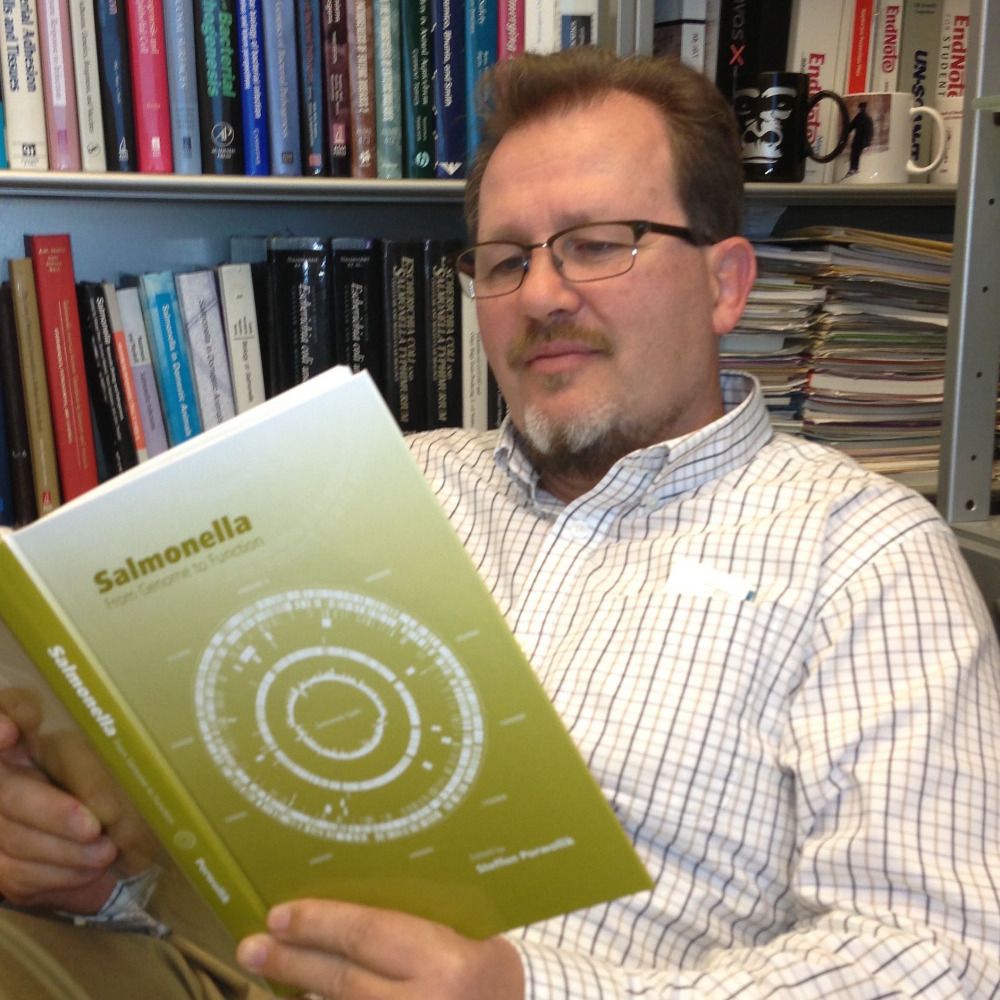
A Salmonella T3SS-2 mutant grows fine in spleen macrophages, contradicting tissue culture dogma (PMID: 23236281). This observation was largely ignored, but adding certain carbon sources rescues growth in cultured macrophages, hinting that T3SS-2 may be doing something entirely different in vivo.

New pre-print in the lab! Beautiful work by Francisco Garcia-Rodriguez in collab with @kamovalenz.bsky.social
and @joaquinbernal.bsky.social : when macrophages are provided with specific nutrients, Salmonella can bypass its requirement of the T3SS to replicate, a process that occurs within the SCV
and @joaquinbernal.bsky.social : when macrophages are provided with specific nutrients, Salmonella can bypass its requirement of the T3SS to replicate, a process that occurs within the SCV

Provision of Preferred Nutrients to Macrophages Enables Salmonella to Replicate Intracellularly Without Relying on Type III Secretion Systems https://www.biorxiv.org/content/10.1101/2025.05.15.653970v1
August 9, 2025 at 12:18 AM
A Salmonella T3SS-2 mutant grows fine in spleen macrophages, contradicting tissue culture dogma (PMID: 23236281). This observation was largely ignored, but adding certain carbon sources rescues growth in cultured macrophages, hinting that T3SS-2 may be doing something entirely different in vivo.
Latest preprint from the lab: doi.org/10.1101/2025...
In this study lead by @lenaamend.bsky.social from the group, we explore carbon cross-feeding between a gut commensal and an enteropathogen. Can we counter infection by cutting sugar supply to pathogens?
In this study lead by @lenaamend.bsky.social from the group, we explore carbon cross-feeding between a gut commensal and an enteropathogen. Can we counter infection by cutting sugar supply to pathogens?
Ablation of polysaccharide breakdown in Bacteroides thetaiotaomicron prevents cross-feeding and growth of Salmonella Typhimurium in the mouse gut
Pathogens invading the intestine compete for nutrients with the resident microbiota. However, there is evidence that commensal members of the gut also provide nutritional resources to enteropathogens ...
doi.org
August 17, 2025 at 6:13 AM
Latest preprint from the lab: doi.org/10.1101/2025...
In this study lead by @lenaamend.bsky.social from the group, we explore carbon cross-feeding between a gut commensal and an enteropathogen. Can we counter infection by cutting sugar supply to pathogens?
In this study lead by @lenaamend.bsky.social from the group, we explore carbon cross-feeding between a gut commensal and an enteropathogen. Can we counter infection by cutting sugar supply to pathogens?
Reposted by Westermann Lab

Absolutely delighted to share the labs latest work. We identify and characterise two pathways for D-ribulose utilisation in pathogenic EHEC and Citrobacter.
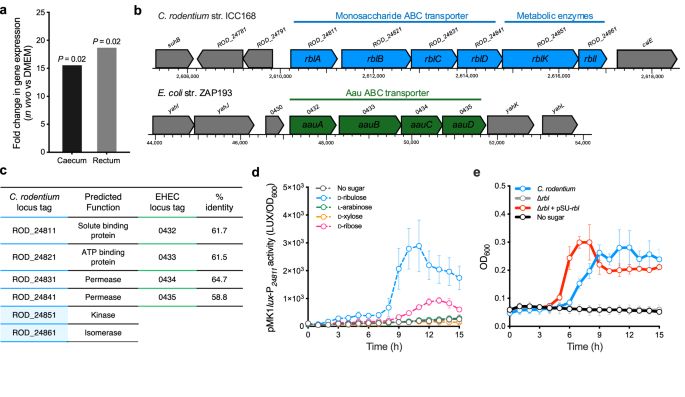
Convergent evolution of distinct D-ribulose utilisation pathways in attaching and effacing pathogens - Nature Communications
Cottam et al. identify distinct pathways for D-ribulose utilisation in pathogenic Escherichia coli and Citrobacter rodentium, providing mechanistic details and suggesting convergent evolution towards ...
www.nature.com
July 30, 2025 at 9:24 AM
Absolutely delighted to share the labs latest work. We identify and characterise two pathways for D-ribulose utilisation in pathogenic EHEC and Citrobacter.
Reposted by Westermann Lab
Finally online!
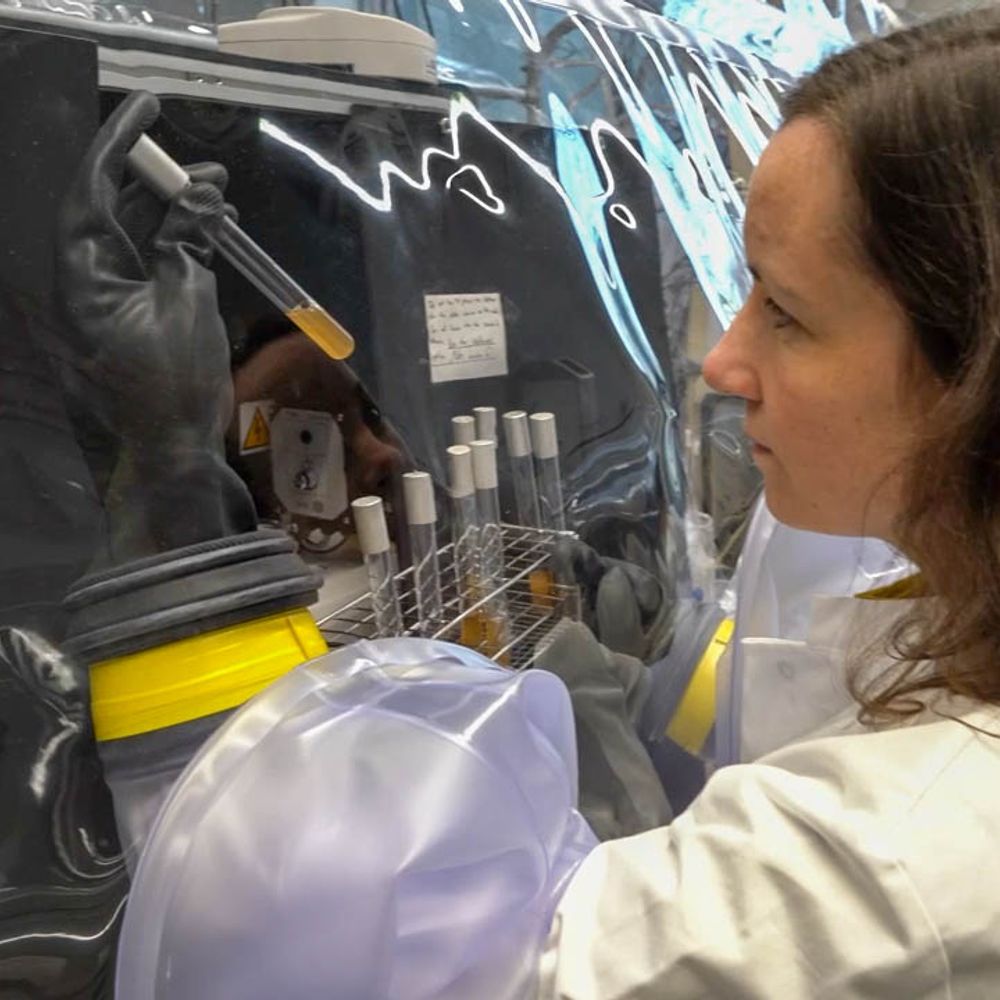
Our latest research is out @nature.com: We show that non-antibiotic drugs can disrupt colonization resistance, raising the risk of enteric infections.
rdcu.be/ewwrG
Our latest research is out @nature.com: We show that non-antibiotic drugs can disrupt colonization resistance, raising the risk of enteric infections.
rdcu.be/ewwrG
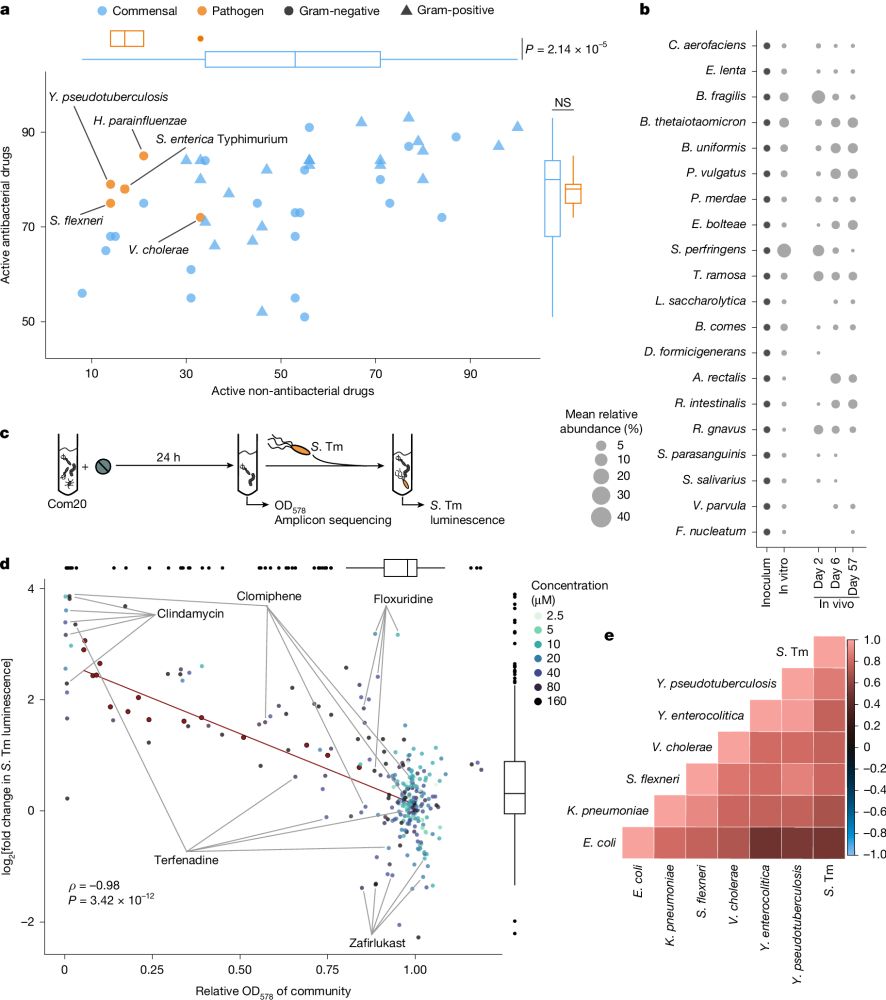
Non-antibiotics disrupt colonization resistance against enteropathogens
Nature - Non-antibiotic drugs from a wide range of therapeutic classes can alter the ability of gut commensals to resist invasion by enteropathogens, a previously underappreciated side effect of...
rdcu.be
July 16, 2025 at 9:20 PM
Finally online!
Our latest research is out @nature.com: We show that non-antibiotic drugs can disrupt colonization resistance, raising the risk of enteric infections.
rdcu.be/ewwrG
Our latest research is out @nature.com: We show that non-antibiotic drugs can disrupt colonization resistance, raising the risk of enteric infections.
rdcu.be/ewwrG
Reposted by Westermann Lab

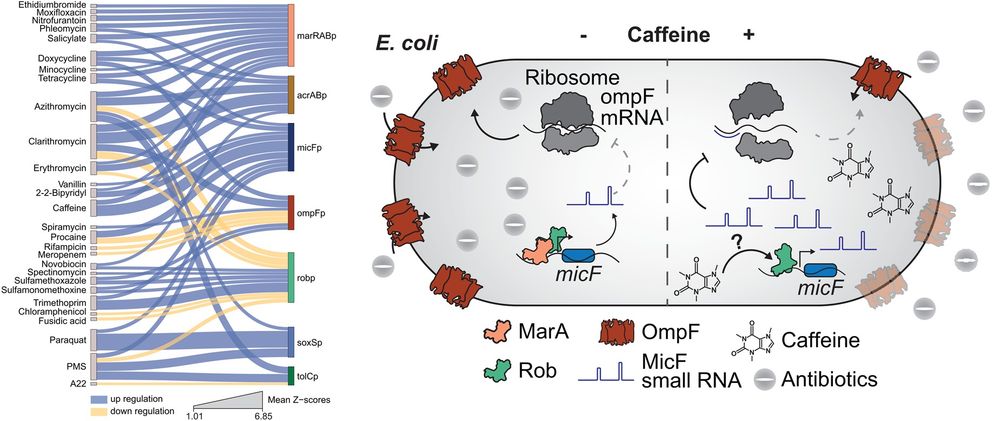
How are bacterial transport machineries regulated by external cues? @brochadolab.bsky.social &co identify environmental chemicals that regulate #transporter transcription, identifying the TF Rob as a key modulator of #EffluxPump expression in #Ecoli #AMR @plosbiology.org 🧪 plos.io/46pUM9Q
July 23, 2025 at 9:20 AM
How are bacterial transport machineries regulated by external cues? @brochadolab.bsky.social &co identify environmental chemicals that regulate #transporter transcription, identifying the TF Rob as a key modulator of #EffluxPump expression in #Ecoli #AMR @plosbiology.org 🧪 plos.io/46pUM9Q
Reposted by Westermann Lab

New preprint! We characterise the small, regulatory RNA Arp which controls DNA uptake and twitching motilty in A. baumannii. Led by our Dr Fergal Hamrock @hamrockfergal.bsky.social and in collaboration with @westermannlab.bsky.social and Mike Gebhardt's lab!
DNA uptake and twitching motility are controlled by the small RNA Arp through repression of pilin translation in Acinetobacter baumannii https://www.biorxiv.org/content/10.1101/2025.07.19.665661v1
July 21, 2025 at 2:56 PM
New preprint! We characterise the small, regulatory RNA Arp which controls DNA uptake and twitching motilty in A. baumannii. Led by our Dr Fergal Hamrock @hamrockfergal.bsky.social and in collaboration with @westermannlab.bsky.social and Mike Gebhardt's lab!
Congrats to Gianluca Prezza (@gprezza.bsky.social) for reveiving the 2025 PhD Award from the Friends of the Helmholtz Centre for Infection Research (HZI)!👏 The award honours excellent PhD theses from the field of life sciences at HZI partner universities. His thesis focused Bacteroides' RNA biology.

Beim gestrigen Festakt wurden zudem die HZI-Promotionspreise an Wenchao Li @ciim-hannover.bsky.social und @gprezza.bsky.social aus der Gruppe von @westermannlab.bsky.social @helmholtz-hiri.bsky.social verliehen. Wir gratulieren den beiden zu ihren ausgezeichneten Doktorarbeiten!
July 11, 2025 at 9:35 AM
Congrats to Gianluca Prezza (@gprezza.bsky.social) for reveiving the 2025 PhD Award from the Friends of the Helmholtz Centre for Infection Research (HZI)!👏 The award honours excellent PhD theses from the field of life sciences at HZI partner universities. His thesis focused Bacteroides' RNA biology.
Very honored that our recent study on Bacteroides morphotypes was spotlighted 🔦 in Trends in Microbiology by Eric Martens & Qinnan Yang: www.cell.com/trends/micro....
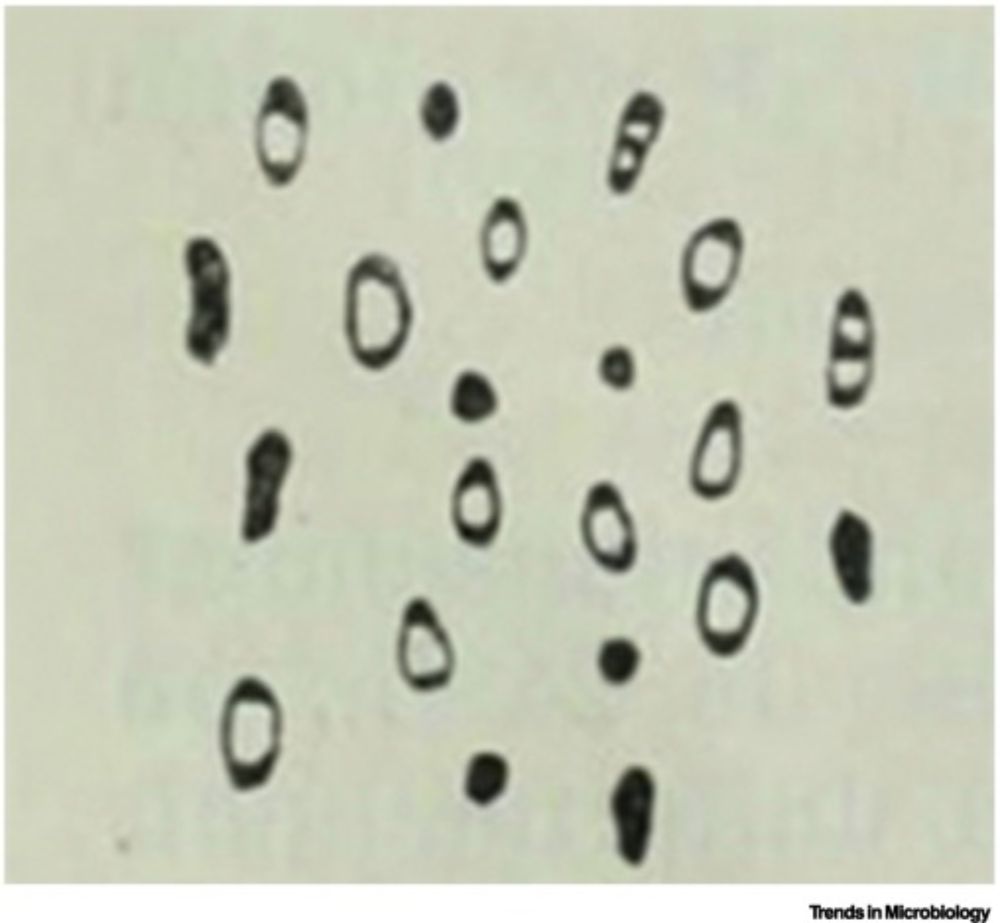
Low biomass bacterial transcriptomics takes shape
Bornet et al. apply a low-input bacterial RNA-seq pipeline to transcriptionally profile
small, medium, and large cell populations of the human gut symbiont Bacteroides thetaiotaomicron
separated by fl...
www.cell.com
July 8, 2025 at 10:59 AM
Very honored that our recent study on Bacteroides morphotypes was spotlighted 🔦 in Trends in Microbiology by Eric Martens & Qinnan Yang: www.cell.com/trends/micro....
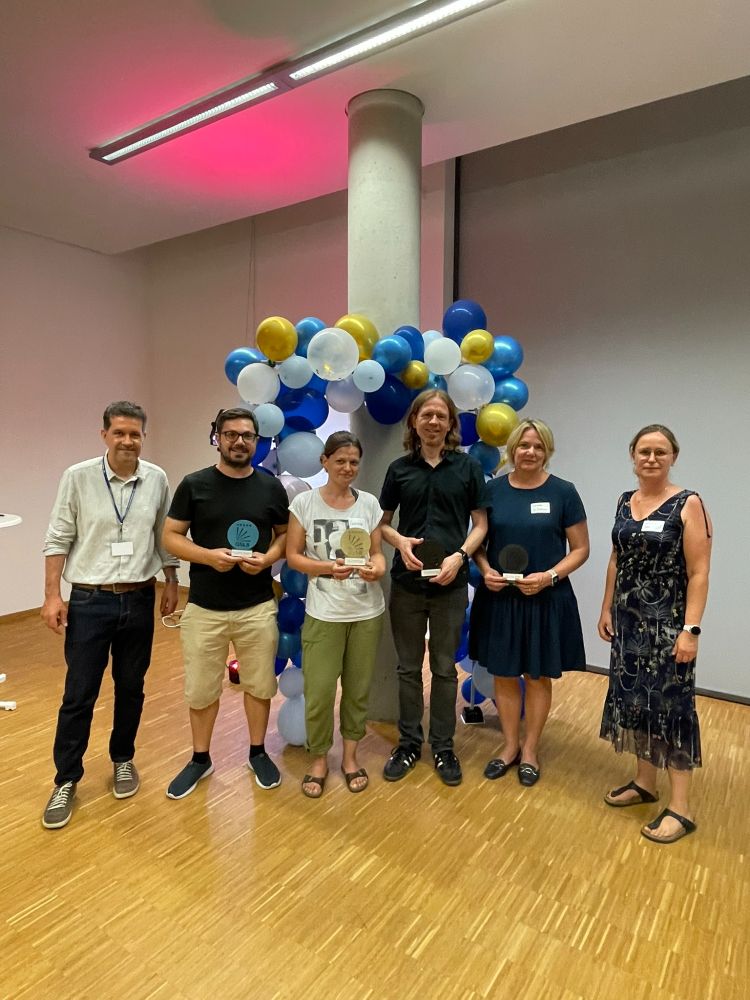
Thank you to all students and to the GSLS for this award! It means a lot to me! (-AW)

We proudly present the first-ever #GSLS Supervisor of the Year Award! 🏆
From 40 nominations, four top PIs were selected:
🥇 Gabriele Büchel
🥈 Alexander Westermann @westermannlab.bsky.social
🥉 Carmen Villmann & Matthias Gamer @gamerlab.bsky.social
Proud to have the best supervisors! @uni-wuerzburg.de
From 40 nominations, four top PIs were selected:
🥇 Gabriele Büchel
🥈 Alexander Westermann @westermannlab.bsky.social
🥉 Carmen Villmann & Matthias Gamer @gamerlab.bsky.social
Proud to have the best supervisors! @uni-wuerzburg.de
July 7, 2025 at 7:46 AM
Thank you to all students and to the GSLS for this award! It means a lot to me! (-AW)
Reposted by Westermann Lab
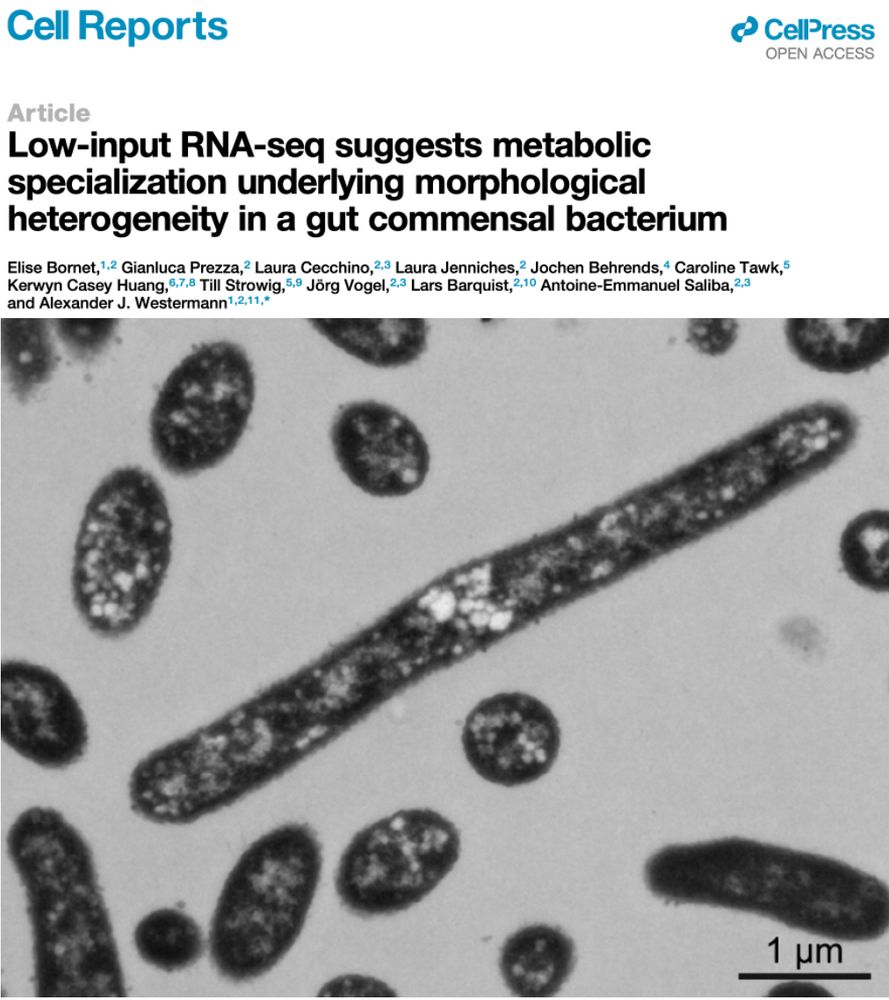
𝔟α𝐜𝐓𝕖Ř𝒾ⒶĹ SHⓐ𝓹Ẹ 丂ħ𝓲ƒ𝓉ⒺⓇร 🦠
Ultra-sensitive RNA-seq and FISH show 𝘉𝘢𝘤𝘵𝘦𝘳𝘰𝘪𝘥𝘦𝘴 𝘵𝘩𝘦𝘵𝘢𝘪𝘰𝘵𝘢𝘰𝘮𝘪𝘤𝘳𝘰𝘯 cells adopt different shapes reflecting distinct gene expression profiles and metabolic specializations
A deliberate survival strategy for the ever-changing gut environment?
www.cell.com/cell-reports...
Ultra-sensitive RNA-seq and FISH show 𝘉𝘢𝘤𝘵𝘦𝘳𝘰𝘪𝘥𝘦𝘴 𝘵𝘩𝘦𝘵𝘢𝘪𝘰𝘵𝘢𝘰𝘮𝘪𝘤𝘳𝘰𝘯 cells adopt different shapes reflecting distinct gene expression profiles and metabolic specializations
A deliberate survival strategy for the ever-changing gut environment?
www.cell.com/cell-reports...
June 18, 2025 at 1:02 AM
𝔟α𝐜𝐓𝕖Ř𝒾ⒶĹ SHⓐ𝓹Ẹ 丂ħ𝓲ƒ𝓉ⒺⓇร 🦠
Ultra-sensitive RNA-seq and FISH show 𝘉𝘢𝘤𝘵𝘦𝘳𝘰𝘪𝘥𝘦𝘴 𝘵𝘩𝘦𝘵𝘢𝘪𝘰𝘵𝘢𝘰𝘮𝘪𝘤𝘳𝘰𝘯 cells adopt different shapes reflecting distinct gene expression profiles and metabolic specializations
A deliberate survival strategy for the ever-changing gut environment?
www.cell.com/cell-reports...
Ultra-sensitive RNA-seq and FISH show 𝘉𝘢𝘤𝘵𝘦𝘳𝘰𝘪𝘥𝘦𝘴 𝘵𝘩𝘦𝘵𝘢𝘪𝘰𝘵𝘢𝘰𝘮𝘪𝘤𝘳𝘰𝘯 cells adopt different shapes reflecting distinct gene expression profiles and metabolic specializations
A deliberate survival strategy for the ever-changing gut environment?
www.cell.com/cell-reports...