



Mika Rantanen
@mikarantane.bsky.social
Researcher at the Finnish Meteorological Institute. Climate change, extreme weather and attribution of extreme events. PhD in meteorology from the University of Helsinki.
Pinned
Mika Rantanen
@mikarantane.bsky.social
· Apr 28
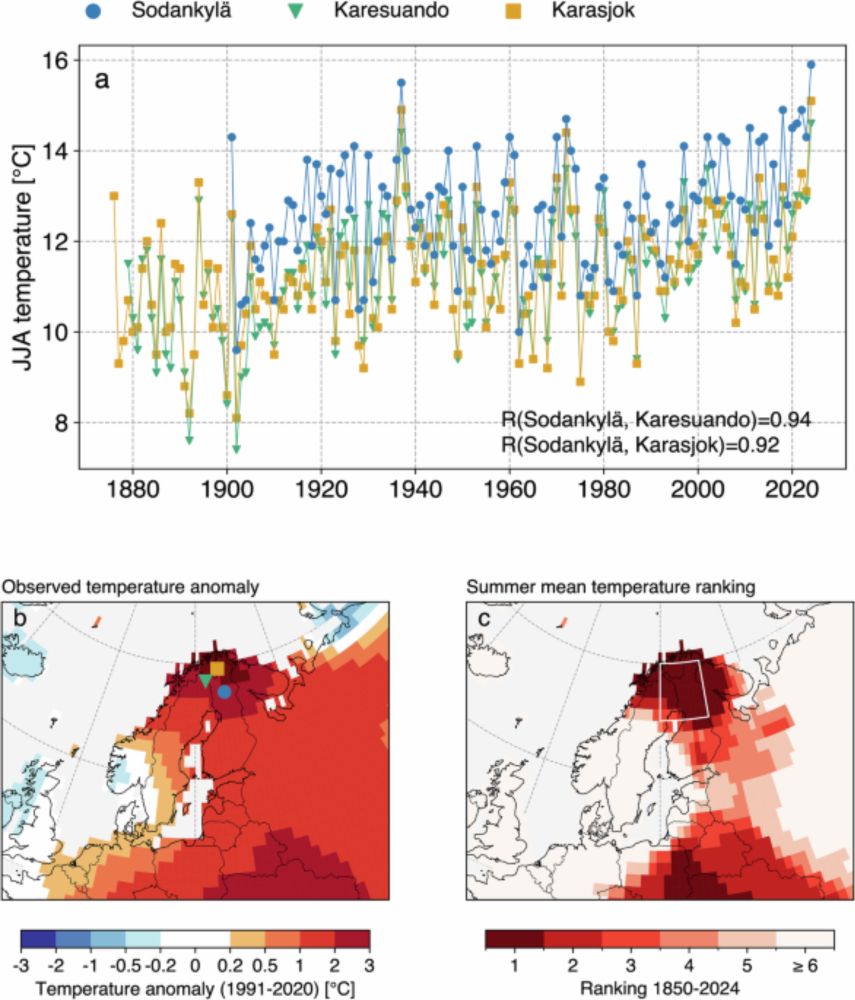
Summer 2024 in northern Fennoscandia was very likely the warmest in 2000 years - npj Climate and Atmospheric Science
npj Climate and Atmospheric Science - Summer 2024 in northern Fennoscandia was very likely the warmest in 2000 years
doi.org
Excited to share that our new paper
“Summer 2024 in northern Fennoscandia was very likely the warmest in 2000 years”
has been published in npj Climate and Atmospheric Science!
See the open-access paper from doi.org/10.1038/s416...
Short thread 👇
“Summer 2024 in northern Fennoscandia was very likely the warmest in 2000 years”
has been published in npj Climate and Atmospheric Science!
See the open-access paper from doi.org/10.1038/s416...
Short thread 👇
The year 2026 has so far been historically dry in Finland.
The total year-to-date precipitation in Finland (averaged over the country) is only 14.1 mm. That's 23 % of normal precipitation over such period.
The total year-to-date precipitation in Finland (averaged over the country) is only 14.1 mm. That's 23 % of normal precipitation over such period.

February 16, 2026 at 11:34 AM
The year 2026 has so far been historically dry in Finland.
The total year-to-date precipitation in Finland (averaged over the country) is only 14.1 mm. That's 23 % of normal precipitation over such period.
The total year-to-date precipitation in Finland (averaged over the country) is only 14.1 mm. That's 23 % of normal precipitation over such period.
Reposted by Mika Rantanen
Are temperatures far from "normal" becoming more common in the Arctic? It's an simple question but it quickly turns complicated. The latest post from the Alaska and Arctic Climate newsletter takes a look this thorny question. #Arctic #Climate
alaskaclimate.substack.com/p/arctic-reg...
alaskaclimate.substack.com/p/arctic-reg...

February 16, 2026 at 6:47 AM
Are temperatures far from "normal" becoming more common in the Arctic? It's an simple question but it quickly turns complicated. The latest post from the Alaska and Arctic Climate newsletter takes a look this thorny question. #Arctic #Climate
alaskaclimate.substack.com/p/arctic-reg...
alaskaclimate.substack.com/p/arctic-reg...
Today, the sea ice extent in the Baltic Sea reached 178,000 km², surpassing the winter 2018 maximum and marking the highest extent since 2012.
en.ilmatieteenlaitos.fi/ice-conditions
en.ilmatieteenlaitos.fi/ice-conditions

February 15, 2026 at 3:58 PM
Today, the sea ice extent in the Baltic Sea reached 178,000 km², surpassing the winter 2018 maximum and marking the highest extent since 2012.
en.ilmatieteenlaitos.fi/ice-conditions
en.ilmatieteenlaitos.fi/ice-conditions
The southern part of Finland in today's sunny and crisp winter day ☀️❄️
Through 12 February, the beginning of the year in Finland has been the coldest since 1987!
Image from NASA Worldview: worldview.earthdata.nasa.gov
Through 12 February, the beginning of the year in Finland has been the coldest since 1987!
Image from NASA Worldview: worldview.earthdata.nasa.gov

February 13, 2026 at 2:53 PM
The southern part of Finland in today's sunny and crisp winter day ☀️❄️
Through 12 February, the beginning of the year in Finland has been the coldest since 1987!
Image from NASA Worldview: worldview.earthdata.nasa.gov
Through 12 February, the beginning of the year in Finland has been the coldest since 1987!
Image from NASA Worldview: worldview.earthdata.nasa.gov
Reposted by Mika Rantanen

The paper describing the new DCENT-I dataset of monthly global surface temperature since 1850 is just published.
rmets.onlinelibrary.wiley.com/doi/10.1002/...
rmets.onlinelibrary.wiley.com/doi/10.1002/...

DCENT‐I: A Globally Infilled Extension of the Dynamically Consistent ENsemble of Temperature Dataset
DCENT-I infills data gaps in DCENT, producing spatially coherent temperature fields (top) and a slightly higher GMST warming estimate (bottom). Top: December 1877 temperature anomalies (°C; 1961–1990...
rmets.onlinelibrary.wiley.com
February 13, 2026 at 11:08 AM
The paper describing the new DCENT-I dataset of monthly global surface temperature since 1850 is just published.
rmets.onlinelibrary.wiley.com/doi/10.1002/...
rmets.onlinelibrary.wiley.com/doi/10.1002/...
"The latest calculations by IOW researchers show that the Baltic Sea is currently missing around 275 cubic kilometers of water compared to the long-term average."
That's about as much as there is water in all Finnish lakes combined.
phys.org/news/2026-02...
That's about as much as there is water in all Finnish lakes combined.
phys.org/news/2026-02...

Record low sea levels in the Baltic Sea could reshape sea's physical conditions
Since the beginning of January, an unusually long period of easterly winds has caused the average water level in the Baltic Sea to fall to a historic low. Measurements at the Swedish Landsort-Norra ga...
phys.org
February 11, 2026 at 10:31 AM
"The latest calculations by IOW researchers show that the Baltic Sea is currently missing around 275 cubic kilometers of water compared to the long-term average."
That's about as much as there is water in all Finnish lakes combined.
phys.org/news/2026-02...
That's about as much as there is water in all Finnish lakes combined.
phys.org/news/2026-02...
I calculated the daily average sea level across all 14 tide gauges in Finnish coast (1000 km coastline) for 1971–2026.
The results show that the average sea level in the Baltic Sea has been historically low in recent days, with an average of -79 cm on 6 February 2026.
The results show that the average sea level in the Baltic Sea has been historically low in recent days, with an average of -79 cm on 6 February 2026.

February 11, 2026 at 10:21 AM
I calculated the daily average sea level across all 14 tide gauges in Finnish coast (1000 km coastline) for 1971–2026.
The results show that the average sea level in the Baltic Sea has been historically low in recent days, with an average of -79 cm on 6 February 2026.
The results show that the average sea level in the Baltic Sea has been historically low in recent days, with an average of -79 cm on 6 February 2026.
Another extremely low sea level event is expected this weekend due to low pressure that passes to the south. The forecast based on ECMWF meteorological forcing suggests -90 cm for Helsinki.
This comes at a time when the total water volume of the Baltic Sea is already extremely low.
This comes at a time when the total water volume of the Baltic Sea is already extremely low.


February 10, 2026 at 11:12 AM
Another extremely low sea level event is expected this weekend due to low pressure that passes to the south. The forecast based on ECMWF meteorological forcing suggests -90 cm for Helsinki.
This comes at a time when the total water volume of the Baltic Sea is already extremely low.
This comes at a time when the total water volume of the Baltic Sea is already extremely low.
Kooste sää- ja ilmastovuodesta 2025 Suomessa on nyt julkaistu ilmastovuosikatsauksessa!
Ilmastovuosikatsaus paketoi vuoden 2025 sää- ja meritilastot yhteen ja nostaa esille merkittäviä ilmiöitä Suomen säässä ja merialueilla.
Käy tsekkaamassa:
www.ilmastokatsaus.fi/ilmastovuosi...
Ilmastovuosikatsaus paketoi vuoden 2025 sää- ja meritilastot yhteen ja nostaa esille merkittäviä ilmiöitä Suomen säässä ja merialueilla.
Käy tsekkaamassa:
www.ilmastokatsaus.fi/ilmastovuosi...

February 10, 2026 at 10:07 AM
Kooste sää- ja ilmastovuodesta 2025 Suomessa on nyt julkaistu ilmastovuosikatsauksessa!
Ilmastovuosikatsaus paketoi vuoden 2025 sää- ja meritilastot yhteen ja nostaa esille merkittäviä ilmiöitä Suomen säässä ja merialueilla.
Käy tsekkaamassa:
www.ilmastokatsaus.fi/ilmastovuosi...
Ilmastovuosikatsaus paketoi vuoden 2025 sää- ja meritilastot yhteen ja nostaa esille merkittäviä ilmiöitä Suomen säässä ja merialueilla.
Käy tsekkaamassa:
www.ilmastokatsaus.fi/ilmastovuosi...
Reposted by Mika Rantanen

I've created a new dashboard for The Climate Brink that is updated daily with ERA5 global mean surface temperature data. It includes daily anomalies, monthly and annual forecasts, and a bunch of interactive data visualizations: dashboard.theclimate...

February 9, 2026 at 5:47 PM
I've created a new dashboard for The Climate Brink that is updated daily with ERA5 global mean surface temperature data. It includes daily anomalies, monthly and annual forecasts, and a bunch of interactive data visualizations: dashboard.theclimate...
Meanwhile, no meaningful precipitation in Finland in this year so far. Snow depths are exceptionally low in central Finland despite the cold January.
Incredibly stuck pattern!
Incredibly stuck pattern!

February 6, 2026 at 2:25 PM
Meanwhile, no meaningful precipitation in Finland in this year so far. Snow depths are exceptionally low in central Finland despite the cold January.
Incredibly stuck pattern!
Incredibly stuck pattern!
Breaking: Helsinki, Finland, has just recorded its lowest sea level on record, as a cold easterly flow and strong high pressure have pushed water out of the Baltic Sea.
The observed minimum this morning was −93.5 cm below normal.
The Helsinki tide gauge record goes back to 1904.
The observed minimum this morning was −93.5 cm below normal.
The Helsinki tide gauge record goes back to 1904.

February 6, 2026 at 7:13 AM
Breaking: Helsinki, Finland, has just recorded its lowest sea level on record, as a cold easterly flow and strong high pressure have pushed water out of the Baltic Sea.
The observed minimum this morning was −93.5 cm below normal.
The Helsinki tide gauge record goes back to 1904.
The observed minimum this morning was −93.5 cm below normal.
The Helsinki tide gauge record goes back to 1904.
"Lisäksi tässä voi olla “shifting baselines” -syndroomaa: eli kun ilmasto lämpenee, totumme siihen, jolloin tällaiset pakkaset voivat tuntua todella poikkeuksellisilta vaikka oikeasti näin ei ole."
suomenluonto.fi/uutiset/mist...
suomenluonto.fi/uutiset/mist...

Mistä alkuvuoden kylmä jakso Suomessa johtuu? Kysyimme asiaa tutkijalta
Ilmatieteen laitoksen tutkija Mika Rantanen kertoo, mistä poikkeuksellinen suursäätila johtuu ja voimmeko odottaa vastaavia pakkaspiikkejä tulevaisuudessa.
suomenluonto.fi
February 6, 2026 at 6:52 AM
"Lisäksi tässä voi olla “shifting baselines” -syndroomaa: eli kun ilmasto lämpenee, totumme siihen, jolloin tällaiset pakkaset voivat tuntua todella poikkeuksellisilta vaikka oikeasti näin ei ole."
suomenluonto.fi/uutiset/mist...
suomenluonto.fi/uutiset/mist...
Reposted by Mika Rantanen

All Finnish icebreakers are busy assisting maritime traffic, and the #seaice on the #BalticSea continues to expand. If the Bothnian Sea becomes fully ice-covered this winter, it would be the first time since February 2011.
Follow the daily ice situation at:
en.ilmatieteenlaitos.fi/ice-conditio...
Follow the daily ice situation at:
en.ilmatieteenlaitos.fi/ice-conditio...

February 5, 2026 at 3:11 PM
All Finnish icebreakers are busy assisting maritime traffic, and the #seaice on the #BalticSea continues to expand. If the Bothnian Sea becomes fully ice-covered this winter, it would be the first time since February 2011.
Follow the daily ice situation at:
en.ilmatieteenlaitos.fi/ice-conditio...
Follow the daily ice situation at:
en.ilmatieteenlaitos.fi/ice-conditio...
The cold spell in northern Europe is not going anywhere.
Next two weeks look again very cold as there will be another outbreak of Arctic air mass from the northeast. What a cold Jan-Feb period in the making!
Next two weeks look again very cold as there will be another outbreak of Arctic air mass from the northeast. What a cold Jan-Feb period in the making!


February 5, 2026 at 11:50 AM
The cold spell in northern Europe is not going anywhere.
Next two weeks look again very cold as there will be another outbreak of Arctic air mass from the northeast. What a cold Jan-Feb period in the making!
Next two weeks look again very cold as there will be another outbreak of Arctic air mass from the northeast. What a cold Jan-Feb period in the making!
Reposted by Mika Rantanen

Tuore raportti AMOC-kiertoliikkeen keikahduspisteen vaikutuksista kehottaa tehostamaan ilmastonmuutoksen hillitsemistä, seurantaa ja varautumista.
Raporttiin on koostettu tieteellinen tieto AMOCin mahdollisen romahduksen vaikutuksista Pohjoismaissa.
www.ilmatieteenlaitos.fi/tiedote/6TWT...
Raporttiin on koostettu tieteellinen tieto AMOCin mahdollisen romahduksen vaikutuksista Pohjoismaissa.
www.ilmatieteenlaitos.fi/tiedote/6TWT...

Pohjoismainen raportti AMOC-kiertoliikkeen keikahduspisteen
Tuoreeseen raporttiin on koostettu tieteellinen tieto Pohjois-Atlantin kiertoliikkeen (AMOC) mahdollisen romahduksen vaikutuksista Pohjoismaissa. Raportissa annetaan toimenpidesuosituksia alueen
www.ilmatieteenlaitos.fi
February 5, 2026 at 11:11 AM
Tuore raportti AMOC-kiertoliikkeen keikahduspisteen vaikutuksista kehottaa tehostamaan ilmastonmuutoksen hillitsemistä, seurantaa ja varautumista.
Raporttiin on koostettu tieteellinen tieto AMOCin mahdollisen romahduksen vaikutuksista Pohjoismaissa.
www.ilmatieteenlaitos.fi/tiedote/6TWT...
Raporttiin on koostettu tieteellinen tieto AMOCin mahdollisen romahduksen vaikutuksista Pohjoismaissa.
www.ilmatieteenlaitos.fi/tiedote/6TWT...
The ice extent in the Baltic Sea is growing rapidly, and yesterday's value of 140,000 km² is close to the largest extent in 2007–2021.
We have already surpassed the winter maximum values for 2019–2025, with the previous higher extent being in 2018.
en.ilmatieteenlaitos.fi/ice-conditions
We have already surpassed the winter maximum values for 2019–2025, with the previous higher extent being in 2018.
en.ilmatieteenlaitos.fi/ice-conditions

February 5, 2026 at 8:05 AM
The ice extent in the Baltic Sea is growing rapidly, and yesterday's value of 140,000 km² is close to the largest extent in 2007–2021.
We have already surpassed the winter maximum values for 2019–2025, with the previous higher extent being in 2018.
en.ilmatieteenlaitos.fi/ice-conditions
We have already surpassed the winter maximum values for 2019–2025, with the previous higher extent being in 2018.
en.ilmatieteenlaitos.fi/ice-conditions
Reposted by Mika Rantanen

Europe had its coldest January in 16 years. Historically, it would have been considered a warm January (pre-1990).

February 5, 2026 at 3:38 AM
Europe had its coldest January in 16 years. Historically, it would have been considered a warm January (pre-1990).
Alhainen vedenkorkeus ja jäätilanne muuttavat saariston lauttareittejä – osa ajetaan nyt ilmatyynyaluksilla
yle.fi/a/74-2020832...
yle.fi/a/74-2020832...

Alhainen vedenkorkeus ja jäätilanne muuttavat saariston lauttareittejä – osa ajetaan nyt ilmatyynyaluksilla
Lautta- ja yhteysalusliikennettä operoivan Finferries-yhtiön liikennepäällikkö ei muista yhtä pahaa tilannetta yli kaksikymmentävuotisen uransa ajalta.
yle.fi
February 4, 2026 at 5:04 PM
Alhainen vedenkorkeus ja jäätilanne muuttavat saariston lauttareittejä – osa ajetaan nyt ilmatyynyaluksilla
yle.fi/a/74-2020832...
yle.fi/a/74-2020832...
New all-time minimum sea level in the Baltic Sea!
The Föglö tide gauge measured just -71.6 cm below the mean level which is the lowest value ever recorded there. Records have been kept over 100 years, since 1924 (!).
The sea level is still decreasing. (1/3)
The Föglö tide gauge measured just -71.6 cm below the mean level which is the lowest value ever recorded there. Records have been kept over 100 years, since 1924 (!).
The sea level is still decreasing. (1/3)

February 4, 2026 at 10:12 AM
New all-time minimum sea level in the Baltic Sea!
The Föglö tide gauge measured just -71.6 cm below the mean level which is the lowest value ever recorded there. Records have been kept over 100 years, since 1924 (!).
The sea level is still decreasing. (1/3)
The Föglö tide gauge measured just -71.6 cm below the mean level which is the lowest value ever recorded there. Records have been kept over 100 years, since 1924 (!).
The sea level is still decreasing. (1/3)
When I hear these cold extremes are associated to climate change, I often make a thought experiment in my head: imagine a counterfactual world in which climate change were causing global *cooling* rather than warming, and the Arctic would be cooling 4x faster than the global mean. 1/2

Is climate change responsible for increasingly frequent or severe cold events?
The evidence suggests it is not.
Instead, the impact of climate change is warmer winters and less severe cold events.
@hausfath.bsky.social has a great post on The Climate Brink talking about this.
The evidence suggests it is not.
Instead, the impact of climate change is warmer winters and less severe cold events.
@hausfath.bsky.social has a great post on The Climate Brink talking about this.

Fact check: Climate change is not making extreme cold more common
Sometimes it just gets cold
substack.com
February 3, 2026 at 7:10 PM
When I hear these cold extremes are associated to climate change, I often make a thought experiment in my head: imagine a counterfactual world in which climate change were causing global *cooling* rather than warming, and the Arctic would be cooling 4x faster than the global mean. 1/2
Reposted by Mika Rantanen

While there *is* evidence of both "wetter wets" & "drier dries" in warming climate, temperatures are going almost universally in one direction: Up. We're just not seeing "colder colds."
Some interesting potential Arctic-related caveats still remain TBD, but that doesn't change big picture.
Some interesting potential Arctic-related caveats still remain TBD, but that doesn't change big picture.
Is climate change responsible for increasingly frequent or severe cold events?
The evidence suggests it is not.
Instead, the impact of climate change is warmer winters and less severe cold events.
@hausfath.bsky.social has a great post on The Climate Brink talking about this.
The evidence suggests it is not.
Instead, the impact of climate change is warmer winters and less severe cold events.
@hausfath.bsky.social has a great post on The Climate Brink talking about this.
Fact check: Climate change is not making extreme cold more common
Sometimes it just gets cold
substack.com
February 3, 2026 at 1:57 AM
While there *is* evidence of both "wetter wets" & "drier dries" in warming climate, temperatures are going almost universally in one direction: Up. We're just not seeing "colder colds."
Some interesting potential Arctic-related caveats still remain TBD, but that doesn't change big picture.
Some interesting potential Arctic-related caveats still remain TBD, but that doesn't change big picture.
Reposted by Mika Rantanen

The weather regime that on average brings the coldest weather is warming the fastest in a large part of northern Europe. In contrast, the weather regime that typically brings the warmest weather has warmed the slowest.
doi.org/10.1002/asl.... @mikarantane.bsky.social
doi.org/10.1002/asl.... @mikarantane.bsky.social
Is climate change responsible for increasingly frequent or severe cold events?
The evidence suggests it is not.
Instead, the impact of climate change is warmer winters and less severe cold events.
@hausfath.bsky.social has a great post on The Climate Brink talking about this.
The evidence suggests it is not.
Instead, the impact of climate change is warmer winters and less severe cold events.
@hausfath.bsky.social has a great post on The Climate Brink talking about this.
Fact check: Climate change is not making extreme cold more common
Sometimes it just gets cold
substack.com
February 3, 2026 at 2:59 PM
The weather regime that on average brings the coldest weather is warming the fastest in a large part of northern Europe. In contrast, the weather regime that typically brings the warmest weather has warmed the slowest.
doi.org/10.1002/asl.... @mikarantane.bsky.social
doi.org/10.1002/asl.... @mikarantane.bsky.social
Cold January! The wind rose from Helsinki Kaisaniemi shows that the most common wind direction so far this year has been from the northeast.
Wind has blown from that direction almost half (44%) of the time.
Wind has blown from that direction almost half (44%) of the time.

February 2, 2026 at 2:22 PM
Cold January! The wind rose from Helsinki Kaisaniemi shows that the most common wind direction so far this year has been from the northeast.
Wind has blown from that direction almost half (44%) of the time.
Wind has blown from that direction almost half (44%) of the time.
January climate statistics are out. Remarkably in Lapland, January 2026 was the coldest month since January 1987!
www.ilmatieteenlaitos.fi/tiedote/1GU2...
www.ilmatieteenlaitos.fi/tiedote/1GU2...

February 2, 2026 at 9:21 AM
January climate statistics are out. Remarkably in Lapland, January 2026 was the coldest month since January 1987!
www.ilmatieteenlaitos.fi/tiedote/1GU2...
www.ilmatieteenlaitos.fi/tiedote/1GU2...