



Guillaume Andrey
@guandrey.bsky.social
Associate Professor / enhancers - 3D genome - morphogenesis
Website: https://www.unige.ch/medecine/gede/en/research-groups/999andrey
Website: https://www.unige.ch/medecine/gede/en/research-groups/999andrey
Reposted by Guillaume Andrey
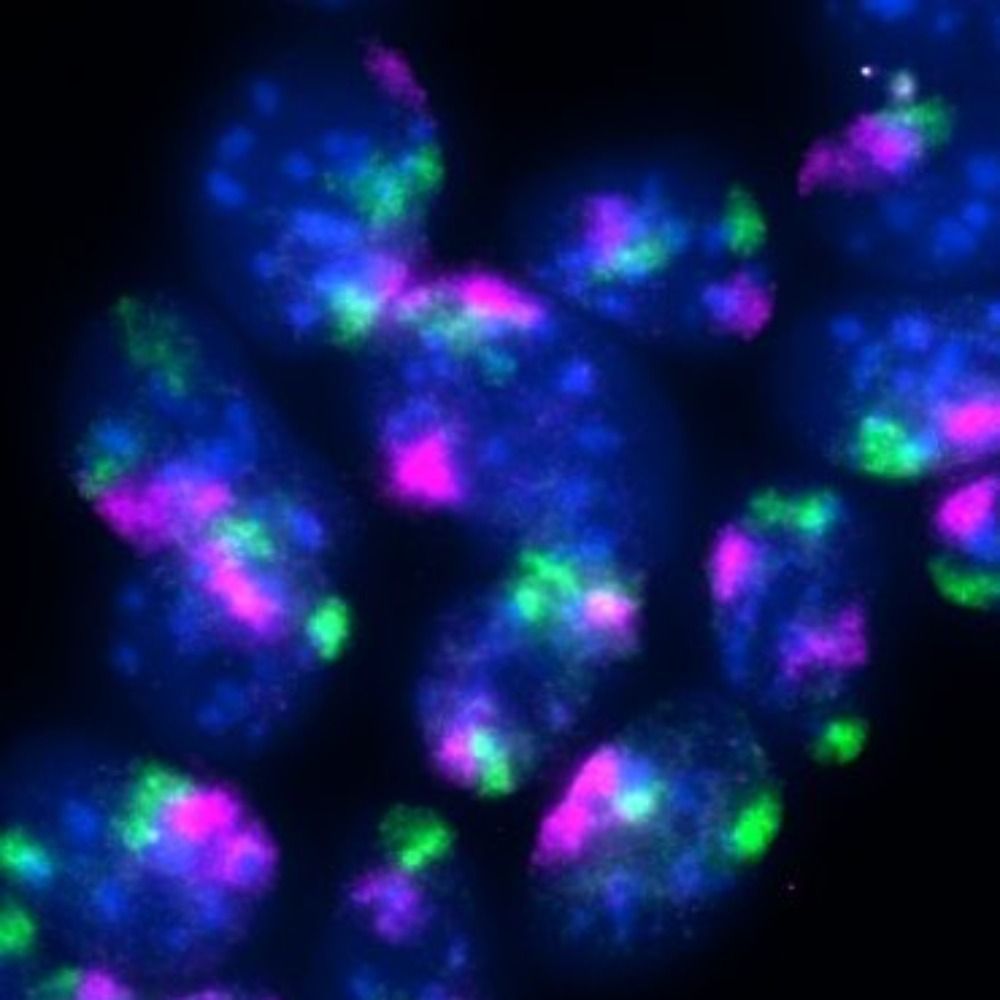
Interested in transcriptional regulation, enhancers and 3D genome folding?
In this new study we wondered about the role of cohesin loading at enhancers for long-range transcriptional control
www.biorxiv.org/content/10.6...
detailed 🧵👇
In this new study we wondered about the role of cohesin loading at enhancers for long-range transcriptional control
www.biorxiv.org/content/10.6...
detailed 🧵👇
www.biorxiv.org
February 12, 2026 at 9:39 PM
Interested in transcriptional regulation, enhancers and 3D genome folding?
In this new study we wondered about the role of cohesin loading at enhancers for long-range transcriptional control
www.biorxiv.org/content/10.6...
detailed 🧵👇
In this new study we wondered about the role of cohesin loading at enhancers for long-range transcriptional control
www.biorxiv.org/content/10.6...
detailed 🧵👇
Reposted by Guillaume Andrey
Happy International Day of Women and Girls in Science! #11F #NoMoreMatildas 🧑💻🧑🔬🧑🏫🧑🔧🧑⚕️

February 11, 2026 at 8:14 AM
Happy International Day of Women and Girls in Science! #11F #NoMoreMatildas 🧑💻🧑🔬🧑🏫🧑🔧🧑⚕️
Reposted by Guillaume Andrey

I love this portrait of a scientist so much. Portrait of Dr Bouchard, by Tamara de Lempicka, 1928

February 7, 2026 at 3:59 PM
I love this portrait of a scientist so much. Portrait of Dr Bouchard, by Tamara de Lempicka, 1928
Reposted by Guillaume Andrey
🧬 We’re #Hiring a #Bioinformatician/ Computational Biologist!
#Single-cell genomics, #Epigenomics & #3Dgenome biology in #Zebrafish #DevBio 🐟
📍 @cabd-upo-csic.bsky.social, CABD, Seville (Spain)
🕒 Full-time, 3-year position (start March 2026)
📅 Apply by Feb 15, 2026
👉 drive.google.com/file/d/1M8rp...
#Single-cell genomics, #Epigenomics & #3Dgenome biology in #Zebrafish #DevBio 🐟
📍 @cabd-upo-csic.bsky.social, CABD, Seville (Spain)
🕒 Full-time, 3-year position (start March 2026)
📅 Apply by Feb 15, 2026
👉 drive.google.com/file/d/1M8rp...
Job offer 2026.pdf
drive.google.com
January 12, 2026 at 3:57 PM
🧬 We’re #Hiring a #Bioinformatician/ Computational Biologist!
#Single-cell genomics, #Epigenomics & #3Dgenome biology in #Zebrafish #DevBio 🐟
📍 @cabd-upo-csic.bsky.social, CABD, Seville (Spain)
🕒 Full-time, 3-year position (start March 2026)
📅 Apply by Feb 15, 2026
👉 drive.google.com/file/d/1M8rp...
#Single-cell genomics, #Epigenomics & #3Dgenome biology in #Zebrafish #DevBio 🐟
📍 @cabd-upo-csic.bsky.social, CABD, Seville (Spain)
🕒 Full-time, 3-year position (start March 2026)
📅 Apply by Feb 15, 2026
👉 drive.google.com/file/d/1M8rp...
Reposted by Guillaume Andrey

Did you ever wonder how gene expression, once activated, it's maintained for a precise period of time before being decommissioned? Happy to present the final version of our manuscript on the discovery of regulatory trajectories, just published in Nat. Comms: www.nature.com/articles/s41...
1/14
1/14
January 12, 2026 at 12:23 PM
Did you ever wonder how gene expression, once activated, it's maintained for a precise period of time before being decommissioned? Happy to present the final version of our manuscript on the discovery of regulatory trajectories, just published in Nat. Comms: www.nature.com/articles/s41...
1/14
1/14
Our work on #RegulatoryTrajectories is out today in Nat. Comms: www.nature.com/articles/s41...
Led by @raquelrouco.bsky.social, this study establishes a new framework to study how enhancer landscapes act sequentially at developmental loci and are silenced to shape gene expression patterns. (1/n)
Led by @raquelrouco.bsky.social, this study establishes a new framework to study how enhancer landscapes act sequentially at developmental loci and are silenced to shape gene expression patterns. (1/n)
Client Challenge
www.nature.com
January 12, 2026 at 11:48 AM
Our work on #RegulatoryTrajectories is out today in Nat. Comms: www.nature.com/articles/s41...
Led by @raquelrouco.bsky.social, this study establishes a new framework to study how enhancer landscapes act sequentially at developmental loci and are silenced to shape gene expression patterns. (1/n)
Led by @raquelrouco.bsky.social, this study establishes a new framework to study how enhancer landscapes act sequentially at developmental loci and are silenced to shape gene expression patterns. (1/n)
Reposted by Guillaume Andrey

Our preprint "Predictive design of tissue-specific mammalian enhancers that function in vivo in the mouse embryo" is on bioRxiv: www.biorxiv.org/content/10.6... . Amazing collaboration by @shenzhichen1999.bsky.social, Vincent Loubiere (@impvienna.bsky.social,@viennabiocenter.bsky.social),... (1/2)

Predictive design of tissue-specific mammalian enhancers that function in vivo in the mouse embryo
Enhancers control tissue-specific gene expression across metazoans. Although deep learning has enabled enhancer prediction and design in mammalian cell lines and invertebrate systems, it remains uncle...
www.biorxiv.org
December 24, 2025 at 3:06 PM
Our preprint "Predictive design of tissue-specific mammalian enhancers that function in vivo in the mouse embryo" is on bioRxiv: www.biorxiv.org/content/10.6... . Amazing collaboration by @shenzhichen1999.bsky.social, Vincent Loubiere (@impvienna.bsky.social,@viennabiocenter.bsky.social),... (1/2)
Another elegant study on the SWI/SNF complex from our wonderful neighbors in the Braun Lab. Congratulations to the team!

New paper on bioRxiv by YounJu So in our lab! She shows that while SMARCD paralogs compensate for each other during neurodevelopment, each still drives distinct gene expression programs, explaining selective vulnerability of these SWI/SNF subunits in brain disorders.
www.biorxiv.org/content/10.6...
www.biorxiv.org/content/10.6...

Redundancy masks functional specificity of SMARCD paralogs in neurodevelopment
The SWI/SNF complex is an essential chromatin remodeler that regulates DNA accessibility during brain development. Through combinatorial assembly of subunits encoded by paralogous genes, SWI/SNF compl...
www.biorxiv.org
December 8, 2025 at 11:05 PM
Another elegant study on the SWI/SNF complex from our wonderful neighbors in the Braun Lab. Congratulations to the team!
Reposted by Guillaume Andrey

We recently reported that promoter competition can contribute to the robust insulation of gene regulatory domains (www.nature.com/articles/s41...).
We now offer a 4-years PhD contract to investigate whether the dirsuption of this regulatory mechanism can lead to congenital defects. More details 👇
We now offer a 4-years PhD contract to investigate whether the dirsuption of this regulatory mechanism can lead to congenital defects. More details 👇

November 6, 2025 at 6:37 PM
We recently reported that promoter competition can contribute to the robust insulation of gene regulatory domains (www.nature.com/articles/s41...).
We now offer a 4-years PhD contract to investigate whether the dirsuption of this regulatory mechanism can lead to congenital defects. More details 👇
We now offer a 4-years PhD contract to investigate whether the dirsuption of this regulatory mechanism can lead to congenital defects. More details 👇
Reposted by Guillaume Andrey
Why fundamental research is fundamental to progress, seeding major breakthroughs
Editorial @nature.com this week
And 7 basic science discoveries that changed the world
nature.com/articles/d41...
nature.com/articles/d41...
Editorial @nature.com this week
And 7 basic science discoveries that changed the world
nature.com/articles/d41...
nature.com/articles/d41...


October 29, 2025 at 12:58 PM
Why fundamental research is fundamental to progress, seeding major breakthroughs
Editorial @nature.com this week
And 7 basic science discoveries that changed the world
nature.com/articles/d41...
nature.com/articles/d41...
Editorial @nature.com this week
And 7 basic science discoveries that changed the world
nature.com/articles/d41...
nature.com/articles/d41...
Reposted by Guillaume Andrey

What is a promoter? And how does it work?
We very happy to share our latest work trying to understand enhancer-promoter compatibility.
I am very excited about the results of @blanka-majchrzycka.bsky.social, which changed the way I think about promoters
www.biorxiv.org/content/10.1...
We very happy to share our latest work trying to understand enhancer-promoter compatibility.
I am very excited about the results of @blanka-majchrzycka.bsky.social, which changed the way I think about promoters
www.biorxiv.org/content/10.1...

Enhancer-promoter compatibility is mediated by the promoter-proximal region
Gene promoters induce transcription in response to distal enhancers. How enhancers specifically activate their target promoter while bypassing other promoters remains unclear. Here, we find that the p...
www.biorxiv.org
October 16, 2025 at 3:06 PM
What is a promoter? And how does it work?
We very happy to share our latest work trying to understand enhancer-promoter compatibility.
I am very excited about the results of @blanka-majchrzycka.bsky.social, which changed the way I think about promoters
www.biorxiv.org/content/10.1...
We very happy to share our latest work trying to understand enhancer-promoter compatibility.
I am very excited about the results of @blanka-majchrzycka.bsky.social, which changed the way I think about promoters
www.biorxiv.org/content/10.1...
Reposted by Guillaume Andrey
Really excited to share our latest work led by @mattiaubertini.bsky.social and @nesslfy.bsky.social: we report that cohesin loop extrusion creates rare but long-lived encounters between genomic sequences which underlie efficient enhancer-promoter communication.
www.biorxiv.org/content/10.1...
A🧵👇
www.biorxiv.org/content/10.1...
A🧵👇
September 24, 2025 at 9:45 PM
Really excited to share our latest work led by @mattiaubertini.bsky.social and @nesslfy.bsky.social: we report that cohesin loop extrusion creates rare but long-lived encounters between genomic sequences which underlie efficient enhancer-promoter communication.
www.biorxiv.org/content/10.1...
A🧵👇
www.biorxiv.org/content/10.1...
A🧵👇
Reposted by Guillaume Andrey

Out today. 🙏 again to everyone for this wonderful piece of work, in particular to Aurelie @aurhin.bsky.social Chase @chasebolt.bsky.social and Brent @homeobox.bsky.social. 🙏 also to the Harris lab @fish4walking.bsky.social and @neilshubin.bsky.social @biology-unige.bsky.social @college-de-france.fr

September 17, 2025 at 5:30 PM
Out today. 🙏 again to everyone for this wonderful piece of work, in particular to Aurelie @aurhin.bsky.social Chase @chasebolt.bsky.social and Brent @homeobox.bsky.social. 🙏 also to the Harris lab @fish4walking.bsky.social and @neilshubin.bsky.social @biology-unige.bsky.social @college-de-france.fr
Reposted by Guillaume Andrey

If you like transcription regulation and its mechanisms, this WIP list is for you.
I'm sure I've forgotten lots of people, so don't hesitate to let me know so I can add you to the list.
go.bsky.app/8vTgeXB
I'm sure I've forgotten lots of people, so don't hesitate to let me know so I can add you to the list.
go.bsky.app/8vTgeXB
August 28, 2025 at 12:48 PM
If you like transcription regulation and its mechanisms, this WIP list is for you.
I'm sure I've forgotten lots of people, so don't hesitate to let me know so I can add you to the list.
go.bsky.app/8vTgeXB
I'm sure I've forgotten lots of people, so don't hesitate to let me know so I can add you to the list.
go.bsky.app/8vTgeXB
Reposted by Guillaume Andrey
I am very excited to share our latest work where we describe a new method to profile genome-wide chromatin transitions over time in single cells. Great collaborative effort with the van Oudenaarden group @hubrechtinstitute.bsky.social @oncodeinstitute.bsky.social www.nature.com/articles/s41....
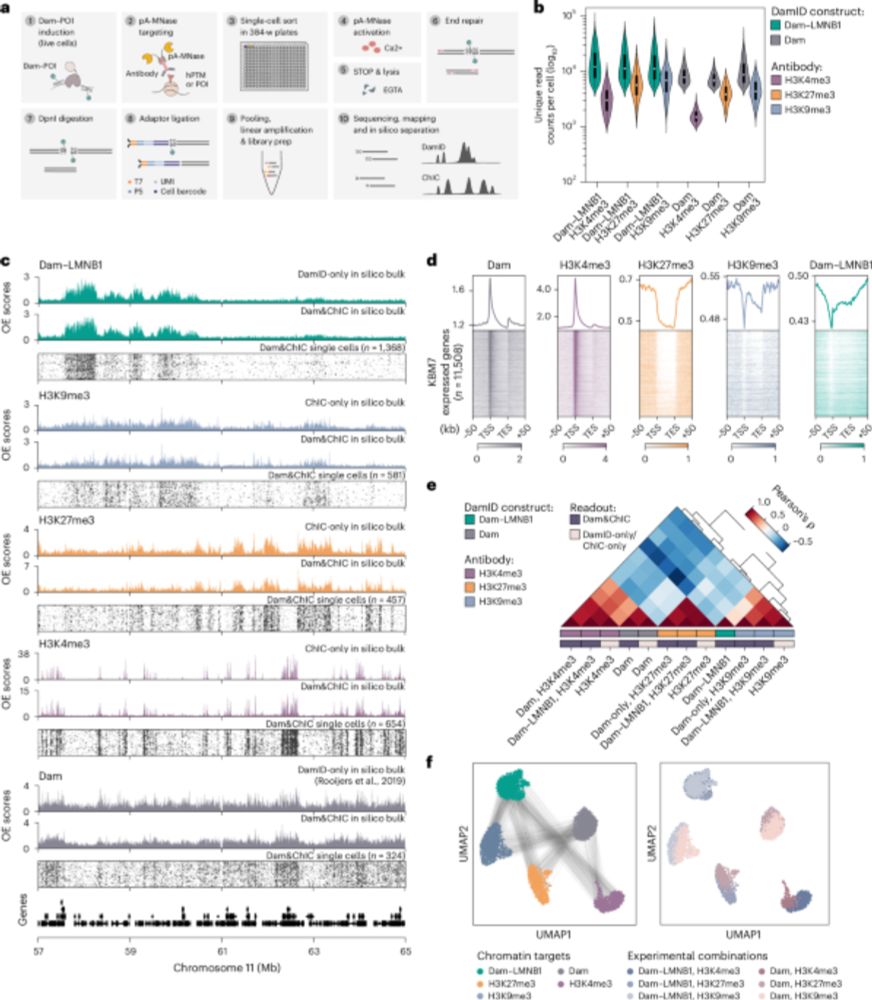
Retrospective and multifactorial single-cell profiling reveals sequential chromatin reorganization during X inactivation - Nature Cell Biology
Kefalopoulou, Rullens et al. develop Dam&ChIC to assay chromatin state at two different time points in the same cell. The method was used to study the reorganization of LADs during cell division a...
www.nature.com
July 10, 2025 at 2:36 PM
I am very excited to share our latest work where we describe a new method to profile genome-wide chromatin transitions over time in single cells. Great collaborative effort with the van Oudenaarden group @hubrechtinstitute.bsky.social @oncodeinstitute.bsky.social www.nature.com/articles/s41....
Reposted by Guillaume Andrey

Intriguing plot twist 🧐
Tissue-specific changes in 3D genome folding cause enhancer hijacking in Liebenberg syndrome
But it’s NOT the overall expression level that drives the phenotype - it’s the proportion of cells hijacked into misexpressing Pitx1 that matters
Tissue-specific changes in 3D genome folding cause enhancer hijacking in Liebenberg syndrome
But it’s NOT the overall expression level that drives the phenotype - it’s the proportion of cells hijacked into misexpressing Pitx1 that matters
Our work bridging enhancer-promoter proximity to phenotypic outcomes in vivo is out! Shout out to @olimpiabompadre.bsky.social, to Marie Kmita's lab, and to all the co-authors. www.nature.com/articles/s41...
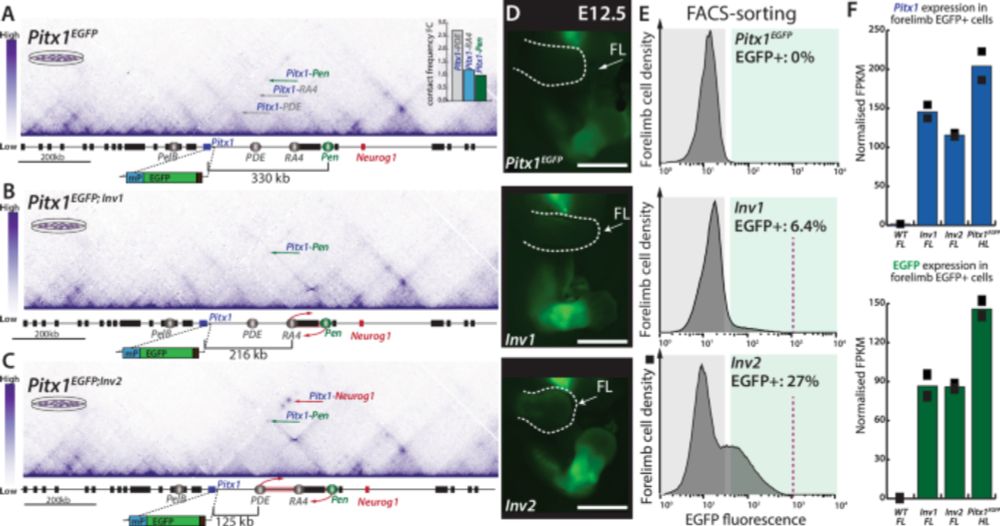
Liebenberg syndrome severity arises from variations in Pitx1 locus topology and proportion of ectopically transcribing cells - Nature Communications
Here the authors show that reducing enhancer-promoter distance at the Pitx1 locus increases proportion of Pitx1 forelimb expressing cells, worsening skeletal defects in Liebenberg syndrome. They also ...
www.nature.com
July 10, 2025 at 8:35 AM
Intriguing plot twist 🧐
Tissue-specific changes in 3D genome folding cause enhancer hijacking in Liebenberg syndrome
But it’s NOT the overall expression level that drives the phenotype - it’s the proportion of cells hijacked into misexpressing Pitx1 that matters
Tissue-specific changes in 3D genome folding cause enhancer hijacking in Liebenberg syndrome
But it’s NOT the overall expression level that drives the phenotype - it’s the proportion of cells hijacked into misexpressing Pitx1 that matters
Reposted by Guillaume Andrey
The final chapter of my Pitx1 adventure is out! 1 simple question:”How do SVs that shorten enhancer-promoter distance affect limb development?” We find the impact on transcription, cell populations, epigenetics, and chromatin structure. A labour of joy with @guandrey.bsky.social & all co-authors.
Our work bridging enhancer-promoter proximity to phenotypic outcomes in vivo is out! Shout out to @olimpiabompadre.bsky.social, to Marie Kmita's lab, and to all the co-authors. www.nature.com/articles/s41...
Liebenberg syndrome severity arises from variations in Pitx1 locus topology and proportion of ectopically transcribing cells - Nature Communications
Here the authors show that reducing enhancer-promoter distance at the Pitx1 locus increases proportion of Pitx1 forelimb expressing cells, worsening skeletal defects in Liebenberg syndrome. They also ...
www.nature.com
July 9, 2025 at 12:55 PM
The final chapter of my Pitx1 adventure is out! 1 simple question:”How do SVs that shorten enhancer-promoter distance affect limb development?” We find the impact on transcription, cell populations, epigenetics, and chromatin structure. A labour of joy with @guandrey.bsky.social & all co-authors.
Reposted by Guillaume Andrey
Finally out! 🥳 Our paper showing how a transposable element (TE) insertion can cause developmental phenotypes is now published @natgenet.nature.com 🧬🦠🐁
Below is a brief description of the major findings. Check the full version of the paper for more details: www.nature.com/articles/s41588-025-02248-5
Below is a brief description of the major findings. Check the full version of the paper for more details: www.nature.com/articles/s41588-025-02248-5
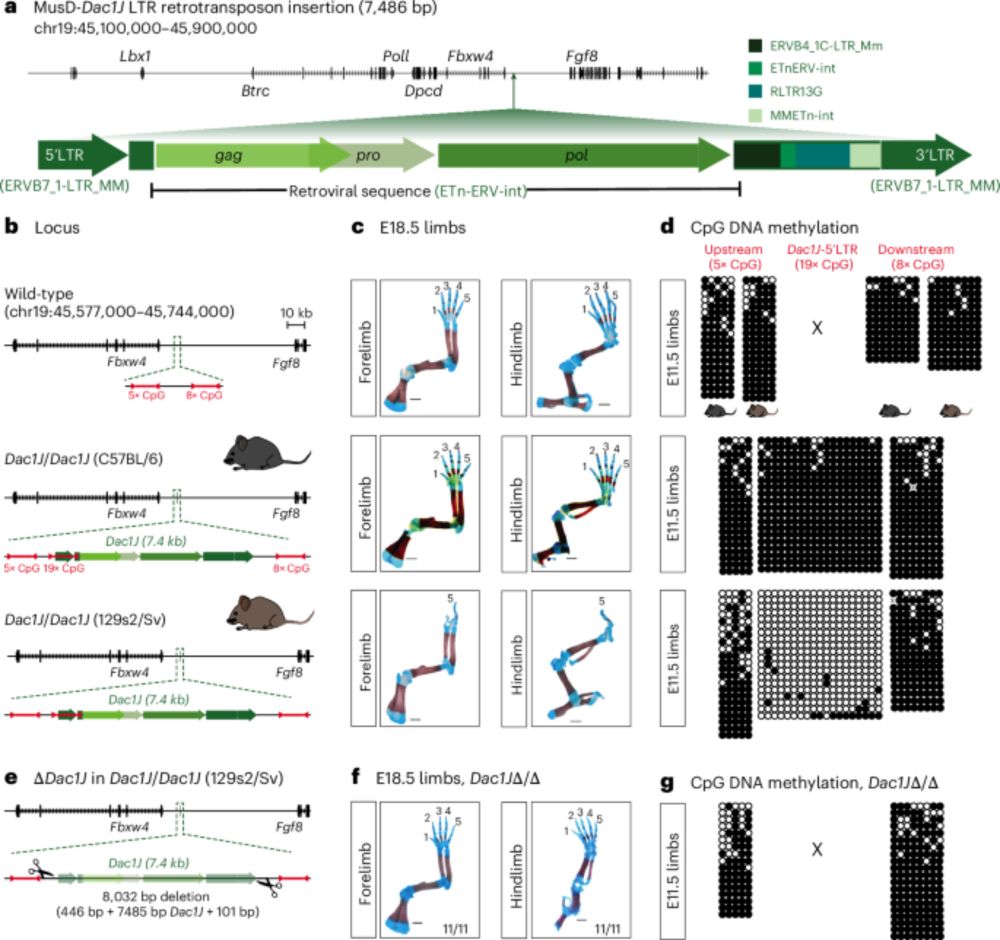
Enhancer adoption by an LTR retrotransposon generates viral-like particles, causing developmental limb phenotypes - Nature Genetics
Activation of an LTR retrotransposon inserted upstream of the Fgf8 gene produces viral-like particles in the mouse developing limb, triggering apoptosis and causing limb malformation. This phenotype c...
www.nature.com
July 9, 2025 at 10:05 AM
Finally out! 🥳 Our paper showing how a transposable element (TE) insertion can cause developmental phenotypes is now published @natgenet.nature.com 🧬🦠🐁
Below is a brief description of the major findings. Check the full version of the paper for more details: www.nature.com/articles/s41588-025-02248-5
Below is a brief description of the major findings. Check the full version of the paper for more details: www.nature.com/articles/s41588-025-02248-5
Our work bridging enhancer-promoter proximity to phenotypic outcomes in vivo is out! Shout out to @olimpiabompadre.bsky.social, to Marie Kmita's lab, and to all the co-authors. www.nature.com/articles/s41...
Liebenberg syndrome severity arises from variations in Pitx1 locus topology and proportion of ectopically transcribing cells - Nature Communications
Here the authors show that reducing enhancer-promoter distance at the Pitx1 locus increases proportion of Pitx1 forelimb expressing cells, worsening skeletal defects in Liebenberg syndrome. They also ...
www.nature.com
July 9, 2025 at 11:58 AM
Our work bridging enhancer-promoter proximity to phenotypic outcomes in vivo is out! Shout out to @olimpiabompadre.bsky.social, to Marie Kmita's lab, and to all the co-authors. www.nature.com/articles/s41...
Reposted by Guillaume Andrey

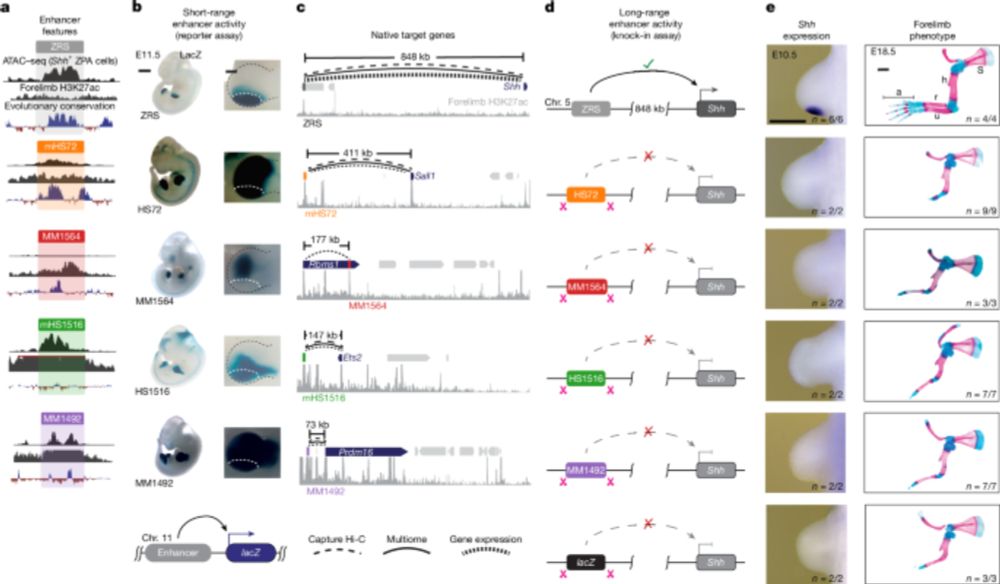
Our paper describing the Range Extender element which is required and sufficient for long-range enhancer activation at the Shh locus is now available at @nature.com. Congrats to @gracebower.bsky.social who led the study. Below is a brief summary of the main findings www.nature.com/articles/s41... 1/
Range extender mediates long-distance enhancer activity - Nature
The REX element is associated with long-range enhancer–promoter interactions.
www.nature.com
July 2, 2025 at 4:17 PM
Our paper describing the Range Extender element which is required and sufficient for long-range enhancer activation at the Shh locus is now available at @nature.com. Congrats to @gracebower.bsky.social who led the study. Below is a brief summary of the main findings www.nature.com/articles/s41... 1/
Reposted by Guillaume Andrey

Postdoc🚨!
Come join our HFSP team to uncover how chromatin moves in cells and what this means for genome function! Great opportunity to combine single-cell genomics, live imaging and polymer physics in the unique mammalian retina with @andersshansen.bsky.social, Davide Michieletto & Sandra Tenreiro
Come join our HFSP team to uncover how chromatin moves in cells and what this means for genome function! Great opportunity to combine single-cell genomics, live imaging and polymer physics in the unique mammalian retina with @andersshansen.bsky.social, Davide Michieletto & Sandra Tenreiro

Wissenschaftliche*r Mitarbeiter*in/ Postdoc (m/f/d)
Chromatin ist nicht unbeweglich. Es handelt sich um ein hochdynamisches Material, dessen 3D-Struktur zentrale genomische Prozesse – von der Transkription bis zur DNA-Reparatur – steuert. Doch wie verhält sich Chromatin als Material – als Flüssigkeit, Feststoff oder viskoelastisches Gel –, um diese Funktionen in lebenden Zellen auszuführen? Ohne eine Antwort auf diese Frage können wir nicht vollständig verstehen, wie Chromatin bei Krankheiten gestört wird.
www.mdc-berlin.de
June 20, 2025 at 7:58 AM
Postdoc🚨!
Come join our HFSP team to uncover how chromatin moves in cells and what this means for genome function! Great opportunity to combine single-cell genomics, live imaging and polymer physics in the unique mammalian retina with @andersshansen.bsky.social, Davide Michieletto & Sandra Tenreiro
Come join our HFSP team to uncover how chromatin moves in cells and what this means for genome function! Great opportunity to combine single-cell genomics, live imaging and polymer physics in the unique mammalian retina with @andersshansen.bsky.social, Davide Michieletto & Sandra Tenreiro
Reposted by Guillaume Andrey
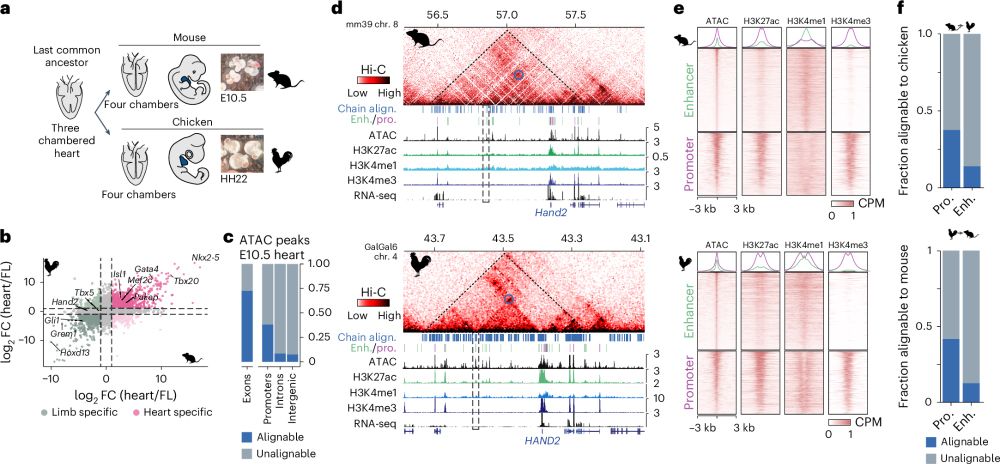
How to find Evolutionary Conserved Enhancers in 2025? 🐣-🐭
Check out our paper - fresh off the press!!!
We find widespread functional conservation of enhancers in absence of sequence homology
Including: a bioinformatic tool to map sequence-diverged enhancers!
rdcu.be/enVDN
github.com/tobiaszehnde...
Check out our paper - fresh off the press!!!
We find widespread functional conservation of enhancers in absence of sequence homology
Including: a bioinformatic tool to map sequence-diverged enhancers!
rdcu.be/enVDN
github.com/tobiaszehnde...
Conservation of regulatory elements with highly diverged sequences across large evolutionary distances
Nature Genetics - Combining functional genomic data from mouse and chicken with a synteny-based strategy identifies positionally conserved cis-regulatory elements in the absence of direct sequence...
rdcu.be
May 27, 2025 at 12:19 PM
How to find Evolutionary Conserved Enhancers in 2025? 🐣-🐭
Check out our paper - fresh off the press!!!
We find widespread functional conservation of enhancers in absence of sequence homology
Including: a bioinformatic tool to map sequence-diverged enhancers!
rdcu.be/enVDN
github.com/tobiaszehnde...
Check out our paper - fresh off the press!!!
We find widespread functional conservation of enhancers in absence of sequence homology
Including: a bioinformatic tool to map sequence-diverged enhancers!
rdcu.be/enVDN
github.com/tobiaszehnde...
Reposted by Guillaume Andrey

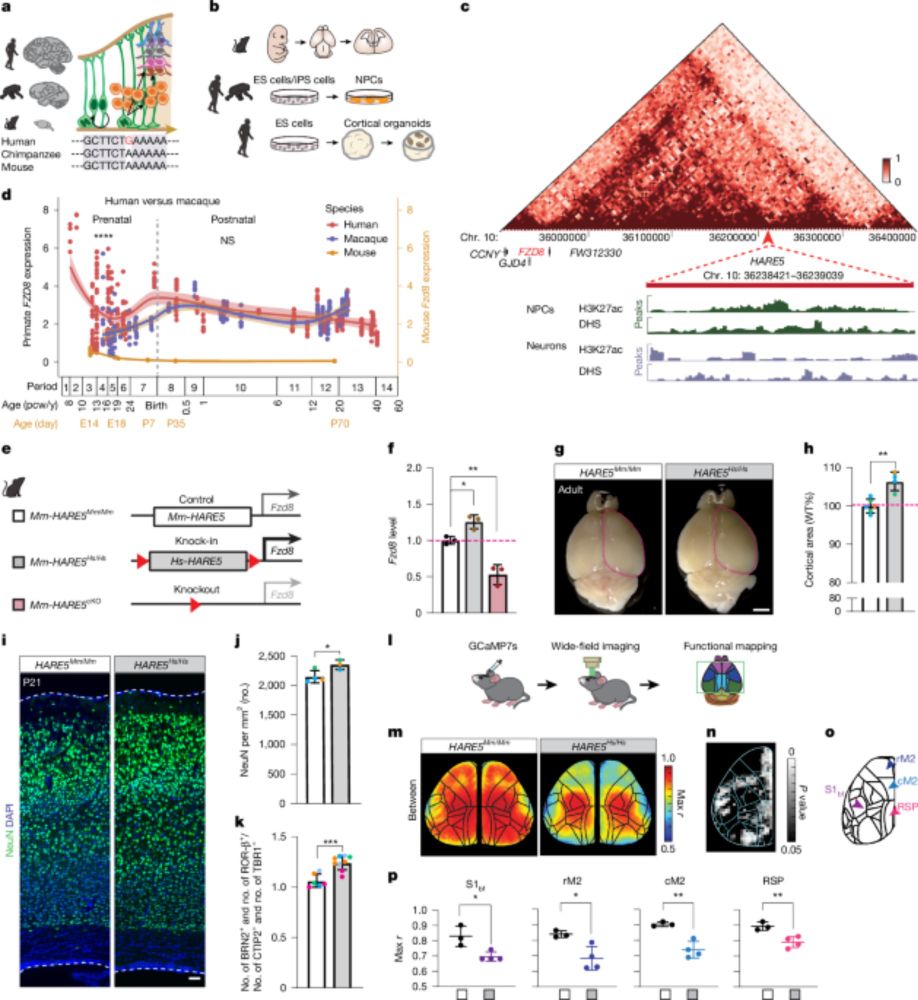
Thrilled to share our latest study out in @natureportfolio.nature.com led by the fantastically talented Jing Liu. Our study provides insight into a long standing question in biology: What molecular features make us uniquely human and how do these function? www.nature.com/articles/s41...
A human-specific enhancer fine-tunes radial glia potency and corticogenesis - Nature
HARE5, a human accelerated region enhancer, modulates cortical development by influencing neural progenitor cell behaviour, leading to an enlarged neocortex with increased functional independence betw...
www.nature.com
May 14, 2025 at 4:09 PM
Thrilled to share our latest study out in @natureportfolio.nature.com led by the fantastically talented Jing Liu. Our study provides insight into a long standing question in biology: What molecular features make us uniquely human and how do these function? www.nature.com/articles/s41...
Reposted by Guillaume Andrey
The Robson lab's second paper! A truly fun collaboration with an unexpected and important finding - progenitors reconfigure 3D genomes organisation to commission loci for future cell fates. A heroic amount of work from a rockstar team.

🚨 Preprint 🚨
Ever wondered how cells prepare their genomes to enable new cell-fates? In this team up with the Kind lab, we show that genes are repositioned in the nucleus to get ready for future activation and tissue formation. Read 🧵👇 to find out how and when this happens!
doi.org/10.1101/2025...
Ever wondered how cells prepare their genomes to enable new cell-fates? In this team up with the Kind lab, we show that genes are repositioned in the nucleus to get ready for future activation and tissue formation. Read 🧵👇 to find out how and when this happens!
doi.org/10.1101/2025...

Reconfiguration of genome-lamina interactions marks the commissioning of limb cell-fates
Diverse forms of heterochromatin block inappropriate transcription and safeguard differentiation and cell identity. Yet, how and when heterochromatin is reconfigured to facilitate changes in cell-fate...
www.biorxiv.org
May 8, 2025 at 10:47 AM
The Robson lab's second paper! A truly fun collaboration with an unexpected and important finding - progenitors reconfigure 3D genomes organisation to commission loci for future cell fates. A heroic amount of work from a rockstar team.
Reposted by Guillaume Andrey
Our BAT paper is accepted in Nature Ecology & Evolution! Single cell, gene regulation, TADs and key TFs that shape the bat wing. Genomics goes Evodevo 😍

May 6, 2025 at 8:34 AM
Our BAT paper is accepted in Nature Ecology & Evolution! Single cell, gene regulation, TADs and key TFs that shape the bat wing. Genomics goes Evodevo 😍