


Emilia Dimitrova
@edimitrova.bsky.social
Scientist interested in chromatin and regulation of transcription. Klose lab, University of Oxford
Pinned
Emilia Dimitrova
@edimitrova.bsky.social
· Nov 26
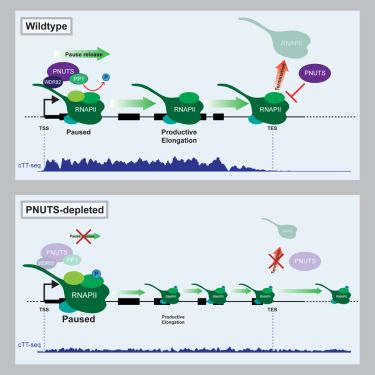
The PNUTS phosphatase complex controls transcription pause release
Kelley et al. discover that the PNUTS phosphatase complex plays an essential role
in gene transcription by controlling RNA polymerase II pause release. PNUTS achieves
this through its TND, which recog...
www.cell.com
Latest from the Klose lab: we discover a new role for the PNUTS-PP1 phosphatase complex in regulation of PolII pause release. www.cell.com/molecular-ce...
Reposted by Emilia Dimitrova

This was a really fantastic read. Felt like the eras tour albums with one hit unfolding after another!
December 16, 2025 at 11:21 PM
This was a really fantastic read. Felt like the eras tour albums with one hit unfolding after another!
Reposted by Emilia Dimitrova
🧬🎉Join us on Dec 17th for our last session of 2025! 🎉🧬Two fantastic talks on transcriptional regulation:
🔬JB Lalanne on developmental enhancers (and starting a lab in 2025?)
🔬 @rberrens.bsky.social on transposable elements in development
📋Register here: us06web.zoom.us/webinar/regi...
🔬JB Lalanne on developmental enhancers (and starting a lab in 2025?)
🔬 @rberrens.bsky.social on transposable elements in development
📋Register here: us06web.zoom.us/webinar/regi...

December 11, 2025 at 6:54 PM
🧬🎉Join us on Dec 17th for our last session of 2025! 🎉🧬Two fantastic talks on transcriptional regulation:
🔬JB Lalanne on developmental enhancers (and starting a lab in 2025?)
🔬 @rberrens.bsky.social on transposable elements in development
📋Register here: us06web.zoom.us/webinar/regi...
🔬JB Lalanne on developmental enhancers (and starting a lab in 2025?)
🔬 @rberrens.bsky.social on transposable elements in development
📋Register here: us06web.zoom.us/webinar/regi...
Read Alan's thread below to find out more about the latest work from the Klose lab @au-ho-yu.bsky.social @robklose.bsky.social @aleksszczurek.bsky.social

Excited to share our new preprint from the Klose lab, where we investigate how SET1/MLL complexes shape H3K4me3 and regulate transcription in mouse ES cells. www.biorxiv.org/content/10.6...

SET1/MLL complexes control transcription independently of H3K4me3
Histone H3 lysine 4 trimethylation (H3K4me3) at gene promoters is thought to play a central role in gene transcription. H3K4 methylation is deposited by the SET1 (A/B) and MLL (1-4) multi-protein comp...
www.biorxiv.org
December 11, 2025 at 4:21 PM
Read Alan's thread below to find out more about the latest work from the Klose lab @au-ho-yu.bsky.social @robklose.bsky.social @aleksszczurek.bsky.social
Also @au-ho-yu.bsky.social probably holds the world record for the most degron-tagged proteins in the same line. Guess how many!
Excited to see the latest from the Klose lab out this morning! Our brilliant PhD student Alan, now Dr Au, has dissected how SET1/MLL complexes shape H3K4me3 and shows they regulate transcription independently of their cat activity. He teamed up with Aleks to explore how. A few surprises!
An early Christmas present for those interested in chromatin and transcription! Fantastic work from @au-ho-yu.bsky.social and @aleksszczurek.bsky.social . Thanks to Inge and Michiel for their help. Please repost!
www.biorxiv.org/content/10.6...
www.biorxiv.org/content/10.6...
December 11, 2025 at 7:26 AM
Also @au-ho-yu.bsky.social probably holds the world record for the most degron-tagged proteins in the same line. Guess how many!
Excited to see the latest from the Klose lab out this morning! Our brilliant PhD student Alan, now Dr Au, has dissected how SET1/MLL complexes shape H3K4me3 and shows they regulate transcription independently of their cat activity. He teamed up with Aleks to explore how. A few surprises!
An early Christmas present for those interested in chromatin and transcription! Fantastic work from @au-ho-yu.bsky.social and @aleksszczurek.bsky.social . Thanks to Inge and Michiel for their help. Please repost!
www.biorxiv.org/content/10.6...
www.biorxiv.org/content/10.6...

SET1/MLL complexes control transcription independently of H3K4me3
Histone H3 lysine 4 trimethylation (H3K4me3) at gene promoters is thought to play a central role in gene transcription. H3K4 methylation is deposited by the SET1 (A/B) and MLL (1-4) multi-protein comp...
www.biorxiv.org
December 11, 2025 at 7:22 AM
Excited to see the latest from the Klose lab out this morning! Our brilliant PhD student Alan, now Dr Au, has dissected how SET1/MLL complexes shape H3K4me3 and shows they regulate transcription independently of their cat activity. He teamed up with Aleks to explore how. A few surprises!
Reposted by Emilia Dimitrova

We have just published a tribute to John Gurdon, reflecting on his scientific legacy and the profound influence he had on generations of developmental biologists.
The piece is available open access in Nature Communications:
www.nature.com/articles/s41...
The piece is available open access in Nature Communications:
www.nature.com/articles/s41...

Reversibility, regulation, and the community of development: the legacy of Sir John B. Gurdon - Nature Communications
Nature Communications - Reversibility, regulation, and the community of development: the legacy of Sir John B. Gurdon
www.nature.com
December 5, 2025 at 8:05 AM
We have just published a tribute to John Gurdon, reflecting on his scientific legacy and the profound influence he had on generations of developmental biologists.
The piece is available open access in Nature Communications:
www.nature.com/articles/s41...
The piece is available open access in Nature Communications:
www.nature.com/articles/s41...
Reposted by Emilia Dimitrova

Very proud to have our latest work now online in
@natsmb.nature.com. A wonderful team effort across the centromere community, across @jansenlab.bsky.social @naltemose.bsky.social @dfachinetti.bsky.social and Giunta labs. Happy reading! 1/4
www.nature.com/articles/s41...
@natsmb.nature.com. A wonderful team effort across the centromere community, across @jansenlab.bsky.social @naltemose.bsky.social @dfachinetti.bsky.social and Giunta labs. Happy reading! 1/4
www.nature.com/articles/s41...

Heterochromatin boundaries maintain centromere position, size and number - Nature Structural & Molecular Biology
Carty et al. identify the H3K9 methyltransferases that restrict the size and position of the centromere protein A chromatin domain, maintaining functional centromeres.
www.nature.com
November 27, 2025 at 9:58 PM
Very proud to have our latest work now online in
@natsmb.nature.com. A wonderful team effort across the centromere community, across @jansenlab.bsky.social @naltemose.bsky.social @dfachinetti.bsky.social and Giunta labs. Happy reading! 1/4
www.nature.com/articles/s41...
@natsmb.nature.com. A wonderful team effort across the centromere community, across @jansenlab.bsky.social @naltemose.bsky.social @dfachinetti.bsky.social and Giunta labs. Happy reading! 1/4
www.nature.com/articles/s41...
Reposted by Emilia Dimitrova
1/8🧵 Excited to share two studies in which I was involved within the Bird Lab📄📄 We have explored how the transcription factor SALL4 assembles and shapes chromatin in embryonic stem cells.
@kashyapchhatbar.bsky.social @saragiuliani.bsky.social @drphcb-uoe.bsky.social @edinburghbiology.bsky.social
@kashyapchhatbar.bsky.social @saragiuliani.bsky.social @drphcb-uoe.bsky.social @edinburghbiology.bsky.social
November 26, 2025 at 1:59 PM
1/8🧵 Excited to share two studies in which I was involved within the Bird Lab📄📄 We have explored how the transcription factor SALL4 assembles and shapes chromatin in embryonic stem cells.
@kashyapchhatbar.bsky.social @saragiuliani.bsky.social @drphcb-uoe.bsky.social @edinburghbiology.bsky.social
@kashyapchhatbar.bsky.social @saragiuliani.bsky.social @drphcb-uoe.bsky.social @edinburghbiology.bsky.social
New method by Davies lab pushing the boundaries of the C-technologies, going down to a single base-pair resolution. Glad we could contribute to the story. Well done, Hangpeng and team!
Our latest paper has just been published in Cell!
doi.org/10.1016/j.ce...
We developed a new method called MCC ultra, which allows 3D chromatin structure to be visualised with a 1 base pair pixel size.
doi.org/10.1016/j.ce...
We developed a new method called MCC ultra, which allows 3D chromatin structure to be visualised with a 1 base pair pixel size.

November 6, 2025 at 7:54 AM
New method by Davies lab pushing the boundaries of the C-technologies, going down to a single base-pair resolution. Glad we could contribute to the story. Well done, Hangpeng and team!
Reposted by Emilia Dimitrova
Awesome stuff James and team! Thanks for giving @edimitrova.bsky.social and I the opportunity to contribute.
Our latest paper has just been published in Cell!
doi.org/10.1016/j.ce...
We developed a new method called MCC ultra, which allows 3D chromatin structure to be visualised with a 1 base pair pixel size.
doi.org/10.1016/j.ce...
We developed a new method called MCC ultra, which allows 3D chromatin structure to be visualised with a 1 base pair pixel size.
November 5, 2025 at 9:02 PM
Awesome stuff James and team! Thanks for giving @edimitrova.bsky.social and I the opportunity to contribute.
Reposted by Emilia Dimitrova
Very happy to see our paper published online natcomms.nature.com. Thank you to @wellcometrust.bsky.social for funding this work during my time with @robklose.bsky.social and David Booth! Thanks also to collaborators @garcialabms.bsky.social @alexdemendoza.bsky.social and the other authors!

Chromatin profiling identifies putative dual roles for H3K27me3 in regulating cell type-specific genes and transposable elements in choanoflagellates
Nature Communications - Here, the authors investigate chromatin-based gene regulation in the closest relative of animal, choanoflagellates. They uncover a putative dual role for the histone...
rdcu.be
October 29, 2025 at 1:40 PM
Very happy to see our paper published online natcomms.nature.com. Thank you to @wellcometrust.bsky.social for funding this work during my time with @robklose.bsky.social and David Booth! Thanks also to collaborators @garcialabms.bsky.social @alexdemendoza.bsky.social and the other authors!
Reposted by Emilia Dimitrova

🚀 Excited to share my latest paper on using SHAP, to predict direct target genes of chromatin-associated factors! Check it out for insights into gene regulation and the power of explainable AI in genomics! #XAI #SHAP #Genomics
doi.org/10.1371/jour...
Let's break down what we found! 👇
doi.org/10.1371/jour...
Let's break down what we found! 👇

Modelling transcription with explainable AI uncovers context-specific epigenetic gene regulation at promoters and gene bodies
Author summary Genes are turned on or off through complex processes involving many proteins that interact with DNA wrapped histones and modify their structure. These changes, known as epigenetic modif...
doi.org
October 24, 2025 at 11:37 AM
🚀 Excited to share my latest paper on using SHAP, to predict direct target genes of chromatin-associated factors! Check it out for insights into gene regulation and the power of explainable AI in genomics! #XAI #SHAP #Genomics
doi.org/10.1371/jour...
Let's break down what we found! 👇
doi.org/10.1371/jour...
Let's break down what we found! 👇
Reposted by Emilia Dimitrova
Check out our new story on how broad enhancer inputs are restricted into tissue-specific gene expression 🧬
Hint: Promoter-proximal regions are the key!
Hint: Promoter-proximal regions are the key!
Ever wondered what drives enhancer-promoter specificity? Why would an enhancer activate one gene rather than another neighboring one?
Check our latest preprint, led by @mmasoura.bsky.social, to find out!
www.biorxiv.org/content/10.1...
Check our latest preprint, led by @mmasoura.bsky.social, to find out!
www.biorxiv.org/content/10.1...

Promoter-proximal gatekeepers restrict pleiotropic enhancer inputs to achieve tissue specificity
Developmental enhancers are central regulatory elements that can activate multiple genes, yet how they selectively regulate one gene over its neighbours remains unclear. Using the Drosophila twist E3 ...
www.biorxiv.org
October 16, 2025 at 4:53 PM
Check out our new story on how broad enhancer inputs are restricted into tissue-specific gene expression 🧬
Hint: Promoter-proximal regions are the key!
Hint: Promoter-proximal regions are the key!
Reposted by Emilia Dimitrova
What is a promoter? And how does it work?
We very happy to share our latest work trying to understand enhancer-promoter compatibility.
I am very excited about the results of @blanka-majchrzycka.bsky.social, which changed the way I think about promoters
www.biorxiv.org/content/10.1...
We very happy to share our latest work trying to understand enhancer-promoter compatibility.
I am very excited about the results of @blanka-majchrzycka.bsky.social, which changed the way I think about promoters
www.biorxiv.org/content/10.1...

Enhancer-promoter compatibility is mediated by the promoter-proximal region
Gene promoters induce transcription in response to distal enhancers. How enhancers specifically activate their target promoter while bypassing other promoters remains unclear. Here, we find that the p...
www.biorxiv.org
October 16, 2025 at 3:06 PM
What is a promoter? And how does it work?
We very happy to share our latest work trying to understand enhancer-promoter compatibility.
I am very excited about the results of @blanka-majchrzycka.bsky.social, which changed the way I think about promoters
www.biorxiv.org/content/10.1...
We very happy to share our latest work trying to understand enhancer-promoter compatibility.
I am very excited about the results of @blanka-majchrzycka.bsky.social, which changed the way I think about promoters
www.biorxiv.org/content/10.1...
Reposted by Emilia Dimitrova
Many of you know, we lost Béla Novák this year. John Tyson, Francis Barr & I tried to capture his wonderful character & great mind so that those that didn't know him can see what a fantastic person he was.
Thanks to @jcellsci.bsky.social for publishing.
journals.biologists.com/jcs/article/...
Thanks to @jcellsci.bsky.social for publishing.
journals.biologists.com/jcs/article/...

Béla Novák (1956–2025) – a legacy of scientific discovery and personal charm
In February 2025, we were shocked and deeply saddened to hear about the death of Béla Novák, Professor in Integrative Systems Biology at the University of Oxford, UK, and a beloved grandfather, father...
journals.biologists.com
October 9, 2025 at 12:59 PM
Many of you know, we lost Béla Novák this year. John Tyson, Francis Barr & I tried to capture his wonderful character & great mind so that those that didn't know him can see what a fantastic person he was.
Thanks to @jcellsci.bsky.social for publishing.
journals.biologists.com/jcs/article/...
Thanks to @jcellsci.bsky.social for publishing.
journals.biologists.com/jcs/article/...
Reposted by Emilia Dimitrova
Wonderful opportunity to work with Martin Howard and my group trying to understand how chromatin influences gene transcription and expression. Integration of theory, modelling, and experimentation. Come and join the team!
Please repost!
jobs.jic.ac.uk/Details.asp?...
Please repost!
jobs.jic.ac.uk/Details.asp?...
John Innes Centre
jobs.jic.ac.uk
October 8, 2025 at 9:04 AM
Wonderful opportunity to work with Martin Howard and my group trying to understand how chromatin influences gene transcription and expression. Integration of theory, modelling, and experimentation. Come and join the team!
Please repost!
jobs.jic.ac.uk/Details.asp?...
Please repost!
jobs.jic.ac.uk/Details.asp?...
Reposted by Emilia Dimitrova
If you are a computational biologist come, apply and join Howard & Klose lab in a joint Norwich-Oxford collaboration on chromatin dynamics!

VACANCY - We have an opportunity for a Postdoctoral Researcher to join the Howard Group, working to develop computational models of epigenetic dynamics in the Polycomb system.
www.jic.ac.uk/vacancies/po...
Closing date - 9 November 2025
Salary - £37,500 - £45,350
Contract - 36 months, full-time
www.jic.ac.uk/vacancies/po...
Closing date - 9 November 2025
Salary - £37,500 - £45,350
Contract - 36 months, full-time

Postdoctoral Researcher (Howard Group) | John Innes Centre
An exciting opportunity has arisen for a Postdoctoral Researcher to join the Howard Group at the John Innes Centre, working on cutting-edge science in the field of Computational and Systems Biology.
www.jic.ac.uk
October 8, 2025 at 10:44 AM
If you are a computational biologist come, apply and join Howard & Klose lab in a joint Norwich-Oxford collaboration on chromatin dynamics!
Reposted by Emilia Dimitrova

Very exciting opportunity for those with a quantitative background and interested in epigenetics / gene regulation. Highly collaborative environment!
VACANCY - We have an opportunity for a Postdoctoral Researcher to join the Howard Group, working to develop computational models of epigenetic dynamics in the Polycomb system.
www.jic.ac.uk/vacancies/po...
Closing date - 9 November 2025
Salary - £37,500 - £45,350
Contract - 36 months, full-time
www.jic.ac.uk/vacancies/po...
Closing date - 9 November 2025
Salary - £37,500 - £45,350
Contract - 36 months, full-time
Postdoctoral Researcher (Howard Group) | John Innes Centre
An exciting opportunity has arisen for a Postdoctoral Researcher to join the Howard Group at the John Innes Centre, working on cutting-edge science in the field of Computational and Systems Biology.
www.jic.ac.uk
October 7, 2025 at 6:34 AM
Very exciting opportunity for those with a quantitative background and interested in epigenetics / gene regulation. Highly collaborative environment!
If you are a computational biologist interested in how chromatin states are established and maintained to regulate transcription, this is the dream job for you! This will be in close collaboration with the Klose lab in Oxford and we have a lot of cool projects you can get involved in. Apply!
VACANCY - We have an opportunity for a Postdoctoral Researcher to join the Howard Group, working to develop computational models of epigenetic dynamics in the Polycomb system.
www.jic.ac.uk/vacancies/po...
Closing date - 9 November 2025
Salary - £37,500 - £45,350
Contract - 36 months, full-time
www.jic.ac.uk/vacancies/po...
Closing date - 9 November 2025
Salary - £37,500 - £45,350
Contract - 36 months, full-time
Postdoctoral Researcher (Howard Group) | John Innes Centre
An exciting opportunity has arisen for a Postdoctoral Researcher to join the Howard Group at the John Innes Centre, working on cutting-edge science in the field of Computational and Systems Biology.
www.jic.ac.uk
October 6, 2025 at 8:17 PM
If you are a computational biologist interested in how chromatin states are established and maintained to regulate transcription, this is the dream job for you! This will be in close collaboration with the Klose lab in Oxford and we have a lot of cool projects you can get involved in. Apply!
On my way back from the Transcription and Chromatin UK meeting in Manchester. It was a great meeting with lots of cool science discussed! At dinner we were trying to guess where it will be next year - Edinburgh or Birmingham? 😀 @biochemsoc.bsky.social #BiochemEvent
September 19, 2025 at 1:40 PM
On my way back from the Transcription and Chromatin UK meeting in Manchester. It was a great meeting with lots of cool science discussed! At dinner we were trying to guess where it will be next year - Edinburgh or Birmingham? 😀 @biochemsoc.bsky.social #BiochemEvent
Reposted by Emilia Dimitrova
Delighted to share our lab's first preprint identifying DDIAS as a mitotic DNA repair protein. Great collaboration with the @andrewblackford.bsky.social, @tcr-miller.bsky.social and @profstewartlab.bsky.social labs, and many more. Read the paper here: www.biorxiv.org/content/10.1...

DDIAS is a single-stranded DNA-binding effector of the TOPBP1-CIP2A complex in mitosis
DNA double-strand breaks and unresolved DNA replication intermediates are particularly dangerous during mitosis. Paradoxically, cells inactivate canonical DNA repair mechanisms during chromosome segre...
www.biorxiv.org
September 10, 2025 at 7:01 PM
Delighted to share our lab's first preprint identifying DDIAS as a mitotic DNA repair protein. Great collaboration with the @andrewblackford.bsky.social, @tcr-miller.bsky.social and @profstewartlab.bsky.social labs, and many more. Read the paper here: www.biorxiv.org/content/10.1...
Double celebration on our floor @oxfordbiochemistry.bsky.social with @guifengwei.bsky.social from the Brockdorff lab and Dounia and Sherry from Fisher lab having their papers published today! And I hear there is more to come...
www.nature.com/articles/s41...
www.nature.com/articles/s41...
www.nature.com/articles/s41...
www.nature.com/articles/s41...

m6A and the NEXT complex direct Xist RNA turnover and X-inactivation dynamics - Nature Structural & Molecular Biology
Wei et al. show that the primary function of m6A on the nuclear long noncoding RNA Xist, a master regulator of X inactivation, is to promote RNA degradation. Xist turnover is mediated by the nuclear e...
www.nature.com
September 9, 2025 at 12:22 PM
Double celebration on our floor @oxfordbiochemistry.bsky.social with @guifengwei.bsky.social from the Brockdorff lab and Dounia and Sherry from Fisher lab having their papers published today! And I hear there is more to come...
www.nature.com/articles/s41...
www.nature.com/articles/s41...
www.nature.com/articles/s41...
www.nature.com/articles/s41...
Guifeng's study on the role of m6A on Xist is published today! Have a read!

Thrilled to share our new Brockdorff lab paper at NSMB: we show that the primary role of m6A RNA modification on Xist is to promote RNA degradation. Xist turnover is mediated by the NEXT complex, not PAXT, and is independent of the m6A reader YTHDC1. www.nature.com/articles/s41...

m6A and the NEXT complex direct Xist RNA turnover and X-inactivation dynamics - Nature Structural & Molecular Biology
Wei et al. show that the primary function of m6A on the nuclear long noncoding RNA Xist, a master regulator of X inactivation, is to promote RNA degradation. Xist turnover is mediated by the nuclear e...
www.nature.com
September 9, 2025 at 12:13 PM
Guifeng's study on the role of m6A on Xist is published today! Have a read!
Reposted by Emilia Dimitrova
We're super excited to announce the entire lineup for the Fall season of Fragile Nucleosome Seminars, starting on Sept 10th at 1200 EDT / 1600 UTC with @gracebower.bsky.social and @creminslab.bsky.social!
register here for the entire series: us06web.zoom.us/webinar/regi...
register here for the entire series: us06web.zoom.us/webinar/regi...

September 1, 2025 at 2:59 PM
We're super excited to announce the entire lineup for the Fall season of Fragile Nucleosome Seminars, starting on Sept 10th at 1200 EDT / 1600 UTC with @gracebower.bsky.social and @creminslab.bsky.social!
register here for the entire series: us06web.zoom.us/webinar/regi...
register here for the entire series: us06web.zoom.us/webinar/regi...
Great lab doing fun science! Come and join our lab neighbours in Oxford!
Please re-post: If you know (or are!) somebody who might fancy doing a PhD (Oct 2026 start) in my group @oxfordbiochemistry.bsky.social, working on chromatin evolution in prokaryotes (or other things we're interested in), please have a look at www.bioch.ox.ac.uk/supervisors-...

Supervisors and Projects
www.bioch.ox.ac.uk
September 1, 2025 at 11:46 AM
Great lab doing fun science! Come and join our lab neighbours in Oxford!