


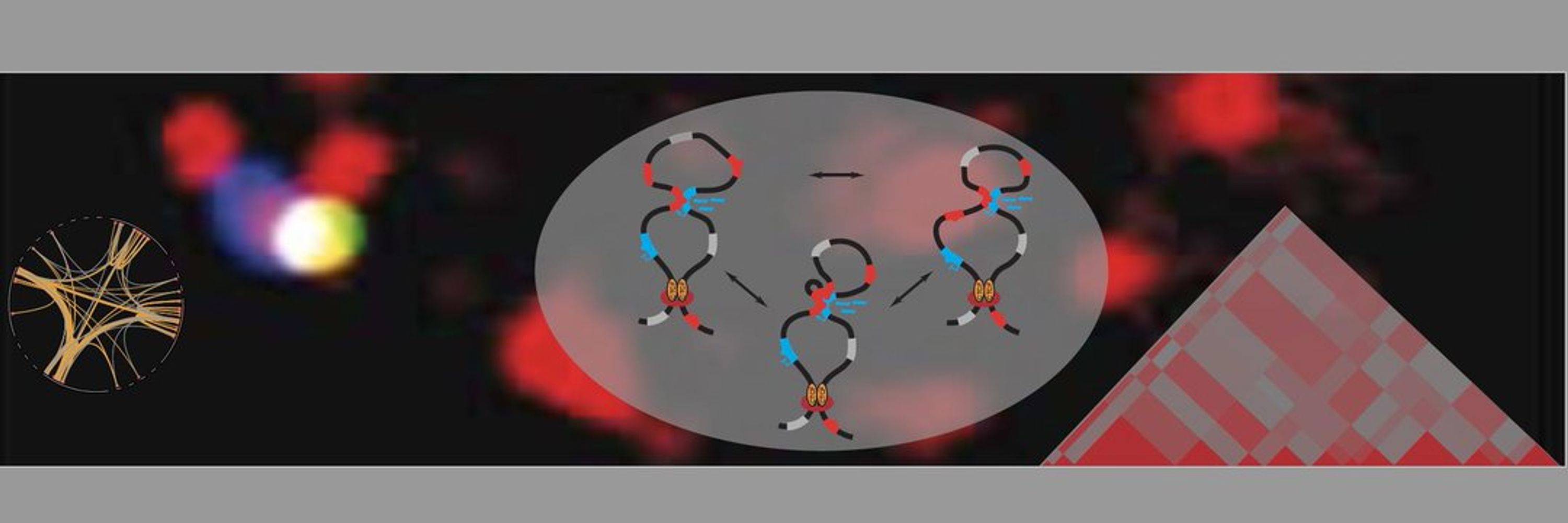

Stefan Schoenfelder
@stefanschoenfelder.bsky.social
Enhancers, 3D genome organisation, pluripotent stem cells
Babraham Institute and Enhanc3D Genomics
Babraham Institute and Enhanc3D Genomics
Pinned

Non-canonical enhancers control gene expression and cell fate in human pluripotent stem cells
Enhancers are key gene regulatory elements that ensure the precise spatiotemporal execution of developmental gene expression programmes. However recent findings indicate that approaches to identify en...
www.biorxiv.org
Delighted & excited to share our latest preprint on non-canonical enhancers in human pluripotent stem cells, the result of a fantastic and fun collaboration with @guenesdoganlab.bsky.social:
www.biorxiv.org/content/10.1...
🧵 below
www.biorxiv.org/content/10.1...
🧵 below
Reposted by Stefan Schoenfelder
#FragileNuclesome is back tomorrow! Join us to hear about exciting talks from:
- @au-ho-yu.bsky.social in @robklose.bsky.social's group about transcriptional control by SET1/MLL complexes
- @gcloner.bsky.social at @epicypher.bsky.social about the histone PTM landscape of the immune system
- @au-ho-yu.bsky.social in @robklose.bsky.social's group about transcriptional control by SET1/MLL complexes
- @gcloner.bsky.social at @epicypher.bsky.social about the histone PTM landscape of the immune system

🥁 #FragileNucleosome is back on Jan 28! We are very excited to host @au-ho-yu.bsky.social and @gcloner.bsky.social as our first speakers of 2026!
📋Please don't forget to register for our 2026 seminar series: us06web.zoom.us/webinar/regi...
📋Please don't forget to register for our 2026 seminar series: us06web.zoom.us/webinar/regi...

January 27, 2026 at 6:24 PM
#FragileNuclesome is back tomorrow! Join us to hear about exciting talks from:
- @au-ho-yu.bsky.social in @robklose.bsky.social's group about transcriptional control by SET1/MLL complexes
- @gcloner.bsky.social at @epicypher.bsky.social about the histone PTM landscape of the immune system
- @au-ho-yu.bsky.social in @robklose.bsky.social's group about transcriptional control by SET1/MLL complexes
- @gcloner.bsky.social at @epicypher.bsky.social about the histone PTM landscape of the immune system
Very excited for @livcracknell.bsky.social and @eugenia-w.bsky.social to represent our lab at the Keystone Symposia Meeting "iPSCs: Progress, Opportunities and Challenges" in Kyoto, Japan
www.keystonesymposia.org/conferences/...
www.keystonesymposia.org/conferences/...

iPSCs: Progress, Opportunities, and Challenges | Keystone Symposia
Join us at the Keystone Symposia on iPSCs: Progress, Opportunities, and Challenges, January 2026, in Kyoto, with field leaders!
www.keystonesymposia.org
January 26, 2026 at 11:27 AM
Very excited for @livcracknell.bsky.social and @eugenia-w.bsky.social to represent our lab at the Keystone Symposia Meeting "iPSCs: Progress, Opportunities and Challenges" in Kyoto, Japan
www.keystonesymposia.org/conferences/...
www.keystonesymposia.org/conferences/...
Reposted by Stefan Schoenfelder

Have you wondered how the rules of chromatin folding have evolved? Well, this task is not easy to formalize. But here is our take on it: train species-specific DNA-to-chromatin encoder, apply to DNA of unseen species, and build chromatin rules-based tree of life. Have a look:
doi.org/10.1093/nar/...
doi.org/10.1093/nar/...

January 26, 2026 at 10:58 AM
Have you wondered how the rules of chromatin folding have evolved? Well, this task is not easy to formalize. But here is our take on it: train species-specific DNA-to-chromatin encoder, apply to DNA of unseen species, and build chromatin rules-based tree of life. Have a look:
doi.org/10.1093/nar/...
doi.org/10.1093/nar/...
Reposted by Stefan Schoenfelder
I had the privilege to meet artist Mary Griffiths. Mary got inspired by Hi-C maps and over zooms we spoke about Hi-C maps, patterns and drawings. Mary’s Hi-C inspired art has been exhibited eg the Royal Academy. We wrote this piece about this art-science collaboration
pubs.aip.org/aip/bpr/arti...
pubs.aip.org/aip/bpr/arti...

Seeing into Hi-C: How our scientific connectivity revealed the close connections in our DNA to be a work of art
Scientific data can be beautiful. An example where the data itself have a particularly striking appearance even before any scientific meaning has been ascribed
pubs.aip.org
January 24, 2026 at 12:50 AM
I had the privilege to meet artist Mary Griffiths. Mary got inspired by Hi-C maps and over zooms we spoke about Hi-C maps, patterns and drawings. Mary’s Hi-C inspired art has been exhibited eg the Royal Academy. We wrote this piece about this art-science collaboration
pubs.aip.org/aip/bpr/arti...
pubs.aip.org/aip/bpr/arti...
Reposted by Stefan Schoenfelder
📣 Please spread: we’re hiring a Lab Manager! It is a critical position in our new lab. As our lab moves to Barcelona and joins the @crg.eu, we’re looking for a Lab Manager to help build the lab and set the lab atmosphere.
🔗 Apply here 👉 recruitment.crg.eu/content/jobs...
🔗 Apply here 👉 recruitment.crg.eu/content/jobs...

January 23, 2026 at 6:41 AM
📣 Please spread: we’re hiring a Lab Manager! It is a critical position in our new lab. As our lab moves to Barcelona and joins the @crg.eu, we’re looking for a Lab Manager to help build the lab and set the lab atmosphere.
🔗 Apply here 👉 recruitment.crg.eu/content/jobs...
🔗 Apply here 👉 recruitment.crg.eu/content/jobs...
Reposted by Stefan Schoenfelder

🚨Postdoc opportunity🚨Our lab at MRC-LMB Cambridge is recruting a postdoc to study transcription-coupled splicing using cryoEM and endogenous isolation! 🔬 🧬
Please feel free to get in touch directly #postdoc #cryoEM #biochemistry #splicing
Apply here by 11 Feb
www.nature.com/naturecareer...
Please feel free to get in touch directly #postdoc #cryoEM #biochemistry #splicing
Apply here by 11 Feb
www.nature.com/naturecareer...

Postdoctoral Researcher - Structural Studies - Dr Suyang Zhang - LMB 2761 - Cambridgeshire (GB) job with MRC Laboratory of Molecular Biology (LMB) | 12852642
Postdoctoral Researcher Salary £42,694 per annum MRC Laboratory of Molecular Biology, Cambridge, UK We are recruiting a Postdoctoral Researcher to...
www.nature.com
January 23, 2026 at 12:20 PM
🚨Postdoc opportunity🚨Our lab at MRC-LMB Cambridge is recruting a postdoc to study transcription-coupled splicing using cryoEM and endogenous isolation! 🔬 🧬
Please feel free to get in touch directly #postdoc #cryoEM #biochemistry #splicing
Apply here by 11 Feb
www.nature.com/naturecareer...
Please feel free to get in touch directly #postdoc #cryoEM #biochemistry #splicing
Apply here by 11 Feb
www.nature.com/naturecareer...
Reposted by Stefan Schoenfelder

Turns out that if you use a broom to scratch yourself everyone thinks you're a weirdo but if a cow does it they end up in the cover of Current Biology
January 22, 2026 at 2:33 PM
Turns out that if you use a broom to scratch yourself everyone thinks you're a weirdo but if a cow does it they end up in the cover of Current Biology
Reposted by Stefan Schoenfelder
🔔 New paper alert 🔔 www.nature.com/articles/s41...
Some regions in the genome replicate early and some late, but the why and how remain poorly understood. DNA replication and 3D genome organization appear linked, raising the question if one may regulate the other? (1/n)
Some regions in the genome replicate early and some late, but the why and how remain poorly understood. DNA replication and 3D genome organization appear linked, raising the question if one may regulate the other? (1/n)
DNA methylation and lncRNA control asynchronous DNA replication at specific imprinted gene domains - Nature Communications
It is not fully understood why genomic loci show asynchronous DNA replication. Here, the authors show that two imprinted gene domains replicate asynchronously between the parental chromosomes due to d...
www.nature.com
January 21, 2026 at 8:53 PM
🔔 New paper alert 🔔 www.nature.com/articles/s41...
Some regions in the genome replicate early and some late, but the why and how remain poorly understood. DNA replication and 3D genome organization appear linked, raising the question if one may regulate the other? (1/n)
Some regions in the genome replicate early and some late, but the why and how remain poorly understood. DNA replication and 3D genome organization appear linked, raising the question if one may regulate the other? (1/n)
Reposted by Stefan Schoenfelder
Preprint alert: Jiangyuan Liu developed a new workflow for chromatin loop calling across Hi-C datasets, e.g., during differentiation. Most loops are shared between datasets/cell states. Important work for all interested in chromatin loops and how to identify them!
www.biorxiv.org/content/10.6...
www.biorxiv.org/content/10.6...
www.biorxiv.org
January 21, 2026 at 11:20 AM
Preprint alert: Jiangyuan Liu developed a new workflow for chromatin loop calling across Hi-C datasets, e.g., during differentiation. Most loops are shared between datasets/cell states. Important work for all interested in chromatin loops and how to identify them!
www.biorxiv.org/content/10.6...
www.biorxiv.org/content/10.6...
Reposted by Stefan Schoenfelder

If you are looking to build your lab, take a listen to these interviews on @lonelypipette.bsky.social!
www.buzzsprout.com/1356877/epis...
www.buzzsprout.com/1356877/epis...
🔴 Ignoring the needs and identities of your lab crew, doesn't make you objective. It makes you lose talent.
So how do you build an inclusive lab culture where evrybody can thrive ?
In our new episode, we learn how to build labs where people belong : www.buzzsprout.com/1356877/epis...
#academicsky
So how do you build an inclusive lab culture where evrybody can thrive ?
In our new episode, we learn how to build labs where people belong : www.buzzsprout.com/1356877/epis...
#academicsky

January 21, 2026 at 10:51 AM
If you are looking to build your lab, take a listen to these interviews on @lonelypipette.bsky.social!
www.buzzsprout.com/1356877/epis...
www.buzzsprout.com/1356877/epis...
Reposted by Stefan Schoenfelder

New preprint on technologies to scale up CRISPR screens.
We use them to map 665,856 pairwise genetic perturbations and outline a path to comprehensive interaction mapping in human cells.
We also introduce an approach for cloning lentiviral libraries with billions of elements.
We use them to map 665,856 pairwise genetic perturbations and outline a path to comprehensive interaction mapping in human cells.
We also introduce an approach for cloning lentiviral libraries with billions of elements.

January 20, 2026 at 1:42 PM
New preprint on technologies to scale up CRISPR screens.
We use them to map 665,856 pairwise genetic perturbations and outline a path to comprehensive interaction mapping in human cells.
We also introduce an approach for cloning lentiviral libraries with billions of elements.
We use them to map 665,856 pairwise genetic perturbations and outline a path to comprehensive interaction mapping in human cells.
We also introduce an approach for cloning lentiviral libraries with billions of elements.
Reposted by Stefan Schoenfelder

What can we learn from comparing ~2,000 fungal genomes?
Find out about:
🍄evolutionary transitions
🍄lifestyles
🍄genome dynamics
🍄sampling gaps
🍄efforts to uncover the remaining fungal dark matter
New review by @jgi.doe.gov's Stephen Mondo and Igor Grigoriev
www.nature.com/articles/s41...
Find out about:
🍄evolutionary transitions
🍄lifestyles
🍄genome dynamics
🍄sampling gaps
🍄efforts to uncover the remaining fungal dark matter
New review by @jgi.doe.gov's Stephen Mondo and Igor Grigoriev
www.nature.com/articles/s41...

January 20, 2026 at 8:34 PM
What can we learn from comparing ~2,000 fungal genomes?
Find out about:
🍄evolutionary transitions
🍄lifestyles
🍄genome dynamics
🍄sampling gaps
🍄efforts to uncover the remaining fungal dark matter
New review by @jgi.doe.gov's Stephen Mondo and Igor Grigoriev
www.nature.com/articles/s41...
Find out about:
🍄evolutionary transitions
🍄lifestyles
🍄genome dynamics
🍄sampling gaps
🍄efforts to uncover the remaining fungal dark matter
New review by @jgi.doe.gov's Stephen Mondo and Igor Grigoriev
www.nature.com/articles/s41...
Reposted by Stefan Schoenfelder
⚠️ The final work of two former PhD students Till @tschwammle.bsky.social and Verena @verenamutzel.bsky.social is out!
➡️⬅️ They dissect how memory can arise from antisense transcription using mathematical modelling 💻, genomics 🧬 and synthetic biology ⚒️! link.springer.com/article/10.1...
➡️⬅️ They dissect how memory can arise from antisense transcription using mathematical modelling 💻, genomics 🧬 and synthetic biology ⚒️! link.springer.com/article/10.1...

Antisense transcription can induce expression memory via stable promoter repression - Genome Biology
Background The capacity of cells to retain a memory of previous signals enables acquisition of unique fates and adaptation to their environment. The underlying gene expression memory can arise from mu...
link.springer.com
January 20, 2026 at 11:02 AM
⚠️ The final work of two former PhD students Till @tschwammle.bsky.social and Verena @verenamutzel.bsky.social is out!
➡️⬅️ They dissect how memory can arise from antisense transcription using mathematical modelling 💻, genomics 🧬 and synthetic biology ⚒️! link.springer.com/article/10.1...
➡️⬅️ They dissect how memory can arise from antisense transcription using mathematical modelling 💻, genomics 🧬 and synthetic biology ⚒️! link.springer.com/article/10.1...
Reposted by Stefan Schoenfelder

"We need to ask ourselves, on both sides of the Atlantic, if we want to live in a world where democracy is recast as weakness, truth as opinion and justice as an option." Perfectly summed up by the secretary general of the Council of Europe. (gift article) www.nytimes.com/2026/01/19/o...

Opinion | I’m the Secretary General of the Council of Europe. This Is Something I Thought I’d Never Have to Write.
www.nytimes.com
January 19, 2026 at 10:07 PM
"We need to ask ourselves, on both sides of the Atlantic, if we want to live in a world where democracy is recast as weakness, truth as opinion and justice as an option." Perfectly summed up by the secretary general of the Council of Europe. (gift article) www.nytimes.com/2026/01/19/o...
Thank you @auersperga.bsky.social and Veronika for this perfect timeline cleanse.

Our new paper (with @biotay.bsky.social) is out and on the cover story of @currentbiology.bsky.social !!!! Veronika, a Carinthian mountain cow flexibly uses a “multi-purpose tool” to scratch herself. A video and more information will follow in the comments.
www.cell.com/current-biol...
www.cell.com/current-biol...

January 19, 2026 at 9:17 PM
Thank you @auersperga.bsky.social and Veronika for this perfect timeline cleanse.
Reposted by Stefan Schoenfelder

Happy New Year all. I know it's been a draining and difficult year for science in general, but wanted to share some good news: our intrabody paper has now been published in Science Advances with lots of additional data.
www.science.org/doi/10.1126/...
www.science.org/doi/10.1126/...

AI-assisted protein design to rapidly convert antibody sequences to intrabodies targeting diverse peptides and histone modifications
AI-powered pipeline converts antibodies into functional intrabodies, enabling live-cell imaging of peptides and histone marks.
www.science.org
January 19, 2026 at 5:43 PM
Happy New Year all. I know it's been a draining and difficult year for science in general, but wanted to share some good news: our intrabody paper has now been published in Science Advances with lots of additional data.
www.science.org/doi/10.1126/...
www.science.org/doi/10.1126/...
Reposted by Stefan Schoenfelder

Thrilled to share our latest work: Fine-tuning BACH2 dosage balances stemness and effector function to enhance antitumor T cell therapy - now online in Nature Immunology. Led by Alberto Conti, Alex Evans and Teresa von Linde in the lab. www.nature.com/articles/s41...

January 16, 2026 at 12:00 PM
Thrilled to share our latest work: Fine-tuning BACH2 dosage balances stemness and effector function to enhance antitumor T cell therapy - now online in Nature Immunology. Led by Alberto Conti, Alex Evans and Teresa von Linde in the lab. www.nature.com/articles/s41...
Reposted by Stefan Schoenfelder

There is a special Current Opinion in Genetics & Development issue about genome architecture and expression and it looks great including reviews by @lennarthilbert.bsky.social @yghavi.bsky.social and @wbickmor.bsky.social
www.sciencedirect.com/special-issu...
www.sciencedirect.com/special-issu...
Current Opinion in Genetics & Development | Genome Architecture and Expression (2026) | ScienceDirect.com by Elsevier
This collection summarizes key aspects of our current experimental and theoretical understanding of eukaryotic genome folding and its relationship with the molecular processes governing cell fate. Ove...
www.sciencedirect.com
January 16, 2026 at 8:39 AM
There is a special Current Opinion in Genetics & Development issue about genome architecture and expression and it looks great including reviews by @lennarthilbert.bsky.social @yghavi.bsky.social and @wbickmor.bsky.social
www.sciencedirect.com/special-issu...
www.sciencedirect.com/special-issu...
Reposted by Stefan Schoenfelder

The Vlaming lab continues to grow!
It's an exciting time in the Vlaming lab: we've just had our 2nd PhD student join, and the 3rd is joining in February. Now, we're looking to recruit a postdoc!
It's an exciting time in the Vlaming lab: we've just had our 2nd PhD student join, and the 3rd is joining in February. Now, we're looking to recruit a postdoc!
January 15, 2026 at 9:33 PM
The Vlaming lab continues to grow!
It's an exciting time in the Vlaming lab: we've just had our 2nd PhD student join, and the 3rd is joining in February. Now, we're looking to recruit a postdoc!
It's an exciting time in the Vlaming lab: we've just had our 2nd PhD student join, and the 3rd is joining in February. Now, we're looking to recruit a postdoc!
Reposted by Stefan Schoenfelder
The total NSF budget was 9 billion. I doubt they spend 89% of it on quail.

January 15, 2026 at 9:21 PM
The total NSF budget was 9 billion. I doubt they spend 89% of it on quail.
Reposted by Stefan Schoenfelder
"RNAPII clusters reflect local accumulations of transcriptionally engaged polymerases and do not form through higher-order mechanisms such as phase separation"
😬
www.biorxiv.org/content/10.1...
by the @mirlab.bsky.social
😬
www.biorxiv.org/content/10.1...
by the @mirlab.bsky.social

A single cluster of RNA Polymerase II molecules is stably associated with active genes
In eukaryotic nuclei, transcription is associated with the clustering of RNA Polymerase II (RNAPII) molecules. The mechanisms underlying cluster formation, their interactions with genes, and their imp...
www.biorxiv.org
January 15, 2026 at 9:50 AM
"RNAPII clusters reflect local accumulations of transcriptionally engaged polymerases and do not form through higher-order mechanisms such as phase separation"
😬
www.biorxiv.org/content/10.1...
by the @mirlab.bsky.social
😬
www.biorxiv.org/content/10.1...
by the @mirlab.bsky.social
Reposted by Stefan Schoenfelder
TF-MINDI is out! A new method to learn cis-regulatory codes through rich embeddings of TF binding sites. TF-MINDI decomposes motif neighbourhoods, and works downstream of any sequence-to-function deep learning model. We deeply study the enhancer code in human neural development, check out the thread

January 15, 2026 at 12:32 PM
TF-MINDI is out! A new method to learn cis-regulatory codes through rich embeddings of TF binding sites. TF-MINDI decomposes motif neighbourhoods, and works downstream of any sequence-to-function deep learning model. We deeply study the enhancer code in human neural development, check out the thread
Reposted by Stefan Schoenfelder
Looking forward to this meeting.
Early bird registration encouraged!!
Early bird registration encouraged!!

Early bird registration deadline of our joint meeting in Potsdam between March 10-13, 2026 - “Joint international meeting of the German @gfeev.bsky.social, Dutch (DSDB), and #SEBD for #DevBio “Development & Regeneration” is approaching fast. Please apply before the 15th of January!

January 13, 2026 at 6:11 PM
Looking forward to this meeting.
Early bird registration encouraged!!
Early bird registration encouraged!!
Reposted by Stefan Schoenfelder

Novel compact CRISPR systems unlock easier delivery and more applications... epigenome editing anyone 👀
Very happy to be involved in work to rationally engineer enhanced Cme2 - an ultra-high fidelity & compact Cas, delivered in vivo in a single AAV (with gRNA)
www.biorxiv.org/content/10.6...
Very happy to be involved in work to rationally engineer enhanced Cme2 - an ultra-high fidelity & compact Cas, delivered in vivo in a single AAV (with gRNA)
www.biorxiv.org/content/10.6...

Iterative engineering of a compact Cas9 ortholog for in vivo gene editing via single AAV delivery
The development of compact and efficient CRISPR-Cas systems is crucial for biomedical and therapeutic genome editing, particularly in vivo applications based on viral delivery. Here, we performed a co...
www.biorxiv.org
January 13, 2026 at 2:45 PM
Novel compact CRISPR systems unlock easier delivery and more applications... epigenome editing anyone 👀
Very happy to be involved in work to rationally engineer enhanced Cme2 - an ultra-high fidelity & compact Cas, delivered in vivo in a single AAV (with gRNA)
www.biorxiv.org/content/10.6...
Very happy to be involved in work to rationally engineer enhanced Cme2 - an ultra-high fidelity & compact Cas, delivered in vivo in a single AAV (with gRNA)
www.biorxiv.org/content/10.6...
Reposted by Stefan Schoenfelder

Our work on #RegulatoryTrajectories is out today in Nat. Comms: www.nature.com/articles/s41...
Led by @raquelrouco.bsky.social, this study establishes a new framework to study how enhancer landscapes act sequentially at developmental loci and are silenced to shape gene expression patterns. (1/n)
Led by @raquelrouco.bsky.social, this study establishes a new framework to study how enhancer landscapes act sequentially at developmental loci and are silenced to shape gene expression patterns. (1/n)
Client Challenge
www.nature.com
January 12, 2026 at 11:48 AM
Our work on #RegulatoryTrajectories is out today in Nat. Comms: www.nature.com/articles/s41...
Led by @raquelrouco.bsky.social, this study establishes a new framework to study how enhancer landscapes act sequentially at developmental loci and are silenced to shape gene expression patterns. (1/n)
Led by @raquelrouco.bsky.social, this study establishes a new framework to study how enhancer landscapes act sequentially at developmental loci and are silenced to shape gene expression patterns. (1/n)