



Xianhao Jin
@xianhaojin.bsky.social
PhD student in Biology with an interest in transcription termination and poly(A) regulation in plants
Reposted by Xianhao Jin

Lovely new review on H3K27me3 dynamics and potential functions in #plantscience by @drosborneplantsci.bsky.social
nph.onlinelibrary.wiley.com/doi/10.1111/...
nph.onlinelibrary.wiley.com/doi/10.1111/...

Finding balance: the dynamic interplay between H3K27me3 writers and erasers in regulating environmental plasticity and memory
Subject to an ever-changing world, plants must respond to harmful conditions and environmental fluctuations. Their evolutionary success can be attributed to their plasticity in both perceiving and in...
nph.onlinelibrary.wiley.com
December 4, 2025 at 7:54 AM
Lovely new review on H3K27me3 dynamics and potential functions in #plantscience by @drosborneplantsci.bsky.social
nph.onlinelibrary.wiley.com/doi/10.1111/...
nph.onlinelibrary.wiley.com/doi/10.1111/...
Reposted by Xianhao Jin

Oxidative phosphorylation complexes contain subunits encoded by both the nuclear and mitochondrial genomes. How do cells coordinate the synthesis and assembly of these complexes at the inner membrane? We teamed up with Martin Ott (@mitolab.bsky.social) to address this in two recent papers.
December 3, 2025 at 8:42 PM
Oxidative phosphorylation complexes contain subunits encoded by both the nuclear and mitochondrial genomes. How do cells coordinate the synthesis and assembly of these complexes at the inner membrane? We teamed up with Martin Ott (@mitolab.bsky.social) to address this in two recent papers.
Reposted by Xianhao Jin

Thanks to @chriscrsmith.bsky.social for the invitation to write this Tansley Insight together! First pub in one of my favorite journals @newphyt.bsky.social 🌱 🥹

✨ Paper spotlight ✨
(🧵 1/6) Evolutionary genetics of alternative splicing in plants
nph.onlinelibrary.wiley.com/doi/10.1111/...
(🧵 1/6) Evolutionary genetics of alternative splicing in plants
nph.onlinelibrary.wiley.com/doi/10.1111/...

November 14, 2025 at 4:43 PM
Thanks to @chriscrsmith.bsky.social for the invitation to write this Tansley Insight together! First pub in one of my favorite journals @newphyt.bsky.social 🌱 🥹
Reposted by Xianhao Jin

🧬 INSIGHT 🧬
✍️ "Oxidative stress: a new player in the regulation of AGO1 homeostasis?" - Jullien & Molinier comment on recent research by Tomassi et al.
Insight 🔗 doi.org/10.1093/jxb/...
Research 🔗 doi.org/10.1093/jxb/...
#PlantScience 🧪
✍️ "Oxidative stress: a new player in the regulation of AGO1 homeostasis?" - Jullien & Molinier comment on recent research by Tomassi et al.
Insight 🔗 doi.org/10.1093/jxb/...
Research 🔗 doi.org/10.1093/jxb/...
#PlantScience 🧪

November 15, 2025 at 9:21 AM
🧬 INSIGHT 🧬
✍️ "Oxidative stress: a new player in the regulation of AGO1 homeostasis?" - Jullien & Molinier comment on recent research by Tomassi et al.
Insight 🔗 doi.org/10.1093/jxb/...
Research 🔗 doi.org/10.1093/jxb/...
#PlantScience 🧪
✍️ "Oxidative stress: a new player in the regulation of AGO1 homeostasis?" - Jullien & Molinier comment on recent research by Tomassi et al.
Insight 🔗 doi.org/10.1093/jxb/...
Research 🔗 doi.org/10.1093/jxb/...
#PlantScience 🧪
Reposted by Xianhao Jin

This work is now officially published
@natsmb.nature.com
with some fun new analyses included in the revised version. Congratulations to all the authors! @connyyu.bsky.social @rappsilber.bsky.social @lrsinn.bsky.social @fjoreilly.bsky.social www.nature.com/articles/s41...
@natsmb.nature.com
with some fun new analyses included in the revised version. Congratulations to all the authors! @connyyu.bsky.social @rappsilber.bsky.social @lrsinn.bsky.social @fjoreilly.bsky.social www.nature.com/articles/s41...
November 15, 2025 at 9:51 AM
This work is now officially published
@natsmb.nature.com
with some fun new analyses included in the revised version. Congratulations to all the authors! @connyyu.bsky.social @rappsilber.bsky.social @lrsinn.bsky.social @fjoreilly.bsky.social www.nature.com/articles/s41...
@natsmb.nature.com
with some fun new analyses included in the revised version. Congratulations to all the authors! @connyyu.bsky.social @rappsilber.bsky.social @lrsinn.bsky.social @fjoreilly.bsky.social www.nature.com/articles/s41...
Reposted by Xianhao Jin

📣 Looking for a 3-Year Postdoc @johninnescentre.bsky.social to join my Wellcome project.
This is a highly interdisciplinary project that explores chromatin dynamics in 🌱 plant responses across timescales, from circadian rhythms to seasonal changes
📅 Closes on 10 Dec.
www.jic.ac.uk/vacancies/36...
This is a highly interdisciplinary project that explores chromatin dynamics in 🌱 plant responses across timescales, from circadian rhythms to seasonal changes
📅 Closes on 10 Dec.
www.jic.ac.uk/vacancies/36...

Postdoctoral Researcher (Dr Miguel Montez) | John Innes Centre
An exciting opportunity has arisen for a Postdoctoral Researcher to join the Wellcome Trust project led by Dr Miguel Montez and hosted within the Dodd Group at the John Innes Centre.
www.jic.ac.uk
November 13, 2025 at 8:34 AM
📣 Looking for a 3-Year Postdoc @johninnescentre.bsky.social to join my Wellcome project.
This is a highly interdisciplinary project that explores chromatin dynamics in 🌱 plant responses across timescales, from circadian rhythms to seasonal changes
📅 Closes on 10 Dec.
www.jic.ac.uk/vacancies/36...
This is a highly interdisciplinary project that explores chromatin dynamics in 🌱 plant responses across timescales, from circadian rhythms to seasonal changes
📅 Closes on 10 Dec.
www.jic.ac.uk/vacancies/36...
Reposted by Xianhao Jin
Very excited to share our work published in Nature Comms last week! Here we describe a range of cool things that can be done once you have the power to control deposition of H3K4me3…
rdcu.be/eNEf4
A short thread:
rdcu.be/eNEf4
A short thread:

CRISPR targeting of H3K4me3 activates gene expression and unlocks centromere-proximal crossover recombination in Arabidopsis
Nature Communications - Binenbaum et al. demonstrate that precise CRISPR-based targeting of a key chromatin mark (H3K4me3) can switch on genes, boost disease resistance, and unlock meiotic...
rdcu.be
November 5, 2025 at 9:30 PM
Very excited to share our work published in Nature Comms last week! Here we describe a range of cool things that can be done once you have the power to control deposition of H3K4me3…
rdcu.be/eNEf4
A short thread:
rdcu.be/eNEf4
A short thread:
Reposted by Xianhao Jin

1/ Excited to share our new study with @brumbaugh-lab.bsky.social, out in @natbiotech.nature.com! P-bodies selectively sequester RNAs encoding cell fate regulators, often from the preceding developmental stage. Releasing these RNAs can drive changes in cell identity. 🧵 www.nature.com/articles/s41...

Selective RNA sequestration in biomolecular condensates directs cell fate transitions - Nature Biotechnology
Stem cell differentiation is controlled by manipulating RNA condensates.
www.nature.com
October 28, 2025 at 4:02 PM
1/ Excited to share our new study with @brumbaugh-lab.bsky.social, out in @natbiotech.nature.com! P-bodies selectively sequester RNAs encoding cell fate regulators, often from the preceding developmental stage. Releasing these RNAs can drive changes in cell identity. 🧵 www.nature.com/articles/s41...
Reposted by Xianhao Jin

Check out the latest work from our lab, led by Arash Latifkar @ara-latifkar.bsky.social , www.biorxiv.org/content/10.1...

mRNA poly(A)-tail length is a battleground for coronavirus–host competition
Most eukaryotic mRNAs contain a poly(A) tail, which in post-embryonic cells enhances their stability. Many cytoplasmic RNA viruses also harbor poly(A) tails on their genomic RNA and mRNAs. Here, we re...
www.biorxiv.org
October 13, 2025 at 7:44 PM
Check out the latest work from our lab, led by Arash Latifkar @ara-latifkar.bsky.social , www.biorxiv.org/content/10.1...
Reposted by Xianhao Jin

#RNAsky #RNAbiology check out the latest story from the Bartel lab!
Check out the latest work from our lab, led by Arash Latifkar @ara-latifkar.bsky.social , www.biorxiv.org/content/10.1...
mRNA poly(A)-tail length is a battleground for coronavirus–host competition
Most eukaryotic mRNAs contain a poly(A) tail, which in post-embryonic cells enhances their stability. Many cytoplasmic RNA viruses also harbor poly(A) tails on their genomic RNA and mRNAs. Here, we re...
www.biorxiv.org
October 13, 2025 at 8:15 PM
#RNAsky #RNAbiology check out the latest story from the Bartel lab!
Reposted by Xianhao Jin

Thrilled to share our work on transcription initiation and termination being spatially coordinated out today in Science! www.science.org/doi/10.1126/...

mRNA initiation and termination are spatially coordinated
Transcriptional initiation and termination decisions drive messenger RNA (mRNA) isoform diversity but the relationship between them remains poorly understood. By systematically profiling joint usage o...
www.science.org
October 10, 2025 at 6:14 PM
Thrilled to share our work on transcription initiation and termination being spatially coordinated out today in Science! www.science.org/doi/10.1126/...
Reposted by Xianhao Jin

RNA Pol II-based regulations of chromosome folding by @christophechapard.bsky.social @rkoszul.bsky.social and coll
www.cell.com/cell-genomic...
www.cell.com/cell-genomic...

October 9, 2025 at 7:48 AM
RNA Pol II-based regulations of chromosome folding by @christophechapard.bsky.social @rkoszul.bsky.social and coll
www.cell.com/cell-genomic...
www.cell.com/cell-genomic...
Reposted by Xianhao Jin
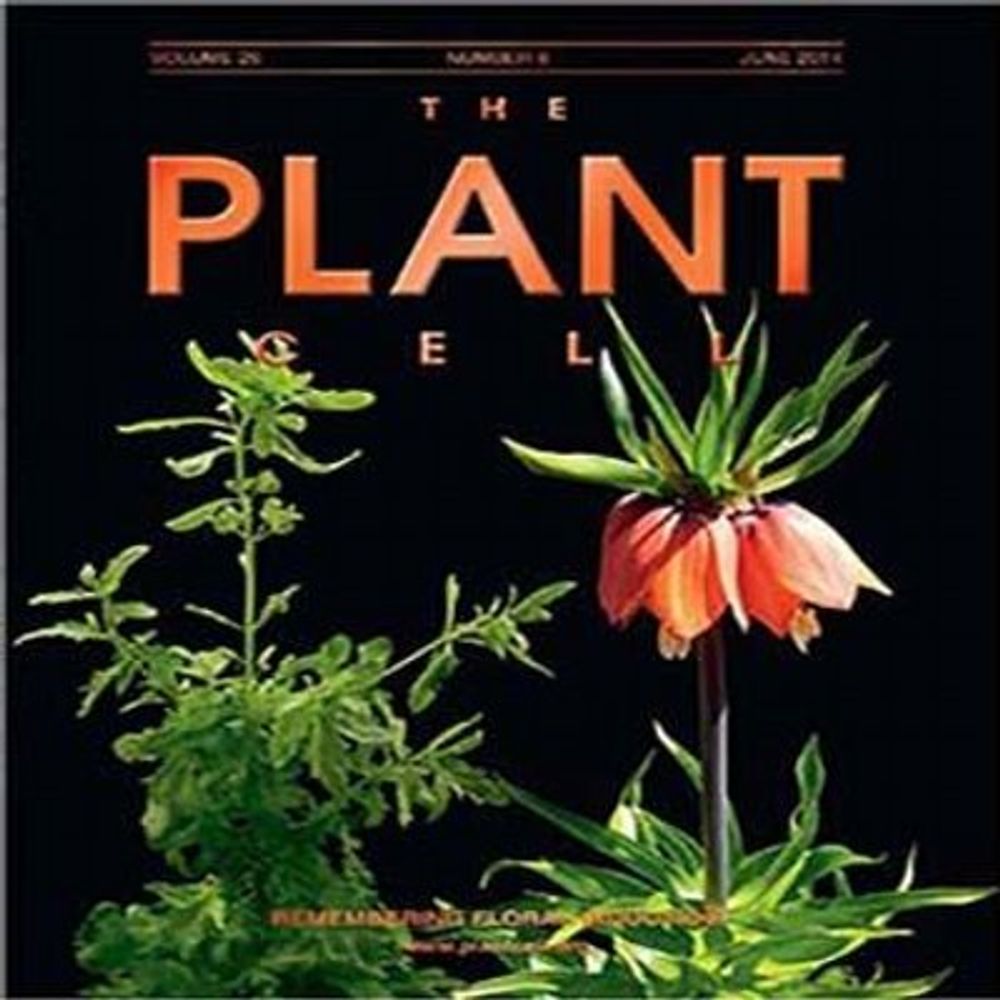
Natural variation in the ZmPIMT1 promoter enhances seed aging tolerance by regulating PABP2 repair in maize (Yumin Zhang, Lynnette M A Dirk, et al) doi.org/10.1093/plce... #PlantScience

Natural variation in the ZmPIMT1 promoter enhances seed aging tolerance by regulating PABP2 repair in maize
A natural variation in the promoter of a protein damage repair gene enhances seed vigor and longevity, providing a target for breeding improvement.
doi.org
October 6, 2025 at 8:34 PM
Natural variation in the ZmPIMT1 promoter enhances seed aging tolerance by regulating PABP2 repair in maize (Yumin Zhang, Lynnette M A Dirk, et al) doi.org/10.1093/plce... #PlantScience
Reposted by Xianhao Jin

Happy to share that our multi-omic analysis comparing two Arabidopsis accessions is now published 🌿 The first story from our @ukri.org BBSRC sLoLa #plant #proteostasis project. A great collaboration between @rothamsted.bsky.social @richardmott.bsky.social @ucl.ac.uk and Kathryn Lilley at Cambridge.

We have just published a paper in Genome Biology, rdcu.be/eIMLf. We explore the information flow between genome, gene body methylation, transcriptome, translatome and proteome in Arabidopsis. This is part of a BBSRC-funded collaboration with UCL, Rothamsted Research and University of Cambridge.

September 30, 2025 at 9:56 AM
Happy to share that our multi-omic analysis comparing two Arabidopsis accessions is now published 🌿 The first story from our @ukri.org BBSRC sLoLa #plant #proteostasis project. A great collaboration between @rothamsted.bsky.social @richardmott.bsky.social @ucl.ac.uk and Kathryn Lilley at Cambridge.
Reposted by Xianhao Jin

CDCA7 facilitates MET1-mediated CG DNA methylation maintenance in centromeric heterochromatin via histone H1 www.biorxiv.org/content/10.1...
www.biorxiv.org
September 29, 2025 at 11:14 AM
CDCA7 facilitates MET1-mediated CG DNA methylation maintenance in centromeric heterochromatin via histone H1 www.biorxiv.org/content/10.1...
Reposted by Xianhao Jin

How are RNAs sorted for export vs. degradation in the nucleus? In collaboration with @heick.bsky.social’s lab we (@clemensplaschka.bsky.social and @juliusbrennecke.bsky.social labs) discovered a direct mechanistic link between the export and decay machineries: www.biorxiv.org/content/10.1... (1/x)

Molecular basis of polyadenylated RNA fate determination in the nucleus
Eukaryotic genomes generate a plethora of polyadenylated (pA+) RNAs[1][1],[2][2], that are packaged into ribonucleoprotein particles (RNPs). To ensure faithful gene expression, functional pA+ RNPs, in...
www.biorxiv.org
September 22, 2025 at 11:23 PM
How are RNAs sorted for export vs. degradation in the nucleus? In collaboration with @heick.bsky.social’s lab we (@clemensplaschka.bsky.social and @juliusbrennecke.bsky.social labs) discovered a direct mechanistic link between the export and decay machineries: www.biorxiv.org/content/10.1... (1/x)
Reposted by Xianhao Jin

The final version of our paper on how ants and possibly other insects use a crazy mechanism involving extensive transcriptional interference to regulate odorant receptor expression is now open access in my favorite journal, @currentbiology.bsky.social
authors.elsevier.com/sd/article/S...
authors.elsevier.com/sd/article/S...
ScienceDirect.com | Science, health and medical journals, full text articles and books.
authors.elsevier.com
September 19, 2025 at 3:44 PM
The final version of our paper on how ants and possibly other insects use a crazy mechanism involving extensive transcriptional interference to regulate odorant receptor expression is now open access in my favorite journal, @currentbiology.bsky.social
authors.elsevier.com/sd/article/S...
authors.elsevier.com/sd/article/S...
Reposted by Xianhao Jin

Many conserved exons in the heart and brain utilize weak 5 ′ splice sites, yet they are accurately spliced. But how? We show that splicing fidelity is actively enforced through a QKI-U6 checkpoint at the U1→U6 handover in essential cardiac genes during organogenesis.
www.biorxiv.org/content/10.1...
www.biorxiv.org/content/10.1...

QKI ensures splicing fidelity during cardiogenesis by engaging the U6 tri-snRNP to activate splicing at weak 5ʹ splice sites
During organogenesis, precise pre-mRNA splicing is essential to assemble tissue architecture. Many developmentally essential exons bear weak 5'splice sites (5'SS) yet are spliced with high precision, ...
www.biorxiv.org
September 8, 2025 at 6:12 AM
Many conserved exons in the heart and brain utilize weak 5 ′ splice sites, yet they are accurately spliced. But how? We show that splicing fidelity is actively enforced through a QKI-U6 checkpoint at the U1→U6 handover in essential cardiac genes during organogenesis.
www.biorxiv.org/content/10.1...
www.biorxiv.org/content/10.1...
Reposted by Xianhao Jin

How do cells sort which RNAs to keep or destroy? New preprint from THJ, Brenneke and Plaschka labs shows that export and decay machineries (TREX2/PAXT) both recognise UAP56-bound RNAs. Whether they’re exported or degraded depends on where in the nucleus this happens.
www.biorxiv.org/content/10.1...
www.biorxiv.org/content/10.1...

Molecular basis of polyadenylated RNA fate determination in the nucleus
Eukaryotic genomes generate a plethora of polyadenylated (pA+) RNAs, that are packaged into ribonucleoprotein particles (RNPs). To ensure faithful gene expression, functional pA+ RNPs, including prote...
www.biorxiv.org
September 17, 2025 at 10:31 AM
How do cells sort which RNAs to keep or destroy? New preprint from THJ, Brenneke and Plaschka labs shows that export and decay machineries (TREX2/PAXT) both recognise UAP56-bound RNAs. Whether they’re exported or degraded depends on where in the nucleus this happens.
www.biorxiv.org/content/10.1...
www.biorxiv.org/content/10.1...
Reposted by Xianhao Jin

Very happy to share our latest work “Systematic discovery and engineering of synthetic immune receptors in plants” out in @science.org !
www.science.org/doi/10.1126/...
www.science.org/doi/10.1126/...

Systematic discovery and engineering of synthetic immune receptors in plants
Plants deploy a diverse array of pattern recognition receptors (PRRs), which perceive microbe-associated molecular patterns to activate immune responses. Leucine-rich repeat receptor-like kinase subgr...
www.science.org
September 4, 2025 at 7:33 PM
Very happy to share our latest work “Systematic discovery and engineering of synthetic immune receptors in plants” out in @science.org !
www.science.org/doi/10.1126/...
www.science.org/doi/10.1126/...
Reposted by Xianhao Jin
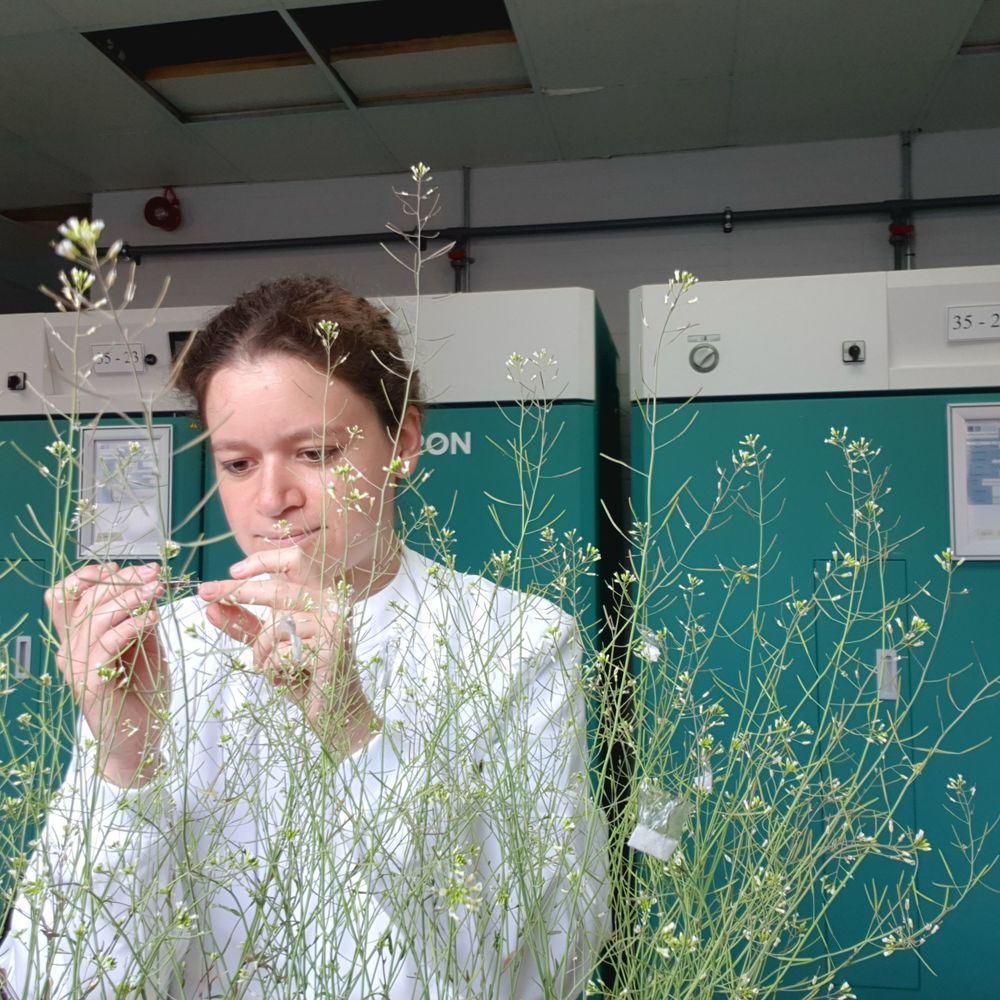
Our paper on VEL-dependent polymerization is featured on the cover of this month's issue of @cp-molcell.bsky.social 🎉 The cover art was created by my talented friend Awesta - the result of hours of brainstorming together over video. Great fun teaming up for this!

September 5, 2025 at 2:32 PM
Our paper on VEL-dependent polymerization is featured on the cover of this month's issue of @cp-molcell.bsky.social 🎉 The cover art was created by my talented friend Awesta - the result of hours of brainstorming together over video. Great fun teaming up for this!
Reposted by Xianhao Jin

Online Now: A CDK11-dependent RNA polymerase II pause-checkpoint precedes CDK9-mediated transition to transcriptional elongation Online now:

A CDK11-dependent RNA polymerase II pause-checkpoint precedes CDK9-mediated transition to transcriptional elongation
Devlin et al. posit a critical role for CDK11 in Pol II transcription cycles, operating within a dynamic multi-checkpoint pause-release zone to regulate steady-state and inducible gene expression. CDK11 kinase activity facilitates Pol II transition from a paused to an elongative state at a regulatory checkpoint upstream of and distinct from CDK9.
dlvr.it
August 26, 2025 at 10:57 PM
Online Now: A CDK11-dependent RNA polymerase II pause-checkpoint precedes CDK9-mediated transition to transcriptional elongation Online now:
Reposted by Xianhao Jin

Our #research on #drought #recovery, now published with @springernature.com in @natcomms.nature.com:
Drought recovery in plants triggers a cell-state-specific immune activation.
doi.org/10.1038/s414...
Read thread below 👇
Drought recovery in plants triggers a cell-state-specific immune activation.
doi.org/10.1038/s414...
Read thread below 👇

Drought recovery in plants triggers a cell-state-specific immune activation - Nature Communications
Post-drought rehydration triggers a preventive immune response in plants, revealing targets to enhance crop resilience by linking drought stress recovery with improved pathogen resistance.
doi.org
August 31, 2025 at 2:17 AM
Our #research on #drought #recovery, now published with @springernature.com in @natcomms.nature.com:
Drought recovery in plants triggers a cell-state-specific immune activation.
doi.org/10.1038/s414...
Read thread below 👇
Drought recovery in plants triggers a cell-state-specific immune activation.
doi.org/10.1038/s414...
Read thread below 👇
Reposted by Xianhao Jin
Our new preprint 🧬🔗 www.biorxiv.org/content/10.1...
BRD4-NUT forms liquid-like condensates that locally constrain nucleosomes via BRD4-mediated crosslinking— physical control of #chromatin by #LLPS transcription condensates. @semeigazin.bsky.social @katsuminami.bsky.social @masaashimazoe.bsky.social
BRD4-NUT forms liquid-like condensates that locally constrain nucleosomes via BRD4-mediated crosslinking— physical control of #chromatin by #LLPS transcription condensates. @semeigazin.bsky.social @katsuminami.bsky.social @masaashimazoe.bsky.social
July 10, 2025 at 4:21 AM
Our new preprint 🧬🔗 www.biorxiv.org/content/10.1...
BRD4-NUT forms liquid-like condensates that locally constrain nucleosomes via BRD4-mediated crosslinking— physical control of #chromatin by #LLPS transcription condensates. @semeigazin.bsky.social @katsuminami.bsky.social @masaashimazoe.bsky.social
BRD4-NUT forms liquid-like condensates that locally constrain nucleosomes via BRD4-mediated crosslinking— physical control of #chromatin by #LLPS transcription condensates. @semeigazin.bsky.social @katsuminami.bsky.social @masaashimazoe.bsky.social
Reposted by Xianhao Jin

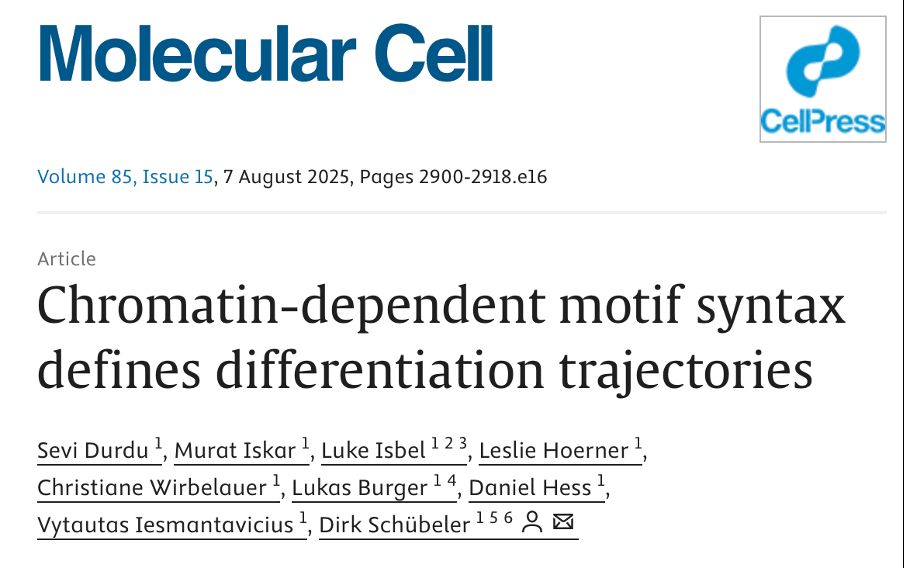
Excited to see this published with additional data following our preprint a while back. Cool combination (in our biased view) of controlled TF expression and machine learning to decode chromatin sensitivity. www.sciencedirect.com/science/arti....
August 7, 2025 at 4:20 PM
Excited to see this published with additional data following our preprint a while back. Cool combination (in our biased view) of controlled TF expression and machine learning to decode chromatin sensitivity. www.sciencedirect.com/science/arti....