


@plumlab.bsky.social
Reposted

An anti-allergy vaccine protects mice from anaphylaxis for as long as one year, mRNA-ferrying nanoparticles treat fatty liver disease in animals and potentiate immunotherapy against liver tumors, and more this week in #ScienceTranslationalMedicine. https://scim.ag/3XxHAdi

December 3, 2025 at 10:12 PM
An anti-allergy vaccine protects mice from anaphylaxis for as long as one year, mRNA-ferrying nanoparticles treat fatty liver disease in animals and potentiate immunotherapy against liver tumors, and more this week in #ScienceTranslationalMedicine. https://scim.ag/3XxHAdi

Reposted

Online now: Long-lived IgE plasma cells that reside in the spleen contribute to the persistence of the IgE response

Long-lived IgE plasma cells that reside in the spleen contribute to the persistence of the IgE response
Allergies can persist even in the absence of allergen exposure. Miranda-Waldetario et al. find that IgE-producing plasma cells mature, acquire survival adaptations, and persist for extended periods of time in the spleen and bone marrow, secreting antibodies that can trigger anaphylaxis.
dlvr.it
November 1, 2025 at 2:48 PM
Online now: Long-lived IgE plasma cells that reside in the spleen contribute to the persistence of the IgE response
Reposted
Central neural circuits underlying itch sensation — a Review by Yan-Gang Sun
#neuroscience #neuroskyence
www.nature.com/articles/s41...
#neuroscience #neuroskyence
www.nature.com/articles/s41...

Central neural circuits underlying itch sensation - Nature Reviews Neuroscience
Itch has an important role as a somatosensory defensive mechanism. In this Review, Sun synthesizes CNS circuits underlying itch signal processing and its modulation in the spinal cord, transmission of...
www.nature.com
October 24, 2025 at 12:42 PM
Central neural circuits underlying itch sensation — a Review by Yan-Gang Sun
#neuroscience #neuroskyence
www.nature.com/articles/s41...
#neuroscience #neuroskyence
www.nature.com/articles/s41...
Another piece of the puzzle pointing towards the existence of a continuum of host defenses. Classical immunology (search and destroy) and neural protective reflexes/anticipatory reactions go hand in hand to maintain health. Exciting times to study neuroimmunology!

September 6, 2025 at 3:28 PM
Another piece of the puzzle pointing towards the existence of a continuum of host defenses. Classical immunology (search and destroy) and neural protective reflexes/anticipatory reactions go hand in hand to maintain health. Exciting times to study neuroimmunology!
Reposted

Nature research paper: Maternal stress triggers early-life eczema through fetal mast cell programming
go.nature.com/3UPz8Vm
go.nature.com/3UPz8Vm

Maternal stress triggers early-life eczema through fetal mast cell programming - Nature
Prenatal stress triggers molecular dysregulations in fetal neuroimmune circuits, leading to altered mast cell and sensory neuron function, which predisposes offspring to develop eczema in response to otherwise harmless mechanical friction after birth.
go.nature.com
September 3, 2025 at 8:21 AM
Nature research paper: Maternal stress triggers early-life eczema through fetal mast cell programming
go.nature.com/3UPz8Vm
go.nature.com/3UPz8Vm
Reposted
The causes of early-life eczema have been unclear, but evidence indicates that changes to fetal immune cells and sensory neurons during pregnancy play a key part
go.nature.com/45Y9aUQ
go.nature.com/45Y9aUQ

Childhood eczema linked to mother’s stress during pregnancy
The causes of early-life eczema have been unclear, but evidence indicates that changes to fetal immune cells and sensory neurons during pregnancy play a key part.
go.nature.com
August 27, 2025 at 4:08 PM
The causes of early-life eczema have been unclear, but evidence indicates that changes to fetal immune cells and sensory neurons during pregnancy play a key part
go.nature.com/45Y9aUQ
go.nature.com/45Y9aUQ
Reposted
The sneezing, itchy eyes and coughing elicited by some allergens are caused by proteins creating holes in airway cells.
go.nature.com/3H9B1cd
go.nature.com/3H9B1cd

How allergens make us cough and weeze — by poking holes in airway cells
The immune system senses damage to cell membranes caused by pore-forming proteins and mounts a response.
go.nature.com
July 31, 2025 at 9:30 AM
The sneezing, itchy eyes and coughing elicited by some allergens are caused by proteins creating holes in airway cells.
go.nature.com/3H9B1cd
go.nature.com/3H9B1cd
Reposted
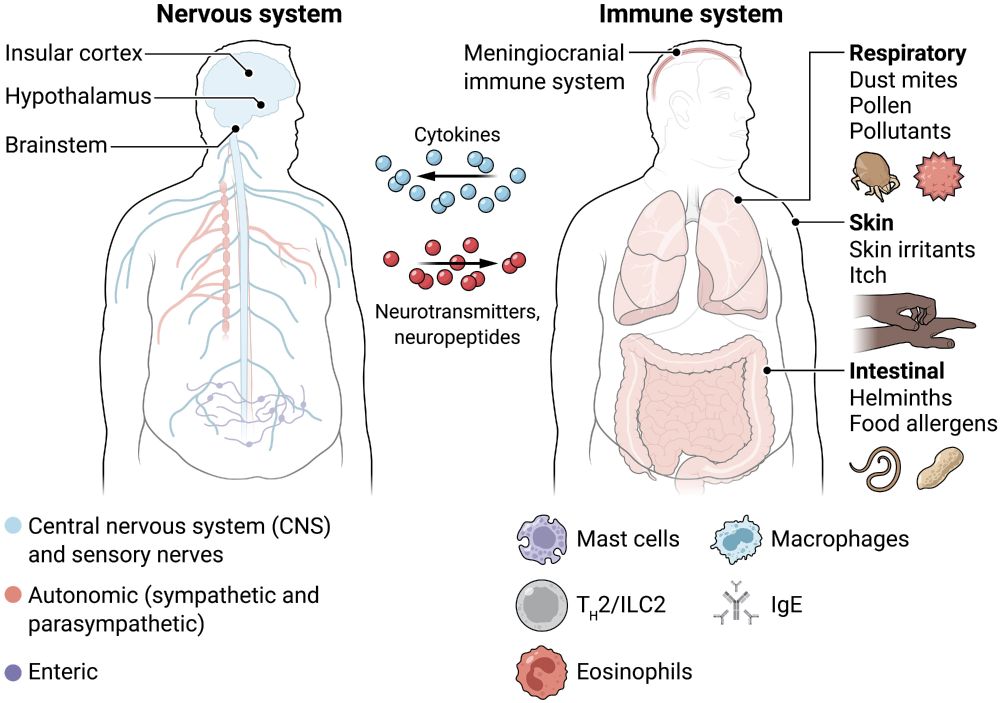
In a recent #ScienceImmunology Review, researchers discuss how interactions between the nervous and immune systems could impact neurological disorders and allergy-related behaviors like food avoidance.
Learn more: scim.ag/4mpgzE5
Learn more: scim.ag/4mpgzE5
July 28, 2025 at 8:22 PM
In a recent #ScienceImmunology Review, researchers discuss how interactions between the nervous and immune systems could impact neurological disorders and allergy-related behaviors like food avoidance.
Learn more: scim.ag/4mpgzE5
Learn more: scim.ag/4mpgzE5
Reposted

Online now:
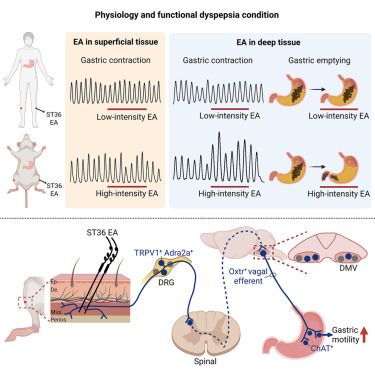
Neuroanatomical organization of electroacupuncture in modulating gastric function in mice and humans
Dong et al. establish that somatic electroacupuncture potentiates gastric motility in a manner critically dependent on both stimulation intensity and needle insertion depth while delineating the underlying neuroanatomical basis comprising somatosensory primary afferents and vagal motor efferents.
dlvr.it
July 25, 2025 at 6:36 PM
Online now:
Reposted

Excited to share our new work, led by an exceptional graduate student, Tornike Mamuladze, on the role of meningeal mast cells in regulation of brain/dura access points, with implications to CSF flow dynamics and meningitis || www.cell.com/cell/fulltex...
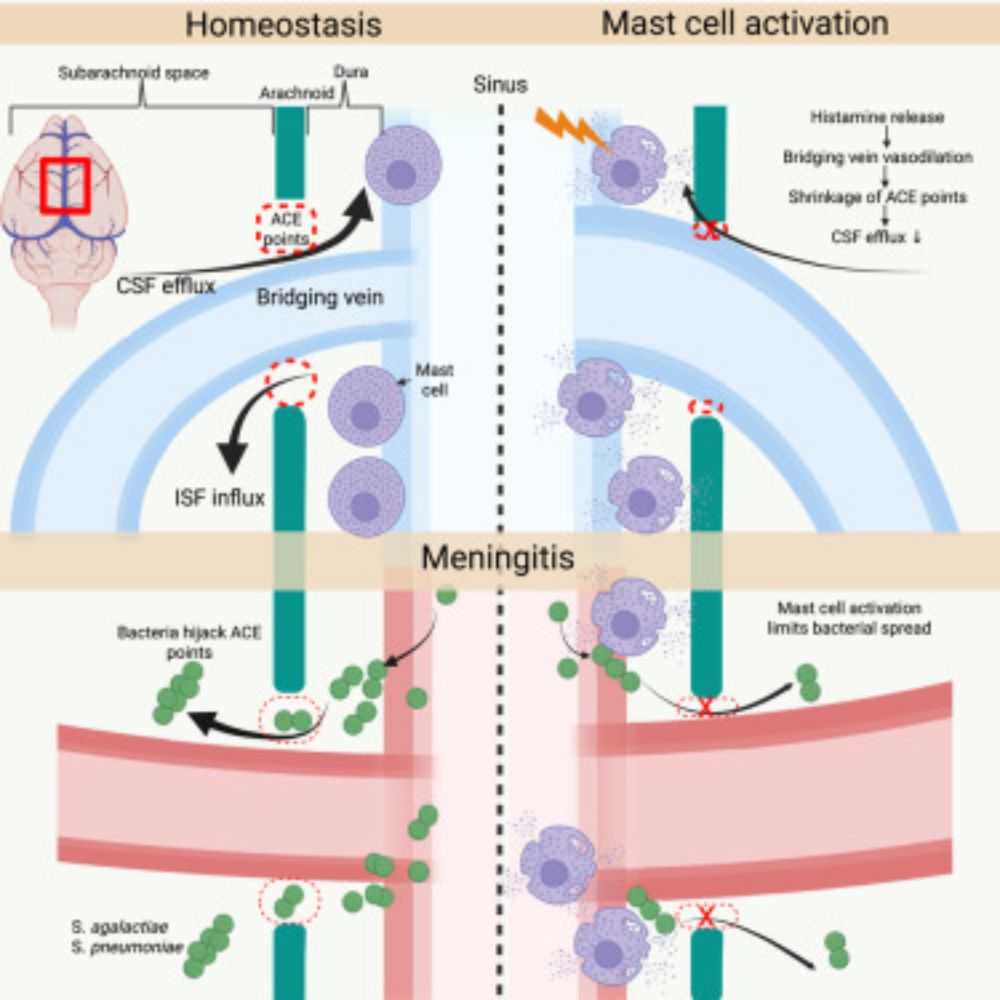
Mast cells regulate the brain-dura interface and CSF dynamics
Dural mast cells control cerebrospinal fluid dynamics at critical brain-dura interfaces,
specifically arachnoid cuff exit points. Their activation limits pathogen brain entry
via histamine-induced vas...
www.cell.com
July 24, 2025 at 8:10 PM
Excited to share our new work, led by an exceptional graduate student, Tornike Mamuladze, on the role of meningeal mast cells in regulation of brain/dura access points, with implications to CSF flow dynamics and meningitis || www.cell.com/cell/fulltex...
Reposted
A speedy imaging method can map the nerves running from a mouse’s brain and spinal cord to the rest of its body at micrometre-scale resolution
go.nature.com/3Il0e3x
go.nature.com/3Il0e3x

Giant map details nerves across a mouse's body: see stunning pics
Nature - High-resolution imaging method could lead to wiring diagram for the whole body.
go.nature.com
July 12, 2025 at 3:07 PM
A speedy imaging method can map the nerves running from a mouse’s brain and spinal cord to the rest of its body at micrometre-scale resolution
go.nature.com/3Il0e3x
go.nature.com/3Il0e3x
Reposted
Forum @cp-trendsimmuno.bsky.social
Neuro–immune crosstalk: focus on innate lymphoid cells
www.cell.com/trends/immun...
Neuro–immune crosstalk: focus on innate lymphoid cells
www.cell.com/trends/immun...

July 12, 2025 at 3:13 AM
Forum @cp-trendsimmuno.bsky.social
Neuro–immune crosstalk: focus on innate lymphoid cells
www.cell.com/trends/immun...
Neuro–immune crosstalk: focus on innate lymphoid cells
www.cell.com/trends/immun...

Reposted
Online now: DOCK8 in T cells promotes Th17 and Treg cell functionality to restrain mucosal mast cells and limit susceptibility to oral anaphylaxis

DOCK8 in T cells promotes Th17 and Treg cell functionality to restrain mucosal mast cells and limit susceptibility to oral anaphylaxis
DOCK8-deficient patients and mice are prone to food allergy and oral anaphylaxis. Here, Janssen et al. demonstrate that DOCK8 deficiency yields expanded mucosal mast cells and elevated circulating tryptase concentrations. Loss of DOCK8 in T cells impairs Th17 and Treg cells, resulting in dysbiosis and unrestrained IL-4-driven mast cell expansion. Disruption of this cascade attenuates oral anaphylaxis.
dlvr.it
June 25, 2025 at 7:56 PM
Online now: DOCK8 in T cells promotes Th17 and Treg cell functionality to restrain mucosal mast cells and limit susceptibility to oral anaphylaxis
Reposted

Time is running out to register for the AAI Introductory Course in Immunology! Generous (1k) travel grants available! www.surveymonkey.com/r/intro25fun...
Join me and other expert faculty in LA from July 8-13. I will be lecturing on my favorite topic: Type 2 immunity! www.aai.org/Education/Co....
Join me and other expert faculty in LA from July 8-13. I will be lecturing on my favorite topic: Type 2 immunity! www.aai.org/Education/Co....
The American Association of Immunologists - Introductory Course
www.aai.org
June 9, 2025 at 8:59 PM
Time is running out to register for the AAI Introductory Course in Immunology! Generous (1k) travel grants available! www.surveymonkey.com/r/intro25fun...
Join me and other expert faculty in LA from July 8-13. I will be lecturing on my favorite topic: Type 2 immunity! www.aai.org/Education/Co....
Join me and other expert faculty in LA from July 8-13. I will be lecturing on my favorite topic: Type 2 immunity! www.aai.org/Education/Co....
Reposted

🚨New paper with @thexavierlab.bsky.social @science.org on the critical role of 🔄neuroimmune crosstalk in immune defense in the gut🪱🪱.
🧪@genelayinstitute.bsky.social @mgbresearch.bsky.social @harvardmed.bsky.social @broadinstitute.org
www.science.org/doi/10.1126/...
🧪@genelayinstitute.bsky.social @mgbresearch.bsky.social @harvardmed.bsky.social @broadinstitute.org
www.science.org/doi/10.1126/...
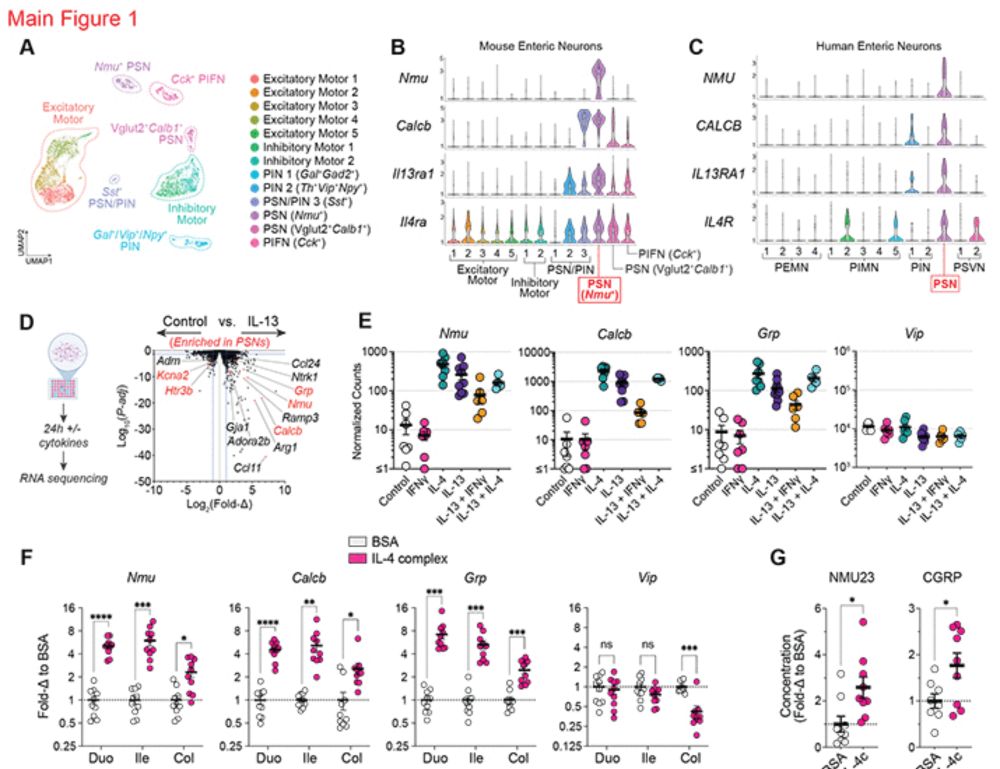
Type 2 cytokines act on enteric sensory neurons to regulate neuropeptide-driven host defense
Enteric nervous system (ENS)–derived neuropeptides modulate immune cell function, yet our understanding of how inflammatory cues directly influence enteric neuron responses during infection is conside...
www.science.org
May 23, 2025 at 1:26 AM
🚨New paper with @thexavierlab.bsky.social @science.org on the critical role of 🔄neuroimmune crosstalk in immune defense in the gut🪱🪱.
🧪@genelayinstitute.bsky.social @mgbresearch.bsky.social @harvardmed.bsky.social @broadinstitute.org
www.science.org/doi/10.1126/...
🧪@genelayinstitute.bsky.social @mgbresearch.bsky.social @harvardmed.bsky.social @broadinstitute.org
www.science.org/doi/10.1126/...
Reposted
In a new #ScienceImmunology Review, researchers discuss how interactions between the nervous and immune systems could impact neurological disorders and allergy-related behaviors like food avoidance. scim.ag/4mpgzE5
May 22, 2025 at 8:38 PM
In a new #ScienceImmunology Review, researchers discuss how interactions between the nervous and immune systems could impact neurological disorders and allergy-related behaviors like food avoidance. scim.ag/4mpgzE5
Reposted
Review @sciimmunology.bsky.social @arimolofskylab.bsky.social @annamolofskylab.bsky.social @nickmroz.bsky.social @phagocyticpai.bsky.social
The nervous and type 2 immune systems regulate each other via cytokines and neurotransmitters
www.science.org/doi/10.1126/...
The nervous and type 2 immune systems regulate each other via cytokines and neurotransmitters
www.science.org/doi/10.1126/...

May 16, 2025 at 6:11 PM
Review @sciimmunology.bsky.social @arimolofskylab.bsky.social @annamolofskylab.bsky.social @nickmroz.bsky.social @phagocyticpai.bsky.social
The nervous and type 2 immune systems regulate each other via cytokines and neurotransmitters
www.science.org/doi/10.1126/...
The nervous and type 2 immune systems regulate each other via cytokines and neurotransmitters
www.science.org/doi/10.1126/...
Reposted
The CS: Neuro-immune axis: Charting the periphery #CSNeuroimmune25 abstract deadline has been extended until May 23. @cp-neuron.bsky.social @cp-immunity.bsky.social @alleninstitute.org, Sept 7–9, 2025. hubs.li/Q03lPtw90

May 12, 2025 at 5:12 PM
The CS: Neuro-immune axis: Charting the periphery #CSNeuroimmune25 abstract deadline has been extended until May 23. @cp-neuron.bsky.social @cp-immunity.bsky.social @alleninstitute.org, Sept 7–9, 2025. hubs.li/Q03lPtw90
Reposted
Online now: The sensory neuroimmune frontier

The sensory neuroimmune frontier
Studies of peripheral neuroimmunology have unveiled sensory biology as a powerful new lens through which both immunology and neuroscience can be viewed. In this perspective, Kim and Artis discuss recent advances in sensory neuroimmunology and highlight how it shapes our understanding of immunity, inflammation, cancer, and beyond.
dlvr.it
May 4, 2025 at 10:38 PM
Online now: The sensory neuroimmune frontier
Reposted
Scratching a mosquito bite can offer a moment of bliss, and now scientists have learnt why: scratching activates an immune response that helps to protect the skin against harmful infections, at least in mice.
https://go.nature.com/4aJpL0r
https://go.nature.com/4aJpL0r

Why it feels good to scratch that itch: the immune benefits of scratching
Scratching where it itches reduces the presence of potentially harmful bacteria on the skin, studies in mice show.
go.nature.com
January 30, 2025 at 10:00 PM
Scratching a mosquito bite can offer a moment of bliss, and now scientists have learnt why: scratching activates an immune response that helps to protect the skin against harmful infections, at least in mice.
https://go.nature.com/4aJpL0r
https://go.nature.com/4aJpL0r
Reposted

Why scratching makes a rash worse and a potential benefit to scratching--it reduced S. aureus on skin. Andrew Liu's paper from our lab is out now at #science #neuroimmune #immunology www.science.org/doi/10.1126/...
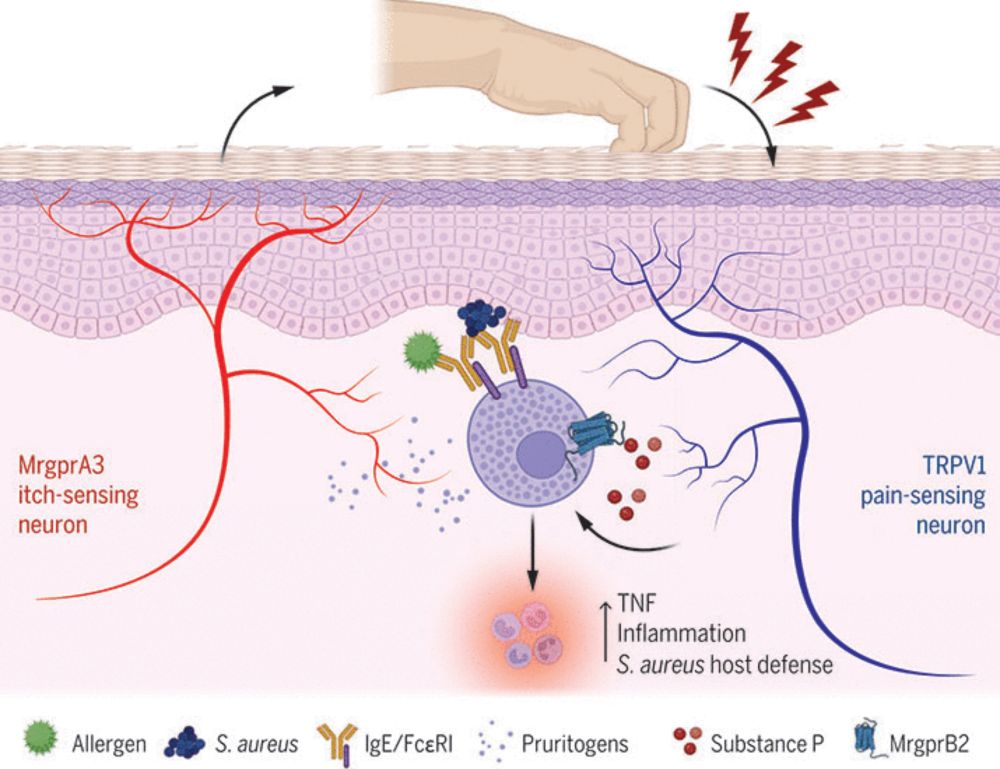
Scratching promotes allergic inflammation and host defense via neurogenic mast cell activation
Itch is a dominant symptom in dermatitis, and scratching promotes cutaneous inflammation, thereby worsening disease. However, the mechanisms through which scratching exacerbates inflammation and wheth...
www.science.org
January 30, 2025 at 8:31 PM
Why scratching makes a rash worse and a potential benefit to scratching--it reduced S. aureus on skin. Andrew Liu's paper from our lab is out now at #science #neuroimmune #immunology www.science.org/doi/10.1126/...
Happy to share our latest review, 'Beyond classical immunity: Mast cells as signal converters between tissues and neurons'. Mast cells finally emerge as important mediators of neuro-immune communication and host-protective behavior! 🔗 tinyurl.com/3f7eufsm

Beyond classical immunity: Mast cells as signal converters between tissues and neurons
Mast cells act as “signal converters,” translating immunological and tissue signals into host-protective behaviors. They sense antigen and possibly toxins driving avoidance behavior, which can prevent inflammation and tissue damage. Beyond classical immunity, mast cells rapidly activate antigen expulsion responses and initiate nociception. These reflexes promote host-protective behavior and maintain tissue integrity.
tinyurl.com
December 10, 2024 at 5:28 PM
Happy to share our latest review, 'Beyond classical immunity: Mast cells as signal converters between tissues and neurons'. Mast cells finally emerge as important mediators of neuro-immune communication and host-protective behavior! 🔗 tinyurl.com/3f7eufsm
Excited to join BlueSky! 🌌 We study the interactions between mast cells and neurons, focusing on how they drive behaviors like itch, cough, and sneezing. Follow along for updates on our research and discoveries here and on our twitter x.com/Plum_immunol...! 🧬✨
x.com
x.com
November 24, 2024 at 8:55 PM
Excited to join BlueSky! 🌌 We study the interactions between mast cells and neurons, focusing on how they drive behaviors like itch, cough, and sneezing. Follow along for updates on our research and discoveries here and on our twitter x.com/Plum_immunol...! 🧬✨