



@karinebastard.bsky.social
Reposted

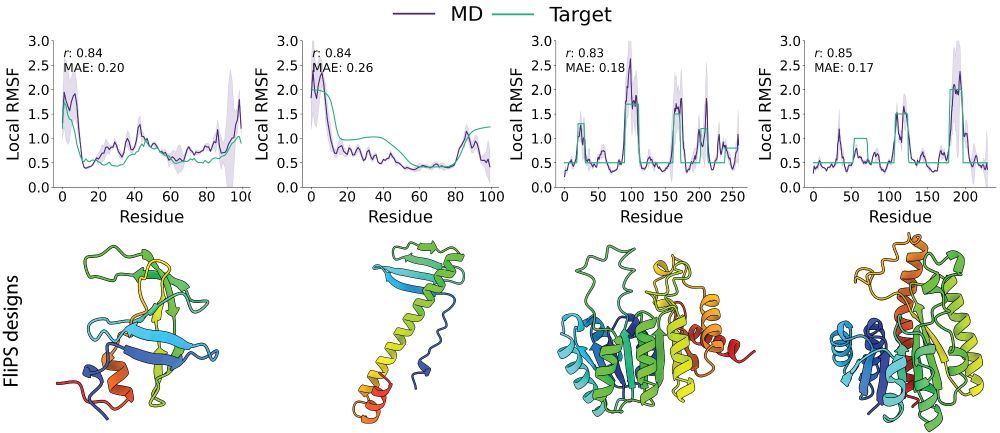
1/6 One of the key features of functional proteins is their inherent structural flexibility. In our recent work at #ICML, we introduce flexibility to protein structure design! More in a thread below.
Code / Tutorial: github.com/graeter-grou...
Poster: W-109, Thu 17 Jul 11 a.m. PDT — 1:30 p.m. PDT
Code / Tutorial: github.com/graeter-grou...
Poster: W-109, Thu 17 Jul 11 a.m. PDT — 1:30 p.m. PDT
July 17, 2025 at 4:19 AM
1/6 One of the key features of functional proteins is their inherent structural flexibility. In our recent work at #ICML, we introduce flexibility to protein structure design! More in a thread below.
Code / Tutorial: github.com/graeter-grou...
Poster: W-109, Thu 17 Jul 11 a.m. PDT — 1:30 p.m. PDT
Code / Tutorial: github.com/graeter-grou...
Poster: W-109, Thu 17 Jul 11 a.m. PDT — 1:30 p.m. PDT
Reposted

Super excited 3 days at the CECAM workshop co-organized with @drgregbowman.bsky.social @bettinagkeller.bsky.social! Protein dynamics is definitely shaping up to be the next big topic in AI for Science! Huge thanks to @cecamevents.bsky.social, @uwdsi.bsky.social, TCI, Chem, Emma and the DSI staff!

July 19, 2025 at 5:05 PM
Super excited 3 days at the CECAM workshop co-organized with @drgregbowman.bsky.social @bettinagkeller.bsky.social! Protein dynamics is definitely shaping up to be the next big topic in AI for Science! Huge thanks to @cecamevents.bsky.social, @uwdsi.bsky.social, TCI, Chem, Emma and the DSI staff!
Reposted
Excited to share our latest paper on @natcomputsci.nature.com! We present MEMnets, a deep learning framework for coarse-graining protein dynamics, driven by an analytical statistical mechanics theory to minimize memory kernels. Congratulations to all the authors! @uwmadisonchem.bsky.social

June 10, 2025 at 8:42 PM
Excited to share our latest paper on @natcomputsci.nature.com! We present MEMnets, a deep learning framework for coarse-graining protein dynamics, driven by an analytical statistical mechanics theory to minimize memory kernels. Congratulations to all the authors! @uwmadisonchem.bsky.social
Reposted

Elucidating the Design Space of Multimodal Protein Language Models [new]
Analyzes multimodal protein language models, identifying & addressing fidelity loss from 3D structure tokenization through enhanced modeling, architectures & data.
Analyzes multimodal protein language models, identifying & addressing fidelity loss from 3D structure tokenization through enhanced modeling, architectures & data.


April 16, 2025 at 5:03 AM
Elucidating the Design Space of Multimodal Protein Language Models [new]
Analyzes multimodal protein language models, identifying & addressing fidelity loss from 3D structure tokenization through enhanced modeling, architectures & data.
Analyzes multimodal protein language models, identifying & addressing fidelity loss from 3D structure tokenization through enhanced modeling, architectures & data.
Reposted

RFDiffusion2: a diffusion model that scaffolds enzyme active sites at the atomic level enables the generation of functional de novo enzymes
www.biorxiv.org/content/10.1...
www.biorxiv.org/content/10.1...


April 11, 2025 at 7:54 PM
RFDiffusion2: a diffusion model that scaffolds enzyme active sites at the atomic level enables the generation of functional de novo enzymes
www.biorxiv.org/content/10.1...
www.biorxiv.org/content/10.1...
Reposted
ProtFlow: Fast Protein Sequence Design via Flow Matching on Compressed Protein Language Model Embeddings [new]
Designs protein seqs w/ flow matching on compressed embeddings from protein LMs to improve efficiency & reduce training costs.
Designs protein seqs w/ flow matching on compressed embeddings from protein LMs to improve efficiency & reduce training costs.


April 16, 2025 at 4:40 AM
ProtFlow: Fast Protein Sequence Design via Flow Matching on Compressed Protein Language Model Embeddings [new]
Designs protein seqs w/ flow matching on compressed embeddings from protein LMs to improve efficiency & reduce training costs.
Designs protein seqs w/ flow matching on compressed embeddings from protein LMs to improve efficiency & reduce training costs.
Reposted

🎉Congrats to Chase on her new preprint! She developed OMEGA--a simple method for assembling custom gene panels for as little as $1.50 per gene. Big step forward protein engineering and design!🧬
www.biorxiv.org/content/10.1...
www.biorxiv.org/content/10.1...

Scalable and cost-efficient custom gene library assembly from oligopools
Advances in metagenomics, deep learning, and generative protein design have enabled broad in silico exploration of sequence space, but experimental characterization is still constrained by the cost an...
www.biorxiv.org
March 24, 2025 at 4:50 PM
🎉Congrats to Chase on her new preprint! She developed OMEGA--a simple method for assembling custom gene panels for as little as $1.50 per gene. Big step forward protein engineering and design!🧬
www.biorxiv.org/content/10.1...
www.biorxiv.org/content/10.1...
Reposted

Systematic comparison of Generative AI-Protein Models reveals fundamental differences between structural and sequence-based approaches. https://www.biorxiv.org/content/10.1101/2025.03.23.644844v1
March 25, 2025 at 3:03 AM
Systematic comparison of Generative AI-Protein Models reveals fundamental differences between structural and sequence-based approaches. https://www.biorxiv.org/content/10.1101/2025.03.23.644844v1
Reposted
Lyra: An Efficient and Expressive Subquadratic Architecture for Modeling Biological Sequences [new]
Lyra:
Models sequence-to-function relationships using epistasis with state space models and gated convolutions, for efficient biological sequence modeling.
Lyra:
Models sequence-to-function relationships using epistasis with state space models and gated convolutions, for efficient biological sequence modeling.


March 21, 2025 at 3:29 AM
Lyra: An Efficient and Expressive Subquadratic Architecture for Modeling Biological Sequences [new]
Lyra:
Models sequence-to-function relationships using epistasis with state space models and gated convolutions, for efficient biological sequence modeling.
Lyra:
Models sequence-to-function relationships using epistasis with state space models and gated convolutions, for efficient biological sequence modeling.
Reposted

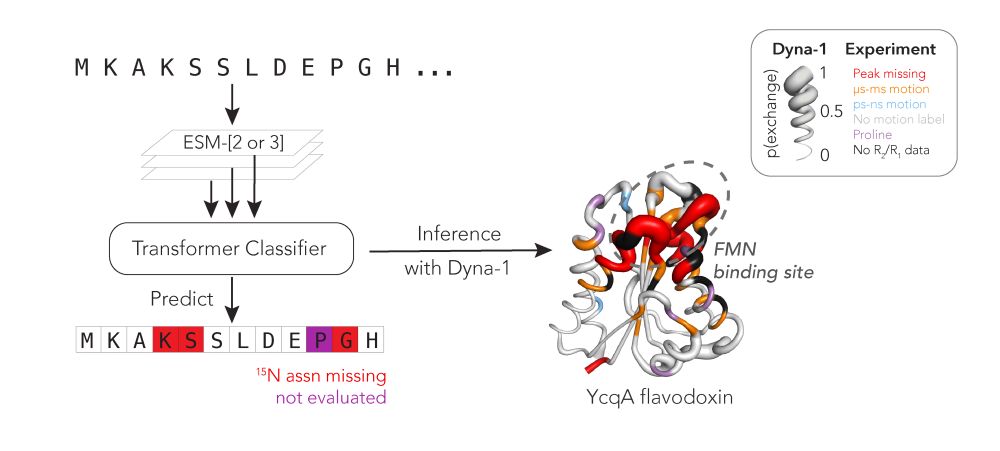
Protein function often depends on protein dynamics. To design proteins that function like natural ones, how do we predict their dynamics?
@hkws.bsky.social and I are thrilled to share the first big, experimental datasets on protein dynamics and our new model: Dyna-1!
🧵
@hkws.bsky.social and I are thrilled to share the first big, experimental datasets on protein dynamics and our new model: Dyna-1!
🧵
March 20, 2025 at 3:02 PM
Protein function often depends on protein dynamics. To design proteins that function like natural ones, how do we predict their dynamics?
@hkws.bsky.social and I are thrilled to share the first big, experimental datasets on protein dynamics and our new model: Dyna-1!
🧵
@hkws.bsky.social and I are thrilled to share the first big, experimental datasets on protein dynamics and our new model: Dyna-1!
🧵
Reposted
Thrilled to announce that this year’s European RosettaCon protein design conference will take place in Ljubljana, Oct 20–22, 2025!
Open to all, with a remote keynote by Nobel laureate David Baker.
More info coming soon — it’s going to be amazing! Hope to see you there!
Open to all, with a remote keynote by Nobel laureate David Baker.
More info coming soon — it’s going to be amazing! Hope to see you there!

March 17, 2025 at 12:06 PM
Thrilled to announce that this year’s European RosettaCon protein design conference will take place in Ljubljana, Oct 20–22, 2025!
Open to all, with a remote keynote by Nobel laureate David Baker.
More info coming soon — it’s going to be amazing! Hope to see you there!
Open to all, with a remote keynote by Nobel laureate David Baker.
More info coming soon — it’s going to be amazing! Hope to see you there!
Reposted

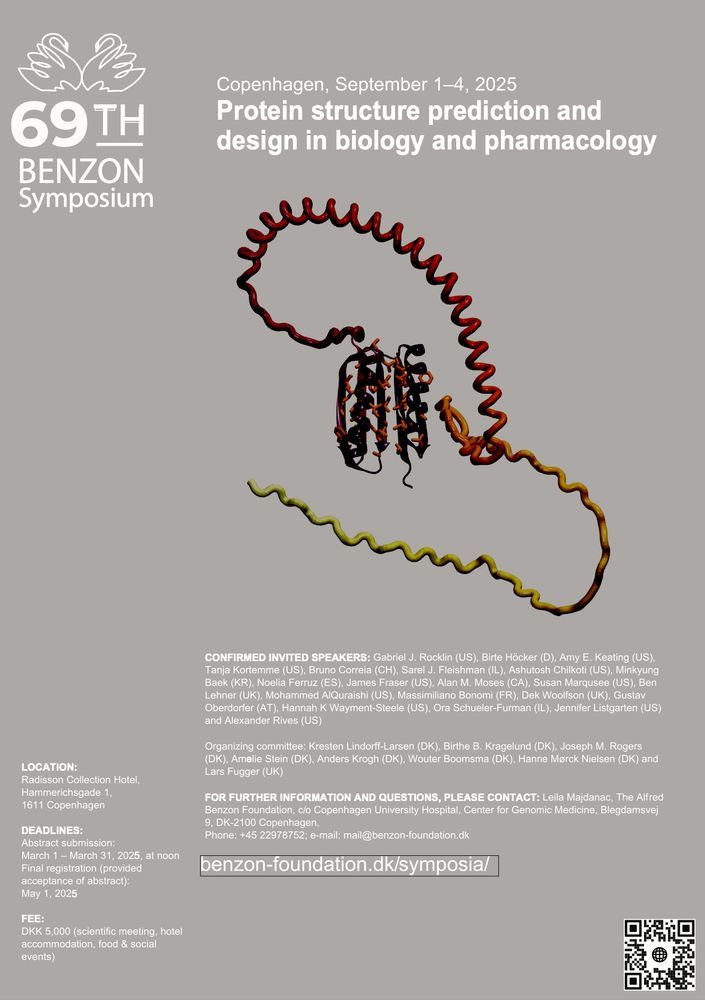
⏰ Two weeks left to register for our Benzon Symposium on Protein structure prediction and design 🧶🧬🖥️
Meeting will take place in Copenhagen 🇩🇰 on Sept. 1–4, 2025, and will feature an amazing list of speakers 👨🔬👩🔬👩💻👨💻
Submit your application via:
benzon-foundation.dk/benzon-sympo...
Meeting will take place in Copenhagen 🇩🇰 on Sept. 1–4, 2025, and will feature an amazing list of speakers 👨🔬👩🔬👩💻👨💻
Submit your application via:
benzon-foundation.dk/benzon-sympo...
March 17, 2025 at 5:52 PM
⏰ Two weeks left to register for our Benzon Symposium on Protein structure prediction and design 🧶🧬🖥️
Meeting will take place in Copenhagen 🇩🇰 on Sept. 1–4, 2025, and will feature an amazing list of speakers 👨🔬👩🔬👩💻👨💻
Submit your application via:
benzon-foundation.dk/benzon-sympo...
Meeting will take place in Copenhagen 🇩🇰 on Sept. 1–4, 2025, and will feature an amazing list of speakers 👨🔬👩🔬👩💻👨💻
Submit your application via:
benzon-foundation.dk/benzon-sympo...
Reposted
From Atoms to Fragments: A Coarse Representation for Functional and Efficient Protein Design [new]
Uses fragments to represent proteins as sets/graphs. Reduces dimensionality, preserves function, and aids in protein design tasks.
Uses fragments to represent proteins as sets/graphs. Reduces dimensionality, preserves function, and aids in protein design tasks.


March 19, 2025 at 9:21 PM
From Atoms to Fragments: A Coarse Representation for Functional and Efficient Protein Design [new]
Uses fragments to represent proteins as sets/graphs. Reduces dimensionality, preserves function, and aids in protein design tasks.
Uses fragments to represent proteins as sets/graphs. Reduces dimensionality, preserves function, and aids in protein design tasks.
Reposted
A post by @ncfrey.bsky.social and @amyxlu.bsky.social on repurposing ESMFold for protein design, featuring one of my favorite phrases in the field ncfrey.substack.com/p/hit-the-vi...

March 19, 2025 at 4:51 PM
A post by @ncfrey.bsky.social and @amyxlu.bsky.social on repurposing ESMFold for protein design, featuring one of my favorite phrases in the field ncfrey.substack.com/p/hit-the-vi...
Reposted
FeatureDock - a transformer-based docking software leveraging local chemical features - is now published in @Nature_NPJ! Congrats to Mingyi, Bojun, and Siqin!
Paper:
www.nature.com/articles/s44...
Software:
github.com/xuhuihuang/f...
Paper:
www.nature.com/articles/s44...
Software:
github.com/xuhuihuang/f...

FeatureDock for protein-ligand docking guided by physicochemical feature-based local environment learning using transformer - npj Drug Discovery
npj Drug Discovery - FeatureDock for protein-ligand docking guided by physicochemical feature-based local environment learning using transformer
www.nature.com
March 4, 2025 at 3:08 PM
FeatureDock - a transformer-based docking software leveraging local chemical features - is now published in @Nature_NPJ! Congrats to Mingyi, Bojun, and Siqin!
Paper:
www.nature.com/articles/s44...
Software:
github.com/xuhuihuang/f...
Paper:
www.nature.com/articles/s44...
Software:
github.com/xuhuihuang/f...
Reposted

openRxiv has arrived!
We’re thrilled to announce the launch of openRxiv as an independent, researcher-led nonprofit to oversee bioRxiv and medRxiv, the world’s leading preprint servers for life and health sciences.
openrxiv.org/introducing-...
#openRxiv #OpenScience #Preprints #bioRxiv #medRxiv
We’re thrilled to announce the launch of openRxiv as an independent, researcher-led nonprofit to oversee bioRxiv and medRxiv, the world’s leading preprint servers for life and health sciences.
openrxiv.org/introducing-...
#openRxiv #OpenScience #Preprints #bioRxiv #medRxiv

March 11, 2025 at 1:18 PM
openRxiv has arrived!
We’re thrilled to announce the launch of openRxiv as an independent, researcher-led nonprofit to oversee bioRxiv and medRxiv, the world’s leading preprint servers for life and health sciences.
openrxiv.org/introducing-...
#openRxiv #OpenScience #Preprints #bioRxiv #medRxiv
We’re thrilled to announce the launch of openRxiv as an independent, researcher-led nonprofit to oversee bioRxiv and medRxiv, the world’s leading preprint servers for life and health sciences.
openrxiv.org/introducing-...
#openRxiv #OpenScience #Preprints #bioRxiv #medRxiv
Reposted

We're excited to introduce 🌿 MINT (Multimer Interaction Transformer) – a Protein Language Model (PLM) trained on 96M protein-protein interactions (PPIs) to predict binding affinity, mutational impacts, & antibody interactions better than existing PLMs!
💻 github.com/VarunUllanat...
🧵⬇️
💻 github.com/VarunUllanat...
🧵⬇️
GitHub - VarunUllanat/mint: Learning the language of protein-protein interactions
Learning the language of protein-protein interactions - VarunUllanat/mint
github.com
March 12, 2025 at 5:37 PM
We're excited to introduce 🌿 MINT (Multimer Interaction Transformer) – a Protein Language Model (PLM) trained on 96M protein-protein interactions (PPIs) to predict binding affinity, mutational impacts, & antibody interactions better than existing PLMs!
💻 github.com/VarunUllanat...
🧵⬇️
💻 github.com/VarunUllanat...
🧵⬇️
Reposted

The AI tools in the study could one day be used to design enzymes capable of entirely new chemical reactions that do not exist in nature, says @noeliaferruz.bsky.social in @nature.com. “The limitations are just basically your imagination; you can design anything.”
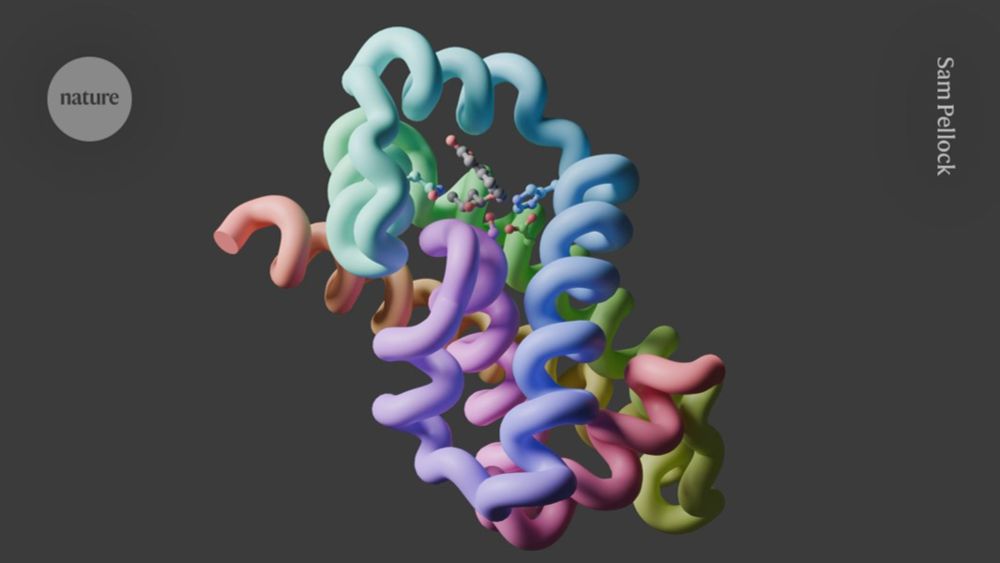
Scientists use AI to design life-like enzymes from scratch
Combined approach takes AI-engineered enzymes one step closer to practical applications.
www.nature.com
February 27, 2025 at 7:32 AM
The AI tools in the study could one day be used to design enzymes capable of entirely new chemical reactions that do not exist in nature, says @noeliaferruz.bsky.social in @nature.com. “The limitations are just basically your imagination; you can design anything.”
Reposted

I decided to make the datasets I'm generating for my phd project public. For each protein in Swiss-Prot, I'm making available PLM embeddings (ProtTrans, Ankh, ESM2), GO annotations and taxonomy representations. All files follow the same order, one line per protein.
github.com/pentalpha/pr...
github.com/pentalpha/pr...

GitHub - pentalpha/protein_dimension_db: Datasets with embeddings and other representations for all proteins in Uniprot/Swiss-Prot
Datasets with embeddings and other representations for all proteins in Uniprot/Swiss-Prot - pentalpha/protein_dimension_db
github.com
December 27, 2024 at 3:51 PM
I decided to make the datasets I'm generating for my phd project public. For each protein in Swiss-Prot, I'm making available PLM embeddings (ProtTrans, Ankh, ESM2), GO annotations and taxonomy representations. All files follow the same order, one line per protein.
github.com/pentalpha/pr...
github.com/pentalpha/pr...
Reposted

Hi all! Inspired by how easy ColabFold ( @sokrypton.org ) made prot structure prediction for me, I have started ColabRNA to facilitate making predictions with RNA-based models!
Currently, the following models are available:
- SpliceAI
- Pangolin
- SpliceTransformer
- Borzoi
Happy to get feedback!
Currently, the following models are available:
- SpliceAI
- Pangolin
- SpliceTransformer
- Borzoi
Happy to get feedback!
GitHub - MiqG/ColabRNA: Making RNA-based models accessible to all.
Making RNA-based models accessible to all. Contribute to MiqG/ColabRNA development by creating an account on GitHub.
github.com
February 15, 2025 at 10:31 PM
Hi all! Inspired by how easy ColabFold ( @sokrypton.org ) made prot structure prediction for me, I have started ColabRNA to facilitate making predictions with RNA-based models!
Currently, the following models are available:
- SpliceAI
- Pangolin
- SpliceTransformer
- Borzoi
Happy to get feedback!
Currently, the following models are available:
- SpliceAI
- Pangolin
- SpliceTransformer
- Borzoi
Happy to get feedback!
Reposted

You're starting a #structuralbiology project and want to learn the basics. Please go there : www.biostine.fr/home-biostine/

home - Comment acquérir les bases de la biologie structurale
What is a 3D structure? Some applications The foundations and origins of structural biology Knowing and preparing your sample Choising a structural biology method Expérimental methods : NMR 1 Choose y...
www.biostine.fr
November 21, 2024 at 1:54 PM
You're starting a #structuralbiology project and want to learn the basics. Please go there : www.biostine.fr/home-biostine/
Reposted
ProtGPS can predict protein location based on sequence and guide the design for novel protein with precise compartmentalisation - new AI tool for protein biology beyond the AlphaFold!! 👏| Science www.science.org/doi/10.1126/...

Protein codes promote selective subcellular compartmentalization
Cells have evolved mechanisms to distribute ~10 billion protein molecules to subcellular compartments where diverse proteins involved in shared functions must assemble. Here, we demonstrate that prote...
www.science.org
February 8, 2025 at 10:13 AM
ProtGPS can predict protein location based on sequence and guide the design for novel protein with precise compartmentalisation - new AI tool for protein biology beyond the AlphaFold!! 👏| Science www.science.org/doi/10.1126/...
Reposted

LLMs are the LEAST valuable AI model FWIW. Their ability to interface verbally with humans confuses people into thinking that the computer is thinking.
Compare that to the Nobel Prize winning AI model behind AlphaFold for predictive protein modeling.
Compare that to the Nobel Prize winning AI model behind AlphaFold for predictive protein modeling.
February 17, 2025 at 8:11 PM
LLMs are the LEAST valuable AI model FWIW. Their ability to interface verbally with humans confuses people into thinking that the computer is thinking.
Compare that to the Nobel Prize winning AI model behind AlphaFold for predictive protein modeling.
Compare that to the Nobel Prize winning AI model behind AlphaFold for predictive protein modeling.
Reposted

AlphaFold predicted over 200 million protein structures, solving a decades-old biology puzzle & turbocharging research. Before this, scientists took over 60 years to determine just 100,000 protein structures. Painstakingly slow compard to AlphaFold’s rapid, AI-driven predictions
Add it to the list
Add it to the list
February 18, 2025 at 5:12 PM
AlphaFold predicted over 200 million protein structures, solving a decades-old biology puzzle & turbocharging research. Before this, scientists took over 60 years to determine just 100,000 protein structures. Painstakingly slow compard to AlphaFold’s rapid, AI-driven predictions
Add it to the list
Add it to the list
Reposted

#BPS2025 Another great talk on IDP and AlphaFold by Vincent Schnapka from the @bonomimax.bsky.social lab at @ipdbsc.bsky.social @pasteur.fr

February 16, 2025 at 6:12 PM
#BPS2025 Another great talk on IDP and AlphaFold by Vincent Schnapka from the @bonomimax.bsky.social lab at @ipdbsc.bsky.social @pasteur.fr