



Ali Akbari
@aliakbari.bsky.social
Research Associate at Reich lab @HarvardMed and @HarvardHEB
Reposted by Ali Akbari
I have an opportunity to hire a staff scientist for my lab. Looking for someone with outstanding skillset in ML/statistics, genomics applications; interest in mentoring, strong publication record, PD experience required.
Email CV to me+cc my assistant (see 'contact' on my website). Ad to follow.
Email CV to me+cc my assistant (see 'contact' on my website). Ad to follow.
June 1, 2025 at 3:33 PM
I have an opportunity to hire a staff scientist for my lab. Looking for someone with outstanding skillset in ML/statistics, genomics applications; interest in mentoring, strong publication record, PD experience required.
Email CV to me+cc my assistant (see 'contact' on my website). Ad to follow.
Email CV to me+cc my assistant (see 'contact' on my website). Ad to follow.
Reposted by Ali Akbari
Our paper on the theoretical properties of SNP heritability in admixed populations is out in Genetics:
academic.oup.com/genetics/adv...
with @jinguohuang.bsky.social, @nicole-kleman.bsky.social , Saonli Basu, and Mark Shriver
academic.oup.com/genetics/adv...
with @jinguohuang.bsky.social, @nicole-kleman.bsky.social , Saonli Basu, and Mark Shriver
May 25, 2025 at 2:03 AM
Our paper on the theoretical properties of SNP heritability in admixed populations is out in Genetics:
academic.oup.com/genetics/adv...
with @jinguohuang.bsky.social, @nicole-kleman.bsky.social , Saonli Basu, and Mark Shriver
academic.oup.com/genetics/adv...
with @jinguohuang.bsky.social, @nicole-kleman.bsky.social , Saonli Basu, and Mark Shriver
Reposted by Ali Akbari

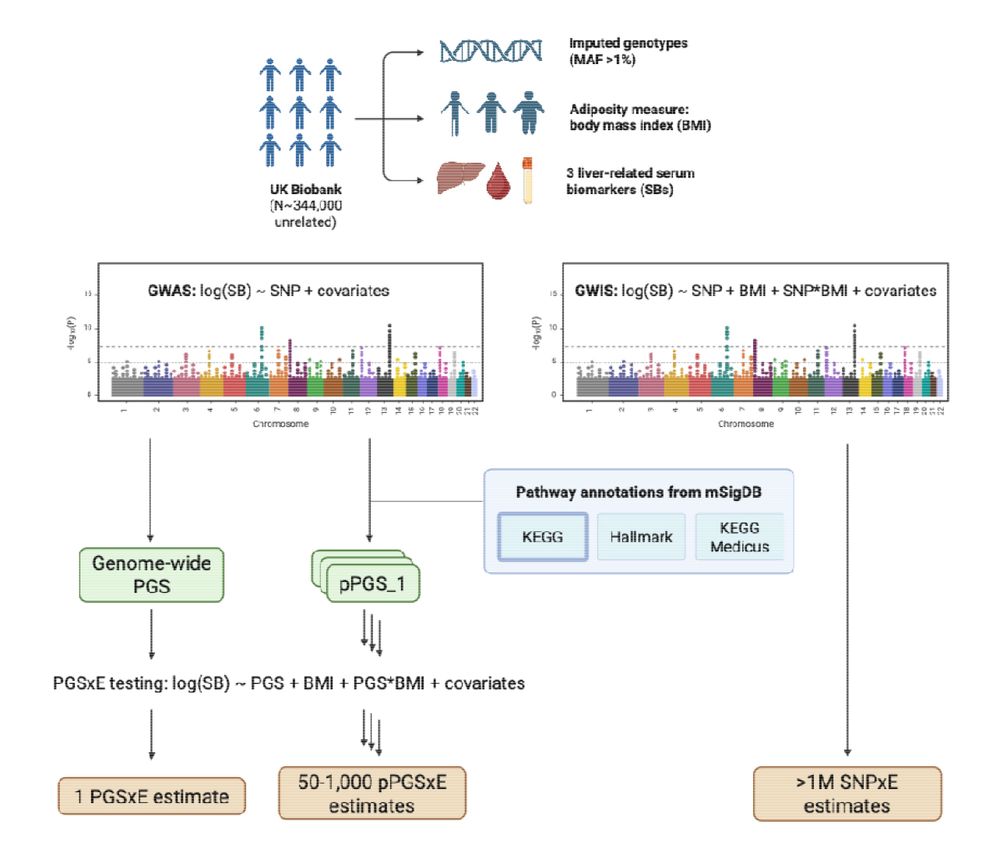
Excited to share our work on using pathway-specific polygenic scores to discover gene-environment interactions www.medrxiv.org/content/10.1...
May 22, 2025 at 3:09 PM
Excited to share our work on using pathway-specific polygenic scores to discover gene-environment interactions www.medrxiv.org/content/10.1...
Reposted by Ali Akbari

When should adaptation arise from a polygenic response versus few large effect changes? https://www.biorxiv.org/content/10.1101/2025.05.15.654234v1
May 17, 2025 at 8:32 PM
When should adaptation arise from a polygenic response versus few large effect changes? https://www.biorxiv.org/content/10.1101/2025.05.15.654234v1
J-PEP is a new method that clusters disease-associated loci by combining pleiotropic SNP effects with tissue-specific epigenomic data. It improves biological resolution across complex traits.
doi.org/10.1101/2025...
doi.org/10.1101/2025...

Mapping disease loci to biological processes via joint pleiotropic and epigenomic partitioning
Genome-wide association studies (GWAS) have identified thousands of disease-associated loci, yet their interpretation remains limited by the heterogeneity of underlying biological processes. We propos...
doi.org
May 13, 2025 at 8:37 PM
J-PEP is a new method that clusters disease-associated loci by combining pleiotropic SNP effects with tissue-specific epigenomic data. It improves biological resolution across complex traits.
doi.org/10.1101/2025...
doi.org/10.1101/2025...
Reposted by Ali Akbari

Integrative multi-omics QTL colocalization maps regulatory architecture in aging human brain https://www.medrxiv.org/content/10.1101/2025.04.17.25326042v1
April 20, 2025 at 5:25 PM
Integrative multi-omics QTL colocalization maps regulatory architecture in aging human brain https://www.medrxiv.org/content/10.1101/2025.04.17.25326042v1
Reposted by Ali Akbari

Very excited to share our preprint led by M. Levin @skoyama.bsky.social J. Woerner & with S. Damrauer assessing genome-wide pleiotropy of >1,000 clinical traits across ~1.7M individuals with nearly 30K locus-trait associations!
www.medrxiv.org/content/10.1... @medrxivpreprint.bsky.social
www.medrxiv.org/content/10.1... @medrxivpreprint.bsky.social


April 23, 2025 at 11:35 AM
Very excited to share our preprint led by M. Levin @skoyama.bsky.social J. Woerner & with S. Damrauer assessing genome-wide pleiotropy of >1,000 clinical traits across ~1.7M individuals with nearly 30K locus-trait associations!
www.medrxiv.org/content/10.1... @medrxivpreprint.bsky.social
www.medrxiv.org/content/10.1... @medrxivpreprint.bsky.social
Reposted by Ali Akbari

What is epistasis?
New preprint Blue-torial!
(Work by the wonderful postdocs Maryn Carlson and Bryan Andrews)
www.biorxiv.org/content/10.1...
New preprint Blue-torial!
(Work by the wonderful postdocs Maryn Carlson and Bryan Andrews)
www.biorxiv.org/content/10.1...

Robust detection of specific epistasis using rank statistics
The phenotypic effect of a mutation may depend on the genetic background in which it occurs, a phenomenon referred to as epistasis. One source of epistasis in proteins is direct interactions between r...
www.biorxiv.org
April 24, 2025 at 6:56 PM
What is epistasis?
New preprint Blue-torial!
(Work by the wonderful postdocs Maryn Carlson and Bryan Andrews)
www.biorxiv.org/content/10.1...
New preprint Blue-torial!
(Work by the wonderful postdocs Maryn Carlson and Bryan Andrews)
www.biorxiv.org/content/10.1...
Reposted by Ali Akbari
If we take regional averages, genes associated with education predict height better than genes associated with height. Why? On a regional level, education-associated genes pick up environmental differences between richer and poorer neighborhoods 🧬💰
From www.nature.com/articles/s41...
From www.nature.com/articles/s41...

April 21, 2025 at 3:18 PM
If we take regional averages, genes associated with education predict height better than genes associated with height. Why? On a regional level, education-associated genes pick up environmental differences between richer and poorer neighborhoods 🧬💰
From www.nature.com/articles/s41...
From www.nature.com/articles/s41...
Reposted by Ali Akbari

A flu lineage has likely gone extinct since 2020 🧵

April 3, 2025 at 10:41 AM
A flu lineage has likely gone extinct since 2020 🧵
Reposted by Ali Akbari

The New York Times recently had an article on IVF and embryo selection which I think buries a few important ledes about these products ...

Opinion | Should Human Life Be Optimized?
Advances in genetic testing and artificial intelligence are changing what’s possible for those undergoing I.V.F. Are we ready for the future of fertility?
www.nytimes.com
April 3, 2025 at 5:29 PM
The New York Times recently had an article on IVF and embryo selection which I think buries a few important ledes about these products ...
Reposted by Ali Akbari
Did you get a chance to read the thread on our new @naturehumbehav.bsky.social paper on SES yet?
If not, don't worry, I have something better for you!
Check out this comic by the amazing @lizahaart.bsky.social
Complete comic: communities.springernature.com/posts/are-we...
Or in this thread 👇🏾
If not, don't worry, I have something better for you!
Check out this comic by the amazing @lizahaart.bsky.social
Complete comic: communities.springernature.com/posts/are-we...
Or in this thread 👇🏾

March 28, 2025 at 12:41 PM
Did you get a chance to read the thread on our new @naturehumbehav.bsky.social paper on SES yet?
If not, don't worry, I have something better for you!
Check out this comic by the amazing @lizahaart.bsky.social
Complete comic: communities.springernature.com/posts/are-we...
Or in this thread 👇🏾
If not, don't worry, I have something better for you!
Check out this comic by the amazing @lizahaart.bsky.social
Complete comic: communities.springernature.com/posts/are-we...
Or in this thread 👇🏾
Reposted by Ali Akbari
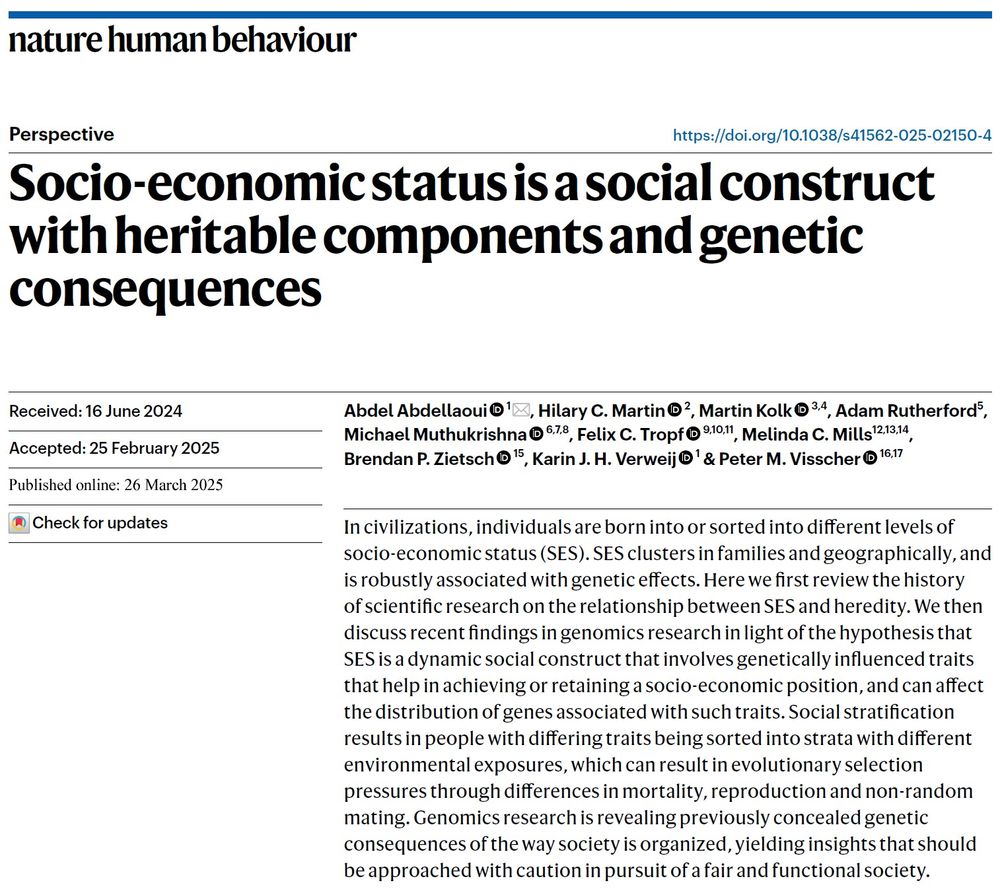
In every civilization, people end up sorted into levels of socio-economic status (SES). We explore the history, present, and future of scientific research on the complicated relationship between SES and DNA in @naturehumbehav.bsky.social💰🧬🎓
Link: rdcu.be/efacK
Thread below 👇🏽
Link: rdcu.be/efacK
Thread below 👇🏽
March 26, 2025 at 11:16 AM
In every civilization, people end up sorted into levels of socio-economic status (SES). We explore the history, present, and future of scientific research on the complicated relationship between SES and DNA in @naturehumbehav.bsky.social💰🧬🎓
Link: rdcu.be/efacK
Thread below 👇🏽
Link: rdcu.be/efacK
Thread below 👇🏽
Reposted by Ali Akbari

New preprint! We worked with @msftresearch.bsky.social and @broadinstitute.org to see whether large language models (LLMs) can be useful to variant scientists in deciding whether genetic variants seen in a patient are responsible for their disease. tl;dr yes they can: www.biorxiv.org/content/10.1...

Evidence Aggregator: AI reasoning applied to rare disease diagnostics
Retrieving, reviewing, and synthesizing technical information can be time-consuming and challenging, particularly when requiring specialized expertise, as is the case of variant assessment for rare di...
www.biorxiv.org
March 15, 2025 at 2:44 AM
New preprint! We worked with @msftresearch.bsky.social and @broadinstitute.org to see whether large language models (LLMs) can be useful to variant scientists in deciding whether genetic variants seen in a patient are responsible for their disease. tl;dr yes they can: www.biorxiv.org/content/10.1...
How selection can incorporate evolutionary history into the genetic architecture of a single cell, giving rise to a hypermutable locus that appears to anticipate environmental change, thereby accelerating adaptive evolution.
www.science.org/doi/10.1126/...
www.science.org/doi/10.1126/...

Experimental evolution of evolvability
Evolvability—the capacity to generate adaptive variation—is a trait that can itself evolve through natural selection. However, the idea that mutation can become biased toward adaptive outcomes remains...
www.science.org
March 5, 2025 at 7:02 AM
How selection can incorporate evolutionary history into the genetic architecture of a single cell, giving rise to a hypermutable locus that appears to anticipate environmental change, thereby accelerating adaptive evolution.
www.science.org/doi/10.1126/...
www.science.org/doi/10.1126/...
Reposted by Ali Akbari

I can't believe we're still allowing completely inadequate and uninterpretable Epigenome-Wide Association Studies (EWAS) to be published.
I don't care that this study is probably well-intentioned, and probably trying to draw attention to awful events in Syria.
www.nature.com/articles/s41...
I don't care that this study is probably well-intentioned, and probably trying to draw attention to awful events in Syria.
www.nature.com/articles/s41...
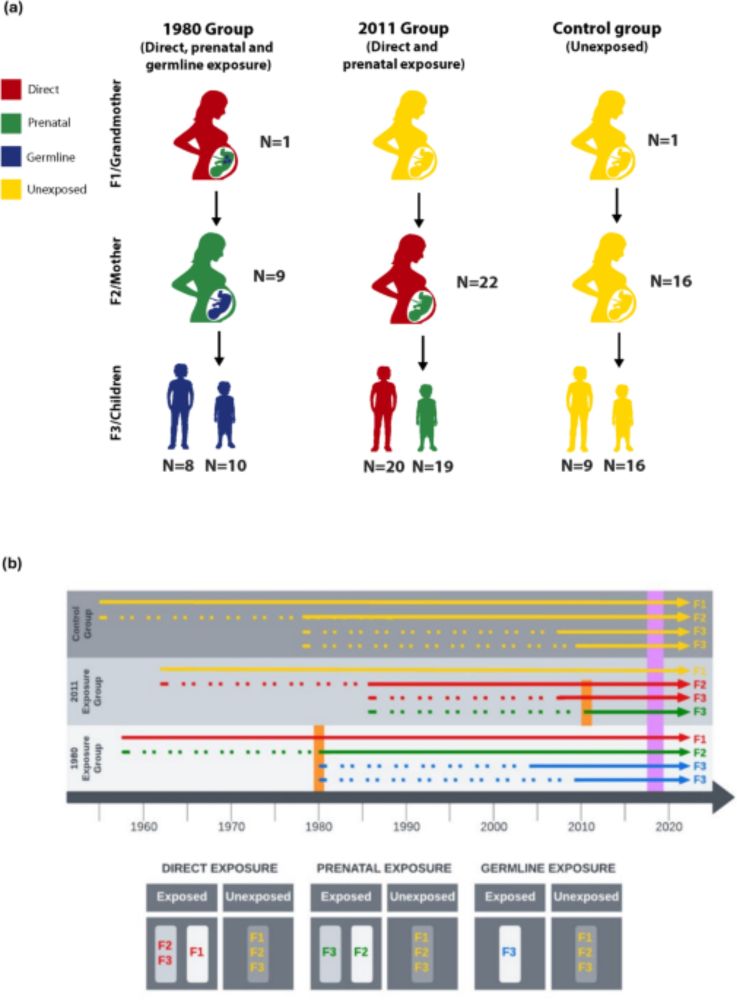
Epigenetic signatures of intergenerational exposure to violence in three generations of Syrian refugees - Scientific Reports
Scientific Reports - Epigenetic signatures of intergenerational exposure to violence in three generations of Syrian refugees
www.nature.com
March 1, 2025 at 4:51 PM
I can't believe we're still allowing completely inadequate and uninterpretable Epigenome-Wide Association Studies (EWAS) to be published.
I don't care that this study is probably well-intentioned, and probably trying to draw attention to awful events in Syria.
www.nature.com/articles/s41...
I don't care that this study is probably well-intentioned, and probably trying to draw attention to awful events in Syria.
www.nature.com/articles/s41...
Insufficient evidence for natural selection associated with the Black Death
These claims are unsupported for four reasons...
Finally, we find no evidence of significant change in frequency of the ERAP2 variant rs2549794...
www.nature.com/articles/s41...
These claims are unsupported for four reasons...
Finally, we find no evidence of significant change in frequency of the ERAP2 variant rs2549794...
www.nature.com/articles/s41...

Insufficient evidence for natural selection associated with the Black Death - Nature
Nature - Insufficient evidence for natural selection associated with the Black Death
www.nature.com
February 20, 2025 at 6:31 AM
Insufficient evidence for natural selection associated with the Black Death
These claims are unsupported for four reasons...
Finally, we find no evidence of significant change in frequency of the ERAP2 variant rs2549794...
www.nature.com/articles/s41...
These claims are unsupported for four reasons...
Finally, we find no evidence of significant change in frequency of the ERAP2 variant rs2549794...
www.nature.com/articles/s41...
Reposted by Ali Akbari
Insufficient evidence for a severe bottleneck in humans during the Early to Middle Pleistocene transition
academic.oup.com/mbe/advance-...
academic.oup.com/mbe/advance-...

Insufficient evidence for a severe bottleneck in humans during the Early to Middle Pleistocene transition
Abstract. A recently proposed model suggests a severe bottleneck in the panmictic ancestral population of modern humans during the Early to Middle Pleistoc
academic.oup.com
February 17, 2025 at 4:56 PM
Insufficient evidence for a severe bottleneck in humans during the Early to Middle Pleistocene transition
academic.oup.com/mbe/advance-...
academic.oup.com/mbe/advance-...
Reposted by Ali Akbari
Distinct explanations underlie gene-environment interactions in the UK Biobank.
www.cell.com/ajhg/abstrac...
www.cell.com/ajhg/abstrac...
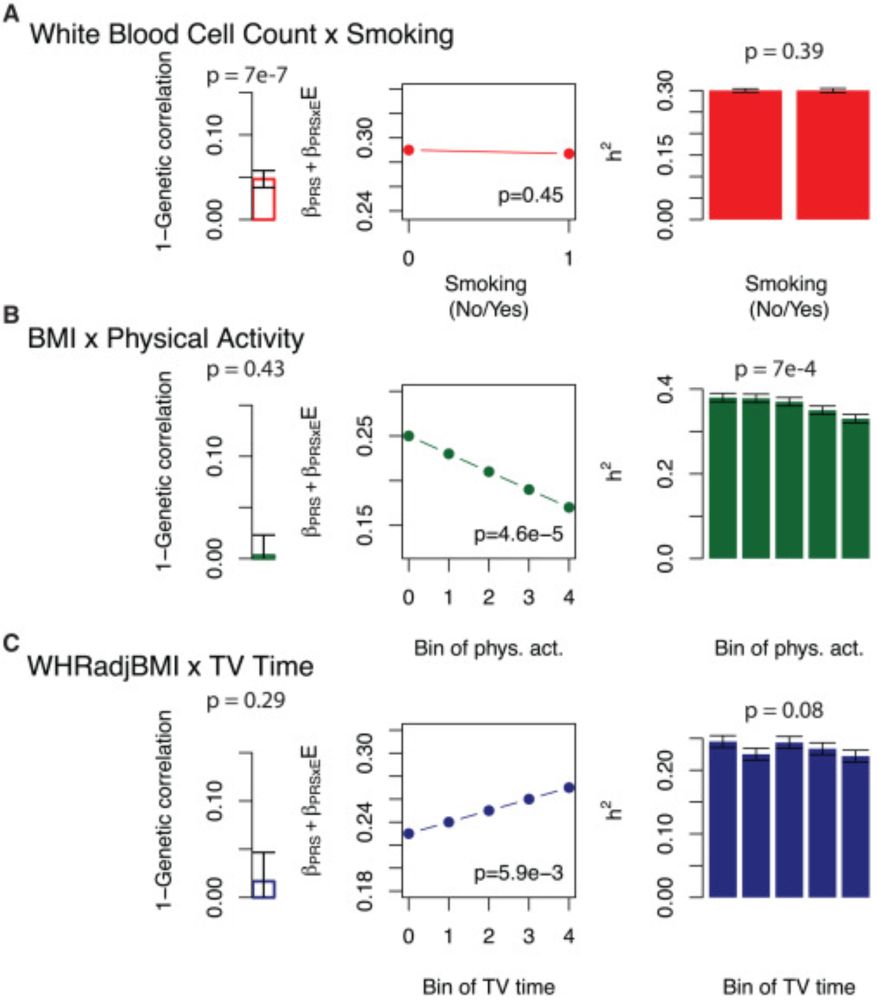
Distinct explanations underlie gene-environment interactions in the UK Biobank
The role of gene-environment (GxE) interaction in disease and complex trait architectures
is widely hypothesized but currently unknown. Here, we apply three statistical approaches
to quantify and dist...
www.cell.com
February 17, 2025 at 4:56 PM
Distinct explanations underlie gene-environment interactions in the UK Biobank.
www.cell.com/ajhg/abstrac...
www.cell.com/ajhg/abstrac...
Reposted by Ali Akbari

Multiple-testing corrections in selection scans using identity-by-descent segments https://www.biorxiv.org/content/10.1101/2025.01.29.635528v1
January 30, 2025 at 8:32 AM
Multiple-testing corrections in selection scans using identity-by-descent segments https://www.biorxiv.org/content/10.1101/2025.01.29.635528v1
Reposted by Ali Akbari
Our review on the genomics of rare disease in the Greater Middle East is out this week in @naturegenet.bsky.social
www.nature.com/articles/s41...
www.nature.com/articles/s41...

Genomics of rare diseases in the Greater Middle East - Nature Genetics
The Greater Middle East is home to a rich genetic diversity that remains largely untapped in genomic research. This Perspective explores its potential for rare disease research, obstacles limiting pro...
www.nature.com
February 6, 2025 at 3:06 PM
Our review on the genomics of rare disease in the Greater Middle East is out this week in @naturegenet.bsky.social
www.nature.com/articles/s41...
www.nature.com/articles/s41...
Reposted by Ali Akbari

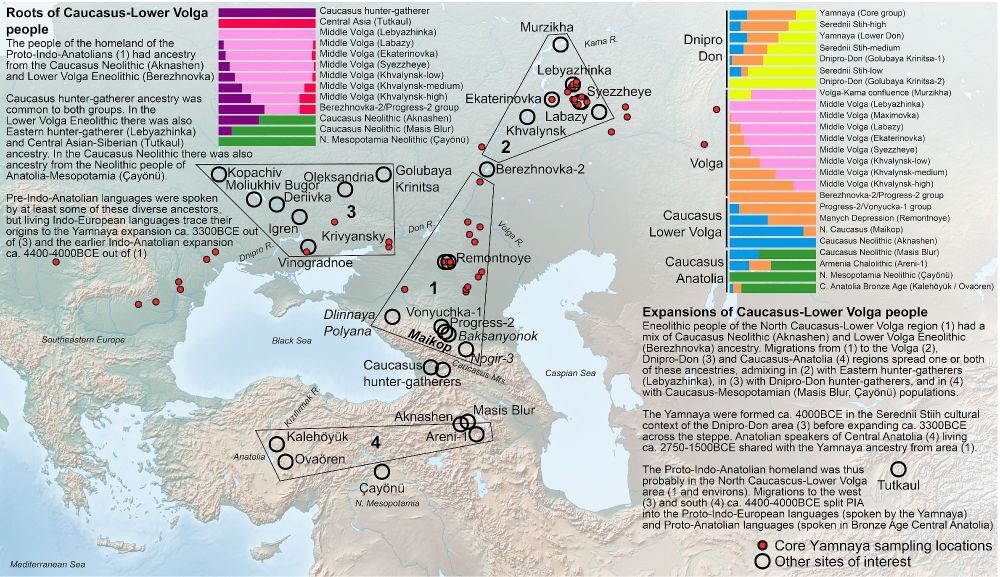
Our papers, out today in @nature.com, show how ancient DNA from the Eneolithic and Bronze Age steppe points to a North Pontic origin of the Indo-European language family and a Caucasus-Lower Volga (CLV) origin of Indo-Anatolian (inclusive of the now extinct Anatolian languages). 1/
February 5, 2025 at 6:33 PM
Our papers, out today in @nature.com, show how ancient DNA from the Eneolithic and Bronze Age steppe points to a North Pontic origin of the Indo-European language family and a Caucasus-Lower Volga (CLV) origin of Indo-Anatolian (inclusive of the now extinct Anatolian languages). 1/
Reposted by Ali Akbari

“The distribution of highly deleterious variants across human ancestry groups”. Preprint with Anastasia Stolyarova and @gcbias.bsky.social: www.biorxiv.org/content/10.1...

The distribution of highly deleterious variants across human ancestry groups
A major focus of human genetics is to map severe disease mutations. Increasingly that goal is understood as requiring huge numbers of people to be sequenced from every broadly-defined genetic ancestry...
www.biorxiv.org
February 2, 2025 at 7:00 PM
“The distribution of highly deleterious variants across human ancestry groups”. Preprint with Anastasia Stolyarova and @gcbias.bsky.social: www.biorxiv.org/content/10.1...
Reposted by Ali Akbari

Think of a polygenic score you care about. Are direct genetic effects driving variation among people in this predictor? Or perhaps other, confounding factors? We at the @arbelharpak.bsky.social & @docedge.bsky.social Labs developed a method to tackle this question. [1/n]
A Litmus Test for Confounding in Polygenic Scores
Polygenic scores (PGSs) are being rapidly adopted for trait prediction in the clinic and beyond. PGSs are often thought of as capturing the direct genetic effect of one's genotype on their phenotype. ...
www.biorxiv.org
February 4, 2025 at 6:04 PM
Think of a polygenic score you care about. Are direct genetic effects driving variation among people in this predictor? Or perhaps other, confounding factors? We at the @arbelharpak.bsky.social & @docedge.bsky.social Labs developed a method to tackle this question. [1/n]
Reposted by Ali Akbari

A homozygous SVA retrotransposon insertion is discovered to be likely the most common mutation in ASPA (encodes aspartoacylase) underlying Canavan disease. 1/
Gonzalez, Bell, et al. medRxiv
www.medrxiv.org/content/10.1...
Gonzalez, Bell, et al. medRxiv
www.medrxiv.org/content/10.1...

A Diagnostic Blind Spot: Deep intronic SVA_E Insertion identified as the most Common Pathogenic Variant Associated with Canavan Disease
Canavan disease (CD) is a neurodegenerative disorder caused by biallelic disease-causing variants in the ASPA gene. Here, we utilized long-read sequencing (LRS) to investigate eight individuals clinic...
www.medrxiv.org
December 23, 2024 at 4:59 AM
A homozygous SVA retrotransposon insertion is discovered to be likely the most common mutation in ASPA (encodes aspartoacylase) underlying Canavan disease. 1/
Gonzalez, Bell, et al. medRxiv
www.medrxiv.org/content/10.1...
Gonzalez, Bell, et al. medRxiv
www.medrxiv.org/content/10.1...