




Sebastian Ramirez-Ruiz
@seramirezruiz.bsky.social
Max Weber Postdoctoral Fellow at @eui-eu.bsky.social
Interested in causal inference, evidence in policy- and decision-making, #rstats, and most importantly, bicycles | Ph.D. @hertiedatascience.bsky.social
🌐 https://seramirezruiz.github.io/
Interested in causal inference, evidence in policy- and decision-making, #rstats, and most importantly, bicycles | Ph.D. @hertiedatascience.bsky.social
🌐 https://seramirezruiz.github.io/
Pinned
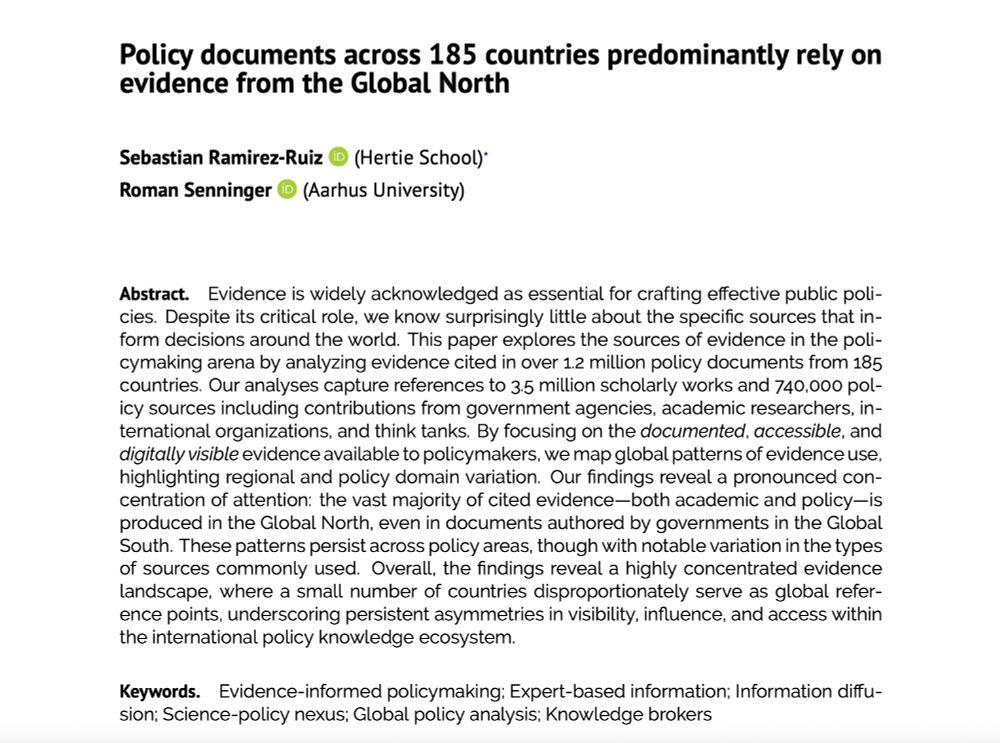
📄 Whose expert knowledge informs policymaking around the world?
@rsenninger.bsky.social and I analyze data from 1.2 million government policy documents from 185 countries—and find a prominent pattern:
🌍 Policy evidence is overwhelmingly sourced from the Global North.
Preprint: osf.io/w8q3y
🧪🧵👇
@rsenninger.bsky.social and I analyze data from 1.2 million government policy documents from 185 countries—and find a prominent pattern:
🌍 Policy evidence is overwhelmingly sourced from the Global North.
Preprint: osf.io/w8q3y
🧪🧵👇
Reposted by Sebastian Ramirez-Ruiz

We’re organizing a workshop at Aarhus University. Please share and consider submitting!
🗓️ 13–14 April 2026 | 📝 Deadline: Mon, 16 Feb 2026 (extended abstract) — junior scholars prioritized
🎤 Keynotes: @stefwalter.bsky.social (Univ. of Zurich) & @hhuang.bsky.social (Ohio State)
🗓️ 13–14 April 2026 | 📝 Deadline: Mon, 16 Feb 2026 (extended abstract) — junior scholars prioritized
🎤 Keynotes: @stefwalter.bsky.social (Univ. of Zurich) & @hhuang.bsky.social (Ohio State)

January 15, 2026 at 1:52 PM
We’re organizing a workshop at Aarhus University. Please share and consider submitting!
🗓️ 13–14 April 2026 | 📝 Deadline: Mon, 16 Feb 2026 (extended abstract) — junior scholars prioritized
🎤 Keynotes: @stefwalter.bsky.social (Univ. of Zurich) & @hhuang.bsky.social (Ohio State)
🗓️ 13–14 April 2026 | 📝 Deadline: Mon, 16 Feb 2026 (extended abstract) — junior scholars prioritized
🎤 Keynotes: @stefwalter.bsky.social (Univ. of Zurich) & @hhuang.bsky.social (Ohio State)
Reposted by Sebastian Ramirez-Ruiz

🚨Job alert! 🚨
I'm advertising a PhD position (66%) in Comparative Politics at HU Berlin. Ideal candidates combine a research interest in autocratic politics, conflict, and/or political violence with strong quantitative methods skills.
⏳ 4 (+2) years | 🗓 DL 16.01; Start March/April 26
More info:
I'm advertising a PhD position (66%) in Comparative Politics at HU Berlin. Ideal candidates combine a research interest in autocratic politics, conflict, and/or political violence with strong quantitative methods skills.
⏳ 4 (+2) years | 🗓 DL 16.01; Start March/April 26
More info:
Research fellow (m/f/d) in the field of “contentious politics/political violence/autocratic politics” - Humboldt-Universität zu Berlin
www.hu-berlin.de
January 6, 2026 at 11:17 AM
🚨Job alert! 🚨
I'm advertising a PhD position (66%) in Comparative Politics at HU Berlin. Ideal candidates combine a research interest in autocratic politics, conflict, and/or political violence with strong quantitative methods skills.
⏳ 4 (+2) years | 🗓 DL 16.01; Start March/April 26
More info:
I'm advertising a PhD position (66%) in Comparative Politics at HU Berlin. Ideal candidates combine a research interest in autocratic politics, conflict, and/or political violence with strong quantitative methods skills.
⏳ 4 (+2) years | 🗓 DL 16.01; Start March/April 26
More info:
Reposted by Sebastian Ramirez-Ruiz

🇪🇺🇩🇪 Published Today in @bjpols.bsky.social 🇮🇹🇫🇷
How a voting advice application affected voting behavior in three large-scale field experiments:
shorturl.at/2ekBj
TLDR of our study (with @simonhix.bsky.social & @rlachat.bsky.social) below 👇 1/14
How a voting advice application affected voting behavior in three large-scale field experiments:
shorturl.at/2ekBj
TLDR of our study (with @simonhix.bsky.social & @rlachat.bsky.social) below 👇 1/14


December 18, 2025 at 11:41 AM
🇪🇺🇩🇪 Published Today in @bjpols.bsky.social 🇮🇹🇫🇷
How a voting advice application affected voting behavior in three large-scale field experiments:
shorturl.at/2ekBj
TLDR of our study (with @simonhix.bsky.social & @rlachat.bsky.social) below 👇 1/14
How a voting advice application affected voting behavior in three large-scale field experiments:
shorturl.at/2ekBj
TLDR of our study (with @simonhix.bsky.social & @rlachat.bsky.social) below 👇 1/14
Reposted by Sebastian Ramirez-Ruiz

It's out!!
www.science.org/doi/10.1126/...
Big thank you to my coauthors @small-schulz.bsky.social and @lorenzspreen.bsky.social, and to all participants who discussed 20 political issues over 4 weeks in 6 subreddit, 3 experimental conditions and let us observe.
www.science.org/doi/10.1126/...
Big thank you to my coauthors @small-schulz.bsky.social and @lorenzspreen.bsky.social, and to all participants who discussed 20 political issues over 4 weeks in 6 subreddit, 3 experimental conditions and let us observe.

December 11, 2025 at 10:34 AM
It's out!!
www.science.org/doi/10.1126/...
Big thank you to my coauthors @small-schulz.bsky.social and @lorenzspreen.bsky.social, and to all participants who discussed 20 political issues over 4 weeks in 6 subreddit, 3 experimental conditions and let us observe.
www.science.org/doi/10.1126/...
Big thank you to my coauthors @small-schulz.bsky.social and @lorenzspreen.bsky.social, and to all participants who discussed 20 political issues over 4 weeks in 6 subreddit, 3 experimental conditions and let us observe.
Reposted by Sebastian Ramirez-Ruiz
Political communication research overwhelmingly relies on text. But parliamentary speech is multimodal! In our new @psrm.bsky.social article, Mathias Rask and I show that legislators also signal partisan conflict nonverbally— through changes in vocal pitch during floor speeches. 🧵 1/11 #polisky

December 4, 2025 at 3:19 PM
Political communication research overwhelmingly relies on text. But parliamentary speech is multimodal! In our new @psrm.bsky.social article, Mathias Rask and I show that legislators also signal partisan conflict nonverbally— through changes in vocal pitch during floor speeches. 🧵 1/11 #polisky
Reposted by Sebastian Ramirez-Ruiz

A gentle summary of the last twenty-odd years of Pearl-style causal inference with DAGs, perhaps most helpful if you're just arriving from old-school philosophy of causation.
I like this genre. And if you do too, I can also recommend Weinberger et al.'s forthcoming piece in BJPS
1/2
I like this genre. And if you do too, I can also recommend Weinberger et al.'s forthcoming piece in BJPS
1/2
New paper out in Synthese—a metaphysical theory of causation designed to explain statistical causal inference. Basically a summary of a 100,000-word book (Causation: Science, Statistics and Metaphysics) that'll go into production with CUP soon. Watch this space link.springer.com/article/10.1...

Causal inference and the metaphysics of causation - Synthese
The techniques of causal inference are widely used throughout the non-experimental sciences to derive causal conclusions from probabilistic premises. This poses a philosophical question. What in the n...
link.springer.com
November 30, 2025 at 5:37 PM
A gentle summary of the last twenty-odd years of Pearl-style causal inference with DAGs, perhaps most helpful if you're just arriving from old-school philosophy of causation.
I like this genre. And if you do too, I can also recommend Weinberger et al.'s forthcoming piece in BJPS
1/2
I like this genre. And if you do too, I can also recommend Weinberger et al.'s forthcoming piece in BJPS
1/2
Reposted by Sebastian Ramirez-Ruiz

🚨 Please send in your application by 10 December to be considered for this ESRC studentship in collaboration with @campaign-lab.bsky.social. Both home and international students are eligible for funding. Some advice on how to apply below 👇
🚨 We have a cool new ESRC PhD studentship opportunity on the topic of political persuasion for someone interested in campaigning, field experiments and/or computational methods @lsegovernment.bsky.social, in collaboration with
@campaign-lab.bsky.social. All info 👇
www.lse.ac.uk/study-at-lse...
@campaign-lab.bsky.social. All info 👇
www.lse.ac.uk/study-at-lse...

LSE Collaborative Studentship with Campaign Lab
LSE Collaborative Studentship with Campaign Lab
www.lse.ac.uk
November 28, 2025 at 9:09 PM
🚨 Please send in your application by 10 December to be considered for this ESRC studentship in collaboration with @campaign-lab.bsky.social. Both home and international students are eligible for funding. Some advice on how to apply below 👇
Reposted by Sebastian Ramirez-Ruiz
🚨 New working paper!
How well do people predict the results of studies?
@sdellavi.bsky.social and I leverage data from the first 100 studies to have been posted on the SSPP, containing 1,482 key questions, on which over 50,000 forecasts were placed. Some surprising results below.... 🧵👇
How well do people predict the results of studies?
@sdellavi.bsky.social and I leverage data from the first 100 studies to have been posted on the SSPP, containing 1,482 key questions, on which over 50,000 forecasts were placed. Some surprising results below.... 🧵👇

November 24, 2025 at 3:43 PM
🚨 New working paper!
How well do people predict the results of studies?
@sdellavi.bsky.social and I leverage data from the first 100 studies to have been posted on the SSPP, containing 1,482 key questions, on which over 50,000 forecasts were placed. Some surprising results below.... 🧵👇
How well do people predict the results of studies?
@sdellavi.bsky.social and I leverage data from the first 100 studies to have been posted on the SSPP, containing 1,482 key questions, on which over 50,000 forecasts were placed. Some surprising results below.... 🧵👇
Reposted by Sebastian Ramirez-Ruiz

We wrote the Strain on scientific publishing to highlight the problems of time & trust. With a fantastic group of co-authors, we present The Drain of Scientific Publishing:
a 🧵 1/n
Drain: arxiv.org/abs/2511.04820
Strain: direct.mit.edu/qss/article/...
Oligopoly: direct.mit.edu/qss/article/...
a 🧵 1/n
Drain: arxiv.org/abs/2511.04820
Strain: direct.mit.edu/qss/article/...
Oligopoly: direct.mit.edu/qss/article/...


November 11, 2025 at 11:52 AM
We wrote the Strain on scientific publishing to highlight the problems of time & trust. With a fantastic group of co-authors, we present The Drain of Scientific Publishing:
a 🧵 1/n
Drain: arxiv.org/abs/2511.04820
Strain: direct.mit.edu/qss/article/...
Oligopoly: direct.mit.edu/qss/article/...
a 🧵 1/n
Drain: arxiv.org/abs/2511.04820
Strain: direct.mit.edu/qss/article/...
Oligopoly: direct.mit.edu/qss/article/...
Reposted by Sebastian Ramirez-Ruiz
📄 New WP version out - full overhaul!
The Politics of Evidence Selection (w/ @jesperasring.bsky.social )
Comments welcome!
🔗 osf.io/preprints/so...
The Politics of Evidence Selection (w/ @jesperasring.bsky.social )
Comments welcome!
🔗 osf.io/preprints/so...


November 6, 2025 at 3:30 PM
📄 New WP version out - full overhaul!
The Politics of Evidence Selection (w/ @jesperasring.bsky.social )
Comments welcome!
🔗 osf.io/preprints/so...
The Politics of Evidence Selection (w/ @jesperasring.bsky.social )
Comments welcome!
🔗 osf.io/preprints/so...
Reposted by Sebastian Ramirez-Ruiz
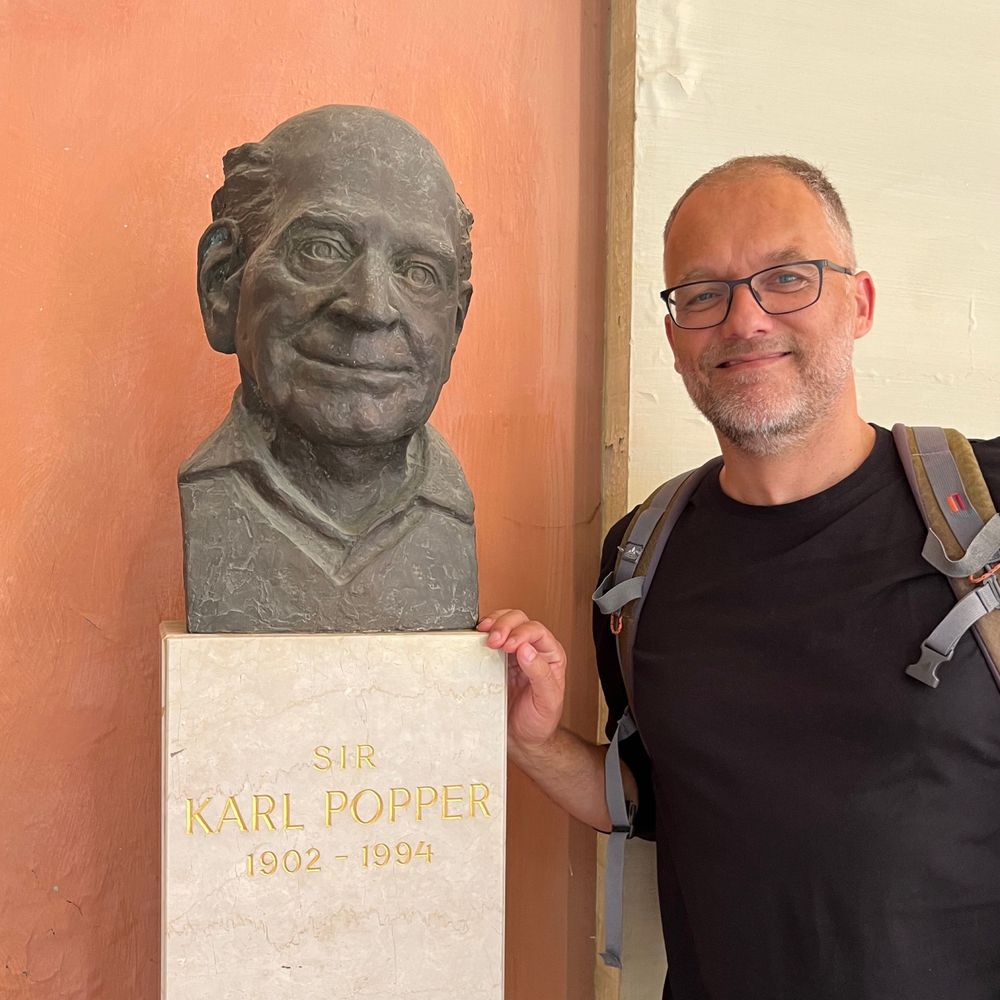
Job! A vacancy at the @eui-eu.bsky.social for a postdoc joining the @learnineq.bsky.social project, for 13 months, starting mid January. We study inequalities in school careers, and we engage with policy makers. The vacancy is here, please forward. DEADLINE 24 NOVEMBER. www.eui.eu/Documents/Se...
November 5, 2025 at 6:11 PM
Job! A vacancy at the @eui-eu.bsky.social for a postdoc joining the @learnineq.bsky.social project, for 13 months, starting mid January. We study inequalities in school careers, and we engage with policy makers. The vacancy is here, please forward. DEADLINE 24 NOVEMBER. www.eui.eu/Documents/Se...
Reposted by Sebastian Ramirez-Ruiz

@matthewfacciani.bsky.social, co-author of our latest study on science communication behavior in 68 countries, just published a blog post with a great summary of the main results. Check it out! ⬇️

How do people around the world encounter science, and what shapes those encounters?
Our new global study found that social media now carries much of the world’s science content, but local culture, infrastructure, and curiosity still determine how people engage. #ScienceSky #scicomm
Our new global study found that social media now carries much of the world’s science content, but local culture, infrastructure, and curiosity still determine how people engage. #ScienceSky #scicomm

How the World Talks About Science
Our new international study finds that science communication looks very different depending on culture, media systems, and access to technology.
matthewfacciani.substack.com
November 4, 2025 at 7:17 PM
@matthewfacciani.bsky.social, co-author of our latest study on science communication behavior in 68 countries, just published a blog post with a great summary of the main results. Check it out! ⬇️
Reposted by Sebastian Ramirez-Ruiz
We have a new preprint: osf.io/preprints/so...
What have we learned about social media - the constantly moving target of empirical research - over the past decade?
What have we learned about social media - the constantly moving target of empirical research - over the past decade?

October 30, 2025 at 10:53 AM
We have a new preprint: osf.io/preprints/so...
What have we learned about social media - the constantly moving target of empirical research - over the past decade?
What have we learned about social media - the constantly moving target of empirical research - over the past decade?
Reposted by Sebastian Ramirez-Ruiz

🌍 Brussels effect or 🪃 boomerang?
Francesca Minetto (@hertieschool.bsky.social) shows that over 20% of EU legislation draws directly on international models, revealing that the EU not only exports but also imports policies 👇
🔗 www.tandfonline.com/doi/full/10....
Francesca Minetto (@hertieschool.bsky.social) shows that over 20% of EU legislation draws directly on international models, revealing that the EU not only exports but also imports policies 👇
🔗 www.tandfonline.com/doi/full/10....

October 27, 2025 at 1:00 PM
🌍 Brussels effect or 🪃 boomerang?
Francesca Minetto (@hertieschool.bsky.social) shows that over 20% of EU legislation draws directly on international models, revealing that the EU not only exports but also imports policies 👇
🔗 www.tandfonline.com/doi/full/10....
Francesca Minetto (@hertieschool.bsky.social) shows that over 20% of EU legislation draws directly on international models, revealing that the EU not only exports but also imports policies 👇
🔗 www.tandfonline.com/doi/full/10....
Reposted by Sebastian Ramirez-Ruiz
Published today: One of the biggest #science #communication studies to date. We asked 71,922 people in 68 countries how they #engage with information about #science and combined the data with several country-level factors: journals.sagepub.com/doi/10.1177/... #OpenAccess

October 21, 2025 at 12:27 PM
Published today: One of the biggest #science #communication studies to date. We asked 71,922 people in 68 countries how they #engage with information about #science and combined the data with several country-level factors: journals.sagepub.com/doi/10.1177/... #OpenAccess
Reposted by Sebastian Ramirez-Ruiz

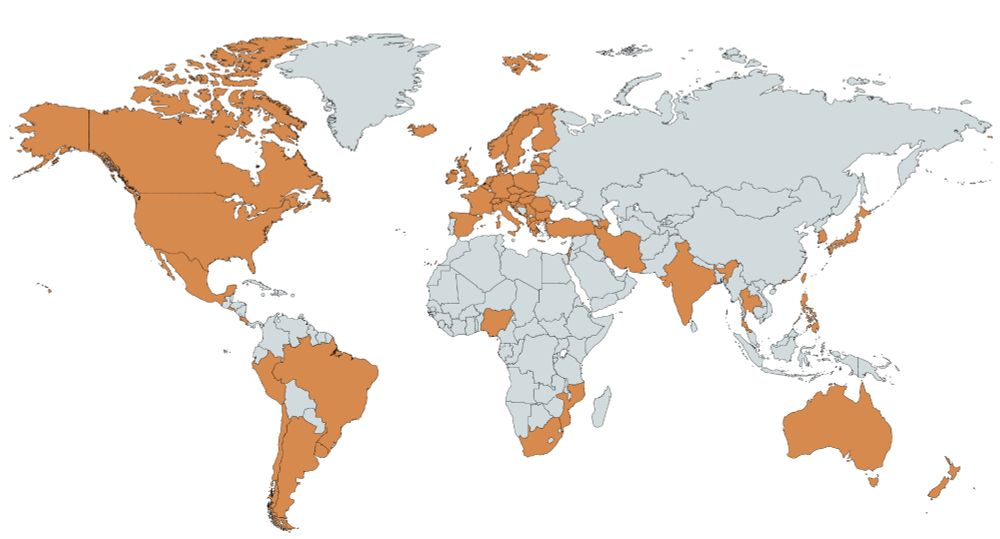
🚨 We're hiring!
Join our CSES Team @gesis.org Cologne as a Senior Researcher. If you’re into comparative electoral research and love diving into data, this is your moment.
Come shape global democracy with us! 🌍📊
www.gesis.org/en/institute...
Join our CSES Team @gesis.org Cologne as a Senior Researcher. If you’re into comparative electoral research and love diving into data, this is your moment.
Come shape global democracy with us! 🌍📊
www.gesis.org/en/institute...

July 16, 2025 at 6:09 AM
🚨 We're hiring!
Join our CSES Team @gesis.org Cologne as a Senior Researcher. If you’re into comparative electoral research and love diving into data, this is your moment.
Come shape global democracy with us! 🌍📊
www.gesis.org/en/institute...
Join our CSES Team @gesis.org Cologne as a Senior Researcher. If you’re into comparative electoral research and love diving into data, this is your moment.
Come shape global democracy with us! 🌍📊
www.gesis.org/en/institute...
Reposted by Sebastian Ramirez-Ruiz

A 2023 NHB paper concluded that corrections of science-relevant misinformation are, on average, ineffective. Our response (in press) challenges this conclusion, showing why corrections *are* effective, and why considering measurement is important:
🔗 osf.io/preprints/ps...
(1/5)
🔗 osf.io/preprints/ps...
(1/5)
OSF
osf.io
June 27, 2025 at 6:56 PM
A 2023 NHB paper concluded that corrections of science-relevant misinformation are, on average, ineffective. Our response (in press) challenges this conclusion, showing why corrections *are* effective, and why considering measurement is important:
🔗 osf.io/preprints/ps...
(1/5)
🔗 osf.io/preprints/ps...
(1/5)
Reposted by Sebastian Ramirez-Ruiz

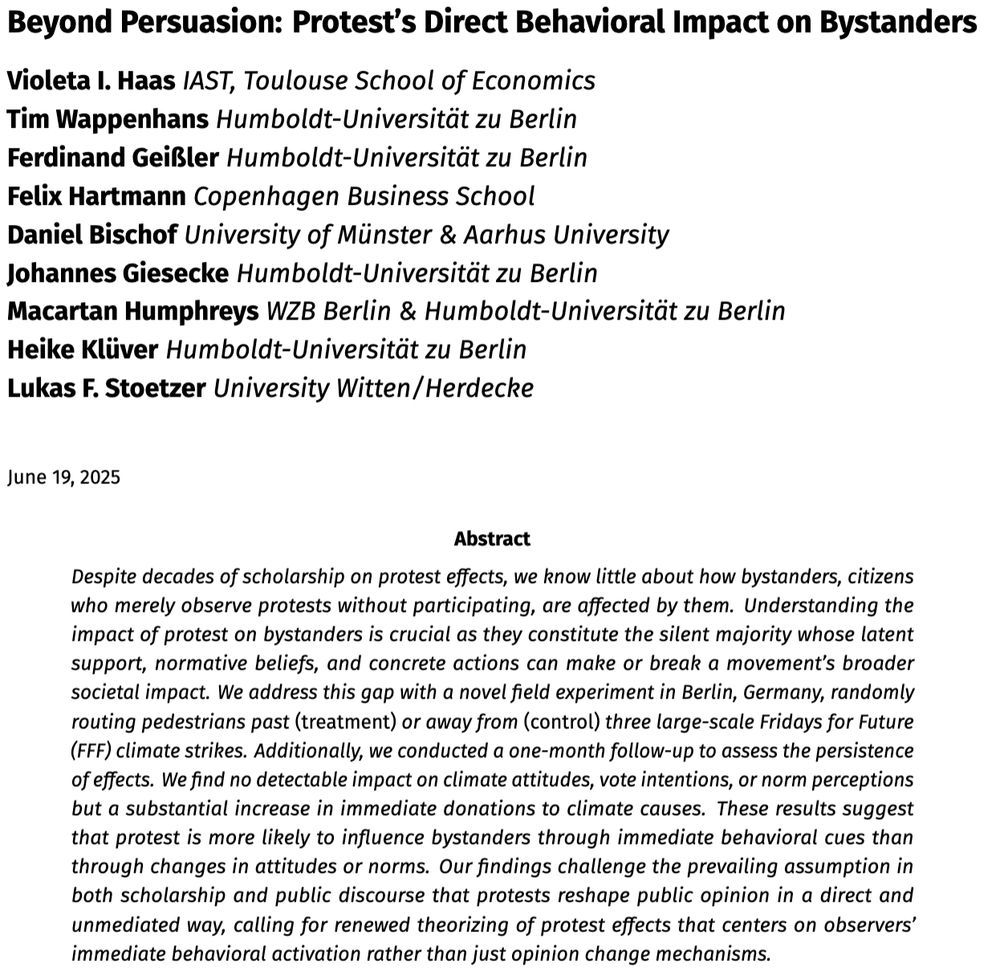
🚨 New working paper 🚨
Can protests move Bystanders, citizens who observe protest without participating?
We tested this in a 3-wave field experiment. Check out our thread below👇🧵
Can protests move Bystanders, citizens who observe protest without participating?
We tested this in a 3-wave field experiment. Check out our thread below👇🧵

🪧 New research 🪧
osf.io/preprints/os...
Can protests move bystanders, people who observe protests without being part of the march?
We conducted a 3-wave field experiment during real Fridays for Future (FFF) protests in Berlin.
Here's what we found 🧵👇
osf.io/preprints/os...
Can protests move bystanders, people who observe protests without being part of the march?
We conducted a 3-wave field experiment during real Fridays for Future (FFF) protests in Berlin.
Here's what we found 🧵👇
June 23, 2025 at 1:06 PM
🚨 New working paper 🚨
Can protests move Bystanders, citizens who observe protest without participating?
We tested this in a 3-wave field experiment. Check out our thread below👇🧵
Can protests move Bystanders, citizens who observe protest without participating?
We tested this in a 3-wave field experiment. Check out our thread below👇🧵
Reposted by Sebastian Ramirez-Ruiz
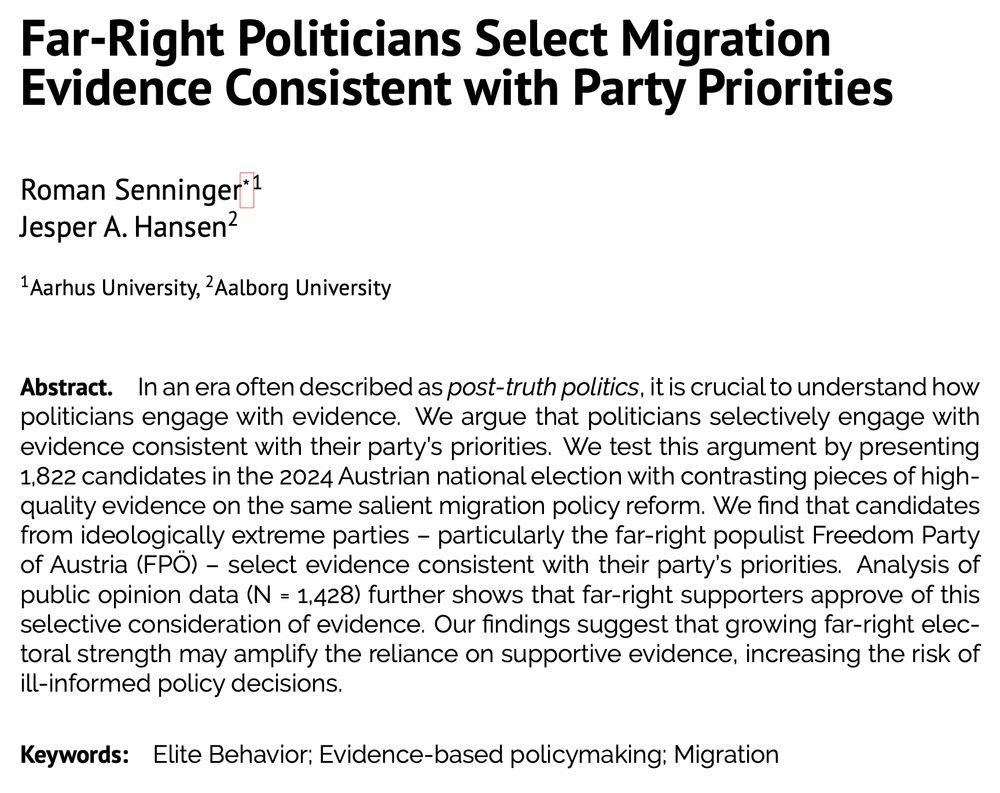
Very excited to share a new preprint.
@jesperasring.bsky.social and I study how politicians engage with evidence in the real world.
Link: osf.io/8zv9s
@jesperasring.bsky.social and I study how politicians engage with evidence in the real world.
Link: osf.io/8zv9s
June 20, 2025 at 8:26 AM
Very excited to share a new preprint.
@jesperasring.bsky.social and I study how politicians engage with evidence in the real world.
Link: osf.io/8zv9s
@jesperasring.bsky.social and I study how politicians engage with evidence in the real world.
Link: osf.io/8zv9s
Reposted by Sebastian Ramirez-Ruiz

Cool data! The Global North is really where expert knowledge is produced.
Not fair, not just, but yes soft power is mostly concentrated there. Wish GN elites cared.
Also: differently from elsewhere, 60% of expert refs in USA docs cite papers with only USA-based academics as authors #exceptionalism
Not fair, not just, but yes soft power is mostly concentrated there. Wish GN elites cared.
Also: differently from elsewhere, 60% of expert refs in USA docs cite papers with only USA-based academics as authors #exceptionalism
📄 Whose expert knowledge informs policymaking around the world?
@rsenninger.bsky.social and I analyze data from 1.2 million government policy documents from 185 countries—and find a prominent pattern:
🌍 Policy evidence is overwhelmingly sourced from the Global North.
Preprint: osf.io/w8q3y
🧪🧵👇
@rsenninger.bsky.social and I analyze data from 1.2 million government policy documents from 185 countries—and find a prominent pattern:
🌍 Policy evidence is overwhelmingly sourced from the Global North.
Preprint: osf.io/w8q3y
🧪🧵👇
June 12, 2025 at 10:55 AM
Cool data! The Global North is really where expert knowledge is produced.
Not fair, not just, but yes soft power is mostly concentrated there. Wish GN elites cared.
Also: differently from elsewhere, 60% of expert refs in USA docs cite papers with only USA-based academics as authors #exceptionalism
Not fair, not just, but yes soft power is mostly concentrated there. Wish GN elites cared.
Also: differently from elsewhere, 60% of expert refs in USA docs cite papers with only USA-based academics as authors #exceptionalism
📄 Whose expert knowledge informs policymaking around the world?
@rsenninger.bsky.social and I analyze data from 1.2 million government policy documents from 185 countries—and find a prominent pattern:
🌍 Policy evidence is overwhelmingly sourced from the Global North.
Preprint: osf.io/w8q3y
🧪🧵👇
@rsenninger.bsky.social and I analyze data from 1.2 million government policy documents from 185 countries—and find a prominent pattern:
🌍 Policy evidence is overwhelmingly sourced from the Global North.
Preprint: osf.io/w8q3y
🧪🧵👇
June 12, 2025 at 9:27 AM
📄 Whose expert knowledge informs policymaking around the world?
@rsenninger.bsky.social and I analyze data from 1.2 million government policy documents from 185 countries—and find a prominent pattern:
🌍 Policy evidence is overwhelmingly sourced from the Global North.
Preprint: osf.io/w8q3y
🧪🧵👇
@rsenninger.bsky.social and I analyze data from 1.2 million government policy documents from 185 countries—and find a prominent pattern:
🌍 Policy evidence is overwhelmingly sourced from the Global North.
Preprint: osf.io/w8q3y
🧪🧵👇
Reposted by Sebastian Ramirez-Ruiz
What do a 1963 Science letter, two “No” votes, & Sherlock Holmes have to do with academic writing?
More than you think.
New Respect the Marble post on moving from insight to understanding, from bricks to walls, & why it’s worth our effort.
🧵
catherineeunicedevries.substack.com/p/sherlock-a...
More than you think.
New Respect the Marble post on moving from insight to understanding, from bricks to walls, & why it’s worth our effort.
🧵
catherineeunicedevries.substack.com/p/sherlock-a...

Sherlock at the Brickyard: On Clues, Chaos, and Construction
What Two “No” Votes Taught Me about the Resilience and Rupture in International Cooperation
catherineeunicedevries.substack.com
June 10, 2025 at 8:44 AM
What do a 1963 Science letter, two “No” votes, & Sherlock Holmes have to do with academic writing?
More than you think.
New Respect the Marble post on moving from insight to understanding, from bricks to walls, & why it’s worth our effort.
🧵
catherineeunicedevries.substack.com/p/sherlock-a...
More than you think.
New Respect the Marble post on moving from insight to understanding, from bricks to walls, & why it’s worth our effort.
🧵
catherineeunicedevries.substack.com/p/sherlock-a...
Reposted by Sebastian Ramirez-Ruiz

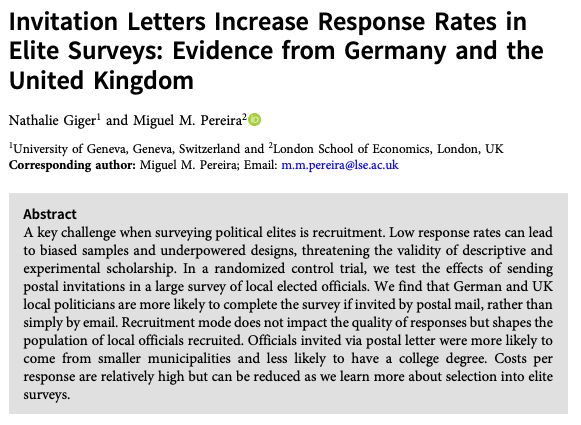
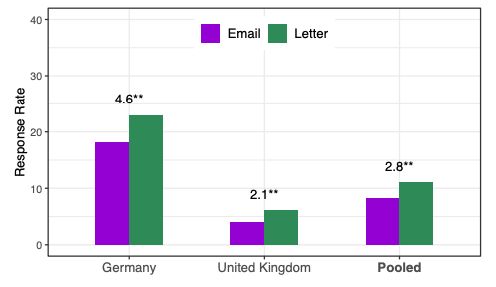
"Invitation Letters Increase Response Rates in Elite Surveys" with @nathaliegiger.bsky.social. Short report @ JEPS.
www.cambridge.org/core/journal...
www.cambridge.org/core/journal...
June 10, 2025 at 2:00 PM
"Invitation Letters Increase Response Rates in Elite Surveys" with @nathaliegiger.bsky.social. Short report @ JEPS.
www.cambridge.org/core/journal...
www.cambridge.org/core/journal...
Reposted by Sebastian Ramirez-Ruiz

We should have orders of magnitude fewer “theories” in PS than we do papers.
June 6, 2025 at 12:45 PM
We should have orders of magnitude fewer “theories” in PS than we do papers.
Reposted by Sebastian Ramirez-Ruiz

If you're a researcher (or, less likely, a policymaker) reading this, you'll definitely want to read on. Featuring a dataset that may include you - and findings that make a solid case for hanging out in this space and sharing your work.
🤔 How much do politicians engage with academic researchers online?
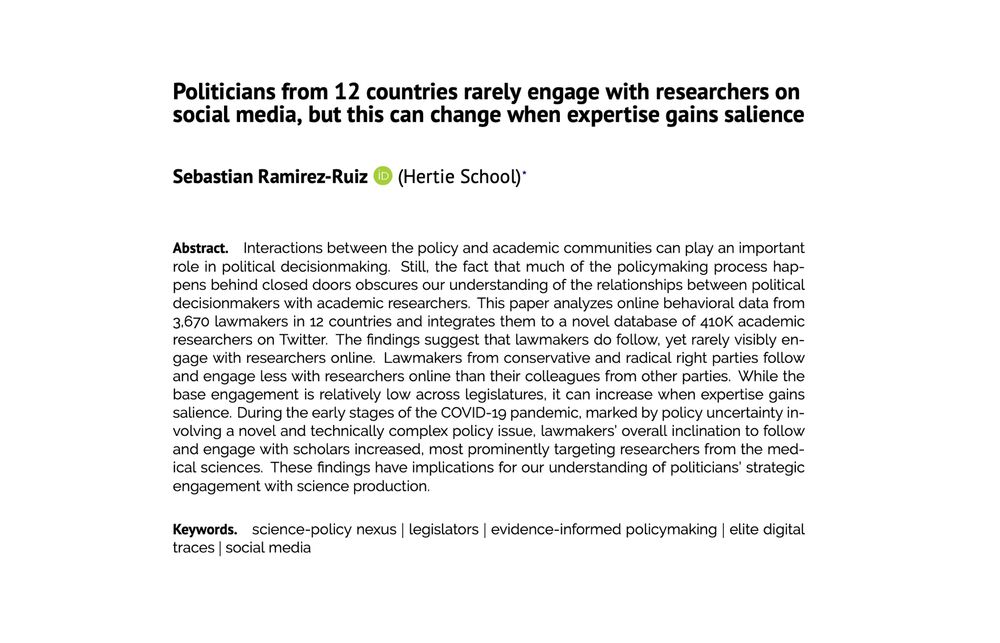
In my latest paper, I find that politicians from 12 countries rarely engage with researchers on social media, but this can change when expertise gains salience
Preprint: osf.io/preprints/osf/wqbe4_v1
🧵👇
In my latest paper, I find that politicians from 12 countries rarely engage with researchers on social media, but this can change when expertise gains salience
Preprint: osf.io/preprints/osf/wqbe4_v1
🧵👇
June 5, 2025 at 6:49 AM
If you're a researcher (or, less likely, a policymaker) reading this, you'll definitely want to read on. Featuring a dataset that may include you - and findings that make a solid case for hanging out in this space and sharing your work.