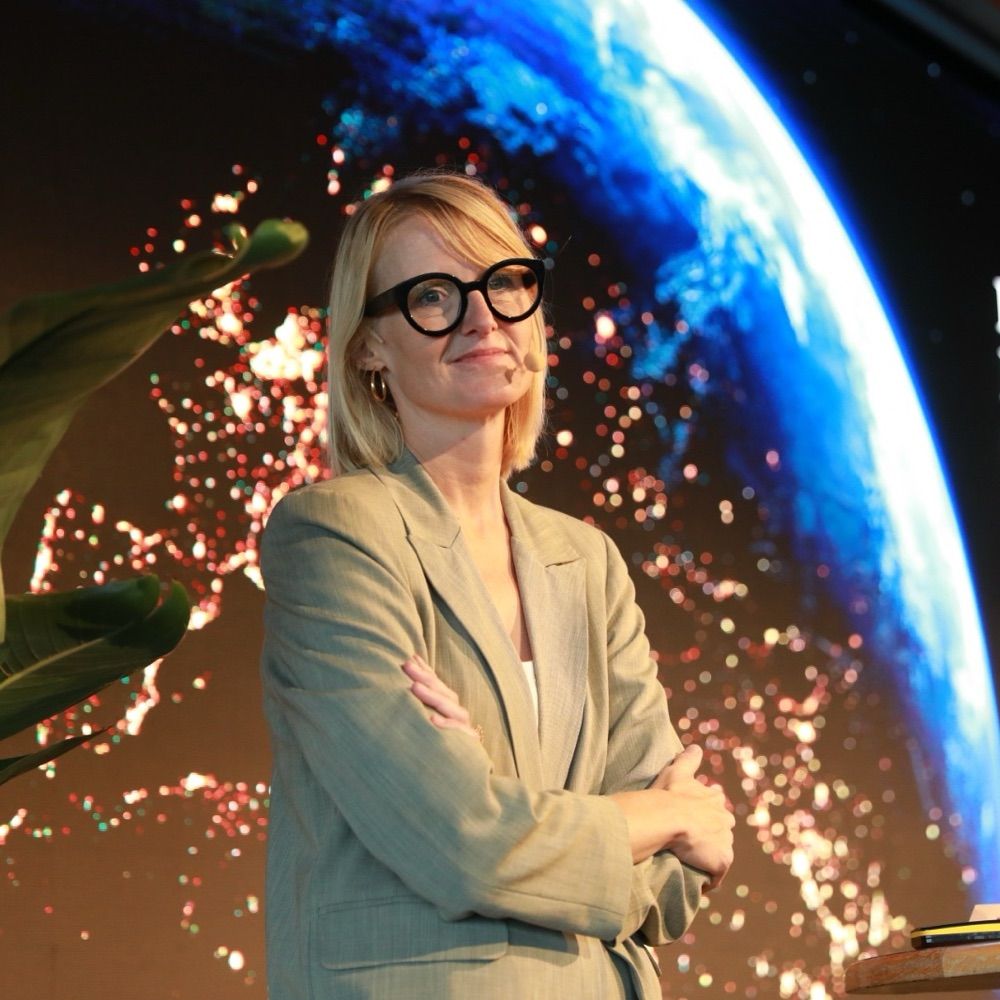
Catherine E. de Vries
banner
catherinedevries.bsky.social
Catherine E. de Vries
@catherinedevries.bsky.social

Vice Dean and Professor at the School of Economics, Politics and Globale Affairs at IE University, Madrid (she/her)

www.catherinedevries.eu

Respect the Marble Substack: catherineeunicedevries.substack.com

Catherine E. de Vries is a Dutch political scientist. She is Dean of Diversity & Inclusion and Professor of Political Science at Bocconi University. She is known for her research on European politics, including political behaviour, comparative European politics and political economy. She is also a columnist for the Dutch newspaper Het Financieele Dagblad. .. more

Political science 78%
Sociology 8%
Pinned
📢 Launching the Etched in Marble series on my Substack today.

💡 Conversations with writers + thinkers about how ideas last.

First guest: Simon Kuper, FT columnist & author of Football Against the Enemy & Chums

🔗 catherineeunicedevries.substack.com/p/etched-in-...

🧵
Etched in Marble: Simon Kuper on Clarity, Memory, and Why Writing Still Matters
Writers on the Forces That Shape Us and the Writing That Endures
catherineeunicedevries.substack.com
Gardiner was ook al een groot pleitbezorger van #Brexit... en om de Brexit te laten slagen moet de EU verdwijnen. Zo simpel is het. Dat is de agenda.

En die is niet in het Nederlandse belang

nos.nl/nieuwsuur/ar...
Trump-denktank pleit openlijk voor einde Europese Unie
"Ik zie geen enkel toekomstscenario waarin Europa beter af is mét het voortbestaan van de Europese Unie dan zonder", zegt Nile Gardiner, Europadirecteur van de Heritage Foundation.
nos.nl
Alle maskers vallen af. De EU moet kapot, vindt Trump-trouwe Denktank. Waarom? Omdat de EU als enige nog een vuist maakt in de westerse wereld tegen de techgiganten en Amerikaanse monopoliehouders. Als dat geen schallend compliment voor de kracht van de EU is! nos.nl/l/2595747
Trump-denktank pleit openlijk voor einde Europese Unie
"Ik zie geen enkel toekomstscenario waarin Europa beter af is mét het voortbestaan van de Europese Unie dan zonder", zegt Nile Gardiner, Europadirecteur van de Heritage Foundation.
nos.nl

I would like to thank @rosiecollington.bsky.social for taking time to share your ideas with me. I have learned so much.

This is the last Etched in Marble post of the year * what a finale it is.

I’ll be back tomorrow with some of my own thoughts about the year, to return mid-January.

/end

Her marble?

“Don’t take your reader for granted. Write for the reader you respect.”

Make your writing honest, vivid and make sure it’s yours.

🔗 Read the full conversation here:

catherineeunicedevries.substack.com/p/rosie-coll...

8/
Rosie Collington on Writing Against the Machine, and Bringing People Back Into Our Stories
Writers on the Forces That Shape Us and the Writing That Endures
catherineeunicedevries.substack.com

Public writing doesn’t distract from her academic work. In fact, it sharpens it.

“Academic papers reward narrowness. Public writing lets me think bigger.”

That space opens up innovative ideas.

7/

That respect shapes her craft:

- She reads drafts aloud

- She avoids AI tools (“they drain the life out of language”)

- She leaves paragraphs unfinished so ‘future Rosie’ has something to grab onto

Writing should sound like a person thinking, not like a machine summarizing.

6/

She’s also clear-eyed about access to writing: “It doesn’t feel fair to keep our ideas locked behind paywalls.”

Public writing, for her, is about fairness. It’s about respect for readers who are giving you their commute, their nap break, their Saturday afternoon.

You have to earn every word.

5/

For Collington, writing is not output.

It’s meditation: Thinking slowed down enough to feel where ideas resist.

In an age of AI drafts and frictionless text, that insistence is radical, especially for a younger scholar.

4/

“I’ve always needed to write.”

Diaries as a child, a novel written in the evenings while working.

This practice taught her how writing actually works: returning to the page until something true emerges.

3/

A postdoc at Copenhagen Business School and co-author of The Big Con, Collington studies expertise, governance, and climate finance, the hidden infrastructures shaping state power.

But what struck me most wasn’t only her analysis.
It was her relationship to writing itself.

2/

Rosie Collington is one of the most compelling new voices in political economy, not just for what she studies, but for how she writes.

New Etched in Marble conversation just out. 👇

catherineeunicedevries.substack.com/p/rosie-coll...

🧵
Rosie Collington on Writing Against the Machine, and Bringing People Back Into Our Stories
Writers on the Forces That Shape Us and the Writing That Endures
catherineeunicedevries.substack.com

A big thank you to @lapuente.bsky.social for taking the time to talk to me.

Check out last week’s conversation with @drodrik.bsky.social

& next week @rosiecollington.bsky.social closes the Etched in Marble series!

/end

If you care about writing, public scholarship, or how to guide readers through complex ideas without losing them, this one is for you.

🔗 Read the full conversation here:

catherineeunicedevries.substack.com/p/etched-in-...

8/
Etched in Marble: Victor Lapuente on Writing Across Audiences and the Art of Guiding the Reader
Writers on the Forces That Shape Us and the Writing That Endures
catherineeunicedevries.substack.com

When I asked what he’d etch in marble for future writers and thinkers, he didn’t pause: “Write with love for the reader.”

Take their hand.

Show them the view.

Use your freedom carefully.

7/

Writing in two languages (Spanish & English) became his test of clarity.

You can’t hide behind idiom when you have to rebuild the sentence in another language.

6/

Fiction, interestingly, made his political science better.

An editor told him:

“Don’t park the argument in a room, let it walk through the forest.”

Ideas shouldn’t just sit in abstract paragraphs. They should move through scenes, actions, and examples.

5/

He warns against treating the reader as an adversary to defeat or a hurdle to clear.

Instead:

- Slow down where the footing is tricky

- Avoid cliffs of jargon

- Point out the ridge line

Clarity, for him, is a form of kindness.

4/

His favourite metaphor for writing is simple and disarming:

“When you write, imagine taking the reader’s hand, like a child you care about, and show them the landscape.”

If the path is muddy, that’s on the guide, not the traveler.

3/

Lapuente has spent his career studying democratic institutions.

He’s written academic books, newspaper columns, and now fiction about democracy and AI.

Across all of it, he holds on to one principle:

“Be clear. And be kind to your reader.”

2/

Víctor Lapuente writes like a good guide: steady hand, clear map, and his eye always on the reader.

New Etched in Marble conversation is up: on writing as service, not performance. 👇

catherineeunicedevries.substack.com/p/etched-in-...

🧵
Etched in Marble: Victor Lapuente on Writing Across Audiences and the Art of Guiding the Reader
Writers on the Forces That Shape Us and the Writing That Endures
catherineeunicedevries.substack.com
Possibly the most self-destructive reaction towards the US antagonism against the EU is by national leaders offering national partnerships.

This is exactly the kind of avenue for the US/Trump to split Europe and reign over smaller European countries.

I would like to thank @drodrik.bsky.social for taking the time to share his insights.

Remember also to check last weeks’ discussion with @leaypi.bsky.social

And look out for next week’s conversation with @lapuente.bsky.social

/end

If you care about clear thinking, public debate, or taking intellectual risks, this conversation is for you.

🔗 catherineeunicedevries.substack.com/p/etched-in-...

Good arguments don’t start fully formed, they’re made, one sentence at a time.

9/
Etched in Marble: Dani Rodrik on Writing as Thinking and the Courage to Say It Out Loud
Writers on the Forces That Shape Us and the Writing That Endures
catherineeunicedevries.substack.com

What would he put in marble for a next generation? “Write to think.”

Don’t wait for perfect understanding.

Use writing to discover where your argument holds, where it breaks & where it needs courage.

8/

His favorite craft tip?

“Alternate long sentences with very short ones.”

Long sentences can hide uncertainty. Short ones force clarity.

The mix does the work.

7/

Rodrik has also taken risks that most academics avoid.

He challenged globalization orthodoxy early, “spending his reputational capital,” as he puts it, because no one else would occupy that space.

“If we only talk to each other, we mistake our consensus for truth.”

6/

One editor’s advice changed how he writes for public audiences: “Start with the conclusion.”

Lead with the idea, then bring in evidence to complicate & illuminate, but don’t bury it.

5/

The hardest part?

“The first sentence.”

Once he has that, structure reveals itself.

If something breaks two paragraphs in, Rodrik stops and rethinks.

Writing is how his convictions & ideas get tested.

4/

When I asked why he writes, he didn’t talk about productivity or prestige:

“I write because I like to write.”

Writing is his laboratory.

He begins before he fully knows where the argument will go & finds clarity by putting ideas on the page.

3/

Rodrik has spent decades urging economics to look at its own blind spots:
globalization’s trade-offs, industrial policy, inequality, & the politics buried under equations.

His gift? He pulls abstract arguments back down to earth & spells out the choices that societies actually face.

2/