


Sean Montgomery
@seanamontgomery.bsky.social
Postdoc in the Sebé-Pedrós lab at the CRG studying heterochromatin diversity and function across eukaryotes. Can be found chasing frisbees when not in the lab.
Pinned
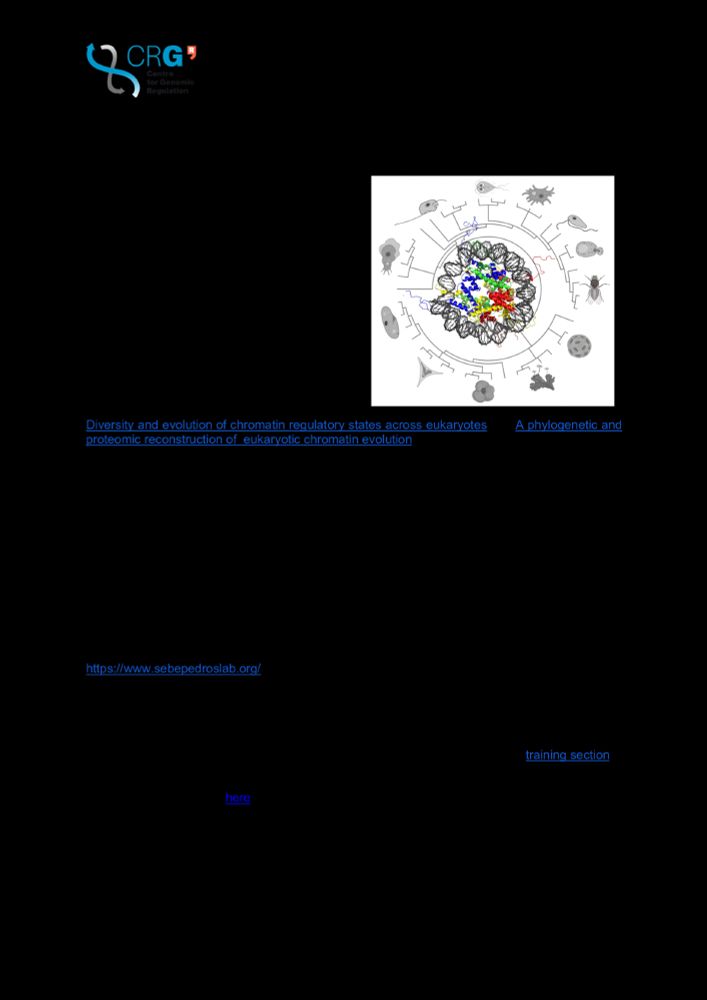
We're looking for a potential PhD student to come explore the evolution of chromatin across eukaryotes in the @arnausebe.bsky.social lab! The project is flexible and a wide range of backgrounds will be considered! Please reach out if you have any questions. Link to application: shorturl.at/LlsJw
Reposted by Sean Montgomery
Excited to share our new paper led by a wonderful Jing Liu on designing de novo IDRs🧪🖥️

Online Now: Engineering intrinsically disordered regions for guiding genome navigation Online now:

Engineering intrinsically disordered regions for guiding genome navigation
Liu et al. design and test synthetic IDRs based on simple design rules derived from mutation-based analysis of 25 native TF IDRs. They show that hydrophobic amino acids endow activity, acidic ones prevent autoinhibition, and hydrophilic ones can tune specificity.
dlvr.it
February 17, 2026 at 11:21 AM
Excited to share our new paper led by a wonderful Jing Liu on designing de novo IDRs🧪🖥️
Reposted by Sean Montgomery

How does the piRNA pathway solve the self vs. non-self problem? 🧬
Since piRNAs come from single-stranded RNA, how does the cell choose the right ones? For years, "piRNA clusters" were seen as THE privileged source. But are they really special and earmarked for biogenesis? (1/19)
Since piRNAs come from single-stranded RNA, how does the cell choose the right ones? For years, "piRNA clusters" were seen as THE privileged source. But are they really special and earmarked for biogenesis? (1/19)

A Naïve RNA Sampling Core Enables Adaptive piRNA Specificity Against Transposable Elements https://www.biorxiv.org/content/10.64898/2026.02.07.704324v1
February 13, 2026 at 3:11 PM
How does the piRNA pathway solve the self vs. non-self problem? 🧬
Since piRNAs come from single-stranded RNA, how does the cell choose the right ones? For years, "piRNA clusters" were seen as THE privileged source. But are they really special and earmarked for biogenesis? (1/19)
Since piRNAs come from single-stranded RNA, how does the cell choose the right ones? For years, "piRNA clusters" were seen as THE privileged source. But are they really special and earmarked for biogenesis? (1/19)
Reposted by Sean Montgomery
My good friend and director of the natural history museum of Denmark is looking for a curator for #bryophytes. Thus, if you like these small #plants, you should really apply. Great place to work, great city and amazing plants.
#sciencejobs #plantscijobs
www.linkedin.com/posts/nina-r...
#sciencejobs #plantscijobs
www.linkedin.com/posts/nina-r...

We are hiring a Tenure-track Assistant Professor and Curator in Bryology at the National Natural History Museum Denmark, in central Copenhagen.
Duties are collection-based research, curation of a… ...
We are hiring a Tenure-track Assistant Professor and Curator in Bryology at the National Natural History Museum Denmark, in central Copenhagen.
Duties are collection-based research, curation of a h...
www.linkedin.com
February 11, 2026 at 8:59 AM
My good friend and director of the natural history museum of Denmark is looking for a curator for #bryophytes. Thus, if you like these small #plants, you should really apply. Great place to work, great city and amazing plants.
#sciencejobs #plantscijobs
www.linkedin.com/posts/nina-r...
#sciencejobs #plantscijobs
www.linkedin.com/posts/nina-r...
Reposted by Sean Montgomery

How do compartmentalization & loop extrusion organize eukaryotic genomes beyond classical model organisms?
Hi-C analysis of silkworm chromosomes by Drinnenberg, Muller, Mirny et al reveals new combination of these mechanisms, and a new, secluded “S” compartment
link.springer.com/article/10.1...
Hi-C analysis of silkworm chromosomes by Drinnenberg, Muller, Mirny et al reveals new combination of these mechanisms, and a new, secluded “S” compartment
link.springer.com/article/10.1...

Unique territorial and compartmental organization of chromosomes in the holocentric silkworm - The EMBO Journal
Hallmarks of multicellular eukaryotic genome organization are chromosome territories, compartments, and loop-extrusion-mediated structures, including TADs. However, these have mainly been observed in ...
link.springer.com
February 3, 2026 at 10:37 AM
How do compartmentalization & loop extrusion organize eukaryotic genomes beyond classical model organisms?
Hi-C analysis of silkworm chromosomes by Drinnenberg, Muller, Mirny et al reveals new combination of these mechanisms, and a new, secluded “S” compartment
link.springer.com/article/10.1...
Hi-C analysis of silkworm chromosomes by Drinnenberg, Muller, Mirny et al reveals new combination of these mechanisms, and a new, secluded “S” compartment
link.springer.com/article/10.1...
Reposted by Sean Montgomery
Comparative Genomics of Unicellular Eukaryotes (San Feliu, Spain):
Abstract submission is open, with a short deadline! comparativegenomics2026.com
Join us as we explore the most diverse, surprising, and still largely uncharted branches of the eukaryotic tree.
Abstract submission is open, with a short deadline! comparativegenomics2026.com
Join us as we explore the most diverse, surprising, and still largely uncharted branches of the eukaryotic tree.


February 2, 2026 at 6:49 PM
Comparative Genomics of Unicellular Eukaryotes (San Feliu, Spain):
Abstract submission is open, with a short deadline! comparativegenomics2026.com
Join us as we explore the most diverse, surprising, and still largely uncharted branches of the eukaryotic tree.
Abstract submission is open, with a short deadline! comparativegenomics2026.com
Join us as we explore the most diverse, surprising, and still largely uncharted branches of the eukaryotic tree.
Reposted by Sean Montgomery
One protein. One pathway. A whole germline fate.
New paper from my postdoc @mpi-bio-fml.bsky.social out in PNAS:
Germline fate determination by a single ARGONAUTE protein in Ectocarpus www.pnas.org/doi/10.1073/...
New paper from my postdoc @mpi-bio-fml.bsky.social out in PNAS:
Germline fate determination by a single ARGONAUTE protein in Ectocarpus www.pnas.org/doi/10.1073/...

Germline fate determination by a single ARGONAUTE protein in Ectocarpus | PNAS
ARGONAUTE (AGO) proteins are a highly conserved family of RNA-binding proteins that
play central roles in gene regulation and developmental process...
www.pnas.org
January 30, 2026 at 9:14 AM
One protein. One pathway. A whole germline fate.
New paper from my postdoc @mpi-bio-fml.bsky.social out in PNAS:
Germline fate determination by a single ARGONAUTE protein in Ectocarpus www.pnas.org/doi/10.1073/...
New paper from my postdoc @mpi-bio-fml.bsky.social out in PNAS:
Germline fate determination by a single ARGONAUTE protein in Ectocarpus www.pnas.org/doi/10.1073/...
Reposted by Sean Montgomery

Nice feature summarising the decades-long debate about the first-branching animal lineages — sponges or ctenophores?
Key quote:
“I’m not going to say this is the answer because I’ve been around long enough”
www.nature.com/articles/d41...
Key quote:
“I’m not going to say this is the answer because I’ve been around long enough”
www.nature.com/articles/d41...

What were the first animals? The fierce sponge–jelly battle that just won’t end
For almost two decades, scientists have debated whether sponges or comb jellies are the first animal lineage. Now some are calling for a more harmonious approach.
www.nature.com
January 27, 2026 at 3:15 PM
Nice feature summarising the decades-long debate about the first-branching animal lineages — sponges or ctenophores?
Key quote:
“I’m not going to say this is the answer because I’ve been around long enough”
www.nature.com/articles/d41...
Key quote:
“I’m not going to say this is the answer because I’ve been around long enough”
www.nature.com/articles/d41...
Reposted by Sean Montgomery

I’m happy to share the main result of my PhD, which you can find on bioRxiv www.biorxiv.org/content/10.6.... If you are interested in learning about a new way to perform DNA-PAINT multiplexing, which we call Combi-PAINT, or if you are interested in the study of mRNA conformation, keep reading! 1/10
January 26, 2026 at 11:31 AM
I’m happy to share the main result of my PhD, which you can find on bioRxiv www.biorxiv.org/content/10.6.... If you are interested in learning about a new way to perform DNA-PAINT multiplexing, which we call Combi-PAINT, or if you are interested in the study of mRNA conformation, keep reading! 1/10
Reposted by Sean Montgomery

This is a very special paper for me. I had the idea of combining transcription factor binding with chromatin in 2016/8. It took some time, but thanks to Fred and Vikas, we can finally share the story in @plos.org Genetics looking at chromatin states in Arabidopsis and Marchantia. #PlantScience

Chromatin state architecture governs transcription factor accessibility across plant genomes
Author summary In eukaryotes, DNA is tightly associated with histone proteins. Histone covalent modifications and histones isoforms, also called histone variants provide most of the complexity of chro...
journals.plos.org
January 23, 2026 at 3:17 PM
This is a very special paper for me. I had the idea of combining transcription factor binding with chromatin in 2016/8. It took some time, but thanks to Fred and Vikas, we can finally share the story in @plos.org Genetics looking at chromatin states in Arabidopsis and Marchantia. #PlantScience
Reposted by Sean Montgomery

Our eLetter github.com/caseywdunn/s... responding to a recent Science paper was just posted. The paper found more genes with consistent support for sponge-sister than ctenophore-sister. We found several technical issues that, when corrected, reverse the conclusions and recover ctenophore-sister.

January 9, 2026 at 11:44 AM
Our eLetter github.com/caseywdunn/s... responding to a recent Science paper was just posted. The paper found more genes with consistent support for sponge-sister than ctenophore-sister. We found several technical issues that, when corrected, reverse the conclusions and recover ctenophore-sister.
Reposted by Sean Montgomery

Open Senior Bioinformatician position at
@sangerinstitute.bsky.social
Tree of Life, to work on the Biodiversity Cell Atlas initiative with @marakat.bsky.social and me.
📅 Apply by January 18
🔗 sanger.wd103.myworkdayjobs.com/en-US/Wellco...
Please share with anyone who might be interested!
@sangerinstitute.bsky.social
Tree of Life, to work on the Biodiversity Cell Atlas initiative with @marakat.bsky.social and me.
📅 Apply by January 18
🔗 sanger.wd103.myworkdayjobs.com/en-US/Wellco...
Please share with anyone who might be interested!
Senior Bioinformatician - Biodiversity Cell Atlas
Do you want to help us improve human health and understand life on Earth? Make your mark by shaping the future to enable or deliver life-changing science to solve some of humanity’s greatest challenge...
sanger.wd103.myworkdayjobs.com
January 2, 2026 at 1:12 PM
Open Senior Bioinformatician position at
@sangerinstitute.bsky.social
Tree of Life, to work on the Biodiversity Cell Atlas initiative with @marakat.bsky.social and me.
📅 Apply by January 18
🔗 sanger.wd103.myworkdayjobs.com/en-US/Wellco...
Please share with anyone who might be interested!
@sangerinstitute.bsky.social
Tree of Life, to work on the Biodiversity Cell Atlas initiative with @marakat.bsky.social and me.
📅 Apply by January 18
🔗 sanger.wd103.myworkdayjobs.com/en-US/Wellco...
Please share with anyone who might be interested!
Reposted by Sean Montgomery

Lovely Xmas gift 🎄—our paper is out today in @natecoevo.nature.com www.nature.com/articles/s41...! Huge thanks to everyone who made it possible, especially @aelek.bsky.social and @arnausebe.bsky.social

Decoding cnidarian cell type gene regulation - Nature Ecology & Evolution
This study reconstructs the gene regulatory networks that define cell types in the sea anemone Nematostella vectensis, providing a valuable resource for comparative regulatory genomics and the evoluti...
www.nature.com
December 22, 2025 at 11:10 AM
Lovely Xmas gift 🎄—our paper is out today in @natecoevo.nature.com www.nature.com/articles/s41...! Huge thanks to everyone who made it possible, especially @aelek.bsky.social and @arnausebe.bsky.social
Bryophyte-friendly tenure-track position in the UBC Botany department! Deadline on the 19th botany.ubc.ca/job-postings...
UBC
botany.ubc.ca
December 15, 2025 at 12:38 AM
Bryophyte-friendly tenure-track position in the UBC Botany department! Deadline on the 19th botany.ubc.ca/job-postings...
Reposted by Sean Montgomery
Have you ever wondered how new DNA methylation patterns are established?
Paradigm shift ahead! We discovered a new mode of DNA methylation targeting in plants that relies on transcription factors and sequence motifs rather than chromatin modifications to regulate the methylome. rdcu.be/eQ6L5
1/8
Paradigm shift ahead! We discovered a new mode of DNA methylation targeting in plants that relies on transcription factors and sequence motifs rather than chromatin modifications to regulate the methylome. rdcu.be/eQ6L5
1/8

December 11, 2025 at 9:56 PM
Have you ever wondered how new DNA methylation patterns are established?
Paradigm shift ahead! We discovered a new mode of DNA methylation targeting in plants that relies on transcription factors and sequence motifs rather than chromatin modifications to regulate the methylome. rdcu.be/eQ6L5
1/8
Paradigm shift ahead! We discovered a new mode of DNA methylation targeting in plants that relies on transcription factors and sequence motifs rather than chromatin modifications to regulate the methylome. rdcu.be/eQ6L5
1/8
Reposted by Sean Montgomery
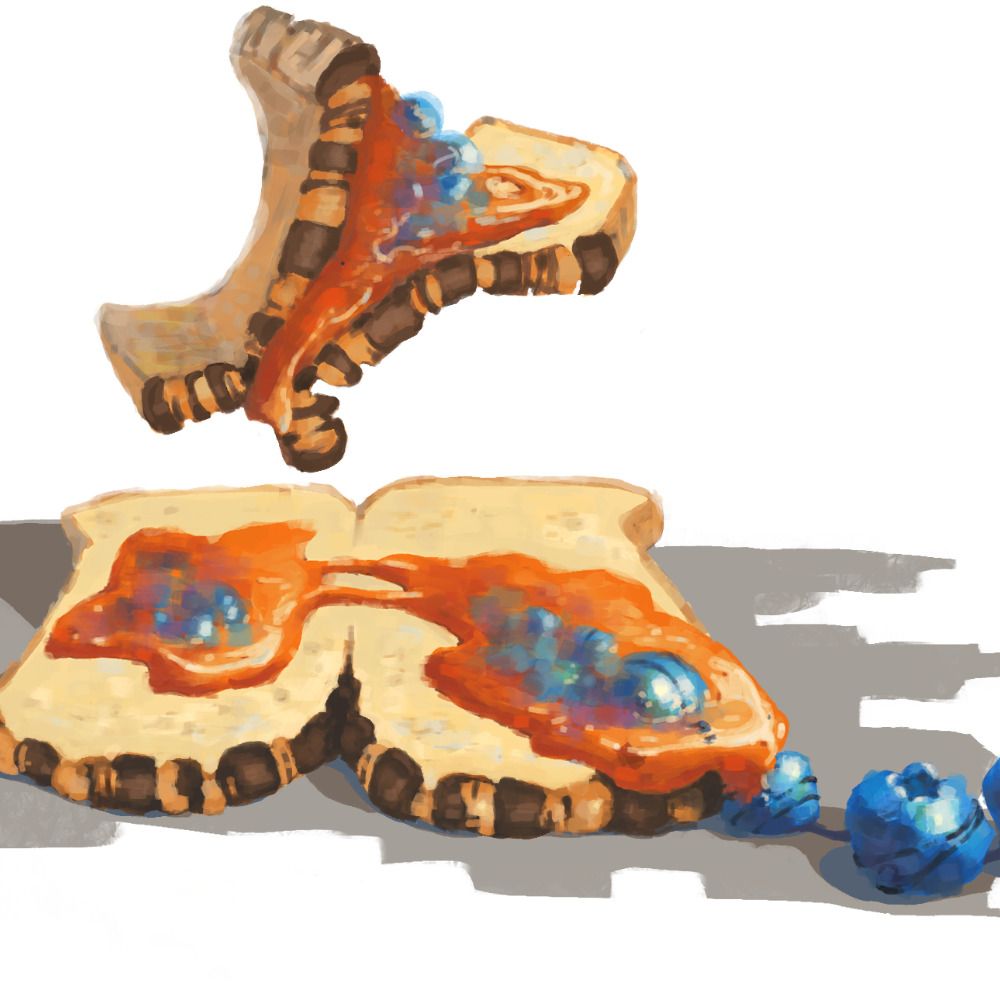
Took us a bit, but proud of this published version. We now examine the genetic interaction of phosphorylation with oligomerization and where bulk and phospho-Swi6 localize. Wonder if chromatin affinity tuning to enable Suv39 H3K9me3 spreading is a conserved mechanism ?
doi.org/10.1093/nar/...
doi.org/10.1093/nar/...
December 12, 2025 at 11:37 PM
Took us a bit, but proud of this published version. We now examine the genetic interaction of phosphorylation with oligomerization and where bulk and phospho-Swi6 localize. Wonder if chromatin affinity tuning to enable Suv39 H3K9me3 spreading is a conserved mechanism ?
doi.org/10.1093/nar/...
doi.org/10.1093/nar/...
Reposted by Sean Montgomery

@pravrutharaman.bsky.social got super intrigued about EZHIP/CATACOMB, previously identified as a histone H3K27M mimic of PRC2. You can read about her efforts here: www.biorxiv.org/content/10.6... We hope these analyses will help spur more analyses in this very cool gene! 1/

Dynamic evolution of EZHIP, an inhibitor of the Polycomb Repressive Complex 2 in mammals
The Polycomb Repressive Complex 2 (PRC2) is an ancient, conserved chromatin-interacting complex that controls gene expression, facilitating differentiation and cellular identity during development. It...
www.biorxiv.org
December 13, 2025 at 10:08 PM
@pravrutharaman.bsky.social got super intrigued about EZHIP/CATACOMB, previously identified as a histone H3K27M mimic of PRC2. You can read about her efforts here: www.biorxiv.org/content/10.6... We hope these analyses will help spur more analyses in this very cool gene! 1/
Reposted by Sean Montgomery
So happy to announce our new preprint, “A geothermal amoeba sets a new upper temperature limit for eukaryotes.” We cultured a novel amoeba from Lassen Volcanic NP (CA, USA) that divides at 63°C (145°F) 🔥 - a new record for euk growth!
#protistsonsky 🧵
#protistsonsky 🧵
November 25, 2025 at 8:41 PM
So happy to announce our new preprint, “A geothermal amoeba sets a new upper temperature limit for eukaryotes.” We cultured a novel amoeba from Lassen Volcanic NP (CA, USA) that divides at 63°C (145°F) 🔥 - a new record for euk growth!
#protistsonsky 🧵
#protistsonsky 🧵
Reposted by Sean Montgomery

Reposted by Sean Montgomery
How do cells adapt morphology to function? In a 🔥 preprint by @zjmaggiexu.bsky.social , with @dudinlab.bsky.social and @amyweeks.bsky.social , we identify a self-organizing single-cell morphology circuit that optimizes the feeding trap structure of the suctorian P. collini. 🧵 tinyurl.com/4k8nv926
November 18, 2025 at 4:15 PM
How do cells adapt morphology to function? In a 🔥 preprint by @zjmaggiexu.bsky.social , with @dudinlab.bsky.social and @amyweeks.bsky.social , we identify a self-organizing single-cell morphology circuit that optimizes the feeding trap structure of the suctorian P. collini. 🧵 tinyurl.com/4k8nv926
Reposted by Sean Montgomery

Out today, our take on 6-methyladenine #6mA evolution in Eukaryotes @natgenet.nature.com. We asked a simple question, is really DNA 6mA common across the eukaryotes? The answer is "yes" if you're a unicellular eukaryote 🦠, not so if you're multicellular 🐝🌱🍄. www.nature.com/articles/s41... 1/9

Adenine DNA methylation associated with transcriptionally permissive chromatin is widespread across eukaryotes - Nature Genetics
Long-read sequencing in 18 unicellular eukaryotes reveals that 6mA is widespread across eukaryotes and is enriched at transcriptionally permissive regions, which are also marked by H3K4me3.
www.nature.com
November 18, 2025 at 12:00 PM
Out today, our take on 6-methyladenine #6mA evolution in Eukaryotes @natgenet.nature.com. We asked a simple question, is really DNA 6mA common across the eukaryotes? The answer is "yes" if you're a unicellular eukaryote 🦠, not so if you're multicellular 🐝🌱🍄. www.nature.com/articles/s41... 1/9
Reposted by Sean Montgomery

🌍Open call: Junior Group Leader positions!
Join a world-class biomedical research institute at the heart of the Vienna BioCenter, where curiosity drives discovery.
Lead your own lab, pursue bold ideas, and shape the future of science at the IMP: www.imp.ac.at/career/open-...
Join a world-class biomedical research institute at the heart of the Vienna BioCenter, where curiosity drives discovery.
Lead your own lab, pursue bold ideas, and shape the future of science at the IMP: www.imp.ac.at/career/open-...

November 10, 2025 at 1:26 PM
🌍Open call: Junior Group Leader positions!
Join a world-class biomedical research institute at the heart of the Vienna BioCenter, where curiosity drives discovery.
Lead your own lab, pursue bold ideas, and shape the future of science at the IMP: www.imp.ac.at/career/open-...
Join a world-class biomedical research institute at the heart of the Vienna BioCenter, where curiosity drives discovery.
Lead your own lab, pursue bold ideas, and shape the future of science at the IMP: www.imp.ac.at/career/open-...
Reposted by Sean Montgomery

this looks very interesting with numerous implications for nuclear biology and gene expression.
Mapping chromatin structure at base-pair resolution unveils a unified model of cis-regulatory element interactions: Cell www.cell.com/cell/fulltex...
Mapping chromatin structure at base-pair resolution unveils a unified model of cis-regulatory element interactions: Cell www.cell.com/cell/fulltex...

Mapping chromatin structure at base-pair resolution unveils a unified model of cis-regulatory element interactions
Li et al. apply base-pair resolution Micro Capture-C ultra to map chromatin contacts
between individual motifs within cis-regulatory elements and reveal a unified model
of biophysically mediated enhan...
www.cell.com
November 9, 2025 at 5:07 PM
this looks very interesting with numerous implications for nuclear biology and gene expression.
Mapping chromatin structure at base-pair resolution unveils a unified model of cis-regulatory element interactions: Cell www.cell.com/cell/fulltex...
Mapping chromatin structure at base-pair resolution unveils a unified model of cis-regulatory element interactions: Cell www.cell.com/cell/fulltex...
Reposted by Sean Montgomery
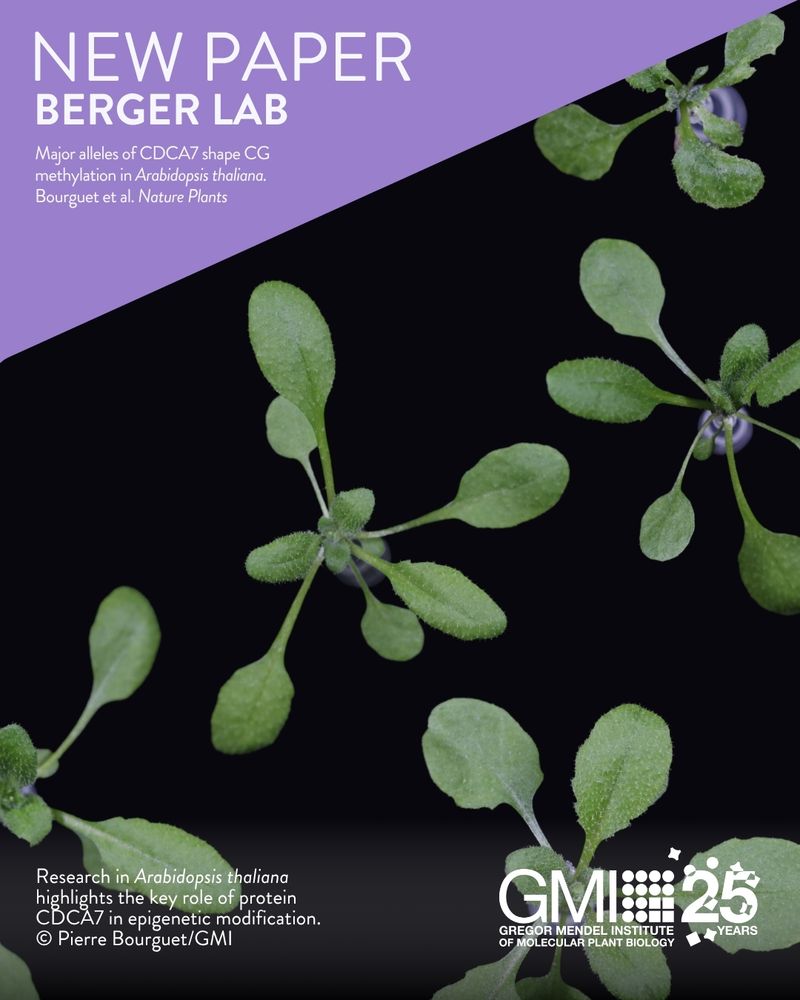
How is epigenetic information inherited? We found that CDCA7 proteins are critical players in the inheritance of DNA methylation at CG sites in plants, and this is true both in the lab and in the wild. How does this work? 🧵👇

New paper! Work led by @p-bourguet.bsky.social and Frédéric Berger at the GMI of the @oeaw.bsky.social and @esasaki007.bsky.social identified how protein CDCA7 helps plants stably maintain epigenetic modifications across generations.
Read more: www.oeaw.ac.at/gmi/detail/n...
Read more: www.oeaw.ac.at/gmi/detail/n...
November 7, 2025 at 5:05 PM
How is epigenetic information inherited? We found that CDCA7 proteins are critical players in the inheritance of DNA methylation at CG sites in plants, and this is true both in the lab and in the wild. How does this work? 🧵👇
Reposted by Sean Montgomery

Excited to share our new preprint on BioRxiv!
A collaborative effort spanning many years and several labs to uncover what the germline chromosomes of Paramecium really look like. 🔗 www.biorxiv.org/content/10.1...
1/5
A collaborative effort spanning many years and several labs to uncover what the germline chromosomes of Paramecium really look like. 🔗 www.biorxiv.org/content/10.1...
1/5

The tiny germline chromosomes of Paramecium aurelia have an exceptionally high recombination rate and are capped by a new class of Helitrons
Background. Paramecia belong to the ciliate phylum of unicellular eukaryotes characterized by nuclear dimorphism. A diploid germline micronucleus (MIC) transmits genetic information across sexual gene...
www.biorxiv.org
November 10, 2025 at 9:21 AM
Excited to share our new preprint on BioRxiv!
A collaborative effort spanning many years and several labs to uncover what the germline chromosomes of Paramecium really look like. 🔗 www.biorxiv.org/content/10.1...
1/5
A collaborative effort spanning many years and several labs to uncover what the germline chromosomes of Paramecium really look like. 🔗 www.biorxiv.org/content/10.1...
1/5
Reposted by Sean Montgomery

🚨Our collaboration with @centriolelab.bsky.social & @gautamdey.bsky.social is out today in @cp-cell.bsky.social
We show that #Expansion #Microscopy is a broad-spectrum modality for Euks, enabling 3D phenotypic maps rooted to phylogeny.
#ProtistsOnSky #SciComm #SciSky
www.cell.com/cell/fulltex...
We show that #Expansion #Microscopy is a broad-spectrum modality for Euks, enabling 3D phenotypic maps rooted to phylogeny.
#ProtistsOnSky #SciComm #SciSky
www.cell.com/cell/fulltex...
October 31, 2025 at 2:42 PM
🚨Our collaboration with @centriolelab.bsky.social & @gautamdey.bsky.social is out today in @cp-cell.bsky.social
We show that #Expansion #Microscopy is a broad-spectrum modality for Euks, enabling 3D phenotypic maps rooted to phylogeny.
#ProtistsOnSky #SciComm #SciSky
www.cell.com/cell/fulltex...
We show that #Expansion #Microscopy is a broad-spectrum modality for Euks, enabling 3D phenotypic maps rooted to phylogeny.
#ProtistsOnSky #SciComm #SciSky
www.cell.com/cell/fulltex...