



Roshni Patel
@roshnipatel.bsky.social
assistant prof at University of Oregon. interested in pop gen, stat gen, human complex traits. also ELSI, metascience, ethics education, etc...
she/they. 🌈
roshnipatel.github.io
she/they. 🌈
roshnipatel.github.io
Pinned
Roshni Patel
@roshnipatel.bsky.social
· Oct 15
We'll primarily work at the intersection of statistical and population genetics, and we also have active projects related to the ethical and social implications of human genetics (ELSI). Please get in touch if that's a combination that sounds interesting to you!
I'm recruiting a postdoc for my group (based in beautiful Eugene, OR). Please get in touch if you're interested, esp if you'd like to chat at #ASHG25!
Reposted by Roshni Patel

Relatedly, some cool recent work from @roshnipatel.bsky.social, Jeffrey Spence, @jkpritch.bsky.social et al. dives deep into expectations, based on models of natural selection, for allele frequency in a group B conditional on allele frequency in group A.
academic.oup.com/genetics/art...
(16/27)
academic.oup.com/genetics/art...
(16/27)

January 26, 2026 at 11:20 PM
Relatedly, some cool recent work from @roshnipatel.bsky.social, Jeffrey Spence, @jkpritch.bsky.social et al. dives deep into expectations, based on models of natural selection, for allele frequency in a group B conditional on allele frequency in group A.
academic.oup.com/genetics/art...
(16/27)
academic.oup.com/genetics/art...
(16/27)
Reposted by Roshni Patel
Our work on the generalizability of polygenic scores (PGS) from the @arbelharpak.bsky.social Lab is now officially out!
We examine the accuracy of PGS predictions at the individual level. We make 3 observations that expose gaps in our understanding of PGS “portability.”
rdcu.be/e0LAr
(1/27)
We examine the accuracy of PGS predictions at the individual level. We make 3 observations that expose gaps in our understanding of PGS “portability.”
rdcu.be/e0LAr
(1/27)

Three open questions in polygenic score portability
Nature Communications - Genetic predictors of health outcomes often drop in accuracy when applied to people dissimilar to participants of large genetic studies. Here, the authors investigate the...
rdcu.be
January 26, 2026 at 11:20 PM
Our work on the generalizability of polygenic scores (PGS) from the @arbelharpak.bsky.social Lab is now officially out!
We examine the accuracy of PGS predictions at the individual level. We make 3 observations that expose gaps in our understanding of PGS “portability.”
rdcu.be/e0LAr
(1/27)
We examine the accuracy of PGS predictions at the individual level. We make 3 observations that expose gaps in our understanding of PGS “portability.”
rdcu.be/e0LAr
(1/27)
Reposted by Roshni Patel

🚨 New from me: Grant review at more than half of NIH's institutes could be frozen by the end of the year.
That's because crucial NIH grant-review panels are slated to be empty at those institutes by Jan 2027.
A wonky bureaucratic problem with big implications.
A short 🧵
That's because crucial NIH grant-review panels are slated to be empty at those institutes by Jan 2027.
A wonky bureaucratic problem with big implications.
A short 🧵

Exclusive: key NIH review panels due to lose all members by the end of 2026
Thirteen of the agency’s advisory councils, which must review grant applications before funding is awarded, are on track to have no voting members.
www.nature.com
January 22, 2026 at 7:46 PM
🚨 New from me: Grant review at more than half of NIH's institutes could be frozen by the end of the year.
That's because crucial NIH grant-review panels are slated to be empty at those institutes by Jan 2027.
A wonky bureaucratic problem with big implications.
A short 🧵
That's because crucial NIH grant-review panels are slated to be empty at those institutes by Jan 2027.
A wonky bureaucratic problem with big implications.
A short 🧵
Reposted by Roshni Patel
How well does TWAS estimate a gene’s direction of effect on a trait? We think of this as an important stress-test for the accuracy of TWAS.
In a new pre-print, we find that TWAS gets the sign wrong around 20-30% of the time!
doi.org/10.64898/202...
1/n
In a new pre-print, we find that TWAS gets the sign wrong around 20-30% of the time!
doi.org/10.64898/202...
1/n

High false sign rates in transcriptome-wide association studies
Transcriptome-wide association studies (TWAS) are widely used to identify genes involved in complex traits and to infer the direction of gene effects on traits. However, despite their popularity, it r...
doi.org
January 6, 2026 at 2:30 AM
How well does TWAS estimate a gene’s direction of effect on a trait? We think of this as an important stress-test for the accuracy of TWAS.
In a new pre-print, we find that TWAS gets the sign wrong around 20-30% of the time!
doi.org/10.64898/202...
1/n
In a new pre-print, we find that TWAS gets the sign wrong around 20-30% of the time!
doi.org/10.64898/202...
1/n
Reposted by Roshni Patel

I wrote about the bizarre case of Herasight, the embryo selection company going all in on eugenics.

Embryo selection company Herasight goes all in on eugenics
...
open.substack.com
December 13, 2025 at 8:16 PM
I wrote about the bizarre case of Herasight, the embryo selection company going all in on eugenics.
Reposted by Roshni Patel

Thank you Alex! Excited to see our paper published in @nature.com ! Huge thanks to @jeffspence.github.io , @tkyzeng.bsky.social , @emmamarydann.bsky.social, @nikhilmilind.dev, @marsonlab.bsky.social, @jkpritch.bsky.social, and all the members of the Pritchard and Marson labs for your enormous help!
December 11, 2025 at 3:04 AM
Thank you Alex! Excited to see our paper published in @nature.com ! Huge thanks to @jeffspence.github.io , @tkyzeng.bsky.social , @emmamarydann.bsky.social, @nikhilmilind.dev, @marsonlab.bsky.social, @jkpritch.bsky.social, and all the members of the Pritchard and Marson labs for your enormous help!
Reposted by Roshni Patel
After time in the Bay Area, I’ve started a new role as Lecturer in the Department of Allergy and Rheumatology at the University of Tokyo. We’re the group of clinicians who see patients with autoimmune diseases, while researching new treatments and patient stratification. (continued)
December 11, 2025 at 3:15 AM
After time in the Bay Area, I’ve started a new role as Lecturer in the Department of Allergy and Rheumatology at the University of Tokyo. We’re the group of clinicians who see patients with autoimmune diseases, while researching new treatments and patient stratification. (continued)
Reposted by Roshni Patel

“What I do think is that it has become normalized in modern behavioral genomics to do what you have to do in order to make every result, no matter how small, look like a win for team genetics”
ericturkheimer.substack.com/p/within-fam...
ericturkheimer.substack.com/p/within-fam...

Within family prediction of psychopathology
Honey it's fine. The ratio with my shoe size is actually pretty good.
ericturkheimer.substack.com
December 9, 2025 at 8:04 PM
“What I do think is that it has become normalized in modern behavioral genomics to do what you have to do in order to make every result, no matter how small, look like a win for team genetics”
ericturkheimer.substack.com/p/within-fam...
ericturkheimer.substack.com/p/within-fam...
Reposted by Roshni Patel

I taught Genetics again this year. We need to include discussion of the problematic history of our field, especially as the claims of eugenics are once again centered in our political discourse. Last year I wrote this piece, explaining my reasoning and approach 🧪 1/n
www.cell.com/trends/genet...
www.cell.com/trends/genet...

December 8, 2025 at 12:37 PM
I taught Genetics again this year. We need to include discussion of the problematic history of our field, especially as the claims of eugenics are once again centered in our political discourse. Last year I wrote this piece, explaining my reasoning and approach 🧪 1/n
www.cell.com/trends/genet...
www.cell.com/trends/genet...
Reposted by Roshni Patel

My first lead author paper is out with Ben Kerr and @alisonfeder.bsky.social! We found that making an antiviral too strong can sometimes make resistance easier to evolve. This has implications for how we design drugs, choose doses, and think about viral evolution in the face of treatment. (1/n)

Intracellular interactions shape antiviral resistance outcomes in poliovirus via eco-evolutionary feedback - Nature Ecology & Evolution
A model of intrahost poliovirus replication shows that, after several rounds of replication, pocapavir, a poliovirus capsid inhibitor, collapses viral density, preventing intracellular interactions th...
www.nature.com
December 8, 2025 at 5:15 PM
My first lead author paper is out with Ben Kerr and @alisonfeder.bsky.social! We found that making an antiviral too strong can sometimes make resistance easier to evolve. This has implications for how we design drugs, choose doses, and think about viral evolution in the face of treatment. (1/n)
Reposted by Roshni Patel
And this. My experience also supports that being *more* open about racist, sexist, and ableist histories of our fields is more engaging, not less, for students (and faculty) from minoritized backgrounds. Transparency can only enhance rigor.

December 4, 2025 at 2:15 PM
And this. My experience also supports that being *more* open about racist, sexist, and ableist histories of our fields is more engaging, not less, for students (and faculty) from minoritized backgrounds. Transparency can only enhance rigor.
Reposted by Roshni Patel
12 former commissioners of the FDA came together to write a Perspectives piece for the New England Journal of Medicine; raising our concerns about recent changes to vaccine approval policy at the FDA and its implications for patients and public health.

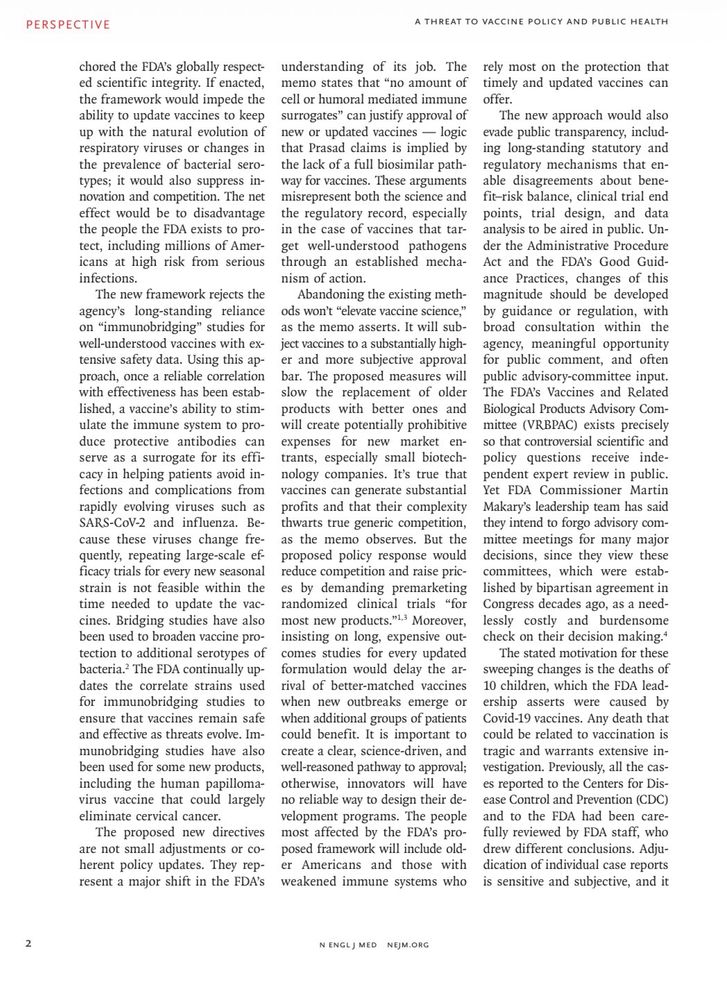

December 3, 2025 at 10:28 PM
12 former commissioners of the FDA came together to write a Perspectives piece for the New England Journal of Medicine; raising our concerns about recent changes to vaccine approval policy at the FDA and its implications for patients and public health.
Reposted by Roshni Patel

It was a total pleasure to work with @roshnipatel.bsky.social on this, who really led the charge in all respects. Anyone interested in learning about the intersection of population genetics and statistical genetics should check out her new lab in Oregon!
Excited to share work from my postdoc with @docedge.bsky.social and collaborators Matt Pennell and @jgschraiber.bsky.social, newly out over the weekend: www.biorxiv.org/content/10.1... (1/6)

Observational epidemiological studies can mitigate genetic confounding with the genetic relatedness matrix
Observational studies are commonly used in psychology and epidemiology to identify risk factors correlated with health outcomes. However, these studies are vulnerable to confounding when shared geneti...
www.biorxiv.org
December 2, 2025 at 12:11 AM
It was a total pleasure to work with @roshnipatel.bsky.social on this, who really led the charge in all respects. Anyone interested in learning about the intersection of population genetics and statistical genetics should check out her new lab in Oregon!
As promised, a longer thread on what I consider to be some of the most interesting and important contributions of this paper (1/10)
Here, we show that the genetic relatedness matrix (GRM) can be used to control this type of genetic confounding. (Though our model has not been explicitly described in prior literature, we show that it is the basis for existing methods to control genetic confounding... but more on that later.) (4/6)
December 1, 2025 at 9:20 PM
As promised, a longer thread on what I consider to be some of the most interesting and important contributions of this paper (1/10)
Reposted by Roshni Patel

This was a super fun project to do my small part on. @roshnipatel.bsky.social really helped me understand what we're doing when we're trying to "control for genetics" when assessing associations between interventions and outcomes, and how a lot of the standard ways to do so are simply inadequate.
Excited to share work from my postdoc with @docedge.bsky.social and collaborators Matt Pennell and @jgschraiber.bsky.social, newly out over the weekend: www.biorxiv.org/content/10.1... (1/6)
Observational epidemiological studies can mitigate genetic confounding with the genetic relatedness matrix
Observational studies are commonly used in psychology and epidemiology to identify risk factors correlated with health outcomes. However, these studies are vulnerable to confounding when shared geneti...
www.biorxiv.org
December 1, 2025 at 7:11 PM
This was a super fun project to do my small part on. @roshnipatel.bsky.social really helped me understand what we're doing when we're trying to "control for genetics" when assessing associations between interventions and outcomes, and how a lot of the standard ways to do so are simply inadequate.
Excited to share work from my postdoc with @docedge.bsky.social and collaborators Matt Pennell and @jgschraiber.bsky.social, newly out over the weekend: www.biorxiv.org/content/10.1... (1/6)
Observational epidemiological studies can mitigate genetic confounding with the genetic relatedness matrix
Observational studies are commonly used in psychology and epidemiology to identify risk factors correlated with health outcomes. However, these studies are vulnerable to confounding when shared geneti...
www.biorxiv.org
December 1, 2025 at 7:09 PM
Excited to share work from my postdoc with @docedge.bsky.social and collaborators Matt Pennell and @jgschraiber.bsky.social, newly out over the weekend: www.biorxiv.org/content/10.1... (1/6)
Reposted by Roshni Patel
www.biorxiv.org/content/10.1...
We finally submitted the earlier preprint to a journal after massive restructuring.
We've expanded the REML section for those interested in the method. We clarify that ARG-LMM estimates mutational variance and not additive variance.
We finally submitted the earlier preprint to a journal after massive restructuring.
We've expanded the REML section for those interested in the method. We clarify that ARG-LMM estimates mutational variance and not additive variance.

Genetic prediction with ARG-powered linear algebra
Ancestral recombination graphs (ARGs) are an attractive means for quantitative genetic analysis of complex traits because they encode the realized genetic relatedness between a sample of individuals i...
www.biorxiv.org
November 30, 2025 at 5:08 PM
www.biorxiv.org/content/10.1...
We finally submitted the earlier preprint to a journal after massive restructuring.
We've expanded the REML section for those interested in the method. We clarify that ARG-LMM estimates mutational variance and not additive variance.
We finally submitted the earlier preprint to a journal after massive restructuring.
We've expanded the REML section for those interested in the method. We clarify that ARG-LMM estimates mutational variance and not additive variance.
Reposted by Roshni Patel

I taught (and co-taught) a course on human population genetics from 2000-2024. Having retired, I'm now making all the course materials public: github.com/alanrogers/p... #popgen #evbio

GitHub - alanrogers/popgen: A course on population genetics
A course on population genetics. Contribute to alanrogers/popgen development by creating an account on GitHub.
github.com
November 27, 2025 at 7:10 PM
I taught (and co-taught) a course on human population genetics from 2000-2024. Having retired, I'm now making all the course materials public: github.com/alanrogers/p... #popgen #evbio
Reposted by Roshni Patel

Out now in @natgenet.nature.com, our Comment analyzing uses of the Human Genome Diversity Project (HGDP), a controversial dataset in human genomics research. A 🧵
rdcu.be/eRu65
1/
rdcu.be/eRu65
1/

November 25, 2025 at 4:57 AM
Out now in @natgenet.nature.com, our Comment analyzing uses of the Human Genome Diversity Project (HGDP), a controversial dataset in human genomics research. A 🧵
rdcu.be/eRu65
1/
rdcu.be/eRu65
1/
Reposted by Roshni Patel

Excited to share a preprint of my PhD project looking at interactions between SNPs and polygenic scores in the UK Biobank!
A thread... 🧵
www.medrxiv.org/content/10.1...
A thread... 🧵
www.medrxiv.org/content/10.1...

Interactions with polygenic background impact quantitative traits in the UK Biobank
Association studies have linked many genetic variants to a variety of phenotypes but under-standing the biological mechanisms underlying these signals remains a major challenge. Since genes operate wi...
www.medrxiv.org
November 24, 2025 at 5:13 PM
Excited to share a preprint of my PhD project looking at interactions between SNPs and polygenic scores in the UK Biobank!
A thread... 🧵
www.medrxiv.org/content/10.1...
A thread... 🧵
www.medrxiv.org/content/10.1...
Reposted by Roshni Patel

In #GENETICS, @alan-aw.bsky.social et al. introduce models for how individual variant effects in admixed individuals may be influenced by ancestry, contributing to work on the genetic architecture of complex traits and their implications for polygenic prediction. buff.ly/34ZvEil

November 19, 2025 at 11:02 PM
In #GENETICS, @alan-aw.bsky.social et al. introduce models for how individual variant effects in admixed individuals may be influenced by ancestry, contributing to work on the genetic architecture of complex traits and their implications for polygenic prediction. buff.ly/34ZvEil
Reposted by Roshni Patel

this is cool, and more departments should do it!
Wisconsin Evolution is accepting applications for our Seminar Series' Early Career Scientist Award. Come share your evolution research and visit UW-Madison's evolution community. Open to grad students and postdocs (<5 yrs post PhD) from outside UW-Madison.
Apply by Dec 15th here: shorturl.at/4a4O6
Apply by Dec 15th here: shorturl.at/4a4O6

Early Career Scientist Awards 2026
Application to the UW-Madison Evolution Seminar Series - Early Career Scientist Awards.
urldefense.com
November 19, 2025 at 10:10 PM
this is cool, and more departments should do it!
Reposted by Roshni Patel

Wisconsin Evolution is accepting applications for our Seminar Series' Early Career Scientist Award. Come share your evolution research and visit UW-Madison's evolution community. Open to grad students and postdocs (<5 yrs post PhD) from outside UW-Madison.
Apply by Dec 15th here: shorturl.at/4a4O6
Apply by Dec 15th here: shorturl.at/4a4O6
Early Career Scientist Awards 2026
Application to the UW-Madison Evolution Seminar Series - Early Career Scientist Awards.
urldefense.com
November 19, 2025 at 8:55 PM
Wisconsin Evolution is accepting applications for our Seminar Series' Early Career Scientist Award. Come share your evolution research and visit UW-Madison's evolution community. Open to grad students and postdocs (<5 yrs post PhD) from outside UW-Madison.
Apply by Dec 15th here: shorturl.at/4a4O6
Apply by Dec 15th here: shorturl.at/4a4O6
Reposted by Roshni Patel

@hakha.bsky.social and I wrote a Research Briefing (with a lay summary + "behind the scenes") of our paper on how genes are prioritized by GWAS and rare variant burden tests. 🧬🧪
www.nature.com/articles/d41...
www.nature.com/articles/d41...

How do genetic association studies rank genes?
Genome-wide association studies and rare-variant burden tests reveal complementary aspects of trait biology.
www.nature.com
November 19, 2025 at 6:43 PM
@hakha.bsky.social and I wrote a Research Briefing (with a lay summary + "behind the scenes") of our paper on how genes are prioritized by GWAS and rare variant burden tests. 🧬🧪
www.nature.com/articles/d41...
www.nature.com/articles/d41...
Reposted by Roshni Patel

My experience with the academic job market is that there is simply far more luck involved than the vast majority of people are comfortable saying. Which departments are even hiring, what internal politics mean for the research topics they want, what fields the NSF has postdocs for, etc.

All of us from the post-2008 era (and before, no doubt) have traumatic memories of the academic job market, but I don't think the real problem was the hotel rooms (or the ballroom!), & I think it should be noticed that the real problem (no jobs, ridiculous power disparities) is now worse
November 17, 2025 at 8:28 PM
My experience with the academic job market is that there is simply far more luck involved than the vast majority of people are comfortable saying. Which departments are even hiring, what internal politics mean for the research topics they want, what fields the NSF has postdocs for, etc.