




Lino Ferreira
@linoafferreira.bsky.social
Researcher in statistical genetics looking for new professional opportunities
PhD from Oxford
lfe.pt
PhD from Oxford
lfe.pt
Reposted by Lino Ferreira
Some Open Problems in Probability that are Relevant to Applied Statistics (my talk this Wed noon at the Columbia statistics department student seminar)
statmodeling.stat.columbia.edu/2026/02/10/m...
statmodeling.stat.columbia.edu/2026/02/10/m...
Some Open Problems in Probability that are Relevant to Applied Statistics (my talk this Wed noon at the Columbia statistics department student seminar) | Statistical Modeling, Causal Inference, and S...
statmodeling.stat.columbia.edu
February 10, 2026 at 2:23 PM
Some Open Problems in Probability that are Relevant to Applied Statistics (my talk this Wed noon at the Columbia statistics department student seminar)
statmodeling.stat.columbia.edu/2026/02/10/m...
statmodeling.stat.columbia.edu/2026/02/10/m...
New paper on the problem of "missing regulation" (limited overlap between GWAS signals and eQTLs) from Shamil Sunyaev's lab. Led by Noah Connally.

Farm animal evolution demonstrates hidden molecular basis of human traits https://www.biorxiv.org/content/10.64898/2026.02.02.703413v1
February 9, 2026 at 10:39 AM
New paper on the problem of "missing regulation" (limited overlap between GWAS signals and eQTLs) from Shamil Sunyaev's lab. Led by Noah Connally.
Reposted by Lino Ferreira

Our work on the generalizability of polygenic scores (PGS) from the @arbelharpak.bsky.social Lab is now officially out!
We examine the accuracy of PGS predictions at the individual level. We make 3 observations that expose gaps in our understanding of PGS “portability.”
rdcu.be/e0LAr
(1/27)
We examine the accuracy of PGS predictions at the individual level. We make 3 observations that expose gaps in our understanding of PGS “portability.”
rdcu.be/e0LAr
(1/27)

Three open questions in polygenic score portability
Nature Communications - Genetic predictors of health outcomes often drop in accuracy when applied to people dissimilar to participants of large genetic studies. Here, the authors investigate the...
rdcu.be
January 26, 2026 at 11:20 PM
Our work on the generalizability of polygenic scores (PGS) from the @arbelharpak.bsky.social Lab is now officially out!
We examine the accuracy of PGS predictions at the individual level. We make 3 observations that expose gaps in our understanding of PGS “portability.”
rdcu.be/e0LAr
(1/27)
We examine the accuracy of PGS predictions at the individual level. We make 3 observations that expose gaps in our understanding of PGS “portability.”
rdcu.be/e0LAr
(1/27)
Insightful paper on the importance of phenotypic scale when testing for interactions involving genetic variants (specifically, GxE effects). From Iain Mathieson's and Andy Dahl's labs, and led by Manuela Costantino.
Choice of phenotype scale is critical in biobank-based GxE tests https://www.biorxiv.org/content/10.64898/2026.01.20.694695v1
January 26, 2026 at 3:44 PM
Insightful paper on the importance of phenotypic scale when testing for interactions involving genetic variants (specifically, GxE effects). From Iain Mathieson's and Andy Dahl's labs, and led by Manuela Costantino.
Reposted by Lino Ferreira
Registration for the 2026 NY Area Population Genetics meeting is now open, at events.simonsfoundation.org/e0mEoL?rt=8k.... Registration is free but required; if you are submitting an abstract, note that the deadline is *January 30th*.
January 14, 2026 at 9:37 PM
Registration for the 2026 NY Area Population Genetics meeting is now open, at events.simonsfoundation.org/e0mEoL?rt=8k.... Registration is free but required; if you are submitting an abstract, note that the deadline is *January 30th*.
Reposted by Lino Ferreira
Happy to highlight an essay I wrote together with @marcdemanuel.bsky.social,
@natanaels.bsky.social and Anastasia Stolyarova, trying to think through what sets the mutation rate of a cell type in an animal species: www.biorxiv.org/content/10.6... 1/n
@natanaels.bsky.social and Anastasia Stolyarova, trying to think through what sets the mutation rate of a cell type in an animal species: www.biorxiv.org/content/10.6... 1/n

What sets the mutation rate of a cell type in an animal species?
Germline mutation rates per generation are strikingly similar across animals, despite vast differences in life histories. Analogously, in at least one somatic cell type, mutation rates at the end of l...
www.biorxiv.org
December 22, 2025 at 3:09 PM
Happy to highlight an essay I wrote together with @marcdemanuel.bsky.social,
@natanaels.bsky.social and Anastasia Stolyarova, trying to think through what sets the mutation rate of a cell type in an animal species: www.biorxiv.org/content/10.6... 1/n
@natanaels.bsky.social and Anastasia Stolyarova, trying to think through what sets the mutation rate of a cell type in an animal species: www.biorxiv.org/content/10.6... 1/n
Reposted by Lino Ferreira
GWAS has been an incredible discovery tool for human genetics: it regularly identifies *causal* links from 1000s of SNPs to any given trait. But mechanistic interpretation is usually difficult.
Our latest work on causal models for this is out yesterday:
www.nature.com/articles/s41...
A short🧵:
Our latest work on causal models for this is out yesterday:
www.nature.com/articles/s41...
A short🧵:

Causal modelling of gene effects from regulators to programs to traits - Nature
Approaches combining genetic association and Perturb-seq data that link genetic variants to functional programs to traits are described.
www.nature.com
December 11, 2025 at 5:54 PM
GWAS has been an incredible discovery tool for human genetics: it regularly identifies *causal* links from 1000s of SNPs to any given trait. But mechanistic interpretation is usually difficult.
Our latest work on causal models for this is out yesterday:
www.nature.com/articles/s41...
A short🧵:
Our latest work on causal models for this is out yesterday:
www.nature.com/articles/s41...
A short🧵:
Reposted by Lino Ferreira
Delighted that our paper about the distribution of genomic spans of clades/edges in genealogies (ARGs), and using this for detecting inversions and other SVs (and other phenomena that cause local disruption of recombination) is out in MBE academic.oup.com/mbe/article/... (1/n)

The Length of Haplotype Blocks and Signals of Structural Variation in Reconstructed Genealogies
Abstract. Recent breakthroughs have enabled the accurate inference of large-scale genealogies. Through modelling the impact of recombination on the correla
academic.oup.com
October 3, 2025 at 9:54 AM
Delighted that our paper about the distribution of genomic spans of clades/edges in genealogies (ARGs), and using this for detecting inversions and other SVs (and other phenomena that cause local disruption of recombination) is out in MBE academic.oup.com/mbe/article/... (1/n)
Reposted by Lino Ferreira

SuSiE 2.0: improved methods and implementations for genetic fine-mapping and phenotype prediction https://www.biorxiv.org/content/10.1101/2025.11.25.690514v1
November 28, 2025 at 10:46 AM
SuSiE 2.0: improved methods and implementations for genetic fine-mapping and phenotype prediction https://www.biorxiv.org/content/10.1101/2025.11.25.690514v1
Reposted by Lino Ferreira

🚨 New preprint from the lab!
We’re excited to share “Improving population-scale disease prediction through multi-omics integration” by Ng et al. www.medrxiv.org/content/10.1...
We’re excited to share “Improving population-scale disease prediction through multi-omics integration” by Ng et al. www.medrxiv.org/content/10.1...

November 28, 2025 at 9:56 AM
🚨 New preprint from the lab!
We’re excited to share “Improving population-scale disease prediction through multi-omics integration” by Ng et al. www.medrxiv.org/content/10.1...
We’re excited to share “Improving population-scale disease prediction through multi-omics integration” by Ng et al. www.medrxiv.org/content/10.1...
Excited to share a preprint of my PhD project looking at interactions between SNPs and polygenic scores in the UK Biobank!
A thread... 🧵
www.medrxiv.org/content/10.1...
A thread... 🧵
www.medrxiv.org/content/10.1...

Interactions with polygenic background impact quantitative traits in the UK Biobank
Association studies have linked many genetic variants to a variety of phenotypes but under-standing the biological mechanisms underlying these signals remains a major challenge. Since genes operate wi...
www.medrxiv.org
November 24, 2025 at 5:13 PM
Excited to share a preprint of my PhD project looking at interactions between SNPs and polygenic scores in the UK Biobank!
A thread... 🧵
www.medrxiv.org/content/10.1...
A thread... 🧵
www.medrxiv.org/content/10.1...
Reposted by Lino Ferreira

New study in #GENETICS from @anaignatieva.bsky.social and @linoafferreira.bsky.social shows how ancestral recombination graphs can help detect "phantom" genetic interaction signals that arise due to genealogy and not because of epistasis. buff.ly/TQARoDp

October 16, 2025 at 1:04 PM
New study in #GENETICS from @anaignatieva.bsky.social and @linoafferreira.bsky.social shows how ancestral recombination graphs can help detect "phantom" genetic interaction signals that arise due to genealogy and not because of epistasis. buff.ly/TQARoDp
Reposted by Lino Ferreira
Our paper about how ancestral recombination graphs can be used to detect "phantom" genetic interaction signals (that arise due to the genealogy, rather than "real" epistasis) is out in Genetics! Nice thread here by @linoafferreira.bsky.social
academic.oup.com/genetics/adv...
academic.oup.com/genetics/adv...
September 15, 2025 at 10:33 AM
Our paper about how ancestral recombination graphs can be used to detect "phantom" genetic interaction signals (that arise due to the genealogy, rather than "real" epistasis) is out in Genetics! Nice thread here by @linoafferreira.bsky.social
academic.oup.com/genetics/adv...
academic.oup.com/genetics/adv...
Delighted to see this paper with @anaignatieva.bsky.social now published in Genetics!
academic.oup.com/genetics/adv...
We tackle a thorny issue arising in statistical tests for genetic interactions (epistasis) using ancestral recombination graphs (ARGs)... 🧵
academic.oup.com/genetics/adv...
We tackle a thorny issue arising in statistical tests for genetic interactions (epistasis) using ancestral recombination graphs (ARGs)... 🧵

Phantom epistasis through the lens of genealogies
Abstract. Phantom epistasis arises when, in the course of testing for gene-by-gene interactions, the omission of a causal variant with a purely additive ef
academic.oup.com
September 10, 2025 at 4:31 PM
Delighted to see this paper with @anaignatieva.bsky.social now published in Genetics!
academic.oup.com/genetics/adv...
We tackle a thorny issue arising in statistical tests for genetic interactions (epistasis) using ancestral recombination graphs (ARGs)... 🧵
academic.oup.com/genetics/adv...
We tackle a thorny issue arising in statistical tests for genetic interactions (epistasis) using ancestral recombination graphs (ARGs)... 🧵
Excited to have this out there! Comments are very welcome.
New preprint (with @linoafferreira.bsky.social) where we explore the idea of using genealogies (in the form of ancestral recombination graphs, ARGs) to tell apart real GxG interaction signals between nearby variants from false positives www.biorxiv.org/content/10.1...

Phantom epistasis through the lens of genealogies
Phantom epistasis arises when, in the course of testing for gene-by-gene interactions, the omission of a causal variant (with a purely additive effect on the phenotype) causes the spurious inference o...
www.biorxiv.org
December 9, 2024 at 7:03 PM
Excited to have this out there! Comments are very welcome.
Reposted by Lino Ferreira

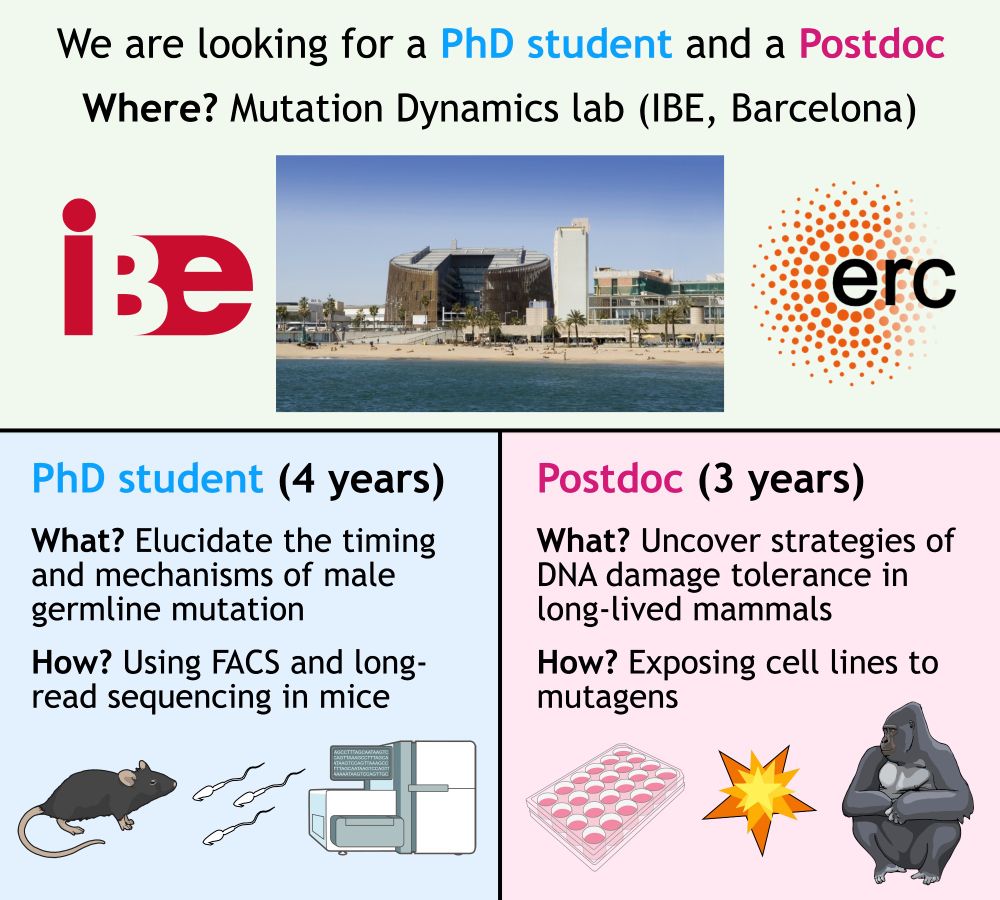
📣 Two ERC-funded positions are available in the lab! If you are interested in exploring the mechanisms underlying mutation, we’d love to hear from you.
PhD: shorturl.at/Oc04N
Postdoc: shorturl.at/1ShHB
RPs and shares would be greatly appreciated!
🧪🧬🖥️ #ScienceJobs #PostdocJobs
PhD: shorturl.at/Oc04N
Postdoc: shorturl.at/1ShHB
RPs and shares would be greatly appreciated!
🧪🧬🖥️ #ScienceJobs #PostdocJobs
November 25, 2024 at 11:19 AM
📣 Two ERC-funded positions are available in the lab! If you are interested in exploring the mechanisms underlying mutation, we’d love to hear from you.
PhD: shorturl.at/Oc04N
Postdoc: shorturl.at/1ShHB
RPs and shares would be greatly appreciated!
🧪🧬🖥️ #ScienceJobs #PostdocJobs
PhD: shorturl.at/Oc04N
Postdoc: shorturl.at/1ShHB
RPs and shares would be greatly appreciated!
🧪🧬🖥️ #ScienceJobs #PostdocJobs
Reposted by Lino Ferreira

The Hinch lab is looking for an enthusiastic statistician, mathematician or physicist to join us as a post doc!
If you'd like to use big data to decode the inner workings of our cells, apply now: germlinegenomics.web.ox.ac.uk
Please re-post and thanks!
#PhDjobs #Postdocs #STEM #meiosis #genomics
If you'd like to use big data to decode the inner workings of our cells, apply now: germlinegenomics.web.ox.ac.uk
Please re-post and thanks!
#PhDjobs #Postdocs #STEM #meiosis #genomics

June 11, 2024 at 11:31 AM
Reposted by Lino Ferreira
Congratulations to Carl Veller on the publication of his article on confounding in population and family GWAS
journals.plos.org/plosbiology/...
journals.plos.org/plosbiology/...

Interpreting population- and family-based genome-wide association studies in the presence of confounding
GWASs aim to estimate direct effects of genotype on an individual’s phenotype, but this can be subject to genetic and environmental confounds and
journals.plos.org
April 12, 2024 at 4:28 AM
Congratulations to Carl Veller on the publication of his article on confounding in population and family GWAS
journals.plos.org/plosbiology/...
journals.plos.org/plosbiology/...
My PhD programme, the 'DPhil in Genomic Medicine and Statistics' at the Wellcome Centre for Human Genetics in Oxford, is accepting applications for next year!
I'm coming to the end of my studies after four years and feel so fortunate to have been part of it. Students get...
I'm coming to the end of my studies after four years and feel so fortunate to have been part of it. Students get...
October 18, 2023 at 1:42 PM
My PhD programme, the 'DPhil in Genomic Medicine and Statistics' at the Wellcome Centre for Human Genetics in Oxford, is accepting applications for next year!
I'm coming to the end of my studies after four years and feel so fortunate to have been part of it. Students get...
I'm coming to the end of my studies after four years and feel so fortunate to have been part of it. Students get...
First post on this celestial platform to mark a happy occasion: I've submitted my PhD thesis!
I've celebrated and rested well and am now back to working on research after all the writing... Excited for what's to come!
I've celebrated and rested well and am now back to working on research after all the writing... Excited for what's to come!
October 18, 2023 at 1:39 PM
First post on this celestial platform to mark a happy occasion: I've submitted my PhD thesis!
I've celebrated and rested well and am now back to working on research after all the writing... Excited for what's to come!
I've celebrated and rested well and am now back to working on research after all the writing... Excited for what's to come!