



Rachel Gregor
@rachelgregor.bsky.social
Assistant Professor at the University of Toronto in Chemical Engineering and Applied Chemistry. Fascinated by microbial communities and their chemistry. https://www.gregorlab.com/
Pinned
Rachel Gregor
@rachelgregor.bsky.social
· Aug 25

Vitamin auxotrophies shape microbial community assembly on model marine particles
Abstract. Microbial community assembly is governed by the flow of carbon sources and other primary metabolites between species. However, central metabolism
doi.org
🌊🦠🧪 Delighted to share this work now out in @isme-microbes.bsky.social: doi.org/10.1093/isme... The currency of microbial life is chemistry, but there’s so much still unknown about how metabolic interactions shape communities. 1/
Reposted by Rachel Gregor

Harnessing microalgae for the biosynthesis of molecular crystals - @bengurionuniv.bsky.social go.nature.com/3MxVqui

Harnessing microalgae for the biosynthesis of molecular crystals - Nature Biotechnology
Crystalline materials for optical applications are synthesized in living dinoflagellates.
go.nature.com
February 19, 2026 at 4:58 PM
Harnessing microalgae for the biosynthesis of molecular crystals - @bengurionuniv.bsky.social go.nature.com/3MxVqui
Reposted by Rachel Gregor

Hey all, excited to share this collab w/
@shaunmckinnie.bsky.social
TL;DR we combined our expertise to develop and validate a MALDI-tims platform for screening the production of isomeric small molecules (~212 Da) directly from E coli colonies in high throughput
www.cell.com/cell-reports...
@shaunmckinnie.bsky.social
TL;DR we combined our expertise to develop and validate a MALDI-tims platform for screening the production of isomeric small molecules (~212 Da) directly from E coli colonies in high throughput
www.cell.com/cell-reports...

A high-throughput biocatalytic platform for screening isomeric kainoid natural products
Shepherd and Ramachandra et al. present a fast, chromatography-free method for resolving
isomeric products from engineered enzymes. This platform enables large-scale screening
and identifies improved ...
www.cell.com
February 5, 2026 at 6:36 PM
Hey all, excited to share this collab w/
@shaunmckinnie.bsky.social
TL;DR we combined our expertise to develop and validate a MALDI-tims platform for screening the production of isomeric small molecules (~212 Da) directly from E coli colonies in high throughput
www.cell.com/cell-reports...
@shaunmckinnie.bsky.social
TL;DR we combined our expertise to develop and validate a MALDI-tims platform for screening the production of isomeric small molecules (~212 Da) directly from E coli colonies in high throughput
www.cell.com/cell-reports...
Reposted by Rachel Gregor

🌊Paper announcement! 📣
Viral infections rewire the metabolic makeup of their host and thereby create distinct chemical signatures. Can we use metabolic biomarkers to diagnose infections of algal blooms in the ocean?
Well, take a look at our new article led by Conny Kuhlisch in @pnas.org
>>
Viral infections rewire the metabolic makeup of their host and thereby create distinct chemical signatures. Can we use metabolic biomarkers to diagnose infections of algal blooms in the ocean?
Well, take a look at our new article led by Conny Kuhlisch in @pnas.org
>>

Mapping of the viral shunt across widespread coccolithophore blooms using metabolic biomarkers | PNAS
The viral shunt is a fundamental ecosystem process which diverts the flux of organic
carbon fixed through photosynthesis during algal bloom events ...
doi.org
February 5, 2026 at 5:22 PM
🌊Paper announcement! 📣
Viral infections rewire the metabolic makeup of their host and thereby create distinct chemical signatures. Can we use metabolic biomarkers to diagnose infections of algal blooms in the ocean?
Well, take a look at our new article led by Conny Kuhlisch in @pnas.org
>>
Viral infections rewire the metabolic makeup of their host and thereby create distinct chemical signatures. Can we use metabolic biomarkers to diagnose infections of algal blooms in the ocean?
Well, take a look at our new article led by Conny Kuhlisch in @pnas.org
>>
Reposted by Rachel Gregor

another example of AI as tracer dye, exposing an already existing problem (and, of course, significantly worsening it)

I think this post nails the actual problem, for researchers at least—AI hallucinations would simply not be a problem in academic work if we’d not normalized citation-as-signaling rather than actual engagement—you can only cite a fake paper if you’re not in the habit of reading the papers you cite

Do not cite an academic paper unless you’ve read it
December 21, 2025 at 7:11 AM
another example of AI as tracer dye, exposing an already existing problem (and, of course, significantly worsening it)
Reposted by Rachel Gregor
The final form of my 2nd postdoc paper with the Bassler Lab! Turns out our favorite quorum-sensing phage isn’t a one-off, but rather a member of a globally dispersed family of phages that sense a universal autoinducer.
#phagesky #microsky
journals.asm.org/doi/10.1128/...
#phagesky #microsky
journals.asm.org/doi/10.1128/...

A family of linear plasmid phages that detect a quorum-sensing autoinducer exists in multiple bacterial species | mBio
The discovery of quorum-sensing responsive linear plasmid phages has transformed understanding
of phage-bacterial interactions by demonstrating inter-domain chemical communication.
To date, however, e...
journals.asm.org
December 21, 2025 at 4:19 PM
The final form of my 2nd postdoc paper with the Bassler Lab! Turns out our favorite quorum-sensing phage isn’t a one-off, but rather a member of a globally dispersed family of phages that sense a universal autoinducer.
#phagesky #microsky
journals.asm.org/doi/10.1128/...
#phagesky #microsky
journals.asm.org/doi/10.1128/...
Reposted by Rachel Gregor

Reposted by Rachel Gregor
Enjoyed reading
“AI for chemistry in 2025 is like AI for images in 2010”
leashbio.substack.com/p/ai-for-che...
“AI for chemistry in 2025 is like AI for images in 2010”
leashbio.substack.com/p/ai-for-che...

December 18, 2025 at 9:39 PM
Enjoyed reading
“AI for chemistry in 2025 is like AI for images in 2010”
leashbio.substack.com/p/ai-for-che...
“AI for chemistry in 2025 is like AI for images in 2010”
leashbio.substack.com/p/ai-for-che...
Reposted by Rachel Gregor

Phosphorus stress and spatial confinement lower the threshold for quorum-sensing activation of redox-active metabolite production in Pseudomonas synxantha
bioRxiv from Dianne Newman
www.biorxiv.org/content/10.1...
bioRxiv from Dianne Newman
www.biorxiv.org/content/10.1...

Phosphorus stress and spatial confinement lower the threshold for quorum-sensing activation of redox-active metabolite production in Pseudomonas synxantha
Bacteria often coordinate collective behaviors such as biofilm formation and secondary metabolite production through quorum sensing (QS), a regulatory system traditionally linked to high cell density....
www.biorxiv.org
December 16, 2025 at 1:45 PM
Phosphorus stress and spatial confinement lower the threshold for quorum-sensing activation of redox-active metabolite production in Pseudomonas synxantha
bioRxiv from Dianne Newman
www.biorxiv.org/content/10.1...
bioRxiv from Dianne Newman
www.biorxiv.org/content/10.1...
Reposted by Rachel Gregor

📢 NEW exciting opportunity!
Join Queen’s University as a tenure-track Assistant Professor in Cell Engineering and Biomanufacturing, with opportunities for interdisciplinary research across #ChemicalEngineering and #Biomedical and #MolecularSciences. 🔬
🔗 stemcellnetwork.ca/career-oppor...
Join Queen’s University as a tenure-track Assistant Professor in Cell Engineering and Biomanufacturing, with opportunities for interdisciplinary research across #ChemicalEngineering and #Biomedical and #MolecularSciences. 🔬
🔗 stemcellnetwork.ca/career-oppor...

December 17, 2025 at 7:16 PM
📢 NEW exciting opportunity!
Join Queen’s University as a tenure-track Assistant Professor in Cell Engineering and Biomanufacturing, with opportunities for interdisciplinary research across #ChemicalEngineering and #Biomedical and #MolecularSciences. 🔬
🔗 stemcellnetwork.ca/career-oppor...
Join Queen’s University as a tenure-track Assistant Professor in Cell Engineering and Biomanufacturing, with opportunities for interdisciplinary research across #ChemicalEngineering and #Biomedical and #MolecularSciences. 🔬
🔗 stemcellnetwork.ca/career-oppor...
Reposted by Rachel Gregor
DOE's Office of Science is making a big push into AI, and that includes our work at the @jgi.doe.gov . We want to hear your thoughts (+ and -) on AI-enabled biological data. Consider joining one of our interviews or focus groups by filling out this form!
🧪🧬🦠🖥️ #secmet
jointgeno.me/PortalStorie...
🧪🧬🦠🖥️ #secmet
jointgeno.me/PortalStorie...

Tell Us Your JGI Portal Stories
The JGI Portal teams (IMG, Mycocosm, Phycocosm, Phytozome, and SMC) would love to sit with you (over Zoom) to hear your stories relating to your usage of the portals, your unsupported use cases, and p...
jointgeno.me
December 15, 2025 at 5:16 PM
DOE's Office of Science is making a big push into AI, and that includes our work at the @jgi.doe.gov . We want to hear your thoughts (+ and -) on AI-enabled biological data. Consider joining one of our interviews or focus groups by filling out this form!
🧪🧬🦠🖥️ #secmet
jointgeno.me/PortalStorie...
🧪🧬🦠🖥️ #secmet
jointgeno.me/PortalStorie...
Reposted by Rachel Gregor

It’s good to see papers start to address LLMs as structural plagiarism — provenance, more hidden than the original words or training data. www.nature.com/articles/s42...

LLM use in scholarly writing poses a provenance problem
Nature Machine Intelligence - LLM use in scholarly writing poses a provenance problem
www.nature.com
December 14, 2025 at 11:13 AM
It’s good to see papers start to address LLMs as structural plagiarism — provenance, more hidden than the original words or training data. www.nature.com/articles/s42...
Reposted by Rachel Gregor

Have you ever used a #bioinformatics #database and were frustrated by its lack of coverage? Did you ever think about starting your own resource? We just published a new strategy for community-driven #biocuration, based on our experiences with the #MIBiG database (1/8)! doi.org/10.1093/bib/...

Strategies for community-sourced biocuration in bioinformatics: a case study on MIBiG 4.0
Abstract. Biocuration is essential to transform molecular sequence data into standardized, machine-readable resources. Such curated datasets enable compara
doi.org
December 11, 2025 at 7:19 PM
Have you ever used a #bioinformatics #database and were frustrated by its lack of coverage? Did you ever think about starting your own resource? We just published a new strategy for community-driven #biocuration, based on our experiences with the #MIBiG database (1/8)! doi.org/10.1093/bib/...
Reposted by Rachel Gregor
What started out as a structure-function project for an undergraduate researcher morphed into something bigger w/ @popea.bsky.social leading the way. Check out how RhlR fine tunes its response to its autoinducer to avoid producing too much pyocyanin.
www.biorxiv.org/content/10.6...
www.biorxiv.org/content/10.6...

RhlR quorum-sensing receptor ligand sensitivity regulates the differential expression of phenazine genes in Pseudomonas aeruginosa
Bacteria control individualistic and group behaviors using a form of cell-cell communication called quorum sensing. Quorum sensing relies on the production of chemical signals called autoinducers and ...
www.biorxiv.org
December 9, 2025 at 2:22 PM
What started out as a structure-function project for an undergraduate researcher morphed into something bigger w/ @popea.bsky.social leading the way. Check out how RhlR fine tunes its response to its autoinducer to avoid producing too much pyocyanin.
www.biorxiv.org/content/10.6...
www.biorxiv.org/content/10.6...
Reposted by Rachel Gregor
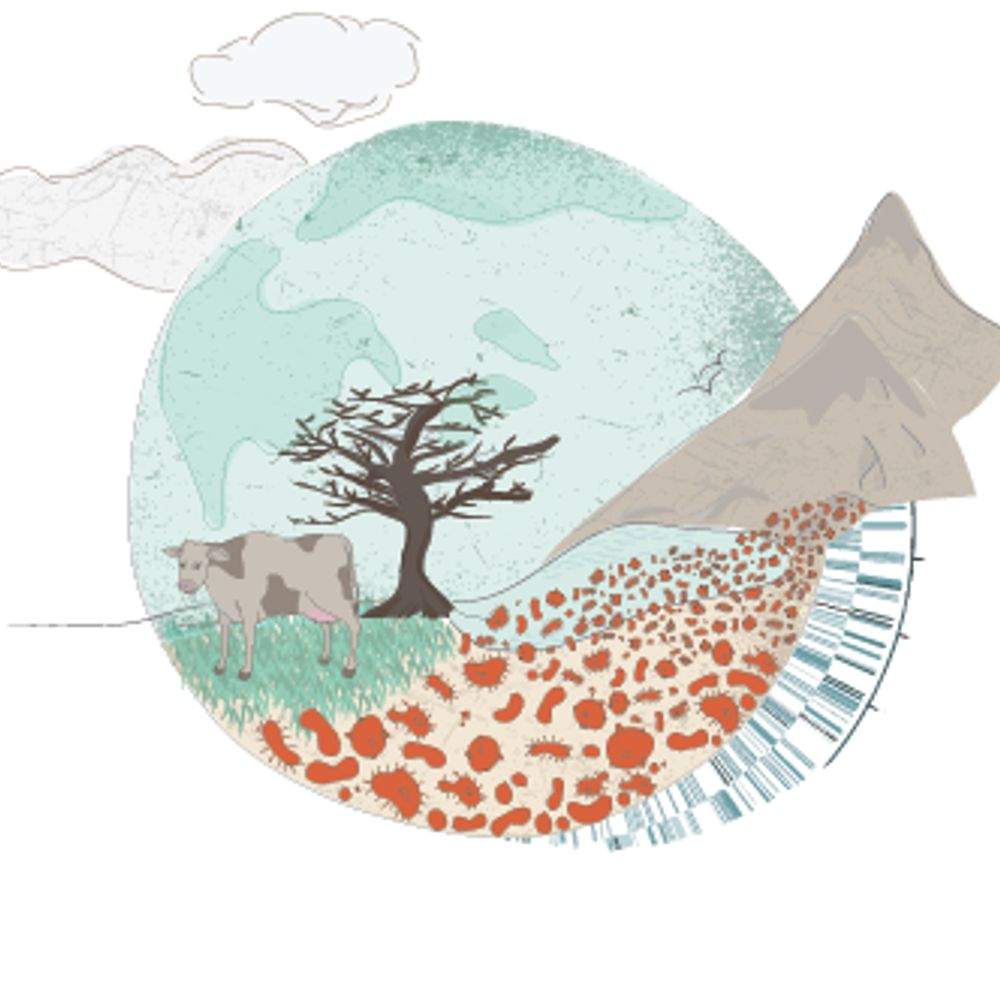
In our new paper in @natcomms.nature.com We discovered how Ruminococcus bromil organizes and regulates its enzyme complex to efficiently break down resistant starch, forming a key metabolic foundation for the human gut ecosystem. (1/12)
📄 www.nature.com/articles/s41...
📄 www.nature.com/articles/s41...

December 9, 2025 at 5:20 PM
In our new paper in @natcomms.nature.com We discovered how Ruminococcus bromil organizes and regulates its enzyme complex to efficiently break down resistant starch, forming a key metabolic foundation for the human gut ecosystem. (1/12)
📄 www.nature.com/articles/s41...
📄 www.nature.com/articles/s41...
Reposted by Rachel Gregor

Our BEHIND THE STORY. A glimpse into the role of auxiliary metabolic genes in cyanophages during infection communities.springernature.com/posts/a-glim...

A glimpse into the role of auxiliary metabolic genes in cyanophages during infection
communities.springernature.com
December 8, 2025 at 12:54 PM
Our BEHIND THE STORY. A glimpse into the role of auxiliary metabolic genes in cyanophages during infection communities.springernature.com/posts/a-glim...
Reposted by Rachel Gregor
Excited to share our new @natecoevo.nature.com
paper. We identified microbes found across nearly all ruminants that act as the functional backbone of both the rumen ecosystem and the host, with major implications for food security and climate change mitigation. (1/8)
www.nature.com/articles/s41...
paper. We identified microbes found across nearly all ruminants that act as the functional backbone of both the rumen ecosystem and the host, with major implications for food security and climate change mitigation. (1/8)
www.nature.com/articles/s41...

December 3, 2025 at 4:00 PM
Excited to share our new @natecoevo.nature.com
paper. We identified microbes found across nearly all ruminants that act as the functional backbone of both the rumen ecosystem and the host, with major implications for food security and climate change mitigation. (1/8)
www.nature.com/articles/s41...
paper. We identified microbes found across nearly all ruminants that act as the functional backbone of both the rumen ecosystem and the host, with major implications for food security and climate change mitigation. (1/8)
www.nature.com/articles/s41...
Reposted by Rachel Gregor

Angelina Fanny Hesse: The Woman Who Brought Agar from the Kitchen to the Laboratory
voxmeditantis.com/2025/10/30/a...
#WomenInSTEM #STEM #Microbiology #Agarology #Bacteriology
voxmeditantis.com/2025/10/30/a...
#WomenInSTEM #STEM #Microbiology #Agarology #Bacteriology

Angelina Fanny Hesse: The Woman Who Brought Agar from the Kitchen to the Laboratory
Angelina Fanny Hesse reveals how childhood memories of Indonesian pudding solved bacteriology’s greatest problem in 1881. The unpaid laboratory technician whose kitchen knowledge enabled Koch…
voxmeditantis.com
October 30, 2025 at 10:21 PM
Angelina Fanny Hesse: The Woman Who Brought Agar from the Kitchen to the Laboratory
voxmeditantis.com/2025/10/30/a...
#WomenInSTEM #STEM #Microbiology #Agarology #Bacteriology
voxmeditantis.com/2025/10/30/a...
#WomenInSTEM #STEM #Microbiology #Agarology #Bacteriology
Reposted by Rachel Gregor
We analyzed changes in physiology relative to menopause using two large scale studies that include millions of lab tests. Rather than align by age, we used statistical inference to align tests to final menstrual period. (1/2)
arunamed.com/the-menopaus...
arunamed.com/the-menopaus...

The Menopause Cliff: What a Million Women's Lab Tests Reveal
TLDR: A massive study of 300+ million lab tests from 1+ million women just proved what women have been saying for years: menopause isn't a gradual slope—it's a physiological cliff. Nearly e
arunamed.com
December 3, 2025 at 8:09 AM
We analyzed changes in physiology relative to menopause using two large scale studies that include millions of lab tests. Rather than align by age, we used statistical inference to align tests to final menstrual period. (1/2)
arunamed.com/the-menopaus...
arunamed.com/the-menopaus...
Reposted by Rachel Gregor
Amazing dataset describing the metabolic profiles of 66 E. coli transporter knockouts by @sulheim.bsky.social with Peter Doubleday and @nzamboni.bsky.social. The tool, set up by @lambdapp.bsky.social and Eric Ulrich allows you to explore for yourself. Enjoy! Pre-print here: doi.org/10.1101/2025...
December 3, 2025 at 1:11 PM
Amazing dataset describing the metabolic profiles of 66 E. coli transporter knockouts by @sulheim.bsky.social with Peter Doubleday and @nzamboni.bsky.social. The tool, set up by @lambdapp.bsky.social and Eric Ulrich allows you to explore for yourself. Enjoy! Pre-print here: doi.org/10.1101/2025...
Reposted by Rachel Gregor

Do you think transporters in E. coli contribute to metabolite release? No? Explore the effect of 66 different transporter knockout mutations on the exometabolome dynamics of ~300 metabolites yourself: keio.unil.ch
Teaser: Increased proline in ΔputP
#microsky #MEvoSky
Teaser: Increased proline in ΔputP
#microsky #MEvoSky

December 3, 2025 at 11:11 AM
Do you think transporters in E. coli contribute to metabolite release? No? Explore the effect of 66 different transporter knockout mutations on the exometabolome dynamics of ~300 metabolites yourself: keio.unil.ch
Teaser: Increased proline in ΔputP
#microsky #MEvoSky
Teaser: Increased proline in ΔputP
#microsky #MEvoSky
Reposted by Rachel Gregor
This project wouldn't been possible without Peter Doubleday and @nzamboni.bsky.social at @imsb-eth.bsky.social. Peter conducted >10,000 mass spec analyses 🤯. So grateful for this opportunity to team up with the best of the best in metabolomics 😍
Read more: www.biorxiv.org/content/10.1...
#microsky
Read more: www.biorxiv.org/content/10.1...
#microsky
Do you think transporters in E. coli contribute to metabolite release? No? Explore the effect of 66 different transporter knockout mutations on the exometabolome dynamics of ~300 metabolites yourself: keio.unil.ch
Teaser: Increased proline in ΔputP
#microsky #MEvoSky
Teaser: Increased proline in ΔputP
#microsky #MEvoSky
December 3, 2025 at 12:50 PM
This project wouldn't been possible without Peter Doubleday and @nzamboni.bsky.social at @imsb-eth.bsky.social. Peter conducted >10,000 mass spec analyses 🤯. So grateful for this opportunity to team up with the best of the best in metabolomics 😍
Read more: www.biorxiv.org/content/10.1...
#microsky
Read more: www.biorxiv.org/content/10.1...
#microsky
Reposted by Rachel Gregor
Poster deadline for the Keystone Microbiome Meeting in Banff is December 30th www.keystonesymposia.org/conferences/...
Will be a great meeting focused on human microbiomes, spanning basic, mechanistic, and applied. Organized by myself, @amibhatt.bsky.social , and Harry Sokol. Join us!
Will be a great meeting focused on human microbiomes, spanning basic, mechanistic, and applied. Organized by myself, @amibhatt.bsky.social , and Harry Sokol. Join us!
Human Microbiome: From Models and Mechanism to Medicine | Keystone Symposia
Join us at the Keystone Symposia on Human Microbiome: From Models and Mechanism to Medicine, January 2026, in Banff, with field leaders!
www.keystonesymposia.org
December 1, 2025 at 6:35 PM
Poster deadline for the Keystone Microbiome Meeting in Banff is December 30th www.keystonesymposia.org/conferences/...
Will be a great meeting focused on human microbiomes, spanning basic, mechanistic, and applied. Organized by myself, @amibhatt.bsky.social , and Harry Sokol. Join us!
Will be a great meeting focused on human microbiomes, spanning basic, mechanistic, and applied. Organized by myself, @amibhatt.bsky.social , and Harry Sokol. Join us!
Reposted by Rachel Gregor
PanBGC: A pangenome-inspired framework for comparative analysis of biosynthetic gene clusters
#ISMEComms from @nadineziemert.bsky.social
academic.oup.com/ismecommun/a...
#ISMEComms from @nadineziemert.bsky.social
academic.oup.com/ismecommun/a...

PanBGC: A pangenome-inspired framework for comparative analysis of biosynthetic gene clusters
Abstract. Bacterial secondary metabolites are a major source of therapeutics and play key roles in microbial ecology. These compounds are encoded by biosyn
academic.oup.com
November 30, 2025 at 1:24 PM
PanBGC: A pangenome-inspired framework for comparative analysis of biosynthetic gene clusters
#ISMEComms from @nadineziemert.bsky.social
academic.oup.com/ismecommun/a...
#ISMEComms from @nadineziemert.bsky.social
academic.oup.com/ismecommun/a...
Reposted by Rachel Gregor

Optimized k-mer search across millions of bacterial genomes on laptops https://www.biorxiv.org/content/10.1101/2025.11.23.690050v1
November 26, 2025 at 4:47 PM
Optimized k-mer search across millions of bacterial genomes on laptops https://www.biorxiv.org/content/10.1101/2025.11.23.690050v1
Reposted by Rachel Gregor

Boris Shraiman points a physicist’s eye on biological quandaries news.ucsb.edu/2025/022264/... 🧪

Boris Shraiman points a physicist’s eye on biological quandaries
Boris Shraiman is awarded the American Physical Society’s Max Delbrück Prize in Biological Physics.
news.ucsb.edu
November 25, 2025 at 7:38 PM
Boris Shraiman points a physicist’s eye on biological quandaries news.ucsb.edu/2025/022264/... 🧪