



Pablo Alcón
@palconh.bsky.social
Scientist. Molecular and structural biology of DNA repair 🧬
Aarhus University 🇩🇰🇪🇺
From Extremadura, Spain 🌍
https://sites.google.com/view/alconlab/home
Aarhus University 🇩🇰🇪🇺
From Extremadura, Spain 🌍
https://sites.google.com/view/alconlab/home
Reposted by Pablo Alcón
It took a while but it’s finally published!
The GAP activity of SEAC (GATOR) is a metabolic switch that allows cells to quickly respond to changes in amino acid levels, both for inhibition and reactivation.
The GAP activity of SEAC (GATOR) is a metabolic switch that allows cells to quickly respond to changes in amino acid levels, both for inhibition and reactivation.

New online: Structure and function of the yeast amino acid-sensing SEAC–EGOC supercomplex

Structure and function of the yeast amino acid-sensing SEAC–EGOC supercomplex
Nature Structural & Molecular Biology, Published online: 12 February 2026; doi:10.1038/s41594-026-01746-2Tafur et al. determined the cryo-electron microscopy structure of the SEA complex (GATOR) bound to its substrate, the EGO complex (Ragulator–Rag), and showed that its GAP activity is essential for both rapid inactivation and reactivation of TORC1.
dlvr.it
February 13, 2026 at 12:56 PM
It took a while but it’s finally published!
The GAP activity of SEAC (GATOR) is a metabolic switch that allows cells to quickly respond to changes in amino acid levels, both for inhibition and reactivation.
The GAP activity of SEAC (GATOR) is a metabolic switch that allows cells to quickly respond to changes in amino acid levels, both for inhibition and reactivation.
Reposted by Pablo Alcón
How could a simple self-replicating system emerge at the origins of life? RNA polymerase ribozymes can replicate RNA, but existing ones are so large that their self-replication seems impossible. Could they be smaller?
Excited to share our latest work in @science.org on a new small polymerase.
1/n
Excited to share our latest work in @science.org on a new small polymerase.
1/n

A small polymerase ribozyme that can synthesize itself and its complementary strand
The emergence of a chemical system capable of self-replication and evolution is a critical event in the origin of life. RNA polymerase ribozymes can replicate RNA, but their large size and structural ...
www.science.org
February 13, 2026 at 11:42 AM
How could a simple self-replicating system emerge at the origins of life? RNA polymerase ribozymes can replicate RNA, but existing ones are so large that their self-replication seems impossible. Could they be smaller?
Excited to share our latest work in @science.org on a new small polymerase.
1/n
Excited to share our latest work in @science.org on a new small polymerase.
1/n
Reposted by Pablo Alcón

A beautifully crafted summary of the extraordinary discovery in the lab of my @mrclmb.bsky.social colleague @philholliger.bsky.social of a tiny RNA that can replicate RNA.
Researchers have discovered a little RNA molecule - small enough to potentially form spontaneously, yet sophisticated enough to begin to copy itself - that could explain how life on Earth began over four billion years ago, Science Director @rogerhighfield.bsky.social reports: https://bit.ly/3ZvPS6s
February 12, 2026 at 10:52 PM
A beautifully crafted summary of the extraordinary discovery in the lab of my @mrclmb.bsky.social colleague @philholliger.bsky.social of a tiny RNA that can replicate RNA.
Reposted by Pablo Alcón
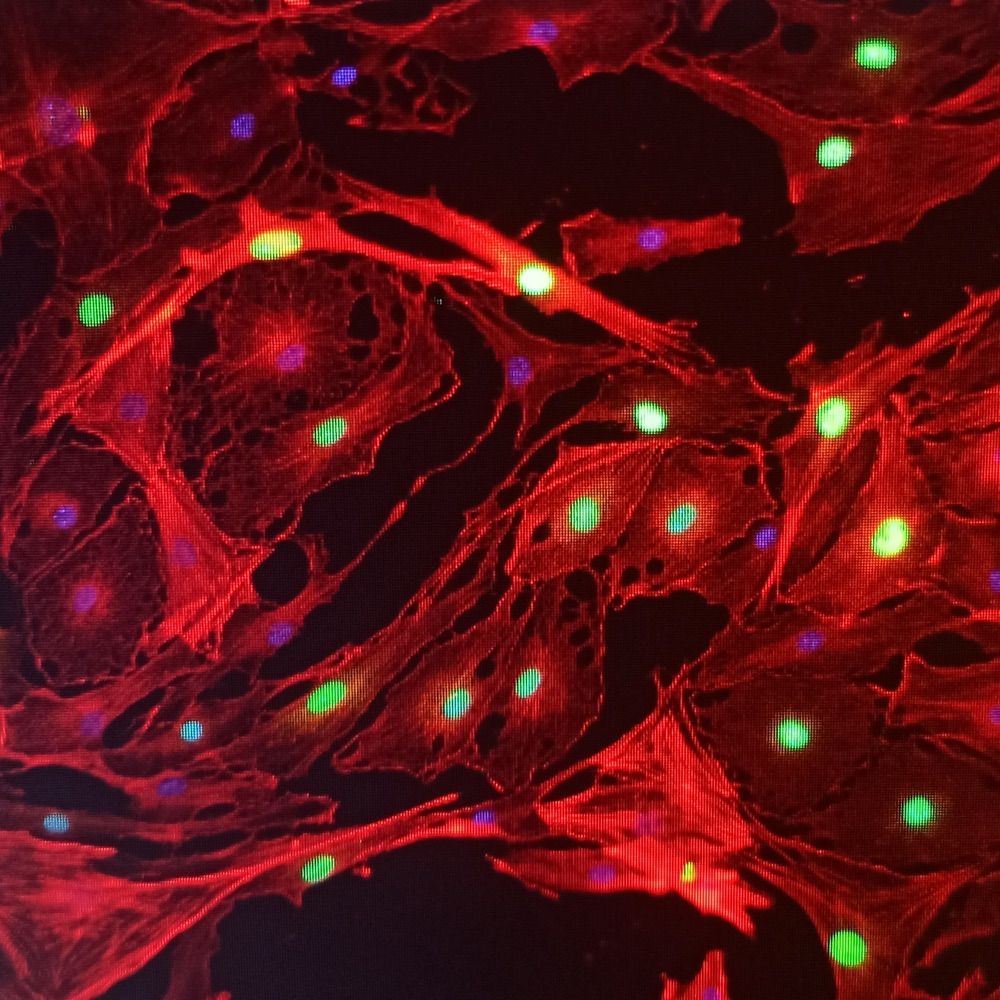
We’re excited to share our latest EMBO Journal paper! We show that STIM1 localizes to ER-mitochondria contact sites to promote direct Ca²⁺ flux into mitochondria, supporting mitochondrial Ca²⁺ homeostasis, respiration, and energy production
link.springer.com/article/10.1...
link.springer.com/article/10.1...

STIM1-containing contact sites promote direct calcium flux from the endoplasmic reticulum to mitochondria - The EMBO Journal
STIM1 is a transmembrane protein localized in the endoplasmic reticulum (ER), where it acts as a calcium ion sensor, activating store-operated Ca2+ entry upon ER Ca2+ depletion. Via cellular calcium i...
link.springer.com
February 11, 2026 at 11:05 AM
We’re excited to share our latest EMBO Journal paper! We show that STIM1 localizes to ER-mitochondria contact sites to promote direct Ca²⁺ flux into mitochondria, supporting mitochondrial Ca²⁺ homeostasis, respiration, and energy production
link.springer.com/article/10.1...
link.springer.com/article/10.1...
Reposted by Pablo Alcón

Very happy to say that our work on how axonemes are generated is now available on bioRxiv: www.biorxiv.org/content/10.6... - if you’ve ever wondered how the incredibly beautiful, complex structures within motile #cilia are constructed then this is for you!
www.biorxiv.org
February 6, 2026 at 11:20 AM
Very happy to say that our work on how axonemes are generated is now available on bioRxiv: www.biorxiv.org/content/10.6... - if you’ve ever wondered how the incredibly beautiful, complex structures within motile #cilia are constructed then this is for you!
Reposted by Pablo Alcón
Astounding words and performance. Take 2 mins to listen to it.

Sir Ian McKellen performing a monologue from Shakespeare’s Sir Thomas More on the Stephen Colbert show. Never have I heard this monologue performed with such a keen sense of prescience. Nor have I ever been in this exact historical moment.TY Sir Ian, for reaching us once again.
#Pinks #ProudBlue
#Pinks #ProudBlue
February 5, 2026 at 1:52 PM
Astounding words and performance. Take 2 mins to listen to it.
Reposted by Pablo Alcón

Cryo-EM helped us to engineering a "nickase" in Type I-F-HNH to create new genome editing tools
Great work by Anders Fuglsang, Sweta Rout, Eliska Bartl Koutna, Nicholas Sofos and Alehandro Redondo Gallego
Our new paper is out lnkd.in/eq5fTquf
Great work by Anders Fuglsang, Sweta Rout, Eliska Bartl Koutna, Nicholas Sofos and Alehandro Redondo Gallego
Our new paper is out lnkd.in/eq5fTquf
February 2, 2026 at 10:14 PM
Cryo-EM helped us to engineering a "nickase" in Type I-F-HNH to create new genome editing tools
Great work by Anders Fuglsang, Sweta Rout, Eliska Bartl Koutna, Nicholas Sofos and Alehandro Redondo Gallego
Our new paper is out lnkd.in/eq5fTquf
Great work by Anders Fuglsang, Sweta Rout, Eliska Bartl Koutna, Nicholas Sofos and Alehandro Redondo Gallego
Our new paper is out lnkd.in/eq5fTquf
Reposted by Pablo Alcón
Does targeting enzymes and substrates in a condensate lead to rate enhancement? No. Here, we investigate how the condensate environment can inhibit an enzyme reaction.
Spoiler: Mass-transport limitations. We find a strong correlation between diffusion and reaction rates.
doi.org/10.64898/202...
Spoiler: Mass-transport limitations. We find a strong correlation between diffusion and reaction rates.
doi.org/10.64898/202...

February 2, 2026 at 2:25 PM
Does targeting enzymes and substrates in a condensate lead to rate enhancement? No. Here, we investigate how the condensate environment can inhibit an enzyme reaction.
Spoiler: Mass-transport limitations. We find a strong correlation between diffusion and reaction rates.
doi.org/10.64898/202...
Spoiler: Mass-transport limitations. We find a strong correlation between diffusion and reaction rates.
doi.org/10.64898/202...
Reposted by Pablo Alcón
Dear Colleagues,
Delighted to share that our first lab paper is now published in Nature.!!! 😊😊😊
We identify a previously concealed “safety limit” in DNA replication program: cells intrinsically rate-limit PCNA via PAF15, shaping strand-specific and global replication dynamics.
👉 rdcu.be/e1bBt
Delighted to share that our first lab paper is now published in Nature.!!! 😊😊😊
We identify a previously concealed “safety limit” in DNA replication program: cells intrinsically rate-limit PCNA via PAF15, shaping strand-specific and global replication dynamics.
👉 rdcu.be/e1bBt

PAF15–PCNA exhaustion governs the strand-specific control of DNA replication
Nature - PCNA–PAF15 has a key role in determining replisome dynamics during genome replication and protecting against genome instability.
rdcu.be
January 29, 2026 at 6:30 PM
Dear Colleagues,
Delighted to share that our first lab paper is now published in Nature.!!! 😊😊😊
We identify a previously concealed “safety limit” in DNA replication program: cells intrinsically rate-limit PCNA via PAF15, shaping strand-specific and global replication dynamics.
👉 rdcu.be/e1bBt
Delighted to share that our first lab paper is now published in Nature.!!! 😊😊😊
We identify a previously concealed “safety limit” in DNA replication program: cells intrinsically rate-limit PCNA via PAF15, shaping strand-specific and global replication dynamics.
👉 rdcu.be/e1bBt
Heading home after a quick visit to beautiful (and absolutely freezing) Copenhagen. Always q pleasure to catch up with friends. And what a view from the top of Panum!
Thanks a lot to @isbuc.bsky.social for the invitation!
⛴️
Thanks a lot to @isbuc.bsky.social for the invitation!
⛴️

January 29, 2026 at 2:52 PM
Heading home after a quick visit to beautiful (and absolutely freezing) Copenhagen. Always q pleasure to catch up with friends. And what a view from the top of Panum!
Thanks a lot to @isbuc.bsky.social for the invitation!
⛴️
Thanks a lot to @isbuc.bsky.social for the invitation!
⛴️
Reposted by Pablo Alcón
Excited to share our latest work on dissecting the mechanism of processive telomeric DNA synthesis by telomerase. Led by amazing PhD student Sebastian Balch in collaboration with lab members,@automnenine.bsky.social @rachael-kretsch.bsky.social,@rdaslab.bsky.social.
www.nature.com/articles/s41...
www.nature.com/articles/s41...
Structures of nucleotide-bound human telomerase at several steps of its telomeric DNA repeat addition cycle - Nature Communications
To maintain genome stability, the specialised reverse transcriptase telomerase processively adds telomeric DNA repeats to chromosome ends. Here the authors reported structures of human telomerase at t...
www.nature.com
January 23, 2026 at 6:57 AM
Excited to share our latest work on dissecting the mechanism of processive telomeric DNA synthesis by telomerase. Led by amazing PhD student Sebastian Balch in collaboration with lab members,@automnenine.bsky.social @rachael-kretsch.bsky.social,@rdaslab.bsky.social.
www.nature.com/articles/s41...
www.nature.com/articles/s41...
Reposted by Pablo Alcón

🔬 Calling all early-career researchers (ECRs) for the GRS Single Molecule Approaches to Biology!
🌎 Location: Les Diablerets, Switzerland
📆 Save the date: June 27-28, 2026
🔗 More information: www.grc.org/single-molec...
#biology #biophysics #single-molecule #microscopy #ECR
🌎 Location: Les Diablerets, Switzerland
📆 Save the date: June 27-28, 2026
🔗 More information: www.grc.org/single-molec...
#biology #biophysics #single-molecule #microscopy #ECR

January 22, 2026 at 3:18 PM
🔬 Calling all early-career researchers (ECRs) for the GRS Single Molecule Approaches to Biology!
🌎 Location: Les Diablerets, Switzerland
📆 Save the date: June 27-28, 2026
🔗 More information: www.grc.org/single-molec...
#biology #biophysics #single-molecule #microscopy #ECR
🌎 Location: Les Diablerets, Switzerland
📆 Save the date: June 27-28, 2026
🔗 More information: www.grc.org/single-molec...
#biology #biophysics #single-molecule #microscopy #ECR
Reposted by Pablo Alcón

The SBBC participates in the organization of the Second Salamanca International Advanced Biophysics and Structural Course, June 22–28, 2026.
The course is led by Profs. Carlos Bustamante and Eva Nogales (University of California, Berkeley)
Registration open until January 20th
biophysal.org
The course is led by Profs. Carlos Bustamante and Eva Nogales (University of California, Berkeley)
Registration open until January 20th
biophysal.org

BioPhySAL - 2nd Salamanca International Advanced Biophysics and Structural Biology Course
First Summer International Advanced Biophysics and Structural Biology Course. Eva Nogales - Carlos Bustamante.
biophysal.org
January 9, 2026 at 3:49 PM
The SBBC participates in the organization of the Second Salamanca International Advanced Biophysics and Structural Course, June 22–28, 2026.
The course is led by Profs. Carlos Bustamante and Eva Nogales (University of California, Berkeley)
Registration open until January 20th
biophysal.org
The course is led by Profs. Carlos Bustamante and Eva Nogales (University of California, Berkeley)
Registration open until January 20th
biophysal.org


Biting cold day to start the new year, but our campus is looking gorgeous in white ❄️

January 5, 2026 at 8:20 AM
Biting cold day to start the new year, but our campus is looking gorgeous in white ❄️
Reposted by Pablo Alcón
Our latest paper on the molecular mechanisms of XPF-ERCC1 recruitment to SLX4-dependent DNA repair pathways has been published! Congratulations to first author Junjie Feng, and a heartfelt thank you to all our collaborators for their contributions to this study!
www.nature.com/articles/s41...
www.nature.com/articles/s41...

December 16, 2025 at 4:29 PM
Our latest paper on the molecular mechanisms of XPF-ERCC1 recruitment to SLX4-dependent DNA repair pathways has been published! Congratulations to first author Junjie Feng, and a heartfelt thank you to all our collaborators for their contributions to this study!
www.nature.com/articles/s41...
www.nature.com/articles/s41...
Reposted by Pablo Alcón
When your PI presents your work
December 15, 2025 at 12:00 PM
When your PI presents your work
Reposted by Pablo Alcón

Our @costerlab.bsky.social review is out!
It’s a great read on the impact of DNA secondary structures on eukaryotic replication fork progression - a totally unbiased opinion, of course!
www.sciencedirect.com/science/arti...
@adityasethi.bsky.social @billiedelpino.bsky.social
It’s a great read on the impact of DNA secondary structures on eukaryotic replication fork progression - a totally unbiased opinion, of course!
www.sciencedirect.com/science/arti...
@adityasethi.bsky.social @billiedelpino.bsky.social

How DNA secondary structures drive replication fork instability
DNA secondary structures, such as hairpins, cruciforms, triplexes, G-quadruplexes and iMotifs, are common, dynamic features that replication forks rou…
www.sciencedirect.com
December 10, 2025 at 11:53 AM
Our @costerlab.bsky.social review is out!
It’s a great read on the impact of DNA secondary structures on eukaryotic replication fork progression - a totally unbiased opinion, of course!
www.sciencedirect.com/science/arti...
@adityasethi.bsky.social @billiedelpino.bsky.social
It’s a great read on the impact of DNA secondary structures on eukaryotic replication fork progression - a totally unbiased opinion, of course!
www.sciencedirect.com/science/arti...
@adityasethi.bsky.social @billiedelpino.bsky.social
Reposted by Pablo Alcón
Thrilled to share that my postdoc research is published today in @science.org! We found that DNA repair uses cohesin complexes to build new chromatin loops that guide the homology search and boost accurate repair! 1/n
www.science.org/doi/10.1126/...
www.science.org/doi/10.1126/...

Cohesin drives chromatin scanning during the RAD51-mediated homology search
Cohesin folds genomes into chromatin loops, the roles of which are under debate. We found that double-strand breaks (DSBs) induce de novo formation of chromatin loops in human cells, with the loop bas...
www.science.org
December 4, 2025 at 9:50 PM
Thrilled to share that my postdoc research is published today in @science.org! We found that DNA repair uses cohesin complexes to build new chromatin loops that guide the homology search and boost accurate repair! 1/n
www.science.org/doi/10.1126/...
www.science.org/doi/10.1126/...
Reposted by Pablo Alcón

This was the first newspaper coverage of the discovery of the double helix, a few weeks after publication of the three articles in Nature. It mentions all those involved, except Rosalind Franklin. She was the only one to keep a cutting (this is from her archive at Churchill College).

December 3, 2025 at 9:40 PM
This was the first newspaper coverage of the discovery of the double helix, a few weeks after publication of the three articles in Nature. It mentions all those involved, except Rosalind Franklin. She was the only one to keep a cutting (this is from her archive at Churchill College).
Reposted by Pablo Alcón

Finally published! Our work on how the #CircadianClock controls DNA repair. This has direct implications for cancer treatment: #Chronotherapy.
@CABIMER @UniSevilla
rdcu.be/eSwxl
@CABIMER @UniSevilla
rdcu.be/eSwxl
Circadian regulation of homologous recombination by cryptochrome1-mediated dampening of DNA end resection
Nature Communications - The study shows that DNA double-strand break repair follows a circadian rhythm: homologous recombination peaks in the morning and declines by evening. CRY1 regulates CCAR2...
rdcu.be
December 1, 2025 at 2:34 PM
Finally published! Our work on how the #CircadianClock controls DNA repair. This has direct implications for cancer treatment: #Chronotherapy.
@CABIMER @UniSevilla
rdcu.be/eSwxl
@CABIMER @UniSevilla
rdcu.be/eSwxl
Reposted by Pablo Alcón
We are looking for a Postdoc to join us at the Center for Gene Expression @cgen2025.bsky.social at the University of Copenhagen! Full advertisement here: employment.ku.dk/faculty/?sho...

Postdocs at Center for Gene Expression in Department of Cellular and Molecular Medicine
employment.ku.dk
December 1, 2025 at 11:37 AM
We are looking for a Postdoc to join us at the Center for Gene Expression @cgen2025.bsky.social at the University of Copenhagen! Full advertisement here: employment.ku.dk/faculty/?sho...
Reposted by Pablo Alcón
This has now been published in print! Check it out:
www.science.org/doi/10.1126/...
www.science.org/doi/10.1126/...
Now out in Science! Cyclin-dependent kinases (CDKs) are key regulators of the cell cycle. In @vcushing.bsky.social's magnum opus, we use #cryoEM to figure out how the CDK-activating kinase recognises CDKs to fully activate them - a key step in cell cycle control.
www.science.org/doi/10.1126/...
www.science.org/doi/10.1126/...

Structural basis of T-loop–independent recognition and activation of CDKs by the CDK-activating kinase
Cyclin-dependent kinases (CDKs) are prototypical regulators of the cell cycle. The CDK-activating kinase (CAK) acts as a master regulator of CDK activity by catalyzing the activating phosphorylation o...
www.science.org
November 28, 2025 at 10:53 AM
This has now been published in print! Check it out:
www.science.org/doi/10.1126/...
www.science.org/doi/10.1126/...
Reposted by Pablo Alcón
open postdoc call in our friendly neighborgroup with Esben Lorentzen. Higly recommed🌟:
www.au.dk/om/stillinge...
www.au.dk/om/stillinge...

Postdoctoral Position in Structural and mechanistic investigation of the ciliary trafficking machinery bound to cargo, Denmark - Ledig stilling på Aarhus Universitet
Ledig stilling ved Institut for Molekylærbiologi og Genetik - Proteinvidenskab, Aarhus Universitet
www.au.dk
November 24, 2025 at 8:13 AM
open postdoc call in our friendly neighborgroup with Esben Lorentzen. Higly recommed🌟:
www.au.dk/om/stillinge...
www.au.dk/om/stillinge...
"Como pasa con mucho de lo que rodea a la ciencia en España, el nombre no es muy conocido en nuestros lares. La única forma en la que un científico salta al candelero es cuando le dan algún premio, se implica en un escándalo o fallece."
elpais.com/ciencia/2025...
elpais.com/ciencia/2025...

Antonio García-Bellido y el hilo de Ariadna de la biología
El influyente científico, fallecido el 10 de noviembre a los 89 años, deja una pregunta: cómo las conversaciones entre células controlan el espacio y la forma
elpais.com
November 19, 2025 at 2:02 PM
"Como pasa con mucho de lo que rodea a la ciencia en España, el nombre no es muy conocido en nuestros lares. La única forma en la que un científico salta al candelero es cuando le dan algún premio, se implica en un escándalo o fallece."
elpais.com/ciencia/2025...
elpais.com/ciencia/2025...