



Ben Sabari
@bsabari.bsky.social
Assistant Professor at UTSW studying nuclear organization by nuclear condensates
Pinned
Ben Sabari
@bsabari.bsky.social
· Apr 25
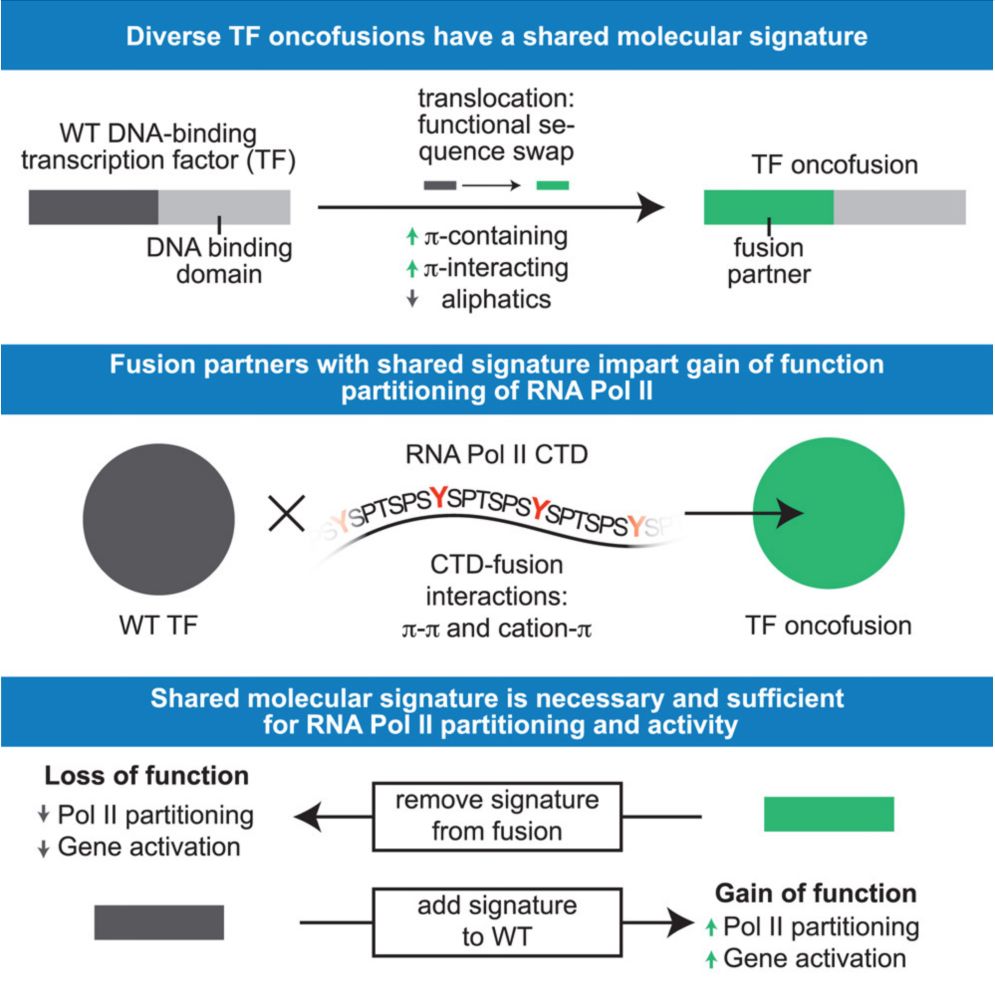
I am excited to share the latest paper from my lab where we leverage the selection bias of condensate-promoting oncofusions to uncover molecular rules governing condensate specificity and function. www.cell.com/cell/fulltex....
Reposted by Ben Sabari
IDPSeminas is back again TOMORROW!
Talks from Lucia Strader (@luciastrader.bsky.social) and Heather Meyer! Sign up at idpseminars.com.
Talks start at 1 pm EST / 7 PM CET!! Come learn about transcriptional adaptation and IDRs as environmental sensors and accuators!
Talks from Lucia Strader (@luciastrader.bsky.social) and Heather Meyer! Sign up at idpseminars.com.
Talks start at 1 pm EST / 7 PM CET!! Come learn about transcriptional adaptation and IDRs as environmental sensors and accuators!

February 4, 2026 at 10:14 PM
IDPSeminas is back again TOMORROW!
Talks from Lucia Strader (@luciastrader.bsky.social) and Heather Meyer! Sign up at idpseminars.com.
Talks start at 1 pm EST / 7 PM CET!! Come learn about transcriptional adaptation and IDRs as environmental sensors and accuators!
Talks from Lucia Strader (@luciastrader.bsky.social) and Heather Meyer! Sign up at idpseminars.com.
Talks start at 1 pm EST / 7 PM CET!! Come learn about transcriptional adaptation and IDRs as environmental sensors and accuators!
I am recruiting postdoctoral fellows to develop new research directions in the lab. We study transcriptional regulation through biomolecular condensates in development and disease, with an emphasis on first-principles and mechanistic discovery. Please repost or share with colleagues.
January 23, 2026 at 6:35 PM
I am recruiting postdoctoral fellows to develop new research directions in the lab. We study transcriptional regulation through biomolecular condensates in development and disease, with an emphasis on first-principles and mechanistic discovery. Please repost or share with colleagues.
Reposted by Ben Sabari

Activator-promoter compatibility in mammals - Hcfc1 is a key and intrinsically CGI-promoter-specific co-activator that cannot activate non-CGI promoters. Lead by @nemcko.bsky.social & Kevin Sabath in collab. with @plaschkalab.bsky.social @impvienna.bsky.social www.biorxiv.org/content/10.6... (1/2)

Activator-promoter compatibility in mammals: a CpG-Island-specific co-activator directly bridges transcription factors to TFIID
Transcription from CpG island (CGI) promoters controls the expression of two-thirds of mammalian genes, yet despite their prevalence, it remains unknown whether CGI-specific co-activators with intrins...
www.biorxiv.org
December 30, 2025 at 8:02 AM
Activator-promoter compatibility in mammals - Hcfc1 is a key and intrinsically CGI-promoter-specific co-activator that cannot activate non-CGI promoters. Lead by @nemcko.bsky.social & Kevin Sabath in collab. with @plaschkalab.bsky.social @impvienna.bsky.social www.biorxiv.org/content/10.6... (1/2)
Reposted by Ben Sabari

Do transcriptional activators work on any promoter? Our data says no. 🙅♂️
Despite driving ~2/3 of mammalian genes, CpG island (CGI) promoters have remained a puzzle. We identified >50 activators that are exclusively compatible with this promoter class. 🧬
Despite driving ~2/3 of mammalian genes, CpG island (CGI) promoters have remained a puzzle. We identified >50 activators that are exclusively compatible with this promoter class. 🧬
December 29, 2025 at 7:30 PM
Do transcriptional activators work on any promoter? Our data says no. 🙅♂️
Despite driving ~2/3 of mammalian genes, CpG island (CGI) promoters have remained a puzzle. We identified >50 activators that are exclusively compatible with this promoter class. 🧬
Despite driving ~2/3 of mammalian genes, CpG island (CGI) promoters have remained a puzzle. We identified >50 activators that are exclusively compatible with this promoter class. 🧬
Reposted by Ben Sabari

🎉Publication alert🎉
Congratulations to @lemkelab.bsky.social, @wittmann-lab.bsky.social, Girard Lab & their teams on their new Nature Communications publication. This work showcases the active cross-disciplinary dialogue that lies at the heart of our network. www.nature.com/articles/s41...
Congratulations to @lemkelab.bsky.social, @wittmann-lab.bsky.social, Girard Lab & their teams on their new Nature Communications publication. This work showcases the active cross-disciplinary dialogue that lies at the heart of our network. www.nature.com/articles/s41...

Differential conformational expansion of NUP98-HOXA9 oncoprotein from nanosized assemblies to macrophases - Nature Communications
Some transcription factors can organize into different structural states, from small nanoscale clusters to macrophases. Here authors show that NHA9 undergoes differential conformational expansion acro...
www.nature.com
November 18, 2025 at 3:30 PM
🎉Publication alert🎉
Congratulations to @lemkelab.bsky.social, @wittmann-lab.bsky.social, Girard Lab & their teams on their new Nature Communications publication. This work showcases the active cross-disciplinary dialogue that lies at the heart of our network. www.nature.com/articles/s41...
Congratulations to @lemkelab.bsky.social, @wittmann-lab.bsky.social, Girard Lab & their teams on their new Nature Communications publication. This work showcases the active cross-disciplinary dialogue that lies at the heart of our network. www.nature.com/articles/s41...
Reposted by Ben Sabari

@science.org 🧬🔬 Multiscale structure of #chromatin condensates explains phase separation and material properties | Science www.science.org/doi/10.1126/... @janhuemar.bsky.social et al.

Multiscale structure of chromatin condensates explains phase separation and material properties
The structure and interaction networks of molecules within biomolecular condensates are poorly understood. Using cryo–electron tomography and molecular dynamics simulations, we elucidated the structur...
www.science.org
December 5, 2025 at 5:24 AM
@science.org 🧬🔬 Multiscale structure of #chromatin condensates explains phase separation and material properties | Science www.science.org/doi/10.1126/... @janhuemar.bsky.social et al.
Reposted by Ben Sabari
Our Science paper is out!
Huge congratulations to @huabin-zhou.bsky.social, Mike Rosen, and the brilliant @janhuemar.bsky.social @juliamaristany.bsky.social and @kieran-russell.bsky.social from our group
News: bit.ly/4avnkAr and bit.ly/3XBGVHS
Great perspective by @vram142.bsky.social +K Zhang
Huge congratulations to @huabin-zhou.bsky.social, Mike Rosen, and the brilliant @janhuemar.bsky.social @juliamaristany.bsky.social and @kieran-russell.bsky.social from our group
News: bit.ly/4avnkAr and bit.ly/3XBGVHS
Great perspective by @vram142.bsky.social +K Zhang
December 5, 2025 at 9:47 AM
Our Science paper is out!
Huge congratulations to @huabin-zhou.bsky.social, Mike Rosen, and the brilliant @janhuemar.bsky.social @juliamaristany.bsky.social and @kieran-russell.bsky.social from our group
News: bit.ly/4avnkAr and bit.ly/3XBGVHS
Great perspective by @vram142.bsky.social +K Zhang
Huge congratulations to @huabin-zhou.bsky.social, Mike Rosen, and the brilliant @janhuemar.bsky.social @juliamaristany.bsky.social and @kieran-russell.bsky.social from our group
News: bit.ly/4avnkAr and bit.ly/3XBGVHS
Great perspective by @vram142.bsky.social +K Zhang
Reposted by Ben Sabari

Love this; inspired by early experiences and cemented by the incomparable @jiwasa.bsky.social at an incredible workshop she and @theroglab.bsky.social organized in '22, I've become thoroughly convinced that - at least for me - developing figures from scratch is a key part of scientific inquiry.
The hidden danger of Biorender
(& the death of scientific illustration)
A short thread 🧵
(& the death of scientific illustration)
A short thread 🧵


December 1, 2025 at 1:04 PM
Love this; inspired by early experiences and cemented by the incomparable @jiwasa.bsky.social at an incredible workshop she and @theroglab.bsky.social organized in '22, I've become thoroughly convinced that - at least for me - developing figures from scratch is a key part of scientific inquiry.
Reposted by Ben Sabari

Anthony A. Hyman will become EMBL’s next Director General.
He joins EMBL from @mpi-cbg.de in Dresden. He is also Professor of Molecular Biology @tudresden.bsky.social, and was a group leader at EMBL Heidelberg from 1993 to 1999.
www.embl.org/news/people-...
He joins EMBL from @mpi-cbg.de in Dresden. He is also Professor of Molecular Biology @tudresden.bsky.social, and was a group leader at EMBL Heidelberg from 1993 to 1999.
www.embl.org/news/people-...

November 27, 2025 at 1:02 PM
Anthony A. Hyman will become EMBL’s next Director General.
He joins EMBL from @mpi-cbg.de in Dresden. He is also Professor of Molecular Biology @tudresden.bsky.social, and was a group leader at EMBL Heidelberg from 1993 to 1999.
www.embl.org/news/people-...
He joins EMBL from @mpi-cbg.de in Dresden. He is also Professor of Molecular Biology @tudresden.bsky.social, and was a group leader at EMBL Heidelberg from 1993 to 1999.
www.embl.org/news/people-...
Reposted by Ben Sabari
6 years ago, Lizz took a leap of faith by moving across the country to join our new and empty lab as a research tech. She then became our 1st grad student, playing a major role in shaping our research directions and lab culture. Today she defended her PhD, and I couldn’t be more proud.

Defended! 🍾 Introducing Elizabeth Maurais, Ph.D. 🎉 Congrats on your successful #dissertationdefense. Dr. Maurais was joined by her mentor @peterlylab.bsky.social & other Ly Lab mates. Next stop: #postdoc! 🧪

November 5, 2025 at 2:11 AM
6 years ago, Lizz took a leap of faith by moving across the country to join our new and empty lab as a research tech. She then became our 1st grad student, playing a major role in shaping our research directions and lab culture. Today she defended her PhD, and I couldn’t be more proud.
Reposted by Ben Sabari
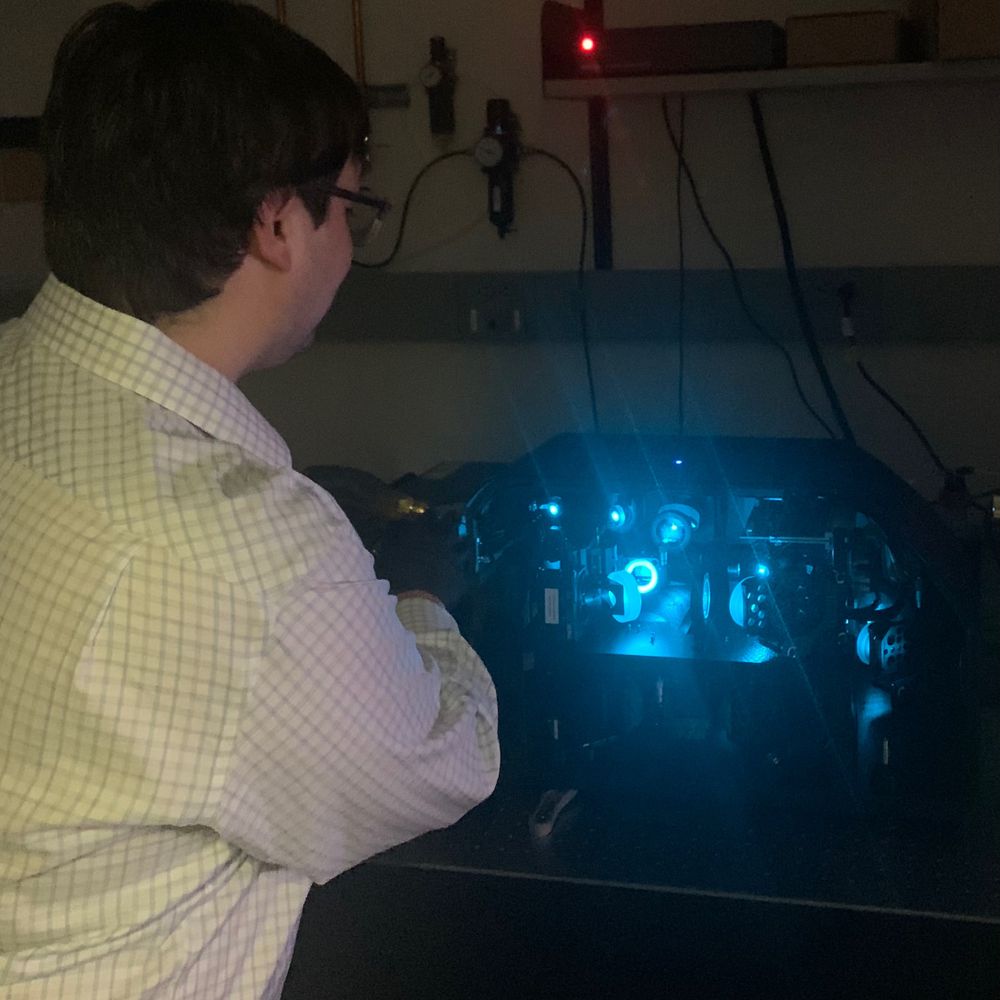
(1/10) How do diverse leukemia mutations converge on the same molecular program? In #RibackLab first manuscript @cp-cell.bsky.social, collaboration with @goodell-lab.bsky.social shows that disparate mutations rewire shared protein networks to form nuclear condensates called C-bodies.

November 4, 2025 at 5:58 PM
(1/10) How do diverse leukemia mutations converge on the same molecular program? In #RibackLab first manuscript @cp-cell.bsky.social, collaboration with @goodell-lab.bsky.social shows that disparate mutations rewire shared protein networks to form nuclear condensates called C-bodies.
Reposted by Ben Sabari
What do the naked mole rat and bowhead whale (lives to ~200 years) have in common to explain their remarkable longevity?
Enhanced DNA repair
www.nature.com/articles/s41...
erictopol.substack.com/p/a-long-awa...
Enhanced DNA repair
www.nature.com/articles/s41...
erictopol.substack.com/p/a-long-awa...

Evidence for improved DNA repair in long-lived bowhead whale - Nature
Analysis of the longest-lived mammal, the bowhead whale, reveals an improved ability to repair DNA breaks, mediated by high levels of cold-inducible RNA-binding protein. &nbs...
www.nature.com
October 29, 2025 at 4:26 PM
What do the naked mole rat and bowhead whale (lives to ~200 years) have in common to explain their remarkable longevity?
Enhanced DNA repair
www.nature.com/articles/s41...
erictopol.substack.com/p/a-long-awa...
Enhanced DNA repair
www.nature.com/articles/s41...
erictopol.substack.com/p/a-long-awa...
In collaboration with Hue Sun Chan and @jonaswessen.bsky.social, we present a polymer theory for sequence-based prediction of selective partitioning of charged IDRs. This method correctly predicted the partitioning of IDRs for which we had no experimental data. www.nature.com/articles/s42...

Sequence-based prediction of condensate composition reveals that specificity can emerge from multivalent interactions among disordered regions - Communications Chemistry
Condensates composed of the disordered region of the mediator of RNA polymerase II transcription subunit 1 (MED1) are known to partition specific proteins, but whether this specificity arises from ord...
www.nature.com
October 22, 2025 at 6:30 PM
In collaboration with Hue Sun Chan and @jonaswessen.bsky.social, we present a polymer theory for sequence-based prediction of selective partitioning of charged IDRs. This method correctly predicted the partitioning of IDRs for which we had no experimental data. www.nature.com/articles/s42...
Reposted by Ben Sabari

Happy to share our latest in @natcomputsci.nature.com
led by (amazing) Ryan Krueger + colab w M. Brenner!
We introduce a framework to directly design intrinsically disordered proteins (IDPs) from physics-based simulations.
🧬 doi.org/10.1038/s435...
📰 www.mccormick.northwestern.edu/news/article...
led by (amazing) Ryan Krueger + colab w M. Brenner!
We introduce a framework to directly design intrinsically disordered proteins (IDPs) from physics-based simulations.
🧬 doi.org/10.1038/s435...
📰 www.mccormick.northwestern.edu/news/article...

October 10, 2025 at 6:16 PM
Happy to share our latest in @natcomputsci.nature.com
led by (amazing) Ryan Krueger + colab w M. Brenner!
We introduce a framework to directly design intrinsically disordered proteins (IDPs) from physics-based simulations.
🧬 doi.org/10.1038/s435...
📰 www.mccormick.northwestern.edu/news/article...
led by (amazing) Ryan Krueger + colab w M. Brenner!
We introduce a framework to directly design intrinsically disordered proteins (IDPs) from physics-based simulations.
🧬 doi.org/10.1038/s435...
📰 www.mccormick.northwestern.edu/news/article...
Reposted by Ben Sabari
Last week, Washington University made the perhaps questionable decision to award me tenure.

September 29, 2025 at 12:53 PM
Last week, Washington University made the perhaps questionable decision to award me tenure.
Reposted by Ben Sabari
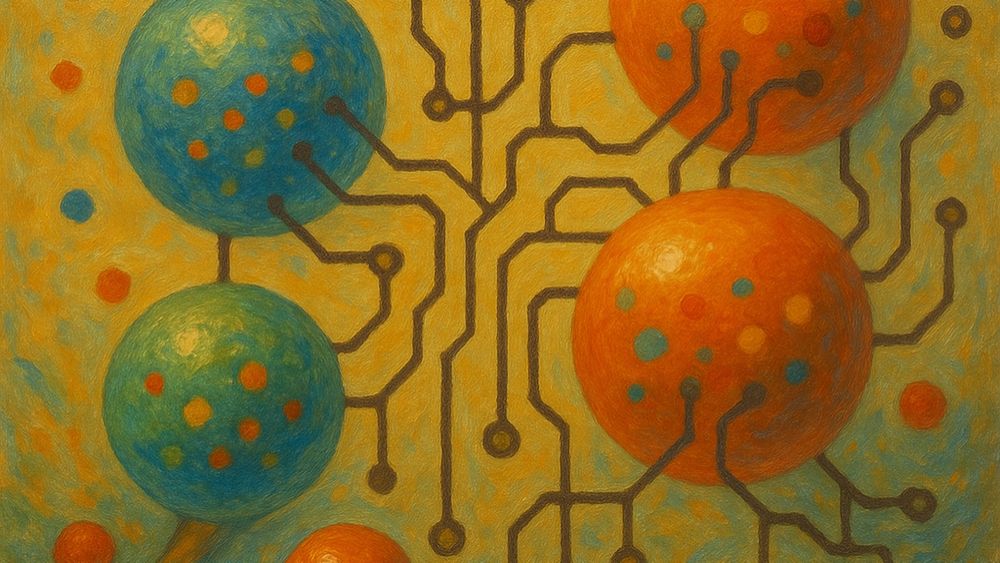
Preprint!
Inspired by condensates that form on specific DNA, we ask:
can we design multicomponent fluids to form distinct condensates on diff. surfaces?
i.e. perform classification by condensation ⚛️ 💻 exploiting phase transitions beyond compartmentalization!
arxiv.org/abs/2509.08100
(1/2)
Inspired by condensates that form on specific DNA, we ask:
can we design multicomponent fluids to form distinct condensates on diff. surfaces?
i.e. perform classification by condensation ⚛️ 💻 exploiting phase transitions beyond compartmentalization!
arxiv.org/abs/2509.08100
(1/2)
September 22, 2025 at 9:38 PM
Preprint!
Inspired by condensates that form on specific DNA, we ask:
can we design multicomponent fluids to form distinct condensates on diff. surfaces?
i.e. perform classification by condensation ⚛️ 💻 exploiting phase transitions beyond compartmentalization!
arxiv.org/abs/2509.08100
(1/2)
Inspired by condensates that form on specific DNA, we ask:
can we design multicomponent fluids to form distinct condensates on diff. surfaces?
i.e. perform classification by condensation ⚛️ 💻 exploiting phase transitions beyond compartmentalization!
arxiv.org/abs/2509.08100
(1/2)
Reposted by Ben Sabari

Congratulations to the Fritz Lipmann Lecturer Michael Rosen (Dallas) by the GBM president Harald Kolmar.


September 18, 2025 at 11:35 AM
Congratulations to the Fritz Lipmann Lecturer Michael Rosen (Dallas) by the GBM president Harald Kolmar.
Reposted by Ben Sabari

Major Medical Prizes Given to Cell Biology and Cystic Fibrosis Pioneers www.nytimes.com/2025/09/11/h...

Major Medical Prizes Given to Cell Biology and Cystic Fibrosis Pioneers
www.nytimes.com
September 11, 2025 at 2:44 PM
Major Medical Prizes Given to Cell Biology and Cystic Fibrosis Pioneers www.nytimes.com/2025/09/11/h...
Reposted by Ben Sabari
New in @pnas.org with @gladfelterlab.bsky.social @sneadlab.bsky.social ! 📢
Cells use condensates (dynamic compartments without membranes) to organize key reactions. Some condensates have core & shell layers… but how do such layers form? 🤔
👉 pnas.org/doi/10.1073/pnas.2504778122 (1/6)
Cells use condensates (dynamic compartments without membranes) to organize key reactions. Some condensates have core & shell layers… but how do such layers form? 🤔
👉 pnas.org/doi/10.1073/pnas.2504778122 (1/6)
PNAS
Proceedings of the National Academy of Sciences (PNAS), a peer reviewed journal of the National Academy of Sciences (NAS) - an authoritative source of high-impact, original research that broadly spans...
pnas.org
September 4, 2025 at 2:44 AM
New in @pnas.org with @gladfelterlab.bsky.social @sneadlab.bsky.social ! 📢
Cells use condensates (dynamic compartments without membranes) to organize key reactions. Some condensates have core & shell layers… but how do such layers form? 🤔
👉 pnas.org/doi/10.1073/pnas.2504778122 (1/6)
Cells use condensates (dynamic compartments without membranes) to organize key reactions. Some condensates have core & shell layers… but how do such layers form? 🤔
👉 pnas.org/doi/10.1073/pnas.2504778122 (1/6)
Reposted by Ben Sabari
The lab is moving to the Salk Institute! We are thrilled to join an inspiring community where we will continue to explore plant growth and development.
Deep gratitude for the years of support and collaboration at Duke/NCSU/UNC.
www.salk.edu/news-release...
Deep gratitude for the years of support and collaboration at Duke/NCSU/UNC.
www.salk.edu/news-release...

Plant biologist Lucia Strader joins Salk faculty to study plant growth signaling - Salk Institute for Biological Studies
LA JOLLA—The Salk Institute will welcome plant biologist Lucia Strader as a new professor and holder of the Howard H. and Maryam R. Newman Chair in Plant Biology in October 2025. Strader is an interna...
www.salk.edu
August 25, 2025 at 6:44 PM
The lab is moving to the Salk Institute! We are thrilled to join an inspiring community where we will continue to explore plant growth and development.
Deep gratitude for the years of support and collaboration at Duke/NCSU/UNC.
www.salk.edu/news-release...
Deep gratitude for the years of support and collaboration at Duke/NCSU/UNC.
www.salk.edu/news-release...
Reposted by Ben Sabari

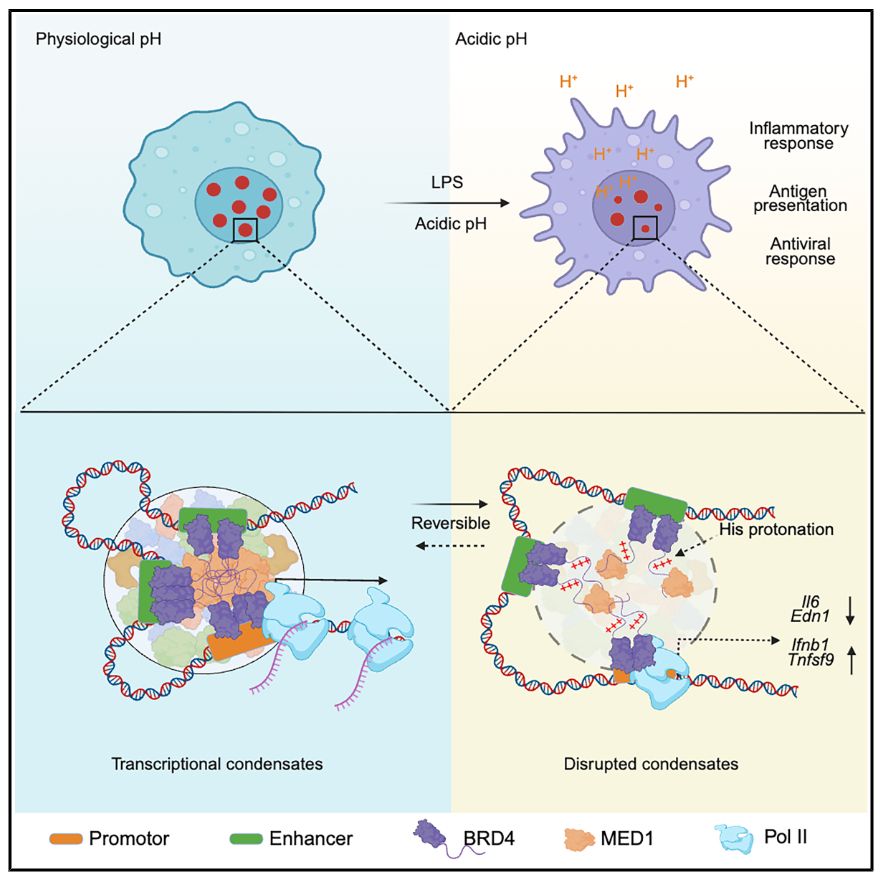
Beyond excited to share our #NewPaper in @cellcellpress.bsky.social! Inflamed environments acidify intracellular #pH. BRD4 senses this via transcriptional condensates, tuning #macrophage responses to match demand and consequences of #inflammation authors.elsevier.com/sd/article/S...
July 22, 2025 at 1:24 PM
Beyond excited to share our #NewPaper in @cellcellpress.bsky.social! Inflamed environments acidify intracellular #pH. BRD4 senses this via transcriptional condensates, tuning #macrophage responses to match demand and consequences of #inflammation authors.elsevier.com/sd/article/S...
Reposted by Ben Sabari
Designed protein pockets recognize intrinsically disordered protein regions @science.org
www.science.org/doi/10.1126/...
www.science.org/doi/10.1126/...
www.statnews.com/2025/07/17/n...
www.science.org/doi/10.1126/...
www.science.org/doi/10.1126/...
www.statnews.com/2025/07/17/n...
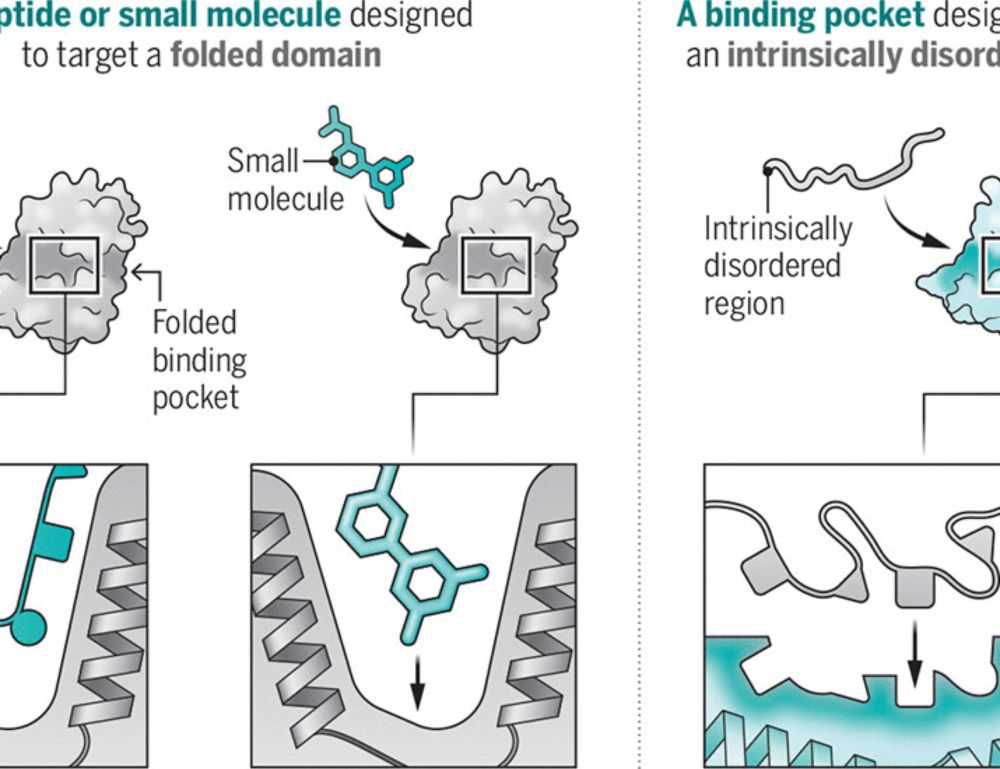
Disorder meets its match
Designed protein pockets recognize intrinsically disordered protein regions
www.science.org
July 17, 2025 at 7:42 PM
Designed protein pockets recognize intrinsically disordered protein regions @science.org
www.science.org/doi/10.1126/...
www.science.org/doi/10.1126/...
www.statnews.com/2025/07/17/n...
www.science.org/doi/10.1126/...
www.science.org/doi/10.1126/...
www.statnews.com/2025/07/17/n...
Reposted by Ben Sabari
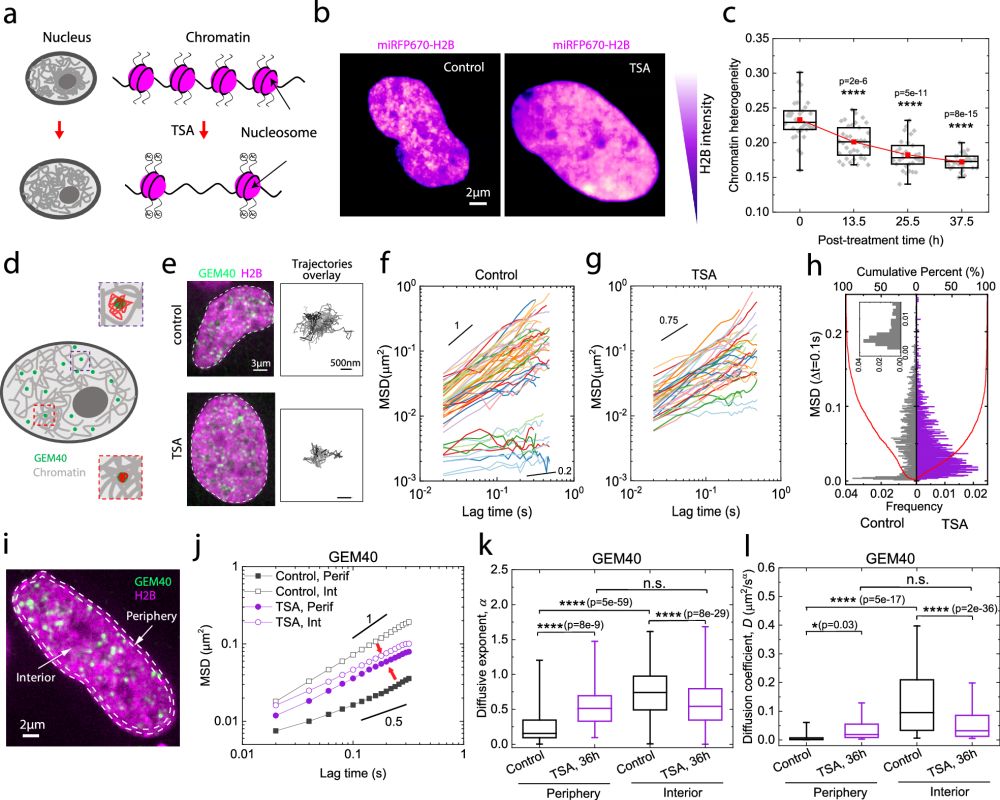
Congrats to Jing @jesszhiyuezhao.bsky.social
& @dnamystrom.bsky.social on cool manuscript!!! Reveals how cell nucleus is a heterogeneous material, w chromatin organization controlling formation & phase behavior of nuclear condensates. #CellBiology #Chromatin #PhaseSeparation rdcu.be/evWxR
& @dnamystrom.bsky.social on cool manuscript!!! Reveals how cell nucleus is a heterogeneous material, w chromatin organization controlling formation & phase behavior of nuclear condensates. #CellBiology #Chromatin #PhaseSeparation rdcu.be/evWxR
Chromatin heterogeneity modulates nuclear condensate dynamics and phase behavior
Nature Communications - Chromatin heterogeneity in the cell nucleus modulates the size, mobility, and formation of biomolecular condensates; decreasing chromatin heterogeneity correlates with...
rdcu.be
July 12, 2025 at 8:33 PM
Congrats to Jing @jesszhiyuezhao.bsky.social
& @dnamystrom.bsky.social on cool manuscript!!! Reveals how cell nucleus is a heterogeneous material, w chromatin organization controlling formation & phase behavior of nuclear condensates. #CellBiology #Chromatin #PhaseSeparation rdcu.be/evWxR
& @dnamystrom.bsky.social on cool manuscript!!! Reveals how cell nucleus is a heterogeneous material, w chromatin organization controlling formation & phase behavior of nuclear condensates. #CellBiology #Chromatin #PhaseSeparation rdcu.be/evWxR
Reposted by Ben Sabari
New paper:
More than 2700 human 3′UTRs are highly conserved. These 3′UTRs are essential components in mRNA templates, as their deletion decreases protein activity without changing protein abundance. Highly conserved 3′UTRs help the folding of proteins with long IDRs.
www.biorxiv.org/content/10.1...
More than 2700 human 3′UTRs are highly conserved. These 3′UTRs are essential components in mRNA templates, as their deletion decreases protein activity without changing protein abundance. Highly conserved 3′UTRs help the folding of proteins with long IDRs.
www.biorxiv.org/content/10.1...
mRNA 3′UTRs chaperone intrinsically disordered regions to control protein activity
More than 2,700 human mRNA 3′UTRs have hundreds of highly conserved (HC) nucleotides, but their biological roles are unclear. Here, we show that mRNAs with HC 3′UTRs mostly encode proteins with long intrinsically disordered regions (IDRs), including MYC, UTX, and JMJD3. These proteins are only fully active when translated from mRNA templates that include their 3′UTRs, raising the possibility of functional interactions between 3′UTRs and IDRs. Rather than affecting protein abundance or localization, we find that HC 3′UTRs control transcriptional or histone demethylase activity through co-translationally determined protein oligomerization states that are kinetically stable. 3′UTR-dependent changes in protein folding require mRNA-IDR interactions, suggesting that mRNAs act as IDR chaperones. These mRNAs are multivalent, a biophysical RNA feature that enables their translation in network-like condensates, which provide favorable folding environments for proteins with long IDRs. These data indicate that the coding sequence is insufficient for the biogenesis of biologically active conformations of IDR-containing proteins and that RNA can catalyze protein folding. ### Competing Interest Statement The authors have declared no competing interest. Pershing Square Foundation, https://ror.org/04tce9s05 G. Harold & Leila Y. Mathers Foundation National Institutes of Health, DP1GM123454, R35GM144046 Memorial Sloan Kettering Cancer Center, https://ror.org/02yrq0923, P30 CA008748
www.biorxiv.org
July 7, 2025 at 2:28 PM
New paper:
More than 2700 human 3′UTRs are highly conserved. These 3′UTRs are essential components in mRNA templates, as their deletion decreases protein activity without changing protein abundance. Highly conserved 3′UTRs help the folding of proteins with long IDRs.
www.biorxiv.org/content/10.1...
More than 2700 human 3′UTRs are highly conserved. These 3′UTRs are essential components in mRNA templates, as their deletion decreases protein activity without changing protein abundance. Highly conserved 3′UTRs help the folding of proteins with long IDRs.
www.biorxiv.org/content/10.1...