




Director of Research at the Reuters Institute for the Study of Journalism, University of Oxford. Lead researcher + co-author of the Digital News Report. www.richardfletcher.me


Reposted by Richard Fletcher, Andreas Jungherr


Reposted by Richard Fletcher



A new joint study from the Oxford Internet Institute and AI Security Institute (AISI) offers unprecedented insights into how conversational AI can exert influence over people’s political beliefs.
Read more: www.oii.ox.ac.uk/news-events/...
Reposted by Richard Fletcher

Last year we found a y-o-y decline in climate news use only in 🇺🇸. Worryingly, it’s now spread to 5/8 countries.
What’s going on? A thread 🧵
Reposted by Richard Fletcher


It is stable in Brazil, India, and Pakistan. Declines in climate news use are driven by two overlapping trends: reduced climate news access via TV, and reduced use by people over 45.
Reposted by Richard Fletcher

💻 Report: reutersinstitute.politics.ox.ac.uk/climate-chan...
🧵 Some key findings below.
Reposted by Richard Fletcher


Authored by @neilthurman.bsky.social @sinatk.bsky.social & @richardfletcher.bsky.social, it's based on a survey conducted in 2024
Read in full
reutersinstitute.politics.ox.ac.uk/ai-adoption-...
10 findings in thread
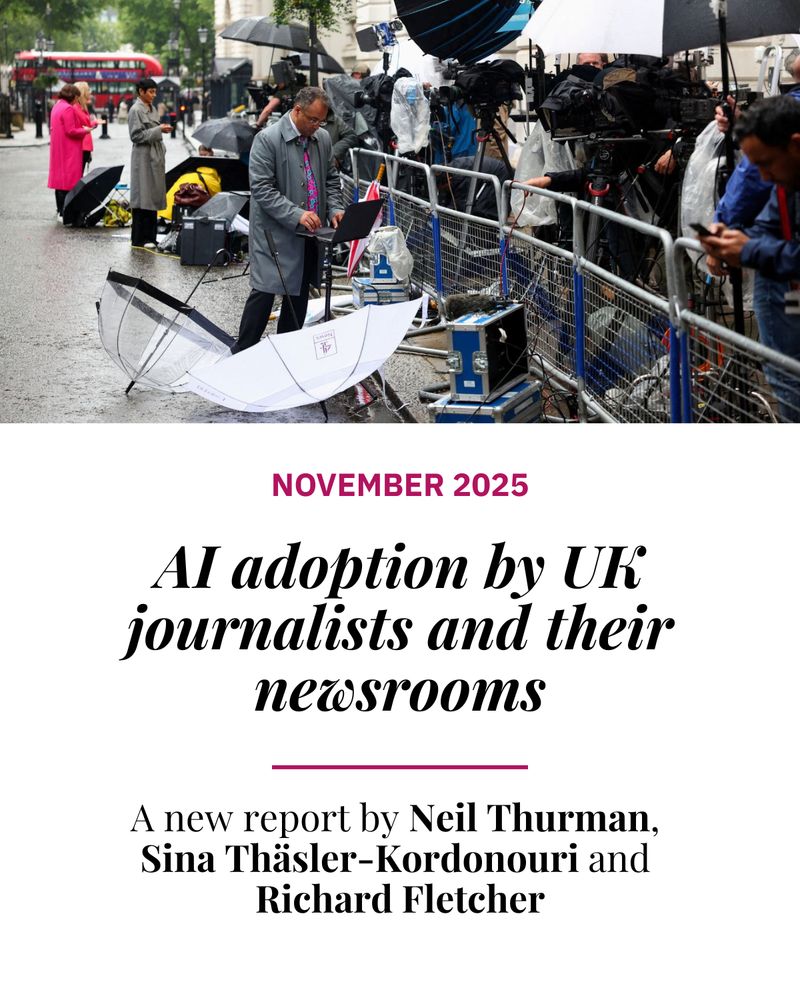
Most journalists are now using AI in their work, but they’re pretty pessimistic about what it means for journalism.
Details in the post below.
Reposted by Richard Fletcher, Neil Thurman
Authored by @neilthurman.bsky.social @sinatk.bsky.social & @richardfletcher.bsky.social, it's based on a survey conducted in 2024
Read in full
reutersinstitute.politics.ox.ac.uk/ai-adoption-...
10 findings in thread
Reposted by Richard Fletcher


Reposted by Richard Fletcher, Charlie Beckett


Reposted by Richard Fletcher

@rasmuskleis.bsky.social chaired a commission tasked by the Danish gov to design a system of direct media subsidies. In this piece he explains how they conceived their proposal and what other countries could learn from it
reutersinstitute.politics.ox.ac.uk/news/taxes-n...
Reposted by Richard Fletcher, Anne Schulz

Here's an updated version of a piece by @rasmuskleis.bsky.social @annisch.bsky.social @richardfletcher.bsky.social and Craig T. Robertson originally published in 2020
📱 Full piece here buff.ly/iLaMzHa
🧵 4 findings in thread
Reposted by Will Jennings, Richard Fletcher, Alessandro Nai
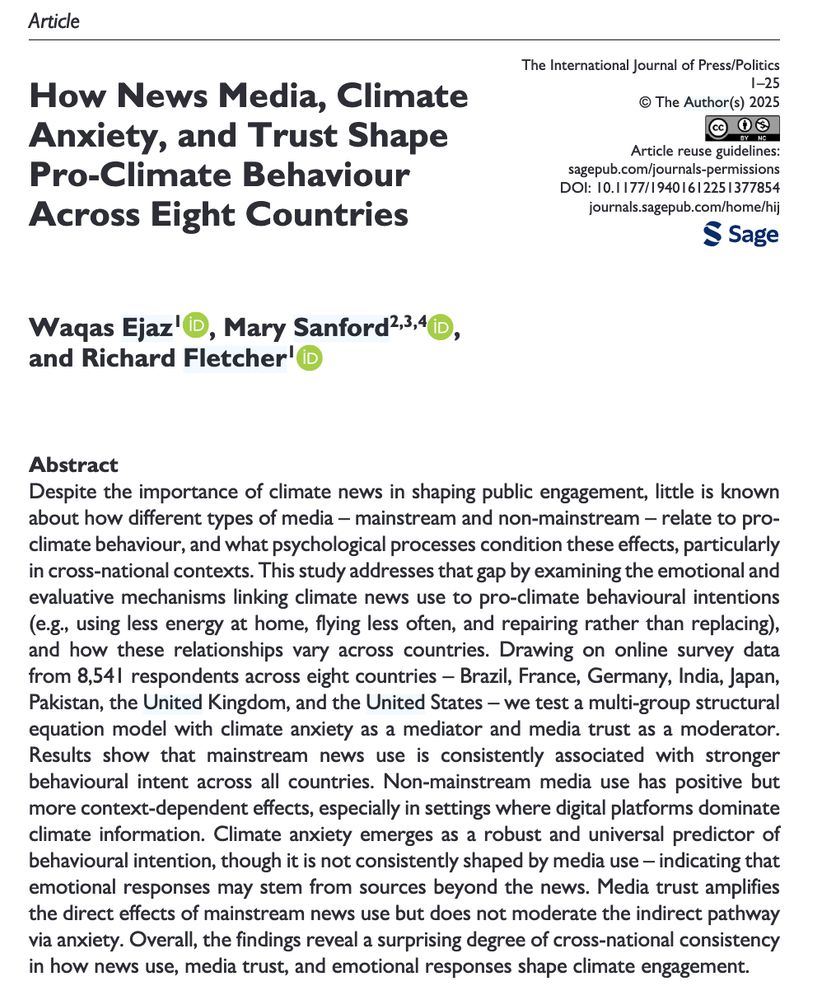
There is a growing concern that the negative valence in climate stories paralyses consumers & perhaps even prevents them from taking pro-environmental actions.
However, we found that climate anxiety is a robust and universal driver of pro-climate behavioral intentions.👇
Reposted by Richard Fletcher, Alberto Acerbi, Dean Eckles , and 1 more Richard Fletcher, Alberto Acerbi, Dean Eckles, Anne Schulz


@annisch.bsky.social et al decided to have a look. Their results? "We found that appreciation for abundance was about twice as common as overload".
Paper: journalqd.org/article/view...
Reposted by Richard Fletcher

Here's a summary by our own Gretel Kahn, which includes four takeaways and many insights from our speakers Emilio Doménech, Akash Banerjee and Mosheh Oinounou
reutersinstitute.politics.ox.ac.uk/news/summary...
Reposted by Will Jennings, Richard Fletcher, Erika Franklin Fowler


@hanaatameez.bsky.social wrote up a fascinating @reutersinstitute.bsky.social report www.niemanlab.org/2025/10/news...
📱Report buff.ly/bL6y8Hj
🧵6 findings in thread

It contains:
- 5 key findings (see link)
- Top 15 most mentioned news influencers and creators by survey respondents in 24 countries
- A typology of different content types (and examples of individuals that primarily produce each)
📱Report buff.ly/bL6y8Hj
🧵6 findings in thread
Reposted by Richard Fletcher, Stephen Cushion

➡️rich data from 3rd wave of WJS study
➡️ survey of more than 32,350 journalists across 75 countries
➡️ perspectives from diverse media systems, political regimes, and cultural contexts
Free download
www.worldsofjournalism.org/reports-wjs3/
Reposted by Richard Fletcher


reutersinstitute.politics.ox.ac.uk/generative-a...

This could suggest that people are using links to find more information rather than check whether AI is accurate - but hard to be sure and probably varies case by case.

This is higher than trust in individual chatbots, but mostly because it is more widely used.
Again, younger people have slightly higher trust.

As with many behaviours around gen AI, younger people are slightly more likely to say they click through.


It's already true that most people (54%) say that they have seen AI search results in the last week.
It's more common than the use of all chatbots combined (34%).
Reposted by Simon Hix, Lisa W. Fazio, Gordon Pennycook , and 13 more Simon Hix, Lisa W. Fazio, Gordon Pennycook, Brendan Nyhan, Mark J. Brandt, Richard Fletcher, Caroline Krafft, Catherine E. De Vries, Alexander Wuttke, John Holbein, Janne Tukiainen, David R. Miller, Nazita Lajevardi, Nikolay Marinov, Georg Weizsäcker, Anita Gohdes

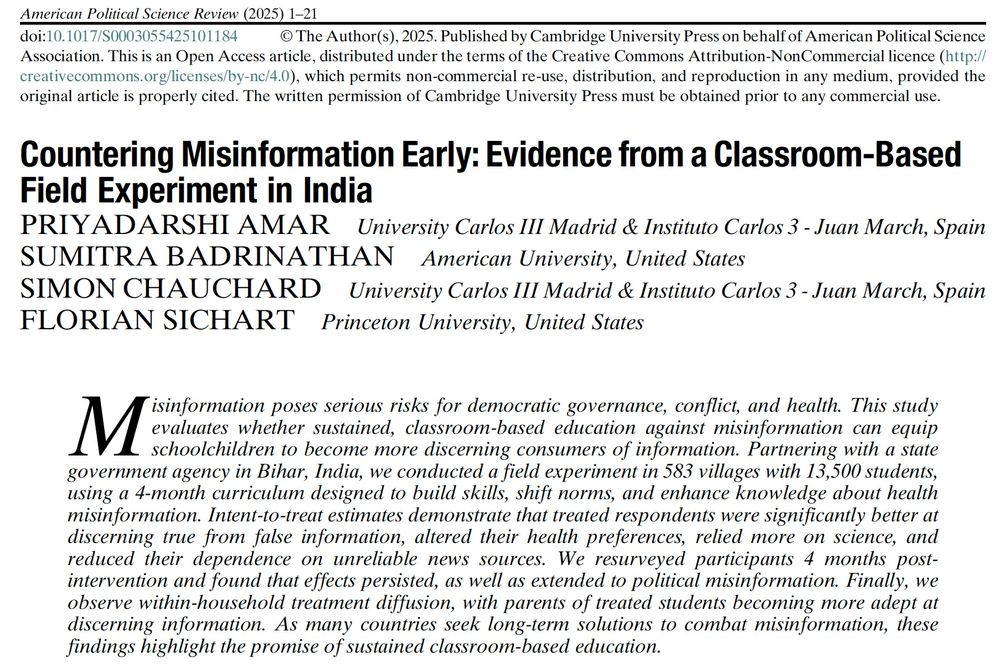
➡️ We ran a large media literacy experiment to fight misinformation
➡️ 13,500 students, 583 villages in Bihar, India
➡️Created custom misinfo curriculum of 4 months
➡️Partnered w the government to roll it out as an official course in classrooms
hopeful findings👇🏽
Full @reutersinstitute.bsky.social report by @felixsimon.bsky.social @rasmuskleis.bsky.social and me.
reutersinstitute.politics.ox.ac.uk/generative-a...