Keith Lilley
banner
profkdlilley.bsky.social
Keith Lilley
@profkdlilley.bsky.social

Academic geographer on a long journey. Coventry kid, washed up on Ireland's shore. Interests in bench marks, industrial archaeology, maps and mapping, new towns, landscape histories, medieval stuff, pottering about on my bike, being outdoors 🚵 .. more

Keith Lilley is Professor at Queen's University Belfast, known as a historical geographer and urban historian.

Source: Wikipedia
History 68%
Philosophy 11%

Reposted by Keith Lilley

Interested in more Map Room Conversations? They will be back as part of #AIC2026 @rgsibg.bsky.social focused on this year's conference theme, inequality. Submit your abstract by 25 February! #CFP #geography #skystorians 🗃️
CfP: Map Room Conversations: Geographies of Inequalities | H-Net
At the 2024 Royal Geographical Society (with IBG) conference, a new type of session was trialled, focused on engagements with the Society’s map collections. The ‘Map Room Conversations’ allowed partic...
networks.h-net.org

Hoping for better weather next weekend for our @niscifest.bsky.social "summit science" walk up Divis with @nationaltrust.org.uk volunteers 👍
Job Opportunity!

Assistant Professor in World History, 1700-1850 (Temporary Cover)
University of Cambridge - Faculty of History

www.jobs.ac.uk/job/DQJ490/a...
Assistant Professor in World History, 1700-1850 (Temporary Cover) at University of Cambridge
Looking for a new job opportunity in academia? Check out this job opening for a Assistant Professor in World History, 1700-1850 (Temporary Cover) on jobs.ac.uk!
www.jobs.ac.uk

Reposted by Keith Lilley

The introduction of “mandatory PPE for users of bicycles is outside the scope of the current measures” focused on e-scooter and e-bike users, the Department of Transport clarified… a day after saying bikes were part of the plans
No plans for compulsory helmets and hi-vis for cyclists, Irish government confirms… 24 hours after saying the exact opposite - Cycling News | Bike Reviews | road.cc
The introduction of “mandatory PPE for users of bicycles is outside the scope of the current measures” focused on e-scooter and e-bike users, the Department of Transport clarified
road.cc

Reposted by Keith Lilley

Call for papers, Irish Conference of Medievalists!
Trinity College Dublin, 28-29 May (in person)
Registration €40 (students €20). 1/4
📢 Call for papers and discussion participation:

Into the Wild Conference & Discussion Meeting - 21st & 22nd May 2026, Glasgow.

Multidisciplinary event of interest to researchers, practitioners & policy makers.

Deadline: 2 March 2026.
Details: tinyurl.com/8twry2zc

Please share 🙏

Reposted by Keith Lilley

🎇Job Klaxon!!🎇 Assistant Lectureship in Medieval Irish and Celtic Studies at Maynooth University (12-month contract). Application deadline 22 March 2026. Come work with us in the Department of Early Irish @ceilteachomn.bsky.social!

my.corehr.com/pls/nuimrecr...

Hannah is a brilliant advocate for museums 👍
We’re delighted that Hannah Crowdy, head of curatorial at National Museums NI, has been elected as Northern Ireland trustee on our Board.

An AMA mentor and previously a member of the MA’s Ethics Committee, Hannah is invested in our campaigns and work, spearheading and advocating for them.
Hannah Crowdy elected to MA Board - Museums Association
The head of curatorial at National Museums NI has been elected as our Northern Ireland trustee
www.museumsassociation.org

Reposted by Keith Lilley

We’re delighted that Hannah Crowdy, head of curatorial at National Museums NI, has been elected as Northern Ireland trustee on our Board.

An AMA mentor and previously a member of the MA’s Ethics Committee, Hannah is invested in our campaigns and work, spearheading and advocating for them.

Hannah Crowdy elected to MA Board - Museums Association
The head of curatorial at National Museums NI has been elected as our Northern Ireland trustee
www.museumsassociation.org
Very pleased to share details of a new permanent academic job opportunity in Creative & Cultural Industries at University College Dublin. We are seeking candidates with a PhD whose work engages with the commercial creative industries. Deadline: 6 March 2026 universityvacancies.com/university-c....
Call for membership to the RIA multidisciplinary committees!

The RIA is inviting applications for membership of its multidisciplinary committees (MDCs) for the 2026–2030 term.

Learn more about what the MDCs do and how to apply for membership on the RIA website: www.ria.ie/2025/12/16/c...

Reposted by Keith Lilley

Our sister project Maps and Memories is holding several events for @niscifest.bsky.social this month and some of the #OS200 project team will be there to represent 😍
Check out the listings here: nisciencefestival.com/programme/ma...
Maps & Memories | NI Science Festival
nisciencefestival.com

Research Fellow in Biomolecular Archaeology as part of the AHRC-funded PELLIS (Investigating the manufacture, trade, and economy of Roman leather via multi-analytical approaches) project co-led by Rhiannon Stevens.

www.ucl.ac.uk/work-at-ucl/...
UCL – University College London
UCL is consistently ranked as one of the top ten universities in the world (QS World University Rankings 2010-2022) and is No.2 in the UK for research power (Research Excellence Framework 2021).
www.ucl.ac.uk

Many thanks 🙏

Reposted by Keith Lilley

You can now read our latest Ezine here: discoveryprogramme.ie/2026/02/04/d...

🍀 New project: Tara by Name, Tara by Nature?
🌎 New tool: CHERISH web map
📖 Reconstructing the Lough Kinale Shrine
✈️AARG conference
💻Paradata in 3D Scholarship
🦺 Survey at St John's Point
🖊️ New paper: Woodstown Viking Site
Discovery Programme Ezine: Spring 2026 now available - The Discovery Programme
The latest Discovery Programme Ezine (Spring 2026) is now available to read here. This edition of the Ezine includes updates on the Discovery Programme’s work including: New project: Tara by Name, Tara by Nature? New tool: the CHERISH Project web map Reconstructing the Lough Kinale Shrine Aerial Archaeology Research Group conference Workshop: Paradata in 3D […]
discoveryprogramme.ie

Reposted by Charles West

For those interested, we've drawn on this dataset and imported into ArcPro
doi.org/10.15131/she...
Mapping The Itinerary of King Edward I
‘Is it the end of the world?’ remarked one thirteenth-century Welsh poet, when English forces stormed into Wales in 1277. This quote is symbolic of how national identity – the subject of this project - was a matter of life and death, sovereignty and submission, dreams and realities. It is an investigation into how Edward I’s movements around the British Isles were linked inextricably to his promotion of a ‘United Kingdom’, a ‘Great Britain’, by bringing Wales and Scotland under English crown control. Using the locations of castles, borders, revolts and battles, and Edward’s movements between these points, we can visually document how location was used to advance Edward’s ideology and establish him as the avenging overlord of Britain. Many scholars have studied Edward I’s life, before and during his kingship. Most have also utilised Henry Gough’s Itinerary of Edward I, which was the basis of my work on Edward’s itinerary. However, my research (stemming from the University of Sheffield’s SURE project) departs from purely static mapping of Edward’s itinerary to dynamic, statistical and static mapping, allowing us to gauge just how important location was; which military, progress and recreational routes were taken; which castles were widely visited, all from a different visual perspective. Using spreadsheets, data sets and mapping software we can demonstrate in-depth that castles and borders – namely the Anglo-Welsh border and River Severn, and Hadrian’s Wall in the north – were the focal points of national identity, the battle grounds of sovereignty, where Edward’s Great Britain was forged, practiced, implemented or destroyed. As we can see, the dynamic map shows both the linear movement of Edward I across his realm, as well as the vast mileage he totalled going between South-Eastern England and North-Eastern Scotland during the years 1277-1307. This is further exemplified through charts detailing his total mileage per month and per year, created by Dr Tom Stafford. The dynamic map is cumulative in form; thus, it plots each location visited on-top of those already present, allowing us to see which areas were most important to Edward’s ideology of a ‘Rex Britanniae’, a ‘Great Britain’. As we would expect from an English king, Edward spent a significant amount of time around London and the South-East. What is most telling, however, is that North Wales, the Welsh Marches, the Anglo-Scottish borderlands and parts of the eastern Scotland, around Stirling and Edinburgh, saw dense clusters of movement. Across these areas, castles are widely present. Considering that movement is clustered around borderland, coastal and inland castles, this confirms my hypothesis: that castles were at the core of Edward’s campaign to subsume Wales and Scotland into the inalienable royal fisc of England, namely, the personal and private property of the English Crown. There are, nevertheless, minor limitations with cumulative mapping. While the importance of particular locations is exemplified by the density of dots, cumulative mapping lacks the fluidity of non-cumulative forms. While this map succeeds in displaying the linear routes that Edward took across his realm, the contrast between peacetime and wartime movements does become more muted. Aside from mapping itself, there are issues with the data source that need addressing and measures I took in response. The data was extracted from Henry Gough’s Itinerary of Edward I, published in 1900. The publication year is in-itself problematic, due to the sources available for Gough to extract his data from, and although some revisions and additions to the data were taken from Spufford’s revised Itinerary of Edward I (Index version), significant gaps in the data still remained. For example, where Edward was said to have spent 52 days in one location, before moving to one nearby 10 days after the last day in the original location, days 53-61 were marked ‘unknown’. This appears frequently throughout the itinerary, so I took the decision to extend the period spent in the original location from day 52 to day 61, in order to make the dynamic map fuller, but also to suggest that the logical place of stay would likely have been the original location. While some will not agree with my methods, the data from the itinerary, latitudes and longitudes, are all correct, and my extensions of duration were infrequent so as not to corrupt the data. People are, of course, more than welcome to further the data harvested from the itineraries, including the years that I have been working on. By Charlotte Tomkins Acknowledgements: I would like to thank Dr Tom Stafford from the University of Sheffield for creating these maps and charts from the data I provided, as well as assisting me on what would work best and give the most coherent and useable results. Also, to Dr Charles West (Department of History), whose suggestions over research and planning and management advice were indispensable. Bibliography (for mapping, data collection and research blog on the Sheffield University History Matters page): Birkholz, D., The King’s Two Maps: Cartography and Culture in Thirteenth-Century England (London, 2004). Connolly, D. K., The Maps of Matthew Paris (Woodbridge, 2009). Crockford, J. E., ‘The Itinerary of Edward I of England: Pleasure, Piety and Governance’, in Journeying along Medieval routes in Europe and the Middle East (Turnhout, 2016). Davies, R. R., ‘Edward I and Wales’ in T. Herbert and G. E. Jones (eds), Edward I and Wales (Cardiff, 1988). Edson, E., ‘Mapping Time and Space: How Medieval Mapmakers viewed their world’ in The British Library Studies in Map History vol.1 (London, 1977). Gough, H., Itinerary of King Edward the First throughout his reign, A.D. 1272-1307, exhibiting his movements so far as they are recorded, vol. 2., 1286-1307 (1900). Gough, H., Itinerary of King Edward the First throughout his reign, A.D. 1272-1307, exhibiting his movements so far as they are recorded, vol. 1., 1272-1285 (1900). Jones, D., The Plantagenets: The Kings Who Made England (London, 2012). Lawson, S., (ed), Hadrian’s Wall (London, 2003). Lilley, K. D., ‘Mapping medieval geographies’, Geographical Encounters in the Latin West and Beyond 300-1600 (January, 2011), pp. 1-20. Morris, M., Castle: A History of the Buildings that shapes Medieval Britain (London, 2012). Morris, M., Edward I: A Great and Terrible King (London, 2009). Parker, P., History of Britain in Maps (Glasgow, 2017). Prestwich, M., Edward I (London, 1988). Spufford, E. W., Itinerary of Edward I: Index, part of the List & Index Society collection, vol. 135., (London, 1977). Traquair, P., Freedom’s Sword: Scotland’s Wars of Independence (London, 1998).
doi.org
Exploring the itineraries of King Edward I 🤓
🚨History Job: Assistant Professor in Early Modern British History (Permanent) 🗃️

Come work with us at Warwick! You will join a group of excellent early-modernists and one of the nicest bunches of historians around!
👇👇👇

@uni-of-warwick.bsky.social

warwick-careers.tal.net/vx/lang-en-G...
Assistant Professor in Early Modern British History (111286-0126) - University of Warwick
Title: Assistant Professor in Early Modern British History (111286-0126). Application Deadline: . Position Type: Permanent
warwick-careers.tal.net

Reposted by Keith Lilley

I'm pleased to announce that my article "The Garden in Movement as a Space and Practice of Care" has been published in @landscaperesearch.bsky.social. Thanks to @tim-waterman.co.uk and Zannah Matson! www.tandfonline.com/eprint/YQ7GT...
The garden in movement as a space and practice of care
A garden developed by professors at a French secondary education institution, Lycée Agricole Jules-Rieffel, demonstrates how landscape maintenance can function as a caring practice. Designed in con...
www.tandfonline.com

Reposted by Keith Lilley

Planning an event that gets people exploring the places around them?

If you’re organising a walking tour, a talk, an exhibition, or even another heritage or walking festival taking place in May, we can help you promote it as part of Out & About Archaeology.

Find out more 👉 shorturl.at/qHZZn

Reposted by Keith Lilley

We have a poster for Fluid Environments & Spatial Humanities! (credit: Giulia Grisot)

Join us in Lancaster on Feb 27 - www.eventbrite.co.uk/e/fluid-envi...

Travel bursaries available for @n8cir.bsky.social students & staff. Details via registration.

#dh #envhum #spatialhumanities #histstm

Reposted by Keith Lilley

🗓️ Reminder! Bannau Brycheiniog Place Names Workshop – 6 Feb 2026!

Help record local place names and stories with Dr James January-McCann.

When: Thu 6 Feb 2026, 1–7pm

Where: Llangynidr Village Hall, Llangynidr, Crickhowell, NP8 1LS

More details: zurl.co/pBCYd
Full time AHRC doctoral studentships now available in Arts & Humanities at University of Hertfordshire for October 2026 start - please do share widely!! This includes both History & Heritage Studies among other subjects 🌟😀 www.herts.ac.uk/research/res...
AHRC Doctoral Landscape Award studentships
The AHRC Doctoral Landscape Award is a major new funding scheme from the Arts and Humanities Research Council (AHRC). Its aim is to grow the UK’s capacity for doctoral research in the arts and humanit...
www.herts.ac.uk

Reposted by Keith Lilley

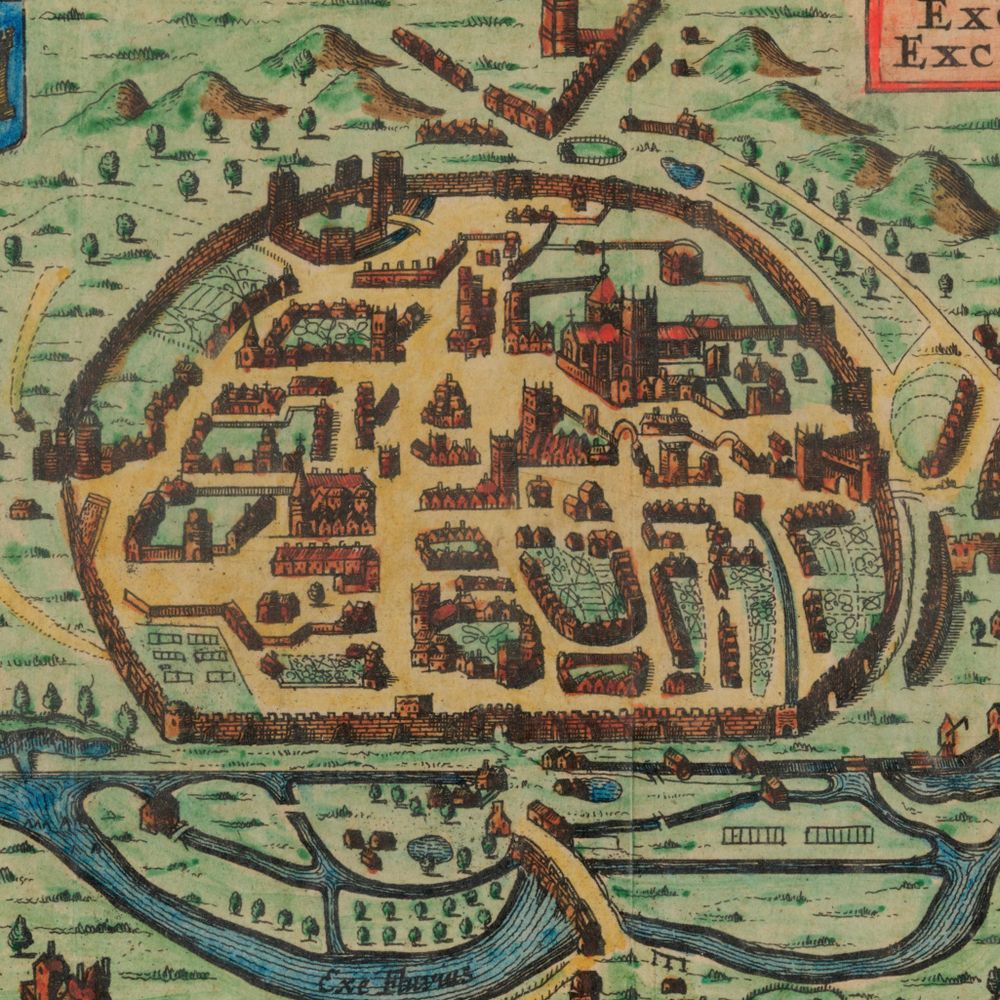
Today is International Map Day!

One of our favourite maps in the collections is this map of Exeter, engraved by Frans Hogenberg in c 1618.

Can you identify any landmarks that still exist today?

📷 Constable Maps 27; digitised by @dhlabexeter.bsky.social

#InternationalMapDay #MappingOurExeter

"County Down experienced their wettest January on record" 🧐 and with no end in sight 😭

Look at the size of these monsters, pounding the roads and taking up space, ban SUVs we don't need them
The extent to which China is powering the world with affordable, clean energy technologies - from solar photovoltaics to electric vehicles - is astonishing. It's already the biggest energy story of my lifetime and it's still early days.
Electric cars go mainstream as adoption surges across rich and developing nations

A wave of affordable Chinese-made EVs is accelerating the shift away from petrol cars, challenging long‑held assumptions about how transport decarbonisation unfolds.
buff.ly/pIGRSrY