David Stott
banner
davstott.bsky.social
David Stott
@davstott.bsky.social

Paleotopographer. Asking how people changed landscapes and landscapes changed people.

GIS, remote sensing, archaeology.

Tinkerer. Aspiring bodger.

Glaswegian in Jutland.

Archaeologist at Moesgaard Museum. Personal account. All views my own etc. .. more

History 18%
Political science 15%
Pinned
There's enough of us now to do one of these!

go.bsky.app/M9FwG2K

🏺

We need to spend some time gently educating our geological colleagues that we're here and we know stuff:

bsky.app/profile/davs...
Interesting. I'm concerned by:
a) a somewhat cursory engagement with prior art & a large body of archaeological literature on this topic
b) referencing Graham Hancock 💀💀💀!!!
New paper from Adam Morley shows that some vegetation anomalies in multi-spectral satellite data correlate with geophysical data, and can be used to identify buried archaeological structures like tunnels and drains, with examples from Cornwall and Normandy.

www.sciencedirect.com/science/arti...

That it is.

Wild / Leica also made the best survey tripods with the nifty interlocks on the legs when closed.

Reposted by David Stott

These are so beautifully designed and built! 😍 and extend the existing 'The Bare Bones' learning materials from Forestry and Land Scotland and written by Gavin Lindsay, Matt Ritchie and Alison Sheridan.

Thanks for highlighting @thebefs.bsky.social 🙏

I'm left handed & wear mine on the right but a people seem to think that's aberrant and wrong for some reason?

The M5 is the most beautiful of all the Leicas.

Reposted by David Stott

Record low sea levels in the Baltic Sea – Will there be a major inflow of saltwater from the North Sea? - IOW

www.iow.de/message/item...
Record low sea levels in the Baltic Sea – Will there be a major inflow of saltwater from the North Sea?
Photo of turbulent waves on the Baltic Sea during stormy weather.
www.iow.de

Dibiye
YouTube video by Francis Bebey - Topic
youtu.be

Post a banger that isn't English

tidal.com/track/232840...

Reposted by David Stott

Relative elevation models are both compelling visualizations of fluvial systems but also frankly useful for geologic mapping of terraces or quantifying zones of potential flood inundation. Several years ago Open Topography coded up an method for using python to make REMs (see below) 🧵

.. in particlarly br Kvamme and @gverhoev.bsky.social.

I'd recommend that you specifically seek out archaeological prospection specialists when you look for domain experts. There's not many of us, but we're nice:

go.bsky.app/M9FwG2K

Good- citing Hancock is tantamount to uncritically citing a a young earth creationist in a geoscience paper.

In terms of the wider literature- multi-spectral imaging has been used by archaeologists for decades at this point, and there are some good papers on sensor fusion and spectral indices...

A slightly magnetic rock or a bumpity rock?

(I work with both)

at this, and pointed out that referencing provably anti-scientific racist isn't really ideal.

Citing these dingdongs risks legitimising them. The state of the world at the minute shows us where that gets us. Beware.

To harp on: This is a problem that happens sometimes in interdisciplinary work. The authors aren't domain experts & aren't well versed in archaeology. Fair enough.

However- this is something that indicates a broken review / editorial process. At some point someone who is should've had a look...

Interesting. I'm concerned by:
a) a somewhat cursory engagement with prior art & a large body of archaeological literature on this topic
b) referencing Graham Hancock 💀💀💀!!!
New paper from Adam Morley shows that some vegetation anomalies in multi-spectral satellite data correlate with geophysical data, and can be used to identify buried archaeological structures like tunnels and drains, with examples from Cornwall and Normandy.

www.sciencedirect.com/science/arti...

Think I've heard that one too.

Reposted by David Stott

Give lengthy and incomprehensible explanations when questioned.

Reposted by David Stott

Cliffs might seem strong and safe but they can provide many hazards. Storms, prolonged periods of wet weather, cold snaps and heatwaves can trigger landslides.

Check the image below to see if you can spot the cliff-based hazards in this scene. Answers here: www.bgs.ac.uk/discovering-...

Reposted by David Stott
New paper from Adam Morley shows that some vegetation anomalies in multi-spectral satellite data correlate with geophysical data, and can be used to identify buried archaeological structures like tunnels and drains, with examples from Cornwall and Normandy.

www.sciencedirect.com/science/arti...

Is it non invasive / non destructive though?

(Insert story here about a certain professor accidentally giving a skull a third eye when probing the extent of a cairn...)
My favorite artifact in the "you don't need AI to do art" discourse is, of course, screenwriter Dan O'Bannon's sketch of the facehugger to explain it to Giger.

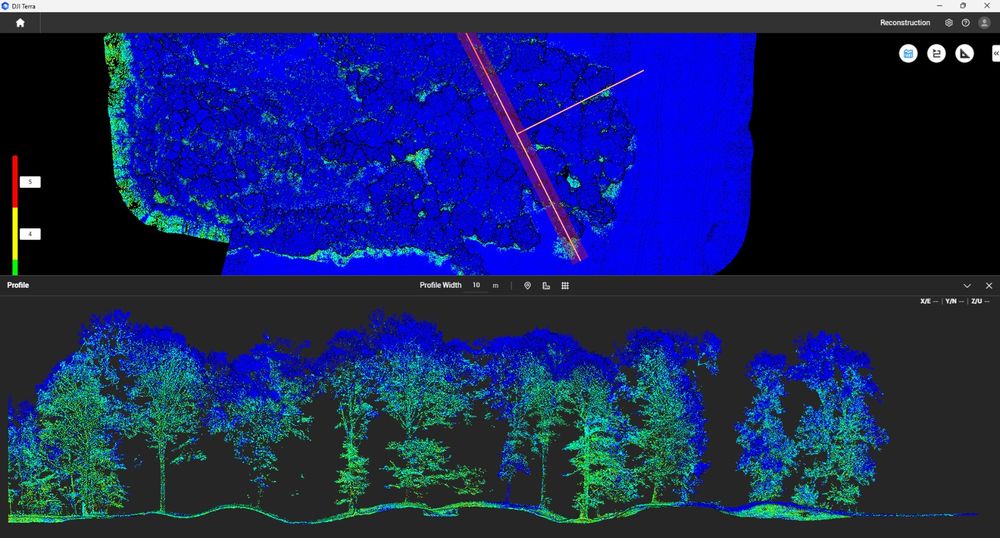
And, as bonus here's a nice lidar scan of an enormous badger sett in a medieval fortress in Denmark.

bsky.app/profile/davs...
Results are good. Now just need to work out the best workflow for processing the data.

Archaeological sites do act as havens for biodiversity - the legal and social protections they have spare them from the worst of commercial forestry and agriculture.

I've been wanting to do a project on looking at fungal diversity on protected vs unprotected sites for ages.

Reposted by David Stott

“February. Another cold, dead month, or so it seems. The elms are bare against the sky, the plough-ground is naked and wet, and still as brown as the sodden leaves.
Yet the world is waking up”.

Artists: Edith Hilder, Rowland Hilder (ShellGuide, 1955)

Comic, possibly?

(In that the New Labour tribute act plays *all* the old songs)

15 grand oven. Holy macaroni.

Turn gently!

Reposted by David Stott

Having fun this evening on the tablet visualising St Mary’s Church, Whitekirk with a lime render.

#Procreate #iPad
#EastLothian

Reposted by David Stott

The Knowth Macehead • c.3300-2800 BC

It has been described as one of the greatest surviving artworks from Neolithic Europe.

All six sides of the flint macehead are delicately decorated. From this view, it appears like a human face, with the hole for the shaft as a mouth.

#Ireland #SpéirGhorm
📢 Call for papers and discussion participation:

Into the Wild Conference & Discussion Meeting - 21st & 22nd May 2026, Glasgow.

Multidisciplinary event of interest to researchers, practitioners & policy makers.

Deadline: 2 March 2026.
Details: tinyurl.com/8twry2zc

Please share 🙏