



Just out: Probing non-radiative quantum relaxation in fluorophores using an optical fiber Bragg grating photothermal sensor

Probing non-radiative quantum relaxation in fluorophores using an optical fiber Bragg grating photothermal sensor
Communications Chemistry, Published online: 10 January 2026; doi:10.1038/s42004-025-01880-wOptical fiber Bragg gratings (FBGs) are widely applied in sensing, but their potential for investigating quantum processes of photon–molecule interactions remains unexplored. Here, the authors report a method for probing photon-induced non-radiative thermal relaxation in fluorophores with FBGs, using Rhodamine B as an example and observing distinct Bragg wavelength shifts based on its vibronic transitions and absorption properties.
dlvr.it
January 11, 2026 at 3:39 AM
Just out: Probing non-radiative quantum relaxation in fluorophores using an optical fiber Bragg grating photothermal sensor

First, a bit about the cover art 🎨🖼️:
We attached the photoclick moiety to proteins in RPE1 cells 🧫 and used a DMD projector from @EKBTechnologies on a @healthcare.nikon.com Ti2🔬 to selectively irradiate regions.
Activated areas are labeled w fluorophores✨ -we even printed the @rsc.org logo!
2/🧵
We attached the photoclick moiety to proteins in RPE1 cells 🧫 and used a DMD projector from @EKBTechnologies on a @healthcare.nikon.com Ti2🔬 to selectively irradiate regions.
Activated areas are labeled w fluorophores✨ -we even printed the @rsc.org logo!
2/🧵


January 9, 2026 at 2:53 AM
First, a bit about the cover art 🎨🖼️:
We attached the photoclick moiety to proteins in RPE1 cells 🧫 and used a DMD projector from @EKBTechnologies on a @healthcare.nikon.com Ti2🔬 to selectively irradiate regions.
Activated areas are labeled w fluorophores✨ -we even printed the @rsc.org logo!
2/🧵
We attached the photoclick moiety to proteins in RPE1 cells 🧫 and used a DMD projector from @EKBTechnologies on a @healthcare.nikon.com Ti2🔬 to selectively irradiate regions.
Activated areas are labeled w fluorophores✨ -we even printed the @rsc.org logo!
2/🧵

Are you staining DNA in your ExM samples?
We have awesome news for you! All our 6 SPY-DNA probes work beautifully well with the U-ExM protocol.
You can now tune the color of the DNA channel to your needs, according to the fluorophores on your preferred antibodies.
spirochrome.com/products/?_c...
We have awesome news for you! All our 6 SPY-DNA probes work beautifully well with the U-ExM protocol.
You can now tune the color of the DNA channel to your needs, according to the fluorophores on your preferred antibodies.
spirochrome.com/products/?_c...

January 8, 2026 at 2:25 PM
Are you staining DNA in your ExM samples?
We have awesome news for you! All our 6 SPY-DNA probes work beautifully well with the U-ExM protocol.
You can now tune the color of the DNA channel to your needs, according to the fluorophores on your preferred antibodies.
spirochrome.com/products/?_c...
We have awesome news for you! All our 6 SPY-DNA probes work beautifully well with the U-ExM protocol.
You can now tune the color of the DNA channel to your needs, according to the fluorophores on your preferred antibodies.
spirochrome.com/products/?_c...

Happy Holidays from the CISR! May all your days and fluorophores be BRIGHT. #MicroscopyMonday

December 22, 2025 at 10:24 PM
Happy Holidays from the CISR! May all your days and fluorophores be BRIGHT. #MicroscopyMonday

Kinetically Trapped Supramolecular Fluorophores: Suppressing Molecular Motion for Enhanced Brightness and Stability in Water www.chinesechemsoc.org/doi/10.31635...
#chemistry #openaccess #science
#chemistry #openaccess #science

December 20, 2025 at 12:03 AM
Kinetically Trapped Supramolecular Fluorophores: Suppressing Molecular Motion for Enhanced Brightness and Stability in Water www.chinesechemsoc.org/doi/10.31635...
#chemistry #openaccess #science
#chemistry #openaccess #science

Rapid accumulation of fluorophores and fast kill identify drugs with bactericidal effects against Gram-negative bacteria. Published Open Access and fee-free in Microbiology using a Publish and Read agreement: doi.org/10.1099/mic.... #MicrobioJ #PublishAndRead

December 19, 2025 at 3:31 PM
Rapid accumulation of fluorophores and fast kill identify drugs with bactericidal effects against Gram-negative bacteria. Published Open Access and fee-free in Microbiology using a Publish and Read agreement: doi.org/10.1099/mic.... #MicrobioJ #PublishAndRead

Issue 48 is here! #ChemSciCovers
Our front cover this week features Georgina K. Such, Chris Ritchie et al 🤩
'Monitoring structural change and drug release of responsive nanoparticles using polarity-sensitive fluorophores'
🔗 doi.org/10.1039/D5SC...
Our front cover this week features Georgina K. Such, Chris Ritchie et al 🤩
'Monitoring structural change and drug release of responsive nanoparticles using polarity-sensitive fluorophores'
🔗 doi.org/10.1039/D5SC...

December 19, 2025 at 2:00 PM
Issue 48 is here! #ChemSciCovers
Our front cover this week features Georgina K. Such, Chris Ritchie et al 🤩
'Monitoring structural change and drug release of responsive nanoparticles using polarity-sensitive fluorophores'
🔗 doi.org/10.1039/D5SC...
Our front cover this week features Georgina K. Such, Chris Ritchie et al 🤩
'Monitoring structural change and drug release of responsive nanoparticles using polarity-sensitive fluorophores'
🔗 doi.org/10.1039/D5SC...

Featured on the front cover of J Mater Chem C issue 48, read HOT paper 'Green-synthesized single-benzene fluorophores exhibiting room-temperature phosphorescence and solid-state fluorescence for biological and optical applications' by Carolin Müller, Stefan Schramm et al.
👉doi.org/10.1039/D5TC...
👉doi.org/10.1039/D5TC...

December 16, 2025 at 1:56 PM
Featured on the front cover of J Mater Chem C issue 48, read HOT paper 'Green-synthesized single-benzene fluorophores exhibiting room-temperature phosphorescence and solid-state fluorescence for biological and optical applications' by Carolin Müller, Stefan Schramm et al.
👉doi.org/10.1039/D5TC...
👉doi.org/10.1039/D5TC...

💡 Instead, do FMO Controls
Fluorescence minus one (FMO) answers the right question:
Where does the true negative population fall once all other fluorophores are present?
(6/n)
Fluorescence minus one (FMO) answers the right question:
Where does the true negative population fall once all other fluorophores are present?
(6/n)
December 16, 2025 at 1:11 PM
💡 Instead, do FMO Controls
Fluorescence minus one (FMO) answers the right question:
Where does the true negative population fall once all other fluorophores are present?
(6/n)
Fluorescence minus one (FMO) answers the right question:
Where does the true negative population fall once all other fluorophores are present?
(6/n)
Microscopy images showing labeled E. coli cells with glowing red or green fluorophores indicating the presence of plasmids, alongside FACS data quantifying the population. (4/7)

December 15, 2025 at 1:36 PM
Microscopy images showing labeled E. coli cells with glowing red or green fluorophores indicating the presence of plasmids, alongside FACS data quantifying the population. (4/7)

A couple spiders fluorescing under a UV (blacklight) flashlight on a night hike in Ecuador. The last shot shows the second spider lit with a normal light. Spiders fluoresce under UV light and possess a huge diversity of fluorophores. #spider

December 12, 2025 at 12:55 AM
A couple spiders fluorescing under a UV (blacklight) flashlight on a night hike in Ecuador. The last shot shows the second spider lit with a normal light. Spiders fluoresce under UV light and possess a huge diversity of fluorophores. #spider
A couple spiders fluorescing under a UV (blacklight) flashlight on a night hike in Ecuador. The last shot shows the second spider lit with a normal light. Spiders fluoresce under UV light and possess a huge diversity of fluorophores. #spider

December 12, 2025 at 12:55 AM
A couple spiders fluorescing under a UV (blacklight) flashlight on a night hike in Ecuador. The last shot shows the second spider lit with a normal light. Spiders fluoresce under UV light and possess a huge diversity of fluorophores. #spider
A couple spiders fluorescing under a UV (blacklight) flashlight on a night hike in Ecuador. The last shot shows the second spider lit with a normal light. Spiders fluoresce under UV light and possess a huge diversity of fluorophores. #spider

December 12, 2025 at 12:55 AM
A couple spiders fluorescing under a UV (blacklight) flashlight on a night hike in Ecuador. The last shot shows the second spider lit with a normal light. Spiders fluoresce under UV light and possess a huge diversity of fluorophores. #spider
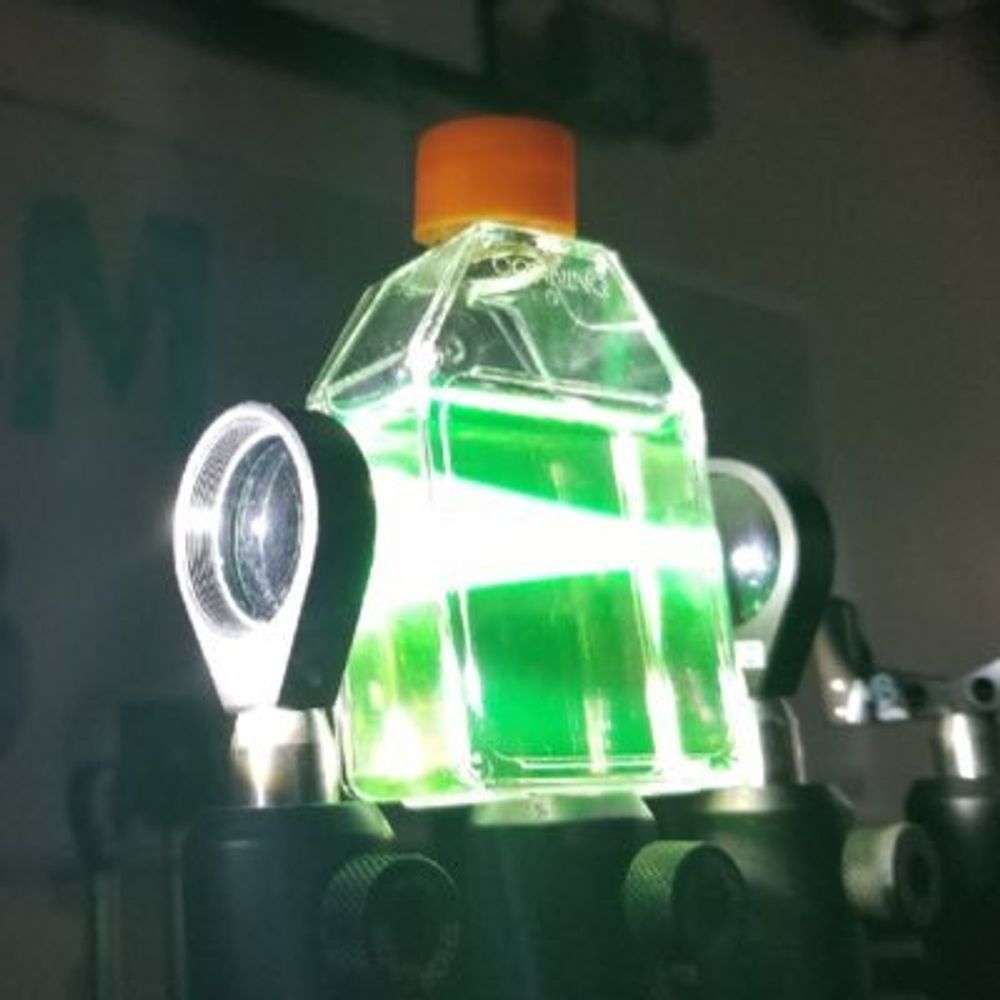
Day 3 begins our dive into #fluorscence #microscopy with a lab and lecture from none other than Dr. Wendy Salmon, @fishcscells.bsky.social, director of the Hooker Imaging Core @UNC. She teaches us about the fluorescence #light path, filters, and #fluorophores!
Apply here- bit.ly/49YQl7q
Apply here- bit.ly/49YQl7q


December 6, 2025 at 2:02 PM
Day 3 begins our dive into #fluorscence #microscopy with a lab and lecture from none other than Dr. Wendy Salmon, @fishcscells.bsky.social, director of the Hooker Imaging Core @UNC. She teaches us about the fluorescence #light path, filters, and #fluorophores!
Apply here- bit.ly/49YQl7q
Apply here- bit.ly/49YQl7q

🚨How do we implement synthetic fluorophores into biosensors? Have a look at Elias Dressler’s review article in Chimia. The issue highlights the work of Young Professors and Ambizione Fellows in Switzerland. Glad to be part of this vibrant community. ⚗️ www.chimia.ch/chimia/artic...

November 27, 2025 at 1:01 PM
🚨How do we implement synthetic fluorophores into biosensors? Have a look at Elias Dressler’s review article in Chimia. The issue highlights the work of Young Professors and Ambizione Fellows in Switzerland. Glad to be part of this vibrant community. ⚗️ www.chimia.ch/chimia/artic...

🔬 New study by Alana Mullins et al. introduces IsletAnalytics, semi-automated workflow for segmentation of immunofluorescent-stained human pancreatic islets, revealing altered islet architecture & OXPHOS proteins in T2D β‑cells.
Open-access article: doi.org/10.1530/JOE-25-0253
Open-access article: doi.org/10.1530/JOE-25-0253

November 20, 2025 at 1:10 PM
🔬 New study by Alana Mullins et al. introduces IsletAnalytics, semi-automated workflow for segmentation of immunofluorescent-stained human pancreatic islets, revealing altered islet architecture & OXPHOS proteins in T2D β‑cells.
Open-access article: doi.org/10.1530/JOE-25-0253
Open-access article: doi.org/10.1530/JOE-25-0253

Our new paper in J. Mater. Chem. C is out! pubs.rsc.org/en/content/a... First collab between the Schramm & Ibl groups. We present a green synthesis of highly emissive single-benzene fluorophores with exciting optical properties. Big shout-out to our B.Sc. student M. Kramp for his key contributions!

November 19, 2025 at 8:06 PM
Our new paper in J. Mater. Chem. C is out! pubs.rsc.org/en/content/a... First collab between the Schramm & Ibl groups. We present a green synthesis of highly emissive single-benzene fluorophores with exciting optical properties. Big shout-out to our B.Sc. student M. Kramp for his key contributions!
Good practice:
• Always check actual emission filters for your machine, not generic vendor diagrams
• Use a spectral viewer for your specific cytometer
• Place bright fluorophores on low-expression markers (and vice versa)
• Use FMOs (fluorescence-minus-one controls) to verify gating
(4/5)
• Always check actual emission filters for your machine, not generic vendor diagrams
• Use a spectral viewer for your specific cytometer
• Place bright fluorophores on low-expression markers (and vice versa)
• Use FMOs (fluorescence-minus-one controls) to verify gating
(4/5)
November 18, 2025 at 11:24 AM
Good practice:
• Always check actual emission filters for your machine, not generic vendor diagrams
• Use a spectral viewer for your specific cytometer
• Place bright fluorophores on low-expression markers (and vice versa)
• Use FMOs (fluorescence-minus-one controls) to verify gating
(4/5)
• Always check actual emission filters for your machine, not generic vendor diagrams
• Use a spectral viewer for your specific cytometer
• Place bright fluorophores on low-expression markers (and vice versa)
• Use FMOs (fluorescence-minus-one controls) to verify gating
(4/5)
Young researchers often think:
“Two fluorophores look similar on the map—that must mean I can’t use them”
(or the opposite…)
“They have different names, so it must be fine”
(2/5)
“Two fluorophores look similar on the map—that must mean I can’t use them”
(or the opposite…)
“They have different names, so it must be fine”
(2/5)
November 18, 2025 at 11:24 AM
Young researchers often think:
“Two fluorophores look similar on the map—that must mean I can’t use them”
(or the opposite…)
“They have different names, so it must be fine”
(2/5)
“Two fluorophores look similar on the map—that must mean I can’t use them”
(or the opposite…)
“They have different names, so it must be fine”
(2/5)
And our first talk of the #ChemSciSymposium is from Professor Tony James, discussing imaging using boron containing compounds with fluorophores for sensing!

November 18, 2025 at 10:17 AM
And our first talk of the #ChemSciSymposium is from Professor Tony James, discussing imaging using boron containing compounds with fluorophores for sensing!

Check out 'Melt, mix, and glow: emulsion-based fabrication of polyphenylsilsesquioxane microspheres with embedded hydrophobic fluorophores' by Guido Kickelbick et al. featured on the inside front cover of Materials Advances issue 21
🔗doi.org/10.1039/D5MA...
🔗doi.org/10.1039/D5MA...

November 12, 2025 at 3:54 PM
Check out 'Melt, mix, and glow: emulsion-based fabrication of polyphenylsilsesquioxane microspheres with embedded hydrophobic fluorophores' by Guido Kickelbick et al. featured on the inside front cover of Materials Advances issue 21
🔗doi.org/10.1039/D5MA...
🔗doi.org/10.1039/D5MA...

Synthetic fluorophores enhance live-cell microscopy, enabling nanoscale to macroscale imaging with improved resolution. PMID:41188619, Nat Chem Biol 2025, @nchembio https://doi.org/10.1038/s41589-025-02038-4 #Medsky #Pharmsky #RNA #ASHG #ESHG 🧪

Synthetic fluorophores for live-cell fluorescence microscopy and biosensing | Nature Chemical Biology
Fluorescence microscopy has become an indispensable tool to investigate the dynamics of macromolecules directly in living cells on length scales ranging from the nanoscale via super-resolution microscopy (SRM) to the macroscale by light sheet technology. Advances in these microscopy techniques and the desire to perform experiments with high spatial and temporal resolution in living cells increase the requirements imposed on the fluorophores used. Tailor-made synthetic small-molecule fluorophores in combination with innovative labeling strategies help to overcome these challenges and continue to push the boundaries in live-cell microscopy. This Review discusses important advances in improving the performance of synthetic fluorophores for live-cell applications and how synergistic effects can be produced by using clever labeling strategies. We detail how synthetic fluorophores advance different microscopy modalities including live-cell SRM and showcase how they can be implemented into bi
doi.org
November 8, 2025 at 10:00 PM

Interested in near-infrared fluorescence imaging?
Check out "Construction and optimization of organic fluorophores in NIR-II fluorescence imaging" by Xiaozhen Li, Yanlong Yang, Ruohan Zhang and Wei Huang
Read the full review here 👇
Check out "Construction and optimization of organic fluorophores in NIR-II fluorescence imaging" by Xiaozhen Li, Yanlong Yang, Ruohan Zhang and Wei Huang
Read the full review here 👇

Construction and optimization of organic fluorophores in NIR-II fluorescence imaging
Second near-infrared fluorescence imaging (NIR-II FLI, 1000–1700 nm) has recently emerged as a cutting-edge imaging modality, offering deeper tissue penetration and superior clarity compared to the visible (400–700 nm) and conventional NIR-I FLI (700–900 nm) due to the reduced photon scattering, weaker tissue autof
pubs.rsc.org
November 8, 2025 at 9:44 AM
Interested in near-infrared fluorescence imaging?
Check out "Construction and optimization of organic fluorophores in NIR-II fluorescence imaging" by Xiaozhen Li, Yanlong Yang, Ruohan Zhang and Wei Huang
Read the full review here 👇
Check out "Construction and optimization of organic fluorophores in NIR-II fluorescence imaging" by Xiaozhen Li, Yanlong Yang, Ruohan Zhang and Wei Huang
Read the full review here 👇
🚨Curious how synthetic fluorophores simplify microscopy? Our review covers applications such as super-resolution microscopy and biosensing. 🎉👩🔬Congrats to my first PhD student, Agnese Nicoli, for the fearless deep dive! 🔬 ⚗️
D-CHAB @ethz.ch
www.nature.com/articles/s41...
D-CHAB @ethz.ch
www.nature.com/articles/s41...

Synthetic fluorophores for live-cell fluorescence microscopy and biosensing - Nature Chemical Biology
Performing live-cell microscopy experiments with high spatial and temporal resolution requires fluorophores with highly optimized properties. This Review examines the progress in developing synthetic ...
www.nature.com
November 5, 2025 at 9:29 PM
🚨Curious how synthetic fluorophores simplify microscopy? Our review covers applications such as super-resolution microscopy and biosensing. 🎉👩🔬Congrats to my first PhD student, Agnese Nicoli, for the fearless deep dive! 🔬 ⚗️
D-CHAB @ethz.ch
www.nature.com/articles/s41...
D-CHAB @ethz.ch
www.nature.com/articles/s41...

Synthetic fluorophores for live-cell fluorescence microscopy and biosensing
->Nature | More from Lil Dr Glen EcoChat at BigEarthData.ai
->Nature | More from Lil Dr Glen EcoChat at BigEarthData.ai

Synthetic fluorophores for live-cell fluorescence microscopy and biosensing
Renz, M. Fluorescence microscopy—a historical and technical perspective. Cytometry A 83, 767–779 (2013). Ellinger, P. & Hirt, A. Mikroskopische Untersuchungen an lebenden Organen. Z. Anat. Entwickl. Gesch. 90, 791–802 (1929). Coons, A. H., Creech, H. J. & Jones, R. N...
www.nature.com
November 5, 2025 at 4:15 AM