



Hanlin Wang
@hanlinw222.bsky.social
❄️🔬PhD student @Sickkids hospital, UofToronto
Reposted by Hanlin Wang
Density animation generated using ChimeraX, using "cootmode" display settings from chimerax-trimmings.
Movie recorded thusly:
cofr showpivot false; movie record; rock y 30; wait 600; movie encode ~/Desktop/rock_movie_more.mp4 framerate 40; stop
Movie recorded thusly:
cofr showpivot false; movie record; rock y 30; wait 600; movie encode ~/Desktop/rock_movie_more.mp4 framerate 40; stop
June 13, 2025 at 6:34 PM
Density animation generated using ChimeraX, using "cootmode" display settings from chimerax-trimmings.
Movie recorded thusly:
cofr showpivot false; movie record; rock y 30; wait 600; movie encode ~/Desktop/rock_movie_more.mp4 framerate 40; stop
Movie recorded thusly:
cofr showpivot false; movie record; rock y 30; wait 600; movie encode ~/Desktop/rock_movie_more.mp4 framerate 40; stop
Reposted by Hanlin Wang
🇨🇦🚨Job Alert🚨🇨🇦
Canada Excellence Research Chair (C$5 or C$10M, 8 yr budget)
U Toronto, Dept of Biochem/LabMedPath
*Was just told they're looking for a structural biologist using cryoEM* (related to infectious disease?)
Are you an established PI ready to move to 🇨🇦?
research.utoronto.ca/funding-oppo...
Canada Excellence Research Chair (C$5 or C$10M, 8 yr budget)
U Toronto, Dept of Biochem/LabMedPath
*Was just told they're looking for a structural biologist using cryoEM* (related to infectious disease?)
Are you an established PI ready to move to 🇨🇦?
research.utoronto.ca/funding-oppo...
2026 Canada Excellence Research Chair Opportunities | Research & Innovation
research.utoronto.ca
May 31, 2025 at 12:46 PM
🇨🇦🚨Job Alert🚨🇨🇦
Canada Excellence Research Chair (C$5 or C$10M, 8 yr budget)
U Toronto, Dept of Biochem/LabMedPath
*Was just told they're looking for a structural biologist using cryoEM* (related to infectious disease?)
Are you an established PI ready to move to 🇨🇦?
research.utoronto.ca/funding-oppo...
Canada Excellence Research Chair (C$5 or C$10M, 8 yr budget)
U Toronto, Dept of Biochem/LabMedPath
*Was just told they're looking for a structural biologist using cryoEM* (related to infectious disease?)
Are you an established PI ready to move to 🇨🇦?
research.utoronto.ca/funding-oppo...
Reposted by Hanlin Wang
Thrilled to announce my first PhD publication in Nature Comms! We determined structures of the Tad pilus ATPase CpaF from Caulobacter. We use these structures to propose how CpaF employs a rotary mechanism of catalysis to drive Tad pilus assembly.
www.nature.com/articles/s41...
www.nature.com/articles/s41...

Conformational changes in the motor ATPase CpaF facilitate a rotary mechanism of Tad pilus assembly - Nature Communications
The bacterial Tad pilus extends and retracts using a single bifunctional ATPase CpaF. Here, the authors employ cryo-EM, fluorescent microscopy, and AlphaFold modelling to propose how a rotary mechanis...
www.nature.com
April 24, 2025 at 3:29 AM
Thrilled to announce my first PhD publication in Nature Comms! We determined structures of the Tad pilus ATPase CpaF from Caulobacter. We use these structures to propose how CpaF employs a rotary mechanism of catalysis to drive Tad pilus assembly.
www.nature.com/articles/s41...
www.nature.com/articles/s41...
Reposted by Hanlin Wang
We are excited to spotlight this structure of the type 3 ryanodine receptor determined by Yu Seby Chen and colleagues from UBC and the University of Siena!
It was a pleasure to collaborate with the Van Petegem (@filipvanpetegem.bsky.social) Lab on this lovely work!
www.nature.com/articles/s41...
It was a pleasure to collaborate with the Van Petegem (@filipvanpetegem.bsky.social) Lab on this lovely work!
www.nature.com/articles/s41...

Cryo-EM investigation of ryanodine receptor type 3 - Nature Communications
Ryanodine Receptor type 3 mediates ER Ca2+ release in different cell types. Here, the authors use cryo-EM to reveal a binding site for chloride and two distinct sites for ATP. Epileptic encephalopathy...
www.nature.com
April 22, 2025 at 11:19 PM
We are excited to spotlight this structure of the type 3 ryanodine receptor determined by Yu Seby Chen and colleagues from UBC and the University of Siena!
It was a pleasure to collaborate with the Van Petegem (@filipvanpetegem.bsky.social) Lab on this lovely work!
www.nature.com/articles/s41...
It was a pleasure to collaborate with the Van Petegem (@filipvanpetegem.bsky.social) Lab on this lovely work!
www.nature.com/articles/s41...
Reposted by Hanlin Wang
There is an exciting opportunity available to work in the vibrant cryoEM community here in Toronto! 🇨🇦
Happy to field informal inquiries about the position or about uprooting and moving to Toronto as a recent Torontonian myself!
Please share widely.
jobs.utoronto.ca/job/Toronto-...
Happy to field informal inquiries about the position or about uprooting and moving to Toronto as a recent Torontonian myself!
Please share widely.
jobs.utoronto.ca/job/Toronto-...
Senior Research Associate
Senior Research Associate
jobs.utoronto.ca
April 7, 2025 at 10:02 PM
There is an exciting opportunity available to work in the vibrant cryoEM community here in Toronto! 🇨🇦
Happy to field informal inquiries about the position or about uprooting and moving to Toronto as a recent Torontonian myself!
Please share widely.
jobs.utoronto.ca/job/Toronto-...
Happy to field informal inquiries about the position or about uprooting and moving to Toronto as a recent Torontonian myself!
Please share widely.
jobs.utoronto.ca/job/Toronto-...
Reposted by Hanlin Wang
Now published J. Med. Chem! @zestytoast.bsky.social's structure of type II NADH dehydrogenase from mycobacteria. A promising drug target for TB & other mycobacterial infections, Yingke demonstrates how an inhibitor can block transfer of electrons from NADH to the ETC.
pubs.acs.org/doi/full/10....
pubs.acs.org/doi/full/10....

Structure of Mycobacterial NDH-2 Bound to a 2-Mercapto-Quinazolinone Inhibitor
Mycobacterial type II NADH dehydrogenase (NDH-2) is a promising drug target because of its central role in energy metabolism in Mycobacterium tuberculosis and other pathogens, and because it lacks a k...
pubs.acs.org
March 21, 2025 at 4:55 PM
Now published J. Med. Chem! @zestytoast.bsky.social's structure of type II NADH dehydrogenase from mycobacteria. A promising drug target for TB & other mycobacterial infections, Yingke demonstrates how an inhibitor can block transfer of electrons from NADH to the ETC.
pubs.acs.org/doi/full/10....
pubs.acs.org/doi/full/10....
Reposted by Hanlin Wang
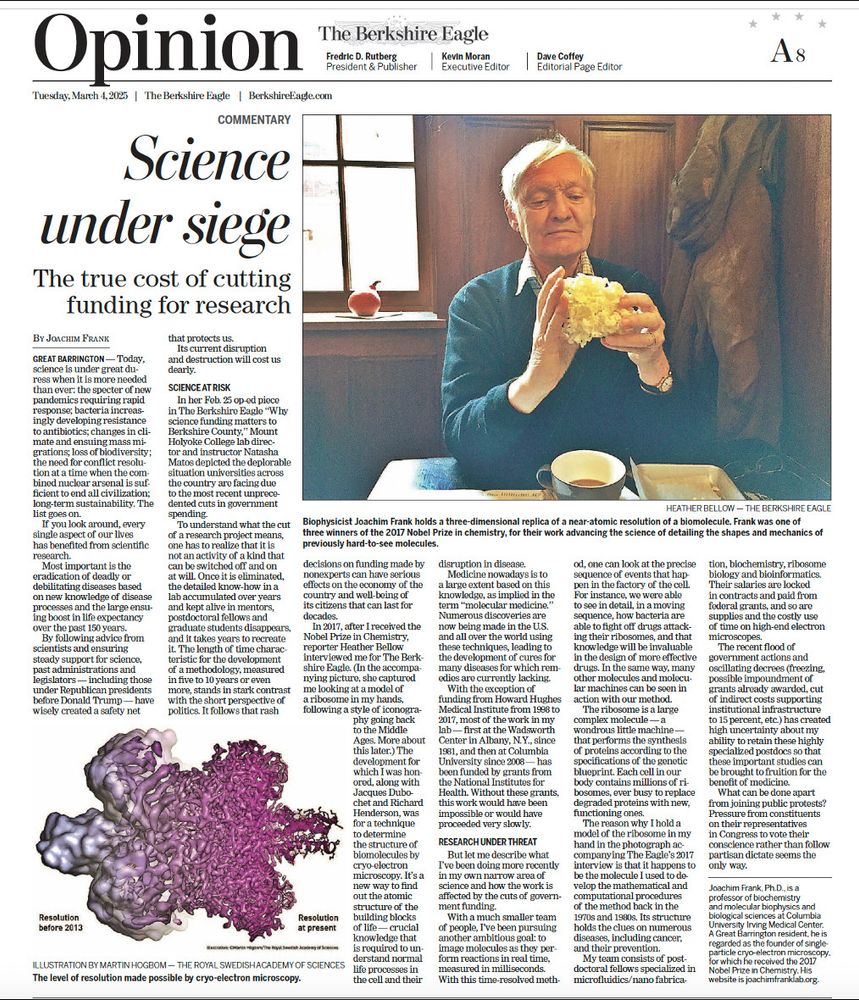
I think it's important to reach out to your own community and explain what the funding cuts mean in practice.
March 9, 2025 at 12:24 AM
I think it's important to reach out to your own community and explain what the funding cuts mean in practice.
Reposted by Hanlin Wang
Dimeric assembly of F1-like ATPase for the gliding motility of Mycoplasma | Science Advances www.science.org/doi/10.1126/...

Dimeric assembly of F1-like ATPase for the gliding motility of Mycoplasma
A unique motor complex for motility of a parasitic bacterium was determined by cryo-EM, suggesting its mechanism and evolution.
www.science.org
February 27, 2025 at 1:21 AM
Dimeric assembly of F1-like ATPase for the gliding motility of Mycoplasma | Science Advances www.science.org/doi/10.1126/...
Reposted by Hanlin Wang
🚨 Amazing Opportunity 🚨
U Alberta is looking for a director for their new #cryoEM facility
Support excellent researchers (who are really nice people) using state-of-the-art infrastructure.
+ reasonable cost of living
+ near some of most beautiful places in world
+ 🇨🇦
apps.ualberta.ca/careers/post...
U Alberta is looking for a director for their new #cryoEM facility
Support excellent researchers (who are really nice people) using state-of-the-art infrastructure.
+ reasonable cost of living
+ near some of most beautiful places in world
+ 🇨🇦
apps.ualberta.ca/careers/post...

February 22, 2025 at 2:47 AM
🚨 Amazing Opportunity 🚨
U Alberta is looking for a director for their new #cryoEM facility
Support excellent researchers (who are really nice people) using state-of-the-art infrastructure.
+ reasonable cost of living
+ near some of most beautiful places in world
+ 🇨🇦
apps.ualberta.ca/careers/post...
U Alberta is looking for a director for their new #cryoEM facility
Support excellent researchers (who are really nice people) using state-of-the-art infrastructure.
+ reasonable cost of living
+ near some of most beautiful places in world
+ 🇨🇦
apps.ualberta.ca/careers/post...
Reposted by Hanlin Wang
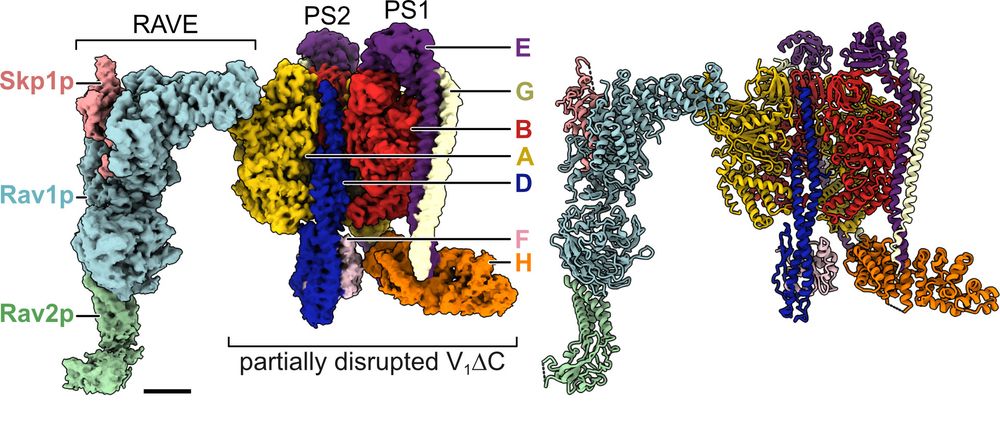
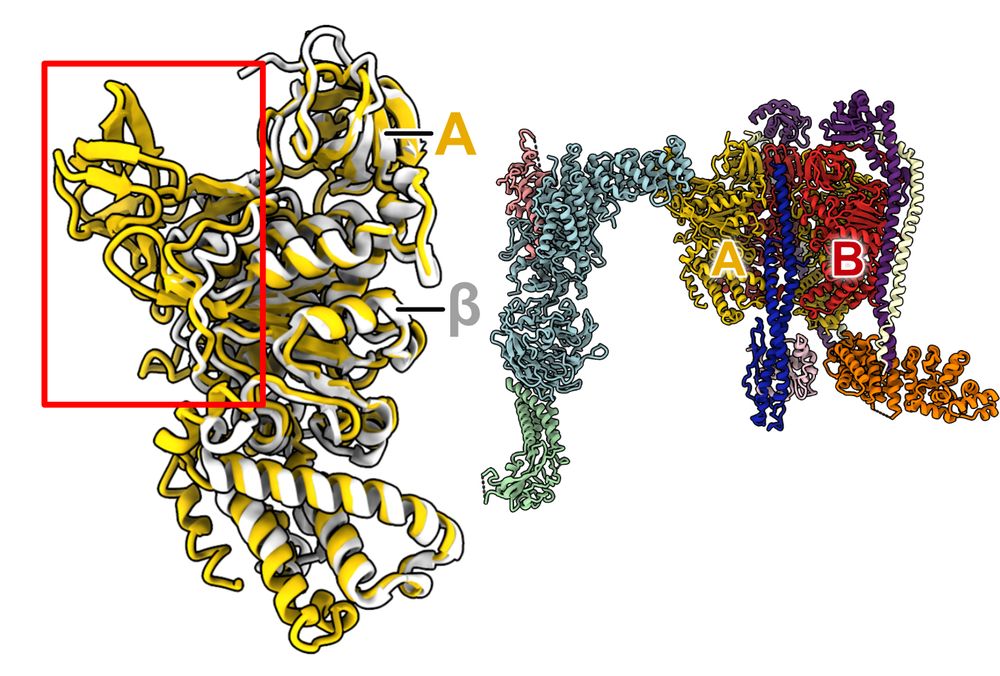
Most protein complexes are born only once. V-ATPase assembles over and over as part of its regulatory mechanism, enabled by RAVE (regulator of ATPase of vacuoles and endosomes)
@hanlinw222.bsky.social's 1st struct of RAVE bound to a partial V1 complex now out in PNAS.
www.pnas.org/doi/10.1073/...
@hanlinw222.bsky.social's 1st struct of RAVE bound to a partial V1 complex now out in PNAS.
www.pnas.org/doi/10.1073/...
December 3, 2024 at 7:34 PM
Most protein complexes are born only once. V-ATPase assembles over and over as part of its regulatory mechanism, enabled by RAVE (regulator of ATPase of vacuoles and endosomes)
@hanlinw222.bsky.social's 1st struct of RAVE bound to a partial V1 complex now out in PNAS.
www.pnas.org/doi/10.1073/...
@hanlinw222.bsky.social's 1st struct of RAVE bound to a partial V1 complex now out in PNAS.
www.pnas.org/doi/10.1073/...