



Diego Rodriguez-Terrones
@diego-rt.bsky.social
I like science, left politics, concrete architecture and exotic plants. Postdoc at IMBA@Vienna studying Axolotl regeneration and transposons at Elly Tanaka's lab
Pinned
Diego Rodriguez-Terrones, postdoc in Elly Tanaka’s Lab, was awarded a Principal Investigator Projects Grant by the Austrian Science Fund (FWF) for his “genomic archaeology” research in the axolotl. Read more: https://imba.science/4kUNwaF

I'm super grateful for this FWF funding to explore the 'fossilized' transposon landscape of the axolotl genome! Thrilled to uncover how these ancient sequences helped sculpt many of our organs and structures!
Reposted by Diego Rodriguez-Terrones
Happy to share that my PhD project is finally published!🪱✨
Selfish genes are found across the tree of life. They can disrupt inheritance patterns and at the same time act as units for molecular innovation. Here we tried to answer one big question: how do selfish genes emerge in the first place?
Selfish genes are found across the tree of life. They can disrupt inheritance patterns and at the same time act as units for molecular innovation. Here we tried to answer one big question: how do selfish genes emerge in the first place?

Recurrent evolution of selfishness from an essential tRNA synthetase in Caenorhabditis tropicalis 🧪
www.nature.com/articles/s41...
www.nature.com/articles/s41...

Recurrent evolution of selfishness from an essential tRNA synthetase in Caenorhabditis tropicalis - Nature Ecology & Evolution
In Caenorhabditis tropicalis, three toxin–antidote elements arose via gene duplication from the essential tRNA-synthetase subunit FARS-3. The ancestral antidote probably acquired affinity for FARS-3, ...
www.nature.com
November 24, 2025 at 9:10 PM
Happy to share that my PhD project is finally published!🪱✨
Selfish genes are found across the tree of life. They can disrupt inheritance patterns and at the same time act as units for molecular innovation. Here we tried to answer one big question: how do selfish genes emerge in the first place?
Selfish genes are found across the tree of life. They can disrupt inheritance patterns and at the same time act as units for molecular innovation. Here we tried to answer one big question: how do selfish genes emerge in the first place?
Reposted by Diego Rodriguez-Terrones

🚨 New paper alert!
Scientists in the Burga lab show for the first time how toxin-antidote elements—selfish genetic elements that perpetuate by poisoning those embryos that don’t inherit them—evolved from normal cellular proteins. More: https://imba.science/3M3fRyq
Scientists in the Burga lab show for the first time how toxin-antidote elements—selfish genetic elements that perpetuate by poisoning those embryos that don’t inherit them—evolved from normal cellular proteins. More: https://imba.science/3M3fRyq

November 24, 2025 at 11:10 AM
🚨 New paper alert!
Scientists in the Burga lab show for the first time how toxin-antidote elements—selfish genetic elements that perpetuate by poisoning those embryos that don’t inherit them—evolved from normal cellular proteins. More: https://imba.science/3M3fRyq
Scientists in the Burga lab show for the first time how toxin-antidote elements—selfish genetic elements that perpetuate by poisoning those embryos that don’t inherit them—evolved from normal cellular proteins. More: https://imba.science/3M3fRyq
Reposted by Diego Rodriguez-Terrones

piRNA-directed DNA methylation may not be a mammalian invention, but can already be found in the germline of axolotl salamanders
Donal O’Carroll and coworkers
www.embopress.org/doi/full/10....
Donal O’Carroll and coworkers
www.embopress.org/doi/full/10....

November 13, 2025 at 11:54 AM
piRNA-directed DNA methylation may not be a mammalian invention, but can already be found in the germline of axolotl salamanders
Donal O’Carroll and coworkers
www.embopress.org/doi/full/10....
Donal O’Carroll and coworkers
www.embopress.org/doi/full/10....
Reposted by Diego Rodriguez-Terrones

💸 Stem cell culture that’s ~95% cheaper and weekend-free: a win-win for PIs and trainees!
Our revised manuscript is online at ORE: open-research-europe.ec.europa.eu/articles/4-1...
Benchmarked across cell lines & differentiation protocols, including scRNA-seq — with lessons for #cultivatedmeat too!
Our revised manuscript is online at ORE: open-research-europe.ec.europa.eu/articles/4-1...
Benchmarked across cell lines & differentiation protocols, including scRNA-seq — with lessons for #cultivatedmeat too!
open-research-europe.ec.europa.eu
September 20, 2025 at 2:41 PM
💸 Stem cell culture that’s ~95% cheaper and weekend-free: a win-win for PIs and trainees!
Our revised manuscript is online at ORE: open-research-europe.ec.europa.eu/articles/4-1...
Benchmarked across cell lines & differentiation protocols, including scRNA-seq — with lessons for #cultivatedmeat too!
Our revised manuscript is online at ORE: open-research-europe.ec.europa.eu/articles/4-1...
Benchmarked across cell lines & differentiation protocols, including scRNA-seq — with lessons for #cultivatedmeat too!
Reposted by Diego Rodriguez-Terrones

1/ How do animals develop immunity against a newly encountered transposable element from scratch? Our study reveals that the mobility of TEs is their Achilles heel, allowing hosts to develop a powerful small RNA-mediated silencing response.
www.biorxiv.org/content/10.1...
www.biorxiv.org/content/10.1...
August 14, 2025 at 5:09 PM
1/ How do animals develop immunity against a newly encountered transposable element from scratch? Our study reveals that the mobility of TEs is their Achilles heel, allowing hosts to develop a powerful small RNA-mediated silencing response.
www.biorxiv.org/content/10.1...
www.biorxiv.org/content/10.1...
Reposted by Diego Rodriguez-Terrones

#Preprint alert! 📣
We are thrilled to share the work led by Lara Zorro-Shahidian and Lucio di Filippo, in which we show that #MLL2 controls gene expression in both #ESC and upon #differentiation by facilitating the #enhancer like activity of #LINE1 elements
www.biorxiv.org/cgi/content/...
We are thrilled to share the work led by Lara Zorro-Shahidian and Lucio di Filippo, in which we show that #MLL2 controls gene expression in both #ESC and upon #differentiation by facilitating the #enhancer like activity of #LINE1 elements
www.biorxiv.org/cgi/content/...

MLL2 facilitates long-range gene regulation through LINE1 elements
Transcriptional regulation is tightly linked to chromatin organization, with H3K4me3 commonly marking both active and bivalent promoters. In embryonic stem cells (ESC), MLL2 is essential for H3K4me3 d...
www.biorxiv.org
August 13, 2025 at 5:54 AM
#Preprint alert! 📣
We are thrilled to share the work led by Lara Zorro-Shahidian and Lucio di Filippo, in which we show that #MLL2 controls gene expression in both #ESC and upon #differentiation by facilitating the #enhancer like activity of #LINE1 elements
www.biorxiv.org/cgi/content/...
We are thrilled to share the work led by Lara Zorro-Shahidian and Lucio di Filippo, in which we show that #MLL2 controls gene expression in both #ESC and upon #differentiation by facilitating the #enhancer like activity of #LINE1 elements
www.biorxiv.org/cgi/content/...
Reposted by Diego Rodriguez-Terrones

Finally out! 🥳 Our paper showing how a transposable element (TE) insertion can cause developmental phenotypes is now published @natgenet.nature.com 🧬🦠🐁
Below is a brief description of the major findings. Check the full version of the paper for more details: www.nature.com/articles/s41588-025-02248-5
Below is a brief description of the major findings. Check the full version of the paper for more details: www.nature.com/articles/s41588-025-02248-5
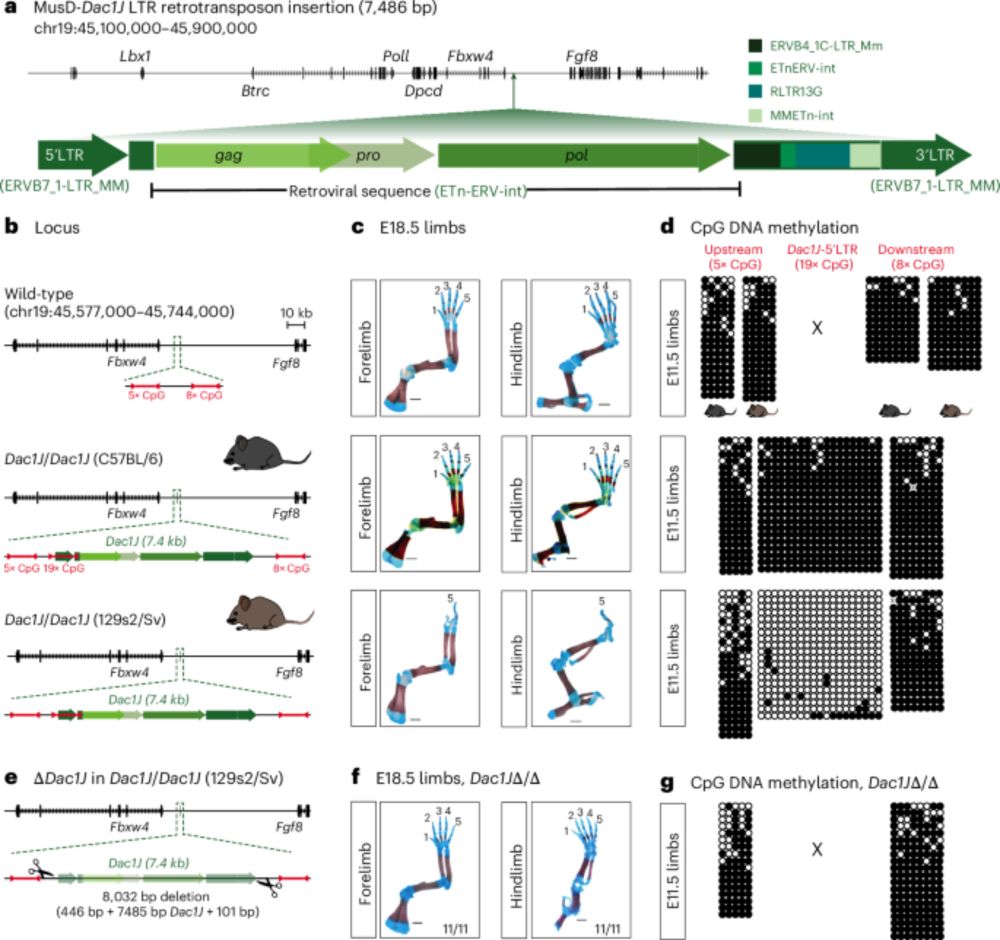
Enhancer adoption by an LTR retrotransposon generates viral-like particles, causing developmental limb phenotypes - Nature Genetics
Activation of an LTR retrotransposon inserted upstream of the Fgf8 gene produces viral-like particles in the mouse developing limb, triggering apoptosis and causing limb malformation. This phenotype c...
www.nature.com
July 9, 2025 at 10:05 AM
Finally out! 🥳 Our paper showing how a transposable element (TE) insertion can cause developmental phenotypes is now published @natgenet.nature.com 🧬🦠🐁
Below is a brief description of the major findings. Check the full version of the paper for more details: www.nature.com/articles/s41588-025-02248-5
Below is a brief description of the major findings. Check the full version of the paper for more details: www.nature.com/articles/s41588-025-02248-5
Reposted by Diego Rodriguez-Terrones

We have created a new DNase I- & ATAC-seq peak caller that uses an adaptive background model that controls for copy number variation & aneuploidy. It performs a per-nucleotide test (+FDR correction) and is very fast. Please try it out and give us feedback!
github.com/vierstralab/...
github.com/vierstralab/...

GitHub - vierstralab/hotspot3: A chromatin accessibility peak caller with an adaptive background model
A chromatin accessibility peak caller with an adaptive background model - vierstralab/hotspot3
github.com
July 8, 2025 at 3:07 AM
We have created a new DNase I- & ATAC-seq peak caller that uses an adaptive background model that controls for copy number variation & aneuploidy. It performs a per-nucleotide test (+FDR correction) and is very fast. Please try it out and give us feedback!
github.com/vierstralab/...
github.com/vierstralab/...
Reposted by Diego Rodriguez-Terrones

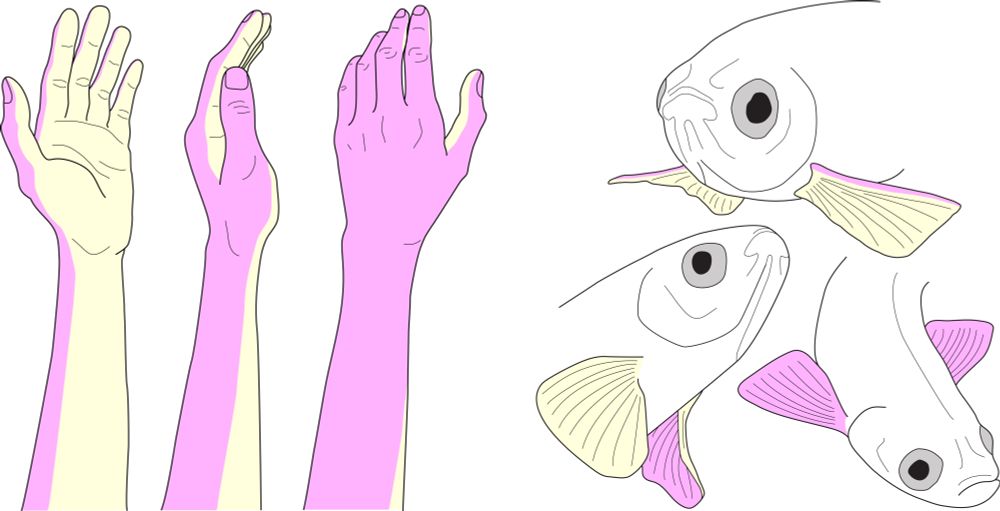
We take for granted that our hands have two sides and can articulate in an endless number of ways. But what about a fish’s fin? Can a fish know something “like the back of its fin,” or have its future told with a fin palm reading? Check out this bluetorial to find out 👇🧪🧬🐟 doi.org/10.1101/2025...
July 7, 2025 at 6:47 AM
We take for granted that our hands have two sides and can articulate in an endless number of ways. But what about a fish’s fin? Can a fish know something “like the back of its fin,” or have its future told with a fin palm reading? Check out this bluetorial to find out 👇🧪🧬🐟 doi.org/10.1101/2025...
Reposted by Diego Rodriguez-Terrones
In today’s publication in Science we introduce Zincore: a novel protein of QRICH1 and SEPHS1 and functions as a transcriptional coregulator dedicated to zinc finger transcription factors. Here’s how we found it: 🧵 www.science.org/doi/10.1126/... 1/11
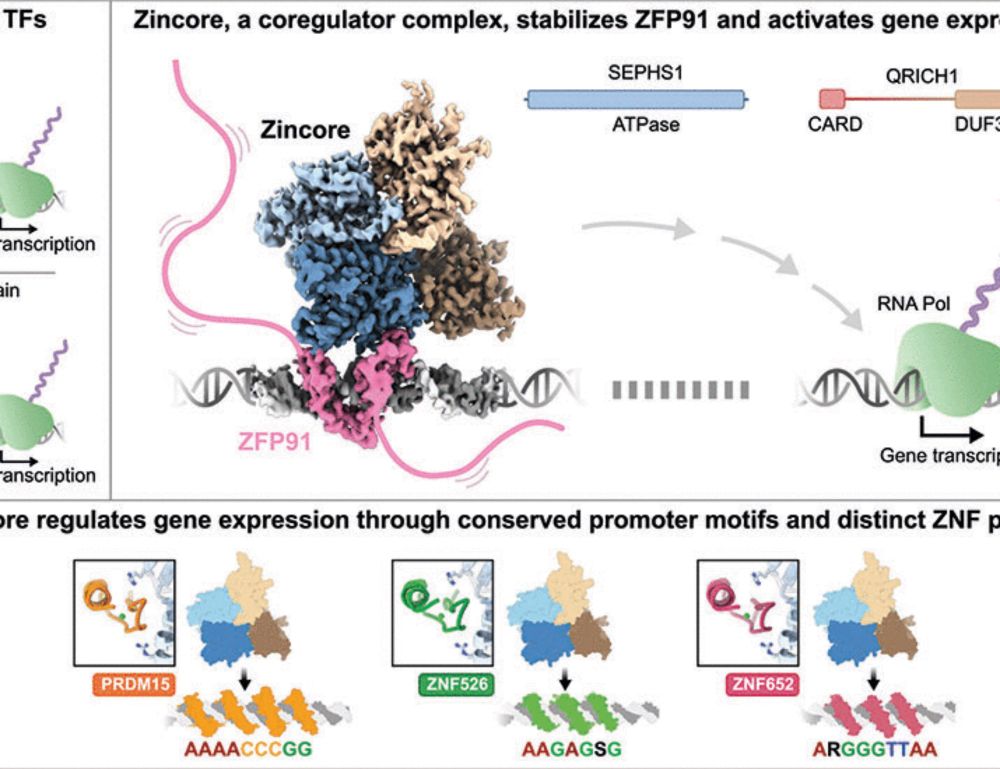
Zincore, an atypical coregulator, binds zinc finger transcription factors to control gene expression
Zinc finger proteins (ZNFs) are the largest family of transcription factors, yet how they activate gene expression remains unclear. In this study, we identified Zincore, a protein complex consisting o...
www.science.org
July 4, 2025 at 11:00 AM
In today’s publication in Science we introduce Zincore: a novel protein of QRICH1 and SEPHS1 and functions as a transcriptional coregulator dedicated to zinc finger transcription factors. Here’s how we found it: 🧵 www.science.org/doi/10.1126/... 1/11
Reposted by Diego Rodriguez-Terrones

Our paper describing the Range Extender element which is required and sufficient for long-range enhancer activation at the Shh locus is now available at @nature.com. Congrats to @gracebower.bsky.social who led the study. Below is a brief summary of the main findings www.nature.com/articles/s41... 1/
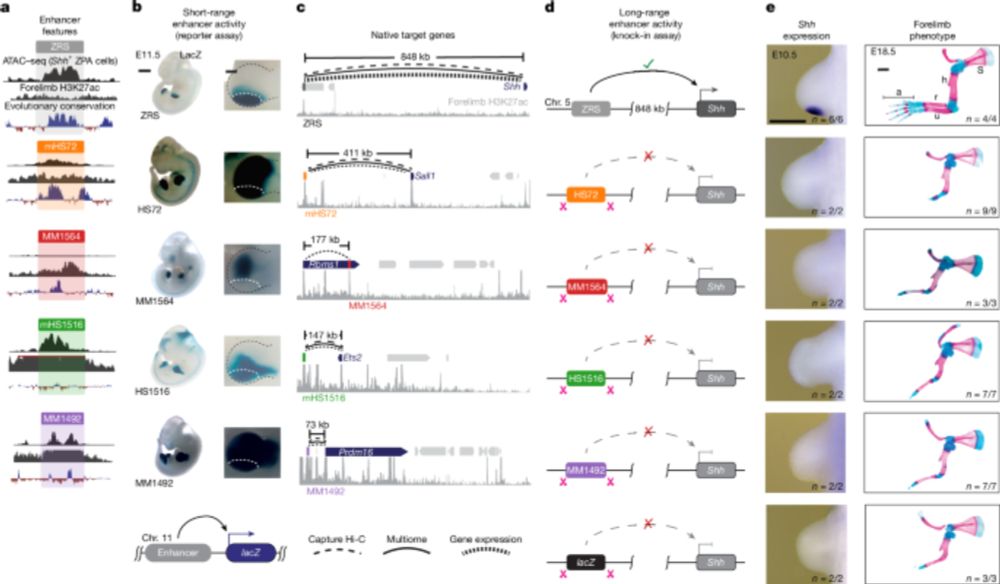
Range extender mediates long-distance enhancer activity - Nature
The REX element is associated with long-range enhancer–promoter interactions.
www.nature.com
July 2, 2025 at 4:17 PM
Our paper describing the Range Extender element which is required and sufficient for long-range enhancer activation at the Shh locus is now available at @nature.com. Congrats to @gracebower.bsky.social who led the study. Below is a brief summary of the main findings www.nature.com/articles/s41... 1/
Reposted by Diego Rodriguez-Terrones

Exciting and rare opportunity to join the @maxperutzlabs.bsky.social and the @viennabiocenter.bsky.social as a Full Professor!
www.nature.com/naturecareer...
www.nature.com/naturecareer...

Full Professorship in Molecular Mechanisms of Disease - Vienna BioCenter, Austria job with Max Perutz Labs, University of Vienna | 12841053
Join theMax Perutz Labs as Full Professor to unravel disease mechanisms—from metabolism and stress to RNA regulation, epigenetics, and immunity.
www.nature.com
July 2, 2025 at 7:19 AM
Exciting and rare opportunity to join the @maxperutzlabs.bsky.social and the @viennabiocenter.bsky.social as a Full Professor!
www.nature.com/naturecareer...
www.nature.com/naturecareer...
Reposted by Diego Rodriguez-Terrones
structure prediction is not science if not experimentally validated. period
Predicted structures from the AFDB are poor substitutes for experimental structures when training inverse folding NNs. Here, authors show that this is because they are "too perfect", and passing them through a custom-trained AFDB-to-PDB NN helps fix this
threadreaderapp.com/thread/19384...
threadreaderapp.com/thread/19384...

June 27, 2025 at 9:53 PM
structure prediction is not science if not experimentally validated. period
Reposted by Diego Rodriguez-Terrones
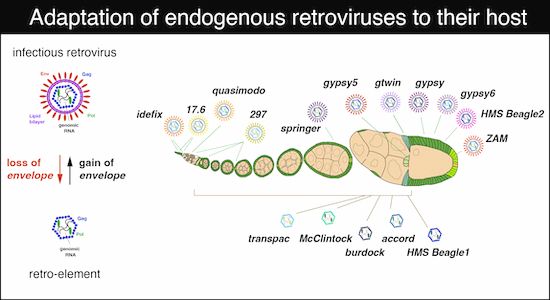
REFEREE 1: “I conclude with a simple, direct statement - this is the best paper I have read all year!”
#TransparentPeerReview
Co-evolving infectivity and expression patterns drive the diversification of endogenous retroviruses
@juliusbrennecke.bsky.social et al
www.embopress.org/doi/full/10....
#TransparentPeerReview
Co-evolving infectivity and expression patterns drive the diversification of endogenous retroviruses
@juliusbrennecke.bsky.social et al
www.embopress.org/doi/full/10....
June 6, 2025 at 2:18 PM
REFEREE 1: “I conclude with a simple, direct statement - this is the best paper I have read all year!”
#TransparentPeerReview
Co-evolving infectivity and expression patterns drive the diversification of endogenous retroviruses
@juliusbrennecke.bsky.social et al
www.embopress.org/doi/full/10....
#TransparentPeerReview
Co-evolving infectivity and expression patterns drive the diversification of endogenous retroviruses
@juliusbrennecke.bsky.social et al
www.embopress.org/doi/full/10....
Reposted by Diego Rodriguez-Terrones

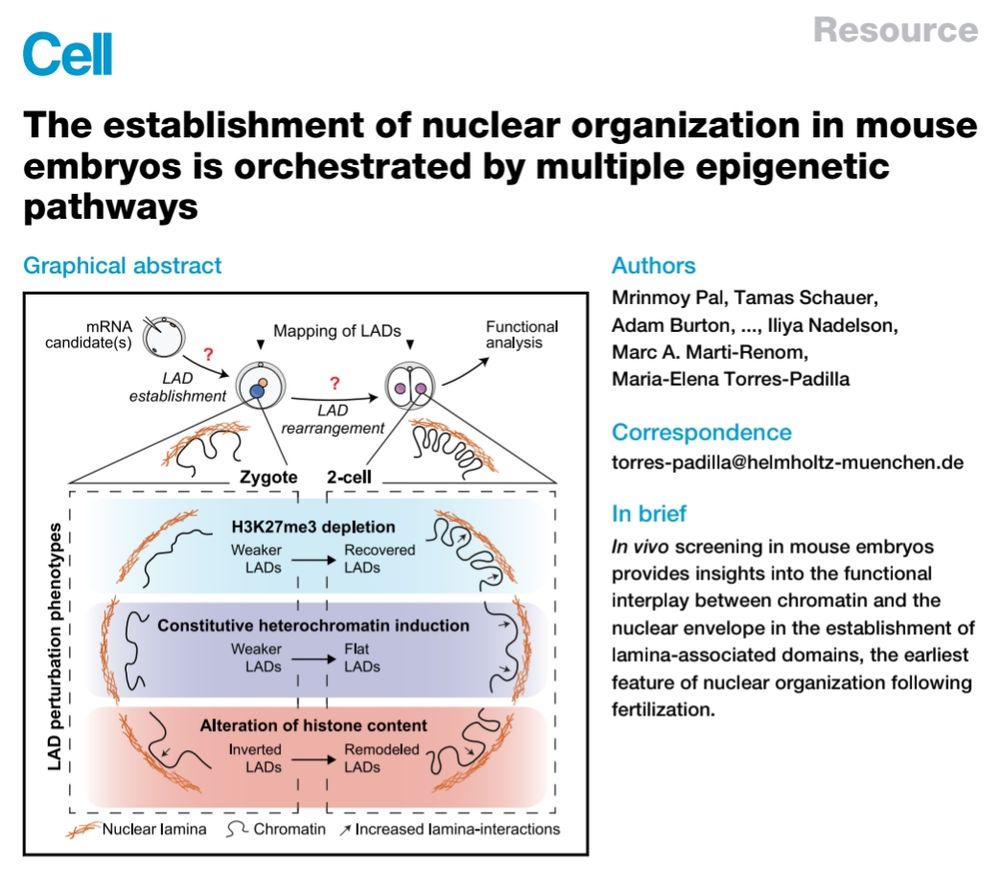
How does the genome find its place in the 3D space of the nucleus after fertilization?
Out now @cellcellpress.bsky.social:
cell.com/cell/fulltext/…
👇 A thread 👇
Out now @cellcellpress.bsky.social:
cell.com/cell/fulltext/…
👇 A thread 👇
April 23, 2025 at 6:04 PM
How does the genome find its place in the 3D space of the nucleus after fertilization?
Out now @cellcellpress.bsky.social:
cell.com/cell/fulltext/…
👇 A thread 👇
Out now @cellcellpress.bsky.social:
cell.com/cell/fulltext/…
👇 A thread 👇
Reposted by Diego Rodriguez-Terrones

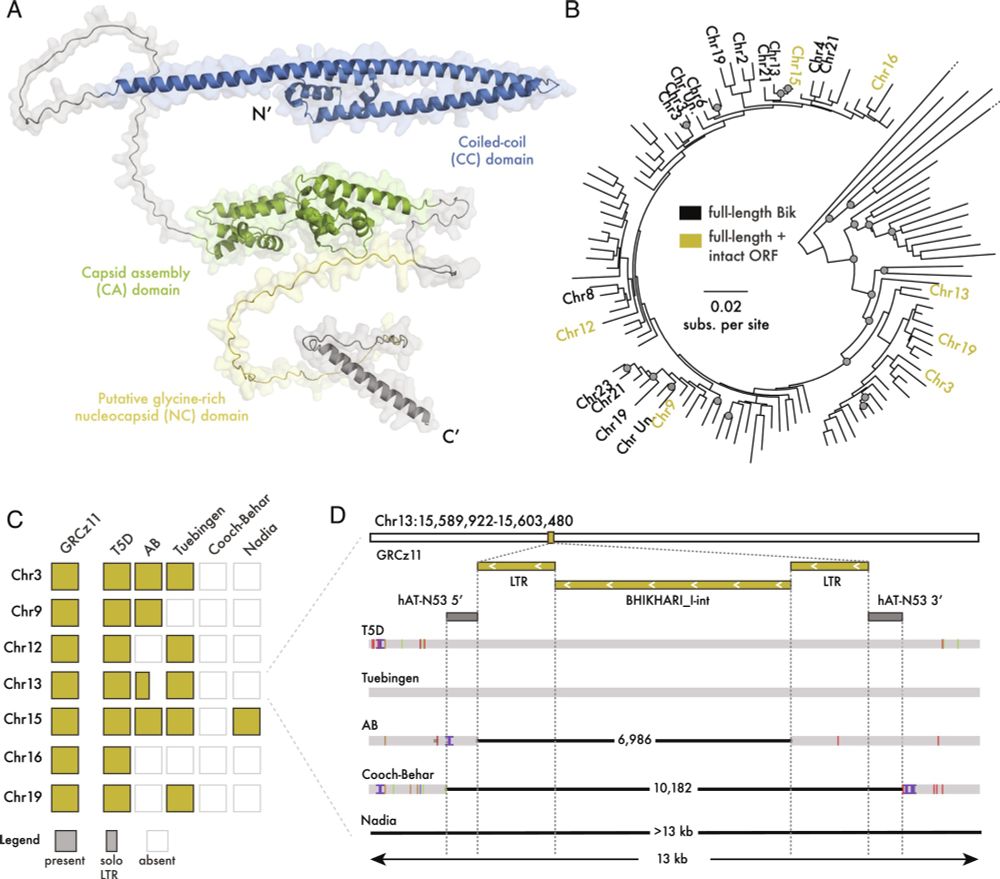
💥🥳 At long last, our latest paper is out!
Gag proteins of endogenous retroviruses are required for zebrafish development
www.pnas.org/doi/10.1073/...
Led heroically by Sylvia Chang & @jonowells.bsky.social
A study which has changed the way I think of #transposons! No less! 🧵 1/n
Gag proteins of endogenous retroviruses are required for zebrafish development
www.pnas.org/doi/10.1073/...
Led heroically by Sylvia Chang & @jonowells.bsky.social
A study which has changed the way I think of #transposons! No less! 🧵 1/n
Gag proteins encoded by endogenous retroviruses are required for zebrafish development | PNAS
Transposable elements (TEs) make up the bulk of eukaryotic genomes and examples abound
of TE-derived sequences repurposed for organismal function. ...
www.pnas.org
April 30, 2025 at 10:45 AM
💥🥳 At long last, our latest paper is out!
Gag proteins of endogenous retroviruses are required for zebrafish development
www.pnas.org/doi/10.1073/...
Led heroically by Sylvia Chang & @jonowells.bsky.social
A study which has changed the way I think of #transposons! No less! 🧵 1/n
Gag proteins of endogenous retroviruses are required for zebrafish development
www.pnas.org/doi/10.1073/...
Led heroically by Sylvia Chang & @jonowells.bsky.social
A study which has changed the way I think of #transposons! No less! 🧵 1/n
Reposted by Diego Rodriguez-Terrones

Join our team as a postdoc and explore the exciting world of transposable elements and developmental biology with us! @imbavienna.bsky.social @vbcscitraining.bsky.social
April 6, 2025 at 4:24 PM
Join our team as a postdoc and explore the exciting world of transposable elements and developmental biology with us! @imbavienna.bsky.social @vbcscitraining.bsky.social
I'm super grateful for this FWF funding to explore the 'fossilized' transposon landscape of the axolotl genome! Thrilled to uncover how these ancient sequences helped sculpt many of our organs and structures!
Diego Rodriguez-Terrones, postdoc in Elly Tanaka’s Lab, was awarded a Principal Investigator Projects Grant by the Austrian Science Fund (FWF) for his “genomic archaeology” research in the axolotl. Read more: https://imba.science/4kUNwaF
March 25, 2025 at 8:58 PM
I'm super grateful for this FWF funding to explore the 'fossilized' transposon landscape of the axolotl genome! Thrilled to uncover how these ancient sequences helped sculpt many of our organs and structures!
Reposted by Diego Rodriguez-Terrones
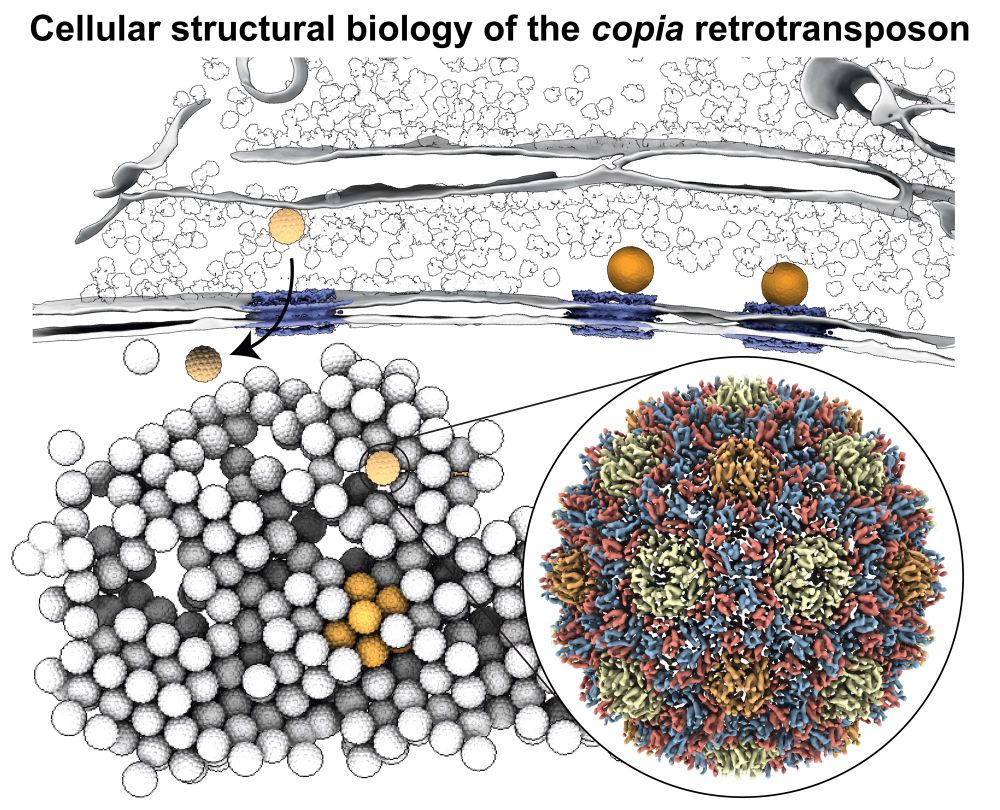
Happy to share our manuscript on the in situ visualization of the copia retrotransposon in its final form today published in @cellcellpress.bsky.social www.cell.com/cell/fulltex.... What’s new?
March 5, 2025 at 4:02 PM
Happy to share our manuscript on the in situ visualization of the copia retrotransposon in its final form today published in @cellcellpress.bsky.social www.cell.com/cell/fulltex.... What’s new?
Reposted by Diego Rodriguez-Terrones
Paper out !!🥳big thanks to all authors @marliesoomen.bsky.social @diego-rt.bsky.social @kaessmannlab.bsky.social @jonathangoeke.bsky.social @lorenzamottes.bsky.social & 'bluesky-less'
Lots of interesting new TE (& genes) biology
Data fully browsable💻 👉 embryo.helmholtz-munich.de/shiny_embryo/
Lots of interesting new TE (& genes) biology
Data fully browsable💻 👉 embryo.helmholtz-munich.de/shiny_embryo/
February 21, 2025 at 3:50 PM
Paper out !!🥳big thanks to all authors @marliesoomen.bsky.social @diego-rt.bsky.social @kaessmannlab.bsky.social @jonathangoeke.bsky.social @lorenzamottes.bsky.social & 'bluesky-less'
Lots of interesting new TE (& genes) biology
Data fully browsable💻 👉 embryo.helmholtz-munich.de/shiny_embryo/
Lots of interesting new TE (& genes) biology
Data fully browsable💻 👉 embryo.helmholtz-munich.de/shiny_embryo/
Reposted by Diego Rodriguez-Terrones
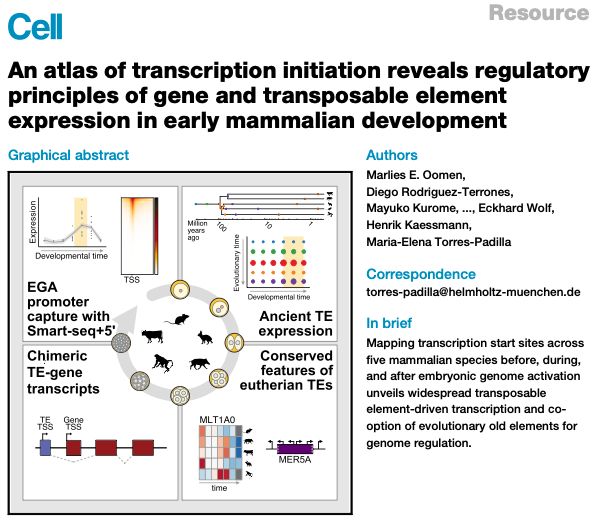
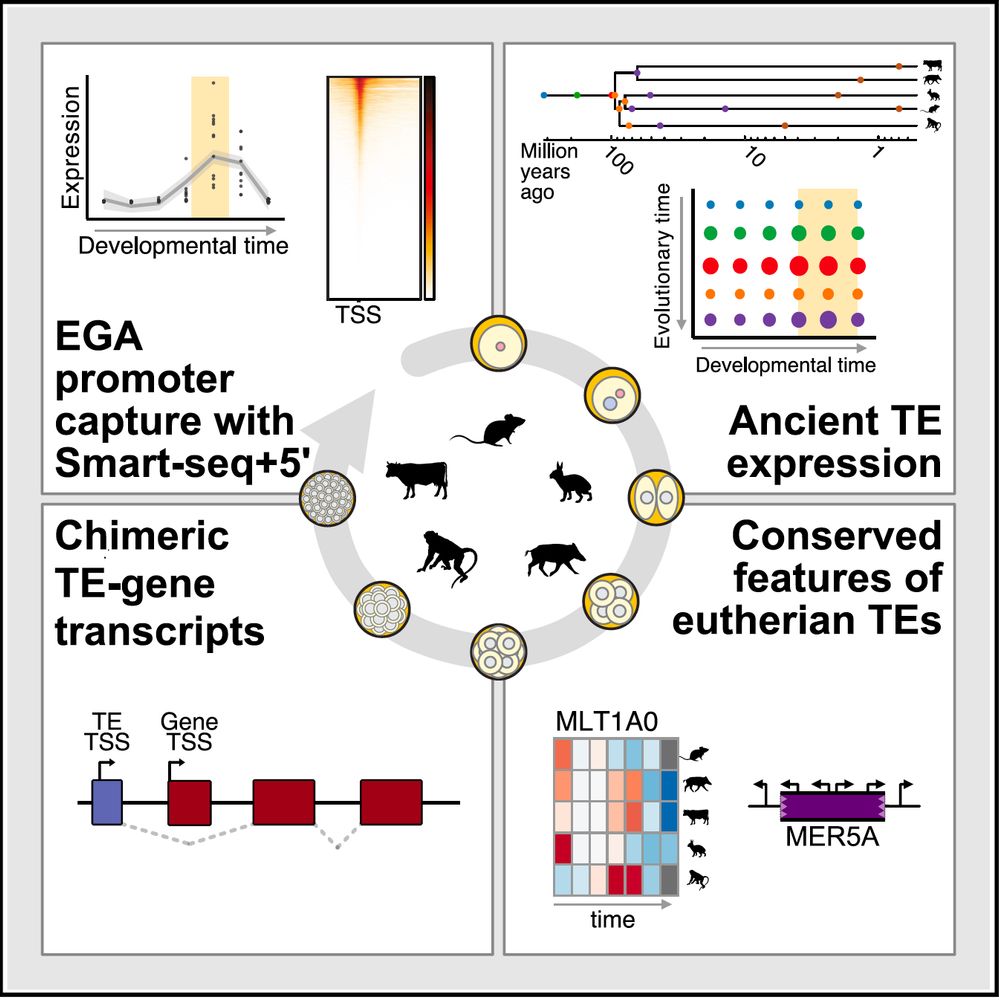
Very excited to share our paper on Gene and Transposable Element expression in mammalian preimplantation development, online today! www.cell.com/cell/fulltex...
A short thread to highlight some of our findings 🧵
A short thread to highlight some of our findings 🧵
January 20, 2025 at 8:29 PM
Very excited to share our paper on Gene and Transposable Element expression in mammalian preimplantation development, online today! www.cell.com/cell/fulltex...
A short thread to highlight some of our findings 🧵
A short thread to highlight some of our findings 🧵
Reposted by Diego Rodriguez-Terrones
Tour de force! @metorrespadilla.bsky.social & team develop Smart-seq+5′ to map TSS in single embryos with unprecedented res revealing plethora of TE-driven transcripts in 5 mammal species. Some surprisingly old & conserved. Treasure trove of new biology for yrs to come!
www.cell.com/cell/fulltex...
www.cell.com/cell/fulltex...
An atlas of transcription initiation reveals regulatory principles of gene and transposable element expression in early mammalian development
Mapping transcription start sites across five mammalian species before, during, and
after embryonic genome activation unveils widespread transposable element-driven transcription
and co-option of evol...
www.cell.com
January 20, 2025 at 7:41 PM
Tour de force! @metorrespadilla.bsky.social & team develop Smart-seq+5′ to map TSS in single embryos with unprecedented res revealing plethora of TE-driven transcripts in 5 mammal species. Some surprisingly old & conserved. Treasure trove of new biology for yrs to come!
www.cell.com/cell/fulltex...
www.cell.com/cell/fulltex...