



Alex Starr
@astarr2.bsky.social
Graduate student using human-chimp cell fusions to study the genetic changes underlying uniquely human brain and cardiovascular phenotypes
Reposted by Alex Starr

@astarr2.bsky.social & Fraser used single-cell RNAseq to determine if abundant cell-types have more conserved gene expression patterns in primates; their findings also argue for a link between the evolution of human cognition and autism.
🔗 doi.org/10.1093/molbev/msaf189
#evobio #molbio #autism
🔗 doi.org/10.1093/molbev/msaf189
#evobio #molbio #autism

September 10, 2025 at 9:56 AM
@astarr2.bsky.social & Fraser used single-cell RNAseq to determine if abundant cell-types have more conserved gene expression patterns in primates; their findings also argue for a link between the evolution of human cognition and autism.
🔗 doi.org/10.1093/molbev/msaf189
#evobio #molbio #autism
🔗 doi.org/10.1093/molbev/msaf189
#evobio #molbio #autism
Reposted by Alex Starr

Congratulations to Nathan for conceiving and designing this unified demultiplexing toolkit!

Picture this: you are running a single cell sequencing experiment and want to incorporate cells from different species, individuals, and maybe even perturbations. You process everything together to save time while reducing batch artifacts. You collect data. What do you do now?

a man in a green shirt is carrying a pink bag
ALT: a man in a green shirt is carrying a pink bag
media.tenor.com
March 24, 2025 at 10:12 PM
Congratulations to Nathan for conceiving and designing this unified demultiplexing toolkit!
Reposted by Alex Starr

Watching axons on the move
Check out this study, ranked ‘Fundamental’, on how the ligand Netrin mediates axon guidance through haptotaxis and chemotaxis.
elifesciences.org/articles/100...
Check out this study, ranked ‘Fundamental’, on how the ligand Netrin mediates axon guidance through haptotaxis and chemotaxis.
elifesciences.org/articles/100...
March 19, 2025 at 9:01 PM
Watching axons on the move
Check out this study, ranked ‘Fundamental’, on how the ligand Netrin mediates axon guidance through haptotaxis and chemotaxis.
elifesciences.org/articles/100...
Check out this study, ranked ‘Fundamental’, on how the ligand Netrin mediates axon guidance through haptotaxis and chemotaxis.
elifesciences.org/articles/100...
Reposted by Alex Starr

Exciting discovery by Svensson lab and collaborators @stanfordmedicine.bsky.social, computational discovery of 2500 new bioactive peptides, including 12-mer named BRP that reduces food intake leading to weight loss w/o nausea in mice!
www.nature.com/articles/s41...
www.nature.com/articles/s41...
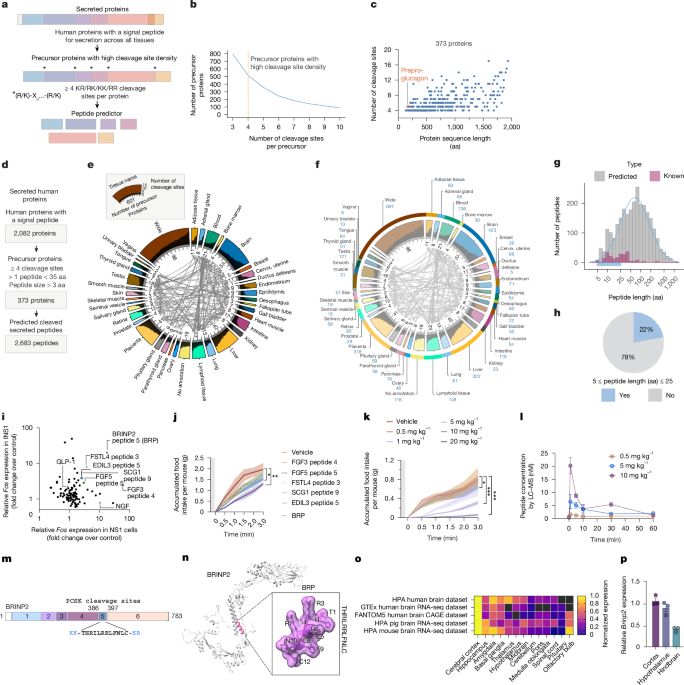
Prohormone cleavage prediction uncovers a non-incretin anti-obesity peptide - Nature
Computational drug discovery is used to identify a 12-mer peptide derived from BRINP2 with potent anti-obesity effects that are independent of leptin, glucagon-like peptide 1 receptor and melanocortin...
www.nature.com
March 11, 2025 at 11:22 PM
Exciting discovery by Svensson lab and collaborators @stanfordmedicine.bsky.social, computational discovery of 2500 new bioactive peptides, including 12-mer named BRP that reduces food intake leading to weight loss w/o nausea in mice!
www.nature.com/articles/s41...
www.nature.com/articles/s41...
This is an awesome approach! I’d be very curious if the causal gene expression change-phenotype links could be used to predict hemoglobin in other species. E.g. if you take all the causal links, compare expression between humans and mice, can you predict what hemoglobin levels in mice are?
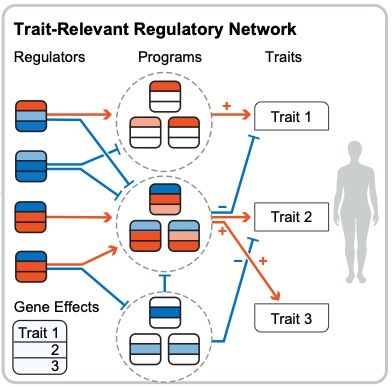
Modern GWAS can identify 1000s of significant hits but it can be hard to turn this into biological insight. What key cellular functions link genetic variation to disease?
I'm very excited to present our new work combining associations and Perturb-seq to build interpretable causal graphs! A 🧵
I'm very excited to present our new work combining associations and Perturb-seq to build interpretable causal graphs! A 🧵
January 26, 2025 at 12:21 AM
This is an awesome approach! I’d be very curious if the causal gene expression change-phenotype links could be used to predict hemoglobin in other species. E.g. if you take all the causal links, compare expression between humans and mice, can you predict what hemoglobin levels in mice are?
Reposted by Alex Starr
Modern GWAS can identify 1000s of significant hits but it can be hard to turn this into biological insight. What key cellular functions link genetic variation to disease?
I'm very excited to present our new work combining associations and Perturb-seq to build interpretable causal graphs! A 🧵
I'm very excited to present our new work combining associations and Perturb-seq to build interpretable causal graphs! A 🧵
January 26, 2025 at 12:13 AM
Modern GWAS can identify 1000s of significant hits but it can be hard to turn this into biological insight. What key cellular functions link genetic variation to disease?
I'm very excited to present our new work combining associations and Perturb-seq to build interpretable causal graphs! A 🧵
I'm very excited to present our new work combining associations and Perturb-seq to build interpretable causal graphs! A 🧵
Glad I could play a role in helping to explore the great findings enabled by this awesome new tool! Excited to see what cool biology will be uncovered using sc-SPLASH in the ever expanding single cell RNA-seq datasets, particularly from emerging and non-model organisms!
sc-SPLASH provides ultra-efficient reference-free discovery in barcoded single-cell sequencing https://www.biorxiv.org/content/10.1101/2024.12.24.630263v1
December 24, 2024 at 9:08 PM
Glad I could play a role in helping to explore the great findings enabled by this awesome new tool! Excited to see what cool biology will be uncovered using sc-SPLASH in the ever expanding single cell RNA-seq datasets, particularly from emerging and non-model organisms!
Reposted by Alex Starr

sc-SPLASH provides ultra-efficient reference-free discovery in barcoded single-cell sequencing https://www.biorxiv.org/content/10.1101/2024.12.24.630263v1
December 24, 2024 at 7:47 PM
sc-SPLASH provides ultra-efficient reference-free discovery in barcoded single-cell sequencing https://www.biorxiv.org/content/10.1101/2024.12.24.630263v1