



Alex Pollen
@brainevodevo.bsky.social
Studying specializations and vulnerabilities of human brain development
Reposted by Alex Pollen

I wrote a little bit about the "missing heritability" question and several recent studies that have brought it to a close. A short 🧵

The missing heritability question is now (mostly) answered
Not with a bang but with a whimper
theinfinitesimal.substack.com
November 21, 2025 at 10:34 PM
I wrote a little bit about the "missing heritability" question and several recent studies that have brought it to a close. A short 🧵
Reposted by Alex Pollen

A deep dive into how transcription factors shape radial glia fate and clonal dynamics.
Manuel Lessi: this work “combines the strengths of primary cultures and pooled CRISPRi perturbation”. #preprint Jingwen Ding & team @brainevodevo.bsky.social
#preLight ⬇️
prelights.biologists.com/highlights/d...
Manuel Lessi: this work “combines the strengths of primary cultures and pooled CRISPRi perturbation”. #preprint Jingwen Ding & team @brainevodevo.bsky.social
#preLight ⬇️
prelights.biologists.com/highlights/d...

Dissecting Gene Regulatory Networks Governing Human Cortical Cell Fate - preLights
A deep dive into how transcription factors shape radial glia fate and clonal dynamics
prelights.biologists.com
November 18, 2025 at 11:59 AM
A deep dive into how transcription factors shape radial glia fate and clonal dynamics.
Manuel Lessi: this work “combines the strengths of primary cultures and pooled CRISPRi perturbation”. #preprint Jingwen Ding & team @brainevodevo.bsky.social
#preLight ⬇️
prelights.biologists.com/highlights/d...
Manuel Lessi: this work “combines the strengths of primary cultures and pooled CRISPRi perturbation”. #preprint Jingwen Ding & team @brainevodevo.bsky.social
#preLight ⬇️
prelights.biologists.com/highlights/d...
This study was supported by NIH funding and an excellent team of collaborators, including @fennak.bsky.social, @mallarinolab.bsky.social, @searslab.bsky.social, Mike DeBerardine, Aunoy Poddar, Miguel Turrero Garcia, and the Paredes, Harwell lab and Berke labs.
November 7, 2025 at 6:06 PM
This study was supported by NIH funding and an excellent team of collaborators, including @fennak.bsky.social, @mallarinolab.bsky.social, @searslab.bsky.social, Mike DeBerardine, Aunoy Poddar, Miguel Turrero Garcia, and the Paredes, Harwell lab and Berke labs.
Collectively, the broad pattern of inhibitory neuron conservation suggests that, on the mammalian timescale, evolution modifies the brain by ‘teaching old cells new tricks’, rather than inventing novel cell types early in development.
November 7, 2025 at 6:06 PM
Collectively, the broad pattern of inhibitory neuron conservation suggests that, on the mammalian timescale, evolution modifies the brain by ‘teaching old cells new tricks’, rather than inventing novel cell types early in development.
Together, we conclude the TAC3 initial class is conserved across placental mammals, but modifies its gene expression and distribution throughout evolution.
November 7, 2025 at 6:06 PM
Together, we conclude the TAC3 initial class is conserved across placental mammals, but modifies its gene expression and distribution throughout evolution.
In adult mouse, we identified a rare subpopulation of Th interneurons which expresses residual Tac2 (TAC3). Using the Allen institute’s Merscope data, we find this rare Tac2-expressing population is spatially restricted to the ventromedial striatum.
November 7, 2025 at 6:06 PM
In adult mouse, we identified a rare subpopulation of Th interneurons which expresses residual Tac2 (TAC3). Using the Allen institute’s Merscope data, we find this rare Tac2-expressing population is spatially restricted to the ventromedial striatum.
Through integrated analysis of adult mouse, marmoset, and human striatal inhibitory neurons, we confirmed the homology of Th interneurons in adult mouse and TAC3 interneurons in the adult primate.
November 7, 2025 at 6:06 PM
Through integrated analysis of adult mouse, marmoset, and human striatal inhibitory neurons, we confirmed the homology of Th interneurons in adult mouse and TAC3 interneurons in the adult primate.
Surprisingly, we find that the population was hiding in plain sight, but disguised by the loss of TAC3 (called Tac2 in mouse) and gain of Th expression, indicating an unappreciated homology between rodent Th and mammalian TAC3 striatal interneurons.
November 7, 2025 at 6:06 PM
Surprisingly, we find that the population was hiding in plain sight, but disguised by the loss of TAC3 (called Tac2 in mouse) and gain of Th expression, indicating an unappreciated homology between rodent Th and mammalian TAC3 striatal interneurons.
Given the conservation of this initial class in Laurasiatherians and marsupials, we next investigate the Glire lineage (rabbit, naked mole rat, rat, mouse), as the population was reported missing in mouse.
November 7, 2025 at 6:06 PM
Given the conservation of this initial class in Laurasiatherians and marsupials, we next investigate the Glire lineage (rabbit, naked mole rat, rat, mouse), as the population was reported missing in mouse.
Although the TAC3 initial class is conserved to marsupials (opossum and sugar glider), we observe turnover of signaling pathway genes across multiple timescales, and an additional migratory destination in Laurasiatherian (pig and ferret) cortex
November 7, 2025 at 6:06 PM
Although the TAC3 initial class is conserved to marsupials (opossum and sugar glider), we observe turnover of signaling pathway genes across multiple timescales, and an additional migratory destination in Laurasiatherian (pig and ferret) cortex
Through integrative analysis, we find that initial classes of inhibitory neurons are conserved across placental mammals. Surprisingly, this conservation includes the MGE-derived TAC3 initial class, which was previously thought to be a primate-specific striatal interneuron population
November 7, 2025 at 6:06 PM
Through integrative analysis, we find that initial classes of inhibitory neurons are conserved across placental mammals. Surprisingly, this conservation includes the MGE-derived TAC3 initial class, which was previously thought to be a primate-specific striatal interneuron population
We begin by performing cross-species analysis of developing initial classes of both striatal and cortical inhibitory neuron populations by integrating single cell sequencing data from 8 mammals, spanning from primates to marsupials.

November 7, 2025 at 6:06 PM
We begin by performing cross-species analysis of developing initial classes of both striatal and cortical inhibitory neuron populations by integrating single cell sequencing data from 8 mammals, spanning from primates to marsupials.
Our new manuscript, led by Emily Corrigan, examines inhibitory neuron diversity across approximately 160 million years of evolutionary divergence, as part of BRAIN Initiative Cell Atlas Network (BICAN) developing brain atlas package: www.nature.com/articles/s41...

Conservation and alteration of mammalian striatal interneurons - Nature
An analysis of cell-type diversity in brain samples from a variety of mammalian species, both during development and in adult animals, reveals that the TAC3 initial class of striatal interneurons is c...
www.nature.com
November 7, 2025 at 6:06 PM
Our new manuscript, led by Emily Corrigan, examines inhibitory neuron diversity across approximately 160 million years of evolutionary divergence, as part of BRAIN Initiative Cell Atlas Network (BICAN) developing brain atlas package: www.nature.com/articles/s41...
Reposted by Alex Pollen

🧠🌟🐭 Excited to share some of my postdoc work on the evolution of dexterity!
We compared deer mice evolved in forest vs prairie habitats. We found that forest mice have:
(1) more corticospinal neurons (CSNs)
(2) better hand dexterity
(3) more dexterous climbing, which is linked to CSN number🧵
We compared deer mice evolved in forest vs prairie habitats. We found that forest mice have:
(1) more corticospinal neurons (CSNs)
(2) better hand dexterity
(3) more dexterous climbing, which is linked to CSN number🧵
October 22, 2025 at 8:41 PM
🧠🌟🐭 Excited to share some of my postdoc work on the evolution of dexterity!
We compared deer mice evolved in forest vs prairie habitats. We found that forest mice have:
(1) more corticospinal neurons (CSNs)
(2) better hand dexterity
(3) more dexterous climbing, which is linked to CSN number🧵
We compared deer mice evolved in forest vs prairie habitats. We found that forest mice have:
(1) more corticospinal neurons (CSNs)
(2) better hand dexterity
(3) more dexterous climbing, which is linked to CSN number🧵
Reposted by Alex Pollen

I am thrilled to share our latest work: we identified a population of central amygdala neurons that promote the earliest and perhaps most important social behavior: pup suckling!... We also developed new tools for pup neuroscience
Work by @Jeff Moore now at USC, a collaboration with @Sam Pfaff lab
Work by @Jeff Moore now at USC, a collaboration with @Sam Pfaff lab


October 21, 2025 at 10:18 AM
I am thrilled to share our latest work: we identified a population of central amygdala neurons that promote the earliest and perhaps most important social behavior: pup suckling!... We also developed new tools for pup neuroscience
Work by @Jeff Moore now at USC, a collaboration with @Sam Pfaff lab
Work by @Jeff Moore now at USC, a collaboration with @Sam Pfaff lab
Reposted by Alex Pollen

“Intraspecific sequence variation and complete genomes refine the identification of rapidly evolved regions in humans”
New work on HAQERs, by
@rimangan.bsky.social Yanting Luo Craig Lowe @debbysilver.bsky.social @manoliskellis.bsky.social & colleagues
🧪🧬
www.biorxiv.org/content/10.1...
New work on HAQERs, by
@rimangan.bsky.social Yanting Luo Craig Lowe @debbysilver.bsky.social @manoliskellis.bsky.social & colleagues
🧪🧬
www.biorxiv.org/content/10.1...

Intraspecific sequence variation and complete genomes refine the identification of rapidly evolved regions in humans
Humans exhibit significant phenotypic differences from other great apes, yet pinpointing the underlying genetic changes has been limited by incomplete reference genomes and a reliance on single assemb...
www.biorxiv.org
October 21, 2025 at 10:14 AM
“Intraspecific sequence variation and complete genomes refine the identification of rapidly evolved regions in humans”
New work on HAQERs, by
@rimangan.bsky.social Yanting Luo Craig Lowe @debbysilver.bsky.social @manoliskellis.bsky.social & colleagues
🧪🧬
www.biorxiv.org/content/10.1...
New work on HAQERs, by
@rimangan.bsky.social Yanting Luo Craig Lowe @debbysilver.bsky.social @manoliskellis.bsky.social & colleagues
🧪🧬
www.biorxiv.org/content/10.1...
Grateful for @enardhellmannwg.bsky.social labs to host @nkschaefer.bsky.social and exchange ideas about village cell culture and human-specific evolution with experts at LMU Munich, including the Hellman and Enard labs as well as @boyanbonev.bsky.social!
September 24, 2025 at 4:36 PM
Grateful for @enardhellmannwg.bsky.social labs to host @nkschaefer.bsky.social and exchange ideas about village cell culture and human-specific evolution with experts at LMU Munich, including the Hellman and Enard labs as well as @boyanbonev.bsky.social!
Reposted by Alex Pollen
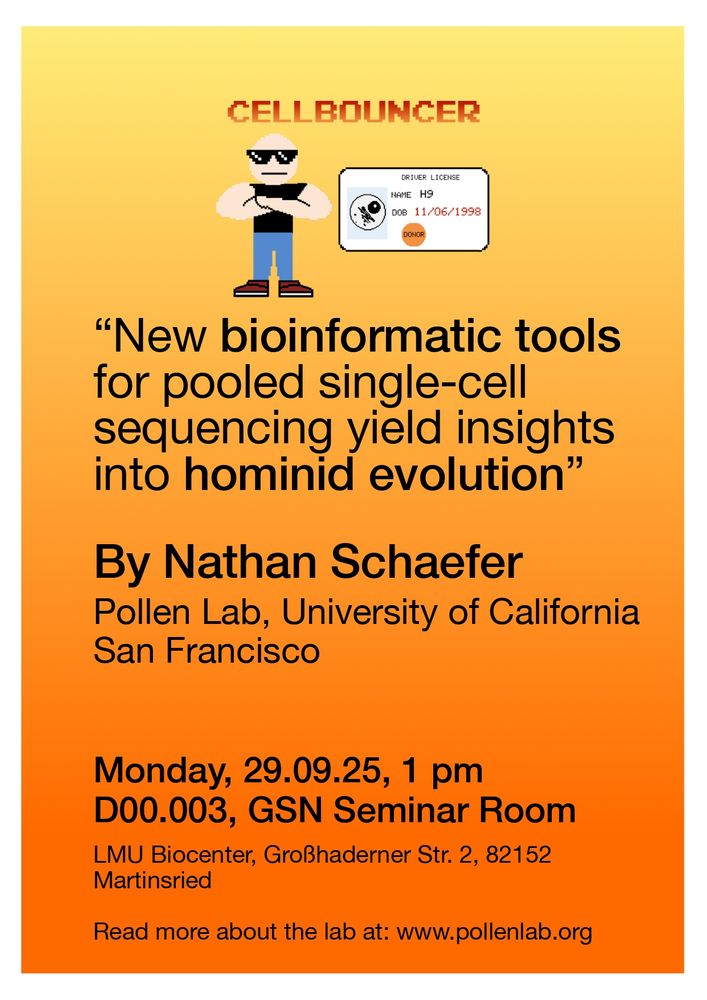
We’re excited to host @nkschaefer.bsky.social from the Pollen Lab @brainevodevo.bsky.social, UCSF!
He’ll present Cellbouncer, a new bioinformatic tool for pooled single-cell processing that yields insights into hominid evolution 🧬
More about the lab 👉 www.pollenlab.org
He’ll present Cellbouncer, a new bioinformatic tool for pooled single-cell processing that yields insights into hominid evolution 🧬
More about the lab 👉 www.pollenlab.org
September 19, 2025 at 11:32 AM
We’re excited to host @nkschaefer.bsky.social from the Pollen Lab @brainevodevo.bsky.social, UCSF!
He’ll present Cellbouncer, a new bioinformatic tool for pooled single-cell processing that yields insights into hominid evolution 🧬
More about the lab 👉 www.pollenlab.org
He’ll present Cellbouncer, a new bioinformatic tool for pooled single-cell processing that yields insights into hominid evolution 🧬
More about the lab 👉 www.pollenlab.org
Reposted by Alex Pollen
"Sources said the administration is specifically considering a full termination of federal grant funding for the University of California and California State University systems."
Pure vandalism.
This could never happen in a country with functioning checks and balances.
Pure vandalism.
This could never happen in a country with functioning checks and balances.

Trump preparing large-scale cancellation of federal funding for California, sources say | CNN Politics
The Trump administration is preparing to cancel a large swath of federal funding to California, an effort which could begin as soon as Friday, according to multiple sources.
www.cnn.com
June 6, 2025 at 8:01 PM
"Sources said the administration is specifically considering a full termination of federal grant funding for the University of California and California State University systems."
Pure vandalism.
This could never happen in a country with functioning checks and balances.
Pure vandalism.
This could never happen in a country with functioning checks and balances.
Reposted by Alex Pollen
EMBOMtg Paris May 6-9
@aydoganlab.bsky.social @jamesbriscoe.bsky.social @brunetlab.bsky.social @ebisuyamiki.bsky.social @mwdorr.bsky.social @beyerlab.bsky.social @franckp.bsky.social @janereznick.bsky.social @olmedo-lab.bsky.social @perez-carrasco.bsky.social
meetings.embo.org/event/25-dev...
@aydoganlab.bsky.social @jamesbriscoe.bsky.social @brunetlab.bsky.social @ebisuyamiki.bsky.social @mwdorr.bsky.social @beyerlab.bsky.social @franckp.bsky.social @janereznick.bsky.social @olmedo-lab.bsky.social @perez-carrasco.bsky.social
meetings.embo.org/event/25-dev...
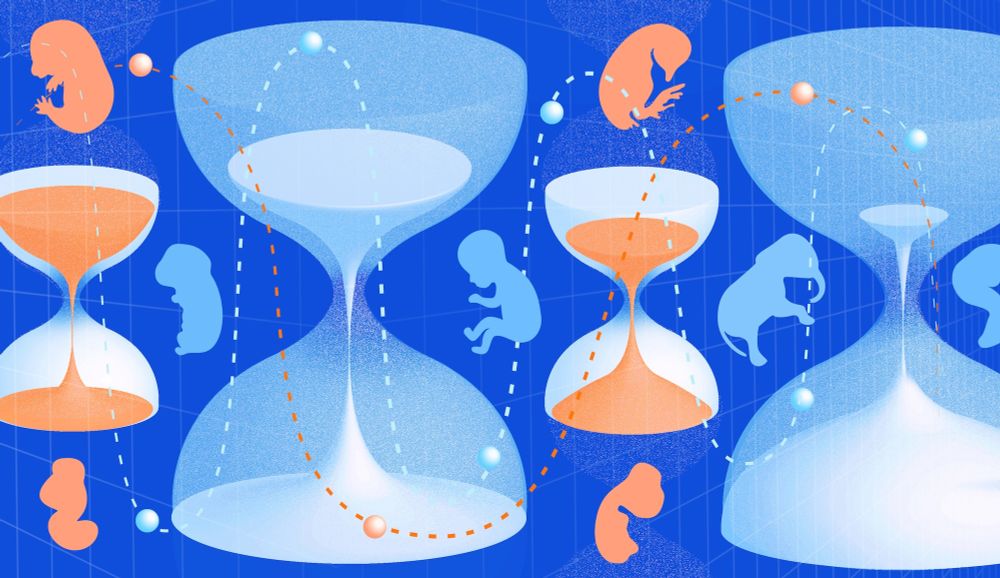
Developmental timing across species: From mechanisms to evolutionary insights
Like choreography, development consists of a highly ordered suite of steps and transitions. Modifying developmental tempo can affect final size and composition of tissues, as well as their plasticity…
meetings.embo.org
March 29, 2025 at 3:00 PM
Congratulations to Nathan for conceiving and designing this unified demultiplexing toolkit!

Picture this: you are running a single cell sequencing experiment and want to incorporate cells from different species, individuals, and maybe even perturbations. You process everything together to save time while reducing batch artifacts. You collect data. What do you do now?

a man in a green shirt is carrying a pink bag
ALT: a man in a green shirt is carrying a pink bag
media.tenor.com
March 24, 2025 at 10:12 PM
Congratulations to Nathan for conceiving and designing this unified demultiplexing toolkit!
We hope that CellBouncer will accelerate population-scale single cell genomic analyses, improve ambient RNA correction, and enable new experimental designs not previously possible.
March 24, 2025 at 10:11 PM
We hope that CellBouncer will accelerate population-scale single cell genomic analyses, improve ambient RNA correction, and enable new experimental designs not previously possible.
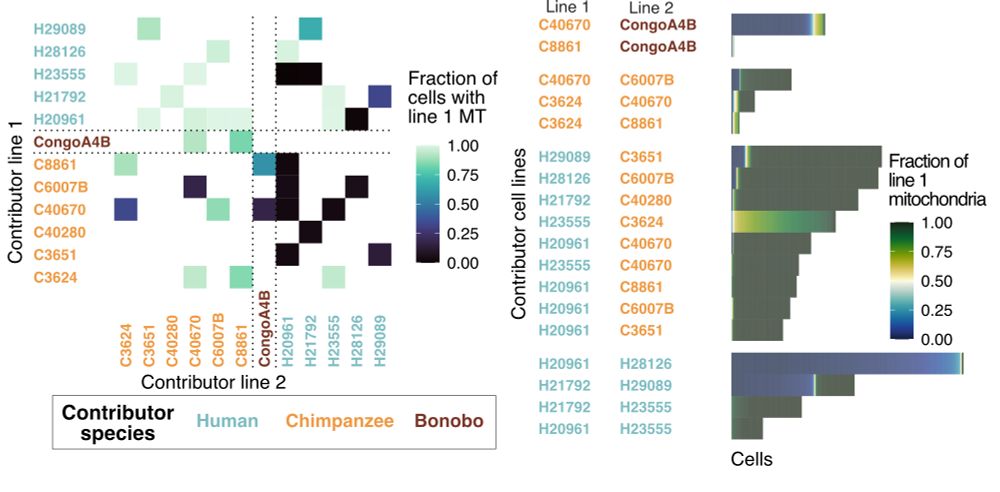
Surprisingly, cells with mitochondria from two hominids show evidence for apoptotic pathway induction, reduced mRNA expression, and less efficient processing of polycistronic mitochondrial transcripts, revealing recently evolved incompatibilities in the hominid lineage.
March 24, 2025 at 10:10 PM
Surprisingly, cells with mitochondria from two hominids show evidence for apoptotic pathway induction, reduced mRNA expression, and less efficient processing of polycistronic mitochondrial transcripts, revealing recently evolved incompatibilities in the hominid lineage.
Our analysis revealed that human and bonobo mitochondria typically outcompete those from chimpanzee, but we also identified a fraction of cells where chimpanzee mitochondria win and cells where both mitochondria survive.
March 24, 2025 at 10:09 PM
Our analysis revealed that human and bonobo mitochondria typically outcompete those from chimpanzee, but we also identified a fraction of cells where chimpanzee mitochondria win and cells where both mitochondria survive.
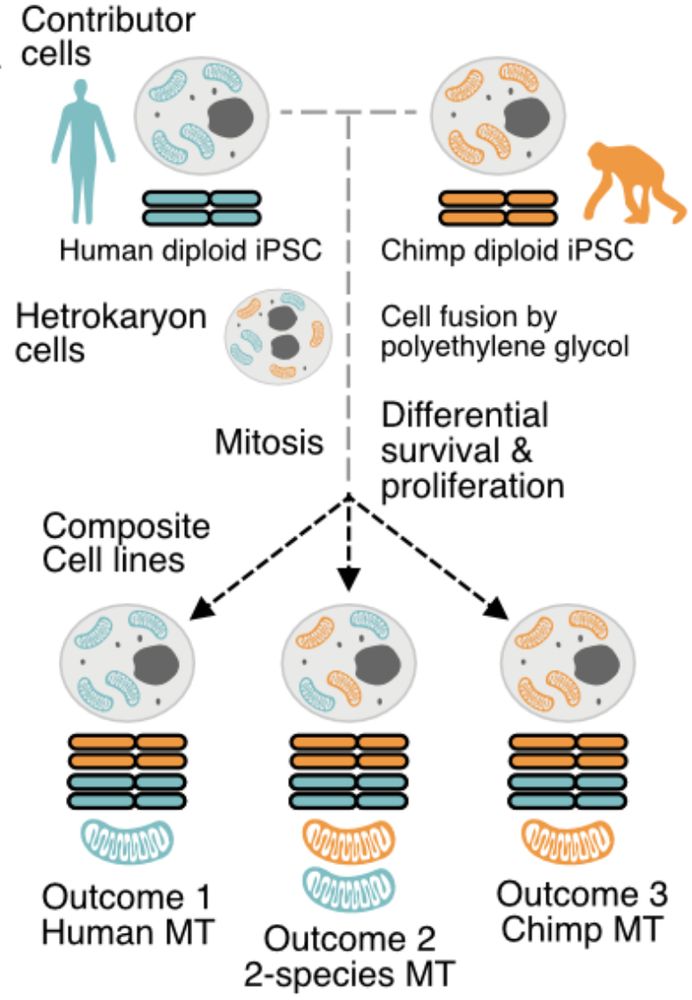
We put CellBouncer to the test with a challenging demultiplexing problem of assigning 24 hominid tetraploid composite cell lines generated by Bryan Pavlovic to both individuals-of-origin and identifying the mitochondrial haplotypes present.
www.biorxiv.org/content/10.1...
www.biorxiv.org/content/10.1...
March 24, 2025 at 10:07 PM
We put CellBouncer to the test with a challenging demultiplexing problem of assigning 24 hominid tetraploid composite cell lines generated by Bryan Pavlovic to both individuals-of-origin and identifying the mitochondrial haplotypes present.
www.biorxiv.org/content/10.1...
www.biorxiv.org/content/10.1...