



Tahsin Khan
@tahsinkhann.bsky.social
MPhil student @Cambridge_Uni and @sangerinstitute
Researcher @icddrb
Researcher @icddrb
Reposted by Tahsin Khan

Very pleased to plug our latest preprint, lead author @microberamon.bsky.social - fantastic collaboration with labs of Dario Carugo (Oxford) and Martha Clokie (Leicester) https:// - and others #UTISKy #UTI #IDSky #MicroSky www.biorxiv.org/content/10.1101/2025.11.12.688052v1 more below👇🧵

Effect of human urinary microenvironment and fluid flow on antibiotic and phage therapy efficacy against uropathogenic Escherichia coli
Urinary tract infections (UTI) remain a major global health burden, with high recurrence despite antibiotic treatment. The escalating prevalence of antimicrobial resistance further compromises therape...
www.biorxiv.org
November 13, 2025 at 9:20 AM
Very pleased to plug our latest preprint, lead author @microberamon.bsky.social - fantastic collaboration with labs of Dario Carugo (Oxford) and Martha Clokie (Leicester) https:// - and others #UTISKy #UTI #IDSky #MicroSky www.biorxiv.org/content/10.1101/2025.11.12.688052v1 more below👇🧵
Comparative genomics reveals diversity and taxonomic relationships among Clostridioides difficile phages | Microbiology Spectrum journals.asm.org/doi/10.1128/...

Comparative genomics reveals diversity and taxonomic relationships among Clostridioides difficile phages | Microbiology Spectrum
Clostridioides difficile is a significant healthcare concern due to its role in causing severe infections
and its increasing resistance to antibiotics. Phages present a promising alternative
to antibi...
journals.asm.org
November 13, 2025 at 9:33 PM
Comparative genomics reveals diversity and taxonomic relationships among Clostridioides difficile phages | Microbiology Spectrum journals.asm.org/doi/10.1128/...
Reposted by Tahsin Khan

Podcast with me and @turiking.bsky.social for the @milnerevolution.bsky.social series, on plasmid evolution over the last 100 years, talking about our ( @cazares-adr.bsky.social , Nick Thomson, @sarah1alexander.bsky.social & co) recent paper www.science.org/doi/10.1126/...
youtu.be/Mzr3TD4ijs0?...
youtu.be/Mzr3TD4ijs0?...

How the Vectors of Antibiotic Resistance Have Evolved - Professor Zamin Iqbal
YouTube video by Milner Centre for Evolution
youtu.be
October 17, 2025 at 11:48 AM
Podcast with me and @turiking.bsky.social for the @milnerevolution.bsky.social series, on plasmid evolution over the last 100 years, talking about our ( @cazares-adr.bsky.social , Nick Thomson, @sarah1alexander.bsky.social & co) recent paper www.science.org/doi/10.1126/...
youtu.be/Mzr3TD4ijs0?...
youtu.be/Mzr3TD4ijs0?...
Reposted by Tahsin Khan

🧬 New #GenEpiBioTrain course!
Bacterial Strain Taxonomy for Genomic Surveillance
📅 22–23.10, 09:00–12:00 (CEST)
Learn how bacterial pathogens are classified & named in genomic surveillance – from #MLST & #cgMLST to SNP-based & k-mer clustering.
Info: bit.ly/48qT5df
#ECDCTraining #IDsky #EpiSky
Bacterial Strain Taxonomy for Genomic Surveillance
📅 22–23.10, 09:00–12:00 (CEST)
Learn how bacterial pathogens are classified & named in genomic surveillance – from #MLST & #cgMLST to SNP-based & k-mer clustering.
Info: bit.ly/48qT5df
#ECDCTraining #IDsky #EpiSky

October 8, 2025 at 2:34 PM
🧬 New #GenEpiBioTrain course!
Bacterial Strain Taxonomy for Genomic Surveillance
📅 22–23.10, 09:00–12:00 (CEST)
Learn how bacterial pathogens are classified & named in genomic surveillance – from #MLST & #cgMLST to SNP-based & k-mer clustering.
Info: bit.ly/48qT5df
#ECDCTraining #IDsky #EpiSky
Bacterial Strain Taxonomy for Genomic Surveillance
📅 22–23.10, 09:00–12:00 (CEST)
Learn how bacterial pathogens are classified & named in genomic surveillance – from #MLST & #cgMLST to SNP-based & k-mer clustering.
Info: bit.ly/48qT5df
#ECDCTraining #IDsky #EpiSky
Reposted by Tahsin Khan

Phylodynamics and genome-wide association studies reveal the expansion of modern Streptococcus canis in Germany https://www.biorxiv.org/content/10.1101/2025.09.29.679251v1
October 2, 2025 at 1:16 PM
Phylodynamics and genome-wide association studies reveal the expansion of modern Streptococcus canis in Germany https://www.biorxiv.org/content/10.1101/2025.09.29.679251v1
Reposted by Tahsin Khan
Delighted to see our paper studying the evolution of plasmids over the last 100 years, now out! Years of work by Adrian Cazares, also Nick Thomson @sangerinstitute.bsky.social - this version much improved over the preprint. Final version should be open access, apols.
Thread 1/n
Thread 1/n

September 25, 2025 at 9:29 PM
Delighted to see our paper studying the evolution of plasmids over the last 100 years, now out! Years of work by Adrian Cazares, also Nick Thomson @sangerinstitute.bsky.social - this version much improved over the preprint. Final version should be open access, apols.
Thread 1/n
Thread 1/n
Reposted by Tahsin Khan
One for you @brockhurstlab.bsky.social !
Functional phages, and cocktails that work (caveat - have only looked at abstract)
www.biorxiv.org/content/10.1...
Functional phages, and cocktails that work (caveat - have only looked at abstract)
www.biorxiv.org/content/10.1...

Generative design of novel bacteriophages with genome language models
Many important biological functions arise not from single genes, but from complex interactions encoded by entire genomes. Genome language models have emerged as a promising strategy for designing biol...
www.biorxiv.org
September 20, 2025 at 4:06 PM
One for you @brockhurstlab.bsky.social !
Functional phages, and cocktails that work (caveat - have only looked at abstract)
www.biorxiv.org/content/10.1...
Functional phages, and cocktails that work (caveat - have only looked at abstract)
www.biorxiv.org/content/10.1...
Reposted by Tahsin Khan

The Atlas blue butterfly evolved 229 chromosome pairs — the most of any animal — over 3 million years, enabling new research 🦋
https://www.sanger.ac.uk/news_item/the-tale-of-the-creature-with-the-most-chromosomes/
@rogervilalab.bsky.social @charlottewright.bsky.social @ibe-barcelona.bsky.social
https://www.sanger.ac.uk/news_item/the-tale-of-the-creature-with-the-most-chromosomes/
@rogervilalab.bsky.social @charlottewright.bsky.social @ibe-barcelona.bsky.social

September 11, 2025 at 11:27 AM
The Atlas blue butterfly evolved 229 chromosome pairs — the most of any animal — over 3 million years, enabling new research 🦋
https://www.sanger.ac.uk/news_item/the-tale-of-the-creature-with-the-most-chromosomes/
@rogervilalab.bsky.social @charlottewright.bsky.social @ibe-barcelona.bsky.social
https://www.sanger.ac.uk/news_item/the-tale-of-the-creature-with-the-most-chromosomes/
@rogervilalab.bsky.social @charlottewright.bsky.social @ibe-barcelona.bsky.social
Reposted by Tahsin Khan

I've written a short blog post introducing "The Art of Visualization with ggplot2"!
This book is all about the end-to-end process of creating charts with #ggplot2 📊 including data wrangling, sketching, and styling your plots!
nrennie.rbind.io/blog/art-of-...
#RStats #DataViz #TidyTuesday
This book is all about the end-to-end process of creating charts with #ggplot2 📊 including data wrangling, sketching, and styling your plots!
nrennie.rbind.io/blog/art-of-...
#RStats #DataViz #TidyTuesday

Introducing The Art of Visualization with ggplot2 – Nicola Rennie
I’ve written a book! This blog post gives a brief introduction to The Art of Visualization with ggplot2, a book of data visualization case studies showing the end-to-end process of building charts, st...
nrennie.rbind.io
September 11, 2025 at 2:32 PM
I've written a short blog post introducing "The Art of Visualization with ggplot2"!
This book is all about the end-to-end process of creating charts with #ggplot2 📊 including data wrangling, sketching, and styling your plots!
nrennie.rbind.io/blog/art-of-...
#RStats #DataViz #TidyTuesday
This book is all about the end-to-end process of creating charts with #ggplot2 📊 including data wrangling, sketching, and styling your plots!
nrennie.rbind.io/blog/art-of-...
#RStats #DataViz #TidyTuesday
Reposted by Tahsin Khan

🚨 New pre-print from the lab! We performed a large-scale meta-analysis of the uncultured gut #microbiome in >10,000 metagenomes enabling us to identify a new candidate biomarker of health. www.biorxiv.org/content/10.1...

Meta-analysis of the uncultured gut microbiome across 11,115 global metagenomes reveals a new candidate biomarker of health
The human gut microbiome plays an important biological role in host health, yet over 60% of gut species remain uncultured and hence inaccessible to experimental manipulation. Here we analysed 11,115 h...
www.biorxiv.org
September 10, 2025 at 11:44 AM
🚨 New pre-print from the lab! We performed a large-scale meta-analysis of the uncultured gut #microbiome in >10,000 metagenomes enabling us to identify a new candidate biomarker of health. www.biorxiv.org/content/10.1...
Reposted by Tahsin Khan

Name changes for fungi of medical importance, 2022–2024 | Journal of Clinical Microbiology journals.asm.org/doi/10.1128/...

Name changes for fungi of medical importance, 2022–2024 | Journal of Clinical Microbiology
Since fungal identification methods based on examination of morphological and phenotypic
features are complicated by the astonishing diversity of organisms capable of causing
human infections especial...
journals.asm.org
September 6, 2025 at 1:59 AM
Name changes for fungi of medical importance, 2022–2024 | Journal of Clinical Microbiology journals.asm.org/doi/10.1128/...
Reposted by Tahsin Khan

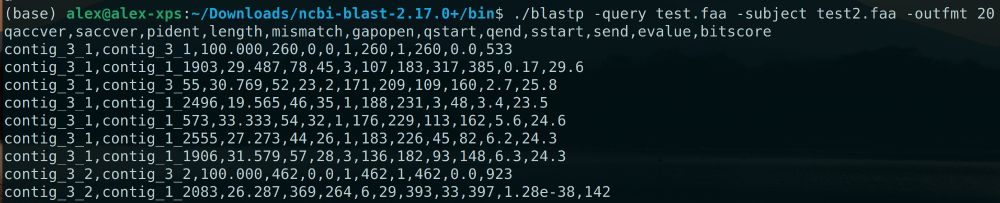
The new -outfmt 20 in BLAST 😍. No more frustrated googling to remember which column is which.....
September 6, 2025 at 2:54 PM
The new -outfmt 20 in BLAST 😍. No more frustrated googling to remember which column is which.....
Reposted by Tahsin Khan
🌡️ Fungi in a warming world: join our PhD on Candida auris evolution – thermal tolerance, immunity & antifungal resistance. Based at Exeter & Bristol, GW4 BioMed2 MRC DTP : www.exeter.ac.uk/study/fundin... #InfectiousDiseases #PhD #GW4 #Exeter #Bristol #MedicalMycology #AMR #ClimateChange

September 8, 2025 at 1:16 PM
🌡️ Fungi in a warming world: join our PhD on Candida auris evolution – thermal tolerance, immunity & antifungal resistance. Based at Exeter & Bristol, GW4 BioMed2 MRC DTP : www.exeter.ac.uk/study/fundin... #InfectiousDiseases #PhD #GW4 #Exeter #Bristol #MedicalMycology #AMR #ClimateChange
Reposted by Tahsin Khan

From asfiston.bsky.social & colleagues in @plos.org #Computational #Biology | Why and how to set up a Bioinformatics Learning Lab (BILL) | #Bioinformatics #Education #OpenScience #OpenEducationalResources 🧬 🖥️ 🧪🔓CC/ @ppalagi.bsky.social
⬇️
journals.plos.org/ploscompbiol...
⬇️
journals.plos.org/ploscompbiol...

Why and how to set up a Bioinformatics Learning Lab (BILL)
journals.plos.org
August 29, 2025 at 10:52 PM
From asfiston.bsky.social & colleagues in @plos.org #Computational #Biology | Why and how to set up a Bioinformatics Learning Lab (BILL) | #Bioinformatics #Education #OpenScience #OpenEducationalResources 🧬 🖥️ 🧪🔓CC/ @ppalagi.bsky.social
⬇️
journals.plos.org/ploscompbiol...
⬇️
journals.plos.org/ploscompbiol...
Reposted by Tahsin Khan

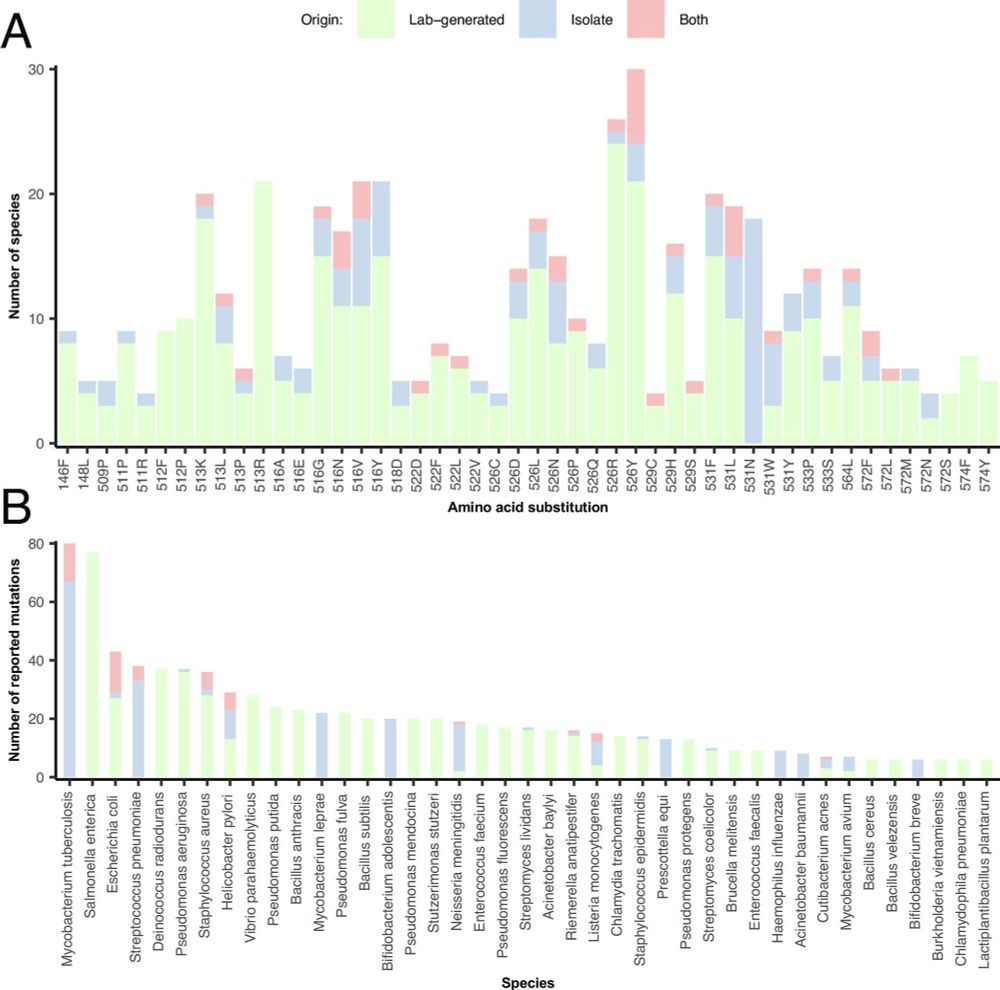
Evolution and evolvability of rifampicin resistance across the bacterial tree of life www.pnas.org/doi/abs/10.1... #jcampubs
Evolution and evolvability of rifampicin resistance across the bacterial tree of life | PNAS
Predicting the ability of bacteria to develop antibiotic resistance is challenging,
especially for the vast majority of species for which no experi...
www.pnas.org
July 31, 2025 at 1:55 PM
Evolution and evolvability of rifampicin resistance across the bacterial tree of life www.pnas.org/doi/abs/10.1... #jcampubs
Reposted by Tahsin Khan

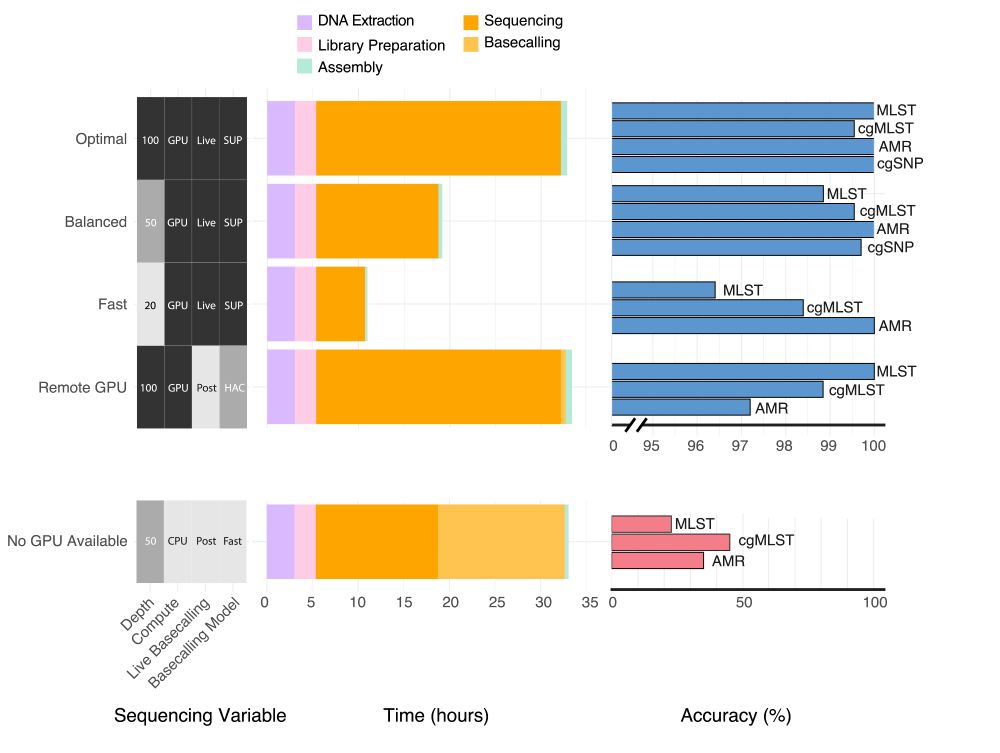
Pleased to say that our preprint benchmarking Nanopore data for MLST, cgMLST, cgSNP & AMR typing from bacterial isolates is out! TL;DR you can get almost perfect results from 50x depth using live SUP basecalling with a GPU in under 20 hours #microsky#IDsky 🦠🧬🖥️ /1
www.medrxiv.org/content/10.1...
www.medrxiv.org/content/10.1...
July 30, 2025 at 2:11 AM
Pleased to say that our preprint benchmarking Nanopore data for MLST, cgMLST, cgSNP & AMR typing from bacterial isolates is out! TL;DR you can get almost perfect results from 50x depth using live SUP basecalling with a GPU in under 20 hours #microsky#IDsky 🦠🧬🖥️ /1
www.medrxiv.org/content/10.1...
www.medrxiv.org/content/10.1...
Reposted by Tahsin Khan
On the biological meaning of the population pangenome: Trends in Microbiology www.cell.com/trends/micro...
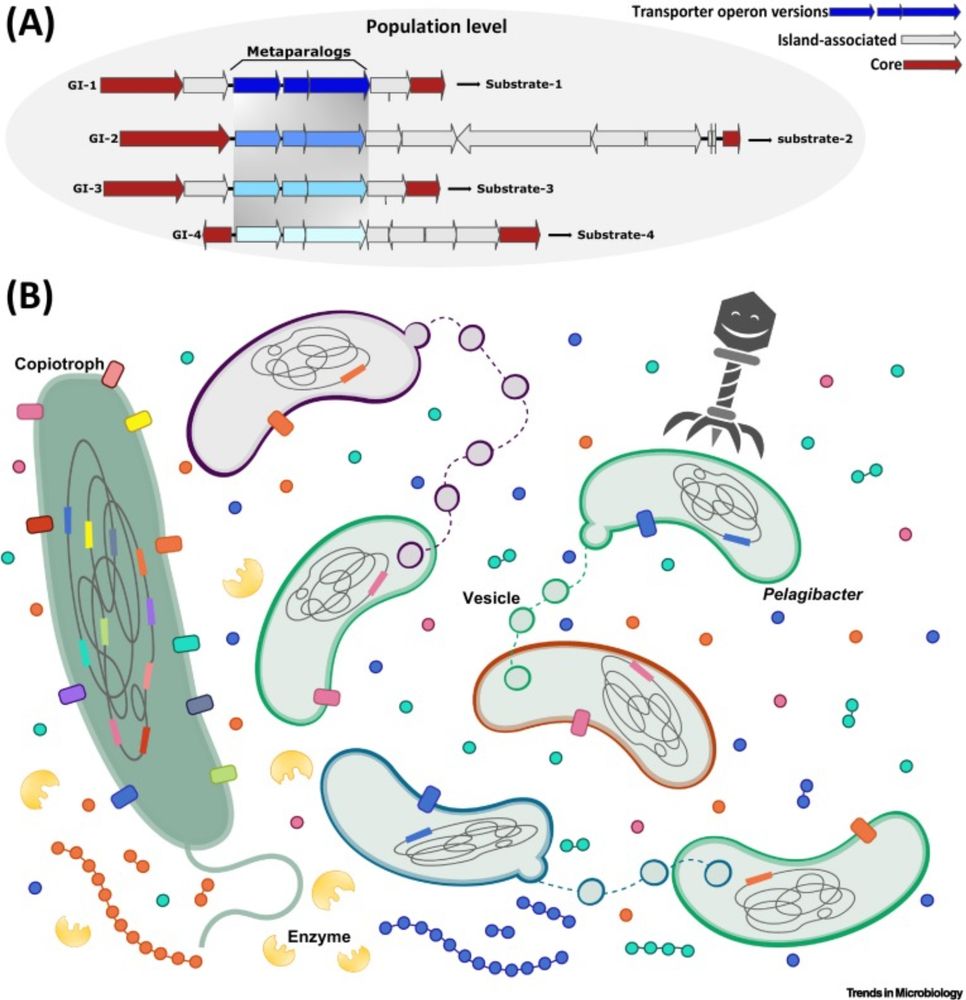
On the biological meaning of the population pangenome
The prokaryotic pangenome, the full complement of genes within a species, is strikingly
large. To understand how ecological forces shape this diversity, it is useful to examine
the variable gene pool ...
www.cell.com
July 30, 2025 at 7:24 AM
On the biological meaning of the population pangenome: Trends in Microbiology www.cell.com/trends/micro...
Reposted by Tahsin Khan

Our paper “Global dissemination of npmA mediated pan‑aminoglycoside resistance via a mobile element in Gram‑positive bacteria” is now in @natcomms.nature.com. Part of my freshly defended PhD, so doubly happy! 😄🎉
🧵 (1/14)
www.doi.org/10.1038/s414...
🧵 (1/14)
www.doi.org/10.1038/s414...
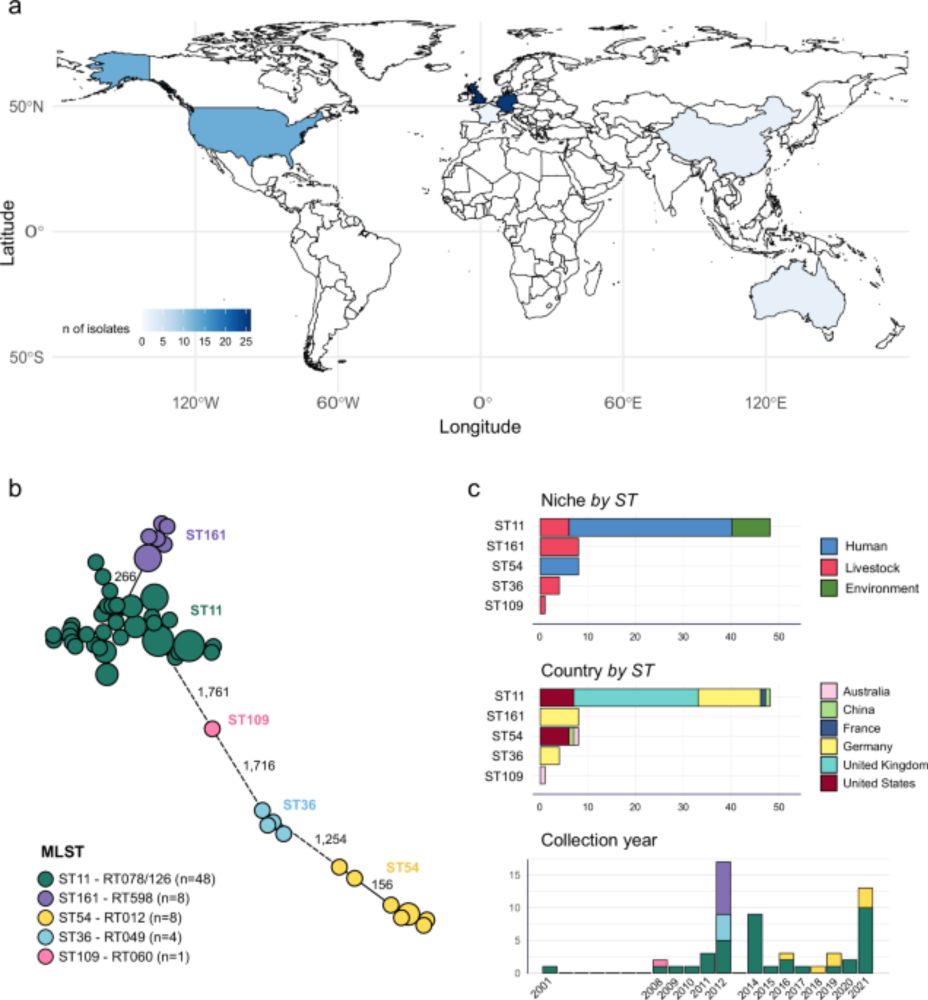
Global dissemination of npmA mediated pan-aminoglycoside resistance via a mobile genetic element in Gram-positive bacteria - Nature Communications
The authors investigate the distribution of the aminoglycoside resistance gene npmA in Gram-positive bacteria via a mobile genetic element, highlighting its global presence and cross-species transfer ...
www.doi.org
July 17, 2025 at 12:13 PM
Our paper “Global dissemination of npmA mediated pan‑aminoglycoside resistance via a mobile element in Gram‑positive bacteria” is now in @natcomms.nature.com. Part of my freshly defended PhD, so doubly happy! 😄🎉
🧵 (1/14)
www.doi.org/10.1038/s414...
🧵 (1/14)
www.doi.org/10.1038/s414...
Reposted by Tahsin Khan

New paper @natgenet.nature.com
nature.com/articles/s41...
Our most recent thinking on HYP effectors involves programmed shuffling of the parasite genome. This prompted us to review how and when organisms edit their own genomes
In so doing, Vincent made two important discoveries...
(1/3)
nature.com/articles/s41...
Our most recent thinking on HYP effectors involves programmed shuffling of the parasite genome. This prompted us to review how and when organisms edit their own genomes
In so doing, Vincent made two important discoveries...
(1/3)
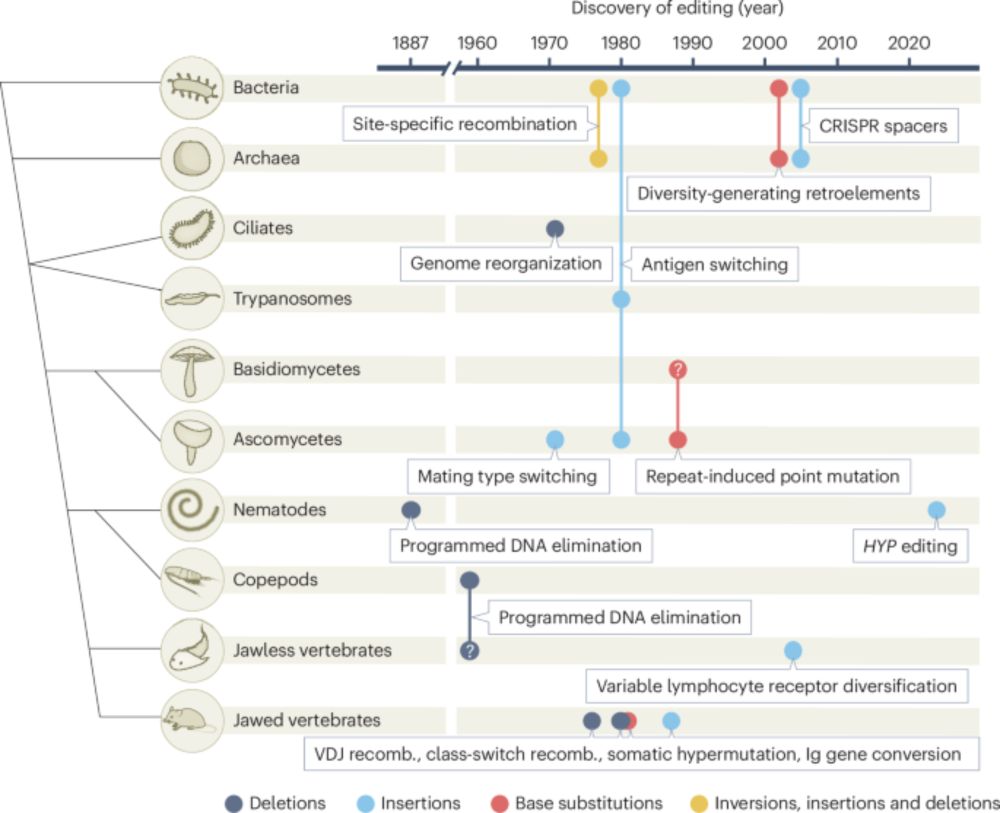
How and when organisms edit their own genomes - Nature Genetics
This Review describes the changes that some organisms make to their own DNA sequences, linking many to common genetic mechanisms built around canonical DNA repair and to a set of functional circumstan...
nature.com
June 27, 2025 at 10:08 AM
New paper @natgenet.nature.com
nature.com/articles/s41...
Our most recent thinking on HYP effectors involves programmed shuffling of the parasite genome. This prompted us to review how and when organisms edit their own genomes
In so doing, Vincent made two important discoveries...
(1/3)
nature.com/articles/s41...
Our most recent thinking on HYP effectors involves programmed shuffling of the parasite genome. This prompted us to review how and when organisms edit their own genomes
In so doing, Vincent made two important discoveries...
(1/3)
Reposted by Tahsin Khan
Excessive use of disinfectants
www.thelancet.com/journals/lan...
A study has, for the first time, revealed a strong and direct link between the rise of antibiotic-resistant bacteria and universal disinfection procedures applied to patients in intensive care units
medicalxpress.com/news/2025-06...
www.thelancet.com/journals/lan...
A study has, for the first time, revealed a strong and direct link between the rise of antibiotic-resistant bacteria and universal disinfection procedures applied to patients in intensive care units
medicalxpress.com/news/2025-06...

Universal versus targeted chlorhexidine and mupirocin decolonisation and clinical and molecular epidemiology of Staphylococcus epidermidis bloodstream infections in patients in intensive care in Scotl...
In ICU settings with low MRSA incidence, the benefits of universal decolonisation
should be balanced against the risks of selecting MRSE sequence types adapted for
invasive and device-associated infec...
www.thelancet.com
June 15, 2025 at 2:24 AM
Excessive use of disinfectants
www.thelancet.com/journals/lan...
A study has, for the first time, revealed a strong and direct link between the rise of antibiotic-resistant bacteria and universal disinfection procedures applied to patients in intensive care units
medicalxpress.com/news/2025-06...
www.thelancet.com/journals/lan...
A study has, for the first time, revealed a strong and direct link between the rise of antibiotic-resistant bacteria and universal disinfection procedures applied to patients in intensive care units
medicalxpress.com/news/2025-06...
Reposted by Tahsin Khan

Very excited to share our preprint on a new resource: the Encyclopaedia of Viral Anti-Defence Systems (EVADES)! This is the main result of my PhD at EMBL-EBI (@ebi.embl.org)
and the University of Cambridge (@cam.ac.uk)! 🔗 www.biorxiv.org/content/10.1... 🧵1/n"
and the University of Cambridge (@cam.ac.uk)! 🔗 www.biorxiv.org/content/10.1... 🧵1/n"

Elucidating the mechanisms of action and evolutionary history of phage anti-defence proteins
Phages and bacteria are locked in a molecular arms race, with phage anti-defence proteins (ADPs) enabling them to evade bacterial immune systems. To streamline access to information on ADPs, we develo...
www.biorxiv.org
June 8, 2025 at 11:08 AM
Very excited to share our preprint on a new resource: the Encyclopaedia of Viral Anti-Defence Systems (EVADES)! This is the main result of my PhD at EMBL-EBI (@ebi.embl.org)
and the University of Cambridge (@cam.ac.uk)! 🔗 www.biorxiv.org/content/10.1... 🧵1/n"
and the University of Cambridge (@cam.ac.uk)! 🔗 www.biorxiv.org/content/10.1... 🧵1/n"
Reposted by Tahsin Khan

The Global Failure Behind the H5N1 Ecological Crisis
We need to talk about our collective failure — as a global society — to prevent the dissemination of H5N1 into wild animal populations. This omission is striking, given the ecological catastrophe currently unfolding. The virus originated(1/6)
We need to talk about our collective failure — as a global society — to prevent the dissemination of H5N1 into wild animal populations. This omission is striking, given the ecological catastrophe currently unfolding. The virus originated(1/6)

May 29, 2025 at 10:33 PM
The Global Failure Behind the H5N1 Ecological Crisis
We need to talk about our collective failure — as a global society — to prevent the dissemination of H5N1 into wild animal populations. This omission is striking, given the ecological catastrophe currently unfolding. The virus originated(1/6)
We need to talk about our collective failure — as a global society — to prevent the dissemination of H5N1 into wild animal populations. This omission is striking, given the ecological catastrophe currently unfolding. The virus originated(1/6)
Reposted by Tahsin Khan

Its here! Finally published. www.tes.com/magazine/tea...
How to bring experimental evolution to the classroom
Pupils of all ages can benefit from witnessing evolution in real time - and it’s now possible in schools, say this researcher from the University of Bath
www.tes.com
May 31, 2025 at 5:04 AM
Its here! Finally published. www.tes.com/magazine/tea...
Reposted by Tahsin Khan
Allelic variations and gene cluster modularity act as nonlinear bottlenecks for #cholera emergence www.pnas.org/doi/10.1073/...

Allelic variations and gene cluster modularity act as nonlinear bottlenecks for cholera emergence | PNAS
The underlying factors that lead to specific strains within a species to emerge as
human pathogens remain mostly enigmatic. The diarrheal disease c...
www.pnas.org
May 29, 2025 at 10:19 AM
Allelic variations and gene cluster modularity act as nonlinear bottlenecks for #cholera emergence www.pnas.org/doi/10.1073/...
Reposted by Tahsin Khan

Excited to share the first beta release of AMRrules at #ABPHM! (Poster 42 tonight)
interpretamr.github.io/AMRrules
interpretamr.github.io/AMRrules

May 22, 2025 at 9:35 AM
Excited to share the first beta release of AMRrules at #ABPHM! (Poster 42 tonight)
interpretamr.github.io/AMRrules
interpretamr.github.io/AMRrules