
Rahil Ryder
@rahilryder.bsky.social
Genomic Data Scientist at CDPH,
Environmental Science Masters Graduate at CSUMB, (she/her). All opinions are my own.
Environmental Science Masters Graduate at CSUMB, (she/her). All opinions are my own.
Reposted by Rahil Ryder

Really excited our paper about how H5N1 rapidly adapted to cattle (and how these adaptations also increased its ability to infect cells from the human respiratory tract) is now published! www.nature.com/articles/s41...
Polymerase mutations underlie early adaptation of H5N1 influenza virus to dairy cattle and other mammals - Nature Communications
Avian influenza jumped from wild birds into dairy cattle. Here, the authors report that two mutations in the viral polymerase helped the virus to quickly adapt to cattle. Mutations increased the polym...
www.nature.com
January 20, 2026 at 2:10 PM
Really excited our paper about how H5N1 rapidly adapted to cattle (and how these adaptations also increased its ability to infect cells from the human respiratory tract) is now published! www.nature.com/articles/s41...
Reposted by Rahil Ryder

Just because the US is pretending that viruses only come from labs & we shouldn't bother with prevention otherwise, H5N1 is still here & is still a huge pandemic threat.
Join me & my expert colleagues Mar 3-4 in DC as we figure out what to do about it.
www.eventbrite.com/e/johns-hopk...
Join me & my expert colleagues Mar 3-4 in DC as we figure out what to do about it.
www.eventbrite.com/e/johns-hopk...
Johns Hopkins H5N1 Influenza Preparedness & Response Forum
Join us at Johns Hopkins for a hands-on forum on tackling H5N1 flu outbreaks and response strategies!
www.eventbrite.com
January 14, 2026 at 11:06 PM
Just because the US is pretending that viruses only come from labs & we shouldn't bother with prevention otherwise, H5N1 is still here & is still a huge pandemic threat.
Join me & my expert colleagues Mar 3-4 in DC as we figure out what to do about it.
www.eventbrite.com/e/johns-hopk...
Join me & my expert colleagues Mar 3-4 in DC as we figure out what to do about it.
www.eventbrite.com/e/johns-hopk...
Reposted by Rahil Ryder
David Ho et al on BA.3.2 and other variants neutralization by LP.8.1. vaccine serum: www.biorxiv.org/content/10.6...
h/t Euan Arnott
h/t Euan Arnott

January 6, 2026 at 1:48 PM
David Ho et al on BA.3.2 and other variants neutralization by LP.8.1. vaccine serum: www.biorxiv.org/content/10.6...
h/t Euan Arnott
h/t Euan Arnott
Reposted by Rahil Ryder

We find that subclade K viruses are antigenically advanced; however, this year's flu vaccine surprisingly elicited antibodies in many individuals that efficiently recognized these viruses. The implications are clear: go get this year’s vaccine if you haven’t already!
www.medrxiv.org/content/10.6...
www.medrxiv.org/content/10.6...

Antibodies elicited by the 2025-2026 influenza vaccine in humans
A new H3N2 variant (named subclade K) possesses several key hemagglutinin substitutions and is circulating widely during the 2025-2026 influenza season. In this report, we completed experiments to det...
www.medrxiv.org
January 7, 2026 at 1:34 PM
We find that subclade K viruses are antigenically advanced; however, this year's flu vaccine surprisingly elicited antibodies in many individuals that efficiently recognized these viruses. The implications are clear: go get this year’s vaccine if you haven’t already!
www.medrxiv.org/content/10.6...
www.medrxiv.org/content/10.6...
Reposted by Rahil Ryder

1/ In the first half of 2025, I wondered whether BA.3.2 would return at all. A few weeks ago, I considered that it might present a gradual shift toward endemicity rather than achieving global dominance.
December 17, 2025 at 1:22 PM
1/ In the first half of 2025, I wondered whether BA.3.2 would return at all. A few weeks ago, I considered that it might present a gradual shift toward endemicity rather than achieving global dominance.
Reposted by Rahil Ryder

New! Public Health Alerts, a joint CIDRAP/NEJM Evidence effort to strengthen early detection and response to emerging health threats.
First 2 reports:
• Community transmission of clade Ib mpox in LA area
• Flu virus characteristics and vax effectiveness data supporting WHO 2025–26 strain selections
First 2 reports:
• Community transmission of clade Ib mpox in LA area
• Flu virus characteristics and vax effectiveness data supporting WHO 2025–26 strain selections
December 17, 2025 at 5:36 PM
New! Public Health Alerts, a joint CIDRAP/NEJM Evidence effort to strengthen early detection and response to emerging health threats.
First 2 reports:
• Community transmission of clade Ib mpox in LA area
• Flu virus characteristics and vax effectiveness data supporting WHO 2025–26 strain selections
First 2 reports:
• Community transmission of clade Ib mpox in LA area
• Flu virus characteristics and vax effectiveness data supporting WHO 2025–26 strain selections
Reposted by Rahil Ryder

We've been doing wastewater metagenomics for 2 years.
In the first 20 months we never detected measles once.
However, in the last 4 months we've detected it 10 times across numerous states.
It's going endemic again; good reason to get vaccinated.
health.hawaii.gov/news/newsroo...
In the first 20 months we never detected measles once.
However, in the last 4 months we've detected it 10 times across numerous states.
It's going endemic again; good reason to get vaccinated.
health.hawaii.gov/news/newsroo...

DOH MONITORING FIRST WASTEWATER DETECTION OF MEASLES IN KAUAʻI COUNTY
HONOLULU — The Hawaiʻi Department of Health (DOH) is monitoring a positive wastewater sample for measles virus, the first wastewater detection of the virus for Kauaʻi County. The sample was collected ...
https://health.hawaii.gov/news/newsroom/doh-monitoring-first-wastewater-detection-of-measles-in-kauaʻi-county/
December 16, 2025 at 5:29 PM
We've been doing wastewater metagenomics for 2 years.
In the first 20 months we never detected measles once.
However, in the last 4 months we've detected it 10 times across numerous states.
It's going endemic again; good reason to get vaccinated.
health.hawaii.gov/news/newsroo...
In the first 20 months we never detected measles once.
However, in the last 4 months we've detected it 10 times across numerous states.
It's going endemic again; good reason to get vaccinated.
health.hawaii.gov/news/newsroo...
Reposted by Rahil Ryder

Tracking SARSCoV2 Lineage BA.3.2* ( #Cicada) over time | 12/15/25
Total BA.3.2* seqs: 184 (+4)
Countries reporting BA.3.2*: #Australia, #SouthAfrica, #Netherlands, #USA, #Germany, #Mozambique, #Slovenia, #UK, #Denmark, #Ireland, #Singapore
Tracker: public.tableau.com/app/profile/...
Total BA.3.2* seqs: 184 (+4)
Countries reporting BA.3.2*: #Australia, #SouthAfrica, #Netherlands, #USA, #Germany, #Mozambique, #Slovenia, #UK, #Denmark, #Ireland, #Singapore
Tracker: public.tableau.com/app/profile/...

December 16, 2025 at 6:16 AM
Tracking SARSCoV2 Lineage BA.3.2* ( #Cicada) over time | 12/15/25
Total BA.3.2* seqs: 184 (+4)
Countries reporting BA.3.2*: #Australia, #SouthAfrica, #Netherlands, #USA, #Germany, #Mozambique, #Slovenia, #UK, #Denmark, #Ireland, #Singapore
Tracker: public.tableau.com/app/profile/...
Total BA.3.2* seqs: 184 (+4)
Countries reporting BA.3.2*: #Australia, #SouthAfrica, #Netherlands, #USA, #Germany, #Mozambique, #Slovenia, #UK, #Denmark, #Ireland, #Singapore
Tracker: public.tableau.com/app/profile/...
Reposted by Rahil Ryder

New preprint alert from the PHA4GE Wastewater Subgroup:
Community-led standards for global wastewater-based infectious disease surveillance. 💧
Read the full work:
zenodo.org/records/1778...
Share feedback via GitHub:
github.com/pha4ge/waste...
#PHA4GE #WastewaterSurveillance
Community-led standards for global wastewater-based infectious disease surveillance. 💧
Read the full work:
zenodo.org/records/1778...
Share feedback via GitHub:
github.com/pha4ge/waste...
#PHA4GE #WastewaterSurveillance
Community-led standards for global wastewater-based infectious disease surveillance
The COVID-19 pandemic accelerated global adoption of wastewater and environmental surveillance (WES) and revealed its value as a complement to case-based monitoring. However, practical scientific, eth...
zenodo.org
December 16, 2025 at 6:58 AM
New preprint alert from the PHA4GE Wastewater Subgroup:
Community-led standards for global wastewater-based infectious disease surveillance. 💧
Read the full work:
zenodo.org/records/1778...
Share feedback via GitHub:
github.com/pha4ge/waste...
#PHA4GE #WastewaterSurveillance
Community-led standards for global wastewater-based infectious disease surveillance. 💧
Read the full work:
zenodo.org/records/1778...
Share feedback via GitHub:
github.com/pha4ge/waste...
#PHA4GE #WastewaterSurveillance
Reposted by Rahil Ryder
Three more BA.3.2 detections from US wastewater. Rhode Island (different sewershed, but near the previous one), Vermont, and Florida. All from CDC NWSS data.
Looks like it might be getting a foothold in New England.
@snpoehlm.bsky.social @ryanhisner.bsky.social @siamosolocani.bsky.social
Looks like it might be getting a foothold in New England.
@snpoehlm.bsky.social @ryanhisner.bsky.social @siamosolocani.bsky.social
December 11, 2025 at 7:07 PM
Three more BA.3.2 detections from US wastewater. Rhode Island (different sewershed, but near the previous one), Vermont, and Florida. All from CDC NWSS data.
Looks like it might be getting a foothold in New England.
@snpoehlm.bsky.social @ryanhisner.bsky.social @siamosolocani.bsky.social
Looks like it might be getting a foothold in New England.
@snpoehlm.bsky.social @ryanhisner.bsky.social @siamosolocani.bsky.social
Reposted by Rahil Ryder

As wastewater has become a core part of infectious disease surveillance worldwide, new guidance from WHO, GLOWACON, ASTHO, and others has laid key foundations for public health. But in practice, it’s not always obvious how to apply these recommendations or choose among available tools.
December 10, 2025 at 7:54 PM
As wastewater has become a core part of infectious disease surveillance worldwide, new guidance from WHO, GLOWACON, ASTHO, and others has laid key foundations for public health. But in practice, it’s not always obvious how to apply these recommendations or choose among available tools.
Reposted by Rahil Ryder
Another US wastewater detection of BA.3.2.2 (from CDC-NWSS surveillance)
This time from Austin on 11/19
The score:
Wastewater 2
Patient surveillance 0
This time from Austin on 11/19
The score:
Wastewater 2
Patient surveillance 0

December 3, 2025 at 5:40 PM
Another US wastewater detection of BA.3.2.2 (from CDC-NWSS surveillance)
This time from Austin on 11/19
The score:
Wastewater 2
Patient surveillance 0
This time from Austin on 11/19
The score:
Wastewater 2
Patient surveillance 0
Reposted by Rahil Ryder

The West Coast Health Alliance, @capublichealth.bsky.social , and Leading National Medical Organizations Continue to Recommend Hepatitis B Vaccination for Newborns
www.cdph.ca.gov/Programs/OPA...
www.cdph.ca.gov/Programs/OPA...

December 6, 2025 at 2:07 AM
The West Coast Health Alliance, @capublichealth.bsky.social , and Leading National Medical Organizations Continue to Recommend Hepatitis B Vaccination for Newborns
www.cdph.ca.gov/Programs/OPA...
www.cdph.ca.gov/Programs/OPA...
Reposted by Rahil Ryder

Fascinating 🧵. The grotesquely mutated spike of this NJ Cryptic binds ACE2 very tightly.
It raises a broader question: Can cryptic wastewater-like lineages transmit?
YES
We knew it happened once. Now we know it's happened at least twice. The results in both cases were not pretty. 1/15
It raises a broader question: Can cryptic wastewater-like lineages transmit?
YES
We knew it happened once. Now we know it's happened at least twice. The results in both cases were not pretty. 1/15
This is wild.
Remember the NJ crytic lineage?
I posted 18 months ago that the Spike was too divergent to predict ACE2 binding, and asked if someone else could figure it out.
Some colleagues took me up on it.
Guess what they found?
1/
Remember the NJ crytic lineage?
I posted 18 months ago that the Spike was too divergent to predict ACE2 binding, and asked if someone else could figure it out.
Some colleagues took me up on it.
Guess what they found?
1/
November 22, 2025 at 7:19 PM
Fascinating 🧵. The grotesquely mutated spike of this NJ Cryptic binds ACE2 very tightly.
It raises a broader question: Can cryptic wastewater-like lineages transmit?
YES
We knew it happened once. Now we know it's happened at least twice. The results in both cases were not pretty. 1/15
It raises a broader question: Can cryptic wastewater-like lineages transmit?
YES
We knew it happened once. Now we know it's happened at least twice. The results in both cases were not pretty. 1/15
Reposted by Rahil Ryder

I want to spell this out in case the implications aren't clear:
This means all public tools/webapps of GISAID data (all the ones you've been used to seeing thru the pandemic, as far as we can tell) are prohibited.
The file allowed this. Cut that - cut off all tools the public & others were using.
This means all public tools/webapps of GISAID data (all the ones you've been used to seeing thru the pandemic, as far as we can tell) are prohibited.
The file allowed this. Cut that - cut off all tools the public & others were using.

On Oct 1, 2025, GISAID informed us that they had ended updates to the flat file of SARS-CoV-2 genomic sequences and associated metadata that we had used to update Nextstrain analyses since Feb 2020. GISAID's stated rationale was that their "resources are limited". 1/5

November 7, 2025 at 2:41 PM
I want to spell this out in case the implications aren't clear:
This means all public tools/webapps of GISAID data (all the ones you've been used to seeing thru the pandemic, as far as we can tell) are prohibited.
The file allowed this. Cut that - cut off all tools the public & others were using.
This means all public tools/webapps of GISAID data (all the ones you've been used to seeing thru the pandemic, as far as we can tell) are prohibited.
The file allowed this. Cut that - cut off all tools the public & others were using.
As if the Trump Administration cuts arent doing enough bullying with the public health and research funding cuts, now we are losing access to valuable data and resources. These resources have been valuable and used regularly to track SARS-CoV-2 mutations and lineages in California.
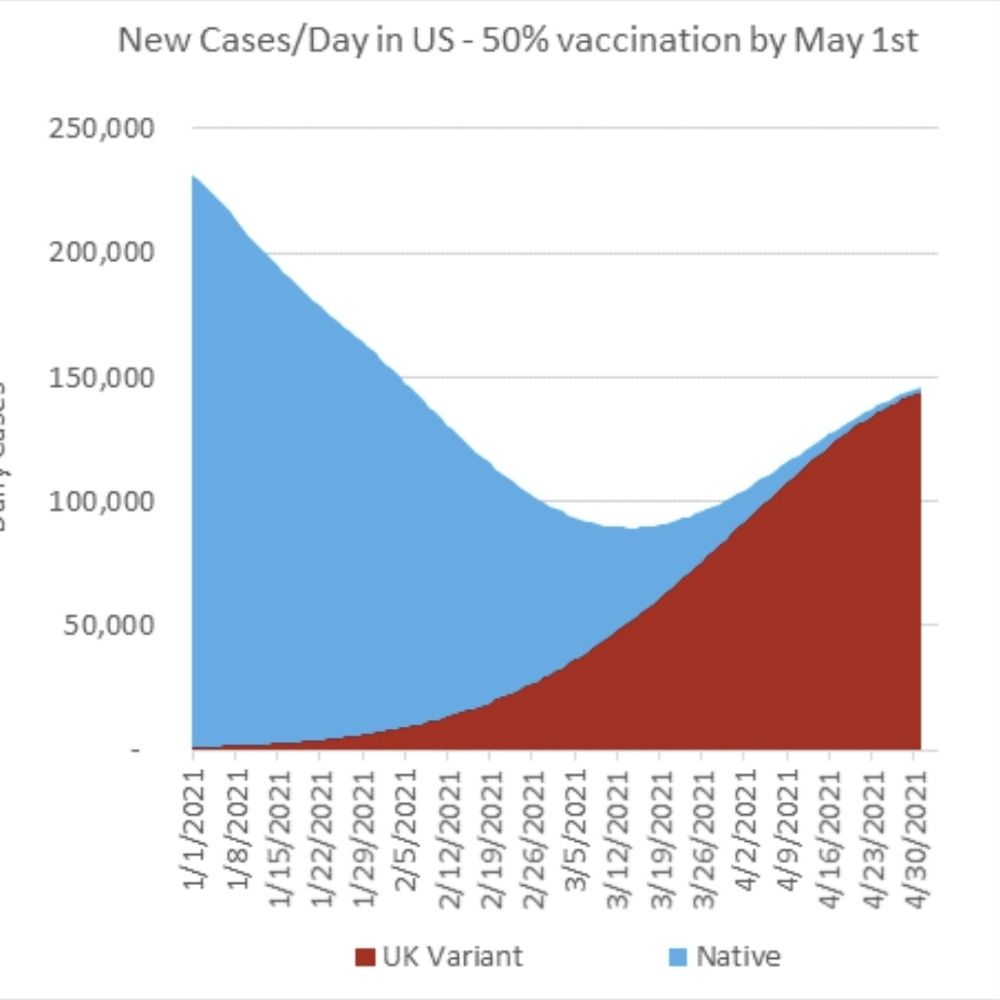
GISAID is now blocking genomic sequencing access to critical resources like Nextstrain, Covspectrum, Outbreak-info, & others.
This makes us less safe, as live tracking of viral evolution remains critical for assessment of emerging threats. This needs to be escalated.
This makes us less safe, as live tracking of viral evolution remains critical for assessment of emerging threats. This needs to be escalated.
Bad. No justification, no communication, no standard procedures for making changes—just arbitrary pronouncements cutting off access to some of the most valuable resources we have.
November 5, 2025 at 12:35 AM
As if the Trump Administration cuts arent doing enough bullying with the public health and research funding cuts, now we are losing access to valuable data and resources. These resources have been valuable and used regularly to track SARS-CoV-2 mutations and lineages in California.
Reposted by Rahil Ryder

Just out📢 Our new paper published in @natmicrobiol.nature.com describes highly potent cross-neutralizing human monoclonal antibodies against H5Nx influenza viruses. Close collaboration with Sara Andrews lab and Tongqing Zhou lab at the VRC. Link to the article: rdcu.be/eKV9T 1/2
October 14, 2025 at 3:10 PM
Just out📢 Our new paper published in @natmicrobiol.nature.com describes highly potent cross-neutralizing human monoclonal antibodies against H5Nx influenza viruses. Close collaboration with Sara Andrews lab and Tongqing Zhou lab at the VRC. Link to the article: rdcu.be/eKV9T 1/2
Reposted by Rahil Ryder
Finally, CoV-Spectrum is meeting trees 🌳 – this week, we released a new feature to browse the SARS-CoV-2 UShER tree on CoV-Spectrum. With the new feature, you can see a subtree of your variant of interest. 1/4

August 28, 2025 at 7:41 AM
Finally, CoV-Spectrum is meeting trees 🌳 – this week, we released a new feature to browse the SARS-CoV-2 UShER tree on CoV-Spectrum. With the new feature, you can see a subtree of your variant of interest. 1/4
Reposted by Rahil Ryder

In new study led by @bdadonaite.bsky.social, we measure how spike mutations affect function & antigenicity of spike of KP.3.1.1 strain of SARS-CoV-2.
Sheds light on how key neutralizing epitopes are changing & importance of RBD up/down motion.
www.biorxiv.org/content/10.1...
Sheds light on how key neutralizing epitopes are changing & importance of RBD up/down motion.
www.biorxiv.org/content/10.1...

Spike mutations that affect the function and antigenicity of recent KP.3.1.1-like SARS-CoV-2 variants
SARS-CoV-2 is under strong evolutionary selection to acquire mutations in its spike protein that reduce neutralization by human polyclonal antibodies. Here we use pseudovirus-based deep mutational sca...
www.biorxiv.org
August 20, 2025 at 5:22 AM
In new study led by @bdadonaite.bsky.social, we measure how spike mutations affect function & antigenicity of spike of KP.3.1.1 strain of SARS-CoV-2.
Sheds light on how key neutralizing epitopes are changing & importance of RBD up/down motion.
www.biorxiv.org/content/10.1...
Sheds light on how key neutralizing epitopes are changing & importance of RBD up/down motion.
www.biorxiv.org/content/10.1...
Reposted by Rahil Ryder

We're back in business with the SEARCH wastewater surveillance - and things aren't looking too shabby!
Head on over to our website for live San Diego data: searchcovid.info
Head on over to our website for live San Diego data: searchcovid.info


August 7, 2025 at 9:57 PM
We're back in business with the SEARCH wastewater surveillance - and things aren't looking too shabby!
Head on over to our website for live San Diego data: searchcovid.info
Head on over to our website for live San Diego data: searchcovid.info
Reposted by Rahil Ryder
Wow, BA.3.2 hits its 4th continent with a new sequence from Western Australia.
Reminder: BA.3.2 is a saltation variant resulting from a ~3-year chronic infection. It is very different from and more immune-evasive than all other current variants. 1/4
Reminder: BA.3.2 is a saltation variant resulting from a ~3-year chronic infection. It is very different from and more immune-evasive than all other current variants. 1/4

July 30, 2025 at 2:18 PM
Wow, BA.3.2 hits its 4th continent with a new sequence from Western Australia.
Reminder: BA.3.2 is a saltation variant resulting from a ~3-year chronic infection. It is very different from and more immune-evasive than all other current variants. 1/4
Reminder: BA.3.2 is a saltation variant resulting from a ~3-year chronic infection. It is very different from and more immune-evasive than all other current variants. 1/4

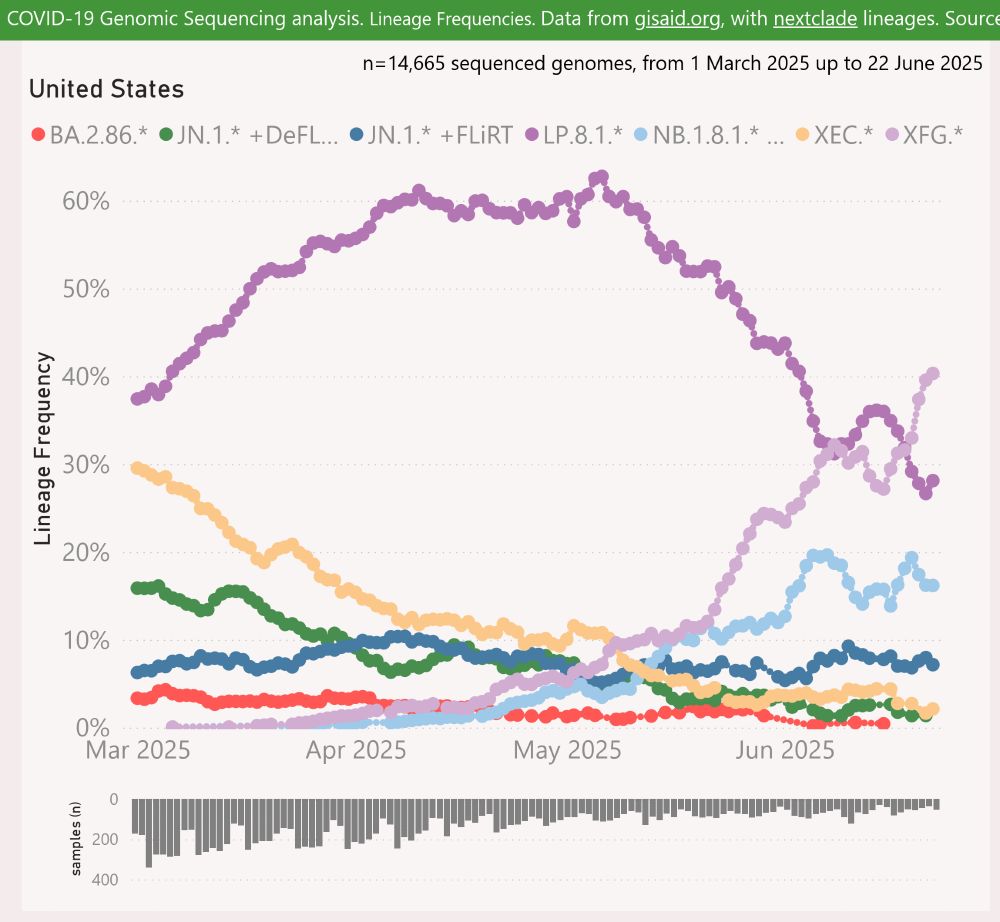
Excited to share our findings of SARS-CoV-2 persistent infections using California WGS surveillance\epidemiology data.
Please feel free to let us know your thoughts as it goes through to publication.
www.biorxiv.org/content/10.1...
Please feel free to let us know your thoughts as it goes through to publication.
www.biorxiv.org/content/10.1...

Genomic and epidemiologic characteristics of SARS-CoV-2 persistent infections in California, January 2021 - July 2023
Novel SARS-CoV-2 variants demonstrating considerable intra-host evolution emerged throughout the pandemic. The persistent infections thought to give rise to these variants, however, have been difficul...
www.biorxiv.org
July 17, 2025 at 4:19 AM
Excited to share our findings of SARS-CoV-2 persistent infections using California WGS surveillance\epidemiology data.
Please feel free to let us know your thoughts as it goes through to publication.
www.biorxiv.org/content/10.1...
Please feel free to let us know your thoughts as it goes through to publication.
www.biorxiv.org/content/10.1...
Reposted by Rahil Ryder
BA.3.2 update, Chapter: "I'm Not Quite Dead, Sir"
A new sequence from a traveler to the USA from the Netherlands was uploaded yesterday, with a collection date of June 17. 1/10
A new sequence from a traveler to the USA from the Netherlands was uploaded yesterday, with a collection date of June 17. 1/10

June 29, 2025 at 4:46 PM
BA.3.2 update, Chapter: "I'm Not Quite Dead, Sir"
A new sequence from a traveler to the USA from the Netherlands was uploaded yesterday, with a collection date of June 17. 1/10
A new sequence from a traveler to the USA from the Netherlands was uploaded yesterday, with a collection date of June 17. 1/10
Reposted by Rahil Ryder