



Jan Soroczynski
@jsoro.bsky.social
Pinned
CAD-C: An engineered nuclease enables repair-free in situ proximity ligation and nucleosome-resolution chromosome walks in human cells
Chromosome conformation capture (3C)-derived methods have become an indispensable tool in the study of gene regulation. The three-dimensional contacts they are able to assay depend strongly on the properties of the enzyme used to fragment chromatin prior to proximity-driven ligation. Micrococcal nuclease (MNase), used in Micro-C, increases resolution at the expense of low ligation efficiency and the need for extensive enzyme titration. To overcome these limitations, we engineered a highly active, TEV protease-activatable caspase-activated DNase (CAD) to enable an efficient, low-sequence-bias, and high-resolution proximity ligation assay we call CAD-C. CAD-C was successful on the first attempt for each human cell line tested and the resulting datasets capture loops, TADs, compartments, and stripes similarly to Micro-C. However, compared to Micro-C and Hi-C, CAD-C shows enhanced sensitivity for promoter-enhancer loops. Leveraging the ligation-competent DNA ends produced by CAD cleavage, we show that CAD-C is compatible with a highly streamlined, repair-free protocol and produces multi-step CADwalks, consecutive ligations between nucleosomal or sub-nucleosomal fragments. With these walks, we probe local chromatin fiber folding contacts, nucleosomal and sub-nucleosomal footprints, and long-range nuclear organization regimes in human cell lines. CAD-C is an efficient, robust chromatin structure assay that can span sub-nucleosomal to chromosomal length scales in a single experiment. ### Competing Interest Statement V.I.R. and J.S. are inventors on a related patent application covering CAD-C (PCT application filed 2024). NIH Common Fund, https://ror.org/001d55x84, 1DP2GM150021 Irma T. Hirschl Trust, https://ror.org/01yaqvf46, Career Scientist Award Rita Allen Foundation, https://ror.org/0515k5w36, Scholar Award Stavros Niarchos Foundation, https://ror.org/0210rze73, Institute for Global Infectious Disease Research at Rockefeller University Grant Robertson Technology Development Fund at Rockefeller University Boehringer Ingelheim (Germany), https://ror.org/00q32j219, PhD Fellowship to JS U.S. National Science Foundation, https://ror.org/021nxhr62, GRFP to LAW International Human Frontier Science Program Organization, https://ror.org/02ebx7v45, Postdoctoral Cross-Disciplinary Fellowship to AO Natural Sciences and Engineering Research Council of Canada, Postgraduate fellowship to HC, Postgraduate fellowship to JLY
doi.org
Excited to share my PhD work from @riscalab.bsky.social on @biorxivpreprint.bsky.social CAD-C & CADwalks –repair-free, nucleosome-resolution chromosome conformation capture with engineered TEVp-activatable CAD. CADwalks: chromosome walks of ligated CAD footprints. doi.org/10.64898/202...
1/
1/
Reposted by Jan Soroczynski
Another announcement! 📣 Our work on hybrid incompatibility in cohesin protection in 🐭oocytes is published!! Congrats Warif El Yakoubi and Eddie Pan!!🎉 We found hybrids with cohesion errors in two distinct genus.
www.science.org/doi/10.1126/...
www.science.org/doi/10.1126/...

Hybrid female sterility due to cohesin protection errors in mouse oocytes
Misregulation of chromosome cohesion during female meiosis serves as a reproductive isolating barrier in mice.
www.science.org
February 7, 2026 at 12:51 AM
Another announcement! 📣 Our work on hybrid incompatibility in cohesin protection in 🐭oocytes is published!! Congrats Warif El Yakoubi and Eddie Pan!!🎉 We found hybrids with cohesion errors in two distinct genus.
www.science.org/doi/10.1126/...
www.science.org/doi/10.1126/...
Reposted by Jan Soroczynski

Not something you see in textbooks very often: tripolar mitosis.
February 7, 2026 at 8:00 AM
Not something you see in textbooks very often: tripolar mitosis.
Reposted by Jan Soroczynski
Our new preprint on SMCHD1! We’ve shown SMCHD1’s ATPase activity is critical for function in vivo, and excitingly a new DNA binding domain neighbouring the ATPase domain activates the enzymatic function, which is important for normal chromatin binding.
urldefense.com/v3/__https:/...
urldefense.com/v3/__https:/...

February 6, 2026 at 7:57 AM
Our new preprint on SMCHD1! We’ve shown SMCHD1’s ATPase activity is critical for function in vivo, and excitingly a new DNA binding domain neighbouring the ATPase domain activates the enzymatic function, which is important for normal chromatin binding.
urldefense.com/v3/__https:/...
urldefense.com/v3/__https:/...
Reposted by Jan Soroczynski

🧬🔬🎥 @science.org Live-cell single-molecule dynamics of eukaryotic RNA polymerase machineries | Science www.science.org/doi/10.1126/...

Live-cell single-molecule dynamics of eukaryotic RNA polymerase machineries
Eukaryotic gene expression is orchestrated by RNA polymerases (RNAPI, II, and III) and associated factors, yet their real-time dynamics remain obscure. Using single-molecule tracking in living yeast, ...
www.science.org
February 6, 2026 at 12:14 AM
🧬🔬🎥 @science.org Live-cell single-molecule dynamics of eukaryotic RNA polymerase machineries | Science www.science.org/doi/10.1126/...
Reposted by Jan Soroczynski

Cognitive decline in aging parasitoid wasps https://www.biorxiv.org/content/10.64898/2026.02.03.703543v1
February 6, 2026 at 12:45 AM
Cognitive decline in aging parasitoid wasps https://www.biorxiv.org/content/10.64898/2026.02.03.703543v1
Reposted by Jan Soroczynski

I’m thrilled to share our latest preprint! Inspired by isothermal Gibson assembly cloning, we wondered whether we could assemble and integrate DNA sequences at a specific genomic locus in human cells. A thread (1/7) www.biorxiv.org/content/10.1...
www.biorxiv.org
June 17, 2025 at 7:02 PM
I’m thrilled to share our latest preprint! Inspired by isothermal Gibson assembly cloning, we wondered whether we could assemble and integrate DNA sequences at a specific genomic locus in human cells. A thread (1/7) www.biorxiv.org/content/10.1...
Reposted by Jan Soroczynski

Some (+)ve news to lighten another heavy weekend: our latest preprint (c/o Mattiroli + Ramani labs) is up!
www.biorxiv.org/content/10.1...
A tour-de-force by 1st authors Bruna Eckhardt & @palindromephd.bsky.social, focusing on chromatin replication. RTs welcome; tweetorial in 3,2...(1/n)
www.biorxiv.org/content/10.1...
A tour-de-force by 1st authors Bruna Eckhardt & @palindromephd.bsky.social, focusing on chromatin replication. RTs welcome; tweetorial in 3,2...(1/n)

The eukaryotic replisome intrinsically generates asymmetric daughter chromatin fibers
DNA replication is molecularly asymmetric, due to distinct mechanisms for lagging and leading strand DNA synthesis. Whether chromatin assembly on newly replicated strands is also asymmetric remains un...
www.biorxiv.org
September 20, 2025 at 4:10 PM
Some (+)ve news to lighten another heavy weekend: our latest preprint (c/o Mattiroli + Ramani labs) is up!
www.biorxiv.org/content/10.1...
A tour-de-force by 1st authors Bruna Eckhardt & @palindromephd.bsky.social, focusing on chromatin replication. RTs welcome; tweetorial in 3,2...(1/n)
www.biorxiv.org/content/10.1...
A tour-de-force by 1st authors Bruna Eckhardt & @palindromephd.bsky.social, focusing on chromatin replication. RTs welcome; tweetorial in 3,2...(1/n)
Reposted by Jan Soroczynski

I’m thrilled to share my postdoc work and the first paper from the McKinley Lab! 🎉
@karalmckinley.bsky.social
We built the first transgenic model of menstruation in mice.
We used it to uncover how the endometrium organizes and sheds during menstruation. 🧪
www.biorxiv.org/content/10.1...
🧵
@karalmckinley.bsky.social
We built the first transgenic model of menstruation in mice.
We used it to uncover how the endometrium organizes and sheds during menstruation. 🧪
www.biorxiv.org/content/10.1...
🧵

Induction of menstruation in mice reveals the regulation of menstrual shedding
During menstruation, an inner layer of the endometrium is selectively shed, while an outer, progenitor-containing layer is preserved to support repeated regeneration. Progress in understanding this co...
www.biorxiv.org
October 10, 2025 at 12:50 PM
I’m thrilled to share my postdoc work and the first paper from the McKinley Lab! 🎉
@karalmckinley.bsky.social
We built the first transgenic model of menstruation in mice.
We used it to uncover how the endometrium organizes and sheds during menstruation. 🧪
www.biorxiv.org/content/10.1...
🧵
@karalmckinley.bsky.social
We built the first transgenic model of menstruation in mice.
We used it to uncover how the endometrium organizes and sheds during menstruation. 🧪
www.biorxiv.org/content/10.1...
🧵
Reposted by Jan Soroczynski
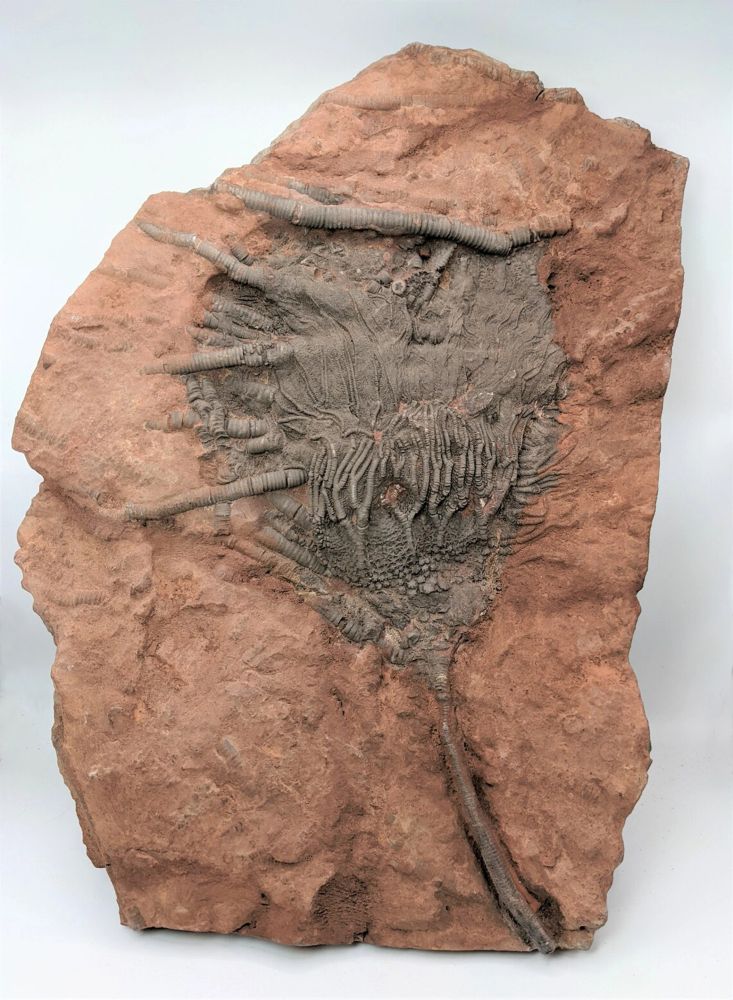
Millions of years ago during the Silurian period, the Sahara Desert was a shallow sea full of aquatic animals like crinoids. Don’t be fooled! Crinoids are commonly called "sea lilies" but they aren't plants! They are echinoderms, like starfish and sea urchins, and many species are still alive today!
January 29, 2026 at 7:59 PM
Millions of years ago during the Silurian period, the Sahara Desert was a shallow sea full of aquatic animals like crinoids. Don’t be fooled! Crinoids are commonly called "sea lilies" but they aren't plants! They are echinoderms, like starfish and sea urchins, and many species are still alive today!
Reposted by Jan Soroczynski
Re-analysis of human population-scale whole genome seq data elucidates genetic architecture of EBV DNA persistence, a framework for the broader human virome
@nature.com @caleblareau.bsky.social @sherrynyeo.bsky.social @erinmayc.bsky.social @ryandhindsa.bsky.social
www.nature.com/articles/s41...
@nature.com @caleblareau.bsky.social @sherrynyeo.bsky.social @erinmayc.bsky.social @ryandhindsa.bsky.social
www.nature.com/articles/s41...

January 28, 2026 at 10:25 PM
Re-analysis of human population-scale whole genome seq data elucidates genetic architecture of EBV DNA persistence, a framework for the broader human virome
@nature.com @caleblareau.bsky.social @sherrynyeo.bsky.social @erinmayc.bsky.social @ryandhindsa.bsky.social
www.nature.com/articles/s41...
@nature.com @caleblareau.bsky.social @sherrynyeo.bsky.social @erinmayc.bsky.social @ryandhindsa.bsky.social
www.nature.com/articles/s41...
Reposted by Jan Soroczynski

AlphaGenome is out in @nature.com today along with model weights! 🧬
📄 Paper: www.nature.com/articles/s41...
💻 Weights: github.com/google-deepm...
Getting here wasn’t a straight path. We discussed the story behind the model, paper & API in the following roundtable: youtu.be/V8lhUqKqzUc
📄 Paper: www.nature.com/articles/s41...
💻 Weights: github.com/google-deepm...
Getting here wasn’t a straight path. We discussed the story behind the model, paper & API in the following roundtable: youtu.be/V8lhUqKqzUc

January 28, 2026 at 9:02 PM
AlphaGenome is out in @nature.com today along with model weights! 🧬
📄 Paper: www.nature.com/articles/s41...
💻 Weights: github.com/google-deepm...
Getting here wasn’t a straight path. We discussed the story behind the model, paper & API in the following roundtable: youtu.be/V8lhUqKqzUc
📄 Paper: www.nature.com/articles/s41...
💻 Weights: github.com/google-deepm...
Getting here wasn’t a straight path. We discussed the story behind the model, paper & API in the following roundtable: youtu.be/V8lhUqKqzUc
Reposted by Jan Soroczynski

Have you wondered how the rules of chromatin folding have evolved? Well, this task is not easy to formalize. But here is our take on it: train species-specific DNA-to-chromatin encoder, apply to DNA of unseen species, and build chromatin rules-based tree of life. Have a look:
doi.org/10.1093/nar/...
doi.org/10.1093/nar/...

January 26, 2026 at 10:58 AM
Have you wondered how the rules of chromatin folding have evolved? Well, this task is not easy to formalize. But here is our take on it: train species-specific DNA-to-chromatin encoder, apply to DNA of unseen species, and build chromatin rules-based tree of life. Have a look:
doi.org/10.1093/nar/...
doi.org/10.1093/nar/...
Reposted by Jan Soroczynski

I’m happy to share the main result of my PhD, which you can find on bioRxiv www.biorxiv.org/content/10.6.... If you are interested in learning about a new way to perform DNA-PAINT multiplexing, which we call Combi-PAINT, or if you are interested in the study of mRNA conformation, keep reading! 1/10
January 26, 2026 at 11:31 AM
I’m happy to share the main result of my PhD, which you can find on bioRxiv www.biorxiv.org/content/10.6.... If you are interested in learning about a new way to perform DNA-PAINT multiplexing, which we call Combi-PAINT, or if you are interested in the study of mRNA conformation, keep reading! 1/10
Reposted by Jan Soroczynski

I love how this graphic is totally unhelpful for determining whether you're going to get 30 inches of snow or half an inch of ice.

January 23, 2026 at 8:57 PM
I love how this graphic is totally unhelpful for determining whether you're going to get 30 inches of snow or half an inch of ice.
Reposted by Jan Soroczynski
I had the privilege to meet artist Mary Griffiths. Mary got inspired by Hi-C maps and over zooms we spoke about Hi-C maps, patterns and drawings. Mary’s Hi-C inspired art has been exhibited eg the Royal Academy. We wrote this piece about this art-science collaboration
pubs.aip.org/aip/bpr/arti...
pubs.aip.org/aip/bpr/arti...

Seeing into Hi-C: How our scientific connectivity revealed the close connections in our DNA to be a work of art
Scientific data can be beautiful. An example where the data itself have a particularly striking appearance even before any scientific meaning has been ascribed
pubs.aip.org
January 24, 2026 at 12:50 AM
I had the privilege to meet artist Mary Griffiths. Mary got inspired by Hi-C maps and over zooms we spoke about Hi-C maps, patterns and drawings. Mary’s Hi-C inspired art has been exhibited eg the Royal Academy. We wrote this piece about this art-science collaboration
pubs.aip.org/aip/bpr/arti...
pubs.aip.org/aip/bpr/arti...
Reposted by Jan Soroczynski
Preprint alert: Jiangyuan Liu developed a new workflow for chromatin loop calling across Hi-C datasets, e.g., during differentiation. Most loops are shared between datasets/cell states. Important work for all interested in chromatin loops and how to identify them!
www.biorxiv.org/content/10.6...
www.biorxiv.org/content/10.6...
www.biorxiv.org
January 21, 2026 at 11:20 AM
Preprint alert: Jiangyuan Liu developed a new workflow for chromatin loop calling across Hi-C datasets, e.g., during differentiation. Most loops are shared between datasets/cell states. Important work for all interested in chromatin loops and how to identify them!
www.biorxiv.org/content/10.6...
www.biorxiv.org/content/10.6...
Reposted by Jan Soroczynski
Chromatin fatigue: DNA repair alters the chromatin environment and introduces heritable variation in gene expression in a larger region around the lesion! Amazing achievement by @sbantele.bsky.social and Jiri Lukas published in @science.org 🙌 Happy we could contribute. See 👇

𝗖𝗮𝗻 𝗰𝗲𝗹𝗹𝘀 𝗲𝘃𝗲𝗿 𝘁𝗿𝘂𝗹𝘆 𝗿𝗲𝗰𝗼𝘃𝗲𝗿 𝗳𝗿𝗼𝗺 𝗗𝗡𝗔 𝗱𝗮𝗺𝗮𝗴𝗲?Excited to share our new study “Repair of DNA double-strand breaks leaves heritable impairment to genome function”, revealing DNA repair’s hidden cost, out now @science.org tinyurl.com/5n6zw3ye. Led by @sbantele.bsky.social and Jiri Lukas.🧵👇1/n

Repair of DNA double-strand breaks leaves heritable impairment to genome function
Upon DNA breakage, a genomic locus undergoes alterations in three-dimensional chromatin architecture to facilitate signaling and repair. Although cells possess mechanisms to repair damaged DNA, it is ...
tinyurl.com
November 12, 2025 at 3:55 AM
Chromatin fatigue: DNA repair alters the chromatin environment and introduces heritable variation in gene expression in a larger region around the lesion! Amazing achievement by @sbantele.bsky.social and Jiri Lukas published in @science.org 🙌 Happy we could contribute. See 👇
Excited to share my PhD work from @riscalab.bsky.social on @biorxivpreprint.bsky.social CAD-C & CADwalks –repair-free, nucleosome-resolution chromosome conformation capture with engineered TEVp-activatable CAD. CADwalks: chromosome walks of ligated CAD footprints. doi.org/10.64898/202...
1/
1/
CAD-C: An engineered nuclease enables repair-free in situ proximity ligation and nucleosome-resolution chromosome walks in human cells
Chromosome conformation capture (3C)-derived methods have become an indispensable tool in the study of gene regulation. The three-dimensional contacts they are able to assay depend strongly on the properties of the enzyme used to fragment chromatin prior to proximity-driven ligation. Micrococcal nuclease (MNase), used in Micro-C, increases resolution at the expense of low ligation efficiency and the need for extensive enzyme titration. To overcome these limitations, we engineered a highly active, TEV protease-activatable caspase-activated DNase (CAD) to enable an efficient, low-sequence-bias, and high-resolution proximity ligation assay we call CAD-C. CAD-C was successful on the first attempt for each human cell line tested and the resulting datasets capture loops, TADs, compartments, and stripes similarly to Micro-C. However, compared to Micro-C and Hi-C, CAD-C shows enhanced sensitivity for promoter-enhancer loops. Leveraging the ligation-competent DNA ends produced by CAD cleavage, we show that CAD-C is compatible with a highly streamlined, repair-free protocol and produces multi-step CADwalks, consecutive ligations between nucleosomal or sub-nucleosomal fragments. With these walks, we probe local chromatin fiber folding contacts, nucleosomal and sub-nucleosomal footprints, and long-range nuclear organization regimes in human cell lines. CAD-C is an efficient, robust chromatin structure assay that can span sub-nucleosomal to chromosomal length scales in a single experiment. ### Competing Interest Statement V.I.R. and J.S. are inventors on a related patent application covering CAD-C (PCT application filed 2024). NIH Common Fund, https://ror.org/001d55x84, 1DP2GM150021 Irma T. Hirschl Trust, https://ror.org/01yaqvf46, Career Scientist Award Rita Allen Foundation, https://ror.org/0515k5w36, Scholar Award Stavros Niarchos Foundation, https://ror.org/0210rze73, Institute for Global Infectious Disease Research at Rockefeller University Grant Robertson Technology Development Fund at Rockefeller University Boehringer Ingelheim (Germany), https://ror.org/00q32j219, PhD Fellowship to JS U.S. National Science Foundation, https://ror.org/021nxhr62, GRFP to LAW International Human Frontier Science Program Organization, https://ror.org/02ebx7v45, Postdoctoral Cross-Disciplinary Fellowship to AO Natural Sciences and Engineering Research Council of Canada, Postgraduate fellowship to HC, Postgraduate fellowship to JLY
doi.org
January 21, 2026 at 7:32 PM
Excited to share my PhD work from @riscalab.bsky.social on @biorxivpreprint.bsky.social CAD-C & CADwalks –repair-free, nucleosome-resolution chromosome conformation capture with engineered TEVp-activatable CAD. CADwalks: chromosome walks of ligated CAD footprints. doi.org/10.64898/202...
1/
1/