


Gavin Thomas (he/him)
@gavinhthomas.bsky.social
Microbiologist @UniofYork. Former EiC of @MicrobioSoc
#MicrobioJ. Transporters, Staph, BO & skin microbiome. CSO
@morfdb.bsky.social York Knavesmire Harrier & EBOR orienteer.
#MicrobioJ. Transporters, Staph, BO & skin microbiome. CSO
@morfdb.bsky.social York Knavesmire Harrier & EBOR orienteer.
Reposted by Gavin Thomas (he/him)
Interesting new paper on Enterococcus lactis (the species formerly known as Clade B E. faecium)
'The Mannose Phosphotransferase System in Enterococcus lactis Is Essential for Gastrointestinal Colonization'
onlinelibrary.wiley.com/doi/abs/10.1...
'The Mannose Phosphotransferase System in Enterococcus lactis Is Essential for Gastrointestinal Colonization'
onlinelibrary.wiley.com/doi/abs/10.1...

The Mannose Phosphotransferase System in Enterococcus lactis Is Essential for Gastrointestinal Colonization
Enterococcus lactis, a recently established species that was previously classified as Enterococcus faecium clade B. Given its recent taxonomic classification, studies on this bacterium are scarce, an...
onlinelibrary.wiley.com
December 27, 2025 at 11:48 AM
Interesting new paper on Enterococcus lactis (the species formerly known as Clade B E. faecium)
'The Mannose Phosphotransferase System in Enterococcus lactis Is Essential for Gastrointestinal Colonization'
onlinelibrary.wiley.com/doi/abs/10.1...
'The Mannose Phosphotransferase System in Enterococcus lactis Is Essential for Gastrointestinal Colonization'
onlinelibrary.wiley.com/doi/abs/10.1...
Interested in the sugars bacteria use to evade our immune system? We are looking to train a student across microbiology & biochemistry to discover the mechanisms for scavenging & recycling these sugars & and join the thriving glycobiology community in York
www.findaphd.com/phds/project...
www.findaphd.com/phds/project...

Breaking the surface of Pseudomonas: elucidation of the biochemical basis of pseudaminic acid transport and catabolism in bacteria (York YBDTP Project) at University of York on FindAPhD.com
PhD Project - Breaking the surface of Pseudomonas: elucidation of the biochemical basis of pseudaminic acid transport and catabolism in bacteria (York YBDTP Project) at University of York, listed on ...
www.findaphd.com
December 29, 2025 at 4:02 PM
Interested in the sugars bacteria use to evade our immune system? We are looking to train a student across microbiology & biochemistry to discover the mechanisms for scavenging & recycling these sugars & and join the thriving glycobiology community in York
www.findaphd.com/phds/project...
www.findaphd.com/phds/project...
Reposted by Gavin Thomas (he/him)

Reposted by Gavin Thomas (he/him)
Our paper on polymyxin interacting with the E. coli outer membrane is out! Simulations by the very talented @dheerajprakaash.bsky.social www.nature.com/articles/s42...
To scale outer membrane protein island simulated at coarse-grained resolution with portions refined at all atom resolution.
To scale outer membrane protein island simulated at coarse-grained resolution with portions refined at all atom resolution.

Polymyxins slow down lateral diffusion of proteins and lipopolysaccharide in the E. coli outer membrane - Communications Biology
Multi-scale molecular dynamics simulations reveal that polymyxins form polymyxin-protein aggregates upon associating with the E. coli outer membrane thereby reducing lateral mobility of outer membrane...
www.nature.com
December 5, 2025 at 3:42 PM
Our paper on polymyxin interacting with the E. coli outer membrane is out! Simulations by the very talented @dheerajprakaash.bsky.social www.nature.com/articles/s42...
To scale outer membrane protein island simulated at coarse-grained resolution with portions refined at all atom resolution.
To scale outer membrane protein island simulated at coarse-grained resolution with portions refined at all atom resolution.
Reposted by Gavin Thomas (he/him)
Amazing dataset describing the metabolic profiles of 66 E. coli transporter knockouts by @sulheim.bsky.social with Peter Doubleday and @nzamboni.bsky.social. The tool, set up by @lambdapp.bsky.social and Eric Ulrich allows you to explore for yourself. Enjoy! Pre-print here: doi.org/10.1101/2025...
December 3, 2025 at 1:11 PM
Amazing dataset describing the metabolic profiles of 66 E. coli transporter knockouts by @sulheim.bsky.social with Peter Doubleday and @nzamboni.bsky.social. The tool, set up by @lambdapp.bsky.social and Eric Ulrich allows you to explore for yourself. Enjoy! Pre-print here: doi.org/10.1101/2025...
Reposted by Gavin Thomas (he/him)
The deadline for the first of our three fully funded PhD studentships is tomorrow! Determining the role of the dual-function VanT in C. diff vancomycin resistance. Collab with @gavinhthomas.bsky.social and Marjan van der Woude

MRC DiMeN Doctoral Training Partnership: Doubling down: determining the dual function of VanT in C. difficile antibiotic resistance. at University of Sheffield on FindAPhD.com
PhD Project - MRC DiMeN Doctoral Training Partnership: Doubling down: determining the dual function of VanT in C. difficile antibiotic resistance. at University of Sheffield, listed on FindAPhD.com
www.findaphd.com
December 3, 2025 at 11:34 AM
The deadline for the first of our three fully funded PhD studentships is tomorrow! Determining the role of the dual-function VanT in C. diff vancomycin resistance. Collab with @gavinhthomas.bsky.social and Marjan van der Woude
Reposted by Gavin Thomas (he/him)
#Throwback 🧪
COMMENT | Metabolites are not genes — avoiding the misuse of pathway analysis in metabolomics
KS Lee, X Su & T Huan
COMMENT | Metabolites are not genes — avoiding the misuse of pathway analysis in metabolomics
KS Lee, X Su & T Huan

Metabolites are not genes — avoiding the misuse of pathway analysis in metabolomics - Nature Metabolism
Pathway analysis, originally developed for gene expression data, has been adapted for metabolomics. However, owing to the unique characteristics and constraints of metabolites compared with genes, pathway analysis in metabolomics often yields misleading or nonsensical results.
bit.ly
November 30, 2025 at 7:01 PM
#Throwback 🧪
COMMENT | Metabolites are not genes — avoiding the misuse of pathway analysis in metabolomics
KS Lee, X Su & T Huan
COMMENT | Metabolites are not genes — avoiding the misuse of pathway analysis in metabolomics
KS Lee, X Su & T Huan
Very nice work from Simon Heilbronner's lab in Munich, which we heard at the Staph GRC this summer. Plenty more of these kinds of interactions going on in these communities I think.
academic.oup.com/ismej/articl...
academic.oup.com/ismej/articl...

Competitive fitness of Staphylococcus aureus against nasal commensals depends on biotin biosynthesis and acquisition
Abstract. The human nasal microbiome can serve as a reservoir for pathogens. In particular, the opportunistic pathogen Staphylococcus aureus can be a membe
academic.oup.com
November 28, 2025 at 9:14 PM
Very nice work from Simon Heilbronner's lab in Munich, which we heard at the Staph GRC this summer. Plenty more of these kinds of interactions going on in these communities I think.
academic.oup.com/ismej/articl...
academic.oup.com/ismej/articl...
Reposted by Gavin Thomas (he/him)

Our sLola consortium is now in BlueSky! Worth following for future updates on our work with IM30 proteins including LiaH, PspA, and VIPP's.

‼️Research update - the last-resort 💊antibiotic daptomycin attacks🧫bacteria through two independent mechanisms & IM30 protein LiaH helps remodel membranes under stress. Great work by @henrikstrahl.bsky.social & @jbuttresssci.bsky.social @newcastleuni.bsky.social team
#microsky #BBSRC #sLoLa ⬇️
#microsky #BBSRC #sLoLa ⬇️
Now properly published at @natcomms.nature.com with few additional experiments incl. demonstration of Daptomycin's ability to depolarise non-growing cells.
See the original preprint-thread for a summary of our findings.
www.nature.com/articles/s41...
#microsky
See the original preprint-thread for a summary of our findings.
www.nature.com/articles/s41...
#microsky
November 25, 2025 at 2:47 PM
Our sLola consortium is now in BlueSky! Worth following for future updates on our work with IM30 proteins including LiaH, PspA, and VIPP's.
Reposted by Gavin Thomas (he/him)
Now properly published at @natcomms.nature.com with few additional experiments incl. demonstration of Daptomycin's ability to depolarise non-growing cells.
See the original preprint-thread for a summary of our findings.
www.nature.com/articles/s41...
#microsky
See the original preprint-thread for a summary of our findings.
www.nature.com/articles/s41...
#microsky
November 24, 2025 at 8:20 PM
Now properly published at @natcomms.nature.com with few additional experiments incl. demonstration of Daptomycin's ability to depolarise non-growing cells.
See the original preprint-thread for a summary of our findings.
www.nature.com/articles/s41...
#microsky
See the original preprint-thread for a summary of our findings.
www.nature.com/articles/s41...
#microsky
Reposted by Gavin Thomas (he/him)
Check out our new paper:
🔗 www.cell.com/structure/fu...
We explored how sulfate-reducing bacteria import isethionate, a sulfur-containing molecule found in the environment and produced by microbes in the human gut. We captured a structure of the IseQM TRAP transporter in a substrate-bound state.
🔗 www.cell.com/structure/fu...
We explored how sulfate-reducing bacteria import isethionate, a sulfur-containing molecule found in the environment and produced by microbes in the human gut. We captured a structure of the IseQM TRAP transporter in a substrate-bound state.

Structural basis of isethionate transport by a TRAP transporter from a sulfate-reducing bacterium
Newton-Vesty et al. used a megabody fiducial to determine the cryo-EM structure of
an isethionate TRAP transporter, revealing the substrate and Na+-binding sites. Transport
is dependent on Na+ and the...
www.cell.com
November 9, 2025 at 8:45 PM
Check out our new paper:
🔗 www.cell.com/structure/fu...
We explored how sulfate-reducing bacteria import isethionate, a sulfur-containing molecule found in the environment and produced by microbes in the human gut. We captured a structure of the IseQM TRAP transporter in a substrate-bound state.
🔗 www.cell.com/structure/fu...
We explored how sulfate-reducing bacteria import isethionate, a sulfur-containing molecule found in the environment and produced by microbes in the human gut. We captured a structure of the IseQM TRAP transporter in a substrate-bound state.
Reposted by Gavin Thomas (he/him)

Contrast this with the response of a president who was an actual decent human being.
November 6, 2025 at 5:51 PM
Contrast this with the response of a president who was an actual decent human being.
Reposted by Gavin Thomas (he/him)
Absolutely delighted (and proud) that @freyaallen.bsky.social passed her viva with minor corrections today.
Thanks very much @jessicamablair.bsky.social @robfagan.bsky.social for examining!
Thanks very much @jessicamablair.bsky.social @robfagan.bsky.social for examining!

November 6, 2025 at 10:09 PM
Absolutely delighted (and proud) that @freyaallen.bsky.social passed her viva with minor corrections today.
Thanks very much @jessicamablair.bsky.social @robfagan.bsky.social for examining!
Thanks very much @jessicamablair.bsky.social @robfagan.bsky.social for examining!
Reposted by Gavin Thomas (he/him)
1. Characterising the role of the dual-function VanT in C. difficile vancomycin resistance.
A collaboration between our group in @molmicrosheffield.bsky.social and the groups of @gavinhthomas.bsky.social and Marjan van der Woude at the University of York
www.findaphd.com/phds/project...
A collaboration between our group in @molmicrosheffield.bsky.social and the groups of @gavinhthomas.bsky.social and Marjan van der Woude at the University of York
www.findaphd.com/phds/project...

October 31, 2025 at 3:44 PM
1. Characterising the role of the dual-function VanT in C. difficile vancomycin resistance.
A collaboration between our group in @molmicrosheffield.bsky.social and the groups of @gavinhthomas.bsky.social and Marjan van der Woude at the University of York
www.findaphd.com/phds/project...
A collaboration between our group in @molmicrosheffield.bsky.social and the groups of @gavinhthomas.bsky.social and Marjan van der Woude at the University of York
www.findaphd.com/phds/project...
Reposted by Gavin Thomas (he/him)
Really enjoyed giving an evening lecture (‘antibiotics from the abyss’) to the Yorkshire Philosophical Society on Tuesday at Tempest Anderson Hall. The AMR series was organised by @gavinhthomas.bsky.social (lectures 1&2 by @jessicamablair.bsky.social & Martha Clokie) www.ypsyork.org/events/antib...

October 16, 2025 at 11:11 AM
Really enjoyed giving an evening lecture (‘antibiotics from the abyss’) to the Yorkshire Philosophical Society on Tuesday at Tempest Anderson Hall. The AMR series was organised by @gavinhthomas.bsky.social (lectures 1&2 by @jessicamablair.bsky.social & Martha Clokie) www.ypsyork.org/events/antib...
Reposted by Gavin Thomas (he/him)

Excited to share our preprint led by Carlos Voogdt et al
We developed new genetic tools & genome-wide libraries for species of the Bacteroidales order; constructed saturated barcoded transposon libraries in key representatives of three genera.
www.biorxiv.org/content/10.1...
We developed new genetic tools & genome-wide libraries for species of the Bacteroidales order; constructed saturated barcoded transposon libraries in key representatives of three genera.
www.biorxiv.org/content/10.1...

October 13, 2025 at 7:48 AM
Excited to share our preprint led by Carlos Voogdt et al
We developed new genetic tools & genome-wide libraries for species of the Bacteroidales order; constructed saturated barcoded transposon libraries in key representatives of three genera.
www.biorxiv.org/content/10.1...
We developed new genetic tools & genome-wide libraries for species of the Bacteroidales order; constructed saturated barcoded transposon libraries in key representatives of three genera.
www.biorxiv.org/content/10.1...
Massive congratulations to Reyme Herman who passed his PhD viva today and has two new papers out on his (side project) developing and characterising the York Skin Microbiome collection. Thanks to @webberma.bsky.social & Marjan van der Woude for examining & @unileveruki.bsky.social for support.

October 10, 2025 at 3:08 PM
Massive congratulations to Reyme Herman who passed his PhD viva today and has two new papers out on his (side project) developing and characterising the York Skin Microbiome collection. Thanks to @webberma.bsky.social & Marjan van der Woude for examining & @unileveruki.bsky.social for support.
Reposted by Gavin Thomas (he/him)

🆕 We catch up with Dr Andrew Bell to find out about his Quadram Institute Fellowship focused on how gut bacteria use a certain group of sugars called sialic acids 🦠
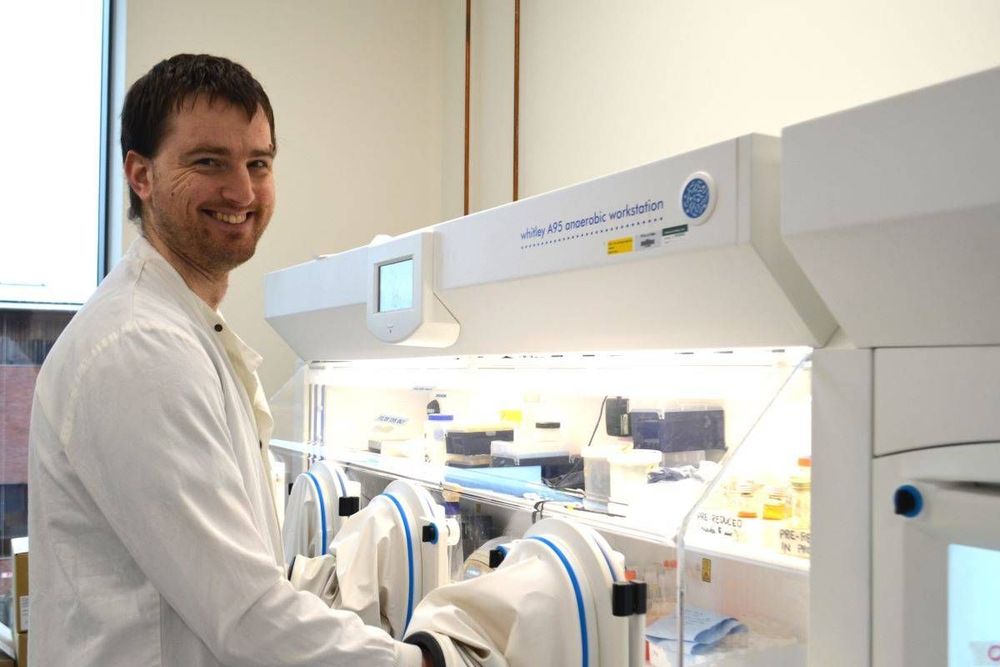
How do gut bacteria use sialic acid sugars? - Quadram Institute
Dr Andrew Bell explains his fundamental research to understand how gut bacteria use specific sugars known as sialic acids
buff.ly
January 24, 2025 at 9:12 AM
🆕 We catch up with Dr Andrew Bell to find out about his Quadram Institute Fellowship focused on how gut bacteria use a certain group of sugars called sialic acids 🦠
Reposted by Gavin Thomas (he/him)
Now published! www.nature.com/articles/s41...
Very nice collaboration with Hoogenboom ( @ucl.ac.uk ) and Bonev ( @uniofnottingham.bsky.social ) labs.
Very nice collaboration with Hoogenboom ( @ucl.ac.uk ) and Bonev ( @uniofnottingham.bsky.social ) labs.
September 29, 2025 at 2:24 PM
Now published! www.nature.com/articles/s41...
Very nice collaboration with Hoogenboom ( @ucl.ac.uk ) and Bonev ( @uniofnottingham.bsky.social ) labs.
Very nice collaboration with Hoogenboom ( @ucl.ac.uk ) and Bonev ( @uniofnottingham.bsky.social ) labs.
Reposted by Gavin Thomas (he/him)
Also see the accompanying paper from Carol Gross' lab that used a similar approach for Bacillus subtilis: www.cell.com/cell-systems...

Comprehensive genetic interaction analysis of the Bacillus subtilis envelope using double-CRISPRi
Koo et al. apply genome-scale double-CRISPRi to map cell envelope gene interactions
in Bacillus subtilis, revealing >1,000 genetic interactions and uncovering gene networks
in envelope biogenesis and ...
www.cell.com
October 4, 2025 at 8:48 AM
Also see the accompanying paper from Carol Gross' lab that used a similar approach for Bacillus subtilis: www.cell.com/cell-systems...
Reposted by Gavin Thomas (he/him)
Delighted to see our paper studying the evolution of plasmids over the last 100 years, now out! Years of work by Adrian Cazares, also Nick Thomson @sangerinstitute.bsky.social - this version much improved over the preprint. Final version should be open access, apols.
Thread 1/n
Thread 1/n

September 25, 2025 at 9:29 PM
Delighted to see our paper studying the evolution of plasmids over the last 100 years, now out! Years of work by Adrian Cazares, also Nick Thomson @sangerinstitute.bsky.social - this version much improved over the preprint. Final version should be open access, apols.
Thread 1/n
Thread 1/n
Reposted by Gavin Thomas (he/him)
Synthetic lethal TN-seq! #microsky 🦠

Dual transposon sequencing profiles the genetic interaction landscape in bacteria | Science www.science.org/doi/10.1126/...

Dual transposon sequencing profiles the genetic interaction landscape in bacteria
Gene redundancy complicates systematic characterization of gene function as single-gene deletions may not produce discernible phenotypes. We report dual transposon sequencing (dual Tn-seq), a platform...
www.science.org
September 26, 2025 at 5:10 AM
Synthetic lethal TN-seq! #microsky 🦠
Big event today as @morfdb.bsky.social
moves into the Catalyst building at the Uni of York where the team assembles for super productive day.
@ybri-uoy.bsky.social
moves into the Catalyst building at the Uni of York where the team assembles for super productive day.
@ybri-uoy.bsky.social


September 24, 2025 at 7:22 PM
Big event today as @morfdb.bsky.social
moves into the Catalyst building at the Uni of York where the team assembles for super productive day.
@ybri-uoy.bsky.social
moves into the Catalyst building at the Uni of York where the team assembles for super productive day.
@ybri-uoy.bsky.social
Reposted by Gavin Thomas (he/him)

#NewResearch
Nasal colonisation by S. aureus is linked with depression in a human cohort and shown in a mouse model to cause decreased serotonin and dopamine in the brain
#MicroSky #Depression
www.nature.com/articles/s41...
Nasal colonisation by S. aureus is linked with depression in a human cohort and shown in a mouse model to cause decreased serotonin and dopamine in the brain
#MicroSky #Depression
www.nature.com/articles/s41...

Nasal Staphylococcus aureus carriage promotes depressive behaviour in mice via sex hormone degradation - Nature Microbiology
Nasal colonization by Staphylococcus aureus is linked with depression in a human cohort and shown in a mouse model to cause decreased serotonin and dopamine in the brain.
www.nature.com
September 22, 2025 at 3:27 PM
#NewResearch
Nasal colonisation by S. aureus is linked with depression in a human cohort and shown in a mouse model to cause decreased serotonin and dopamine in the brain
#MicroSky #Depression
www.nature.com/articles/s41...
Nasal colonisation by S. aureus is linked with depression in a human cohort and shown in a mouse model to cause decreased serotonin and dopamine in the brain
#MicroSky #Depression
www.nature.com/articles/s41...
Reposted by Gavin Thomas (he/him)
www.pnas.org/doi/10.1073/...
#microsky #sialic acid
STM1128 is a Neu5Ac transporter of the sodium-solute symporter (SSS) superfamily, which @gavinhthomas.bsky.social, Arthur Hosie & I identified 15 years :-)
#microsky #sialic acid
STM1128 is a Neu5Ac transporter of the sodium-solute symporter (SSS) superfamily, which @gavinhthomas.bsky.social, Arthur Hosie & I identified 15 years :-)

An RNase III–processed sRNA coordinates sialic acid metabolism of Salmonella enterica during gut colonization | PNAS
Sialic acids derived from colonic mucin glycans are crucial nutrients for enteric
bacterial pathogens like Salmonella. The uptake and utilization o...
www.pnas.org
September 15, 2025 at 5:29 AM
www.pnas.org/doi/10.1073/...
#microsky #sialic acid
STM1128 is a Neu5Ac transporter of the sodium-solute symporter (SSS) superfamily, which @gavinhthomas.bsky.social, Arthur Hosie & I identified 15 years :-)
#microsky #sialic acid
STM1128 is a Neu5Ac transporter of the sodium-solute symporter (SSS) superfamily, which @gavinhthomas.bsky.social, Arthur Hosie & I identified 15 years :-)