




Félix Ramos-León
@felixrl.bsky.social
Postdoctoral fellow at NIH studying cell biology of coccoid bacteria.
Views my own.
He/him/Él 🏳️🌈
Views my own.
He/him/Él 🏳️🌈
Pinned
Félix Ramos-León
@felixrl.bsky.social
· Oct 28

PcdA promotes orthogonal division plane selection in Staphylococcus aureus
Nature Microbiology - PcdA interacts with DivIVA and FtsZ, promoting Z-ring formation and division plane selection in Staphylococcus aureus, which increases virulence in mice and reduces...
rdcu.be
Excited to share that our paper is now out in Nature Microbiology @natureportfolio.bsky.social! We characterize a positive mechanism for Z ring placement in S. aureus governed by the proteins PcdA/DivIVA, and its implication during infection in a mouse model #Microsky
rdcu.be/dYmdC
rdcu.be/dYmdC
Reposted by Félix Ramos-León

Phage induction of Staphylococcus aureus pathogenicity islands promotes the CRISPR-Cas adaptive immune response

Phage induction of Staphylococcus aureus pathogenicity islands promotes the CRISPR-Cas adaptive immune response
Banh et al. show that staphylococci carrying CRISPR-Cas systems and SaPIs display enhanced rates of CRISPR spacer acquisition from phages. This requires delivery of incomplete, non-replicating phage genomes by SaPIs, which, as opposed to fully infective phages that rapidly kill the cell, allows CRISPR immunization of the host before its lysis.
dlvr.it
January 17, 2026 at 12:24 AM
Phage induction of Staphylococcus aureus pathogenicity islands promotes the CRISPR-Cas adaptive immune response
Reposted by Félix Ramos-León

Bacteria are amazing! The abundant Dps protein binds and protects DNA in stationary-phase cells with minimal effect on chromosome accessibility, dynamics, and organization. Now in NAR doi.org/10.1093/nar/...; I'm really proud of our multidisciplinary team led by Lauren, Lindsay, and Xiaofeng, et al.

January 16, 2026 at 1:32 PM
Bacteria are amazing! The abundant Dps protein binds and protects DNA in stationary-phase cells with minimal effect on chromosome accessibility, dynamics, and organization. Now in NAR doi.org/10.1093/nar/...; I'm really proud of our multidisciplinary team led by Lauren, Lindsay, and Xiaofeng, et al.
Reposted by Félix Ramos-León

This is 😮
Structural insights into the assembly and evolution of a complex bacterial flagellar motor
#microsky
www.nature.com/articles/s41...
Structural insights into the assembly and evolution of a complex bacterial flagellar motor
#microsky
www.nature.com/articles/s41...

Structural insights into the assembly and evolution of a complex bacterial flagellar motor - Nature Microbiology
Structural, genetic, functional and biochemical analyses of the complex flagellar motor of Campylobacter jejuni reveal structural adaptations with an ancient origin also found more widely across bacte...
www.nature.com
January 16, 2026 at 6:22 AM
This is 😮
Structural insights into the assembly and evolution of a complex bacterial flagellar motor
#microsky
www.nature.com/articles/s41...
Structural insights into the assembly and evolution of a complex bacterial flagellar motor
#microsky
www.nature.com/articles/s41...
Reposted by Félix Ramos-León

Thrilled to share that my first-author paper is now published in Nature Communications! 🎉 Huge thanks to my PI, Dr. Drew Bridges (@bridgesbio.bsky.social), my collaborators, and all the incredible lab members for their support throughout this project
www.nature.com/articles/s41...
www.nature.com/articles/s41...

A small periplasmic protein governs broad physiological adaptations in Vibrio cholerae via regulation of the DbfRS two-component system - Nature Communications
A two-component system, DbfRS, regulates biofilm formation in Vibrio cholerae. Here, Nguyen et al. identify a small periplasmic protein that controls the activity of the system’s receptor, and show th...
www.nature.com
December 19, 2025 at 4:34 PM
Thrilled to share that my first-author paper is now published in Nature Communications! 🎉 Huge thanks to my PI, Dr. Drew Bridges (@bridgesbio.bsky.social), my collaborators, and all the incredible lab members for their support throughout this project
www.nature.com/articles/s41...
www.nature.com/articles/s41...
Reposted by Félix Ramos-León

I am thrilled to share with you the outcome of the first collaboration with Albesa-Jove's lab (albesalab.org), in which we characterised the molecular mechanisms underlying the binding of a T6SS adaptor-effector pair in P. putida, Tap3–Tke5. (🧵1/9). Read the full paper here: doi.org/10.1038/s443...

January 14, 2026 at 11:38 AM
I am thrilled to share with you the outcome of the first collaboration with Albesa-Jove's lab (albesalab.org), in which we characterised the molecular mechanisms underlying the binding of a T6SS adaptor-effector pair in P. putida, Tap3–Tke5. (🧵1/9). Read the full paper here: doi.org/10.1038/s443...
Reposted by Félix Ramos-León

💊 We are excited to share our preprint that describes an inhibitor of the widespread and highly conserved Two-Partner Secretion (TPS) system that is critical for Gram-negative pathogens to export a multitude of diverse virulence factors.
(1/6)
www.biorxiv.org/content/10.6...
(1/6)
www.biorxiv.org/content/10.6...

First inhibitor of a bacterial two-partner secretion system.
Two-partner secretion system transporter proteins (TpsB) are widely conserved across Gram-negative pathogens. TpsB family proteins secrete exoprotein virulence factors that perform a myriad of functions such as adhesion and immune modulation. Despite their incredible importance in bacterial infectious disease, TpsB inhibitors have not yet been discovered. Here, we describe a potent inhibitor of FhaC, a TpsB protein produced by Bordetella spp . FhaC secretes the exoprotein FhaB that is essential for the establishment of whooping cough. We designed a peptide called P1 that we predicted would prevent substrate binding and lock FhaC in a secretion-inactive state. Simulations and biochemical assays supported our hypothesis and identified interactions important for P1 binding to FhaC. Strikingly, we observed that the peptide strongly inhibited FhaB secretion from clinical isolates and broadly reduced correlates of virulence. Together, this work provides a strong case for further development of a novel class of anti-TpsB anti-virulence compounds. ### Competing Interest Statement The authors have declared no competing interest. National Institute of Allergy and Infectious Diseases, R21AI180112
www.biorxiv.org
January 13, 2026 at 7:02 AM
💊 We are excited to share our preprint that describes an inhibitor of the widespread and highly conserved Two-Partner Secretion (TPS) system that is critical for Gram-negative pathogens to export a multitude of diverse virulence factors.
(1/6)
www.biorxiv.org/content/10.6...
(1/6)
www.biorxiv.org/content/10.6...
Reposted by Félix Ramos-León

A general one-step protocol to generate impermeable fluorescent HaloTag substrates for in situ live cell application and super-resolution imaging
www.nature.com/articles/s41...
www.nature.com/articles/s41...
Client Challenge
www.nature.com
January 13, 2026 at 6:36 PM
A general one-step protocol to generate impermeable fluorescent HaloTag substrates for in situ live cell application and super-resolution imaging
www.nature.com/articles/s41...
www.nature.com/articles/s41...
Reposted by Félix Ramos-León

The Bacillus subtilis class A penicillin-binding protein 4 (PBP4) requires an accessory protein RpdA www.biorxiv.org/content/10.6...

The Bacillus subtilis class A penicillin-binding protein 4 (PBP4) requires an accessory protein RpdA
Peptidoglycan (PG) synthesis is essential to maintain cell integrity during bacterial growth and division. In Bacillus subtilis, PG synthesis involves class A PBPs that act independently and class B P...
www.biorxiv.org
January 12, 2026 at 2:22 PM
The Bacillus subtilis class A penicillin-binding protein 4 (PBP4) requires an accessory protein RpdA www.biorxiv.org/content/10.6...
Reposted by Félix Ramos-León

With the new year, is my time to say bye to @gmivienna.bsky.social as I move to @zmbp-tuebingen.bsky.social in Tuebingen. I will start my solo Group Leader career as a Emmy Norther fellow. Thanks to everyone that helped on the way. I will be advertising PhD and Postdoc positions soon, stay tuned!
January 11, 2026 at 1:04 PM
With the new year, is my time to say bye to @gmivienna.bsky.social as I move to @zmbp-tuebingen.bsky.social in Tuebingen. I will start my solo Group Leader career as a Emmy Norther fellow. Thanks to everyone that helped on the way. I will be advertising PhD and Postdoc positions soon, stay tuned!
Reposted by Félix Ramos-León

Distinctive spore architecture and developmental biology of Turicibacter sanguinis reveal unexpected diversity among gut spore formers https://www.biorxiv.org/content/10.64898/2026.01.06.697881v1
January 6, 2026 at 10:16 PM
Distinctive spore architecture and developmental biology of Turicibacter sanguinis reveal unexpected diversity among gut spore formers https://www.biorxiv.org/content/10.64898/2026.01.06.697881v1
Reposted by Félix Ramos-León

Preprint out! That was a really enjoyable collaboration! We report the structure and higher-order assembly of AbpX, a biofilm component in Archaea. And as a bonus, this protein gave me one of the most beautiful crystals I’ve ever had! 🤩💎

January 6, 2026 at 9:38 AM
Preprint out! That was a really enjoyable collaboration! We report the structure and higher-order assembly of AbpX, a biofilm component in Archaea. And as a bonus, this protein gave me one of the most beautiful crystals I’ve ever had! 🤩💎
Reposted by Félix Ramos-León
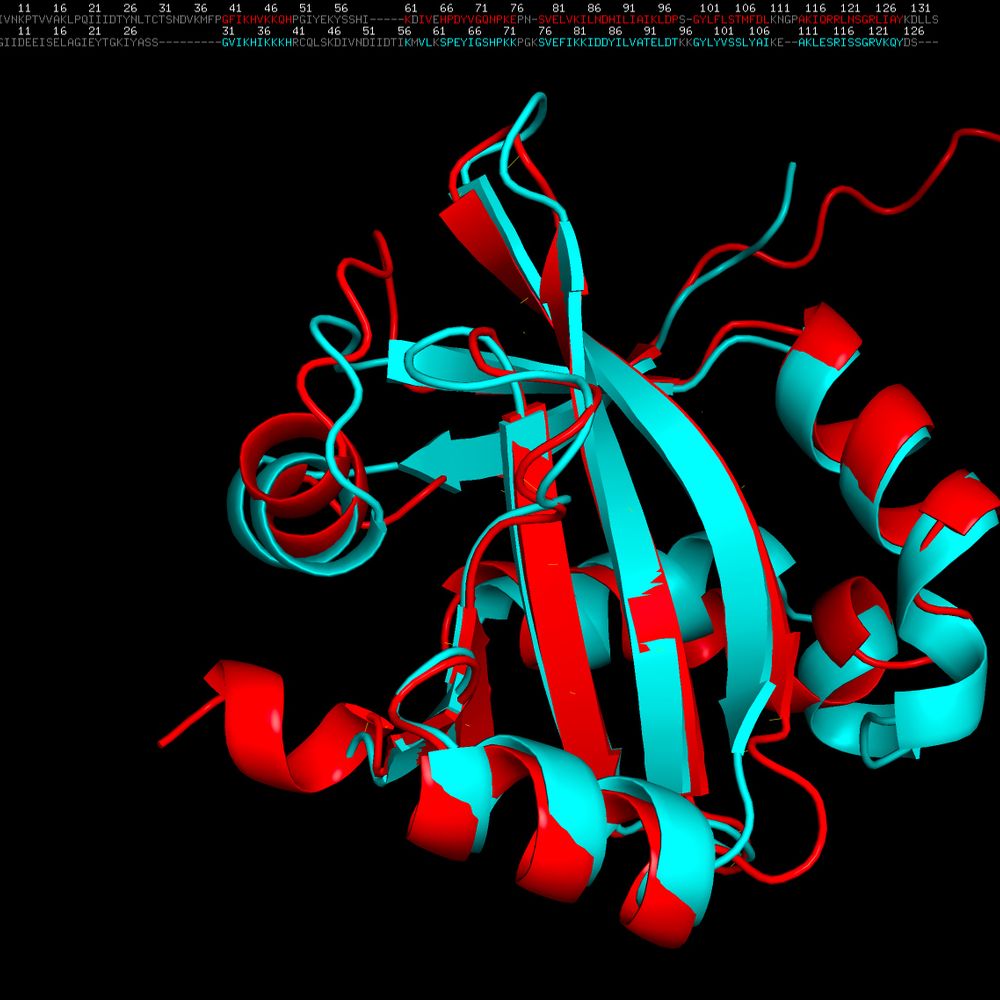
🫴 On the role of cell chaining in the attenuation of a Listeria monocytogenes divIVA mutant:
www.biorxiv.org/content/10.6...
Take a look at Figure 4; you can admire some very interesting phenotypes there!
#Listeria
www.biorxiv.org/content/10.6...
Take a look at Figure 4; you can admire some very interesting phenotypes there!
#Listeria

On the role of cell chaining in the attenuation of a Listeria monocytogenes divIVA mutant
Listeria monocytogenes is a facultative intracellular human pathogen capable of invading non-phagocytic host cells, replicating within their cytosol, and spreading directly from cell to cell. These pr...
www.biorxiv.org
January 6, 2026 at 10:29 AM
🫴 On the role of cell chaining in the attenuation of a Listeria monocytogenes divIVA mutant:
www.biorxiv.org/content/10.6...
Take a look at Figure 4; you can admire some very interesting phenotypes there!
#Listeria
www.biorxiv.org/content/10.6...
Take a look at Figure 4; you can admire some very interesting phenotypes there!
#Listeria
Reposted by Félix Ramos-León


Reposted by Félix Ramos-León

The sporulation phosphorelay protein Spo0B is membrane localized in Paenibacillus! The transmembrane domain appears to increase interaction with relay partners. Congrats to former lab undergrad @isabellalin.bsky.social and her grad mentor @cassidyprints.bsky.social
journals.asm.org/doi/10.1128/...
journals.asm.org/doi/10.1128/...
journals.asm.org
December 30, 2025 at 1:50 PM
The sporulation phosphorelay protein Spo0B is membrane localized in Paenibacillus! The transmembrane domain appears to increase interaction with relay partners. Congrats to former lab undergrad @isabellalin.bsky.social and her grad mentor @cassidyprints.bsky.social
journals.asm.org/doi/10.1128/...
journals.asm.org/doi/10.1128/...
Reposted by Félix Ramos-León

A free, open-access library of high-quality organism illustrations for science communication

A free, open-access library of high-quality organism illustrations for science communication
We create vector graphics of model organisms and emerging biological research organisms to enhance our publications. We’re sharing these editable graphics under a CC0 license for other scientists to...
doi.org
December 29, 2025 at 6:03 PM
A free, open-access library of high-quality organism illustrations for science communication
Reposted by Félix Ramos-León
Reposted by Félix Ramos-León

New preprint. Work led by @ainsley-beaton.bsky.social & Rebecca Devine.
They show the highly conserved Streptomyces MtrAB two component system activates ectoine production and triggers sporulation in response to osmotic stress in Streptomyces venezuelae
www.biorxiv.org/content/10.6...
They show the highly conserved Streptomyces MtrAB two component system activates ectoine production and triggers sporulation in response to osmotic stress in Streptomyces venezuelae
www.biorxiv.org/content/10.6...

MtrAB activates ectoine production and triggers sporulation in response to osmotic stress in Streptomyces venezuelae
The MtrAB two-component system is a master regulator of antibiotic biosynthesis in Streptomyces species. MtrA is also required for sporulation under certain growth conditions, which means that on some...
www.biorxiv.org
December 22, 2025 at 7:19 AM
New preprint. Work led by @ainsley-beaton.bsky.social & Rebecca Devine.
They show the highly conserved Streptomyces MtrAB two component system activates ectoine production and triggers sporulation in response to osmotic stress in Streptomyces venezuelae
www.biorxiv.org/content/10.6...
They show the highly conserved Streptomyces MtrAB two component system activates ectoine production and triggers sporulation in response to osmotic stress in Streptomyces venezuelae
www.biorxiv.org/content/10.6...
Reposted by Félix Ramos-León
Colibactin produced by a honeybee symbiont defends against pathogens and shapes the gut community https://www.biorxiv.org/content/10.64898/2025.12.27.695564v1
December 28, 2025 at 1:16 AM
Colibactin produced by a honeybee symbiont defends against pathogens and shapes the gut community https://www.biorxiv.org/content/10.64898/2025.12.27.695564v1
Reposted by Félix Ramos-León

Coordination of chromosome segregation and cell division in the archaeon Sulfolobus acidocaldarius www.nature.com/articles/s41... #jcampubs
Coordination of chromosome segregation and cell division in the archaeon Sulfolobus acidocaldarius - Nature Communications
Very little is known about the molecular basis of chromosome segregation in archaea. Here, the authors describe conformational changes in the chromosome during the cell cycle of the archaeon Sulfolobu...
www.nature.com
December 24, 2025 at 9:29 PM
Coordination of chromosome segregation and cell division in the archaeon Sulfolobus acidocaldarius www.nature.com/articles/s41... #jcampubs
Reposted by Félix Ramos-León

Today, we held the workshop 'Young Bioscience Researchers: experiences from abroad' at the @cbm-csic-uam.bsky.social
An inspiring day featuring more than 20 scientific talks and networking opportunities, which allowed us to explore talent attraction opportunities.
An inspiring day featuring more than 20 scientific talks and networking opportunities, which allowed us to explore talent attraction opportunities.


December 22, 2025 at 4:28 PM
Today, we held the workshop 'Young Bioscience Researchers: experiences from abroad' at the @cbm-csic-uam.bsky.social
An inspiring day featuring more than 20 scientific talks and networking opportunities, which allowed us to explore talent attraction opportunities.
An inspiring day featuring more than 20 scientific talks and networking opportunities, which allowed us to explore talent attraction opportunities.
Reposted by Félix Ramos-León
MtrAB activates ectoine production and triggers sporulation in response to osmotic stress in Streptomyces venezuelae https://www.biorxiv.org/content/10.64898/2025.12.19.695424v1
December 22, 2025 at 6:16 AM
MtrAB activates ectoine production and triggers sporulation in response to osmotic stress in Streptomyces venezuelae https://www.biorxiv.org/content/10.64898/2025.12.19.695424v1
Reposted by Félix Ramos-León

A major challenge in RNA delivery is overcoming poor loading efficiency into nanoparticles. F. Machinandiarena solves this by using "SSHELs", our particles inspired by bacterial spores, to deliver RNA specifically to HER2+ ovarian cancer cells.
kwnsfk27.r.eu-west-1.awstrack.me/L0/https:%2F...
kwnsfk27.r.eu-west-1.awstrack.me/L0/https:%2F...
kwnsfk27.r.eu-west-1.awstrack.me
December 20, 2025 at 4:11 PM
A major challenge in RNA delivery is overcoming poor loading efficiency into nanoparticles. F. Machinandiarena solves this by using "SSHELs", our particles inspired by bacterial spores, to deliver RNA specifically to HER2+ ovarian cancer cells.
kwnsfk27.r.eu-west-1.awstrack.me/L0/https:%2F...
kwnsfk27.r.eu-west-1.awstrack.me/L0/https:%2F...
Reposted by Félix Ramos-León

What is better than one? Two connected papers!
#NewResearch
S protein of Streptococcus pneumoniae activates PBP1a and coordinates with a wider GpsB-associated multi-protein complex to regulate peptidoglycan remodelling and cell division.
#MicroSky 🦠
www.nature.com/articles/s41...
#NewResearch
S protein of Streptococcus pneumoniae activates PBP1a and coordinates with a wider GpsB-associated multi-protein complex to regulate peptidoglycan remodelling and cell division.
#MicroSky 🦠
www.nature.com/articles/s41...
December 19, 2025 at 2:06 PM
What is better than one? Two connected papers!
#NewResearch
S protein of Streptococcus pneumoniae activates PBP1a and coordinates with a wider GpsB-associated multi-protein complex to regulate peptidoglycan remodelling and cell division.
#MicroSky 🦠
www.nature.com/articles/s41...
#NewResearch
S protein of Streptococcus pneumoniae activates PBP1a and coordinates with a wider GpsB-associated multi-protein complex to regulate peptidoglycan remodelling and cell division.
#MicroSky 🦠
www.nature.com/articles/s41...
Reposted by Félix Ramos-León
December 19, 2025 at 10:31 AM
Reposted by Félix Ramos-León
#NewResearch
Streptococcus equi subsp. zooepidemicus imports glucose via the bacterial mannose phosphotransferase system (PTSman), which inhibits stringent response, supports growth in cerebrospinal fluid and promotes brain damage during meningitis.
#MicroSky 🦠
www.nature.com/articles/s41...
Streptococcus equi subsp. zooepidemicus imports glucose via the bacterial mannose phosphotransferase system (PTSman), which inhibits stringent response, supports growth in cerebrospinal fluid and promotes brain damage during meningitis.
#MicroSky 🦠
www.nature.com/articles/s41...

Zoonotic Streptococcus imports glucose to inhibit stringent response and promote growth during meningitis - Nature Microbiology
Streptococcus equi subsp. zooepidemicus imports glucose via the bacterial mannose phosphotransferase system (PTSman), which inhibits stringent response, supports growth in cerebrospinal fluid and prom...
www.nature.com
December 18, 2025 at 3:06 PM
#NewResearch
Streptococcus equi subsp. zooepidemicus imports glucose via the bacterial mannose phosphotransferase system (PTSman), which inhibits stringent response, supports growth in cerebrospinal fluid and promotes brain damage during meningitis.
#MicroSky 🦠
www.nature.com/articles/s41...
Streptococcus equi subsp. zooepidemicus imports glucose via the bacterial mannose phosphotransferase system (PTSman), which inhibits stringent response, supports growth in cerebrospinal fluid and promotes brain damage during meningitis.
#MicroSky 🦠
www.nature.com/articles/s41...