DEEMteam_Orsay
banner
deemteam.bsky.social
DEEMteam_Orsay
@deemteam.bsky.social

Diversity, Ecology and Evolution of Microbes (DEEM) team. Posts by David Moreira. #treeoflife #evolution
Paris, France
https://www.deemteam.fr/en/

Biology 37%
Environmental science 34%

Reposted by Mart Krupovìč

With our old friends Sergey, Luis and Guifré, we have published a minireview in @currentbiology.bsky.social about aphelids, the sister group to fungi, including why we think they are not fungi but, nevertheless, key to understand early fungal evolution.

authors.elsevier.com/a/1mH793QW8S...

Near the end of the year, we are excited to welcome three new members to the team: Inés Ochoa (PhD student), and Charley McCarthy and Eva Zanditenas (postdocs). They will work on different projects using experimental and bioinformatics approaches.
Microbial eukaryotes keep challenging assumptions about eukaryotic cell and genome biology.

Our upcoming workshop explores the frontier of protist genomics and how it shapes cell biology, ecology and evolution.

Please save the date! Talks, posters and ECR events

Websites and details coming soon

Reposted by David Moreira

SMBE2026 Symposium 12 | Reconstructing the deep Tree of Life: challenges and new approaches

📨 Abstract submission
smbe2026.org/abstracts

📋 Programme details
smbe2026.org/programme

#SMBE2026

Reposted by David Moreira

Those interested in performing maximum likelihood phylogenomic analysis on data sets made up of eukaryotic nuclear genes using site heterogeneous mixture models like C60, I suggest you use the ELM model in IQ-TREE instead of the LG model /1

Discussing the origin and evolution of life in an ancient church during the meeting of the French Astrobiology Society

Reposted by David Moreira

According to the microbial ecologist Puri López-García, pictured here at a salt flat in the Chilean Andes, some 25% to 50% of all bacterial cells may be parasites of other cells.
A Cell So Minimal That It Challenges Definitions of Life | Quanta Magazine
The newly described microbe represents a world of parasitic, intercellular biodiversity only beginning to be revealed by genome sequencing.
www.quantamagazine.org

Reposted by David Moreira

Dive into our November issue featuring:

🪆nested archaeal symbioses
🌱microbiota driven drought responses in plants
🏗️ BAM complex in Bacteroidota
💨microbial fermentative growth in the gut
🍸hospital-specific phage therapy cocktail

and much more..!

www.nature.com/nmicrobiol/v...

Reposted by David Moreira

Bernabeu, @microbiobits.bsky.social and @tonigabaldon.bsky.social use simulations to test for the robustness of inferred relative timings of gene transfers in the lineage leading to the ancestor of eukaryotes

🔗 doi.org/10.1093/gbe/evaf190

#genome #evolution
Phylogeny-aware Simulations Suggest a Low Impact of Unsampled Lineages in the Inference of Gene Flow During Eukaryogenesis
Abstract. The topologies of gene trees are broadly used to infer horizontal gene transfer events and characterize the potential donor and acceptor partners
doi.org
This paper has been a must! Great collaboration with @mkrupovic.bsky.social and @yifanzhou.bsky.social, a N&V by a legend of halophilic archaea tinyurl.com/yc3dcv72, and one picture of one of our expeditions to Dallol making the cover of the November issue of @natmicrobiol.nature.com

rdcu.be/eLtCH
ASM @asm.org · Oct 30
How did life begin, and why does it matter? Scientists are tracing early microbial life–from LUCA to multicellularity–to unlock insights for biotech, climate science and even space exploration. Read the article: asm.org/articles/202...
Early Microbial Evolution | ASM.org
How did life begin, and why does it matter? Scientists are tracing early microbial life—from LUCA to multicellularity—to unlock insights for biotech, climate science and even space exploration.
asm.org

Reposted by David Moreira

Mesquite 4.02 update released! It fixes a few bugs and adds Codon Alignment and various other improvements. Also, much faster with genomics files with 1000s of loci. www.mesquiteproject.org 🧪 #evolbio
@bembidion.bsky.social

Maybe because it is a private organization. Have you tried DSMZ, CCAP, etc.? (depending on what you are looking for)

Congrats!
Our @narjournal.bsky.social manuscript is out! It explores the growth of the GTDB (gtdb.ecogenomic.org) since its inception, as well as updates to the website, methodology, policies, and major taxonomic and nomenclatural changes over the past three years.

academic.oup.com/nar/advance-...
GTDB release 10: a complete and systematic taxonomy for 715 230 bacterial and 17 245 archaeal genomes
Abstract. The Genome Taxonomy Database (GTDB; https://gtdb.ecogenomic.org) provides a phylogenetically consistent and rank normalized genome-based taxonomy
academic.oup.com
Viruses and virus satellites of haloarchaea and their nanosized DPANN symbionts reveal intricate nested interactions

Out now in Nature Microbiology, by Yifan Zhou, Mart Krupovic & colleagues.
@mkrupovic.bsky.social
@yifanzhou.bsky.social
@deemteam.bsky.social

www.nature.com/articles/s41...
Viruses and virus satellites of haloarchaea and their nanosized DPANN symbionts reveal intricate nested interactions - Nature Microbiology
An exploration of the viromes of haloarchaea and their ultra-small DPANN symbionts reveals plasmid-derived satellites of viruses from both archaeal groups, highlighting the complexity of nested symbio...
www.nature.com

Reposted by David Moreira

Check out our paper on intricate nested interactions between viruses and virus satellites of haloarchaea and their nanosized DPANN symbionts. Excellent collaboration with @deemteam.bsky.social, @anagtz.bsky.social and Michail Yakimov
Free access link: rdcu.be/eLtCH
🧵 by @yifanzhou.bsky.social 👇

Congrats!

A proposal for journal accreditation systems to counter predatory practices. If funding agencies enforced these accreditations, predatory journals would quickly vanish.

doi.org/10.1093/fems...

Reposted by David Moreira

Ponce-Toledo et al. confirm the presence, homology, and monophyletic origin of the SELMA protein complex in Cryptophyta, Alveolata, Stramenopiles, and Haptophyta, shedding light on the evolution of photosynthetic eukaryotes.

🔗 doi.org/10.1093/molbev/msaf167

#evobio #molbio
Molecular Phylogeny of the SELMA Translocation Machinery Recounts the Evolution of Complex Photosynthetic Eukaryotes
Abstract. Photosynthetic eukaryotes and their relatives are the result of an intricate evolutionary history involving a series of plastid acquisitions thro
doi.org

Enjoying the mountains that forams built for us (with some help from plate tectonics) long ago.

Thank you very much for teaching her this amazing technique!

Reposted by David Moreira

New paper is out! We have studied the cute tiny Discocelia plataet sp. n. to obtain the first molecular data of the order Discocelida and clarify its cell structure. All this for a better understanding of the evolution of Cercozoa.

onlinelibrary.wiley.com/doi/epdf/10....
We're very happy to release our new database Metalog metalog.embl.de ! It offers manually curated and harmonised contextual data for 110k metagenomics samples across the globe, incl. precomputed taxonomic profiles, for interactive browsing and for download 🧵 1/7

#microsky
Metalog
Metalog is a repository of manually annotated metadata (or contextual data) for metagenomic sequencing data from across the globe.
metalog.embl.de

Congratulations!

Reposted by David Moreira

Our paper describing our new improved GFmix models for phylogenetic inference that capture site-and-branch heterogeneity in amino acid composition.
www.biorxiv.org/content/10.1...
Modeling site-and-branch-heterogeneity with GFmix
Phylogenetic trees are often inferred from protein sequences sampled from diverse taxa across the tree of life. The compositions of these amino acid sequences may be heterogeneous across both sites an...
www.biorxiv.org

Reposted by Simon Roux

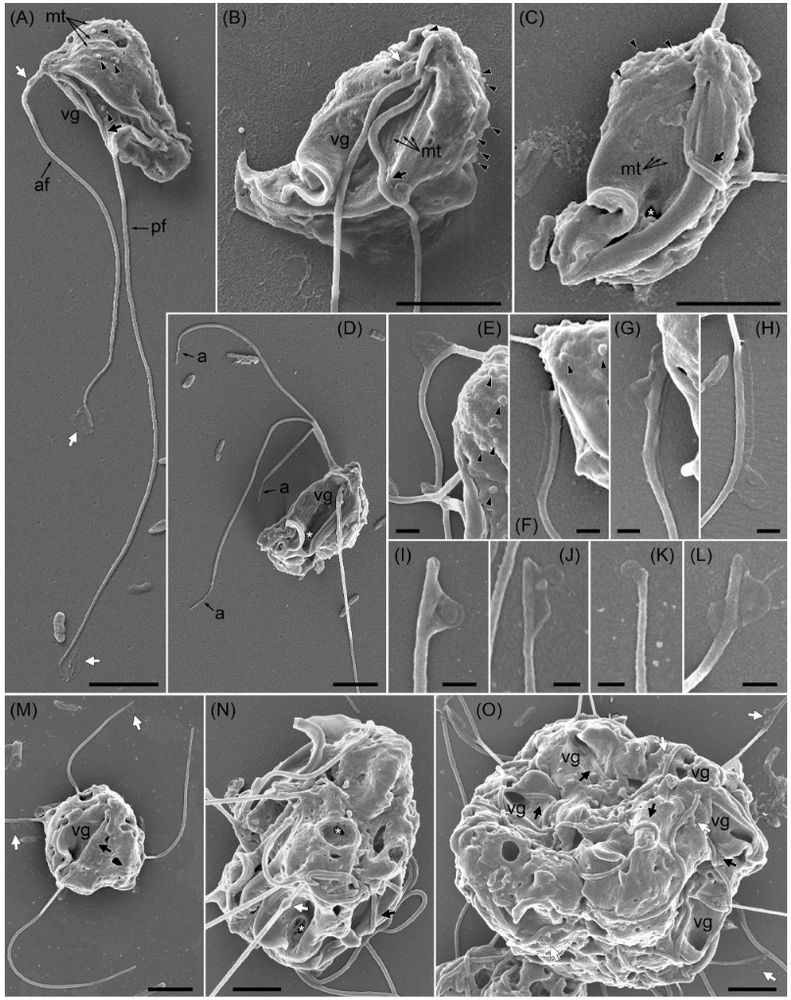
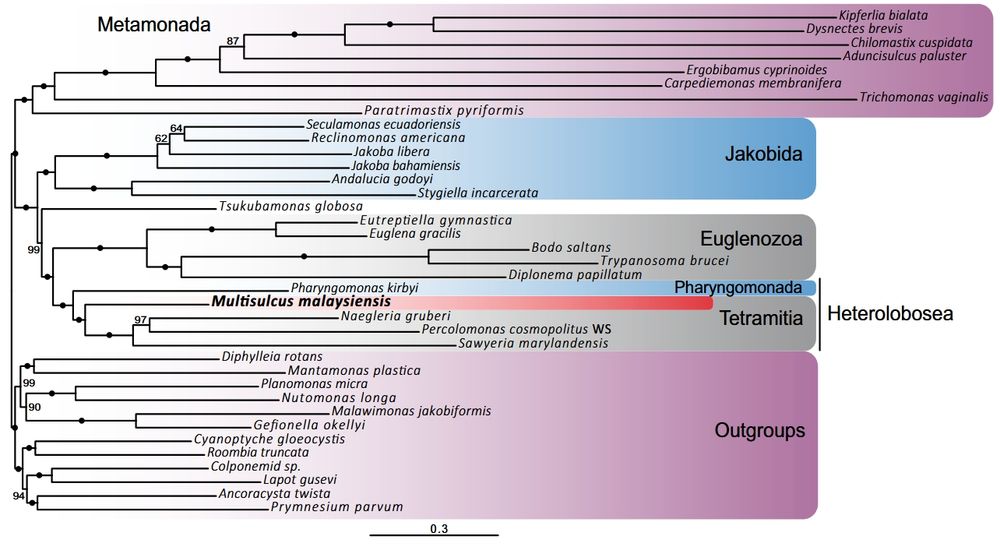
In our ongoing saga of description of new protists, we are happy to introduce Multisulcus malaysiensis, a deep-branching heterolobosean that forms highly unusual multiflagellated cells with multiple ventral grooves. Great work by @kristina-prokina.bsky.social

onlinelibrary.wiley.com/doi/epdf/10....

Gloeomargarita lithophora, it has many interesting metabolic and evolutionary stories to tell.

This could have been avoided if Science had requested a second round of reviews when the deluge of criticisms arrived following the paper’s pre-publication. Publishing it along with all the criticisms, and then retracting it now -and only this paper- after so many years, seems odd.