



Bryan Dickinson
@chembiobryan.bsky.social
chemical/synthetic biologist, Luddite trying to find better ways to make molecules that do important stuff, dad, @uchicago professor of chemistry
http://www.dickinsonlab.uchicago.edu/
http://www.dickinsonlab.uchicago.edu/
Reposted by Bryan Dickinson
A true Christmas story well worth a read 👇
1/ Check out our newest paper where we ask: How fast can we experimentally discover binders from scratch?
And we mean scratch: a blinded study.
TLDR: 26 days. And the binders work…and led to new cancer biology.
We’re coming for you AI….
chemrxiv.org/engage/chemr...
And we mean scratch: a blinded study.
TLDR: 26 days. And the binders work…and led to new cancer biology.
We’re coming for you AI….
chemrxiv.org/engage/chemr...

December 26, 2025 at 9:40 PM
A true Christmas story well worth a read 👇
1/ Check out our newest paper where we ask: How fast can we experimentally discover binders from scratch?
And we mean scratch: a blinded study.
TLDR: 26 days. And the binders work…and led to new cancer biology.
We’re coming for you AI….
chemrxiv.org/engage/chemr...
And we mean scratch: a blinded study.
TLDR: 26 days. And the binders work…and led to new cancer biology.
We’re coming for you AI….
chemrxiv.org/engage/chemr...
December 26, 2025 at 6:24 PM
1/ Check out our newest paper where we ask: How fast can we experimentally discover binders from scratch?
And we mean scratch: a blinded study.
TLDR: 26 days. And the binders work…and led to new cancer biology.
We’re coming for you AI….
chemrxiv.org/engage/chemr...
And we mean scratch: a blinded study.
TLDR: 26 days. And the binders work…and led to new cancer biology.
We’re coming for you AI….
chemrxiv.org/engage/chemr...
Reposted by Bryan Dickinson

Organelles do NOT have a single uniform pH.
And if you think they must, because “protons diffuse fast,” this paper is for you.
A thread on why that assumption is wrong; and what we found instead. 🧵 1/n
And if you think they must, because “protons diffuse fast,” this paper is for you.
A thread on why that assumption is wrong; and what we found instead. 🧵 1/n

Organelles harbour pH gradients https://www.biorxiv.org/content/10.64898/2025.12.12.694065v1
December 17, 2025 at 12:46 AM
Organelles do NOT have a single uniform pH.
And if you think they must, because “protons diffuse fast,” this paper is for you.
A thread on why that assumption is wrong; and what we found instead. 🧵 1/n
And if you think they must, because “protons diffuse fast,” this paper is for you.
A thread on why that assumption is wrong; and what we found instead. 🧵 1/n
Reposted by Bryan Dickinson
One more paper from our lab! This ACS Synthetic Biology paper reports bottom-up construction of eukaryotic-like synthetic cells with an artificial nucleus-like organelle, enabling on-demand protein localization control by a small molecule. 💊 pubs.acs.org/doi/full/10....

Eukaryotic-like Synthetic Cells with Chemically Controlled Protein Localization
Compartmentalization by organelles and the dynamic control of protein localization within these compartmentalized spaces are key mechanisms for regulating biological processes in eukaryotic cells. Here, we present a bottom-up approach for constructing cell-sized liposomes (giant unilamellar vesicles, GUVs) encapsulating an artificial organelle with chemically controlled protein localization. In this system, proteins fused to Escherichia coli dihydrofolate reductase are rapidly recruited on demand from the inner solution to the interior of a DNA-droplet-based (“nucleus”-like) organelle within GUVs upon addition of a synthetic, DNA-binding trimethoprim derivative to the external solution. By coupling this system with a sequence-specific protease, we constructed a synthetic cell platform that enables chemically induced, multistep cascade reactions─including protein relocalization, organelle-specific enzymatic activity, and product release from the organelle─that culminate in the control of synthetic-cell phenotypes, such as pore formation in the GUV membrane. This work provides a versatile platform for the bottom-up creation of eukaryotic-like synthetic cells with sophisticated and programmable functions.
pubs.acs.org
December 16, 2025 at 6:02 AM
One more paper from our lab! This ACS Synthetic Biology paper reports bottom-up construction of eukaryotic-like synthetic cells with an artificial nucleus-like organelle, enabling on-demand protein localization control by a small molecule. 💊 pubs.acs.org/doi/full/10....
Reposted by Bryan Dickinson
Our latest paper on a novel synthetic condensate platform, LAMA-SPREC, is out in ACS Chemical Biology! It enables chemically switchable and reversible control of protein function via sequestration and release in mammalian cells. 🔬💊🚿
pubs.acs.org/doi/full/10....
pubs.acs.org/doi/full/10....

A Chemically Switchable Synthetic Condensate Platform for Reversible Protein Sequestration and Release
Creating artificial organelles that sequester and release specific proteins in response to a small molecule in mammalian cells is an attractive approach for regulating protein function. In this work, ...
pubs.acs.org
December 16, 2025 at 5:31 AM
Our latest paper on a novel synthetic condensate platform, LAMA-SPREC, is out in ACS Chemical Biology! It enables chemically switchable and reversible control of protein function via sequestration and release in mammalian cells. 🔬💊🚿
pubs.acs.org/doi/full/10....
pubs.acs.org/doi/full/10....
Reposted by Bryan Dickinson

While the White Paper gives many important recommendations, this sentence especially struck a cord with me: "We need selfless leaders who unite individuals towards creating a shared vision." I definitely felt the willingness of this great cohort of NextGen Leaders to put this into reality. (10/11)
December 12, 2025 at 11:29 AM
While the White Paper gives many important recommendations, this sentence especially struck a cord with me: "We need selfless leaders who unite individuals towards creating a shared vision." I definitely felt the willingness of this great cohort of NextGen Leaders to put this into reality. (10/11)
Reposted by Bryan Dickinson

Professor @krishnanyamuna.bsky.social builds molecular reporters that survive inside living cells to send back data. Her inspired work at U of Chicago shows us the chemical maps of our own biology. It is delicate work with heavy implications. She is watching life happen from the inside out.

December 9, 2025 at 12:59 AM
Professor @krishnanyamuna.bsky.social builds molecular reporters that survive inside living cells to send back data. Her inspired work at U of Chicago shows us the chemical maps of our own biology. It is delicate work with heavy implications. She is watching life happen from the inside out.
Check out our newest work! This is a story on how to get selectivity in binders - both isoform and site selectivity. Read the paper or enjoy this brief Skytorial of what we did!
www.biorxiv.org/content/10.1...
1/n
www.biorxiv.org/content/10.1...
1/n

PANCS-spec-Binders: A system for rapidly discovering isoform- or epitope-specific binders
Proteins that bind to a target protein of interest, termed "binders," are essential components of biological research reagents and therapeutics. Target proteins present multiple binding surfaces with ...
www.biorxiv.org
November 19, 2025 at 6:10 PM
Check out our newest work! This is a story on how to get selectivity in binders - both isoform and site selectivity. Read the paper or enjoy this brief Skytorial of what we did!
www.biorxiv.org/content/10.1...
1/n
www.biorxiv.org/content/10.1...
1/n
Reposted by Bryan Dickinson

Okay okay. How about THE EUROPEAN chemical biology conference. Seems like good people attending Janelia too. Except that Bryan guy?? What the heck has he done recently?
ahem, ONE of THE chemical biology conferences of 2026:) www.janelia.org/you-janelia/...

Chemical Tools for Complex Biological Systems IV
Organizers Luke Lavis, HHMI/Janelia Research Campus Matthew Bogyo, Stanford University Zev Gartner, University of California, San Francisco Jennifer Prescher, University of California, Irvine
www.janelia.org
November 11, 2025 at 6:13 PM
Okay okay. How about THE EUROPEAN chemical biology conference. Seems like good people attending Janelia too. Except that Bryan guy?? What the heck has he done recently?
Registration for THE chemical biology conference of 2026 is now open! EMBO ChemBio 2026 in Heidelberg
DeGrado, Arikin, Picotti (Keynotes). @lmkdassama.bsky.social @brianliau.bsky.social @rhodamine110.bsky.social @benlehner.bsky.social @alitavassoli.bsky.social
www.embl.org/about/info/c...
DeGrado, Arikin, Picotti (Keynotes). @lmkdassama.bsky.social @brianliau.bsky.social @rhodamine110.bsky.social @benlehner.bsky.social @alitavassoli.bsky.social
www.embl.org/about/info/c...
Chemical biology 2026
www.embl.org
November 11, 2025 at 5:46 PM
Registration for THE chemical biology conference of 2026 is now open! EMBO ChemBio 2026 in Heidelberg
DeGrado, Arikin, Picotti (Keynotes). @lmkdassama.bsky.social @brianliau.bsky.social @rhodamine110.bsky.social @benlehner.bsky.social @alitavassoli.bsky.social
www.embl.org/about/info/c...
DeGrado, Arikin, Picotti (Keynotes). @lmkdassama.bsky.social @brianliau.bsky.social @rhodamine110.bsky.social @benlehner.bsky.social @alitavassoli.bsky.social
www.embl.org/about/info/c...
Do you study lipids or lipidation, but don't know where to send your newest work?
Send us your fat papers, phat papers, and even phatty acid papers. While the special issue is not saturated, it's filling up fast, and won't be unsaturated forever!
Phase separate with us and build community!
Send us your fat papers, phat papers, and even phatty acid papers. While the special issue is not saturated, it's filling up fast, and won't be unsaturated forever!
Phase separate with us and build community!
#ACSChemBio and #Biochemistry invite submissions to a special issue on Lipids and Lipidation guest edited by @chembiobryan.bsky.social and me! Find details in the #CallforPapers and submit your exciting findings to one of these journals by May 31, 2026. axial.acs.org/chemical-bio... #lipidtime

Call for Papers: Lipids and Lipidation | ACS Publications Chemistry Blog
This Special Issue in _ACS Chemical Biology_ will highlight the latest advancements and perspectives in the chemical biology of lipids and lipidation. Submit your manuscript by May 31, 2026.
axial.acs.org
October 28, 2025 at 4:12 PM
Do you study lipids or lipidation, but don't know where to send your newest work?
Send us your fat papers, phat papers, and even phatty acid papers. While the special issue is not saturated, it's filling up fast, and won't be unsaturated forever!
Phase separate with us and build community!
Send us your fat papers, phat papers, and even phatty acid papers. While the special issue is not saturated, it's filling up fast, and won't be unsaturated forever!
Phase separate with us and build community!
Reposted by Bryan Dickinson
🚨Our paper is out! 🥳
Hijacking a bacterial ABC transporter for efficient genetic code expansion.
Many congrats to everyone involved - a multi-year effort led by @taruniype.bsky.social @maxfottner.bsky.social
www.nature.com/articles/s41...
it all started years ago with a failed experiment
🧵👇 1/9
Hijacking a bacterial ABC transporter for efficient genetic code expansion.
Many congrats to everyone involved - a multi-year effort led by @taruniype.bsky.social @maxfottner.bsky.social
www.nature.com/articles/s41...
it all started years ago with a failed experiment
🧵👇 1/9

Hijacking a bacterial ABC transporter for genetic code expansion - Nature
Bacterial ATP-binding cassette (ABC) transporters can be utilized and engineered to transport non-canonical amino acids into Escherichia coli for highly efficient synthesis of proteins with novel func...
www.nature.com
October 16, 2025 at 2:06 PM
🚨Our paper is out! 🥳
Hijacking a bacterial ABC transporter for efficient genetic code expansion.
Many congrats to everyone involved - a multi-year effort led by @taruniype.bsky.social @maxfottner.bsky.social
www.nature.com/articles/s41...
it all started years ago with a failed experiment
🧵👇 1/9
Hijacking a bacterial ABC transporter for efficient genetic code expansion.
Many congrats to everyone involved - a multi-year effort led by @taruniype.bsky.social @maxfottner.bsky.social
www.nature.com/articles/s41...
it all started years ago with a failed experiment
🧵👇 1/9
Congrats to my fantastic colleague!!! Go Anna!!
Please join us in congratulating Neubauer Family Assistant Prof Anna Wuttig, who has been named the recipient of the 2025 Early Excellence in Science Award in Chemistry. The Bayer Foundation is honoring her "for advancing electrocatalysis for energy storage, conversion, and medicinal chemistry."

October 16, 2025 at 5:18 PM
Congrats to my fantastic colleague!!! Go Anna!!
Reposted by Bryan Dickinson
Apply - Interfolio
{{$ctrl.$state.data.pageTitle}} - Apply - Interfolio
apply.interfolio.com
October 15, 2025 at 9:41 PM
Our latest work seeks to answer a longstanding question: why is discovering new protein binders seemingly unpredictable – and can we better quantify and understand the de novo binder discover process? 1/12
www.biorxiv.org/content/10.1...
www.biorxiv.org/content/10.1...
Mapping the diverse topologies of protein-protein interaction fitness landscapes
De novo binder discovery is unpredictable and inefficient due to a lack of quantitative understanding of protein-protein interaction (PPI) sequence-function landscapes. Here, we use our PANCS-Binder t...
www.biorxiv.org
October 15, 2025 at 5:19 PM
Our latest work seeks to answer a longstanding question: why is discovering new protein binders seemingly unpredictable – and can we better quantify and understand the de novo binder discover process? 1/12
www.biorxiv.org/content/10.1...
www.biorxiv.org/content/10.1...
Thank you so much to the University of Kansas Department of Chemistry, Chembio program, COBRE program, and most importantly the trainees who invited me to take part in the 4th Annual Chemical Biology Symposium. Fantastic science and a wonderful way to spend a weekend. And congrats to awardees!!


October 11, 2025 at 10:12 PM
Thank you so much to the University of Kansas Department of Chemistry, Chembio program, COBRE program, and most importantly the trainees who invited me to take part in the 4th Annual Chemical Biology Symposium. Fantastic science and a wonderful way to spend a weekend. And congrats to awardees!!
Good balanced take on AI in protein design...hype and potential:
blog.genesmindsmachines.com/p/we-still-c...
blog.genesmindsmachines.com/p/we-still-c...

October 7, 2025 at 4:36 PM
Good balanced take on AI in protein design...hype and potential:
blog.genesmindsmachines.com/p/we-still-c...
blog.genesmindsmachines.com/p/we-still-c...
Reposted by Bryan Dickinson
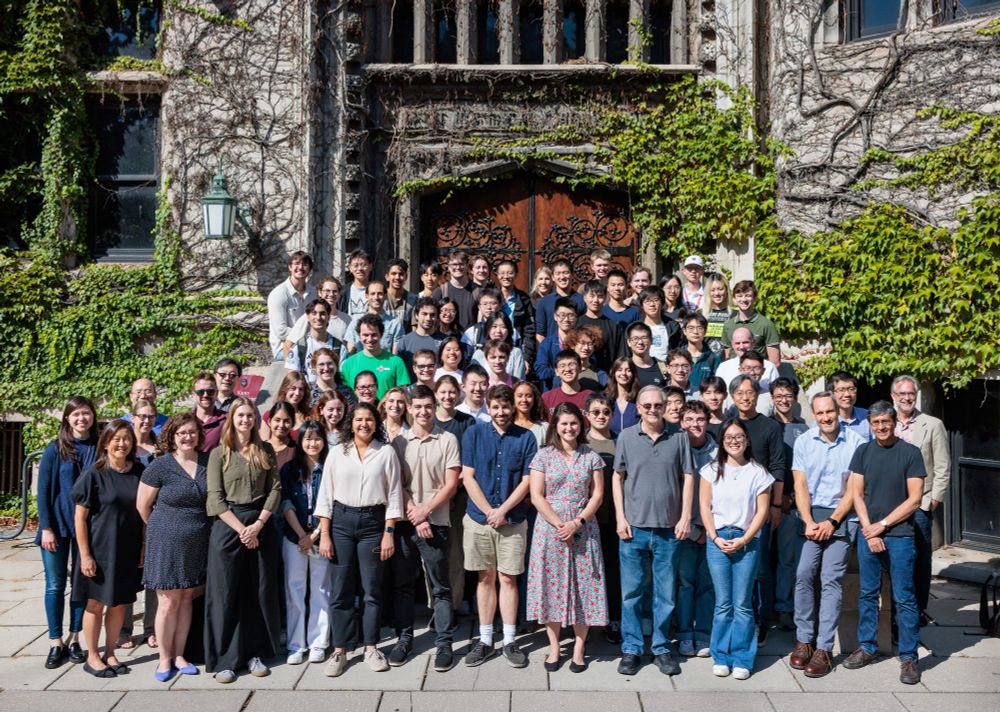
A Warm Welcome to Our Newest UChicago Chemists! As an incoming student, you're now at the epicenter of chemical innovation. We're excited to have you become part of our story and see the discoveries you will make this year.
September 29, 2025 at 6:08 PM
A Warm Welcome to Our Newest UChicago Chemists! As an incoming student, you're now at the epicenter of chemical innovation. We're excited to have you become part of our story and see the discoveries you will make this year.
Reposted by Bryan Dickinson
Excited to hear about the amazing research from the @chembiobryan.bsky.social group on taming acyl chlorides for #ChemBio applications from the first author of the @natchem.nature.com paper, @shubha-pani.bsky.social.
Register for free for the 5th Virtual #ChemBioTalks to join: cvent.me/G1geWW
Register for free for the 5th Virtual #ChemBioTalks to join: cvent.me/G1geWW
The third and final Flash Talk of the 5th Virtual #ChemBioTalks will be given by Shubhashree Pani (@shubha-pani.bsky.social) from the group of @chembiobryan.bsky.social: "Masked acylating agents for proximity labeling of biomolecules" www.nature.com/articles/s41...
#ChemBio #ChemSky #DrugDiscovery
#ChemBio #ChemSky #DrugDiscovery

September 29, 2025 at 4:57 AM
Excited to hear about the amazing research from the @chembiobryan.bsky.social group on taming acyl chlorides for #ChemBio applications from the first author of the @natchem.nature.com paper, @shubha-pani.bsky.social.
Register for free for the 5th Virtual #ChemBioTalks to join: cvent.me/G1geWW
Register for free for the 5th Virtual #ChemBioTalks to join: cvent.me/G1geWW
Reposted by Bryan Dickinson
The third and final Flash Talk of the 5th Virtual #ChemBioTalks will be given by Shubhashree Pani (@shubha-pani.bsky.social) from the group of @chembiobryan.bsky.social: "Masked acylating agents for proximity labeling of biomolecules" www.nature.com/articles/s41...
#ChemBio #ChemSky #DrugDiscovery
#ChemBio #ChemSky #DrugDiscovery
September 29, 2025 at 4:50 AM
The third and final Flash Talk of the 5th Virtual #ChemBioTalks will be given by Shubhashree Pani (@shubha-pani.bsky.social) from the group of @chembiobryan.bsky.social: "Masked acylating agents for proximity labeling of biomolecules" www.nature.com/articles/s41...
#ChemBio #ChemSky #DrugDiscovery
#ChemBio #ChemSky #DrugDiscovery
A successful NSF grant in 2025 deserves a nice dinner celebration. Thanks to this incredible crew of rockstars

September 23, 2025 at 1:10 AM
A successful NSF grant in 2025 deserves a nice dinner celebration. Thanks to this incredible crew of rockstars
Excited to share our most recent work out in @jacs.acspublications.org today! We combined mRNA display with macrocyclic peptide chemistry to discover novel RNA-targeting molecules. This fits into our mission to target RNA regulation with novel therapeutic modalities
pubs.acs.org/doi/10.1021/...
pubs.acs.org/doi/10.1021/...

Discovery of Macrocyclic Peptide Binders, Covalent Modifiers, and Degraders of a Structured RNA by mRNA Display
RNA targeting represents a compelling strategy for addressing challenging therapeutic targets that are otherwise intractable through traditional protein targeting. Revolutionary approaches in RNA-focused small molecule libraries have successfully identified RNA-binding ligands but generally remain limited in diversity and impeded by a dearth of structural insight into RNA and RNA complexes. Cyclic peptides are potential structural mimics of evolutionary RNA-protein interacting motifs and can be massively diversified and selected via genetically encoded libraries, offering a complementary approach. This study introduces genetically encoded thioether cyclic peptide libraries constructed through mRNA display using a dibromoxylene linker and its fluorosulfonyl derivative that can covalently engage RNA nucleophiles. Using an optimized mRNA display workflow for RNA binders, we discovered high affinity, covalent and noncovalent binders for SNCA 5′ UTR IRE, the upstream iron-responsive element that post-transcriptionally regulates the expression of α-synuclein, an intrinsically disordered protein implicated in Parkinsonism and related neurodegenerative diseases. Notably, a stringent selection strategy employing “base-paired” target analog counterselection enhanced specificity by deenriching nonspecific electrostatic interactions mediated by polycationic residues. Further engineering hit peptides with an imidazole tag yielded selective RNA degraders in which covalent degraders showed noticeably improved potency from noncovalent counterparts. This work provides a prototype framework for evolution-driven, high-throughput, RNA-targeted drug discovery using cyclic peptides.
pubs.acs.org
September 15, 2025 at 2:47 PM
Excited to share our most recent work out in @jacs.acspublications.org today! We combined mRNA display with macrocyclic peptide chemistry to discover novel RNA-targeting molecules. This fits into our mission to target RNA regulation with novel therapeutic modalities
pubs.acs.org/doi/10.1021/...
pubs.acs.org/doi/10.1021/...
Reposted by Bryan Dickinson
Update from Chicago. The situation is dire. Complete anarchy. Please send the national guard asap to put an end to this lawlessness
August 31, 2025 at 8:43 PM
Update from Chicago. The situation is dire. Complete anarchy. Please send the national guard asap to put an end to this lawlessness
So excited to have this great collaborative work out!!! It's been a delight working with the @jeffmartell.bsky.social group. More to come for sure!
Excited to share a new pre-print on a joint study between my group and @chembiobryan.bsky.social! Directed Evolution of Enzymes for Bioorthogonal Chemistry Using Acid Chloride Proximity Labeling. chemrxiv.org/engage/chemr...
1/n
1/n

Directed Evolution of Enzymes for Bioorthogonal Chemistry Using Acid Chloride Proximity Labeling
Combining bioorthogonal protecting groups with localized catalysts that can unmask them is a powerful approach to spatially and temporally modulate molecular activity. Enzymes are appealing catalysts ...
chemrxiv.org
August 28, 2025 at 7:51 PM
So excited to have this great collaborative work out!!! It's been a delight working with the @jeffmartell.bsky.social group. More to come for sure!