
Andrea Garnero
banner
agarnero.bsky.social
Andrea Garnero
@agarnero.bsky.social

L'avenir est ce que nous allons faire.
🧰 Economist OECD.
🎓 Board lavoceinfo, scuolapolitiche & Labor Chair PSE.
⚠️ Opinions mine.

Economics 59%
Political science 14%

Per uscirne serve far crescere la dimensione delle imprese, rafforzare i servizi ad alto valore aggiunto, investire sulle competenze di lavoratori e manager, sostenere la buona contrattazione, vigilare sul rispetto delle regole e rimettere mano al sistema fiscale e trasferimenti.

A questo si aggiunge un apparente paradosso. I record occupazionali possono diventare il germe di una nuova stagnazione. Con l’aumento del costo del capitale, molte imprese hanno preferito espandere il fattore lavoro invece di investire in beni capitali e digitalizzazione.

Dopotutto, le debolezze strutturali restano tutte lì: imprese piccole in servizi a basso valore aggiunto, relazioni industriali frammentate, fiscalità sbilanciata sul lavoro, livello di competenze insufficiente e un passaggio scuola-lavoro ampiamente migliorabile.

È una facile scommessa dire che il 2026 sarà ancora l’anno della questione salariale. Secondo l’Istat, le retribuzioni contrattuali in termini reali sono ancora inferiori dell’8,8% rispetto a gennaio 2021. I salari effettivi fanno solo leggermente meglio.

Il riscontro è andato ben oltre le aspettative: a settembre il libro è andato in ristampa e continua a far discutere. Anche nei contesti che consideriamo più avanzati del Paese, la questione salariale è al centro delle preoccupazioni. Perché è una questione davvero nazionale.

Nel 2025 la questione salariale italiana è entrata stabilmente nel dibattito pubblico. Con Roberto Mania, nel libro per Egea editore, abbiamo provato a fornire un quadro per analizzare le cause e ipotizzare soluzioni. La risposta in libreria e in giro per l’Italia ci ha sorpreso.

Here is a handy summary of the literature on the various margins from the latest Handbook of Labor Economics by @arindube.bsky.social & Attila Lindner for reference:

Reposted by Bruce Bradbury

The Economist makes a good point in warning that, at some point, high may be too high, and that we should look beyond the effects on employment. But, I don’t think there is (yet) any consensus that we reached the maximum as they seem to imply in their piece.
As governments champion a consensus on wage floors, scholars are getting cold feet. A growing body of research suggests that they can degrade jobs, even if they don’t destroy them
Why governments should stop raising the minimum wage
After a decade of rises, there are now far better tools for fighting poverty
econ.st

Reposted by Andrea Garnero

As governments champion a consensus on wage floors, scholars are getting cold feet. A growing body of research suggests that they can degrade jobs, even if they don’t destroy them
Why governments should stop raising the minimum wage
After a decade of rises, there are now far better tools for fighting poverty
econ.st

The OECD/AIAS ICTWSS database will continue to support EU Member States and the European Commission in tracking collective bargaining coverage and developments in collective bargaining systems.

🔗 All data available here: www.oecd.org/en/data/data...
OECD/AIAS ICTWSS database
The OECD/AIAS database on Institutional Characteristics of Trade Unions, Wage Setting, State Intervention and Social Pacts (ICTWSS) provides comprehensive and comparable information on the evolving na...
www.oecd.org

All other provisions remain valid — including the obligation for Member States to prepare action plans to promote collective bargaining when coverage is below 80% of workers.

Two elements were annulled:
• the (largely indicative) criteria for assessing when a minimum wage is “adequate”; and
• the prohibition on downward indexation in cases of negative inflation.

The European Court of Justice has delivered its much awaited judgment on the EU Minimum Wage Directive. The Court upheld the directive’s underlying principles but annulled two provisions. 🧵
⚖️ Judgment in Case C-19/23 Denmark v Parliament and Council: is the #EU competent to adopt a directive on adequate minimum wages?

🎥 💬 The President of the Court explains with subtitles in all EU languages 👉 curia.europa.eu/jcms/jcms/p1...
📰 PR 👉 curia.europa.eu/jcms/jcms/Jo...

#MinimumWage

Reposted by Andrea Garnero

🔻The Court of Justice of the EU has upheld the Directive on MinimumWages but annulled parts of Article 5.

The ECJ found that certain provisions on wage adequacy criteria and indexation mechanisms interfered directly with pay, exceeding the EU’s powers under the Treaties!
⚖️ Judgment in Case C-19/23 Denmark v Parliament and Council: is the #EU competent to adopt a directive on adequate minimum wages?

🎥 💬 The President of the Court explains with subtitles in all EU languages 👉 curia.europa.eu/jcms/jcms/p1...
📰 PR 👉 curia.europa.eu/jcms/jcms/Jo...

#MinimumWage
The directive stands, but Denmark gets partial victory in landmark case on minimum wage at European Court of Justice. Changes to some articles. Denmark is ordered to pay 2/3 of the costs. #minimumwage

🚨🚨New up-to-date data on employer organisations, trade union membership and collective bargaining coverage, as well as minimum wage setting mechanisms for 55 countries 👇👇
📊 #TradeUnion density in OECD countries has fallen from 30% in 1985 to 15% in 2024.

#CollectiveBargaining coverage has also declined, while employer organisation membership remains stable.

New OECD Policy Brief explores the trends 👉 oe.cd/6cz

Reposted by OECD, Andrea Garnero

📊 #TradeUnion density in OECD countries has fallen from 30% in 1985 to 15% in 2024.

#CollectiveBargaining coverage has also declined, while employer organisation membership remains stable.

New OECD Policy Brief explores the trends 👉 oe.cd/6cz

Great news indeed!
The IZA network @iza.org will survive!!

That's such great news. Moving to Luxemburg and joining @liser.lu

I don't know details and backend stories, but I see a bright opportunity ahead
The IZA network @iza.org will survive!!

That's such great news. Moving to Luxemburg and joining @liser.lu

I don't know details and backend stories, but I see a bright opportunity ahead

Reposted by Andrea Garnero

📢 Our May newsletter is out now! Check out the latest analysis and upcoming events on health, employment, migration and social affairs here: oe.cd/63P

Interested in our future editions❓ Subscribe here: oe.cd/63Q

Parole importanti del Pres Orsini sui salari stamattina. Confindustria potrebbe trincerarsi (è successo in passato) dietro al fatto che le proprie aziende già pagano meglio delle altre. Invece riconosce un “problema nazionale” a cui sente di contribuire. Una sfida da raccogliere.

Prossimo appuntamento con #laquestionesalariale lunedì prossimo, 2 giugno, al Festival dell’economia si Torino con Eva Giovannini, Giorgio Airaudo, Giulia Tancredi e Roberto Mania al bellissimo Circolo dei lettori! Garantito che non vi annoierete! 😃

Bella, viva e partecipata presentazione de #laquestionesalariale ieri a Roma. Il libro si legge come un giallo, ha detto Nunzia Penelope. Ma non c’è un assassino. Come sull’orient express la mano è di tutti. Più che deresponsabilizzare questo dà a tutti la possibilità di agire.

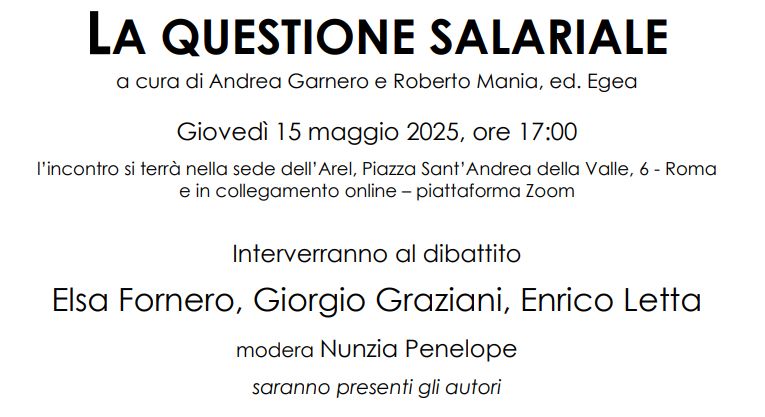
Ci vediamo a Roma giovedì prossimo per parlare de #laquestionesalariale?

📅 Giovedì 15 maggio ⏰ ore 17
📍 AREL – Piazza S. Andrea della Valle 6, Roma

🎙️Con Elsa Fornero, Giorgio Graziani, Enrico Letta e Roberto Mania moderati da Nunzia Penelope.

Per la #GiornataDelLibro 📚 ecco alcuni dei libri che hanno ispirato il dialogo su #laquestionesalariale con Roberto Mania. Da Bocca ad Accornero fino a opere più recenti. Ogni pagina letta, anche quelle che ho condiviso di meno, mi ha fatto pensare. Grazie!

Reposted by Andrea Garnero

UPDATE: New data on public social spending. On average, OECD countries spent 21% of their GDP on public social spending in 2024.

Compare your country and discover more data insights with OECD’s Social Expenditure Database ➡️ oe.cd/5-m

#SocialSpending #SocialPolicy #OECD

Ricca recensione de #LaQuestioneSalariale sulla #Domenica del Sole 24 Ore. Mi ha colpito la sottolineatura che non si tratta di un libro con "soluzioni incorporate". È così! Non volevamo un "libro a tesi". Serve piuttosto un metodo e continuità per avanzare.

📺Il punto di Paolo Pagliaro riprende alcuni dei messaggi de #laquestionesalariale
🔗 www.la7.it/otto-e-mezzo...
#La7 #ottoemezzo