


@srosecoy.bsky.social
Reposted
Proximity-specific ribosome profiling #ribosome #rnabiology in mitochondria
www.cell.com/cell/fulltex...
www.cell.com/cell/fulltex...

Proximity-specific ribosome profiling reveals the logic of localized mitochondrial translation
Development of LOV-domain-controlled ligase for translation localization (LOCL-TL),
an optogenetic approach for monitoring translation with codon resolution at any defined
subcellular location under p...
www.cell.com
January 5, 2026 at 9:57 AM
Proximity-specific ribosome profiling #ribosome #rnabiology in mitochondria
www.cell.com/cell/fulltex...
www.cell.com/cell/fulltex...
Reposted
NLR-like immunity in bacteria
A new study from the Alex Gao lab. The scope of this work is incredible!!!
www.biorxiv.org/content/10.6...
A new study from the Alex Gao lab. The scope of this work is incredible!!!
www.biorxiv.org/content/10.6...

Diverse bacterial pattern recognition receptors sense the conserved phage proteome
Recognition of foreign molecules inside cells is critical for immunity in all domains of life. Proteins of the STAND NTPase superfamily, including eukaryotic nucleotide-binding oligomerization domain ...
www.biorxiv.org
January 5, 2026 at 1:59 PM
NLR-like immunity in bacteria
A new study from the Alex Gao lab. The scope of this work is incredible!!!
www.biorxiv.org/content/10.6...
A new study from the Alex Gao lab. The scope of this work is incredible!!!
www.biorxiv.org/content/10.6...
Reposted
A planetary atlas of plankton 🪐
Closing the year with a bang: out @cellcellpress.bsky.social the @dudinlab.bsky.social & @gautamdey.bsky.social labs used ultrastructure Expansion Microscopy to reveal the stunning cytoskeletal diversity of over 200 plankton species!
A #sciart 🧵
@embl.org
Closing the year with a bang: out @cellcellpress.bsky.social the @dudinlab.bsky.social & @gautamdey.bsky.social labs used ultrastructure Expansion Microscopy to reveal the stunning cytoskeletal diversity of over 200 plankton species!
A #sciart 🧵
@embl.org

January 4, 2026 at 11:35 AM
A planetary atlas of plankton 🪐
Closing the year with a bang: out @cellcellpress.bsky.social the @dudinlab.bsky.social & @gautamdey.bsky.social labs used ultrastructure Expansion Microscopy to reveal the stunning cytoskeletal diversity of over 200 plankton species!
A #sciart 🧵
@embl.org
Closing the year with a bang: out @cellcellpress.bsky.social the @dudinlab.bsky.social & @gautamdey.bsky.social labs used ultrastructure Expansion Microscopy to reveal the stunning cytoskeletal diversity of over 200 plankton species!
A #sciart 🧵
@embl.org
Reposted
#microsky #phagesky
The 3rd (? Lost track!) manuscript on a CRISPR/anti-CRISPR -based transposon tool to study gene essentiality in #phages
www.biorxiv.org/content/10.6...
The 3rd (? Lost track!) manuscript on a CRISPR/anti-CRISPR -based transposon tool to study gene essentiality in #phages
www.biorxiv.org/content/10.6...

High-throughput transposon mutagenesis defines the essential genome of diverse phages
Phages are important drivers of bacterial evolution with therapeutic potential as antimicrobials. However, gaps in our understanding of phages and our inability to rapidly engineer them with new genet...
www.biorxiv.org
December 21, 2025 at 5:01 AM
#microsky #phagesky
The 3rd (? Lost track!) manuscript on a CRISPR/anti-CRISPR -based transposon tool to study gene essentiality in #phages
www.biorxiv.org/content/10.6...
The 3rd (? Lost track!) manuscript on a CRISPR/anti-CRISPR -based transposon tool to study gene essentiality in #phages
www.biorxiv.org/content/10.6...
Reposted

'Twas the solstice in Woods Hole, when all through the labs, not a creature was stirring. Not even the crabs!
The Cape Cod Times is ringing in the longest night of the year with a celebration of all the science that happens here in Woods Hole! Catch the highlights go.whoi.edu/cct-winter
The Cape Cod Times is ringing in the longest night of the year with a celebration of all the science that happens here in Woods Hole! Catch the highlights go.whoi.edu/cct-winter

December 21, 2025 at 5:00 PM
'Twas the solstice in Woods Hole, when all through the labs, not a creature was stirring. Not even the crabs!
The Cape Cod Times is ringing in the longest night of the year with a celebration of all the science that happens here in Woods Hole! Catch the highlights go.whoi.edu/cct-winter
The Cape Cod Times is ringing in the longest night of the year with a celebration of all the science that happens here in Woods Hole! Catch the highlights go.whoi.edu/cct-winter
Reposted
🌊📆 🌊 Ring in the new year with our 2026 wall calendar! Each of these amazing images of ocean life and field work was captured by our scientists and photographers—and your purchase helps support their work!
📲Order yours at the WHOI Store: go.whoi.edu/2025-calendar
📸 © #WHOI
📲Order yours at the WHOI Store: go.whoi.edu/2025-calendar
📸 © #WHOI


December 6, 2025 at 8:59 PM
🌊📆 🌊 Ring in the new year with our 2026 wall calendar! Each of these amazing images of ocean life and field work was captured by our scientists and photographers—and your purchase helps support their work!
📲Order yours at the WHOI Store: go.whoi.edu/2025-calendar
📸 © #WHOI
📲Order yours at the WHOI Store: go.whoi.edu/2025-calendar
📸 © #WHOI
Reposted

🚨Preprint alert - this is a big one! We transfer the revolutionary power of TnSeq to bacteriophages.
Our HIDEN-SEQ links the "dark matter" genes of your favorite phage to any selectable phenotype, guiding the path from fun observations to molecular mechanisms.
A thread 1/8
Our HIDEN-SEQ links the "dark matter" genes of your favorite phage to any selectable phenotype, guiding the path from fun observations to molecular mechanisms.
A thread 1/8

November 20, 2025 at 8:40 PM
🚨Preprint alert - this is a big one! We transfer the revolutionary power of TnSeq to bacteriophages.
Our HIDEN-SEQ links the "dark matter" genes of your favorite phage to any selectable phenotype, guiding the path from fun observations to molecular mechanisms.
A thread 1/8
Our HIDEN-SEQ links the "dark matter" genes of your favorite phage to any selectable phenotype, guiding the path from fun observations to molecular mechanisms.
A thread 1/8
Reposted

Congratulations to my student Josh Hensley and our amazing collaborators at UCSD David Pride lab! In press today, we developed a technique to evolve phages to broaden bacterial host range to tackle bacteria that evade antibiotics. #phagesky #phage #microsky #virussky
www.nature.com/articles/s41...
www.nature.com/articles/s41...

Experimental phage evolution results in expanded host ranges against antibiotic resistant Klebsiella pneumoniae isolates - Nature Communications
Ghatbale et al. adapted a co-evolutionary technique to develop Klebsiella pneumoniae phages to be highly active longitudinally against K. pneumoniae clinical isolates, including drug resistant isolate...
www.nature.com
November 19, 2025 at 4:47 PM
Congratulations to my student Josh Hensley and our amazing collaborators at UCSD David Pride lab! In press today, we developed a technique to evolve phages to broaden bacterial host range to tackle bacteria that evade antibiotics. #phagesky #phage #microsky #virussky
www.nature.com/articles/s41...
www.nature.com/articles/s41...
Reposted

Out today, our take on 6-methyladenine #6mA evolution in Eukaryotes @natgenet.nature.com. We asked a simple question, is really DNA 6mA common across the eukaryotes? The answer is "yes" if you're a unicellular eukaryote 🦠, not so if you're multicellular 🐝🌱🍄. www.nature.com/articles/s41... 1/9

Adenine DNA methylation associated with transcriptionally permissive chromatin is widespread across eukaryotes - Nature Genetics
Long-read sequencing in 18 unicellular eukaryotes reveals that 6mA is widespread across eukaryotes and is enriched at transcriptionally permissive regions, which are also marked by H3K4me3.
www.nature.com
November 18, 2025 at 12:00 PM
Out today, our take on 6-methyladenine #6mA evolution in Eukaryotes @natgenet.nature.com. We asked a simple question, is really DNA 6mA common across the eukaryotes? The answer is "yes" if you're a unicellular eukaryote 🦠, not so if you're multicellular 🐝🌱🍄. www.nature.com/articles/s41... 1/9
Reposted

Amazing piece of work from @rtoshiro.bsky.social
& Kim Seed at UC Berkeley. 🙌
Played a tiny role in this work.
Surviving phage attack dynamically regulates bacterial immunity to defeat counterdefenses
www.biorxiv.org/content/10.1...
& Kim Seed at UC Berkeley. 🙌
Played a tiny role in this work.
Surviving phage attack dynamically regulates bacterial immunity to defeat counterdefenses
www.biorxiv.org/content/10.1...
bsky.app
November 15, 2025 at 3:37 PM
Amazing piece of work from @rtoshiro.bsky.social
& Kim Seed at UC Berkeley. 🙌
Played a tiny role in this work.
Surviving phage attack dynamically regulates bacterial immunity to defeat counterdefenses
www.biorxiv.org/content/10.1...
& Kim Seed at UC Berkeley. 🙌
Played a tiny role in this work.
Surviving phage attack dynamically regulates bacterial immunity to defeat counterdefenses
www.biorxiv.org/content/10.1...

Reposted
#microsky #phagesky #phage plasmids & other #MGE in the bee #microbiome
www.biorxiv.org/content/10.1...
www.biorxiv.org/content/10.1...
Nested Connections: Local Phage and Broad Plasmid Sharing in the Honey Bee Mobilome
Honey bees rely on bacterial symbionts for their nutritional needs and for protection against invading pathogens. Genetic diversity among strains within the colony has the potential to impact symbiont...
www.biorxiv.org
November 2, 2025 at 6:52 AM
#microsky #phagesky #phage plasmids & other #MGE in the bee #microbiome
www.biorxiv.org/content/10.1...
www.biorxiv.org/content/10.1...
Reposted

🚨Our collaboration with @centriolelab.bsky.social & @gautamdey.bsky.social is out today in @cp-cell.bsky.social
We show that #Expansion #Microscopy is a broad-spectrum modality for Euks, enabling 3D phenotypic maps rooted to phylogeny.
#ProtistsOnSky #SciComm #SciSky
www.cell.com/cell/fulltex...
We show that #Expansion #Microscopy is a broad-spectrum modality for Euks, enabling 3D phenotypic maps rooted to phylogeny.
#ProtistsOnSky #SciComm #SciSky
www.cell.com/cell/fulltex...
October 31, 2025 at 2:42 PM
🚨Our collaboration with @centriolelab.bsky.social & @gautamdey.bsky.social is out today in @cp-cell.bsky.social
We show that #Expansion #Microscopy is a broad-spectrum modality for Euks, enabling 3D phenotypic maps rooted to phylogeny.
#ProtistsOnSky #SciComm #SciSky
www.cell.com/cell/fulltex...
We show that #Expansion #Microscopy is a broad-spectrum modality for Euks, enabling 3D phenotypic maps rooted to phylogeny.
#ProtistsOnSky #SciComm #SciSky
www.cell.com/cell/fulltex...
Reposted

The Wilkinson Lab is open for science! @mskcancercenter.bsky.social
🧬We'll be finding funky new RNA biology, mainly by looking at reverse transcriptases (i.e. the Best Enzymes In The World)🧬
annnd: I'm hiring - come join! Especially postdocs and PhD students - please get in touch (NYC is great)
🧬We'll be finding funky new RNA biology, mainly by looking at reverse transcriptases (i.e. the Best Enzymes In The World)🧬
annnd: I'm hiring - come join! Especially postdocs and PhD students - please get in touch (NYC is great)

Wilkinson Lab
We discover and study reverse transcriptases
wilkinsonlab.bio
October 31, 2025 at 7:00 PM
The Wilkinson Lab is open for science! @mskcancercenter.bsky.social
🧬We'll be finding funky new RNA biology, mainly by looking at reverse transcriptases (i.e. the Best Enzymes In The World)🧬
annnd: I'm hiring - come join! Especially postdocs and PhD students - please get in touch (NYC is great)
🧬We'll be finding funky new RNA biology, mainly by looking at reverse transcriptases (i.e. the Best Enzymes In The World)🧬
annnd: I'm hiring - come join! Especially postdocs and PhD students - please get in touch (NYC is great)
Reposted
Please join us next week for the second iteration of the DinoSphere Seminars! This time our two speakers will talk about host-associated dinoflagellates and any challenges they might have encountered when working with them. All current and future friends of dinoflagellates welcome!
#ProtistsOnSky
#ProtistsOnSky
We’re back with the next DinoSphere Online Seminar!
Join us on Nov 4th, we're hosting:
Edmée Royen (ULiège) - Symbiodinium
Nicolas dos Santos Pacheco (Cambridge) - Perkinsids
📅 Tue, Nov 4 - 4 PM CET/3 PM GMT
💻 Zoom link: sites.google.com/view/dinosphere
Please spread the word!
#protistonsky
Join us on Nov 4th, we're hosting:
Edmée Royen (ULiège) - Symbiodinium
Nicolas dos Santos Pacheco (Cambridge) - Perkinsids
📅 Tue, Nov 4 - 4 PM CET/3 PM GMT
💻 Zoom link: sites.google.com/view/dinosphere
Please spread the word!
#protistonsky

October 29, 2025 at 9:19 AM
Please join us next week for the second iteration of the DinoSphere Seminars! This time our two speakers will talk about host-associated dinoflagellates and any challenges they might have encountered when working with them. All current and future friends of dinoflagellates welcome!
#ProtistsOnSky
#ProtistsOnSky
Reposted

Reposted

This might be one of the coolest findings I’ve read this year!
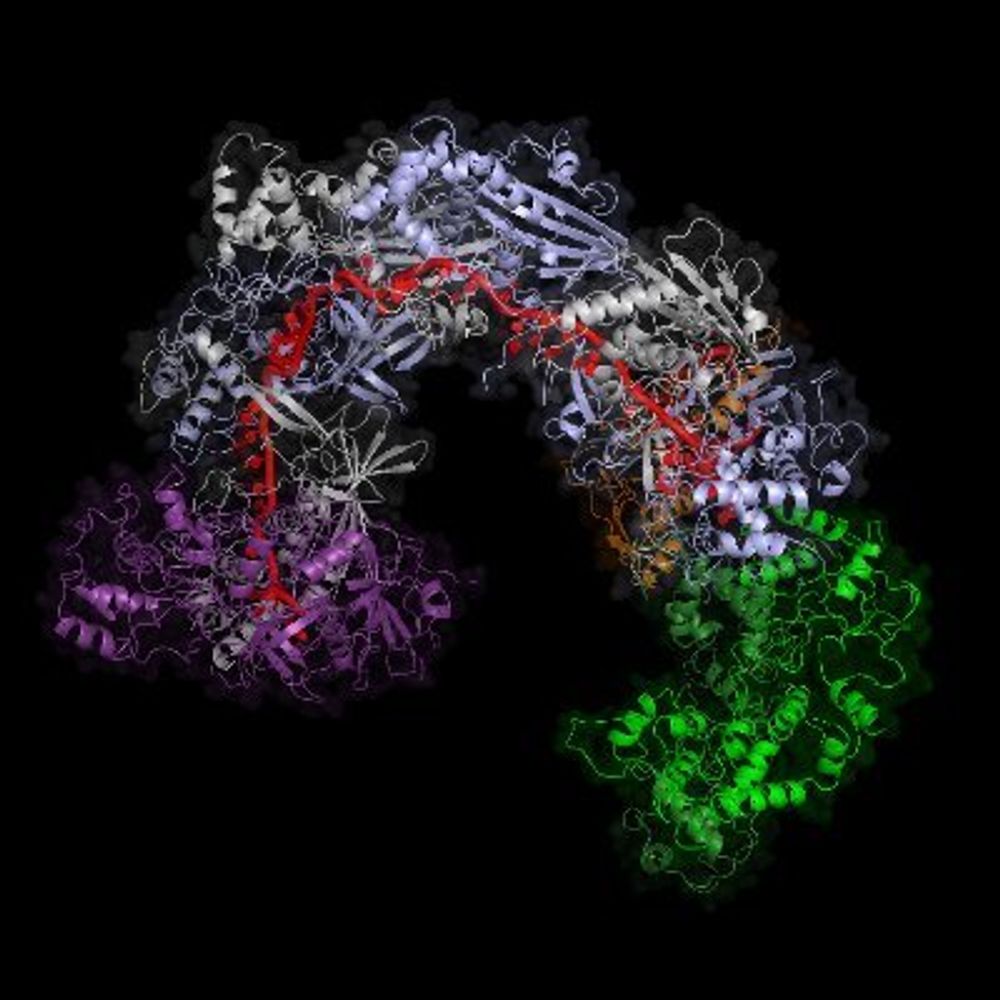
1/10 Genome maintenance by telomerase is a fundamental process in nearly all eukaryotes. But where does it come from?
Today, we report the discovery of telomerase homologs in a family of antiviral RTs, revealing an unexpected evolutionary origin in bacteria.
www.biorxiv.org/content/10.1...
Today, we report the discovery of telomerase homologs in a family of antiviral RTs, revealing an unexpected evolutionary origin in bacteria.
www.biorxiv.org/content/10.1...

Antiviral reverse transcriptases reveal the evolutionary origin of telomerase
Defense-associated reverse transcriptases (DRTs) employ diverse and distinctive mechanisms of cDNA synthesis to protect bacteria against viral infection. However, much of DRT family diversity remains ...
www.biorxiv.org
October 17, 2025 at 11:53 PM
This might be one of the coolest findings I’ve read this year!
Reposted

Half of microbial eukaryote literature focuses on only twelve human parasites
-in #ISMEJournal by Joanna Lepper, @hbrappap.bsky.social and @oliverio.bsky.social
academic.oup.com/ismej/advanc...
-in #ISMEJournal by Joanna Lepper, @hbrappap.bsky.social and @oliverio.bsky.social
academic.oup.com/ismej/advanc...
Half of microbial eukaryote literature focuses on only twelve human parasites
Abstract. Although microbial eukaryotes comprise the majority of eukaryotic phylogenetic diversity and inhabit nearly all ecosystems globally, most researc
academic.oup.com
October 8, 2025 at 1:12 PM
Half of microbial eukaryote literature focuses on only twelve human parasites
-in #ISMEJournal by Joanna Lepper, @hbrappap.bsky.social and @oliverio.bsky.social
academic.oup.com/ismej/advanc...
-in #ISMEJournal by Joanna Lepper, @hbrappap.bsky.social and @oliverio.bsky.social
academic.oup.com/ismej/advanc...
Reposted
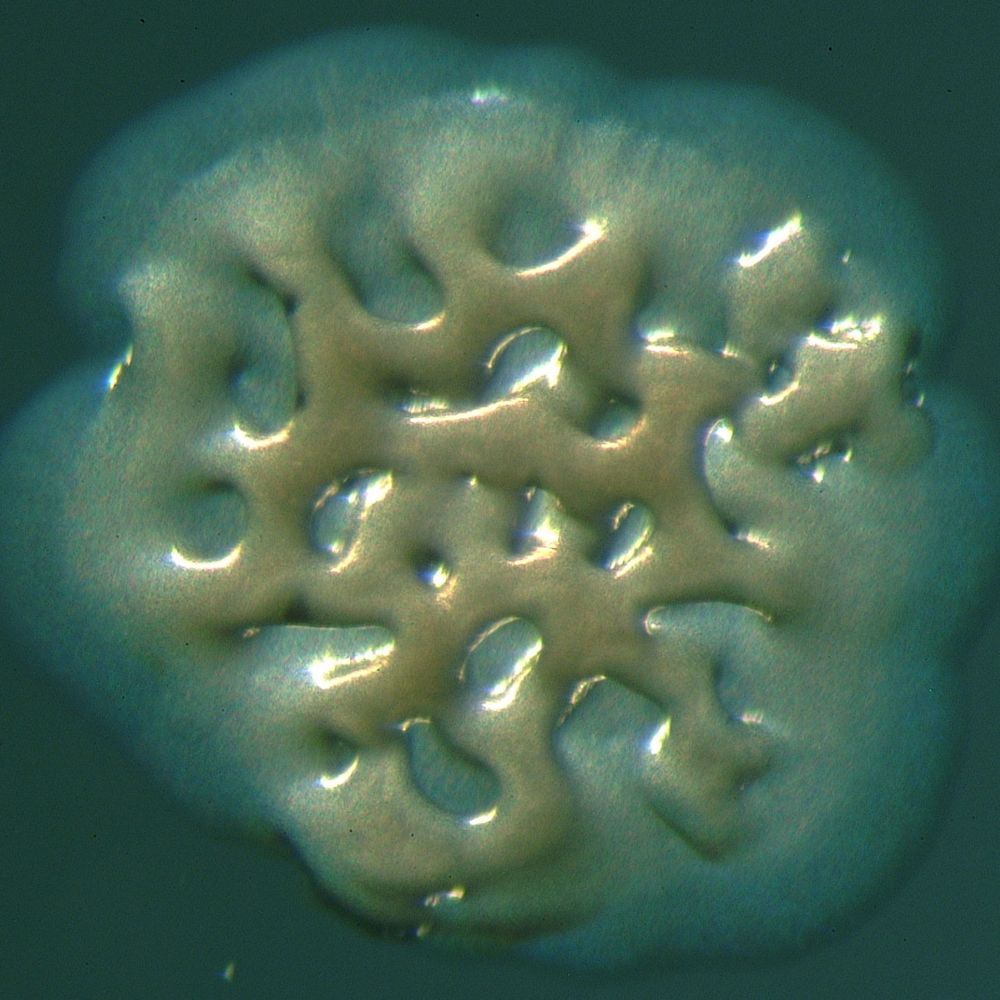
New preprint!
Ever wondered why only a fraction of genomes encode CRISPR immunity? 🧬 🦠
Turns out CRISPR is rarely beneficial against virulent phages, being most beneficial against those for which resistance mutations are rare!
An epic effort by Rosanna Wright
www.biorxiv.org/content/10.1...
Ever wondered why only a fraction of genomes encode CRISPR immunity? 🧬 🦠
Turns out CRISPR is rarely beneficial against virulent phages, being most beneficial against those for which resistance mutations are rare!
An epic effort by Rosanna Wright
www.biorxiv.org/content/10.1...

Resistance mutation supply modulates the benefit of CRISPR immunity against virulent phages
Only a fraction of bacterial genomes encode CRISPR-Cas systems but the selective causes of this variation are unexplained. How naturally virulent bacteriophages (phages) select for CRISPR immunity has...
www.biorxiv.org
October 6, 2025 at 6:27 AM
New preprint!
Ever wondered why only a fraction of genomes encode CRISPR immunity? 🧬 🦠
Turns out CRISPR is rarely beneficial against virulent phages, being most beneficial against those for which resistance mutations are rare!
An epic effort by Rosanna Wright
www.biorxiv.org/content/10.1...
Ever wondered why only a fraction of genomes encode CRISPR immunity? 🧬 🦠
Turns out CRISPR is rarely beneficial against virulent phages, being most beneficial against those for which resistance mutations are rare!
An epic effort by Rosanna Wright
www.biorxiv.org/content/10.1...
Reposted
THANK YOU FOR WRITING THIS!!!!
"Although this is a useful and even satisfying approach, the reality for MGEs is that they are best represented as a spectrum of inter-related elements (Fig. 1)."
"Although this is a useful and even satisfying approach, the reality for MGEs is that they are best represented as a spectrum of inter-related elements (Fig. 1)."

New online! Interactions and evolutionary relationships among bacterial mobile genetic elements

Interactions and evolutionary relationships among bacterial mobile genetic elements
Nature Reviews Microbiology, Published online: 11 March 2025; doi:10.1038/s41579-025-01157-yIn this Review, Lang and colleagues present an overview of the current knowledge landscape regarding mobile genetic elements in bacteria, with a focus on their…
www.nature.com
March 27, 2025 at 5:50 PM
THANK YOU FOR WRITING THIS!!!!
"Although this is a useful and even satisfying approach, the reality for MGEs is that they are best represented as a spectrum of inter-related elements (Fig. 1)."
"Although this is a useful and even satisfying approach, the reality for MGEs is that they are best represented as a spectrum of inter-related elements (Fig. 1)."
Reposted
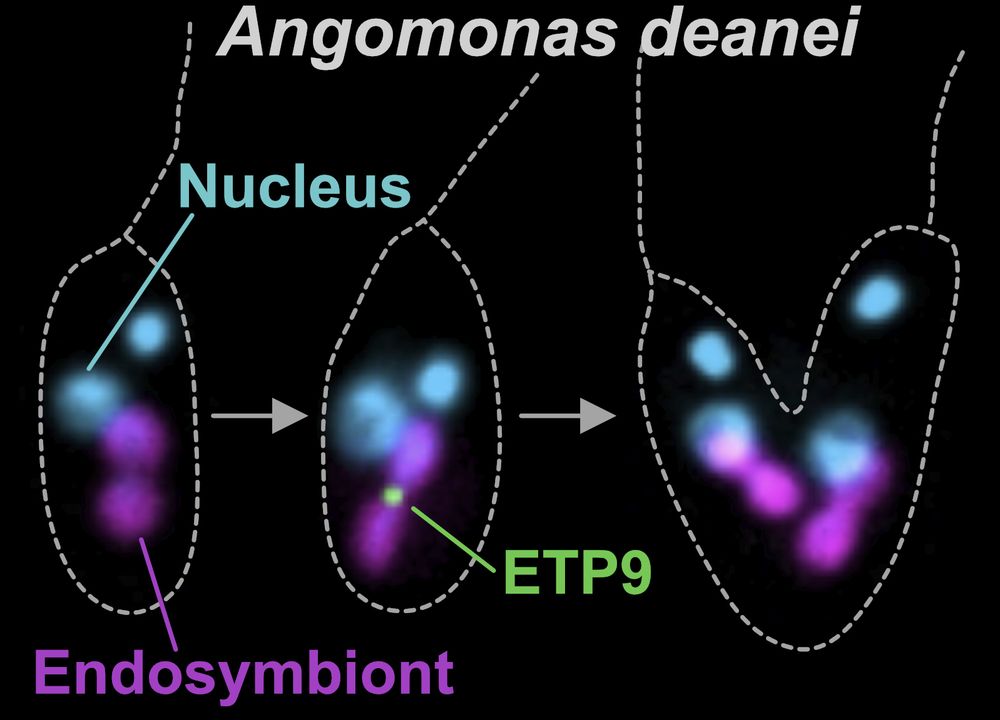
Out today: Exciting intermediate between endosymbiont and organelle identified! Endosymbionts in Angomonas deanei lost nearly all bacterial cell division genes. Instead, we identified a host-encoded protein, ETP9, that became specialized for endosymbiont division. 1/2
www.science.org/doi/10.1126/...
www.science.org/doi/10.1126/...
March 19, 2025 at 8:29 PM
Out today: Exciting intermediate between endosymbiont and organelle identified! Endosymbionts in Angomonas deanei lost nearly all bacterial cell division genes. Instead, we identified a host-encoded protein, ETP9, that became specialized for endosymbiont division. 1/2
www.science.org/doi/10.1126/...
www.science.org/doi/10.1126/...
Reposted
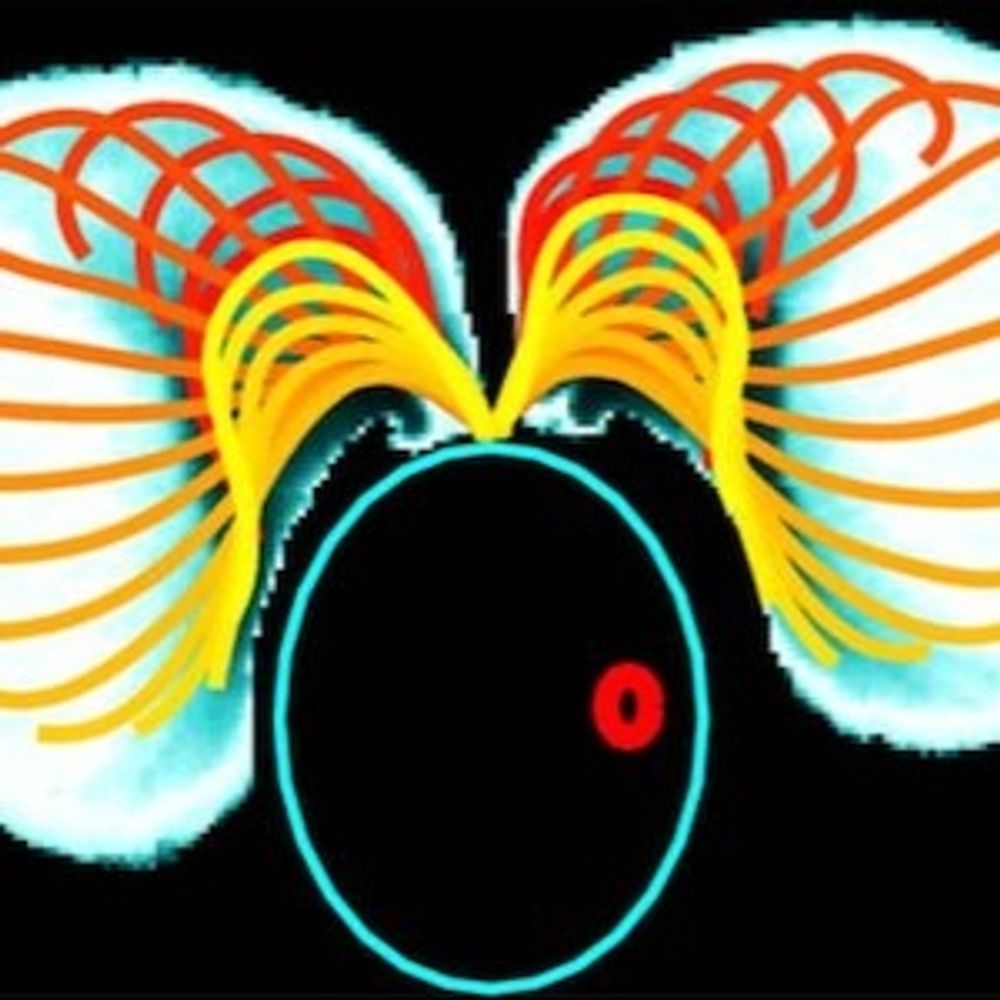
Delighted to see our work on #diatom motility published in @pnas.org !🎉
doi.org/10.1073/pnas...
These abundant single-celled algae are responsible for a significant portion of the air we breathe yet often overlooked. Here we show how how diatom (raphe) shape impacts their gliding function... 1/3
doi.org/10.1073/pnas...
These abundant single-celled algae are responsible for a significant portion of the air we breathe yet often overlooked. Here we show how how diatom (raphe) shape impacts their gliding function... 1/3
March 19, 2025 at 10:21 AM
Delighted to see our work on #diatom motility published in @pnas.org !🎉
doi.org/10.1073/pnas...
These abundant single-celled algae are responsible for a significant portion of the air we breathe yet often overlooked. Here we show how how diatom (raphe) shape impacts their gliding function... 1/3
doi.org/10.1073/pnas...
These abundant single-celled algae are responsible for a significant portion of the air we breathe yet often overlooked. Here we show how how diatom (raphe) shape impacts their gliding function... 1/3

Reposted
Just out - The first global ocean 3-Domain microbial survey where all organisms can be directly compared quantitatively. Unfractionated and amplified from just 2 primers (vetted with mock communities and metagenomics), so all with the same denominator. www.biorxiv.org/content/10.1...
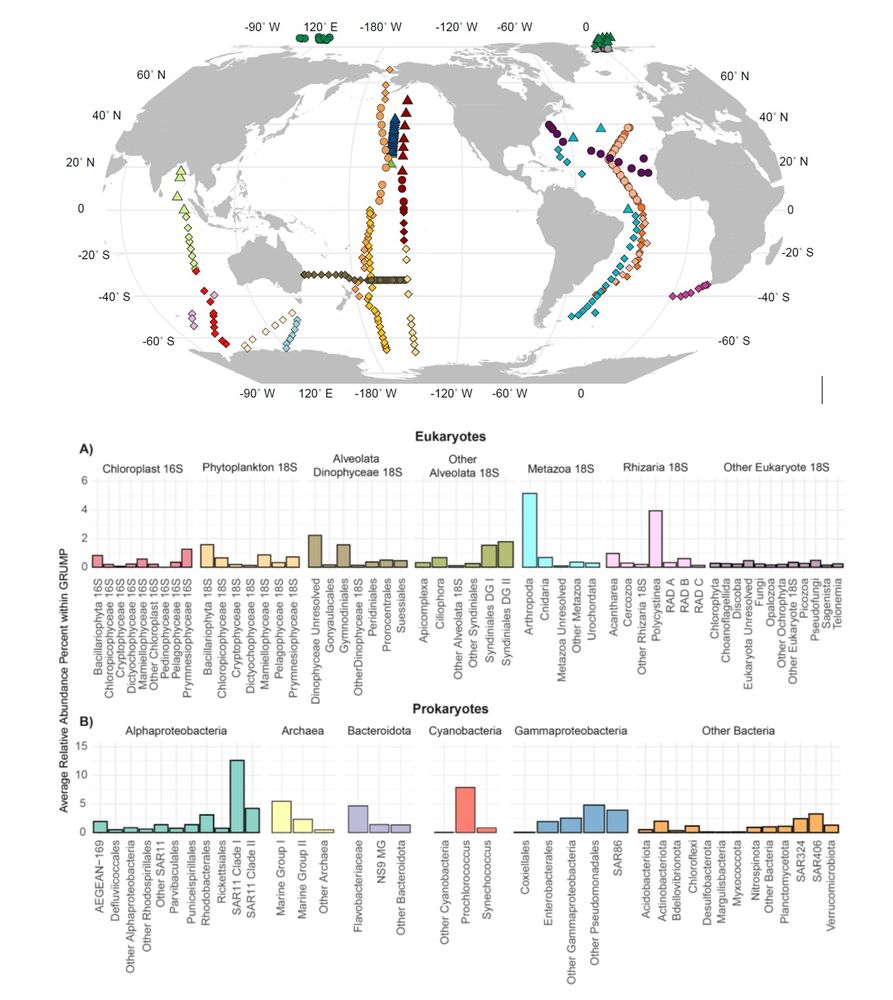
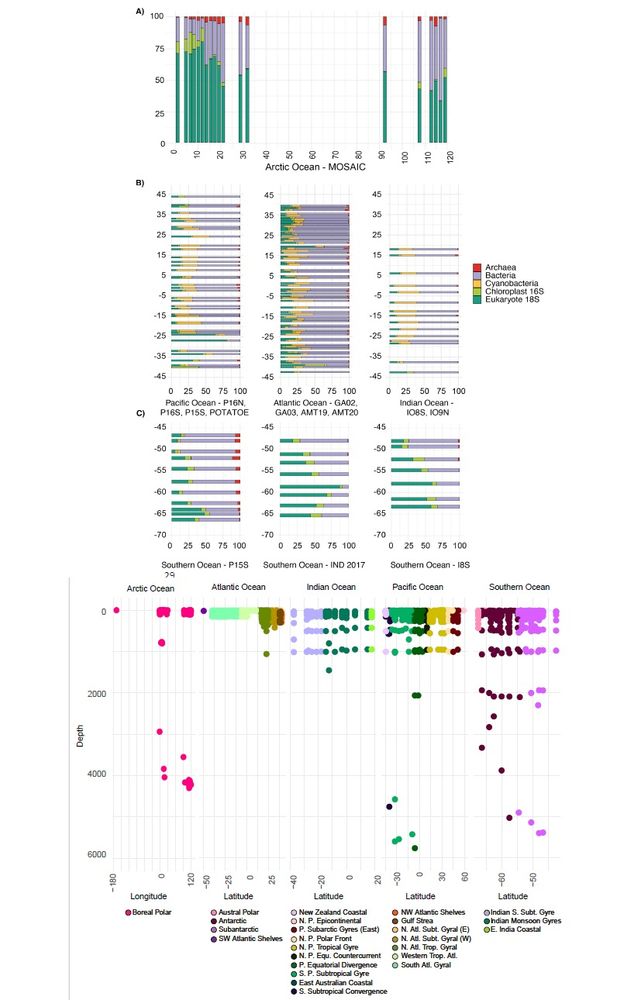
February 27, 2025 at 5:21 PM
Just out - The first global ocean 3-Domain microbial survey where all organisms can be directly compared quantitatively. Unfractionated and amplified from just 2 primers (vetted with mock communities and metagenomics), so all with the same denominator. www.biorxiv.org/content/10.1...