




Jo Herbert
@microjo.bsky.social
Postdoctoral Researcher in Environmental Microbiology - Schölmerich Lab | ETH Zürich🇨🇭| Metagenomics & ONT | 🧬 🧫🧪🔬| losing the ggplot 📊 | she/her
Pinned
Jo Herbert
@microjo.bsky.social
· May 6

Impact of microbiological molecular methodologies on adaptive sampling using nanopore sequencing in metagenomic studies - Environmental Microbiome
Introduction Metagenomics, the genomic analysis of all species present within a mixed population, is an important tool used for the exploration of microbiomes in clinical and environmental microbiolog...
environmentalmicrobiome.biomedcentral.com
First, first author paper! 🥳
If you are interested in using @nanoporetech.com adaptive sampling and how chemistry updates might affect data (or just want to know a good DNA extraction kit for metagenomic samples) then give it a read! 🧬
environmentalmicrobiome.biomedcentral.com/articles/10....
If you are interested in using @nanoporetech.com adaptive sampling and how chemistry updates might affect data (or just want to know a good DNA extraction kit for metagenomic samples) then give it a read! 🧬
environmentalmicrobiome.biomedcentral.com/articles/10....
Reposted by Jo Herbert

🚀New preprint from our lab!
I am very excited to finally share what has been the main focus of my PhD for the past almost 3 years! It is about viral dark matter and a powerful tool we built to shed light on it. 🧬💡
Continue reading (🧵)
I am very excited to finally share what has been the main focus of my PhD for the past almost 3 years! It is about viral dark matter and a powerful tool we built to shed light on it. 🧬💡
Continue reading (🧵)

November 20, 2025 at 6:52 PM
🚀New preprint from our lab!
I am very excited to finally share what has been the main focus of my PhD for the past almost 3 years! It is about viral dark matter and a powerful tool we built to shed light on it. 🧬💡
Continue reading (🧵)
I am very excited to finally share what has been the main focus of my PhD for the past almost 3 years! It is about viral dark matter and a powerful tool we built to shed light on it. 🧬💡
Continue reading (🧵)
Reposted by Jo Herbert

An Asgard archaeon with internal membrane compartments
Brilliant study led by @fmacleod.bsky.social and Andriko von Kügelgen. Tight collaboration with @buzzbaum.bsky.social and lab. Congrats to all authors!
www.biorxiv.org/content/10.1...
Brilliant study led by @fmacleod.bsky.social and Andriko von Kügelgen. Tight collaboration with @buzzbaum.bsky.social and lab. Congrats to all authors!
www.biorxiv.org/content/10.1...

November 7, 2025 at 10:44 AM
An Asgard archaeon with internal membrane compartments
Brilliant study led by @fmacleod.bsky.social and Andriko von Kügelgen. Tight collaboration with @buzzbaum.bsky.social and lab. Congrats to all authors!
www.biorxiv.org/content/10.1...
Brilliant study led by @fmacleod.bsky.social and Andriko von Kügelgen. Tight collaboration with @buzzbaum.bsky.social and lab. Congrats to all authors!
www.biorxiv.org/content/10.1...
Reposted by Jo Herbert

Interested in how microbial #diversity is structured across the global #oceans?
Check out our newest preprint!
We show that latitudinal diversity gradients are taxon-specific, reflecting differing ecological strategies and their responses to environmental gradients
www.biorxiv.org/content/10.1...
Check out our newest preprint!
We show that latitudinal diversity gradients are taxon-specific, reflecting differing ecological strategies and their responses to environmental gradients
www.biorxiv.org/content/10.1...

Variations in the latitudinal diversity gradients of the ocean microbiome
Latitudinal diversity gradients (LDGs), typically declining from the equator to the poles, are among the most pervasive macroecological patterns, yet their generality and underlying drivers in the oce...
www.biorxiv.org
October 14, 2025 at 6:08 AM
Interested in how microbial #diversity is structured across the global #oceans?
Check out our newest preprint!
We show that latitudinal diversity gradients are taxon-specific, reflecting differing ecological strategies and their responses to environmental gradients
www.biorxiv.org/content/10.1...
Check out our newest preprint!
We show that latitudinal diversity gradients are taxon-specific, reflecting differing ecological strategies and their responses to environmental gradients
www.biorxiv.org/content/10.1...
Things you love to see on a Friday afternoon 💚 🧬
October 10, 2025 at 12:34 PM
Things you love to see on a Friday afternoon 💚 🧬
Reposted by Jo Herbert

This is wonderful to play with, highly recommended for anyone who wants to understand the BWT
Just published an interactive article about a magical algorithm known as the Burrows-Wheeler Transform, which powers sequence alignment tools like bowtie and bwa: sandbox.bio/concepts/bwt
It's also notoriously unintuitive so I'm hoping this article helps you build that intuition.
It's also notoriously unintuitive so I'm hoping this article helps you build that intuition.
October 9, 2025 at 8:31 PM
This is wonderful to play with, highly recommended for anyone who wants to understand the BWT
Reposted by Jo Herbert
New pre-print from the Banfield lab, highlighting an interesting case of 1.5Mb megaplasmids found in human gut.
Plasmid genomes were resolved using #PacBio HiFi sequencing with hifiasm-meta for #metagenome assembly. Host association was detected using epigenetic signals.
doi.org/10.1101/2025...
Plasmid genomes were resolved using #PacBio HiFi sequencing with hifiasm-meta for #metagenome assembly. Host association was detected using epigenetic signals.
doi.org/10.1101/2025...

Megaplasmids associate with Escherichia coli and other Enterobacteriaceae
Humans and animals are ubiquitously colonized by Enterobacteriaceae , a bacterial family that contains both commensals and clinically significant pathogens. Here, we report Enterobacteriaceae megaplas...
doi.org
October 1, 2025 at 4:44 PM
New pre-print from the Banfield lab, highlighting an interesting case of 1.5Mb megaplasmids found in human gut.
Plasmid genomes were resolved using #PacBio HiFi sequencing with hifiasm-meta for #metagenome assembly. Host association was detected using epigenetic signals.
doi.org/10.1101/2025...
Plasmid genomes were resolved using #PacBio HiFi sequencing with hifiasm-meta for #metagenome assembly. Host association was detected using epigenetic signals.
doi.org/10.1101/2025...


Reposted by Jo Herbert
Delighted to see our paper studying the evolution of plasmids over the last 100 years, now out! Years of work by Adrian Cazares, also Nick Thomson @sangerinstitute.bsky.social - this version much improved over the preprint. Final version should be open access, apols.
Thread 1/n
Thread 1/n

September 25, 2025 at 9:29 PM
Delighted to see our paper studying the evolution of plasmids over the last 100 years, now out! Years of work by Adrian Cazares, also Nick Thomson @sangerinstitute.bsky.social - this version much improved over the preprint. Final version should be open access, apols.
Thread 1/n
Thread 1/n
Reposted by Jo Herbert
This is amazing science news.
'The therapy uses cutting edge genetic medicine combining gene therapy and gene silencing technologies.'
www.bbc.co.uk/news/article...
'The therapy uses cutting edge genetic medicine combining gene therapy and gene silencing technologies.'
www.bbc.co.uk/news/article...

Huntington's disease successfully treated for first time
One of the most devastating diseases finally has a treatment that can slow its progression and transform lives, tearful doctors tell BBC.
www.bbc.co.uk
September 24, 2025 at 2:19 PM
This is amazing science news.
'The therapy uses cutting edge genetic medicine combining gene therapy and gene silencing technologies.'
www.bbc.co.uk/news/article...
'The therapy uses cutting edge genetic medicine combining gene therapy and gene silencing technologies.'
www.bbc.co.uk/news/article...
Reposted by Jo Herbert
Metagenomic Insights Into Microbial Controls of Carbon Cycling in Alpine Soils www.biorxiv.org/content/10.1... #jcampubs
September 23, 2025 at 3:01 PM
Metagenomic Insights Into Microbial Controls of Carbon Cycling in Alpine Soils www.biorxiv.org/content/10.1... #jcampubs
Reposted by Jo Herbert
🦠Exciting PhD opportunity @ ETH Zürich!
Our Environmental Microbiology group is looking for a motivated student to study microbial processes in peatland restoration — from fieldwork to metagenomics and lab experiments.
🗓 Start: Spring 2026
⏳ Deadline: 3 Oct 2025
👉 Apply: lnkd.in/eSPiy6vQ
Please 🔁
Our Environmental Microbiology group is looking for a motivated student to study microbial processes in peatland restoration — from fieldwork to metagenomics and lab experiments.
🗓 Start: Spring 2026
⏳ Deadline: 3 Oct 2025
👉 Apply: lnkd.in/eSPiy6vQ
Please 🔁
LinkedIn
This link will take you to a page that’s not on LinkedIn
lnkd.in
September 3, 2025 at 5:46 PM
🦠Exciting PhD opportunity @ ETH Zürich!
Our Environmental Microbiology group is looking for a motivated student to study microbial processes in peatland restoration — from fieldwork to metagenomics and lab experiments.
🗓 Start: Spring 2026
⏳ Deadline: 3 Oct 2025
👉 Apply: lnkd.in/eSPiy6vQ
Please 🔁
Our Environmental Microbiology group is looking for a motivated student to study microbial processes in peatland restoration — from fieldwork to metagenomics and lab experiments.
🗓 Start: Spring 2026
⏳ Deadline: 3 Oct 2025
👉 Apply: lnkd.in/eSPiy6vQ
Please 🔁
Reposted by Jo Herbert

New preprint: Antimicrobial Resistance Cartography — a simple way to map multivariate drug-resistance phenotypes, using data from @CDCgov.
www.biorxiv.org/content/10.1...
www.biorxiv.org/content/10.1...

September 17, 2025 at 5:54 PM
New preprint: Antimicrobial Resistance Cartography — a simple way to map multivariate drug-resistance phenotypes, using data from @CDCgov.
www.biorxiv.org/content/10.1...
www.biorxiv.org/content/10.1...
🚨 PhD position in a great lab!
I can highly recommend working in Lucy’s lab, I did my Masters with her and it was an amazing experience (even through the Covid pandemic!)
🧬 🧫 🐷
I can highly recommend working in Lucy’s lab, I did my Masters with her and it was an amazing experience (even through the Covid pandemic!)
🧬 🧫 🐷


September 15, 2025 at 7:05 PM
🚨 PhD position in a great lab!
I can highly recommend working in Lucy’s lab, I did my Masters with her and it was an amazing experience (even through the Covid pandemic!)
🧬 🧫 🐷
I can highly recommend working in Lucy’s lab, I did my Masters with her and it was an amazing experience (even through the Covid pandemic!)
🧬 🧫 🐷
Reposted by Jo Herbert
Join us at the University of Portsmouth on Tuesday, 17th September for a public lecture titled "What has DNA ever done for us?", presented by Professor Sam Robson. Register here: www.eventbrite.co.uk/.../what-has....

September 11, 2025 at 8:22 AM
Join us at the University of Portsmouth on Tuesday, 17th September for a public lecture titled "What has DNA ever done for us?", presented by Professor Sam Robson. Register here: www.eventbrite.co.uk/.../what-has....
First talk at ETH, presenting some of our new work using @nanoporetech.com at the GDC Symposium 🧬
It was a pleasure ✨
It was a pleasure ✨


September 10, 2025 at 3:12 PM
First talk at ETH, presenting some of our new work using @nanoporetech.com at the GDC Symposium 🧬
It was a pleasure ✨
It was a pleasure ✨
Reposted by Jo Herbert

Preprint out for myloasm, our new nanopore / HiFi metagenome assembler!
Nanopore's getting accurate, but
1. Can this lead to better metagenome assemblies?
2. How, algorithmically, to leverage them?
with co-author Max Marin @mgmarin.bsky.social, supervised by Heng Li @lh3lh3.bsky.social
1 / N
Nanopore's getting accurate, but
1. Can this lead to better metagenome assemblies?
2. How, algorithmically, to leverage them?
with co-author Max Marin @mgmarin.bsky.social, supervised by Heng Li @lh3lh3.bsky.social
1 / N

High-resolution metagenome assembly for modern long reads with myloasm https://www.biorxiv.org/content/10.1101/2025.09.05.674543v1
September 7, 2025 at 11:35 PM
Preprint out for myloasm, our new nanopore / HiFi metagenome assembler!
Nanopore's getting accurate, but
1. Can this lead to better metagenome assemblies?
2. How, algorithmically, to leverage them?
with co-author Max Marin @mgmarin.bsky.social, supervised by Heng Li @lh3lh3.bsky.social
1 / N
Nanopore's getting accurate, but
1. Can this lead to better metagenome assemblies?
2. How, algorithmically, to leverage them?
with co-author Max Marin @mgmarin.bsky.social, supervised by Heng Li @lh3lh3.bsky.social
1 / N
🚨 We are looking for a PhD student to join the ETH Environmental Microbiology Group, working on one of our peatland projects!
If you are interested in a position which involves fieldwork, lab work and bioinformatics then this could be for you! 🧬 🦠
Deadline: 03/10/25
jobs.ethz.ch/job/view/JOP...
If you are interested in a position which involves fieldwork, lab work and bioinformatics then this could be for you! 🧬 🦠
Deadline: 03/10/25
jobs.ethz.ch/job/view/JOP...

PhD Position in Environmental Microbiology
jobs.ethz.ch
September 8, 2025 at 12:57 PM
🚨 We are looking for a PhD student to join the ETH Environmental Microbiology Group, working on one of our peatland projects!
If you are interested in a position which involves fieldwork, lab work and bioinformatics then this could be for you! 🧬 🦠
Deadline: 03/10/25
jobs.ethz.ch/job/view/JOP...
If you are interested in a position which involves fieldwork, lab work and bioinformatics then this could be for you! 🧬 🦠
Deadline: 03/10/25
jobs.ethz.ch/job/view/JOP...
Reposted by Jo Herbert
Assistant Prof post in bacterial genomics @unibirmingham.bsky.social Come and join us!!
@imibirmingham.bsky.social
www.jobs.ac.uk/job/DOO184/a...
@imibirmingham.bsky.social
www.jobs.ac.uk/job/DOO184/a...

Assistant Professor (Research and Education) in Bacterial Genomics at University of Birmingham
Looking for a new job opportunity in academia? Check out this job opening for a Assistant Professor (Research and Education) in Bacterial Genomics on jobs.ac.uk!
www.jobs.ac.uk
September 4, 2025 at 8:22 AM
Assistant Prof post in bacterial genomics @unibirmingham.bsky.social Come and join us!!
@imibirmingham.bsky.social
www.jobs.ac.uk/job/DOO184/a...
@imibirmingham.bsky.social
www.jobs.ac.uk/job/DOO184/a...
Reposted by Jo Herbert

A community of microorganisms that can reproduce the flavour attributes of premium chocolate, by fermenting cocoa beans, are reported in Nature Microbiology. go.nature.com/4mH9uOo 🧪

August 18, 2025 at 6:28 PM
A community of microorganisms that can reproduce the flavour attributes of premium chocolate, by fermenting cocoa beans, are reported in Nature Microbiology. go.nature.com/4mH9uOo 🧪
Reposted by Jo Herbert
Beautiful mural honoring Henrietta Lacks painted by Baltimore community members popped up near Hopkins med campus recently.

August 17, 2025 at 1:40 PM
Beautiful mural honoring Henrietta Lacks painted by Baltimore community members popped up near Hopkins med campus recently.
Reposted by Jo Herbert

#NewResearch
Use of artificial intelligence to mine proteomes of archaea led to the discovery of archaeasins, antimicrobials that kill drug-resistant bacteria in laboratory and animal models, offering a promising source of future antibiotics.
#MicroSky 🦠💉🤖
www.nature.com/articles/s41...
Use of artificial intelligence to mine proteomes of archaea led to the discovery of archaeasins, antimicrobials that kill drug-resistant bacteria in laboratory and animal models, offering a promising source of future antibiotics.
#MicroSky 🦠💉🤖
www.nature.com/articles/s41...

Deep learning reveals antibiotics in the archaeal proteome - Nature Microbiology
Use of artificial intelligence to mine proteomes of archaea led to the discovery of archaeasins, antimicrobials that kill drug-resistant bacteria in laboratory and animal models, offering a promising ...
www.nature.com
August 15, 2025 at 2:50 PM
#NewResearch
Use of artificial intelligence to mine proteomes of archaea led to the discovery of archaeasins, antimicrobials that kill drug-resistant bacteria in laboratory and animal models, offering a promising source of future antibiotics.
#MicroSky 🦠💉🤖
www.nature.com/articles/s41...
Use of artificial intelligence to mine proteomes of archaea led to the discovery of archaeasins, antimicrobials that kill drug-resistant bacteria in laboratory and animal models, offering a promising source of future antibiotics.
#MicroSky 🦠💉🤖
www.nature.com/articles/s41...
Reposted by Jo Herbert
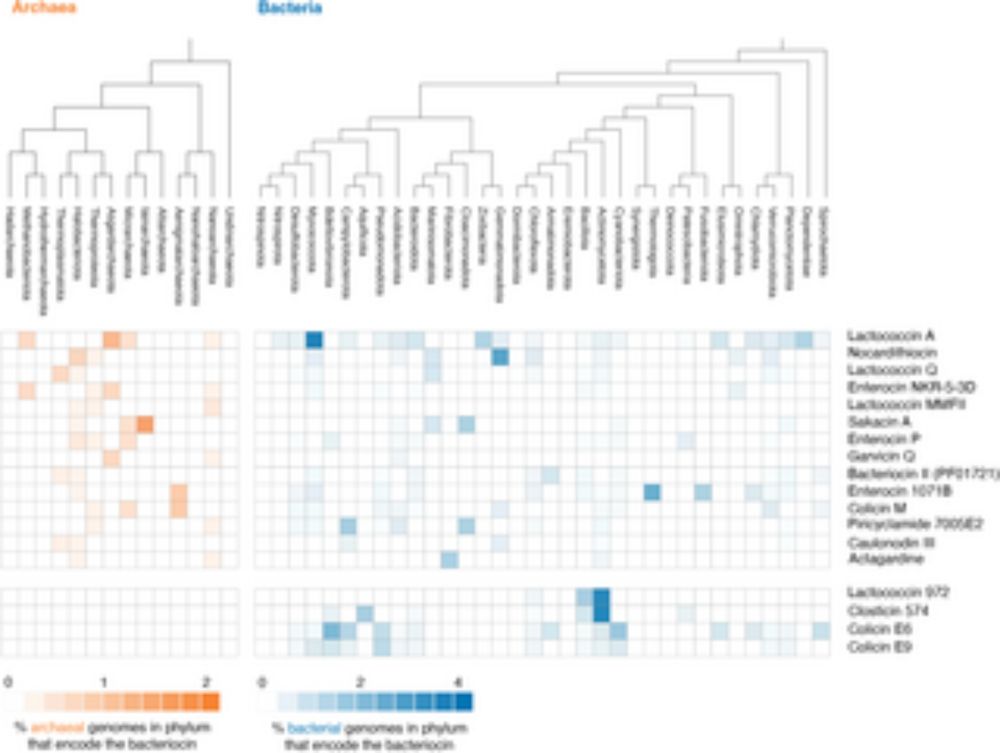
Archaea are often surrounded by bacteria. But is there ever active conflict between the two? Can archaea kill bacteria? If so, how do they do it?
Work by @romainstrock.bsky.social shows that some archaea can kill bacteria by secreting peptidoglycan hydrolases. journals.plos.org/plosbiology/...
Work by @romainstrock.bsky.social shows that some archaea can kill bacteria by secreting peptidoglycan hydrolases. journals.plos.org/plosbiology/...
Archaea produce peptidoglycan hydrolases that kill bacteria
Archaea regularly interact with bacteria but reports of archaea killing bacteria are very rare. This study shows that many archaea encode peptidoglycan hydrolases, which specifically target bacterial ...
journals.plos.org
August 14, 2025 at 6:50 PM
Archaea are often surrounded by bacteria. But is there ever active conflict between the two? Can archaea kill bacteria? If so, how do they do it?
Work by @romainstrock.bsky.social shows that some archaea can kill bacteria by secreting peptidoglycan hydrolases. journals.plos.org/plosbiology/...
Work by @romainstrock.bsky.social shows that some archaea can kill bacteria by secreting peptidoglycan hydrolases. journals.plos.org/plosbiology/...
Reposted by Jo Herbert
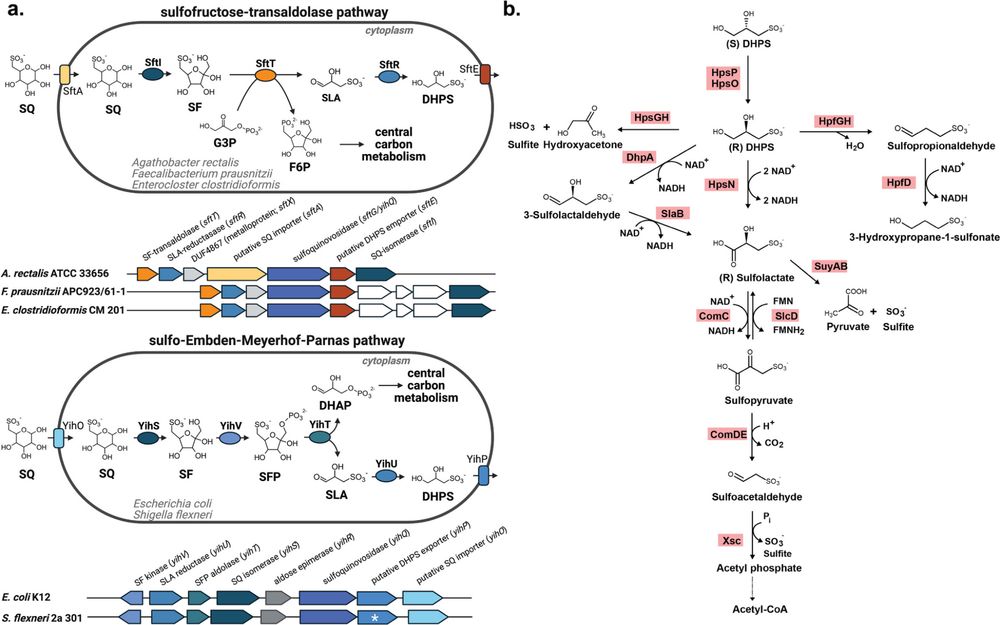
Our recent paper by @julkras.bsky.social provides further insights into the metabolism of sulfoquinovose in humans and lab mice, and its prebiotic potential.
🦠🧫 #microbesky #microbiomesky
microbiomejournal.biomedcentral.com/articles/10....
🦠🧫 #microbesky #microbiomesky
microbiomejournal.biomedcentral.com/articles/10....
Sulfoquinovose is exclusively metabolized by the gut microbiota and degraded differently in mice and humans - Microbiome
Background Sulfoquinovose (SQ) is a green-diet-derived sulfonated glucose and a selective substrate for a limited number of human gut bacteria. Complete anaerobic SQ degradation via interspecies metab...
microbiomejournal.biomedcentral.com
August 7, 2025 at 1:49 PM
Our recent paper by @julkras.bsky.social provides further insights into the metabolism of sulfoquinovose in humans and lab mice, and its prebiotic potential.
🦠🧫 #microbesky #microbiomesky
microbiomejournal.biomedcentral.com/articles/10....
🦠🧫 #microbesky #microbiomesky
microbiomejournal.biomedcentral.com/articles/10....
Also had a blast finally graduating from my PhD last week 🥳
Very thankful to see and celebrate with all that helped me through!
#PhDone #Finally #ForeverPortsmouth
Very thankful to see and celebrate with all that helped me through!
#PhDone #Finally #ForeverPortsmouth


July 28, 2025 at 9:10 PM
Also had a blast finally graduating from my PhD last week 🥳
Very thankful to see and celebrate with all that helped me through!
#PhDone #Finally #ForeverPortsmouth
Very thankful to see and celebrate with all that helped me through!
#PhDone #Finally #ForeverPortsmouth