




Liyang Shi
@liyangshi.bsky.social
PhD student in Genomic Medicine at Kyoto & McGill joint program
#epigenetics #centromere #TE
#epigenetics #centromere #TE
Reposted by Liyang Shi

Haplotype-Resolved Genomics Reveals Conserved Chromatin Architecture and Epigenetic Constraints of Human Neocentromeres https://www.biorxiv.org/content/10.64898/2025.12.23.696241v1
December 26, 2025 at 4:33 AM
Haplotype-Resolved Genomics Reveals Conserved Chromatin Architecture and Epigenetic Constraints of Human Neocentromeres https://www.biorxiv.org/content/10.64898/2025.12.23.696241v1
Reposted by Liyang Shi
Origin and evolution of acrocentric chromosomes in human and great apes https://www.biorxiv.org/content/10.64898/2025.12.22.696095v1
December 24, 2025 at 2:32 AM
Origin and evolution of acrocentric chromosomes in human and great apes https://www.biorxiv.org/content/10.64898/2025.12.22.696095v1
Reposted by Liyang Shi

The discovery of the first kinetochore proteins (CENP-A, CENP-B, CENP-C) was reported by Bill Earnshaw and Naomi Rothfield in 1985 in Chromosoma. Forty years later, Chromosoma/Chromosome Research has published a special issue (most articles are open access)
link.springer.com/collections/...
link.springer.com/collections/...
40 years of CENP-A
In 1985, Earnshaw and Rothfield published in Chromosoma a landmark discovery of the centromere-specific protein CENP-A. Subsequent research has shown that ...
link.springer.com
December 22, 2025 at 10:09 AM
The discovery of the first kinetochore proteins (CENP-A, CENP-B, CENP-C) was reported by Bill Earnshaw and Naomi Rothfield in 1985 in Chromosoma. Forty years later, Chromosoma/Chromosome Research has published a special issue (most articles are open access)
link.springer.com/collections/...
link.springer.com/collections/...
Reposted by Liyang Shi

Happy to highlight an essay I wrote together with @marcdemanuel.bsky.social,
@natanaels.bsky.social and Anastasia Stolyarova, trying to think through what sets the mutation rate of a cell type in an animal species: www.biorxiv.org/content/10.6... 1/n
@natanaels.bsky.social and Anastasia Stolyarova, trying to think through what sets the mutation rate of a cell type in an animal species: www.biorxiv.org/content/10.6... 1/n

What sets the mutation rate of a cell type in an animal species?
Germline mutation rates per generation are strikingly similar across animals, despite vast differences in life histories. Analogously, in at least one somatic cell type, mutation rates at the end of l...
www.biorxiv.org
December 22, 2025 at 3:09 PM
Happy to highlight an essay I wrote together with @marcdemanuel.bsky.social,
@natanaels.bsky.social and Anastasia Stolyarova, trying to think through what sets the mutation rate of a cell type in an animal species: www.biorxiv.org/content/10.6... 1/n
@natanaels.bsky.social and Anastasia Stolyarova, trying to think through what sets the mutation rate of a cell type in an animal species: www.biorxiv.org/content/10.6... 1/n
Reposted by Liyang Shi
Human acrocentric chromosome short arm de novo mutation and recombination https://www.biorxiv.org/content/10.64898/2025.12.16.694519v1
December 18, 2025 at 7:32 AM
Human acrocentric chromosome short arm de novo mutation and recombination https://www.biorxiv.org/content/10.64898/2025.12.16.694519v1
Reposted by Liyang Shi
Complete genomes of a multi-generational pedigree to expand studies of genetic and epigenetic inheritance https://www.biorxiv.org/content/10.64898/2025.12.14.693655v1
December 17, 2025 at 5:32 AM
Complete genomes of a multi-generational pedigree to expand studies of genetic and epigenetic inheritance https://www.biorxiv.org/content/10.64898/2025.12.14.693655v1
Reposted by Liyang Shi

Absolutely thrilled to share the latest work from my lab focused on the variation and evolution of human centromeres among global populations! We assembled 2,110 human centromeres, identifying 226 new major haplotypes and 1,870 α-satellite HOR variants. www.biorxiv.org/content/10.6...

December 16, 2025 at 4:06 PM
Absolutely thrilled to share the latest work from my lab focused on the variation and evolution of human centromeres among global populations! We assembled 2,110 human centromeres, identifying 226 new major haplotypes and 1,870 α-satellite HOR variants. www.biorxiv.org/content/10.6...
Reposted by Liyang Shi

Very happy that this part of my postdoc work is now out as a preprint!! Our findings reveal a new mechanism by which retroviral pandemics may have shaped primate brain evolution 🧬🐒🧠 This was a true team effort! w/ @ofeliakarlsson.bsky.social @raquelgarza.bsky.social @jakobssonlab.bsky.social #TEsky

New preprint from our lab: ‘Retroviral insertions contributed to the divergence of human and chimpanzee brains’. Very proud of this piece which took almost a decade to finish.
www.biorxiv.org/content/10.6...
www.biorxiv.org/content/10.6...

Retroviral insertions contributed to the divergence of human and chimpanzee brains
Over the past 5 to 7 million years, humans and chimpanzees have diverged in brain size, structural complexity, and cognitive abilities despite high conservation of protein-coding genes. Notably, the e...
www.biorxiv.org
December 14, 2025 at 10:10 PM
Very happy that this part of my postdoc work is now out as a preprint!! Our findings reveal a new mechanism by which retroviral pandemics may have shaped primate brain evolution 🧬🐒🧠 This was a true team effort! w/ @ofeliakarlsson.bsky.social @raquelgarza.bsky.social @jakobssonlab.bsky.social #TEsky
Reposted by Liyang Shi

If you ever need to fuzzy search some DNA, sassy is your tool.
Please spread the word; I think many people just outside my own circle could benefit from this :)
cc @rickbitloo.bsky.social
github.com/RagnarGrootK...
Please spread the word; I think many people just outside my own circle could benefit from this :)
cc @rickbitloo.bsky.social
github.com/RagnarGrootK...
December 10, 2025 at 3:50 PM
If you ever need to fuzzy search some DNA, sassy is your tool.
Please spread the word; I think many people just outside my own circle could benefit from this :)
cc @rickbitloo.bsky.social
github.com/RagnarGrootK...
Please spread the word; I think many people just outside my own circle could benefit from this :)
cc @rickbitloo.bsky.social
github.com/RagnarGrootK...
Reposted by Liyang Shi
Some Friday reading...new review in Open Biology where we discuss how SWI/SNF maintains the chromatin environment around centromeres, building on recent work from ourselves and others. Lots of fun putting this together with @alison-harrod.bsky.social and @thedownslab.bsky.social!

Boundary issues: SWI/SNF shapes chromatin patterns in and around centromeres
Abstract. The SWI/SNF family of chromatin remodelling complexes, comprising BAF, PBAF and ncBAF, is known for their critical roles in regulating chromatin
royalsocietypublishing.org
December 5, 2025 at 10:30 AM
Some Friday reading...new review in Open Biology where we discuss how SWI/SNF maintains the chromatin environment around centromeres, building on recent work from ourselves and others. Lots of fun putting this together with @alison-harrod.bsky.social and @thedownslab.bsky.social!
Reposted by Liyang Shi
579 high-quality human genomes from @humanpangenome.bsky.social, Arab Pangenome and individual papers (CHM13, CN1, KSA001, I002C, YAO and KOREF1). Sequences available in the AGC format (3.7GB) and FM-index in the ropebwt3 format (20.3GB). For details, see github.com/lh3/human-asm

GitHub - lh3/human-asm: A collection of high-quality human genomes
A collection of high-quality human genomes. Contribute to lh3/human-asm development by creating an account on GitHub.
github.com
December 3, 2025 at 3:44 AM
579 high-quality human genomes from @humanpangenome.bsky.social, Arab Pangenome and individual papers (CHM13, CN1, KSA001, I002C, YAO and KOREF1). Sequences available in the AGC format (3.7GB) and FM-index in the ropebwt3 format (20.3GB). For details, see github.com/lh3/human-asm
Reposted by Liyang Shi
Here is a copy of last year's Twitter thread explaining our preprint - jump to (21) for the new stuff 👀
Synergy between cis-regulatory elements can render cohesin dispensable for distal enhancer function
now revised and journal accepted at www.science.org/doi/10.1126/...
🧵👇
Synergy between cis-regulatory elements can render cohesin dispensable for distal enhancer function
now revised and journal accepted at www.science.org/doi/10.1126/...
🧵👇
November 27, 2025 at 9:59 PM
Here is a copy of last year's Twitter thread explaining our preprint - jump to (21) for the new stuff 👀
Synergy between cis-regulatory elements can render cohesin dispensable for distal enhancer function
now revised and journal accepted at www.science.org/doi/10.1126/...
🧵👇
Synergy between cis-regulatory elements can render cohesin dispensable for distal enhancer function
now revised and journal accepted at www.science.org/doi/10.1126/...
🧵👇
Reposted by Liyang Shi
How do new centromeres evolve while staying compatible with the division machinery?
Discover it in our new Nature paper! We show centromeres transition gradually via a mix of drift, selection, and sex, reaching new states that still work with the kinetochore.
👉 doi.org/10.1038/s41586-025-09779-1
Discover it in our new Nature paper! We show centromeres transition gradually via a mix of drift, selection, and sex, reaching new states that still work with the kinetochore.
👉 doi.org/10.1038/s41586-025-09779-1

November 26, 2025 at 4:21 PM
How do new centromeres evolve while staying compatible with the division machinery?
Discover it in our new Nature paper! We show centromeres transition gradually via a mix of drift, selection, and sex, reaching new states that still work with the kinetochore.
👉 doi.org/10.1038/s41586-025-09779-1
Discover it in our new Nature paper! We show centromeres transition gradually via a mix of drift, selection, and sex, reaching new states that still work with the kinetochore.
👉 doi.org/10.1038/s41586-025-09779-1
Reposted by Liyang Shi

A new and fascinating story from @bencarty.bsky.social and the group, with crucial help from the teams of @naltemose.bsky.social, Simona Giunta, and @dfachinetti.bsky.social. Many thanks to all for a fantastic collaboration.
www.nature.com/articles/s41...
www.nature.com/articles/s41...

November 25, 2025 at 12:16 PM
A new and fascinating story from @bencarty.bsky.social and the group, with crucial help from the teams of @naltemose.bsky.social, Simona Giunta, and @dfachinetti.bsky.social. Many thanks to all for a fantastic collaboration.
www.nature.com/articles/s41...
www.nature.com/articles/s41...
Reposted by Liyang Shi

Happy to share the “International Symposium on Chromosome Dynamics: from Structure to Cellular Function” that will be held in Japan 31st of May 2026 www.fbs.osaka-u.ac.jp/labs/fukagaw.... Registrations will open on December 1st! Plenty of opportunities to present your work! Hope to seeing you
International Symposium on Chromosome Dynamics from Structure to Cellular Function
www.fbs.osaka-u.ac.jp
November 21, 2025 at 6:33 PM
Happy to share the “International Symposium on Chromosome Dynamics: from Structure to Cellular Function” that will be held in Japan 31st of May 2026 www.fbs.osaka-u.ac.jp/labs/fukagaw.... Registrations will open on December 1st! Plenty of opportunities to present your work! Hope to seeing you
Reposted by Liyang Shi

Our latest paper has just been published in Cell!
doi.org/10.1016/j.ce...
We developed a new method called MCC ultra, which allows 3D chromatin structure to be visualised with a 1 base pair pixel size.
doi.org/10.1016/j.ce...
We developed a new method called MCC ultra, which allows 3D chromatin structure to be visualised with a 1 base pair pixel size.

November 5, 2025 at 5:20 PM
Our latest paper has just been published in Cell!
doi.org/10.1016/j.ce...
We developed a new method called MCC ultra, which allows 3D chromatin structure to be visualised with a 1 base pair pixel size.
doi.org/10.1016/j.ce...
We developed a new method called MCC ultra, which allows 3D chromatin structure to be visualised with a 1 base pair pixel size.
Reposted by Liyang Shi

Genome maintenance by telomerase is a fundamental process in nearly all eukaryotes. But where does it come from?
Today, we report the discovery of telomerase homologs in a family of antiviral reverse transcriptases, revealing an unexpected evolutionary origin in bacteria.
doi.org/10.1101/2025...
Today, we report the discovery of telomerase homologs in a family of antiviral reverse transcriptases, revealing an unexpected evolutionary origin in bacteria.
doi.org/10.1101/2025...

October 17, 2025 at 12:47 PM
Genome maintenance by telomerase is a fundamental process in nearly all eukaryotes. But where does it come from?
Today, we report the discovery of telomerase homologs in a family of antiviral reverse transcriptases, revealing an unexpected evolutionary origin in bacteria.
doi.org/10.1101/2025...
Today, we report the discovery of telomerase homologs in a family of antiviral reverse transcriptases, revealing an unexpected evolutionary origin in bacteria.
doi.org/10.1101/2025...
Reposted by Liyang Shi

A telomere-to-telomere map of somatic mutation burden and functional impact in cancer https://www.biorxiv.org/content/10.1101/2025.10.10.681725v1
October 13, 2025 at 11:33 PM
A telomere-to-telomere map of somatic mutation burden and functional impact in cancer https://www.biorxiv.org/content/10.1101/2025.10.10.681725v1
Reposted by Liyang Shi

Delighted to finally announce a preprint describing the Q100 project! “A complete diploid human genome benchmark for personalized genomics” For which we finished HG002 to near-perfect accuracy: www.biorxiv.org/content/10.1... 🧵[1/14]

A complete diploid human genome benchmark for personalized genomics
Human genome resequencing typically involves mapping reads to a reference genome to call variants; however, this approach suffers from both technical and reference biases, leaving many duplicated and ...
www.biorxiv.org
September 22, 2025 at 5:01 PM
Delighted to finally announce a preprint describing the Q100 project! “A complete diploid human genome benchmark for personalized genomics” For which we finished HG002 to near-perfect accuracy: www.biorxiv.org/content/10.1... 🧵[1/14]
Reposted by Liyang Shi

"Transposable elements are vectors of recurrent transgenerational epigenetic inheritance"
Congrats Vincent Colot and team!
www.science.org/doi/10.1126/...
Congrats Vincent Colot and team!
www.science.org/doi/10.1126/...

Transposable elements are vectors of recurrent transgenerational epigenetic inheritance
DNA methylation loss at transposable elements (TEs) can affect neighboring genes and be epigenetically inherited in plants, yet the determinants and significance of this additional system of inheritan...
www.science.org
September 18, 2025 at 8:27 PM
"Transposable elements are vectors of recurrent transgenerational epigenetic inheritance"
Congrats Vincent Colot and team!
www.science.org/doi/10.1126/...
Congrats Vincent Colot and team!
www.science.org/doi/10.1126/...
Reposted by Liyang Shi

New preprint! Graduate student Océane Marescal leverages quiescence - proliferative hibernation - to reveal unexpected dynamics for “constitutively”-localized centromere proteins. To understand the logic of cell division, you need to consider non-dividing cells.
www.biorxiv.org/content/10.1...
www.biorxiv.org/content/10.1...

The dynamics of centromere assembly and disassembly during quiescence
Quiescence is a state in which cells undergo a prolonged proliferative arrest while maintaining their capacity to reenter the cell cycle. Here, we analyze entry and exit from quiescence, focusing on h...
www.biorxiv.org
September 9, 2025 at 11:14 AM
New preprint! Graduate student Océane Marescal leverages quiescence - proliferative hibernation - to reveal unexpected dynamics for “constitutively”-localized centromere proteins. To understand the logic of cell division, you need to consider non-dividing cells.
www.biorxiv.org/content/10.1...
www.biorxiv.org/content/10.1...
Reposted by Liyang Shi
#1 Centromeres are epigenetic loci defined by CENP-A, positioned in unmethylated DNA flanked by highly methylated regions. Our work, published in @natgenet.nature.com in collaboration with @naltemose.bsky.social investigates the role of DNAme at human centromeres www.nature.com/articles/s41...
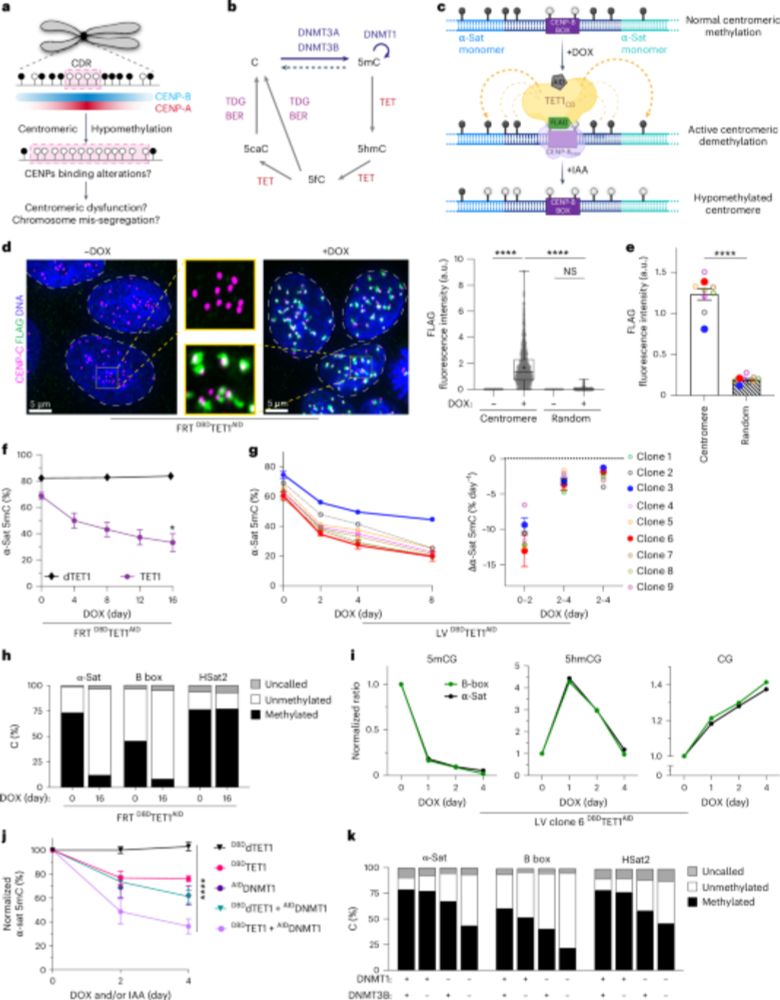
DNA methylation influences human centromere positioning and function - Nature Genetics
Genome-wide and targeted perturbation of DNA methylation at centromeres affects CENP-A positioning and centromere structure, resulting in aneuploidy and reduced cell viability.
www.nature.com
September 4, 2025 at 1:10 PM
#1 Centromeres are epigenetic loci defined by CENP-A, positioned in unmethylated DNA flanked by highly methylated regions. Our work, published in @natgenet.nature.com in collaboration with @naltemose.bsky.social investigates the role of DNAme at human centromeres www.nature.com/articles/s41...
Reposted by Liyang Shi

I believe that over the past ~ two decades, since the breakthrough papers on UHRF1, this is the first reported DNA methylation phenotype of its close paralog, UHRF2 (and not for lack of trying). Congrats to Ambre Bender and Michael Weber on this fantastic study! www.nature.com/articles/s41...

UHRF2 mediates resistance to DNA methylation reprogramming in primordial germ cells - Nature Communications
DNA methylation in mouse primordial germ cells (PGCs) is restricted to transposable elements, but how this unique DNA methylome is established is poorly understood. Here, the authors identify UHRF2 as...
www.nature.com
August 9, 2025 at 6:26 PM
I believe that over the past ~ two decades, since the breakthrough papers on UHRF1, this is the first reported DNA methylation phenotype of its close paralog, UHRF2 (and not for lack of trying). Congrats to Ambre Bender and Michael Weber on this fantastic study! www.nature.com/articles/s41...
Reposted by Liyang Shi

Thrilled to share our latest @cp-cell.bsky.social.
We present VICAR (VIral-induced Centromeric DNA Amplification and Recognition), a new defense system to detect viruses in the nucleus based on nuclear cGAS.
www.cell.com/cell/abstrac...
We present VICAR (VIral-induced Centromeric DNA Amplification and Recognition), a new defense system to detect viruses in the nucleus based on nuclear cGAS.
www.cell.com/cell/abstrac...
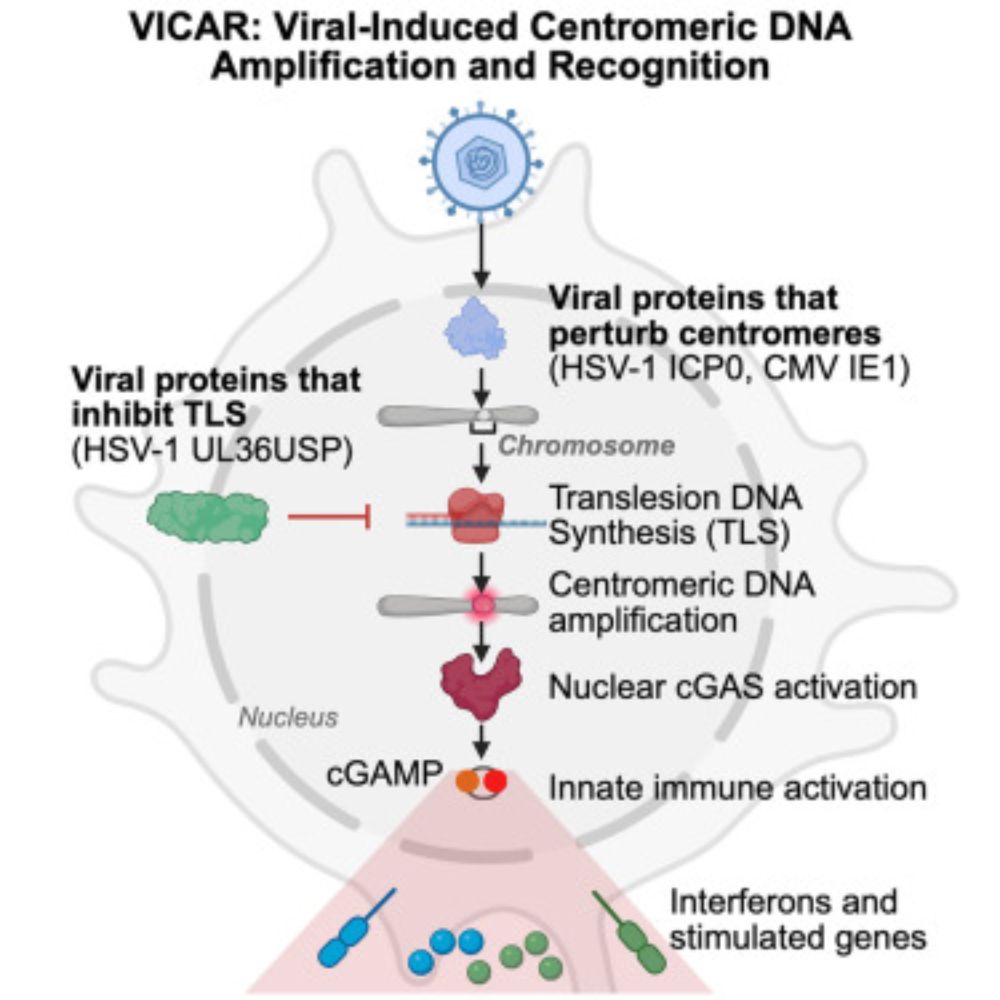
Centromeric DNA amplification triggered by viral proteins activates nuclear cGAS
Herpesvirus proteins disrupt centromeres, triggering centromeric DNA amplification
and local nuclear activation of the nucleic acid sensor cGAS. This reveals an immune
surveillance mechanism in the nu...
www.cell.com
June 2, 2025 at 3:14 PM
Thrilled to share our latest @cp-cell.bsky.social.
We present VICAR (VIral-induced Centromeric DNA Amplification and Recognition), a new defense system to detect viruses in the nucleus based on nuclear cGAS.
www.cell.com/cell/abstrac...
We present VICAR (VIral-induced Centromeric DNA Amplification and Recognition), a new defense system to detect viruses in the nucleus based on nuclear cGAS.
www.cell.com/cell/abstrac...
Reposted by Liyang Shi

Telomere-to-telomere DNA sequencing is set to transform the field of human genetics in coming years. For a flavour of what's coming, see this exciting work on nearly complete genomes of 65 individuals from diverse populations, out today in @nature.com by @glennislogsdon.bsky.social & colleagues. 👇🧬🧪
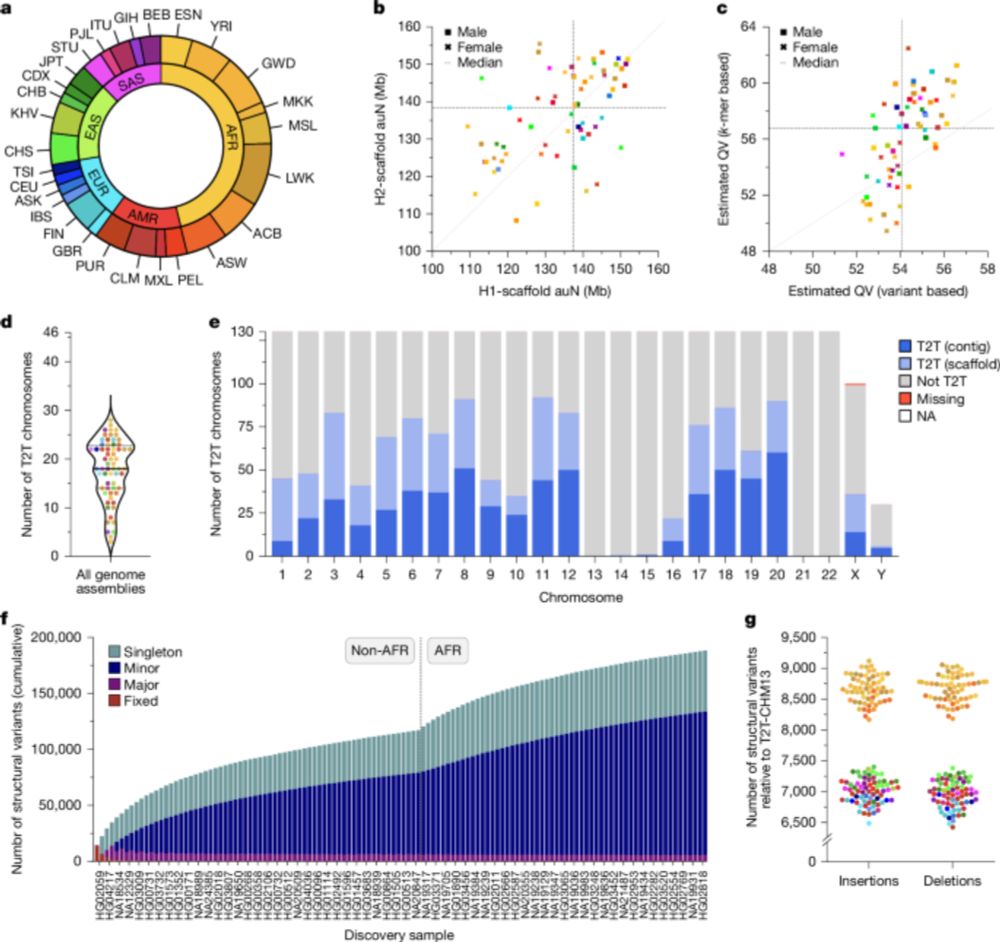
Complex genetic variation in nearly complete human genomes - Nature
Using sequencing and haplotype-resolved assembly of 65 diverse human genomes, complex regions including the major histocompatibility complex and centromeres are analysed.
www.nature.com
July 23, 2025 at 4:20 PM
Telomere-to-telomere DNA sequencing is set to transform the field of human genetics in coming years. For a flavour of what's coming, see this exciting work on nearly complete genomes of 65 individuals from diverse populations, out today in @nature.com by @glennislogsdon.bsky.social & colleagues. 👇🧬🧪